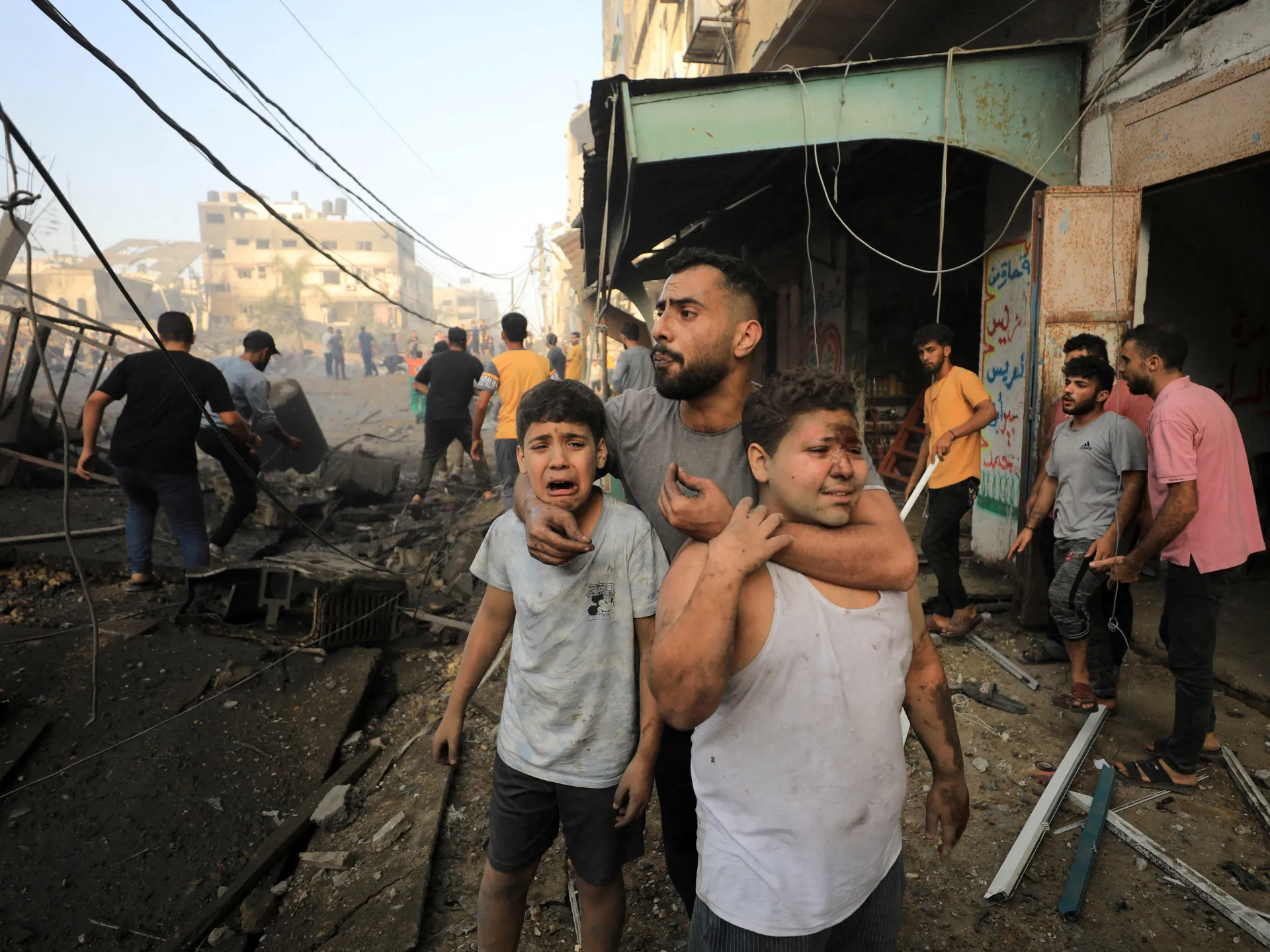
Gaza’s health toll mounts, with 1,439 dead and 5,052 injured since the ceasefire began in October 2025.
Published On 1 Oct 20261 Oct 2026
An Israeli drone strike has killed a Palestinian man and wounded several others in southern Gaza while settlers shot dead another Palestinian man near Ramallah in the occupied West Bank.
The body of Tamer al-Hamayda, 42, and three wounded people were brought to Nasser Medical Complex on Thursday after the strike hit a tent sheltering displaced Palestinians in the al-Mawasi area, west of Khan Younis on the southern coast of the Gaza Strip.
Recommended Stories
list of 3 itemsend of list
Another Palestinian succumbed to wounds sustained in an earlier Israeli drone strike on Tuesday that targeted a gathering of Palestinians in Jabalia refugee camp in northern Gaza, according to medical personnel in Nasser Medical Complex.
Israeli forces also carried out a large-scale demolition operation targeting buildings east of Gaza City’s al-Tuffah neighbourhood.
The Gaza Health Ministry reported eight new deaths and 26 wounded over the past 24 hours, putting the toll since the “ceasefire” took effect in October 2025 at 1,439 killed and 5,052 wounded, with 834 bodies recovered from the rubble.
Israel’s war on Gaza has killed at least 74,040 Palestinians and wounded 175,168 since October 2023, the ministry said.
Occupied West Bank pogroms
In the occupied West Bank, Israeli settlers shot dead a Palestinian man and wounded another during a raid on the village of Yasuf, north of Ramallah, on Thursday.
51-year-old Mashhour Yassin was shot dead by settler gunfire, the Palestinian Health Ministry said.
Describing the attack, the Palestinian Ministry of Foreign Affairs said Israeli forces had detained an ambulance, seizing its key and throwing it aside, “in a crime that reflects clear coordination between the settlers and occupation forces.”
It said the killing “falls within the framework of a serious and continuous escalation in organised settler crimes,” saying Israel gives free rein to settler “terrorism against our people in the service of settlement, annexation, forced displacement and ethnic cleansing plans.”
Yasuf Mayor Jumaa Abdel Fattah told the AFP news agency that dozens of Israeli settlers armed with sticks and firearms had attacked the village, which lies between four Israeli settlements.
“Yassin was at his doorstep when the settlers attacked the village homes. He went out to defend his house,” Abdel Fattah said, adding that Yassin’s nephew was also wounded in the attack.
Abdel Fattah said the settlers had come from Havat Anton, an illegal Israeli settlement established in July that has previously attacked the village’s residents.
Palestinians in the occupied West Bank have reported a surge in settler pogrom attacks in recent months.
More than 500,000 Israelis live in West Bank settlements considered illegal under international law.
According to the UN, at least 1,112 Palestinians in the occupied West Bank have been killed by Israeli forces or settlers in the territory since October 2023, including at least 37 killed by settlers.
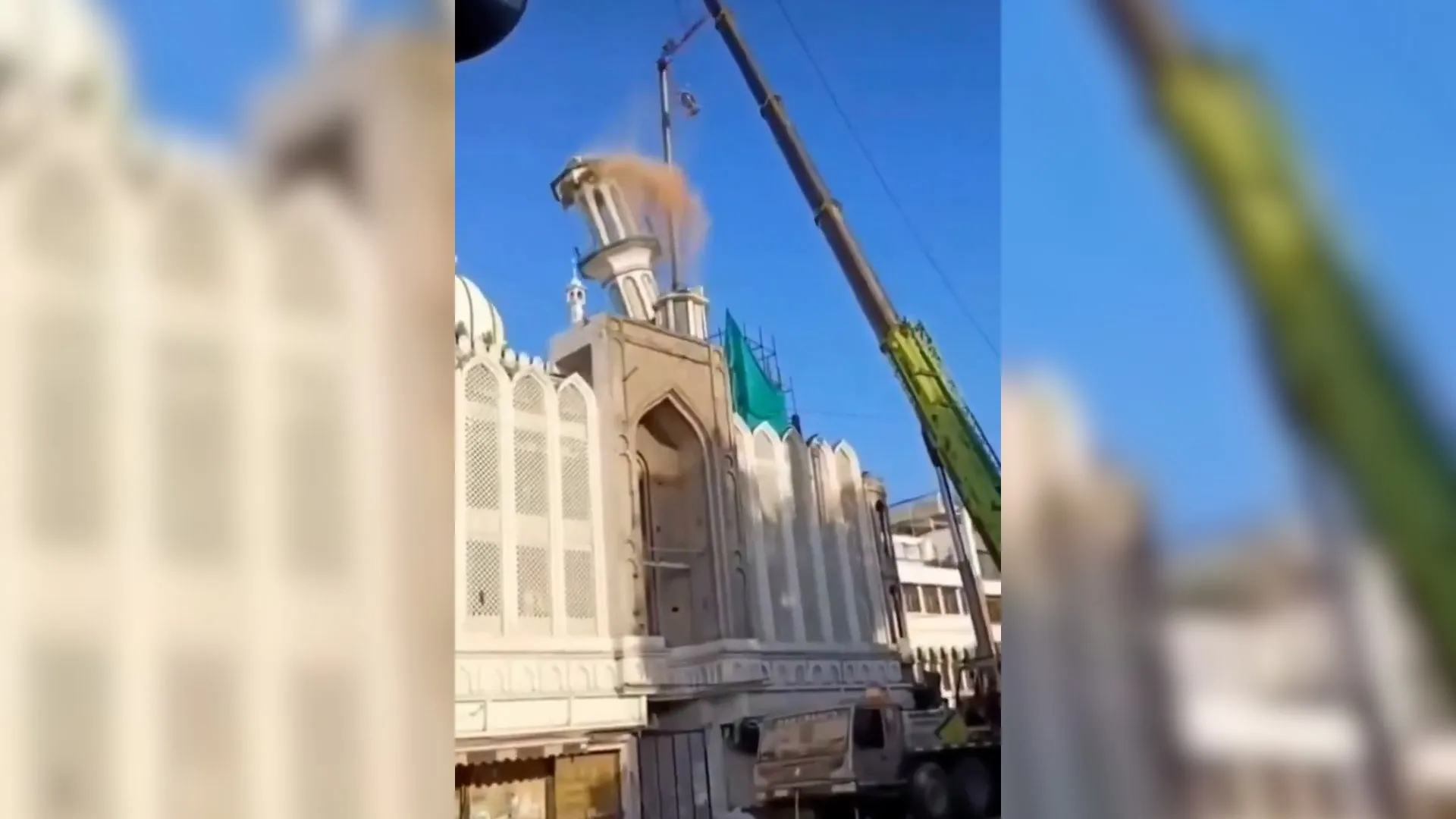
Video shows the moment the minaret of India’s 600-year-old Ujjain mosque collapsed during demolition work for a road-widening project for a Hindu pilgrimage, triggering despair among Muslims onlookers. Officials described it as an accident caused by faulty machinery.
Fighting in Sudan’s Kordofan region has intensified since late 2025, turning it into one of the main battlegrounds in the war between the Sudanese Armed Forces (SAF) and the paramilitary Rapid Support Forces (RSF), now in its fourth year.
The vast region, which comprises North, West and South Kordofan states, lies where the two sides’ areas of control meet, between the army-held central region and the RSF-controlled Darfur in the West. In recent months, the SAF has pushed the RSF out of much of North Kordofan.
The battle is increasingly being fought from the air. Drone strikes on towns in North Kordofan are growing more frequent and deadly, and civilian infrastructure has been hit across the region.
Since the war began in April 2023, one in five recorded attacks in Sudan has taken place in Kordofan.
Al Jazeera maps where the fighting is concentrated in Kordofan and across Sudan, and the displacement that has followed.
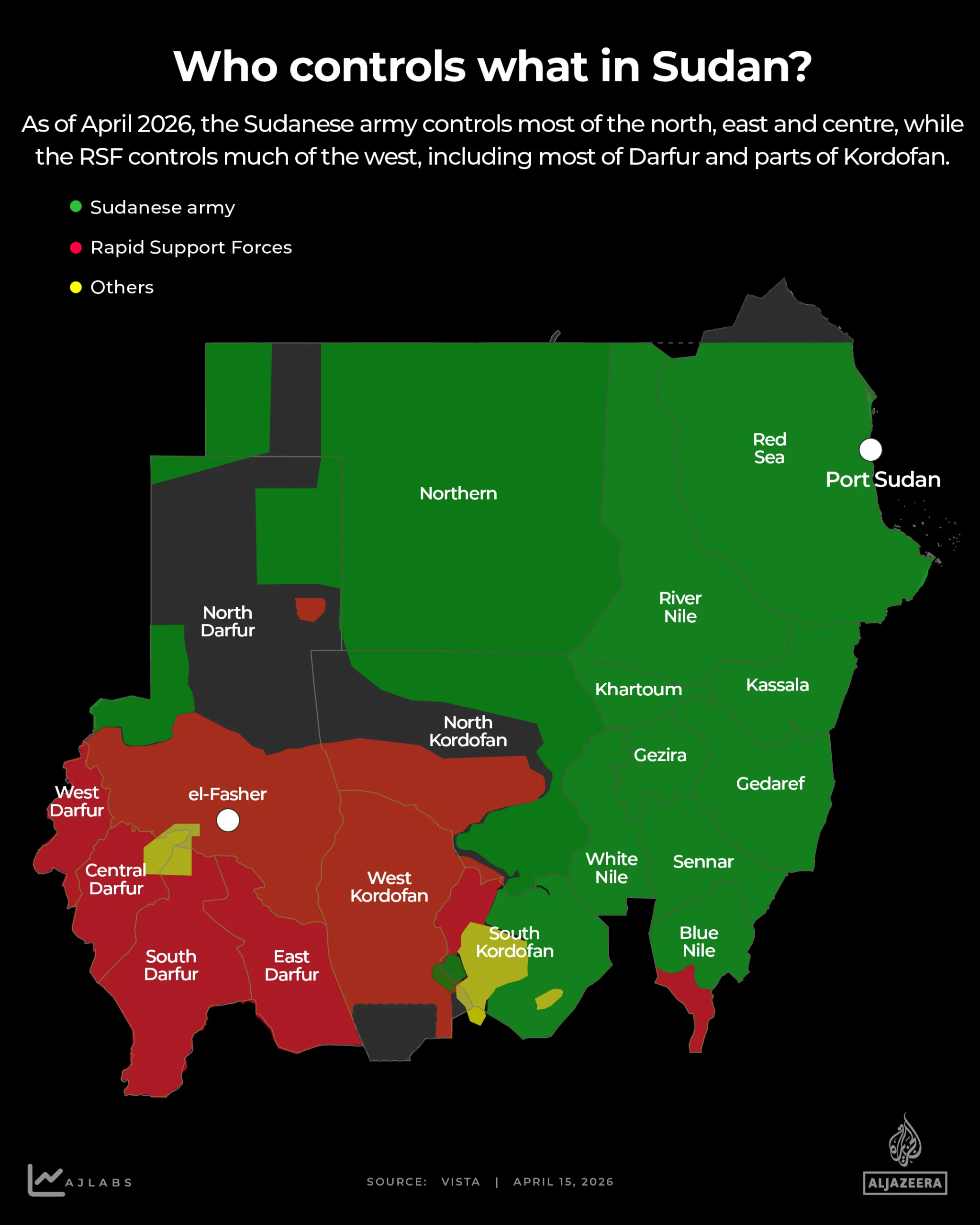
Who controls what on the ground?
Sudan is broadly divided between the two sides. The SAF controls the capital, Khartoum, and most of the north, east and centre, while the RSF controls the west, including almost all of Darfur and parts of Kordofan. Smaller armed groups, including the RSF-allied Sudan People’s Liberation Movement-North (SPLM-N), hold pockets of territory in the south.
The army has the upper hand in the north, the RSF in the west, and South Kordofan remains contested.
Where have most attacks occurred?
According to an Al Jazeera analysis of data from the Armed Conflict Location and Event Data (ACLED), an independent conflict monitor, there were 14,648 recorded attacks between the start of the war on April 15, 2023, and September 19, 2026.
The four most affected states include:
Khartoum: The capital region has seen the most, with 5,719 attacks, or 39 percent of the total, almost three times as many as North Darfur, the second-highest
North Darfur has witnessed 1,999 attacks (13.7 percent)
Gezira state has seen 1,435 attacks (9.8 percent)
Kordofan emerged as a major centre for fighting. North, South and West Kordofan together recorded 2,876 attacks, or about 19.7 percent of all recorded attacks, putting the region behind only Khartoum when considered collectively.
Who has carried out the most attacks?
The SAF is associated with the largest share of recorded attacks between April 15, 2023 and September 19, 2026, accounting for just over half (52 percent), compared with just over a third (34.7 percent) for the RSF and 13.3 percent for other actors.
Smoke billows after drone strikes by the paramilitary Rapid Support Forces (RSF) targeted the northern port in the Red Sea city of Port Sudan, Sudan, on May 6, 2025 [AP Photo]
The balance of attacks has shifted over time. The SAF was associated with more recorded attacks than the RSF in the first year and a half of the war, before the RSF overtook it in number of attacks from late 2024 to mid-2025.
Since August 2025, the two sides’ monthly attack counts have been closer, with the SAF generally recording slightly more, even as the overall number of attacks has fallen sharply.
Where have attacks in Kordofan occurred?
After the fall of el-Fasher, the last major Darfur city held by the army and its allies, in October 2025, attention shifted to Kordofan. The region sits between RSF-held Darfur and the army-held centre, north and east, forming a corridor between the two sides’ heartlands.
Kordofan’s three states recorded 2,717 attacks: North Kordofan had 1,205 (44 percent), South Kordofan 789 and West Kordofan 723. Adding Abyei, a disputed oil-rich area on the Sudan-South Sudan border that was historically part of Kordofan, brings the total to 2,878.
Soldiers arrive at the Allafah market, in an area recently recaptured by Sudan’s army from the Rapid Support Forces paramilitary group, in the al-Kalalah district, south of Khartoum, Sudan, on March 27, 2025 [AP Photo]
The concentration of attacks differs from state to state. In North Kordofan, Sheikan locality alone accounted for 497 attacks, or 41 percent of the state’s total. Sheikan is home to the state capital, el-Obeid, a commercial and administrative hub linking central Sudan with the west. Taking the city would open a route east towards Khartoum for the RSF.
On September 9, a drone strike on a college in el-Obeid tore the roof off the building and killed a security guard, the college’s dean, Abdel Aziz al-Sheikh, told Reuters.
“As you can see, the entire faculty is destroyed and we feel that our dreams are destroyed, our future is destroyed,” Omnia Aboul Gassim, a student who had sat her exams at the el-Obeid college just one day before the attack, told Reuters.
In South Kordofan, Dilling locality was the main hotspot, with 242 attacks (31 percent), followed by Kadugli with 107 (14 percent) and Al Quoz with 94 (12 percent).
Attacks in West Kordofan were spread more evenly across localities. Babnusa recorded the most, with 142, followed by En Nuhud (119), Al Khiwai (112) and Abu Zabad (111).
ACLED has recorded at least 12,314 reported fatalities in Kordofan since April 2023.
The SAF was associated with 1,323 attacks (46 percent) across all three states in Kordofan, compared with 920 (32 percent) for the RSF and 633 (22 percent) for other actors.
How many people are displaced?
About 8.6 million people remain internally displaced across Sudan, according to the latest United Nations figures, down from a peak of 11.6 million in January 2025 as millions returned home to areas retaken by the army. New displacement continues in Kordofan, Darfur and Blue Nile.
Darfur hosts the largest concentrations of internally displaced people (IDPs), particularly South and North Darfur.
Returns have steadily increased since 2025, reaching about 5.1 million by August 2026. Khartoum has seen a major return of displaced people, with about 2.7 million returnees.
A displaced woman from Dalanj braids her grandmother’s hair at a displacement registration centre in El Obeid, North Kordofan State, Sudan, on January 15, 2026 [El Tayeb Siddig/Reuters]
Despite the decline, millions remain displaced more than three years into the war. The International Organization for Migration (IOM) says the number of people newly displaced in Kordofan since fighting escalated in October 2025 has risen 65 percent in four months, from more than 132,000 in February to at least 219,000 by late June.
The agency has warned that el-Obeid, which shelters about 500,000 people, including more than 83,000 displaced, faces a looming threat of a full-scale invasion.
“The warning signs are impossible to ignore,” said IOM Director General Amy Pope earlier this month. “Across Sudan, families are fleeing violence, losing access to water, electricity and healthcare, and now facing the added burden of destructive floods.”
Coffins containing the remains of those killed will be carried in a funeral procession involving family members.
Published On 1 Oct 20261 Oct 2026
Palestinians are preparing to bury the remains of 105 people killed in a devastating Israeli attack on Gaza City in October 2023.
The victims were killed in a series of Israeli air strikes involving at least 20 bombs that levelled the seven-storey Al Taj 3 building and destroyed several other residential buildings in the Yarmouk Square neighbourhood on the afternoon of October 25, 2023.
Recommended Stories
list of 3 itemsend of list
Coffins containing the remains of those killed will be carried in a funeral procession involving family members on Thursday, the General Directorate of Civil Defence said.
The remains will be buried in the Sheikh Radwan cemetery, northwest of Gaza City.
Gaza’s civil defence said the recovery operation was carried out in coordination with an Egyptian committee.
Al Jazeera correspondent Ibrahim Khalili, reporting from Gaza City, said the recovery operation was the fifth largest of its kind since Israel launched its genocidal war against Palestinians in Gaza in October 2023, in terms of the number of bodies recovered.
Civil defence operations director Abdul al-Majdalawi said it had been “impossible” to reach the bodies at the time of the attack.
“Bulldozers, excavators and other heavy machinery used by civil defence teams in Gaza were directly and deliberately targeted,” he said.
Osama Sharaf said 37 members of his family were killed in the attack.
“We recovered some of them at the beginning of the war, and today [Wednesday] 16 more were recovered, including my father, my mother, and all of my siblings. My sister’s son was also there with them,” he said.
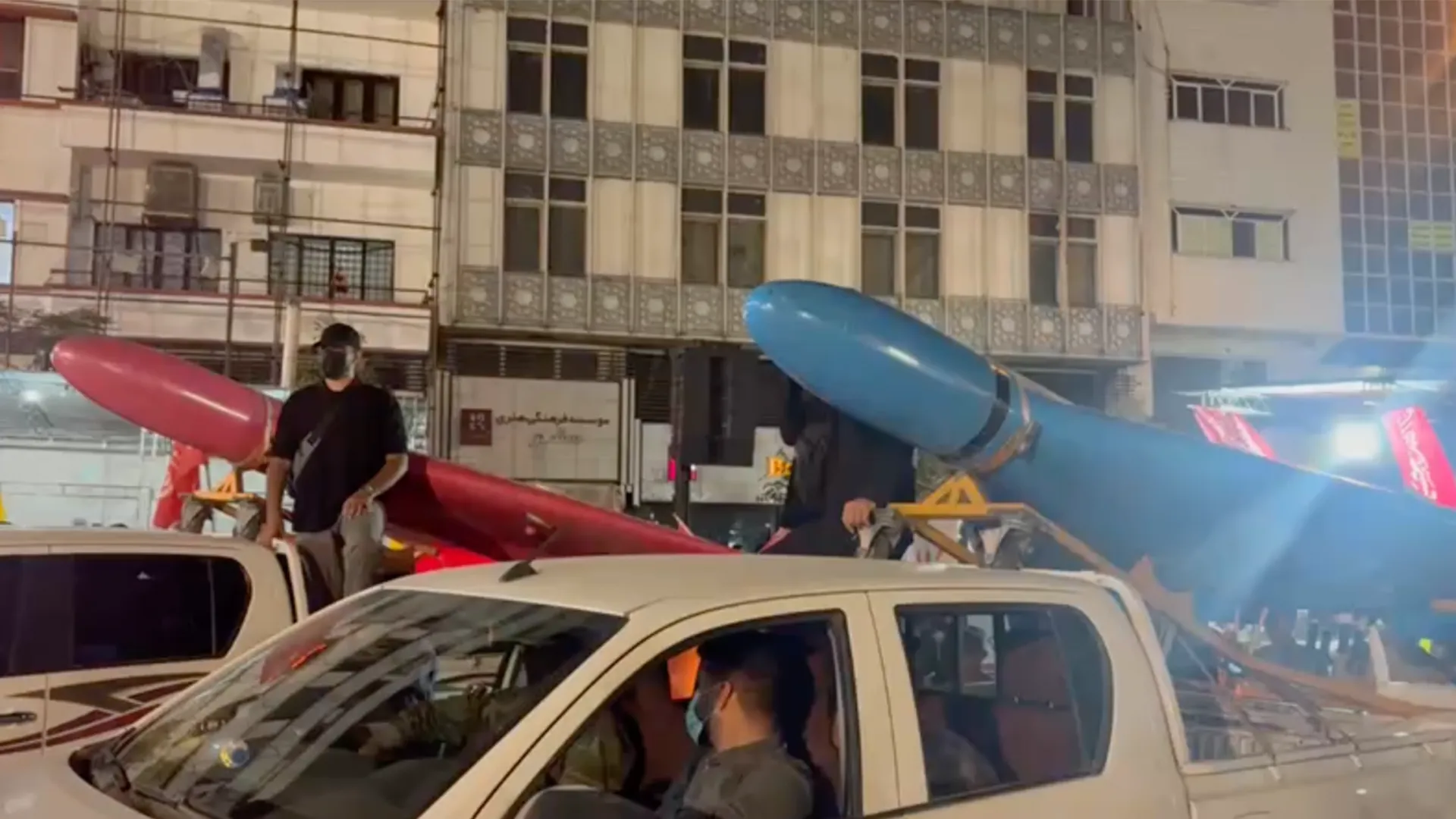
Crowds cheered and waved national flags as two Shahed drones were paraded through Tehran. Iranian-made, low-cost Shahed drones have become a major feature of modern warfare, used in attacks across the Gulf and extensively by Russia in its war in Ukraine.
United States Defense Secretary Pete Hegseth plans to cut the number of positions in the US military reserved for generals and admirals by 20 percent, raising concerns about political interference in the military’s leadership amid strained relations with senior Pentagon officials.
An announcement is expected on Wednesday when Hegseth gives his “State of the Force” address to junior officers and enlisted personnel at Marine Corps Base Quantico in Virginia.
Recommended Stories
list of 4 itemsend of list
The Pentagon has presented previous cuts as a way to reduce bureaucracy. But analysts say Hegseth’s latest changes may be aimed at sidelining experienced commanders, discouraging dissent and appointing more officers loyal to President Donald Trump to the ranks.
So is the US military too top-heavy, and what could the cuts mean? Here’s what we know.
What is Hegseth planning?
Citing Pentagon officials, The Associated Press news agency has reported that Hegseth will double the 10 percent reduction in top-ranking personnel ordered last year, bringing the total decrease to 20 percent by January 1, 2027. The plan affects roughly 800 general and admiral positions across the one- to four-star ranks.
Congress sets statutory limits on the number of generals and admirals. A Congressional Research Service report recorded 848 active-duty generals and admirals in September 2025, below the authorised maximum of 857.
Cutting positions does not necessarily mean immediately dismissing everyone occupying them. An official told the Reuters news agency that some roles would be eliminated, while others would be assigned to lower-ranking officers.
Why are top-ranking military positions being removed?
The argument for reducing senior ranks predates Hegseth’s tenure, with supporters saying fewer layers of command would reduce administrative work and give officers closer to operations greater authority.
Walter Ladwig, a political scientist specialising in US foreign policy at King’s College London, said there is a credible case for reform. “Since the end of the Cold War, the overall size of the force has declined significantly, but we haven’t seen a corresponding reduction in the number of flag officers,” he told Al Jazeera.
“At the same time, we’ve seen headquarters and staffs proliferate.”
Trump and Hegseth have already fired or pushed into retirement more than two dozen military leaders since Trump took office in January 2025.
Those removed include General Randy George, the US Army’s top uniformed officer, in April, and Admiral Lisa Franchetti, the chief of naval operations, in February 2025. The administration also dismissed the only two women serving as four-star officers, alongside other senior female officers.
In February 2025, Trump also fired Air Force General CQ Brown as chairman of the US Joint Chiefs of Staff as part of a wider shake-up of top military leadership.
Other departures have been of civilian leaders. Army Secretary Dan Driscoll resigned in late August after reported disagreements over Hegseth’s handling of senior military personnel.
The dismissals, alongside blocked promotions, have raised questions about how the administration selects commanders and whether professional disagreements could jeopardise careers. Robert Ralston, a lecturer in political science and international studies at the University of Birmingham in the United Kingdom, said the proposed reductions should be weighed alongside these earlier decisions.
“These cuts appear to be part of a broader, sustained effort by Hegseth to fill the ranks based on political, rather than meritocratic, considerations,” he told Al Jazeera.
“Politics is driving these decisions, in my view.”
What political fallout could there be from this?
Democratic Senator Mark Kelly of Arizona criticised Hegseth’s changes at the Pentagon. “The US military doesn’t need more testosterone; it needs better leadership at this point,” Kelly told MS NOW’s Morning Joe programme last week.
“The consequences of firing all these admirals and generals are that we’re losing a portion, a good portion, of a generation of great leadership.”
David Galbreath, professor of war and technology at the University of Bath in the UK, told Al Jazeera that resistance from Congress and military leaders could complicate the changes.
He pointed to the opposition that arose to President Jimmy Carter’s plans to withdraw US ground troops from South Korea as an example of how military and congressional pressure can constrain a president.
“I suspect that after the election, we are likely to see a much more confrontational Congress with investigations and impeachments of Hegseth,” he said.
Whether that prediction comes true will likely depend on November’s congressional elections and whether the Republican Party retains control of both chambers of Congress.
What criticisms have been made of Hegseth?
Hegseth’s tenure at the Pentagon has been marked by controversy and tensions with senior officials. In March 2025, he shared details of forthcoming strikes on Yemen in a Signal chat group which inadvertently included The Atlantic’s editor-in-chief.
A number of US media reports about the dwindling supplies of weapons in the Middle East prompted his department to investigate leaks and restrict journalists’ access earlier this year. The New York Times reported in August that about 50 Joint Staff military and civilian officials had undergone polygraph tests amid growing mistrust inside the Pentagon.
Hegseth has meanwhile made ending what he calls “woke” culture a central priority, introducing new physical fitness requirements and abolishing diversity policies.
Ralston said the combination of dismissals and blocked promotions could damage morale and the military’s future leadership. “His relationship with senior military leaders has been adversarial, his scuttling of promotions has undoubtedly damaged morale, and will have long-term consequences for leadership pipelines within the Department of Defense,” he said.
King’s College’s Ladwig also described Hegseth’s relationship with senior Pentagon leaders as unusually confrontational but cautioned against interpreting every proposed cut as a power struggle.
“When a military is under civilian control, it means that the elected government has the right to determine defence priorities and reorganise the armed forces accordingly,” he said.
But Ladwig warned that the changes could encourage officers to hold back their professional recommendations when advising senior politicians. “That might create incentives for military officers to censor themselves rather than provide candid professional military advice, particularly if being politically aligned with the administration is seen as a path to success,” he said.
“This is a very worrisome pathology, and it’s the kind of thing that produces ineffective militaries in dictatorships.”
At least six people killed in drone attack on passenger van and one person killed in strike on residential apartment.
At least seven Palestinians have been killed and more than 10 wounded in Israeli attacks on the Gaza Strip as Israel continues to violate a nearly year-old “ceasefire”.
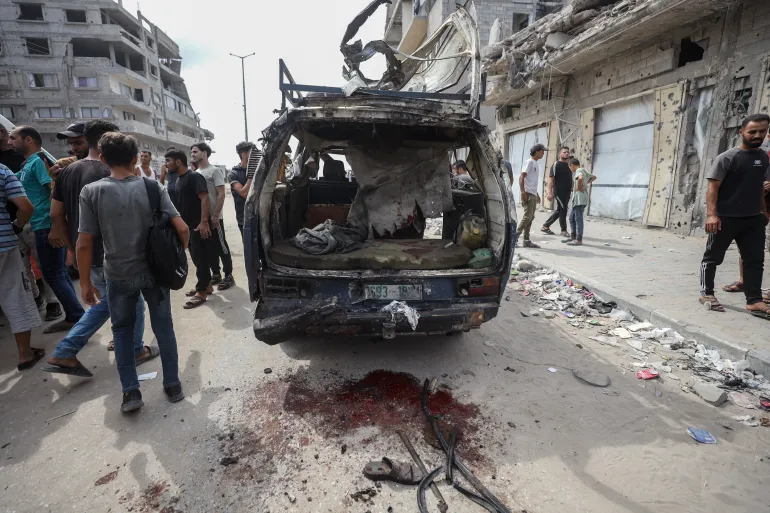
Six of the victims were killed in an Israeli drone attack on a passenger van in Tal al-Hawa, in southwest Gaza City, on Wednesday, according to witnesses and medical sources.
Recommended Stories
list of 2 itemsend of list
The Palestine Red Crescent Society, a humanitarian group that runs ambulance and emergency services, said its crews took 13 wounded people to al-Quds Hospital.
Medical sources told Al Jazeera the injuries sustained by the victims of the attack are “critical”.
“Doctors say it’s difficult to save the lives of the wounded because the health system is decimated by years of Israeli attacks and the blockade,” said Al Jazeera’s Hind Khoudary, reporting from Gaza City. “The number of dead in the strike could rise in the coming hours.”
Earlier, the official Palestinian Wafa news agency reported that an Israeli attack on a residential apartment near al-Shifa Hospital in Gaza City killed at least one woman.
Elsewhere, four Palestinians, including two children, were wounded when an Israeli drone hit a shelter for displaced people in southern Gaza, according to local sources cited by Wafa.
Two other Palestinians were seriously wounded by Israeli forces southeast of Deir el-Balah in central Gaza, while Israeli tank fire was also reported in southern Khan Younis, in the southern part of the Strip.
The attacks came as the Ministry of Health in Gaza, which compiles casualty figures from hospitals across the territory, said in its latest daily update early on Wednesday that the bodies of at least nine people had arrived at hospitals during the last 24 hours.
While eight people were killed around the reporting period, one woman had died from earlier wounds, bringing the number of people killed since the start of the “ceasefire” between Israel and the Palestinian group Hamas in October last year to at least 1,431.
An Israeli strike targeted a vehicle in Tal al-Hawa, in southwest Gaza City [Khames Alrefi/Anadolu]
At least 5,026 have been wounded over the same period, including 31 in the past 24 hours, the ministry said.
“There is supposed to be a ceasefire in Gaza, but the Israeli army’s violence is endless. Every day, Palestinians are killed, injured, and the humanitarian situation is deteriorating,” said Khoudary, describing “terrifying” conditions for Gaza’s residents.
“Everyone inside the Strip is afraid to go to the supermarket, to take their children to school, and to live their everyday lives,” she added.
Overall, Israel’s genocidal war against Palestinians in Gaza has killed at least 74,032 people since October 2023, with another 175,142 wounded, according to health officials.
In August, an analysis by the United Nations Satellite Centre found that the number of destroyed structures across Gaza has increased by 9 percent since the “ceasefire” took effect.
Overall, about 82 percent of structures in Gaza, roughly 200,000 buildings, have been damaged, and about two-thirds of those have been destroyed since the start of the war, according to the UN.
US president’s comments came after he was asked why North Korea can have nuclear weapons when Iran cannot.
Published On 30 Sep 202630 Sep 2026
United States President Donald Trump has described North Korean leader Kim Jong Un as “a friend” and played down concerns about Pyongyang’s nuclear arsenal, saying, “as long as I’m around, he’s going to be fine”.
Trump made the remarks in Washington, DC, on Tuesday after a reporter asked him why North Korea could have nuclear weapons but Iran could not.
Recommended Stories
list of 3 itemsend of list
“That’s interesting. You know why? Because you had a different president, and they could have stopped him,” he said, referring to previous US administrations.
“He happens to be a friend of mine, Kim Jong Un, he’s a friend of mine. He likes Trump, doesn’t like a lot of other people. I’m about the only person in the entire world that he likes, and I like him,” he said.
He said North Korea’s nuclear capacity was “pretty large” but “not like us”.
“You know what, as long as I’m around, he’s going to be fine,” he added. “You know why? Because he respects me and he likes me.”
South Korea’s Defence Minister Ahn Gyu-back said last week that its northern neighbour possessed between 80 and 120 nuclear warheads. The figure is significantly higher than Trump’s recent assertion that Pyongyang has 57 nuclear weapons.
Trump is seeking to re-engage with Kim and secure a win on the international stage as the US and Israel’s war on Iran enters its eighth month.
The US president launched the war along with Israel on February 28, saying Iran could not have a nuclear weapon. Iran has denied seeking a weapon, noting it had signed an agreement with world powers in 2015 that curbed its nuclear programme in exchange for sanctions relief. But Trump abandoned the agreement during his first term in 2018.
The US-Israel war on Iran has disrupted global energy supplies, raised fuel costs and hurt Trump’s popularity ahead of the November midterm elections.
Trump held summits with North Korea’s Kim in 2018 and 2019, but diplomacy broke down over US demands that Pyongyang give up its nuclear weapons. Since then, Kim has expanded his arsenal of nuclear-capable missiles and strengthened his diplomatic footprint by aligning with Russia over its war in Ukraine and tightening relations with China.
Trump had earlier said he planned to hold in-person talks with Kim before the end of the year.
The deaths appear to be the first at the hands of Somali pirates in more than a decade.
By Al Jazeera Staff, AFP and Reuters
Published On 30 Sep 202630 Sep 2026
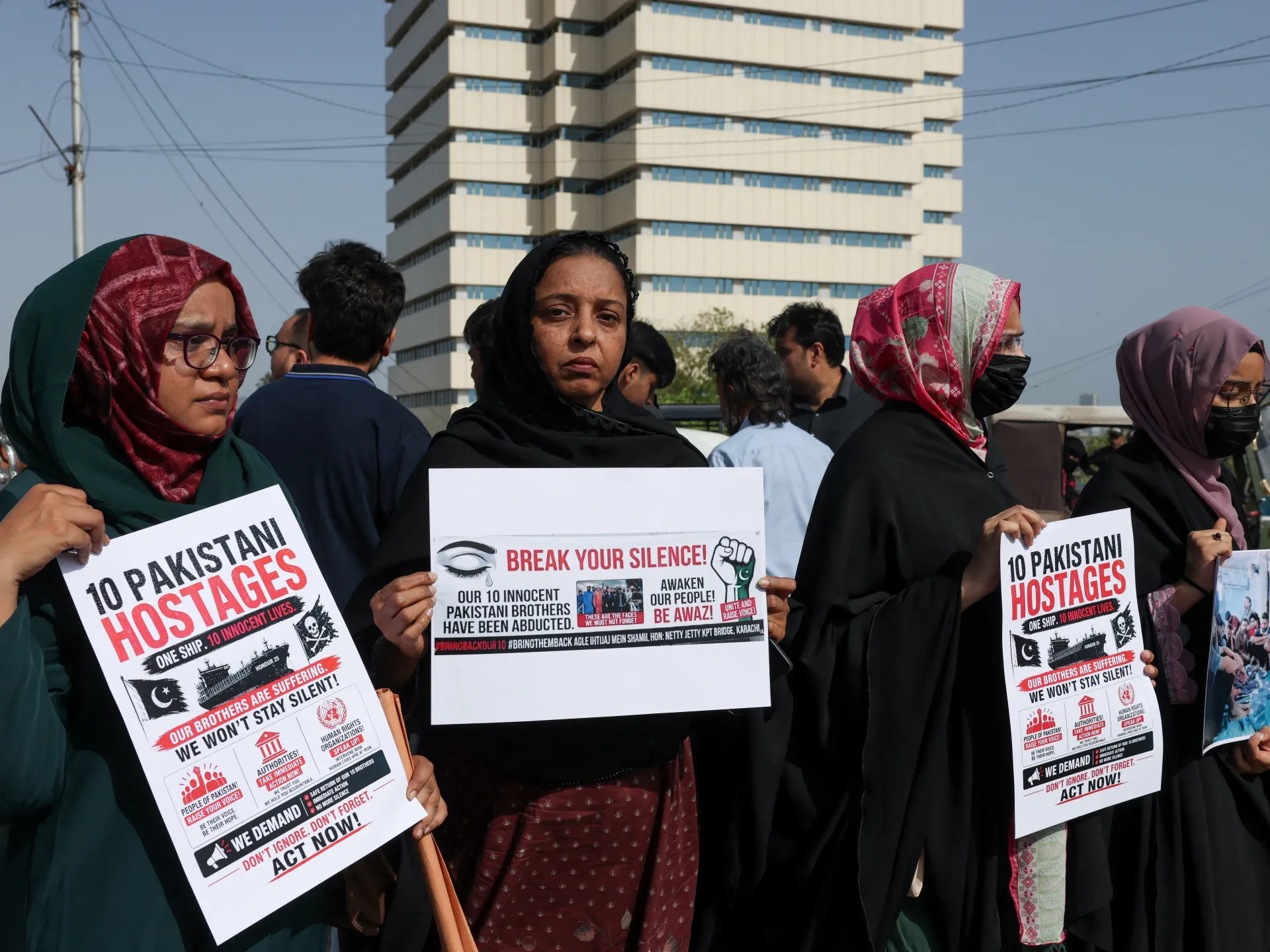
Pirates have killed five crew members on board a Palau-flagged oil tanker off the coast of Somalia before security forces rescued the ship, according to Somali authorities.
The deaths on the tanker, the MT Honour 25, were announced on Tuesday.
Recommended Stories
list of 3 itemsend of list
They appear to be the first deaths at the hands of Somali pirates in more than a decade and come amid a resurgence of Somali piracy that experts have attributed in part to the effects of the United States and Israel’s war on Iran.
The MT Honour 25, which authorities said was carrying 18,500 barrels of oil, was seized by pirates off Somalia on April 21.
The Information Ministry of Puntland, a semiautonomous region of Somalia, said in a statement that a rescue mission had freed the ship and captured 16 suspected pirates.
“Before the operation began, the pirates on board the ship killed five of the crew,” the statement said. “Among those killed were three from Pakistan, one from Myanmar and one from India.”
Four other crew members, three Pakistanis and one Indian, were injured, it said.
In a post on social media, the Puntland Maritime Police Force said the vessel was “safe” and under the government’s control. It said efforts were continuing to find others involved in the hijacking.
The rescue follows another operation last week in which the maritime police freed the Sibu 1, a tanker sanctioned by the US that Somali pirates had hijacked in August.
But 28 of the 41 pirates arrested in that operation later escaped while being transferred to jail, and several Puntland security officials accused local police of complicity.
At least 15 attacks have been reported off Somalia since April, according to officials.
A previous wave of piracy, from 2008 to 2014, disrupted one of the world’s busiest shipping routes, cost the global economy billions of dollars and resulted in hundreds of millions of dollars in ransom payments.
The resolution cites a ‘lack of accountability’ by Israel’s government and an ‘inability to secure justice’ by the US.
The United States Senate has blocked a resolution that would have required President Donald Trump’s administration to report on the killing of nine Americans in the occupied West Bank and on Israel’s treatment of Palestinian children in military detention.
The resolution failed 47-53 on Tuesday, with senators voting largely along party lines.
Recommended Stories
list of 4 itemsend of list
It was brought to the floor by Senator Chris Van Hollen, a Democrat from Maryland, and cited a “lack of accountability” from the government of Israeli Prime Minister Benjamin Netanyahu and an “inability to secure justice” from the US government.
Senator John Fetterman of Pennsylvania was the only Democrat to vote against advancing the resolution, while Senator Rand Paul, a Republican from Kentucky, joined Democrats in supporting it.
Van Hollen forced the vote under the Foreign Assistance Act of 1961, which allows individual members of Congress to demand a formal State Department report on the human rights practices of any country that receives US security assistance.
“Violence is raging in the West Bank, & despite the deaths of nine Americans, the wrongful detention of even more, & the daily torment of Palestinians, we have no accountability from the U.S. or Israeli govt”, Van Hollen wrote on X before the resolution was brought to a vote.
Nine Americans killed
The resolution called for an unclassified report within 30 days of adoption. It would have detailed investigations into the deaths of the Americans, the treatment of US citizens held in Israeli prisons, and the conditions facing Palestinian children in Israeli military detention.
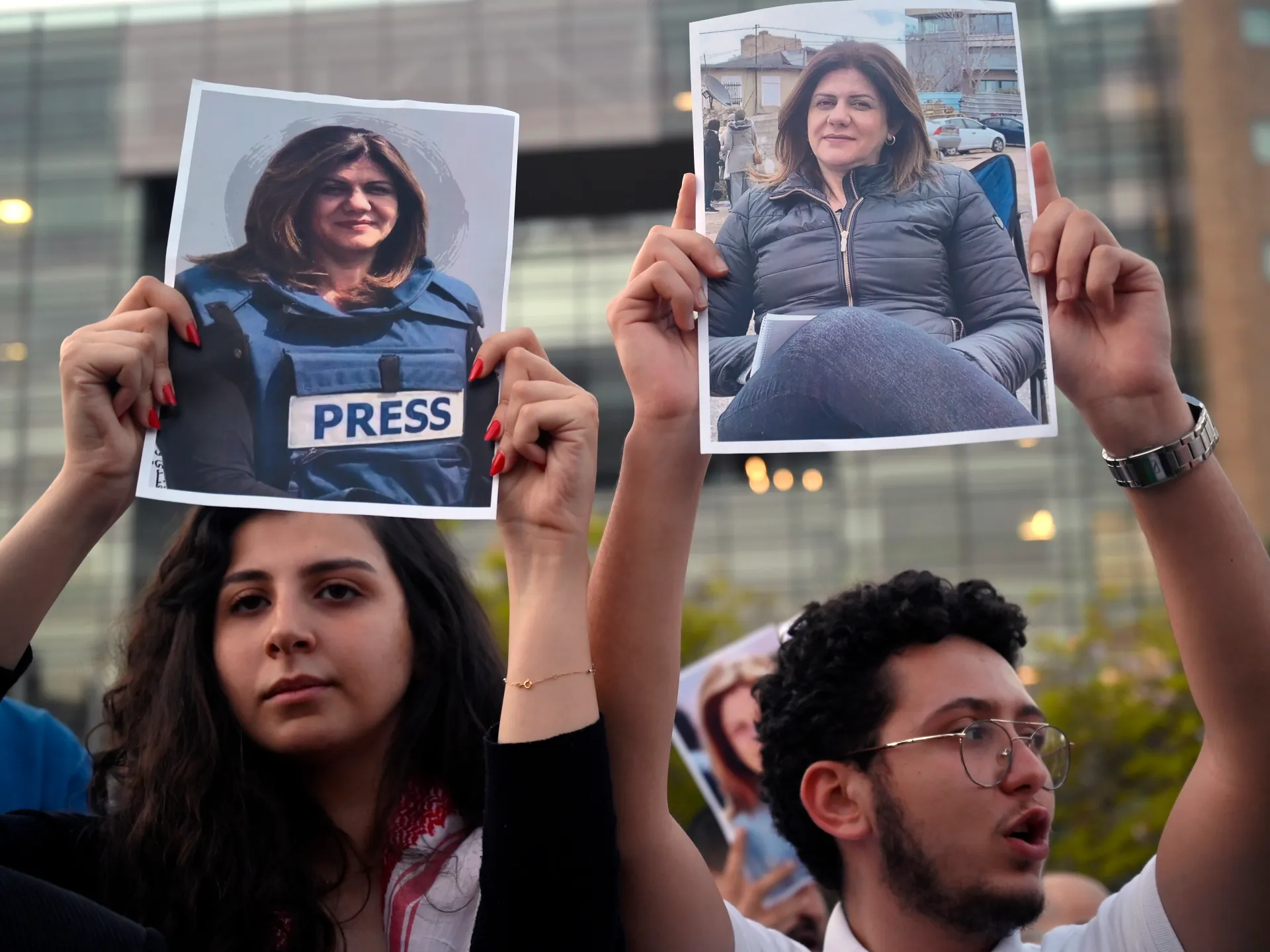
The measure cited the deaths of nine American citizens in the occupied West Bank since January 2022, including Shireen Abu Akleh, a Palestinian-American journalist and Al Jazeera correspondent who was shot in the head and killed in May 2022 while reporting in the city of Jenin.
It also included Aysenur Ezgi Eygi, who was shot in the head and killed by an Israeli soldier in September 2024, and Sayfollah Kamel Musallet, who was beaten to death by Israeli settlers in July 2025.
The others were Amer Mohammad Saada Rabee, who was 14; Tawfic Abdel Jabbar and Mohamed Ahmad Alkhdour, both 17; Omar Assad; Khamid Ayyad; Nasrallah Abu Siyam; and Khamis Rabee Jabara.
The resolution also noted the arrests of several Palestinian-American children by Israeli forces.
Among them was Mohammed Ibrahim, a 16-year-old from Florida, who was arrested in February 2025 and held in pretrial detention for nine months without contact with his family. It noted that US embassy officials and lawyers who met him told his family that he had lost nearly a quarter of his body weight, contracted scabies, and was beaten and tortured.
Other Palestinian Americans who remain in custody include Adam Wajeh Abdelfattah Karakrah, 16, and Sama Safi, 20, a student detained in June in raids targeting students at Birzeit University.
The resolution cited rights groups that have documented the deaths of at least 44 Palestinians in Israeli military camps since the Hamas-led attacks of October 7, 2023. Those groups, it said, have documented widespread abuses, including beatings, sexual violence, harassment and threats, “pointing to systemic and deliberate mistreatment”.
It also went on to note a sharp escalation in Israeli settler pogroms in the occupied West Bank, and stressed that there have been no convictions for the killings of Palestinian civilians by Israeli settlers since 2020.
As renewed fighting spreads across northern Ethiopia, the government has accused Eritrea, Sudan and Egypt of backing armed opposition groups, raising fears that the conflict could draw in regional powers.
Over the weekend, Ethiopian army chief Birhanu Jula attributed his country’s unrest to those he called Ethiopia’s “historical and contemporary adversaries”.
Recommended Stories
list of 3 itemsend of list
Birhanu accused Eritrea of being the go-between linking these external powers – including Sudan and Egypt, which he explicitly named – with armed groups inside Ethiopia.
Eritrea, Sudan and Egypt have all rejected the accusations. Speaking to Al Jazeera, Egyptian Foreign Ministry spokesperson Nader Zaki said that Egypt’s foreign policy was founded on “full respect for the sovereignty, unity and territorial integrity of states, and noninterference in the internal affairs of other countries”.
Zaki added that Egypt “is fully committed to the rules of international law and the Charter of the United Nations, and rejects any practices that would undermine regional security and stability”.
Major-General Samir Farag, the former head of the Egyptian Armed Forces’ Morale Affairs Department, also told Al Jazeera that the accusations against Egypt were false. “It has not been Egypt’s policy to interfere in the internal affairs of any state in the region,” he said.
Sudan’s military also dismissed the accusations as “baseless” and levelled its own charge of destabilising behaviour at Ethiopia, accusing it of supporting the paramilitary Rapid Support Forces (RSF), which has been fighting the Sudanese Armed Forces since 2023. Ethiopia has denied those allegations.
Troubled relations
Ethiopia’s relations with the countries it has accused have already been strained by other disputes that predate the latest fighting.
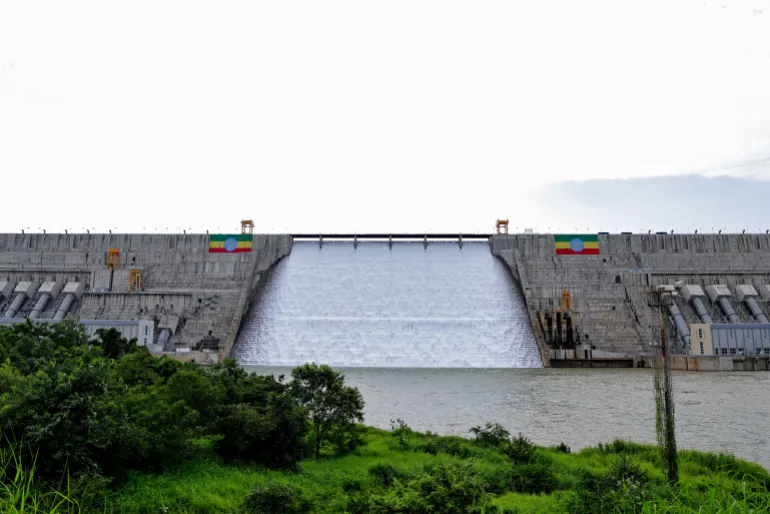
Relations between Cairo and Addis Ababa have remained tense as a longstanding dispute over the Grand Ethiopian Renaissance Dam (GERD) remains unresolved. Competition between the two has increasingly extended to regional security, the Red Sea and the Horn of Africa.
The Grand Ethiopian Renaissance Dam, the construction of which stoked fears in Cairo that Ethiopia could choke off the Nile River, September 9, 2025 [File:Tiksa Negeri/Reuters]
Sudan’s relations with Ethiopia are similarly troubled. Since the outbreak of the Sudanese civil war, Khartoum has accused Addis Ababa of providing training, supplies and the use of Ethiopian territory to the RSF.
Eritrea had fought alongside Ethiopia against rebel groups in the latter’s Tigray region during a war between 2020 and 2022, but relations between the two neighbours have since soured, with Eritrea alarmed by Ethiopia’s attempts to gain access to the Red Sea.
Against that background, some analysts and Ethiopian opposition figures say that Addis Ababa is pointing the finger at foreign conspiracies in a bid to rally support behind its national army.
Mohamed Selim, deputy chair of the Egyptian parliament’s African Affairs Committee, told Al Jazeera that he believes the accusations were an attempt to shift attention from Ethiopia’s domestic problems by creating an external enemy and seeking to unify the internal front.
Amani al-Tawil, director of the Africa Programme at the Al-Ahram Centre for Political and Strategic Studies, similarly described the accusations as “an understandable attempt to escape from internal crises”.
She questioned why Egypt would choose this moment to intervene militarily in Ethiopia, given the two have been in dispute over GERD since 2011.
Al-Tawil said the breadth of the new opposition alliance in Ethiopia – seven groups representing disparate ethnic groups and regions announced the coalition last week – presented a challenge to Addis Ababa.
(Al Jazeera)
Spillover concerns
The renewed fighting in Ethiopia has spread across Tigray and into neighbouring Amhara and Afar.
Mohammed Hussein, the chairman of the Prosperity Party Afar Region Branch Office – the ruling party in Ethiopia’s Afar region – told Al Jazeera that the three regions together have a population of more than 38 million, according to his estimate, and include areas near the borders with Djibouti and Eritrea, raising fears of a regional war.
Ammar Arki, a writer focusing on Horn of Africa affairs, told Al Jazeera that Ethiopia had, at various stages, blamed Sudan, Egypt and Eritrea for contributing to instability inside Ethiopia.
He said the latest accusations could be interpreted as an attempt to redirect some domestic attention towards an external threat and build support around the federal government.
But Arki warned that the longer Addis Ababa continued to explain its internal crisis in terms of an “external conspiracy”, particularly if neighbouring states responded in the same way, the greater the risk that Ethiopia’s conflict could move beyond Ethiopia’s borders and become regional.
Indirect talks between the United States and Iran aimed at ending the seven-month-long war continue – most recently via Qatar as mediator on the sidelines of the United Nations General Assembly (UNGA) in New York – but the two sides still disagree about the agenda.
Iranian Foreign Minister Abbas Araghchi left New York on Tuesday after telling state-run Islamic Republic of Iran Broadcasting (IRIB) that he expects an official response to Tehran’s proposal to reopen the Strait of Hormuz by the end of the day. The proposal, which Iran said would see the strait reopened within seven days, was first passed to the US via Qatari mediators last week.
Recommended Stories
list of 3 itemsend of list
United States President Donald Trump was reported to have rejected that offer, under which Tehran would reopen the strait in return for Washington lifting its naval blockade, waiving sanctions, releasing an estimated $12bn in frozen Iranian assets and enforcing a wider regional ceasefire that includes Lebanon.
Under Iran’s proposal, wider peace talks, including discussions of its nuclear programme, would begin only then
Despite Trump’s public rejection, Araghchi says he has not yet received a formal response from Washington. Meanwhile, US media reports that Trump may well be willing to relax sanctions and unfreeze Iranian assets have been strongly denied by the US president.
Instead, US officials say, the US wants a deal that resolves all outstanding issues, particularly Tehran’s nuclear programme, in one go, rather than pursuing a gradual, step-by-step approach.
Here’s what we know about the talks:
Qatari mediators met Araghchi in New York on Monday to discuss how to advance Tehran’s proposal for reopening the Strait of Hormuz and then progressing to wider peace talks.
In a post on Telegram, Araghchi insisted that the talks focused solely on the Strait of Hormuz. He denied that the US had formally rejected the Iranian proposal.
“Despite what the US president said, I said that we were waiting for the official US response through the mediators … They [Qatar] had ideas, and we discussed them. They are going to raise this issue with the American side again, and then the final response from the American side will be conveyed to us through the Qatari mediator,” Araghchi said late on Monday.
Araghchi also said negotiations had become more “serious”, but cautioned that Tehran’s position has not changed.
“I state firmly that there has been no change in Iran’s position. Our conditions for opening the strait are clear. Our position on other issues is also clear. At present, there has been no discussion at all about flexibility,” he added.
Tehran’s proposal includes elements of the Islamabad memorandum of understanding (MoU), which was signed by both the US and Iran on June 17.
Is Trump willing to accept some Iranian demands?
A US official told The Associated Press news agency last week that Trump is not willing to make a final peace deal with Iran until the issue of its nuclear programme is addressed. According to the official, who has not been named, the US president would be willing, however, to grant Iran sanctions relief and release some frozen funds if progress is made on the nuclear file.
Then, on Monday, US-based news outlet Axios also reported that Trump had offered Iran sanctions relief in return for concessions on its nuclear programme. The report also cited US officials, one of whom told Axios that the indirect talks had been “positive and constructive”, adding that Tehran had indicated it was “flexible” on nuclear issues.
Trump, however, angrily denounced the story as a “hoax” in a post on Truth Social, the social media platform he owns. He said the story was “not true” and demanded Axios remove the article.
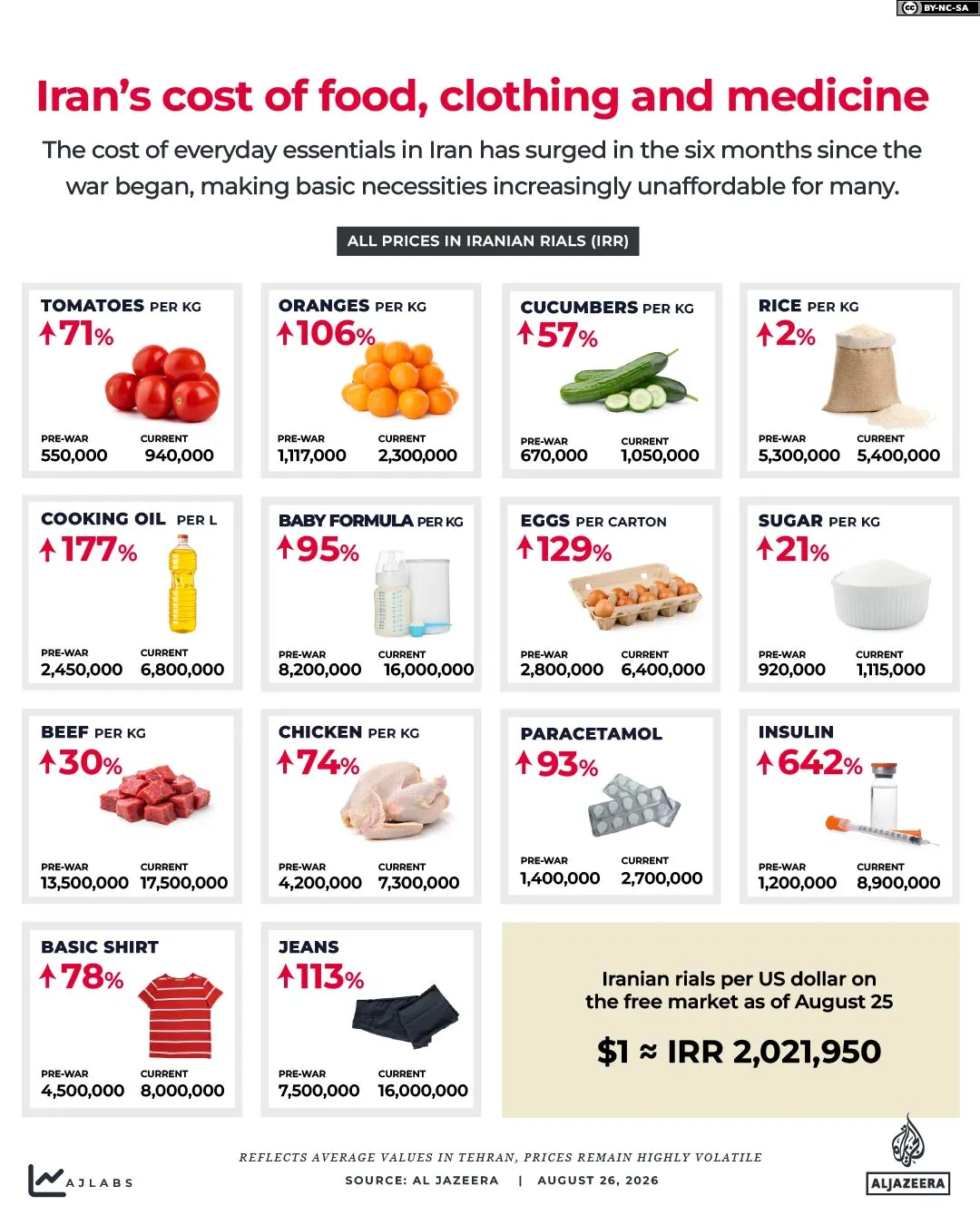
Iran has been heavily sanctioned for decades. The restrictions have severely affected Iranians’ quality of life, including their access to essential medicines and healthcare.
In August, the US announced yet more sweeping economic sanctions on Iran and countries that trade with it as it sought to apply more economic pressure to isolate the country from the global economy during the diplomatic deadlock in their war.
US Treasury Secretary Scott Bessent described the campaign as the “economic asphyxiation” of Iran.
It is difficult to quantify exactly how many Iranians have been killed by what Tehran views as “economic warfare”. However, a study published last year by the highly regarded medical journal The Lancet Global Health concluded that more than 564,250 people worldwide die annually as a result of US sanctions.
What does the US want?
In late February, just before the US launched its first strikes on Iran, the two sides were already holding talks hosted by Oman, which included the issue of Iran’s nuclear programme.
But before those talks could conclude, the US and Israel launched strikes, triggering the closure of the Strait of Hormuz, through which one-fifth of the world’s oil and natural gas is shipped in peacetime, by Iran. The closure of the strait has since become the primary point of contention between the two sides, when it had not been an issue before the war began. The strait is currently subject to blockades by both sides.
Throughout the war, Trump has repeatedly expressed his desire to strike a deal with Tehran. However, serious differences between the two sides will need to be resolved first, including the order in which issues are addressed for the purpose of peace talks.
Iran wants to establish its control of the Strait of Hormuz, have sanctions lifted and assets unfrozen, as well as ensure an end to US-Israeli strikes before it will go back to negotiating other issues, such as its nuclear programme. This was the order of events laid out in the MoU agreed between Iran and the US in June, but which quickly fell apart.
The US, however, wants everything to be on the table at the same time – it does not want to agree to anything relating to these Iranian demands before it addresses the other issues.
Scott Lucas, professor of US politics and international relations at University College Dublin, told Al Jazeera that Washington effectively wants Iran to surrender.
“The Strait of Hormuz has become a fundamental issue. The question here is, will both sides give? The memorandum of understanding clearly gave Iran a role in the management of the strait,” Lucas said.
“When the Trump administration pulled away from negotiating on the basis of the memorandum, they effectively went back to the idea of Iran having to completely allow passage through the Strait of Hormuz with no guarantees over it, in terms of not only what it means for Iran financially, but [also] in terms of Iranian security. The Iranian government is not going to agree to that, so we’re stuck in this limbo right now,” he added.
“Are the Trump folks going to come back to the talks on the basis of the memorandum of understanding or something that is a revised version of it, or are they going to try and break the government with economic warfare until at least after the US elections in November? That’s where we are right now.”
What does Iran want?
After half a century of bitter enmity with Washington, Iran wants to consolidate what it sees as the strategic gains it has made during a war it did not start. This specifically includes its newly established ability to close the Strait of Hormuz, sending global energy markets into a tailspin and placing additional pressure on the Trump administration.
Since US-Israeli strikes on Iran began on February 28, Hormuz has dominated talks aimed at ending the war and emerged as Tehran’s greatest point of leverage. Prior to the conflict, Iran did not exert control over the waterway and all commercial shipping passed through freely.
For this reason, Iran will not move on to wider peace talks until it has leveraged its control of the strait to get its demands met. “Our discussion is clear. Right now, it is only about the Strait of Hormuz,” Araghchi said late on Monday.
“The opening of the Strait of Hormuz is also subject to the fulfilment of a series of conditions that we announced to the other side.”
Ali Salehian, director of the Center for Intellectual Diplomacy at the Governance and Policy Think Tank in Iran, told Al Jazeera that Tehran does not believe Washington will honour any future deal as it did not honour what was agreed under the Pakistan-brokered June MoU.
“For Iran, the bottom line of every negotiation with Trump, considering all of his misbehaving and [military] targeting of Iran during negotiations, is the Islamabad MoU,” Salehian said.
“Tehran thinks that if the US doesn’t fulfil its commitments based on the MoU, there is no guarantee that any kind of future deal would be sustainable.”
Iranian-made Zolfaghar missiles are seen on display beside a large portrait of Iran’s Supreme Leader Mojtaba Khamenei at Baharestan Square in Tehran on September 28, 2026 [AFP]
What is likely to happen next?
It does not look likely that the diplomatic standoff will be eased anytime soon, analysts say.
Both the US and Iran have indicated throughout the war that they would prefer a diplomatic settlement to a continuation of the war. However, Trump has continued to threaten Iran with more strikes if it does not agree to a deal, and Araghchi told US news outlet NBC on Sunday that Tehran is also prepared to resume fighting, even though it has not abandoned diplomacy.
“We are fully prepared for the time for the war to be resumed, and I repeat, we stand firm in the face of any new aggression, even if it comes to a doomsday war,” he said.
Trump said last week that he expects a deal will be reached, but not until after the US midterms on November 3.
“For the moment, the Trump administration is going to try to make the Iranian government capitulate through economic warfare,” Lucas said.
However, a deep sense of distrust remains between the two sides. Senior Iranian officials believe Trump will restart the war after the midterms on a far greater scale and that Israel would also participate.
If that theory proves true, Tehran may well prefer the fighting to resume before November’s elections, as it would allow Iran to impose a greater cost on Trump.
“The reaction of the Iranians to that might be to actually trigger the war themselves, early, right before the midterm elections in order to maximise the pain that [it] will impose on the US president,” Trita Parsi, executive vice president of the US-based Quincy Institute for Responsible Statecraft, told Al Jazeera earlier this month.
Mohammed Abu Hijleh still finds it hard to believe that his mother passed away just over a week ago; she had suffered from nothing more than diabetes. But the restrictions Israel imposes on various cities, towns, and villages in the occupied West Bank can alter a Palestinian’s life in an instant.
Zahriya Abu Hijleh, 66, was attending her niece’s wedding reception in her hometown of Deir Istiya, northwest of Salfit, on September 20, when she suddenly felt dizzy and collapsed.
Recommended Stories
list of 3 itemsend of list
After she was taken to the town’s medical centre, the doctor immediately ordered her transfer to Salfit Governmental Hospital, a facility just an eight-minute drive from Deir Istiya.
Mohammed requested an ambulance, but the vehicle could not enter the town because the iron gate operated by Israeli forces at the entrance was closed. Instead, an ambulance from the medical centre transported her to the gate, and from there, she was taken off the stretcher, carried past the gate on foot, and transferred to a second ambulance waiting on the other side.
It is a scenario that happens repeatedly in the occupied West Bank, Mohammed told Al Jazeera.
“My mother was breathing her last; had the gate been open, we wouldn’t have lost her on the way,” he said.
Medics later determined that Zahriya had suffered a pulmonary embolism and required urgent treatment, according to her family.
“Sadly, she died due to the delay,” Mohammed said. “She had no prior health issues other than diabetes.”
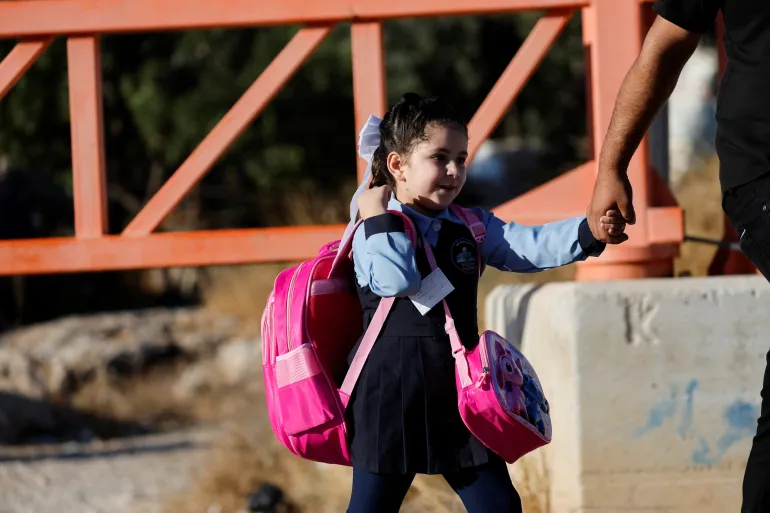
A Palestinian student crosses an Israeli checkpoint as students return to school for the new academic year, near Hebron in the Israeli-occupied West Bank, September 6, 2026 [Mussa Qawasma/Reuters]
Comprehensive closures
The military checkpoints and iron gates erected by Israel in the West Bank have become a significant source of misery for Palestinians.
They disrupt daily life, causing delays for people trying to reach work, schools, and universities, while also posing a daily threat to the lives of the sick.
Israel periodically imposes closures on the West Bank for various reasons, including Jewish holidays. The current closure runs from September 27 to October 3, coinciding with the Jewish festival of Sukkot.
While Israeli settlers move freely between West Bank cities, and even storm Palestinian villages and towns under Israeli army protection, Palestinians are forced to wait for hours at closed checkpoints.
Ibtihal Mansour from Nablus endured such an ordeal last Friday while visiting her in-laws’ home in the village of al-Janiya, near Ramallah.
The family left the village at 10am, hoping to reach Nablus within 45 minutes. But they encountered closures at the Atara and Ein Siniya checkpoints north of Ramallah, effectively trapping them in the area.
“We tried taking alternative routes west of Ramallah, but were surprised to find the road between Ramallah and Nablus blocked by settlers, with all vehicle traffic completely halted. We remained on the roads, trying to find any way through, until midnight, a span of more than 14 hours,” she told Al Jazeera.
Her children were crying, exhausted after spending so long confined in the vehicle. Passing through one roadblock near Nablus, in an area called al-Lubban Asharqiya, a soldier forced Ibtihal to wake the children. When her 11-year-old son did not wake up, she said that the soldier punched him in the head, causing him to jolt awake crying.
“The scene was heartbreaking; I felt a deep lump in my throat and profound sorrow. Long hours of waiting in the vehicle ended with an assault like this, and the ordeal didn’t even end there,” she said, explaining that they had to turn back. “We were forced to spend the night at my sister-in-law’s home in Ramallah before setting out early the next morning for Nablus.”
Like Ibtihal’s family, many Palestinians travelling between cities and villages are forced to stay overnight in hotels or at relatives’ homes. Some municipalities have converted wedding halls and mosques into shelters for those stranded, providing meals donated by residents of towns near the checkpoints.
The Colonization and Wall Resistance Commission (CRRC) recorded 942 checkpoints, closure points, and obstacles across the occupied West Bank as of September 25, up from 793 in March 2024.
The total length of the obstacles amounts to approximately 107.7km (70 miles), according to data from the UN Office for the Coordination of Humanitarian Affairs.
The CRRC says the closures effectively fragment Palestinian communities, making access to workplaces, schools, medical facilities, and agricultural land dependent on whether roads and crossings are open.
Al Jazeera has reached out to Israeli authorities for comment on the road closures and the allegations from Palestinians in this article, but has yet to receive a response.
Strangling Hebron and Jerusalem
In Hebron – which has an Israeli settler presence in the centre of the Old City – the Israeli army has closed the Ibrahimi Mosque to Palestinians and tightened restrictions at checkpoints and gates leading to the site until Wednesday, all while securing access for settlers to celebrate Jewish holidays.
Issa Amro, coordinator of the Youth Against Settlements group, told Al Jazeera that soldiers have closed checkpoints and imposed curfews in several city neighbourhoods, restricting resident movement and making it increasingly difficult to reach the Old City and the Ibrahimi Mosque.
“The area west of the mosque contains settlements and closed zones, while access from the east is limited to a few roads. These measures make reaching the site both more difficult and more dangerous,” he explained.
The situation in occupied East Jerusalem is also fraught, as Israel imposes strict restrictions on Palestinian movement and access to the Al-Aqsa Mosque, while thousands of Israeli settlers enter the site and move about unhindered under heavy security escort.
Activist Fakhri Abu Diab told Al Jazeera that Israel’s closures in occupied East Jerusalem during the Jewish holidays are part of attempts to impose religious sovereignty over the city.
Abu Diab explained that Israeli settlers and hardliners head either to storm the Al-Aqsa Mosque or to synagogues to perform religious rituals, while Palestinians are forced to remain at home.
He described how the closures disrupt daily life in East Jerusalem, shutting shops, schools, and workplaces, and halting movement.
“Israeli police restrict the movement of Jerusalemites. Families and vehicles attempting to move about risk being attacked by extremists and settlers, while the latter are permitted to roam freely and dominate the streets,” he said.
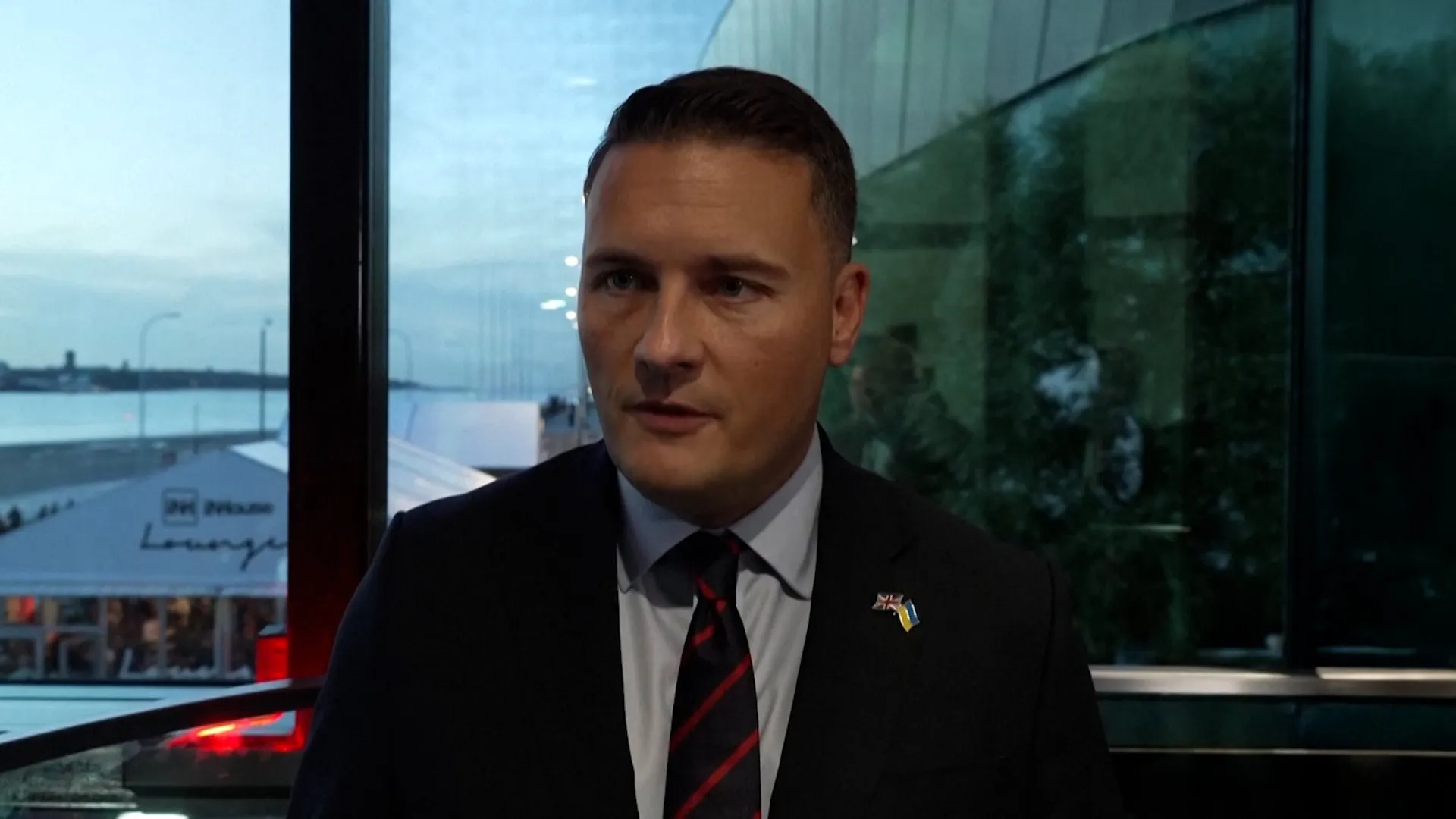
UK’s Defence Secretary Wes Streeting said it was ‘too soon’ to blame a foreign state for a suspected plot near RAF Fairford. Five British nationals were arrested on suspicion of terror offences at the US bomber base.
Nearly half a million people are displaced in Rakhine as a result of the conflict between the military and rebel groups.
Published On 28 Sep 202628 Sep 2026
An air strike carried out by Myanmar’s military has killed at least 33 people in territory controlled by rebel factions.
The attack near a market in the north of the Rakhine state in the west of the country on Monday also wounded 36 people, rescue and rebel group officials reported. The strikes are the latest in a series of assaults against pro-democracy and ethnic armed groups by the military government, which took power in a coup in 2021, sparking armed opposition.
Recommended Stories
list of 4 itemsend of list
The Arakan army said a fighter jet dropped two bombs near a local market in the town of Kyauktaw at noon local time (0530 GMT), killing 33 people, including vendors, shoppers, and pedestrians. It said the death toll “may continue to increase”.
Wai Hun Aung, a senior rescue official in Rakhine, confirmed the details to the Associated Press news agency. He said the market was the region’s main wholesale centre, drawing traders and shoppers from across the state.
“This is one of the most severe airstrikes in Rakhine,” he said. Photos and videos posted on social media showed buildings on fire, damaged vehicles and parts of a nearby bridge destroyed.
Myanmar’s military did not immediately comment, but it has previously said it strikes only legitimate military targets and accused resistance groups of “terrorism”.
Smoke billows from fires in a residential area following a Myanmar military air attack on a market and adjacent bridge in Kyauktaw, Rakhine state, September 28, 2026 [AFP]
Myanmar has been gripped by conflict since the elected government led by Aung San Suu Kyi was ousted in the 2021 coup. A nationwide resistance movement has since evolved into a civil war between the military government and an array of armed ethnic and pro-democracy groups.
President Min Aung Hlaing, Myanmar’s former military government chief, was elected by a military-backed Parliament in April, formalising his grip on power after five years of army rule.
The Arakan army is a well-trained and well-armed military group seeking autonomy for Rakhine’s ethnic minority. It launched an offensive in November 2023 and has since captured strategically important military headquarters and 14 of the state’s 17 townships.
The military has imposed severe restrictions on trade routes to Rakhine since the fighting there intensified, worsening food shortages.
In December, a military airstrike on a hospital in Rakhine’s Mrauk U township killed at least 33 people and wounded 70 others.
Nearly half a million people are displaced in Rakhine as a result of the conflict, according to United Nations data. The UN added in August that the human rights situation in Myanmar has plummeted “to a new low”, citing “brutal abuse” against the Rohingya minority and the devastating impact of illicit economic activity, including illegal mining for rare earth minerals.
Rebel groups and Myanmar’s military are now both using drones in the protracted conflict, which has killed more than 100,000 people, according to the Armed Conflict Location and Event Data (ACLED) project.
Israel’s national security minister declares ‘we are the owners of the place in Al-Aqsa’ during heavily guarded incursion.
Published On 28 Sep 202628 Sep 2026
Hundreds of Israelis led by far-right National Security Minister Itamar Ben-Gvir have stormed the Al-Aqsa Mosque compound under police protection.
The Jerusalem governorate on Monday said Israeli forces closed intersections and streets surrounding the Old City that lead to the Al-Aqsa Mosque compound, which Jews refer to as the Temple Mount, in occupied East Jerusalem on the third day of the Jewish holiday of Sukkot.
Recommended Stories
list of 4 itemsend of list
It said the Israelis danced in circles and sang inside the courtyards of Al-Aqsa Mosque during the raid, noting that 900 people entered the compound in the morning.
“We are the owners of the place in Al-Aqsa and in the prisons, and we have turned the lives of terrorist prisoners into hell,” Ben-Gvir said.
“The people of Israel are on the path to absolute victory, and today we pray in Al-Aqsa, which is the most important place for the Jewish people.”
Monday’s intrusion came as Israeli authorities forced dozens of Palestinian shopkeepers to close their businesses and residents to remain inside their homes in areas near the mosque to allow Jewish prayers during Sukkot.
“Dozens of Palestinian owners of shops, cafes and restaurants in the Cotton Merchants Market in Jerusalem’s Old City were forced to close them during the Jewish Sukkot holiday to make way for Jewish prayers in the market,” the Association for Civil Rights in Israel said in a statement.
‘Playing with fire’
Palestinian presidential spokesman Nabil Abu Rudeineh described the incursion as “playing with fire and a dangerous provocation to the feelings of Muslims around the world”.
He also warned that Israel was seeking to ignite a “religious war” in the region.
Since 2003, Israeli police have allowed groups of Israelis to make daily incursions into the Al-Aqsa Mosque compound, except on Fridays and Saturdays.
Israel often imposes restrictions on Palestinian worshippers. It prevented Eid al-Fitr prayers at Al-Aqsa this year, allowing only 10,000 Palestinians from the occupied West Bank, home to 3.3 million people, into one of Islam’s holiest sites for the first Friday prayers of Ramadan.
Al Jazeera’s Mohamed Tawakul is near a front line in Ethiopia’s Afar region, where fighting has spread after rebel groups formed an alliance to try to oust the government of Prime Minister Abiy Ahmed.
Ukrainian President Zelenskyy says Moscow launched nearly 4,000 drones, aerial bombs and missiles against his country in past week.
Published On 28 Sep 202628 Sep 2026
A Russian military strike on northeastern Kharkiv, Ukraine’s second-largest city, has injured at least 22 people, including children, less than a day after eight people were killed in attacks nationwide.
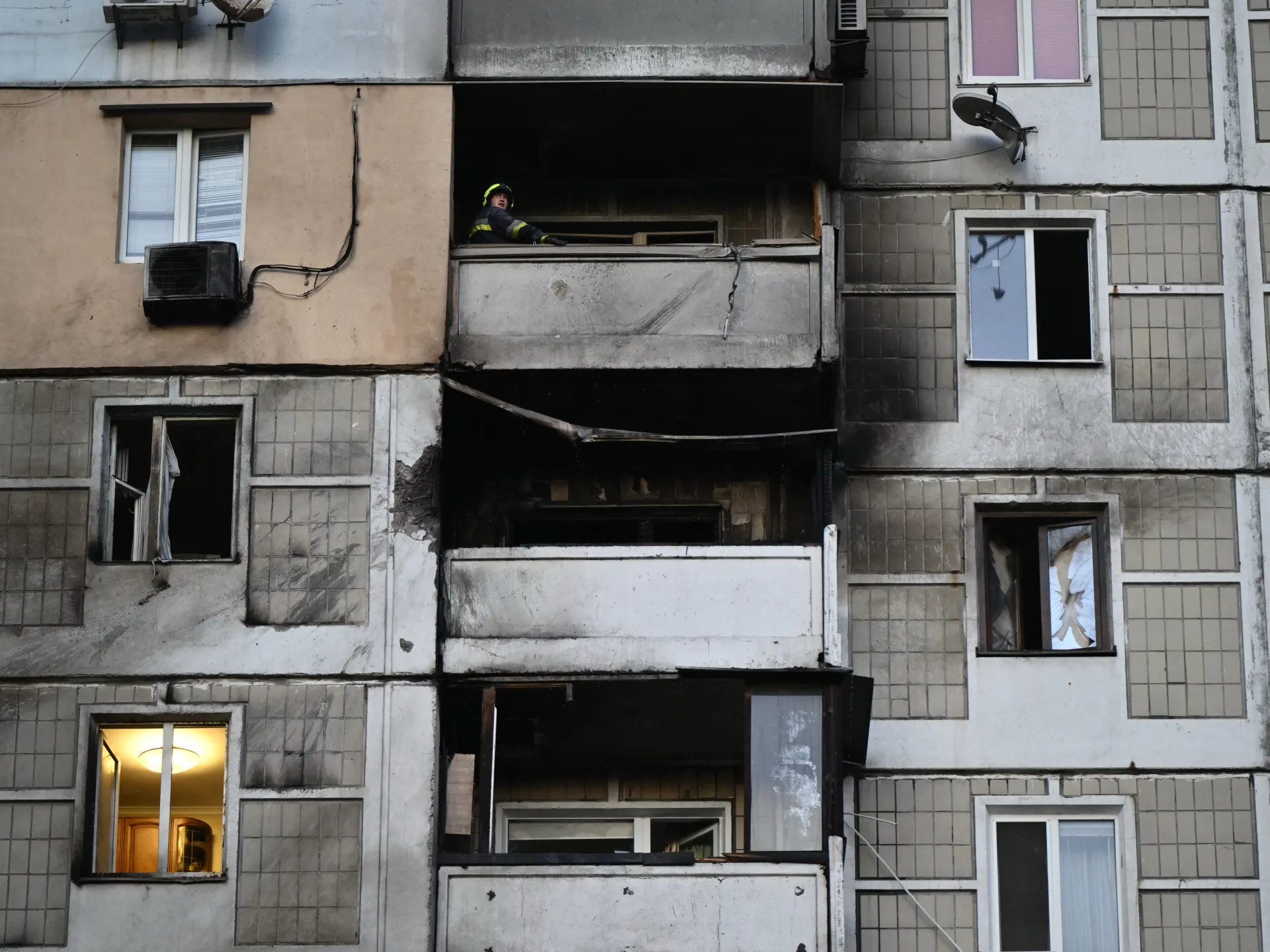
Kharkiv Mayor Ihor Terekov said on his Telegram account that a guided Russian aerial bomb hit an apartment block early on Monday, destroying two floors of the multistorey building.
Recommended Stories
list of 3 itemsend of list
He said six children were among the injured.
Russian attacks were also reported across Ukraine on Sunday.
Ukrainian Minister of Internal Affairs Ivan Vyhivskyi said three people, including a 16-year-old girl, were killed in air strikes that damaged a children’s centre in the northern city of Sumy.
Authorities in the Odesa region, meanwhile, said a “massive strike” on the south of the Black Sea region killed one person and damaged residential buildings, a shop, a hotel, a medical building, and a grain warehouse.
And in the capital, Kyiv, Mayor Vitali Klitschko said a woman and two 16-year-olds were injured and hospitalised.
“The enemy continues to relentlessly attack the Kyiv region with strike drones,” the city’s administration said.
“Sixteen sites have been damaged”, including 12 houses, a warehouse and a production facility, it added.
Ukrainian President Volodymyr Zelenskyy said on Sunday that three people were killed in strikes in the southern Zaporizhia region and that a Russian drone strike had killed one man in Kyiv.
Zelenskyy said in a post on his X account that Russia had launched more than 2,200 attack drones, 1,630 aerial bombs and 38 missiles of various types against Ukraine in the past week.
“If Russia were truly preparing for any real steps towards de-escalation, as it claims, particularly to American negotiators, this wave of Shahed terror would not be happening,” Zelenskyy said in later comments, referring to the Iran-developed drones Moscow has used against Ukraine.
In Moscow, Russia’s Ministry of Defence said it had bombed a Kyivstar data centre in Kyiv and another belonging to the Omega Telecom company. It said that the firms were providing services to the Ukrainian army.
Russian Minister of Foreign Affairs Sergey Lavrov told the United Nations General Assembly in New York on Saturday that Moscow intended to continue its military campaign “to the end”.
Ukrainian drones struck an oil depot in Russia’s Krasnodar region on Monday, according to local reports.
Ukrainian Telegram channel Exilenova+ published footage of a large fire and identified the facility as the Pavlovskaya oil depot.
No injuries have been reported so far.
Ukraine has intensified its targeting of Russian oil infrastructure in recent weeks.
United States-led talks to end the war, which began with Russia’s full-scale invasion of Ukraine in February 2022, have failed to produce a breakthrough, and the UN has highlighted the growing civilian toll.
UK Foreign Secretary Ed Miliband was confronted by activists at a Pizza Express restaurant in Liverpool over the proscription of Palestine Action. Nearby, more than 50 demonstrators were arrested while protesting in support of the group outside a Labour Party conference.
Relations strain further as Afghanistan and Pakistan trade accusations over terrorism and cross-border violence.
Published On 27 Sep 202627 Sep 2026
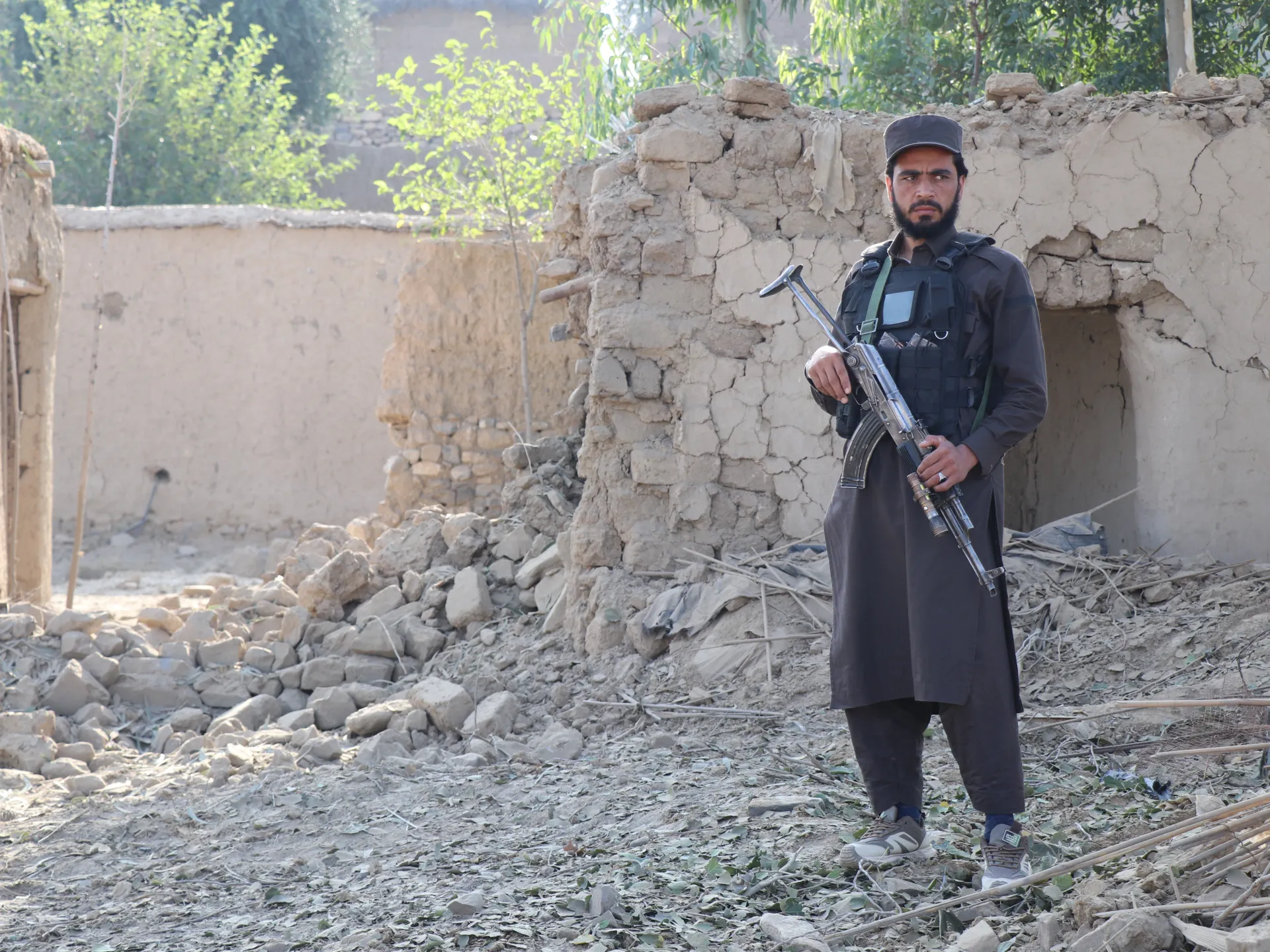
Afghanistan’s Ministry of Defence said its forces killed 28 fighters in the eastern province of Nuristan who had crossed the border from Pakistan.
In a statement posted to X, the Taliban’s defence ministry confirmed it had engaged in clashes with the opposing group on Sunday.
Recommended Stories
list of 3 itemsend of list
The defence ministry alleged that most of the fighters were former Afghan government security personnel recruited by Pakistan’s intelligence services with promises of asylum and well-paid employment in foreign countries.
The defence ministry claimed the fighters included ISIL (ISIS) fighters who were supported by Pakistani militias.
Pakistan’s Ministry of Information and Broadcasting rejected the allegations, describing them in a post on X as “frivolous, baseless and devoid of any truth”.
Pakistan denied that its security forces or intelligence agencies were involved in clashes in Nuristan, had recruited or trained former Afghan security personnel, or had facilitated ISIL (ISIS) or other armed groups in Afghanistan.
Pakistan’s information ministry also said the Taliban “should take credible and verifiable action against terrorist organisations operating from its territory” and fulfil its obligation so that “Afghan soil will not be used for terrorism against Pakistan or any other country rather than attempting to deflect responsibility through fabricated accusations”.
Escalating tensions
The clashes follow increasing tension between the two countries.
Last week, Pakistan launched air strikes on 10 locations in Afghanistan it said were used to store and launch drones, some of which were used in cross-border attacks.
The Pakistani air strikes on Thursday killed at least four people, a spokesman for the Afghan Taliban government said while promising to deliver an “appropriate response”.
Pakistan has repeatedly accused Afghanistan of sheltering fighters who attack its territory, a charge Kabul denies.
Sunday’s incident also follows Pakistani air strikes in Afghanistan on September 21 that Islamabad said killed 28 fighters. Afghan officials said civilians were killed and the U.N. mission in Afghanistan confirmed three civilian deaths.
Yemen’s government forces have conducted multiple air and ground operations in the southwestern governorate of Taiz in 24 hours as they intensify attacks against the Iran-backed Houthi group.
The government’s military media centre on Sunday claimed a number of operations against the rebels, including air strikes on Houthi positions in five locations across the governorate.
Recommended Stories
list of 4 itemsend of list
More than 146,000 people have been displaced since the fighting erupted in July after a period of relative calm since a United Nations-brokered ceasefire in 2022.
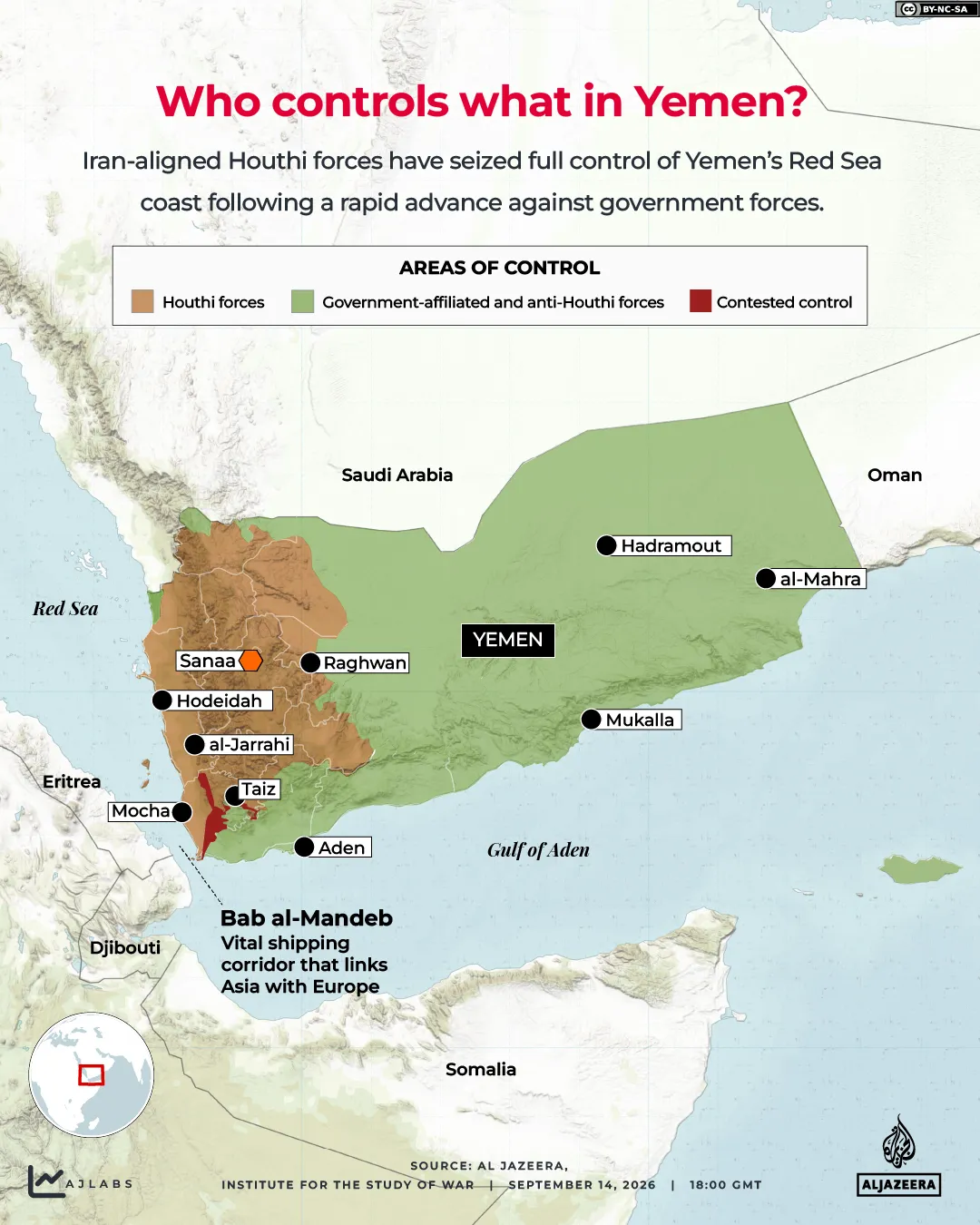
In recent weeks, the Houthis have made dramatic territorial gains against the government forces, seizing the strategic Red Sea coastal city of Mocha and expanding their control over the Bab al-Mandeb strait, a global maritime chokepoint connecting Europe to Asia.
Rashad al-Alimi, the head of the Presidential Leadership Council, has called on citizens to mobilise and join the fight against the Houthis as the government has stepped up its attacks against the Iran-backed group in an effort to stop their advance and regain lost territory.
Meanwhile, Saudi Arabia, which has faced Houthi attacks on its soil since fighting escalated further this month, has been turning to its allies, including Pakistan and Turkiye, for support.
Saudi Arabia backs Yemen’s internationally recognised government.
Here’s what we know about the latest fighting and the humanitarian conditions the impoverished country faces:
What to know about the latest fighting
According to the military media centre on Sunday, dozens of Houthi fighters, including field commanders, were killed or wounded in the previous 24 hours of fighting near Taiz’s capital, which is also named Taiz.
Government forces have carried out operations in several areas of the governorate, including the al-Waziiya district in the west, weapons sites and ammunition depots at Mafraq Mawiya and al-Dhukrah in the east, a Houthi gathering in the Hayfan district in the south and against military vehicles in the Gurab area in the northwest.
Government forces also thwarted infiltration attempts on the al-Ahtoub front and in Hadran as they carried out shelling of Houthi gatherings on the al-Kadha and al-Aqroud fronts, the media centre said.
It added that several Houthi military vehicles were damaged in the attacks.
Al Jazeera could not verify the battlefield claims.
“Government forces say they have made advances in the southern Taiz governorate, taking control of several areas and higher ground. Among them is Jabal Bazel, a mountaintop that places Houthi supply lines within target range,” Al Jazeera’s Maha Ali said on Saturday, reporting from Taiz.
“These developments point to significant and potentially decisive ground operations in recent hours.”
Ali said al-Alimi expressed confidence that government forces were capable of restoring control over the whole country. Houthis currently control vast swaths of northern and western Yemen while the government controls the south and east.
Since the current fighting erupted, the Houthis have accused the Saudis of carrying out attacks in Yemen and promised to prevent Saudi tankers from passing through Bab al-Mandeb, which Riyadh has been using as an alternative shipping route to the Strait of Hormuz. Tehran in effect has closed the Strait of Hormuz since the United States and Israel began a war on it in February. Before the conflict, a fifth of the world’s oil supplies had passed through that waterway.
Government forces, meanwhile, accused the Houthis of using Iranian air defence weapons and said they pose a danger to aircraft.
“These Houthi weapons pose a serious threat to international flight paths over the Red Sea and operate using a heat-tracking system,” Brigadier General Majed al-Nazili, the official spokesperson for the Yemeni government forces, said on social media.
“The weapons employed are capable of attacking military or civilian targets without the ability to distinguish between them, thereby endangering the safety of civil aviation and the lives of passengers.”
Early on Saturday, a Saudi-led coalition in Yemen said its air defence systems intercepted and destroyed two ballistic missiles and two drones launched by the Houthis towards Riyadh and Khamis Mushait in Saudi Arabia.
What has been the regional response to the conflict?
On Saturday, Saudi Foreign Minister Faisal bin Farhan Al Saud, addressed the UN General Assembly and called on the international community to condemn Houthi actions against the kingdom and in Yemen.
At the same forum, Yemeni Vice President Abdullah Abdulkader al-Alimi-Bawzer warned that the Houthis were using shipping security “as a tool for blackmail”.
“It is taking hostage the entire global economy,” he said.
The secretary-general of the Gulf Cooperation Council (GCC), Jassim Mohammed al-Budaiwi, on Saturday strongly condemned the recent Houthi attacks against Saudi Arabia.
“This dangerous escalation constitutes a flagrant violation of the Kingdom’s sovereignty and poses a direct threat to the security and safety of civilians and the stability of the region,” al-Budaiwi said in a statement.
Iran has denied it has any role in the Yemen conflict. Iranian President Masoud Pezeshkian told Al Jazeera that the actions of the Houthis were not connected to Iran and Tehran stands in solidarity with “everyone subjected to injustice”.
He urged the Houthis and Saudi Arabia to resolve their differences through dialogue, saying “a brother should not fight his brother,” and offered Iran’s help in ending the dispute. “We will not be warmongers,” he said.
On Friday, Iran delivered a ceasefire offer, which US President Donald Trump has rejected. It included Yemen and Lebanon. Tehran offered to open the Strait of Hormuz if the US fulfils its conditions, which include the lifting of Washington’s naval blockade on Iranian ports, a sanctions waiver and the release of Iran’s frozen assets.
(Al Jazeera)
Could Saudi allies join the conflict?
Saudi Arabia’s allies have rallied behind it amid intense fighting between the Yemeni government forces and Houthis.
Saudi Defence Minister Khalid bin Salman said on Saturday that there would be continued joint efforts with Pakistan to confront attacks against the kingdom in accordance with the Mecca Joint Defence Agreement signed last month.
He held talks with Pakistani Field Marshal Asim Munir on Thursday. A day earlier, the military chiefs of Saudi Arabia, Pakistan and Turkiye jointly reviewed threats facing Saudi Arabia at a meeting in the Saudi capital.
Multiple Saudi cities, including Riyadh, have been hit by drones and missiles attributed to the Houthis.
Meanwhile, France confirmed on Friday that it was sending troops to guard the major oil terminal at Yanbu, a Saudi port city on the Red Sea, but added that it was not joining the conflict. Yanbu has major oil storage and refining facilities and is connected by the East-West Pipeline, which can carry up to seven million barrels a day. The pipeline was damaged in a drone attack carried out from a group based in Iraq.
The US has so far not pledged military involvement, but the Saudi foreign minister said the kingdom was “continuing to work with our partners in the US”. On September 14, the commander of the US military’s Central Command, Brad Cooper, met the de facto Saudi ruler, Crown Prince Mohammed bin Salman, in Jeddah in the wake of the Houthis’ seizure of Mocha.
What’s the state of humanitarian conditions?
At least 146,000 people have been displaced in the Arab region’s most impoverished country over the past three weeks, most of whom were uprooted from or within Taiz governorate, according to Yemen’s UNICEF country representative, Akhil Iyer.
The number of casualties is still not confirmed as the rival sides have made conflicting claims. As per media reports, the death toll runs into the hundreds.
UNICEF has verified that at least 15 children have been killed and 14 injured in the conflict since early September while three have been reported missing.
According to the UN Office for the Coordination of Humanitarian Affairs, more than 22 million people in Yemen require humanitarian assistance and protection services; 18.3 million people face acute food insecurity; and more than 2.2 million children under five are acutely malnourished.
Army chief accuses Eritrea of funding and supporting armed groups to weaken Ethiopia.
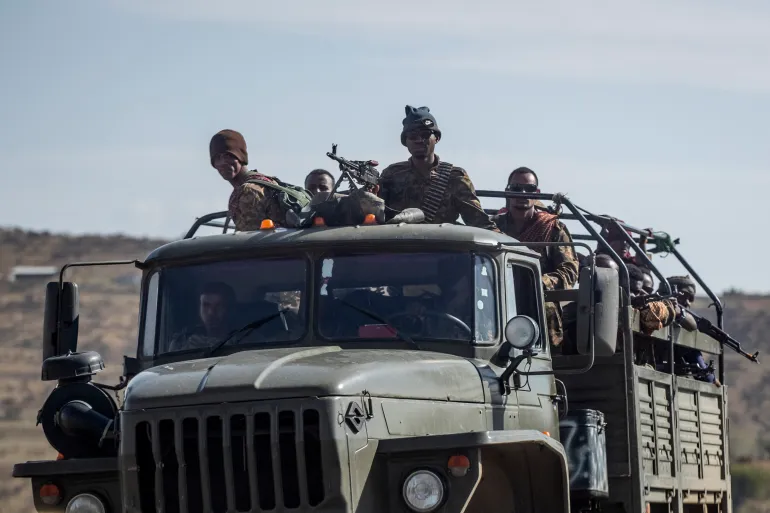
Ethiopia’s federal military has said it is handling rising tensions in the country’s north with restraint, as fears grow that Ethiopia could be heading towards another civil war.
In his first comments on the recent military developments, Army Chief of Staff Field Marshal Berhanu Jula said the army was responding to what he called provocations from the Tigray front with “wisdom and restraint”.
Recommended Stories
list of 3 itemsend of list
He accused Eritrea of funding and supporting armed groups to weaken Ethiopia, describing the “Tsimdo” alliance as an extension of a longstanding pattern of hostile alliances, which he said cannot confront the state without outside backing.
Eritrea, wary that landlocked Ethiopia may be seeking to invade it to gain access to the Red Sea, denied the accusations.
The fighting has spread from Tigray into neighbouring Afar and Amhara regions after seven armed groups announced an alliance, the Ethiopian Peoples’ Forces Alliance for Survival, committed to removing Prime Minister Abiy Ahmed’s government.
In Afar, the latest battles have taken place around Abala, where the military has been trying to prevent rebels from seizing control.
Separately, in North Wollo, a zone of Amhara bordering Tigray, the army said on Thursday it had killed 272 Tigrayan fighters and wounded 260 in a counter-offensive, reporting heavy losses for the Tigray People’s Liberation Front (TPLF).
Members of the armed forces ride a military vehicle as fighting across Ethiopia intensifies amid fears of full-scale civil war [AP]
The TPLF’s Tigray Army said the federal government had launched a “full-scale offensive” involving infantry, mechanised units and drones.
Abdisalam Balema, a TPLF central committee member, told Al Jazeera the situation had become a “full war”.
Fighting has also continued around Sama, Soqota and Raya Alamata, with government forces reportedly closing in on the town of Alamata.
The army command said it prefers a strategy of “strategic calm” over a large-scale military confrontation, arguing the Tigray front’s popular support is dwindling and its leadership divided.
Internet access was reportedly cut across northern Ethiopia on Friday, a day after the UN said it was alarmed by reports of drones being used against civilians there.
The renewed fighting has put the 2022 Pretoria Agreement, which ended a brutal two-year civil war in Tigray, under severe strain. It comes weeks after Washington lifted sanctions on Ethiopia and Eritrea tied to atrocities from the last war, saying the “national emergency … has expired”.
It marks the most serious challenge yet to that agreement, raising fears of a wider regional conflict that could draw in armed groups from across Ethiopia.
Addressing the UN General Assembly, Ethiopia’s president sought to portray the country as a force for regional stability, accusing unnamed external actors of meddling in Ethiopia’s affairs while highlighting Addis Ababa’s role in supporting peace efforts in neighbouring Sudan.
Alemayehu Weldemariam, a professor of law at Indiana University, told Al Jazeera that the federal government bears much of the blame for the collapse of the Pretoria Agreement.
“This war has been in the making for a while now. Much of the provisions in the cessation of hostilities [in the 2022 agreement] were primarily sabotaged by the federal government itself,” he said, citing fuel, service and cash restrictions imposed on Tigray, and the government’s failure to set up the interim administration the deal had promised.
“What was supposed to be an interim arrangement turned out to be permanent,” with Tigray excluded from national elections since, he added.








![Iranian-made Zolfaghar missiles are seen on display beside a large portrait of Iran’s Supreme Leader Mojtaba Khamenei at Baharestan Square in Tehran on September 28, 2026 [AFP]](https://i0.wp.com/occasionaldigest.com/wp-content/uploads/2026/09/afp_6abbb983ec1b-1790687619.jpg?w=640&ssl=1)

![Smoke billows from fires in a residential area following a Myanmar military air attack on a market and adjacent bridge in Kyauktaw, Rakhine state, September 28, 2026 [AFP]](https://i0.wp.com/www.aljazeera.com/wp-content/uploads/2026/09/afp_6abaab2c736e-1790618412.jpg?w=640&ssl=1)