coffee shop

Best cream top coffee and matcha drinks to try in Los Angeles

It looks like cream top beverages are sticking around L.A.’s coffee scene.

“You can’t open a coffee shop in L.A. without having a cream top, fortunately or unfortunately,” said Ryan Solomon, director of wholesale at the Little Marionette, on bringing the cafe from Sydney to L.A. in 2024.

A whipped topping typically made from condensed milk or heavy cream, fans of embellished beverages can’t get enough of the now-standard flourish that local coffee shops add to iced coffee and matcha drinks. The trend evolved from the Austrian Einspänner coffee drinks that first overtook Seoul’s coffee scene in 2016 before landing in L.A. not long afterward.

The verdict on cream tops is split among cafe owners, with some claiming that the rich, luscious topping can overpower the flavors of carefully curated coffee drinks. Last year, prominent L.A. cafes Maru Coffee and Mandarin Coffee Stand limited the add-on on their menus, with Mandarin Coffee Stand owner Sherry Gao saying that the trend went “a little bit out of control.”

About This Guide

Our journalists independently visited every spot recommended in this guide. We do not accept free meals or experiences. What should we check out next? Send ideas to guides@latimes.com.

But for Arian Behboodi and Jared Sielski, co-owners of Lynx Coffee in Sherman Oaks, the pros outweigh the cons.

“We appreciate the cream top drinkers, and we appreciate the coffee fanatics, and we really do try to have a little bit of both,” Behboodi said.

Now, local cafe menus are evolving beyond neutral cream top flavors and offering whipped toppings that pull inspiration from all parts of the world, such as an iced honey latte garnished with a Vegemite cream top at a Palms coffee shop and a cajeta cream top that recalls the gooey Mexican caramel sauce at a new cafe in Hermosa Beach.

Source link

‘Elle’ review: It’s not ‘Legally Blonde,’ but you’ll have a good time

Advertised as “from the world of ‘Legally Blonde,’” the new Prime Video series “Elle” revisits that film’s heroine, Elle Woods (Lexi Minetree), as a 16-year-old high school student, suddenly transported from Beverly Hills to Seattle after her plastic surgeon father (Tom Everett Scott) botches a nose job and has to lie low.

Set in 1995, six years before the events of the first “Legally Blonde” film, with Seattle still living through the long tail of first-wave grunge — Kurt Cobain, Eddie Vedder and Chris Cornell are mentioned almost in a single breath — it shares with the big-screen mothership only its indomitable protagonist, who loves pink and her Chihuahua, Bruiser. (The dog gets its own origin story: It was “rescued” from the Spellings, as in Aaron, who found that its “earth tones” didn’t match “their new color palette.”)

There’s a passing reference to the lawyer Elle might (and does) become, and surely some things I missed, but if you’ve never seen “Legally Blonde,” you will not be at any particular disadvantage. (Possibly you will be at a disadvantage if you have seen it.) Bruiser aside, nothing that happens here affects what happens there. Don’t think twice, or even once, about canon. This is something else entirely.

What that is is a high school comedy, which is to say it’s full of familiar characters swept up in teenage drama. And because this is an eight-episode series and not a two-hour movie, relationships will shift more than once. Indeed, they will not be done shifting by the season’s end; a second is clearly in the producers’ sights.

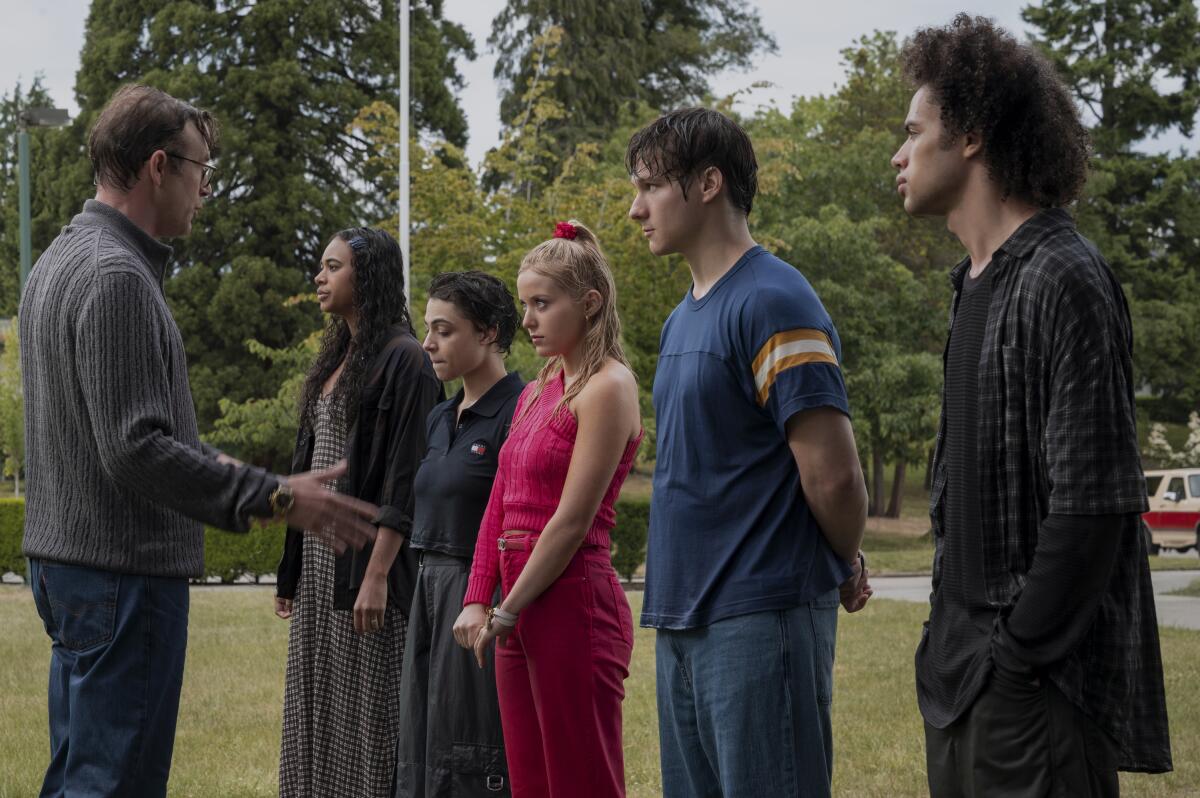
An older man stands in front of four teenagers standing on a lawn.

The series is a fish out of water story as Elle moves from Beverly Hills to Seattle. From left, Kimberly (Chandler Kinney), Liz (Gabrielle Policano), Elle (Lexi Minetree), Miles (Jacob Moskovitz) and Dustin (Zac Looker).

(Kimberley French / Prime Video)

Floating into her new school on a bubble of positivity that will stubbornly refuse to burst, Elle is a spot of color in a sea of black and plaid. (There’s a joke that all the cliques — “jocks, D&D nerds, stoners, kids with parents with Microsoft money, kids with parents with Boeing money” — dress exactly alike.) Her surface mistaken for her substance, she’s mocked by Kimberley (Chandler Kinney), the Mean Queen Bee in a reversal of the usual dynamic; it’s the supposedly deep, authentic characters looking down on the privileged, seemingly shallow one. (Not understanding that Bikini Kill is a band, Elle will offer, “Bikini Kill? I know bikinis … that kill.”) Introducing herself to the skeptical Liz (Gabrielle Policano), who makes music and works in a record store, she says, “I like iced coffee, the month of July and when people dress kind of tennis-y, even when they don’t play tennis.”

At the same time, Elle will quickly bond with Shannon (Danielle Chand), the school’s self-appointed one-woman welcoming committee, and Miles (Jacob Moskovitz), a central-casting nice guy who literally collides with her, as is traditional. (His jacket is blue denim to set him apart.) Socially aware quasi-outsider Dustin (Zac Looker) will take a second longer to sway. Inevitably, all will fall before her goodness, her school spirit and her No Doubt karaoke, though her good intentions will have unintended consequences as well, and she’ll have things to learn — it’s a fish out of water story in which the water will change the fish, and the fish the water. In a late-season plotline, in order to give them something to think about than one another, they’ll become a Scooby Gang (with explicit references to “The Breakfast Club”), investigating adult shenanigans. Well, we love a Scooby Gang.

Chief among the grown-ups is Elle’s equally blond mother, Eva (June Diane Raphael), who will become involved in the mayoral campaign of (the late) James Van Der Beek’s Dean Wilson. At school, there are prickly Principal Anderson (Matt Oberg) and Donna (Amy Pietz, nice to see her), his good-hearted secretary, a champion of needy teens and, it will be revealed, Liz’s mother. It feels wrong to saddle the lovable Scott, as Elle’s father, Wyatt, with a fugitive-from-malpractice plot, such as it is — they had to get the family out of Beverly Hills somehow — and just as his character is lying low, so does he disappear, sadly, a little into the scenery. He does get a nice line about meeting someone named Mike McCready, the Pearl Jam guitarist, in a coffee shop and maybe getting together to play, and a chance to lead partygoers in Oasis’ “Wonderwall.”

Minetree is an apt choice to play a younger Reese Witherspoon (an executive producer), with a dash of “Clueless” Alicia Silverstone stirred in, and the younger cast is likable across the board. Written by Laura Kittrell, “Elle” is lightweight, often obvious and oddly, refreshingly innocent — Elle is waiting for “a perfect first kiss from a perfect guy” — both for the genre and the setting. (As Robyn Hitchcock sang of Seattle in “Viva! Sea-Tac,” “They’ve got the best computers and coffee and smack.”) In a way, it feels like a show made for those who already want what it’s selling, but that’s not me, and I had a perfectly fine time.

Source link

Gun owners may carry a weapon into stores, Supreme Court rules, rejecting a California law

Licensed gun owners have a right to carry a concealed firearm into stores and other private places unless the owner objects, the Supreme Court ruled Thursday.

The 6-3 decision extends gun rights and strikes down laws in Hawaii, California, New York, New Jersey and Maryland.

Those measures would prohibit carrying guns onto private property that is open to the public unless the owner has expressly authorized them.

“This regime hobbles what the 2nd Amendment protects: the right of Americans to carry arms for self-defense as they go about their daily lives. We hold that the law is unconstitutional,” Justice Samuel A. Alito Jr. said for the court.

The new laws, if upheld, would “impose severe restrictions on the daily activities of residents who have satisfied the state’s rigorous requirements for the issuance of a carry permit. When these permit holders leave home in the morning, … they may also be barred from entering many places that people routinely visit in the course of their daily routines, such as gas stations, convenience stores, restaurants, coffee shops, drug stores, grocery stores, ‘big box’ stores, home improvement stores, barber shops or hair salons, dry cleaners, and laundromats.”

The three liberals dissented, saying the law would protect property owners who don’t want guns in their stores.

“There is no constitutional right to enter private property without the owner’s permission, let alone with a firearm,” said Justice Ketanji Brown Jackson.

Trump administration lawyers had joined a coalition of Hawaii gun owners in urging the court to strike down these blue state laws in the case of Wolford vs. Lopez.

They said the laws, if enforced, would mean “a person carrying a handgun for self-defense commits a crime by entering a mall, a gas station, a convenience store, a supermarket, a restaurant or a coffee shop.”

This litigation is part of much broader debate over where guns may be permitted or prohibited.

Four years ago, the justices ruled that law-abiding persons had a right to obtain a permit to carry a concealed gun when they left home. They also agreed there are “sensitive places” where guns may be prohibited, such as schools, courts and other government buildings.

In response, lawmakers in California and Hawaii adopted their own lists of “sensitive places.” They imposed restrictions on concealed weapons at parks, beaches, playgrounds, places of worship and public transit as well as bars and restaurants that serve alcohol.

Gun owners sued but the 9th Circuit Court refused to block most of those restrictions in a single 83-page opinion covering Hawaii and California. Both states would prohibit carrying guns onto private property open to the public without the owner’s consent.

The 9th Circuit upheld that measure in principle but said California went too far by requiring the owner to post a prominent sign expressly authorizing guns.

“While today’s ruling in Wolford is disappointing, owners still have every right to decide whether firearms are allowed in their stores and businesses,” said Janet Carter, managing director of Second Amendment Litigation at Everytown Law. “The Supreme Court may have changed the default rule, but it cannot take away a private property owner’s authority over their own land.”

The Firearms Policy Coalition said the court had properly protected gun rights and barred states from carving out their “own regional version of the 2nd Amendment.”

“The historical record does not support forcing peaceable people to obtain advance permission before carrying for self-defense in places held open to them,” the group said.

Last week, the court upheld gun rights in a Texas case and said the government may not make it a crime for an “unlawful user” of a drug such as marijuana to own a gun.

Source link

Best restaurants, coffee shops and bars in Melbourne, Australia

Among coffee geeks, “pilgrimage” isn’t too strong a word to describe visiting the Collingwood neighborhood cafe owned by barista/roaster/industry visionary Nolan Hirte and his wife, Shari. Nolan was one of the leaders who built on Melbourne’s early coffee culture, established by Italian immigrants and their daily espresso habits in the mid-20th century. After Nolan took a tour of America’s burgeoning third-wave coffee shops in the mid-2000s, he returned to Melbourne determined to push the expressive possibilities of filter coffee even further.

At the cafe, the drink menu — whether drip, espresso drinks or pour-overs — includes flavor descriptions that can resemble wine-tasting notes, but there’s nothing fussy about the experience, or the easygoing breakfast and lunch options. Pour-over freaks looking for the highbrow deep dive should walk two blocks to Aunty Peg’s, the Hirtes’ laboratory/counter/roasting facility, for two or three rounds of Panamanian geishas.

Proud Mary —172 Oxford St., Collingwood
Aunty Peg’s — 200 Wellington St., Collingwood

Source link

Rahm Emanuel’s uphill climb in New Hampshire tests a 2028 presidential bid

For Rahm Emanuel, the road to the White House runs through the uphill climbs of rural New Hampshire.

The onetime Democratic congressman, White House chief of staff, Chicago mayor and U.S. ambassador to Japan hasn’t formally announced his ambition to return to power in Washington. But his weekend trip through the state that typically holds the first presidential primary was hardly subtle.

There were the union hall visits and intimate house parties, staples of New Hampshire political rituals. At one event in the backyard of a handsome home in Concord, Emanuel greeted voters and practiced a stump speech that highlighted strains on the middle class and the excesses of the tax system.

And then there was the bike tour.

Over the course of three days, Emanuel pedaled more than 117 miles across New Hampshire from Portsmouth on the coast to Hanover on the Vermont border in what he dubbed the “Spin-Free Tour,” a nod to his blunt demeanor that he sees as an asset for a Democratic Party trying to move beyond its devastating losses in 2024.

“Tough times require a tough leader,” Emanuel told the Associated Press during a break at a coffee shop in Warner. “I don’t think this is just about learning the words to ‘Kumbaya.’”

For someone who has spent the better part of three decades in the highest orbits of political power, the 66-year-old Emanuel is in the unusual position of lacking a natural platform. His likely rivals in a Democratic presidential contest are mostly younger and, as governors, senators or a recently departed vice president, can more easily attract attention.

And despite his thick resume, Emanuel isn’t especially well known outside political circles, as demonstrated by a woman who asked who he was after he left the coffee shop. When informed that it was Emanuel and that he was considering a campaign, she responded, “A campaign for what?”

How Emanuel taps into tenacity to overcome hurdles

Emanuel is tapping into his hard-wired tenacity in hopes of overcoming such challenges.

As many prominent Democrats focus on castigating President Trump, Emanuel has released a flurry of policy proposals addressing everything from social media bans for children to prediction markets and a mandatory retirement age of 75 for those in public office. That would prevent him from seeking a second term if he were elected.

Emanuel is often on the road, talking education in Mississippi and Michigan. He’ll travel to Israel next month to address the U.S.-Israeli relationship as the war in Gaza has spurred new divisions in both political parties, especially among younger voters.

He is a regular guest on podcasts ranging from those hosted by Katie Couric and Kara Swisher to shows focused on fly fishing. He often uses the appearances to knock his own party for overreaching in cultural debates, particularly those involving the rights of transgender people. It’s a message of centrism that has echoes of that of the first president he served, Bill Clinton.

“We did things that were really ridiculous,” he said of Democrats on an episode of Couric’s podcast that posted last week. “Rather than worry about classroom excellence, we were worried about bathroom and locker room access.”

And he hops on the bike.

The tour gives him a chance to both demonstrate his physical fitness at a time of heightened awareness of the nation’s aging political leaders and to introduce himself to the state’s notoriously picky voters before the rest of the field swoops in after the November midterms.

“It is early,” said Rep. Maggie Goodlander, D-N.H., who appeared alongside Emanuel at the Concord house party. “But what I’d say is the people in New Hampshire know how to vet candidates and they’re the most engaged electorate in the country.”

Martha Kruse, a 76-year-old retired special education teacher from Laconia, New Hampshire, is just that type of voter. Active in her local Democratic Party, she traveled to the Concord event to see Emanuel after hearing him in interviews.

“I’m going away really enthused about him,” she said, adding that he was “right on” to prepare a campaign so early.

Riding through the hills of rural New Hampshire

The future of the presidency seemed a world away during a hilly 20-mile stretch of the ride on Saturday, which included an elevation gain of more than 1,300 feet. Along with a cadre of friends and aides, Emanuel cycled past homes where residents were tending to their yards or celebrating a recent graduation on their front patio. He was chatty at times as he rode with the pack and cycled alone at other points, showing little strain in navigating the steep hills.

With summer finally creeping into New England, the humidity was high and the rain was occasionally intense. The group stopped for water and snacks every 10 to 15 miles, huddling under a barn during one rainy stretch. A small group of local activists met up with Emanuel at the coffee shop in Warner, where he held court from a rocking chair.

But the realities of modern politics occasionally asserted themselves. The group cycled past signs praising Trump and denigrating his predecessor, Joe Biden. As the miles dragged on, a chase vehicle crept by periodically with cameras poking out the window to capture scenes that could later be shared on social media, where Emanuel now has an almost daily presence.

And the whir of the midterms wasn’t far away. In neighboring Maine, Graham Platner was contending with a drumbeat of reports about his history with women that has left some Democrats worried that the party’s path to a Senate majority is suddenly imperiled. Emanuel, who helped power Democrats to their sweeping 2006 victories in the U.S. House, said the “jury is still out” on whether Platner can win the Senate race.

“Everybody is holding their breath whether this is the start of something or the end of something,” he said.

Emanuel hopes voices of moderation are prevailing

But as the broader debate over the Democratic Party’s ideological future unfolds, Emanuel said he thought voices of moderation were prevailing. He noted recent wins by Rebecca Bennett, who emerged from a crowded Democratic primary in New Jersey with the nomination for a competitive House seat, along with Josh Turek, the new Democratic Senate nominee in Iowa.

“There’s a bigger character piece to this than ideological,” Emanuel said. “There’s radical moderates and their profile and character speak to kind of fighting a system, which is what’s needed right now.”

The bike tour was certainly not John McCain’s “Straight Talk Express,” the 2000 campaign bus from which the Arizona Republican senator opined on any question that came his way to seize attention and mount a surprise New Hampshire win over front-runner George W. Bush. But some voters said they were open to Emanuel.

Don Daley, a 60-year-old state employee from Concord, watched Emanuel talk from a bench in the backyard of the house party. He said that Emanuel probably “steps on a few toes.”

“But I think that’s what we need right now,” he said. “Some of our Democratic leaders haven’t been strong enough.”

Sloan writes for the Associated Press.

Source link