I’ve visited the city every year for as long as I can remember
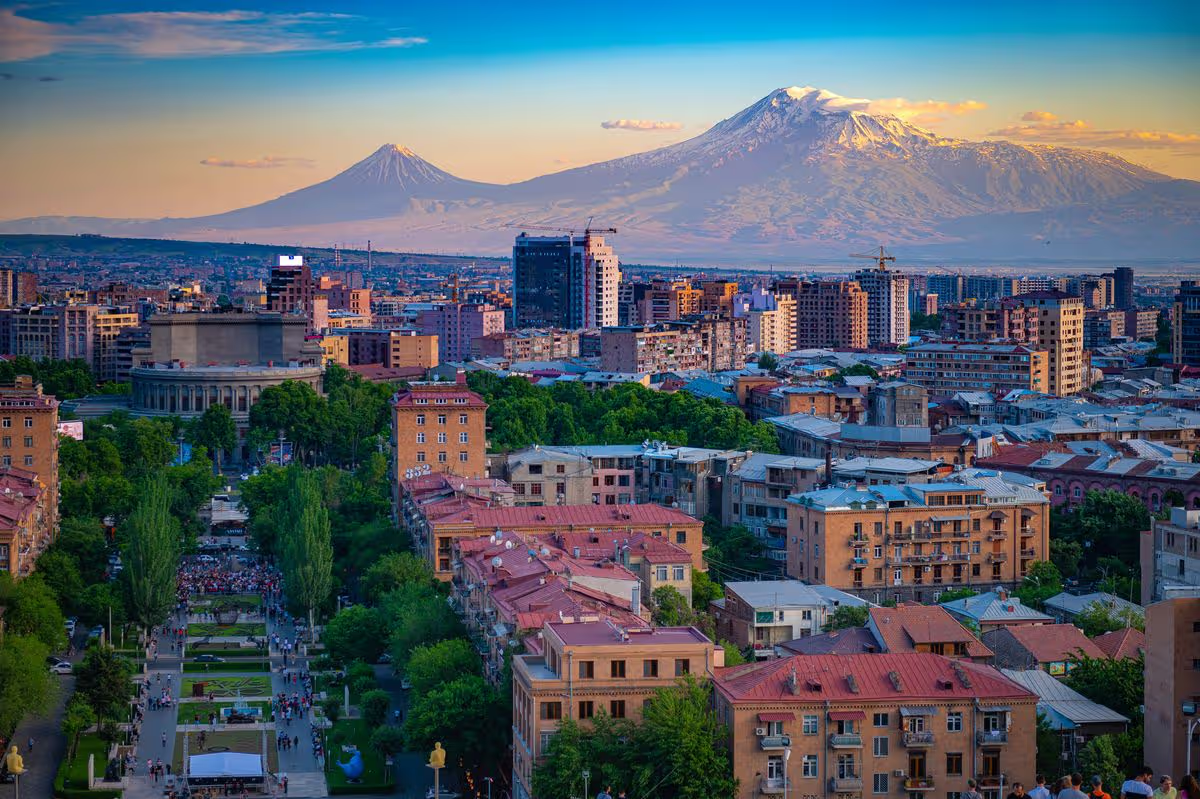
I’ve visited Amsterdam every year for 8 years – and one thing keeps drawing me back(Image: ANDREY DENISYUK via Getty Images)
There are destinations you visit and recall with affection, and then there are those that leave you desperate to go back. For me, Amsterdam belongs firmly in the latter camp — I’ve now returned every year for the past eight years. Nestled in the Netherlands, Amsterdam boasts a fascinating past, having started life as a modest fishing village along the River Amstel.
Across the centuries, it evolved into one of Europe’s foremost trading hubs. During the Dutch Golden Age of the 17th century, it emerged as among the world’s most prosperous cities, drawing merchants and artists from far and wide. The city’s iconic canal system was constructed during this era, shaping the distinctive layout that captivates visitors to this day.
The slender canal houses, adorned with elaborate gables and steeped in centuries of heritage, lend the city a charm unmatched anywhere else across Europe.
Strolling beside the canals feels like entering a living piece of history, yet the city never seems trapped in yesteryear.
Age-old structures nestle seamlessly alongside contemporary cafés, art galleries, eateries, and numerous boutiques.
I’m particularly fond of the Moco Museum in Amsterdam, the Van Gogh Museum, and dining at Pancakes Amsterdam and Sandwichshop Amsterdam.
The canals themselves rank among Amsterdam’s finest draws.
Whether admired from a bridge, discovered by boat, or simply encountered while exploring the streets, they offer a tranquillity I’ve never experienced elsewhere.
Another factor that keeps me coming back is the weather. Despite what many assume, I’ve frequently been blessed with remarkably mild temperatures during my stays.
During my latest visit earlier this month, the mercury hit 28C, creating ideal conditions for lounging by the waterways, relaxing on outdoor terraces and wandering through the streets.
It’s also barely an hour’s flight from London, though I’m equally fond of taking a cruise to the country for a more leisurely journey.
After eight years in a row of visiting the city, my enthusiasm hasn’t waned.
Its convenient location near other destinations, such as Edam, also makes it an excellent starting point for wider exploration.
The blend of fascinating heritage, breathtaking buildings and charming canals keeps pulling me back time and again.
In a few days, Los Angeles voters will be casting ballots for city attorney — and in a few months, they could be voting to sharply diminish the city attorney’s authority.
The city’s Charter Reform Commission has proposed splitting the city attorney’s office into two parts — an elected city prosecutor, charged with handling criminal misdemeanors, and a mayor-appointed and City Council-confirmed city attorney who would represent the city in civil cases and advise the mayor, city council and city departments.
The City Council is reviewing the recommendation as part of sweeping changes to city government, including expanding the council from 15 to 25 seats, which could go before voters in the Nov. 3 general election.
The proposed changes to the city attorney’ office, however, come in the midst of a heated primary campaign, where incumbent Hydee Feldstein Soto is up against three challengers, including a state deputy attorney general and a deputy district attorney.
Both of those challengers say plans to bifurcate the city attorney’s office are rooted in longstanding conflicts between Feldstein Soto and the City Council.
And last year, City Council took a 12-0 vote to direct Feldstein Soto to withdraw an effort to halt a federal judge’s order prohibiting LAPD officers from targeting journalists with crowd control weapons.
“When I first heard about this idea, I thought it was probably the greatest indictment of the current city attorney that I’ve heard yet,” said John McKinney, a Los Angeles County deputy district attorney who is running for city attorney in Tuesday’s primary.
McKinney opposes the bifurcation, saying it will cause overlap and confusion. “If she was doing a good job … we wouldn’t even be having this discussion,” he said.
Marissa Roy, another candidate in the race, hasn’t taken a position on bifurcation but said Feldstein Soto’s actions triggered the proposed change.
“The only reason that bifurcation, or splitting the city attorney’s office, is even going to be going before voters is because we’ve had an incumbent city attorney who has gone so rogue to politicize the role,” said Roy, a deputy state attorney general.
Roy said accused Feldstein Soto of inappropriately blocking an affordable housing project in Venice. And in her office’s role of drafting ordinance language, Roy said, Feldstein Soto has returned to city council ordinance language that isn’t “faithful to the intent of the drafter.”
Feldstein Soto said the proposal to bifurcate the office has nothing to do with her performance.
“This issue comes up every single time charter reform comes up,” Feldstein Soto said. “To me this is all political opportunism.”
Feldstein Soto has opposed the split, and former city attorneys have also come out against it, saying an appointed position threatens the independence of the city attorney’s office, takes away from voters the right to elect a city attorney and could cost taxpayers money in order to split the office.
In a March letter to the Charter Reform Commission, Feldstein Soto said an attorney “serving at the pleasure” of the mayor and city council would face an “innate, human pressure to harmonize legal advice with the political goals of the appointing officials.”
“I have been able to provide honest, accurate legal advice to the Mayor, City Council, Controller and departments — even when that advice is unwelcome — precisely because I am an independently elected officeholder with an ultimate duty to the public,” she wrote. “An appointed City Attorney, serving at the pleasure of the Mayor and City Council, faces enormous political pressure on all of these issues, behind closed doors, cloaked in privilege without an independent voice.”
Burt Pines, a former city attorney who served from 1973 to 1981, deeply opposes the bifurcation proposal, citing the threat to independence as the largest issue at stake. As city attorney, he said, he was empowered to tell city officials when a proposed action was unlawful and refuse to support it.
“You want to be able to call the shots as you see them, true to the law,” Pines said in an interview.
Advocates say other cities have bifurcated offices, and splitting it could reduce conflict and provide a clear delineation of roles.
After consulting with experts and good governance groups, the commission agreed the benefits of bifurcation outweighed the negatives, and it passed unanimously by the commission.
“It was easy to get consensus on this,” said Raymond Meza, chair of the commission. The commission’s proposal calls for the city attorney to be nominated by the mayor, and confirmed by the City Council.
In its report, the commission said that “the current structure creates conflicts when the same office advises the city and prosecutes cases. Separation provides clearer roles, reduces conflicts, and allows each function to be performed effectively.”
Other cities have different models for the city attorney’s office: Long Beach has a similar model with bifurcated duties, while New York City has legal representation split up several ways. The San Francisco City Attorney provides legal representation for the city and county of San Francisco, and the San Francisco District Attorney’s Office handles criminal cases in the city and county.
Mike Bonin, executive director of the Pat Brown Institute, said he has seen the question of splitting the office come up with at least three different city attorneys to varying degrees.
“Given that the city attorney is an elected position, there’s always going to be somebody who doesn’t like them,” Bonin, a former city council member, said. “You need to divorce the question from the occupant and focus on the role — the charter is not about a particular person, the charter is about the function of the office.”
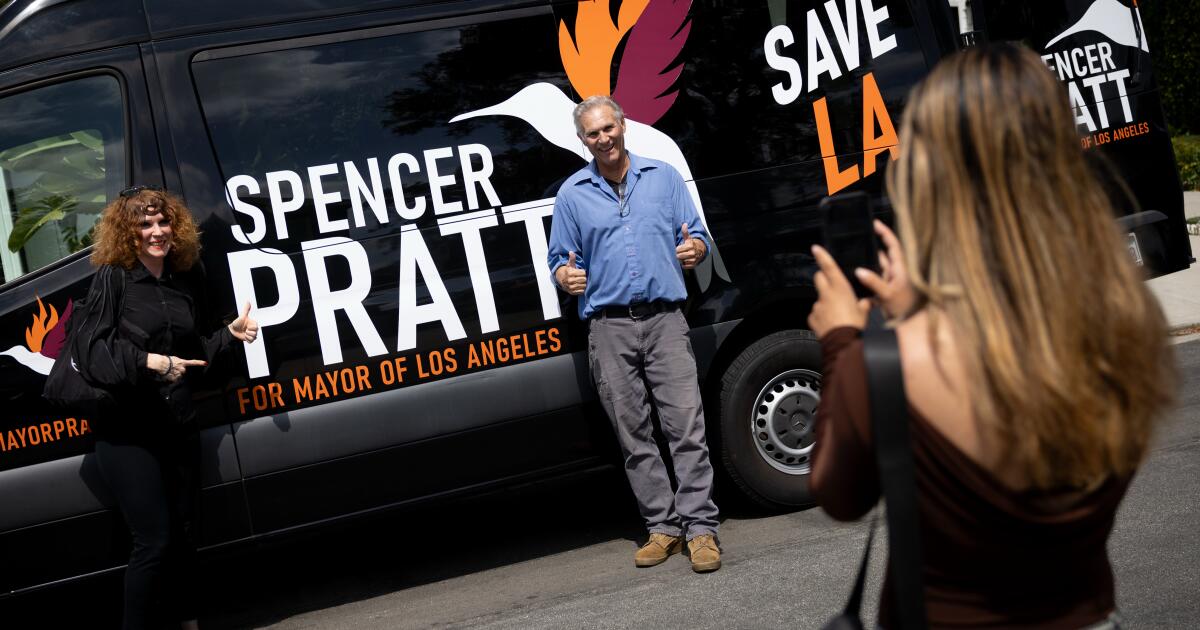
Spencer Pratt is a showboat, a loudmouth, a troll and a self-proclaimed villain who seems willing to say anything in his quest to be the next mayor of Los Angeles.
Little wonder that his critics rolled their eyes when the former reality television star told CNN host Elex Michaelson a few weeks ago that his campaign role model is Jesus Christ, because “he was a politician.” How on earth did Pratt — a man who tosses insults with the ease of someone spitting loogies — come off boasting that his political hero was the Prince of Peace?
But anyone who ridicules the exchange as a blasphemous moment by a deluded wannabe isn’t paying attention — which is exactly the error that has allowed Pratt to storm L.A. politics. He isn’t running on an explicitly Christian message — that would be risky in a city with large Jewish, Catholic and secular constituencies. But the proud born-again evangelical is channeling the zeal of an old-fashioned tent revival, even if some of his rhetoric falls far outside the bounds of the Good Book.
In his recent memoir, Pratt recounted his conversion — actor Stephen Baldwin baptized him in a river during the 2009 season of the reality show “I’m a Celebrity, Get Me Out of Here.” Before that, his Christianity had consisted of wearing a black diamond cross necklace he described as “thirty grand of Jesus bling” bought from a Beverly Hills boutique. Pratt credits his faith with providing direction at a low moment in his life, as he embraced Jesus with such fervor that a pastor told him to stop joining altar calls so much during church services — once was enough.
“I needed the receipt stamped weekly,” Pratt wrote, “like a parking validation, just to make sure it stuck.”
Seventeen years later, he’s still seeking that affirmation.
The memoir comes off as a millennial version of “The Confessions of St. Augustine” — perhaps the most famous literary example of someone who saw their wreck of a life not as a series of mistakes to apologize for but as necessary failures on the road to grace. That’s why Pratt and his followers don’t see his sketchy past as a disqualifier, but rather his biggest strength. Only someone who says he was reborn in the inferno of the Palisades fire could possess the clarity and willpower needed to bring salvation to an accursed land, they argue.
In another era, Pratt would have been a welcome edition to the roster of bombastic Southern California preachers a la Aimee Semple McPherson, Chuck Smith and Gene Scott, as well as radio titans such as George Putnam and John Kobylt. His claims that only he can deliver us from damnation and that we need to repent of City Hall’s status quo at the ballot box are nothing less than a modern-day gospel to his followers. Pratt feels the pulse of L.A.’s civic malaise far better than Mayor Karen Bass or another of his opponents, City Councilmember Nithya Raman. Like any good pastor, he knows how to distill that discontent into soundbites and stories.
That’s why the self-designated “Pratt Daddy” has cast this moment in L.A. history as a modern-day Armageddon, urging voters to wage war against apostates and usher in a Second Coming, lest the city continue its supposed descent into hell. He admits in his memoir to holding “epiphanies and apocalyptic visions” in equal measure — no wonder he told a Canadian podcaster in March that life for him is a “spiritual battlefield” where “however I can be to stop evil at this point feels like a purpose.”
Spencer Pratt is shown on a television while journalists work during the 2026 Los Angeles mayoral debate at Skirball Cultural Center on May 6.
(Jason Armond / Los Angeles Times)
Far from me to criticize someone’s faith. But I urge Pratt to reacquaint himself with the words of the messiah in whose path he professes to follow. Humility, frugality, turning the other cheek — it’s what Jesus taught and what Pratt has long rejected.
Instead of offering compassion or viable initiatives, Pratt consistently calls the unhoused “zombies,” “vagrants,” “drug addicts” and “bums,” with a particular fixation on the naked ones. He vowed to ABC 7 recently that he would push people off L.A.’s streets and onto federal land — like herding stray wildlife. The mayoral hopeful added that “scam homeless nonprofits” exacerbate homelessness, which must have been news to Scripture-based organizations such as the Los Angeles Catholic Worker, Union Rescue Mission and the Salvation Army, which have been trying to help homeless people since before Pratt was born.
“These people, when I unplug them … they’re all going to Seattle, where the mayor will welcome them,” Pratt proclaimed.
Jesus would not only roll out the welcome mat for homeless people — he would embrace them.
Spencer, what New Testament book says that your crude campaign against the most destitute among us is holy?
Christ never looked down on itinerants, famously saying, “The Son of man hath not where to lay his head.” In the Book of Mark, when Jesus sent his disciples out into the world, he told them to bring no food or money, because good people would take care of them.
“And if any place will not welcome you or listen to you, leave that place and shake the dust off your feet as a testimony against them,” Jesus said.
Christ did do some name calling, but his ire was directed at the powerful, the braggarts, the hypocrites — the Pratts of his time. The Nazarene saved his kindest words for the meek, the poor, the peacemakers — who are sorely lacking in Pratt’s caravan of disaffected liberals, Trumpers and the wealthy. Christ didn’t offer counsel to the comfortable but to outcasts — lepers, prostitutes, people possessed by demons or afflicted with disease — whose modern-day contemporaries live on our streets and whom Pratt World blames for all of L.A.’s ills.
Jesus especially embraced outsiders — the Canaanite woman he initially compared to a dog because she sought help for her daughter, the Samaritan lady at the well, the Roman centurion in the Book of Matthew of whom Jesus proclaimed, “I have not found so great faith” anywhere in Israel. Pratt would have rounded up all of them in donkey carts and dumped them in Babylon, if he had been around back then.
I understand how frustrating it is to see homeless encampments in neighborhoods and to deal with unhoused people who disrupt one’s day, as my wife does at her restaurant in Santa Ana. But whenever annoyance gets the better of me, I remember what Jesus told his followers: “Inasmuch as ye have done it unto one of the least of these my brethren, ye have done it unto me,” warning that he would keep this in mind on Judgment Day.
Those who didn’t take his advice? “Depart from me, ye cursed,” Christ thundered, “into everlasting fire, prepared for the devil and his angels.”
Christianity — and good society — calls for us to look to our better angels, not to demonize others, as Pratt regularly does. He knows this too.
“When the whole world hates you,” Pratt wrote, “it’s comforting to think at least the big guy upstairs has your back, so long as you repent.”
But repentance means admitting you’ve done wrong. Instead, Pratt is doubling down on his anti-homelessness nastiness as more and more people join his crusade.
Let’s see how many Angelenos embrace this false prophet on election day.
For thieves looking to strip Los Angeles for parts, copper has become a fast-moving currency.
The problem has become so persistent that the Los Angeles Department of Water and Power is now asking for its own armed police force to protect vulnerable utility equipment, street lighting and critical infrastructure, insisting that the department’s contracted and unarmed security guards aren’t cutting it.
“They lack the authority to detain or arrest suspects, intervene in crimes in progress, conduct searches, or carry firearms for enforcement purposes,” according to a May 21 report from the city agency. “Delays hinder timely intervention, reduce investigative effectiveness, and contribute to repeat victimization of LADWP facilities.”
Under DWP’s current “observe and report” security model, an officer who sees someone cutting a fence or stripping copper from a transformer has little authority apart from yelling a warning or making a 911 call, according to the department report.
The proposal asks for 20 to 50 sworn officers to start, hired over a five-year period, along with support staff. If approved, the force would give the agency’s officers the authority to carry a firearm, make arrests and investigate thefts. The plan was scheduled to be discussed Thursday by the City Council.
The push comes as citywide service requests for streetlight repairs have surged over the last several years.
L.A.’s historic streetlights outside the Bureau of Street Lighting near Virgil Avenue and Santa Monica Boulevard.
(Jason Armond/Los Angeles Times)
The city logged 14,328 electronic streetlight service requests in 2018, according to data from the Bureau of Street Lighting. Requests have tripled since then, reaching an all-time high of 46,079 in 2024, the last full year of available data.
Mayor Karen Bass’ office said in March that copper thefts are a leading cause of streetlight outages. Repairs have been backlogged for months.
Prices for the metal are at an all-time high, driven by major supply disruptions in Indonesia and Chile, and soaring demand from artificial intelligence data centers and electric grid infrastructure. Thieves typically exchange the metal for cash at recycling centers, where it can fetch up to $5.30 per pound. The City Council last year approved a program offering up to $5,000 for information in metal and wire theft cases.
Theft losses alone exceed $1 million annually, according to DWP.
Establishing a new police force would require changing the city charter, meaning voters will have a say come the November midterm elections. Authorities will also need to obtain state legislative approval for the plan.
Officials said rolling out the police department would cost $9.7 million over three years, plus up to $6 million annually to pay for staffing. They maintain those costs are less than the $46 million combined DWP spends each year on private security contractors and unarmed staff security.
On Hill Street in downtown L.A., streetlights have been targeted by thieves and vandals.
(Jason Armond/Los Angeles Times)
Any cost overflows would be paid for by DWP customers.
Timothy O’Connor, executive director for the Los Angeles Office of Public Accountability, a spending watchdog, said his office is not convinced that the agency could minimize long-term cost creep, or that the new force would offset enough costs to justify the program. The proposed force of a few dozen officers, he said, would be too small to get the job done.
“Theft losses at DWP are real and are increasing. However, eliminating these losses is not enough to offset the proposed costs,” he said. “Furthermore, DWP will be unable to fully eliminate theft given the diffuse nature of the DWP system.”
But O’Connor also said the department is faced with real security risks like those posed by drone attacks or terrorism threats, which he said “appear to justify the proposal at some level.”
In February, a man shot himself after he drove his car through the perimeter fence of a power substation while carrying explosives and several firearms. Dubbing the incident an attempted terrorist attack, officials said the episode could have caused catastrophic infrastructure damage.
David Levitus, executive director of the advocacy group LA Forward, said he was surprised to learn of the proposal so late in Los Angeles’ ongoing charter reform process, which his organization has monitored closely.
“The fact that this is being dumped in late May — what’s the rush?” Levitus said. “I think we really need to be wary of creating new police departments in general, but especially without a clear case and clear constraints and accountability mechanisms.”
Bristol City are close to appointing Lincoln boss Michael Skubala as their new manager.
The Robins have moved quickly for the 43-year-old after failing to convince Bournemouth assistant Tommy Elphick to join.
Nothing has been signed yet but it is now expected Skubala will move to the Championship side.
It will cost Bristol City over £1m in compensation with Skubala understood to have signed a new contract at Sincil Bank after initially missing out on the job to Elphick.
Skubala won the League Managers’ Association League One manager of the season after taking the club to the second tier for the first time in 65 years by winning the title.
He is close with Bristol City sporting director James Ellis, only formally appointed at the Robins this month, with the pair having worked together in the Great Britain Universities setup.
The former Leeds Under-21 boss was one of the leading contenders before the Robins initially chose Elphick, 38.
The former Brighton and Aston Villa defender had positive talks and was impressed with the club and its personnel but decided against making the move on Wednesday.
Bristol City, who finished 12th in the Championship, are looking for a permanent manager after appointing former England boss Roy Hodgson as an interim replacement following Gerhard Struber’s sacking in March.
Victor Wembanyama produced an inspired performance as the San Antonio Spurs beat defending NBA champions the Oklahoma City Thunder 118-91 to set up a decisive game seven in the Western Conference Finals.
San Antonio coach Mitch Johnson had called on Wembanyama to score more than 20 points after a disappointing showing in game five, and the 22-year-old duly delivered.
Wembanyama finished with 28 points, 10 rebounds and three blocks as the Spurs dominated after taking an early lead to level the series at 3-3.
The Frenchman came out of the game with almost eight minutes remaining in the third quarter and midway through the Spurs scoring 20 consecutive points.
Johnson praised Wembanyama’s “passion and desire” and taking “responsibility” after his dominant display.
Stephon Castle finished with 17 points, nine assists and one turnover, while Dylan Harper added 18 points off the bench.
Thunder star Shai Gilgeous-Alexander could not replicate his 32-point outing in game five as he finished with 15 points and four assists after making only six of 18 shots.
It was Gilgeous-Alexander’s lowest scoring output since he scored 14 in game three of the 2025 Western Conference finals against the Minnesota Timberwolves.
The two-time NBA MVP is shooting just 37.9% from the floor in the series after making 51.4% of his field-goal attempts during the first two rounds of this year’s post-season.
“I’m not sure, to be honest,” Gilgeous-Alexander said when asked why he is struggling.
“A lot of the shots that I’m shooting, I shot plenty of times before. They feel good, and it’s not good.
“They [San Antonio] were the aggressors from start to finish. They played harder than us, hit more shots, were more aggressive, were in attack mode. We were on our heels.”
Whoever wins game seven in Oklahoma City on Saturday, 30 May (Sunday 01:00 BST), will face the New York Knicks in the NBA Finals.
Karen Bass, Nithya Raman and Spencer Pratt are locked in a tight battle for Los Angeles mayor, according to a poll released Thursday, with incumbent Bass holding what pollsters called a statistically insignificant lead ahead of Tuesday’s primary.
Bass had 26% support from likely voters, followed by City Councilmember Raman with 25% support, according to the poll by the UC Berkeley Institute of Governmental Studies, which was co-sponsored by The Times.
Pratt, the former reality TV personality making his first bid for elected office, had support from 22% of the likely voters surveyed.
Up until this latest poll, Bass had enjoyed a substantial lead over her challengers, with analysts predicting she would garner enough votes to make a Nov. 3 runoff with either Raman or Pratt. The latest survey suggests any of the three could advance.
“You’ve got three very different candidates, each with very different constituencies, all within the margin of error. It’s going to boil down to turnout,” said Mark DiCamillo, the director of Berkeley IGS polls.
The poll also showed that in a head-to-head runoff between Bass and Raman, the councilmember would lead, 32% to 28%, among the city’s registered voters, but in this scenario, a quarter of likely voters say they would choose neither or would not vote, and 15% were undecided.
The survey of 1,913 registered voters — 1,351 of whom are considered likely voters — is the largest sample of any public poll released in advance of the election. It was conducted between May 19 and 24. The poll has a margin of error of around 3% in either direction.
Just 10% of voters were still undecided, the poll found, down from 26% when the last survey by Berkeley IGS was conducted March 9-15.
Mayoral candidate Spencer Pratt at a campaign block party in South Los Angeles last week.
(Robert Gauthier / Los Angeles Times)
Since then, Pratt and Raman have made steady gains while support for Bass has nearly flatlined.
The March poll had Bass with support from 25% of likely voters, followed by Raman with 17% and Pratt with 14%. Since then, Bass has gained just 1 percentage point, while support for Raman and Pratt jumped by 8 percentage points each.
There are 14 candidates running for mayor in Tuesday’s primary and all were listed in the Berkeley IGS poll, but Bass, Raman and Pratt have consistently led in polling. They’ve also raised the most money in campaign contributions. The latest campaign finance reports, filed last week, showed Pratt with $3.26 million in contributions through May 16, followed by Bass with $3.13 million.
Raman reported a total of more than $931,000 through the May 16 filing period, of which $60,000 came in the form of a loan from Raman to her own campaign. She also received the maximum amount of matching funds available in the race, $1.25 million.
Leftist candidate Rae Huang was favored by 9% of the likely voters surveyed, up 1 percentage point from March, while tech entrepreneur Adam Miller dropped from 6% to 5%, despite infusing his campaign with $4 million of his own money after the first poll.
The major issues in the race have included the city’s approach to homelessness, housing affordability and public safety.
Pratt, whose home burned in the Palisades fire, has blamed Bass for failing to prepare for the conflagration and for her postfire response. Raman has criticized Bass’ Inside Safe program for the unhoused, saying its high cost isn’t sustainable.
Bass has deemed Raman an ineffective City Council member who struggles to build alliances on the legislative body, and has said Pratt does not have a clue about how to run a city like Los Angeles.
Although Pratt now appears to have a chance at making the runoff, the poll showed he would face a steeper climb in potential November runoff scenarios with Bass or Raman. Pratt, a Republican who has been labeled “Trumpian” by Raman, is competing in a city where GOP registration is less than 15%.
“Pratt is an unusual candidate and is generating a lot of enthusiasm in the primary, but he trails by double digits to Raman and Bass in a runoff,” DiCamillo said.
In a showdown between Bass and Pratt, the incumbent mayor was ahead, 47% to 29%, among the city’s registered voters, with 12% undecided and 12% choosing neither or saying they would not vote.
Raman also led Pratt in a potential runoff, 45% to 28%, with 16% undecided and 11% choosing neither or saying they would not vote.
Pratt has repeatedly pointed out that the mayor’s race is nonpartisan. Even so, President Trump said last week that he hopes Pratt does well and that he heard Pratt was “a big MAGA person.”
Trump’s unpopularity in Los Angeles could lessen Pratt’s appeal to Democrats, according to a poll by Cygnal, a national polling group that has worked for Republican candidates.
Los Angeles mayoral candidate Nithya Raman walks down Olvera Street alongside Olvera Street business owners on May 19 in Los Angeles.
(Ronaldo Bolaños / Los Angeles Times)
There’s been just one debate featuring all three of the leading candidates, during which Raman asserted that Bass and Pratt were working to ensure that she would be knocked out in the primary, which Bass and Pratt disputed.
Raman’s strong showing in Thursday’s poll shows she is very much in the race despite assertions by Bass’ campaign and Pratt’s campaign that she is faltering after a lackluster debate performance.
The poll shows Bass and Pratt with high unfavorability ratings. Bass was considered unfavorably by 57% of likely voters, up 1 percentage point from the March survey. Pratt’s unfavorable rating in the current poll was also 57% — up dramatically from the 28% unfavorable rating in the previous poll, although in that poll, 55% of likely voters had no opinion of him.
In the May poll, Pratt was rated favorably by 25% of likely voters, and Bass by 35%.
The poll found that 40% of likely voters rated Raman favorably, with 35% viewing her unfavorably.
Travis Kelce has become the latest athlete to buy into a professional sports team, purchasing a minority stake in the Cleveland Guardians, the MLB franchise he rooted for growing up in Cleveland Heights, a vibrant suburb 15 minutes from downtown.
Ballplayers buying into professional sports franchises has become almost routine. And why not? They are wealthy, love sports and often want an ownership stake of a team in a city full of fans who love them back.
Kelce is the latest to do so. The only question is, what took him so long?
“I have so much love for this city,” Kelce told ESPN. “I say it all the time: I’m just a kid from the Heights living the dream. I credit every good thing in my life to Cleveland and being raised here with the values and the people and the work ethic.
“Cleveland Heights is such a diverse and dynamic place. Every friend, neighbor, teacher and teammate — they all made me the man I am today.”
And that man is very wealthy. The Kansas City Chiefs tight end and burgeoning business titan has earned $111 million playing in the NFL. He and his brother Jason have a $100-million deal with Amazon Wondery for their popular New Heights podcast.
Kelce, 36, also makes an estimated $35 million a year from endorsement deals with Nike, Pfizer, State Farm and other major brands.
Oh, and let’s not forget that his fiancee, Taylor Swift, is the wealthiest female musician in the world with an estimated net worth of $1.6 billion.
Although Swift has never publicly mentioned owning a sports franchise, NFL Commissioner Roger Goodell did comment on the possibility at a Super Bowl news conference two years ago.
Tom Brady had been approved as part owner of the Raiders, boosting season-ticket sales, leading to this question posed to Goodell.
Goodell grinned and replied, “I really don’t know the answer to that one. If she’s interested, she has the ability to do it, let’s put it that way.”
The list of athletes who own a piece of sports franchises is long. Begin with Magic Johnson and Billie Jean King, part of the group that owns the Dodgers and Sparks. Kelce’s Chiefs passing partner Patrick Mahomes has been a minority owner of the Kansas City Royals since 2020.
Tennis superstar sisters Venus and Serena Williams became the first black women to hold a stake in an NFL team when they became minority owners of the Miami Dolphins in 2009.
Giannis Antetokounmpo expressed his love for Milwaukee by purchasing a stake in the Brewers baseball team. The Lakers are rumored to possibly trade for the Milwaukee Bucks superstar this offseason. Would that make Antetokounmpo a candidate to take the Angels off the hands of Arte Moreno, who at games has been blistered by a large group of shirtless fans chanting “sell the team?”
Because he is an investor in the Fenway Sports Group, Lakers star LeBron James owns a piece of the Boston Red Sox, Liverpool FC, the Pittsburgh Penguins and RFK Racing. The 41-year-old veteran of 23 NBA seasons makes no secret that he someday wants to own an NBA team.
“I got so much to give to the game. I know what it takes to win at this level. I know talent,” James said in 2021. “I also know how to run a business as well. And so, that is my goal. My goal is to own an NBA franchise.”
James is the first active NBA player to achieve billionaire status, and his estimated net worth of $1.3 billion to $1.5 billion puts him in Swift territory. He might not need to preface his ownership stake with the word minority.
Kelce, meanwhile, is happy for now to own just a piece of the Guardians, whose value has risen from $1 billion four years ago to $1.7 billion today. “I’ve been lucky enough to have a front-row seat to good ownership in my career, and I know the best teams prioritize culture,” Kelce said. “Everyone is there to play their role, and right now, I’m here to observe and learn and really to support the team and the city when and where I can.”
The Granada Hills and Carson softball programs know each other so well they might as well put on their MaxPreps schedule before the season a date for their annual game to decide the City Section Open Division championship.
It’s happening for a fourth consecutive season Friday at 6:30 p.m. at Legacy High in South Gate. Last season, Granada Hills ended a three-game losing streak to the Colts.
On Wednesday, both teams won their semifinal games. Granada Hills’ No. 1 and No. 2 batters in the lineup, Elysse Diaz and Zoe Justman, had big games in a 12-9 win over San Pedro. They combined to go five for eight with five RBIs. Justman had a home run. Gina Evangelista hit an inside-the-park grand slam.
San Pedro scored five runs in the seventh to give the Highlanders a little scare.
At Carson, the Colts came away with a 12-2 semifinal win over Birmingham. Sophomore Anaiyah Popoalii had a home run, double and three RBIs. Olivia Lomeli went three for four with three RBIs. Pitcher Isabella Campos threw a complete game.
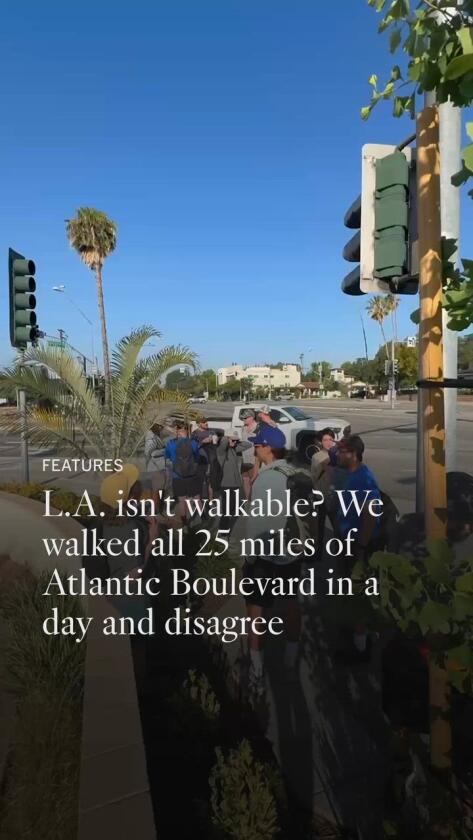
With average gas prices topping $6 in Los Angeles, it can be painful to watch your fuel gauge creep toward “E” during a day out around town. It’s time to stop the car and walk. And where better to do that than in the most walkable city in California?
For more than a decade, West Hollywood has been designated a “Walkers Paradise” by Walk Score, earning a 91 out of 100 on the popular walkability index that looks at distance to amenities, pedestrian friendliness, population density and road metrics. The small city within a city scores two points above the state’s second most walkable city, San Francisco. It’s also a full 22 points above Los Angeles, which has a middling score of 69.
But you don’t need a formula to know that West Hollywood’s well-maintained sidewalks dotted with cafes, shops and historic sites is a great place for walking. Take a stroll around the city and you can find out for yourself.
That’s what I did on a recent Friday afternoon, where I met locals like Kimberly Beauchaine out in the neighborhood — yes — walking. “We really don’t use our car here,” Beauchaine said, pushing her 18-month old in a stroller past the Pacific Design Center on Melrose Avenue. “It’s very walkable and very central.”
Alex Uihlein and Kimberly Beauchaine walk down Melrose Avenue with their 18-month-old on their way to the West Hollywood Aquatic & Recreation Center.
(Scott Strazzante / For The Times)
While West Hollywood is easy to navigate on foot, getting there without a car can be a challenge. The closest Metro stop is along the just-opened D-line on Wilshire Boulevard, a two-mile hike from the West Hollywood border. Fortunately, West Hollywood has ample public parking. I found a spot in a public lot on North San Vincente Boulevard, where I paid $12 for the whole day.
The hardest part about planning a fun day in West Hollywood might be choosing a place to start. According to Walk Score, there are about 339 restaurants, bars and coffee shops in the city and you can walk to an average of 13 of them in 5 minutes.
I asked Eric Parker, director of PR and communications for the city of West Hollywood, why there’s such an abundance of spots to eat and drink in the tiny city. He explained that West Hollywood serves not just residents who live within its borders but also the many folks who live in the residential neighborhood of the Hollywood Hills.
“They need a place to live their lives too,” he said. “Beverly Hills has become a little jam-packed with tourists, so West Hollywood has become the heart of L.A. in many ways.”
My journey began at the Butcher’s Daughter on Melrose Avenue, a cheerful and bright plant-forward cafe a few blocks from where I parked my car. The croissant I ordered was fine, but the atmosphere was lovely — open and airy with a communal wood table inside and green and white bistro chairs outside. Pedestrians of all ages strolled by on the wide flat sidewalks, many with small dogs in tow. Trees along the street offered dappled shade, and there were several other cute restaurants nearby, many with outdoor spaces of their own.
Adisa Aditheparot, left, and Mari Muay enjoy a light lunch at the Butcher’s Daughter on Melrose Avenue after walking over from a nearby Pilates class.
(Scott Strazzante / For The Times)
Moving on from the Butcher’s Daughter I headed one block east to the corner of Melrose and San Vincente to take in the rolling lawns and massive green, red and blue glass buildings of the 14-acre Pacific Design Center, which first opened to the public in 1975 and currently houses nearly 100 showrooms. Across the street on San Vincente, I strolled past the excellent West Hollywood Library, the luxurious rooftop West Hollywood Public Pool, and the green expanse of West Hollywood Park where young children were shrieking on the playground.
The vibe shifted as I continued north toward Santa Monica Boulevard. Here, the city’s identity as a gay haven was in full view. The crosswalks were painted with stripes and triangles celebrating the full range of queer identity and although the many colorful bars were quiet on this early Friday afternoon, it was easy to imagine them filled with revelers after the sun set. On the weekends, a free bus runs down this street every 15 minutes, connecting the Troubadour to Formosa Cafe. The area felt fun and funky, but I was only passing through, determined to get to my next destination.
To be fair, walking in West Hollywood is not ideal for everyone. After having lived in Boston, New York and Santa Monica, Sean Patrick Gallagher points out that the hills are real.
“It’s walkable if you are walking east to west,” said Gallagher, who has lived in the city for two years. “If you have to venture north or south, you are destined to hit inclines that are not for every able body.”
Pedestrian traffic outside Book Soup on Sunset Boulevard.
(Scott Strazzante / For The Times)
At the same time, daily conveniences are generally in easy walking distance for many residents. “Most people in West Hollywood can walk to the gym, the grocery store and the laundromat,” he said. “There are enough things on each street that cater to your needs.”
Parker describes West Hollywood as a place where history is hidden in plain sight. I certainly felt that as I passed onto the quiet, shaded streets of Norma Triangle, a historic neighborhood in West Hollywood where Dorothy Parker and Christopher Isherwood once lived. The sidewalks here are more narrow but well maintained, and the streets are filled with locals walking dogs of all sizes. The homes and apartment buildings, many of which date to the mid-20th century, are beautifully landscaped and clearly tended to with care, but I was searching for one in particular — the Lloyd Wright Home and Studio, designed in 1927 by Frank Lloyd Wright’s eldest son who also worked as an architect.
The house was not a disappointment. It’s not open to the public, so I was only able to see the exterior, but it was worth it. The desert landscaping on the corner lot is on point and the building itself, a two-story space that makes use of the organic textile-block pattern popularized by Lloyd Wright’s father, has a unique interlocking design of stylized Joshua Trees. I loved it. It’s also located in deep shade, which is very welcome on a hot day.
With that done, I made my way up to Sunset Boulevard, which is loud and unshaded and not nearly as pleasant a place to walk as some of West Hollywood’s more green and leafy streets. However, there are some cultural landmarks here that I felt should not be missed along with a surge of oval-eyed delivery robots (seriously, so many). This is the famous Sunset Strip where you’ll find the Roxy Theatre, the Whisky a Go Go and the Viper Room. All very cool, but this writer was most excited about getting to spend some time in Book Soup, the iconic bookstore with a real-life magazine stand outside that celebrated its 50th anniversary last year. Down a narrow alley right next door is the more esoteric Mystery Pier Books, which specializes in first editions and is beloved by celebrities.
Taking a walk down Sunset Boulevard in West Hollywood.
(Scott Strazzante / For The Times)
I had ambitious plans to amble past more spots in West Hollywood. More than one friend suggested I go to Mamie on Sunset and Fairfax for Italian sandwiches (the focaccia is supposed to be amazing). I considered ending my day at the perfect patio at Chateau Marmont on the border of the Hollywood Hills. But reader, I was tired, and walkability is not about exhausting yourself. It’s about enjoying your time car-free. So instead, I headed back toward where I started, walking past the high-end shops of Melrose Place before arriving at Zinque for a simple prosciutto and cornichon sandwich and an Arnold Palmer. At 4 p.m., a waiter came past my table to tell me happy hour had officially begun and asked if I’d like a drink.
There is more than one reason why it makes sense to live in a walkable community.
There is a growing expectation Anderson will leave the City Ground this summer.
United are unwilling to overpay, or get drawn into protracted negotiations.
No deal has been struck between Forest and City and the clubs are far apart on their valuation for the 23-year-old, meaning the situation could still change.
There is a sense at Forest that if there is a big sale this summer it will be Anderson, and a fine World Cup with England would put them in a stronger bargaining position.
Following Sunday’s 1-1 draw with Bournemouth, Forest manager Vitor Pereira said Anderson and Morgan Gibbs-White deserve “the top of the world”.
He would prefer to keep both players but it is Anderson who is the more likely to leave currently, especially with no European football at the City Ground next season after they finished 16th in the Premier League.
“I believe if we want to compete for different goals, we need to keep the best players,” said Pereira.
“If not, if you change every season, it is difficult to be consistent and difficult to build something stronger.
“We cannot control the market, of course, but I think we are aligned; what I think and what the club thinks is to try to keep most of them and to try to control the market.”
Anderson, who won the 2025 European U21 Championship with England last summer, joined Forest from Newcastle in 2024 for £35m and has played 92 times, scoring six goals.
Sunday’s game against Bournemouth was his 50th appearance of the season and he was given a standing ovation when withdrawn in the second half.
THINKING of heading on a city break but struggling to decide where to spend your hard-earned holiday cash?
Sarajevo in Bosnia and Herzegovina will get you the most bang for your buck in 2026, new research has revealed.
Sign up for the Travel newsletter
Thank you!
Sarajevo came out on top as one of the cheapest destinationsCredit: AlamyBucharest – home to Therme – came in secondCredit: Alamy
The Post Office Travel Money’s City Cost Barometer has unveiled the most budget-friendly destinations to visit right now – along with the ones that will make an eye-watering dent in your wallet.
Overall, Sarajevo pipped 49 other spots to the post and has been crowned the most affordable city this year with visitors able to bag free entry to its top heritage attraction and art gallery.
While this city may not have the most affordable accommodation of all the destinations analysed (£157 for two nights in a 3* hotel), basic items like a cup of coffee and a sightseeing city bus tour were shown to be very cheap, costing around £1.72 and £2.46 respectively.
To calculate the most affordable destinations, the Post Office looked at the cost of 12 typical city break items, including tickets to attractions, a bottle of beer/lager, a bottle of Coca-Cola/Pepsi, a glass of wine, a three-course evening meal for two, return airport bus or train transfer and a 48-hour travel card.
It found that a two-night break in Sarajevo will set the average person back around £248.29 in total (around £10 less than the second cheapest destination, Bucharest in Romania).
Accommodation was shown to be more budget-friendly here than in Sarajevo, setting the average holidaymaker back £148 for two nights in a 3* hotel. This still wasn’t as cheap as accommodation in Tirana, though.
At just £128 for the weekend on average, this Albanian hot spot was shown to have the most affordable hotels of all 50 destinations in the barometer.
Overall, Tirana came in third place in the rankings with a total cost of £262.85 for the whole weekend, closely followed by Belgrade in Serbia at £265.13 on average.
While the cost of many things, including coffee, beer and food, were shown to be pricier in Belgrade than Sarajevo, travelling around the city looks to be much cheaper, with buses, trams, trolleybuses, and city trains all entirely free to use – great for those who are keen to go sightseeing.
If you’d rather spend your time taste-testing the local booze, however, you should set your sights on Trenčín in Slovakia instead, which was ranked fourth cheapest spot for a city break, overall.
Top 10 bargain city breaks:
1 Sarajevo, Bosnia and Herzegovina £248.29
2 Bucharest, Romania £258.07
3 Tirana, Albania £252.85
4 Belgrade, Serbia £265.13
5 Trencin, Slovakia £271.64
6 Riga, Latvia £278.19
7 Lille, France £289.33
8 Vilnius, Lithuania £289.39
9 Strasbourg, France £319.13
10 Podgorica, Montenegro £332.45
According to the Post Office Travel Money, a bottle of beer will set you back just £1.49 on average here, less than it would in any other destination, including top budget city Sarajevo, where beer cost £2.46 on average.
It’s also the cheapest spot for sinking wine, at just £3.52 on average per glass.
You can soak up all that booze for little cost, too, with a three-course meal for two with (more) wine costing just £47.64 on average.
Comparatively, a similar three-course dinner with wine in Sarajevo would cost you £62.86.
In sixth place comes Riga in Latvia, followed by the French city of Lille, which may prove popular for holidaymakers worried about the jet fuel crisis as it can be reached by train.
In total, there are ten cities in the charts that can be accessed from the UK by train or ferry, including the ever-popular cities of Paris and Amsterdam, which sit at the pricey end of the charts in 40th and 44th place respectively.
Lisbon was one of the cheapest cities for beerCredit: Alamy
Both were still cheaper than Oslo in Norway, however, which was shown to be the most expensive of all with a total barometer cost of £733.99 – almost triple the amount of a break in the cheapest spot, Sarajevo.
There are still some good bargains to be had for those that do their research, though.
Post Office Travel Money’s Laura Plunkett said: “Despite concerns about rising prices abroad, there are many European cities offering great value for money.
“Sterling has remained fairly strong but, in these challenging times, it will pay holidaymakers to do their homework before booking to see where their pounds are likely to stretch furthest, even for short breaks.”
Earlier on Monday, thousands of City fans lined the streets of Manchester to bid a final farewell to the departing Guardiola.
This season’s successful men’s, women’s and academy teams were driven on buses to Etihad Stadium, where they were greeted by a waiting crowd, before the entourage made its way to Co-Op Live for the ‘after party’.
All three teams celebrated their trophy victories on stage, with City women’s striker Khadija Shaw making the shock announcement that she has signed a new four-year contract to remain at the club.
Guardiola’s three children, as well as former captain Fernandinho, ex-sporting director Txiki Begiristain and goalkeeper Ederson – who left last summer – helped bring out all 20 trophies won under Guardiola.
Surprise appearances by current Bayern Munich boss Kompany and midfielder Jack Grealish, who spent a season-long loan spell at Everton, were loudly cheered by those in attendance.
Guardiola said goodbye for the final time in an interview with Oasis star Noel Gallagher.
“First of all, thank you so much for coming tonight to say bye,” said Guardiola.
“I feel tonight that really shows the connection this club has. [City chairman] Khaldoon Al Mubarak and all the people and all the City fans that were connected from the first minute.
“Thank you so much, I don’t have enough gratitude. Always, for the rest of my life, I will have you in my heart.”
Tributes were also paid to captain Bernardo Silva and defender John Stones, who will also be leaving the club this summer upon the expiry of their contracts.
Striker Erling Haaland said on stage: “It has been a pleasure to play with Bernardo and John – and of course Pep.
“We won a lot of trophies and I was happy to play with Bernardo and John because they are amazing footballers but even better people deep down.
“It has been an amazing journey, but we need to keep pushing and fighting even without them.”
The endlessly exploitable Spider-Man is back in “Spider-Noir,” a retro tale set in a recognizable New York in an inconsistent 1933 (to judge by a preponderance of cultural referents). There is a comic-book precedent for this version of the character, called simply the Spider, though research tells me that, costume and superpowers aside, he is different in nearly every respect. I don’t suppose that will be an issue for most of you.
Shot in “authentic” black and white, the eight-episode series, which premieres Monday on MGM+ channel and streams Wednesday on Prime Video, is something of a stunt, but one that offers a reasonable, (imperfectly) period-appropriate approach to the material. (Stylistically, it belongs to a later decade.) An available colorized version, which seems primarily a sop to younger viewers who refuse to watch anything in black and white, works less well, flattening and softening the image, making the special effects look less special, the expressionist photography less expressive and ordinary scenes more artificial. You can probably tell which I’d choose, but you do you.
Nicolas Cage, in his first live-action television role, plays Ben Reilly, a down-at-the-heels private eye, spiking his morning coffee with whiskey helpfully provided by his knowing secretary, Janet (Karen Rodriguez), and barely scraping by on the occasional divorce case. Five years earlier, as the Spider, he was a super-powered guardian of the people; but he gave it up after the love of his life was murdered on the Spider’s account. In this variation, she’s the one who told him that with great power comes great responsibility, that well-worn Marvel homily, quoted in this world as if it were the work of Abraham Lincoln and not Stan Lee. But Reilly, who calls himself a coward and claims to be no hero, regards his mutant abilities as “a part of me I wish never existed. With no power, there’s no responsibility.”
Naturally, in the Spider’s absence, things have gone to pot in Gotham. “The city’s a mess,” says Reilly’s best and only friend, unemployed reporter Joe “Robbie” Robertson (national treasure Lamorne Morris, keeping it real, relatively speaking). “The people could use a hero.”
“Well, I hope they find someone,” says Ben.
Robbie Robertson (Lamorne Morris) is a journalist and Ben Reilly’s best friend.
(Aaron Epstein/Prime)
Nevertheless, you will not be surprised that, much against his will, Reilly will fall into a web, tee-hee, of intrigue; involving the city’s bootlegging crime boss, Silvermane (Brendan Gleeson, serving a full Irish breakfast), whose superpower is that he has very nice hair; Silvermane’s sort-of mistress, femme fatale nightclub singer Cat Hardy (Li Jun Li), a bird in a gilded cage; and Cat’s bodyguard, Flint (Jack Huston), who has gone missing. Nor will it shock you to learn that other super-powered entities will turn up, to give our hero — who soon enough will be swinging through town, somehow never losing the fedora perched atop his masked head — someone his own size to pick on him.
To coin a phrase, some are born super-powered, some become super-powered and some have superpowers thrust upon them, and in every case this comes with a serving of tragedy and trauma, for heroes and villains alike. If there’s a theme to “Spider-Noir,” beyond “make another Spider-Man show,” it’s this, and there’s a spine of sadness that runs through the series, its best and most depressing feature (and, taking “noir” at is word, fitting to the genre).
The photography and production design, achieved through whatever combination of backlot shoots, dressed locations, digital environments and black magic, work better and worse (though never bad) from shot to shot, but Alfred Hitchcock used background projections and model trains, and it’s nice to see Manhattan before those pencil-thin supertowers began polluting the skyline. (It’s the city as King Kong first knew it.)
The pacing can drag at times. The music goes everywhere but the represented period and characters quote lines from movies yet to be released. The writing and the acting boldly flirt with cliche and caricature, which, as the show is about 100% pastiche, drawn from films more than three-quarters of a century old, could scarcely be avoided and isn’t really a problem. (In a way, it’s the point.) You may spot a scene pinched from Orson Welles’ “The Lady From Shanghai,” narrative echoes of “Casablanca,” a line playing off James Cagney’s final words in “White Heat,” just off the top of my head.) But the overall what and why of the story is clever and the conclusion satisfying.
Cage, who voiced a different version of the “Spider-Noir” character in the animated “Spider-Man: Into the Spider-Verse,” is a good choice for the weary gumshoe. (The series is about 75% detective story, 25% superhero) Metafictionally, he’ll bust out an Edward G. Robinson imitation, mouth Cagney dialogue sitting alone at the movies. But the main model is Humphrey Bogart, whose looks Cage’s recall more than a little; Bogart played Sam Spade and Philip Marlowe in the films most associated with those characters, whose mordant humor creator-writer Oren Uziel seeks to replicate here, with fair success. One can forget that Cage, who finds a middle way between doing a bit and playing a person, is a good comic actor, and not merely a weirdo.
OUR Spotlight On column gives you the lowdown on what to see and do in some of the most popular holiday destinations – as well as some unsung areas.
This week, we’re taking a look at Venice, made up of a group of islands famous for its winding maze of beautiful canals.
Sign up for the Travel newsletter
Thank you!
Venice is world-famous but there is a way to do it on a budgetCredit: Alamy
Travel Reporter Cyann Fielding raved about visiting off-season.
She said: “I visited Venice after the peak season had finished in October – the weather was mild but more enjoyable and all the crowds had disappeared.
“Having read a lot about the city before I visited, I knew to not get a gondola as it would cost me a small fortune.
“But still wanting to see Venice from its waterway, I grabbed a €25 (£21.59) water bus day pass where I hopped on and off boats around the city and got to see many of the amazing views that you see on a gondola (just minus the narrow waterways).
“Eating out in the city can be expensive, but there are plenty of supermarkets around, which are super affordable.
“My family and I managed to pick up a bottle of wine, some meats and cheeses for around €40 (£34.55) total and heading to a pontoon to eat – a much prettier spot than most restaurants.
“The city is also full of quirky Airbnbs which I would recommend over hotels as they often boast original Venetian architectural features.
“And definitely don’t miss out visiting Murano and Burano – two islands in the Venetian Lagoon with the former known for its historic glass-blowing factories and the latter known for picturesque multicoloured houses.”
MUST-SEE/DO
Ride a gondola along the waterways. A 30-minute trip costs from €80 (£69.10) – you can pay more to be serenaded by a singer.
Or try this money-saving tip that won’t sink your budget: to get the experience for just €2 (£1.73) per person, hop on board a traghetto, a smaller taxi gondola that will take you from one side of the Grand Canal to the other.
Venice is much quieter if you visit outside of summerCredit: Alamy
HIDDEN GEM
Venice is made up of around 118 islands, and the main city in the lagoon is really all about tourism.
Many of the locals live and work on the surrounding islands, including Giudecca, just south of the city.
It’s one stop away by vaporetto (water taxi), which has a calmer vibe, but will still give you a fascinating insight into the traditional Venetian way of life.
Here, you’ll find craftsmen making souvenirs in workshops, people creating traditional Venetian masks and glass, or jewellery from paper and growing vegetables in their gardens – everything you’ll buy in the main city.
BEST VIEW
The most obvious is the 98.6metre-tall St Mark’s Campanile (bell tower) in the famous St Mark’s Square.
The tallest structure in Venice, it was originally a watchtower to look out for ships. It costs €15 (£12.96) to enter and you’ll be pleased to know there’s a lift, which takes just 30 seconds to reach the top.
Shopping for famous Venetian masks is a mustCredit: Alamy
RATED RESTAURANT
The Hotel Bauer has a rooftop restaurant, De Pisis, with views over the Grand Canal, while the traditional Ristorante Do Forni (where Charles and Diana dined in 1985) is famous for its seafood dishes and dining room modelled on the Orient Express.
At Trattoria Al Gatto Nero, lagoon-fresh seafood and homemade pasta is made quite literally from scratch – so if you want the lasagne, be prepared to wait two hours.
BEST BAR
In 1948, founder Giuseppe Cipriani Senior invented the Bellini cocktail (white-peach puree and Prosecco) in Harry’s Bar, by the Grand Canal. One drink will set you back €22 (£19) – if you can get in
The Cantina do Mori is the oldest wine bar in Venice, founded in the 15th century, and probably one of the smallest.
It’s like stepping back in time as you enjoy local wines and cicchetti – small Venetian tapas.
Costing just a few Euros for wine and food, it’s a charming bargain. They’re open from 8am, but don’t expect coffee – it’s just wine.
HOTEL PICK
Escape the inflated prices by staying further down the coast in the quiet town of Jesolo, at the five-star Falkensteiner Hotel & Spa – ideal for families and couples with fantastic food, pools and playgrounds.
The items studied were two nights’ three-star weekend accommodation, a three-course meal for two with a bottle of house wine, a cup of coffee, a bottle of beer and Coca Cola, a glass of wine, return airport transfers, a 48-hour travel card, a sightseeing bus tour and tickets to top heritage attraction, top museum and top art gallery
Sarajevo has been crowned Europe’s cheapest city(Image: Getty Images)
An often-overlooked city with a rich history and breathtaking natural scenery is Europe’s best-value city for a short break.
Despite having a population smaller than Reading and sitting hundreds of miles inland from the coast, Sarajevo is a destination that packs a serious cultural punch, while being perfect for a summer holiday.
If for no other reason than for how cheap it is.
The capital of Bosnia and Herzegovina has topped Post Office Money’s City Cost Barometer 2026, ranking it the cheapest of the 50 European destinations included.
The items studied were two nights’ three-star weekend accommodation, a three-course meal for two with a bottle of house wine, a cup of coffee, a bottle of beer and Coca Cola, a glass of wine, return airport transfers, a 48-hour travel card, a sightseeing bus tour and tickets to top heritage attraction, top museum and top art gallery. Sarajevo’s total basket price was £248 – less than a third that of last place, Oslo.
According to local tour guide Nermin Numic, life in Sarajevo is cheap and easy. Filling up on the city’s most famous local dishes, such as grilled minced meat cevapi, or the slow-cooked stew Bosanski Lonac, is easily achievable for £5. A fancier dinner and drink will set you back £15 a person.
In the high season, a simple room for two can be found for under £50, while higher-end hotels and Airbnbs charge around £150.
Nermin spent time out of the country during the Kosovo War and Covid, experiences which helped him see his home through different eyes.
“Sometimes it takes time being separated to appreciate things. It is amazing for me what this city and country has. So much diversity and these amazing mountains that I took for granted.”
Known as the Jerusalem of Europe, Sarajevo is a place where cultures, regions, and religions intersect. The Ottoman influence can be felt in the narrow winding alleys, bustling copper-smithing bazaars and traditional timber-framed houses. It butts up against the Austro-Hungarian influence, felt in the wide European avenues, grand neoclassical facades, and opulent public buildings, reflecting the city’s rapid modernization in the late 19th and early 20th centuries.
“It’s diverse in so many ways. It is called Little Jerusalem, it has churches, mosques, and synagogues next to each other, and it has for centuries. There are Ottoman, Austro-Hungarian, and communist social blocks part of the town,” Nermin explained.
The city sits between four mountains that hosted the 1984 Winter Olympics, meaning skiing opportunities in the colder months – and hiking trails in the summer – are within easy reach.
While Nermin insists that two days and nights in the city is the absolute minimum required, any flying visit should take in the disused bobsleigh track. “It is now a canvas for local artists. You can walk down the track from the hills into the city,” he said.
The Old Town is another must. “It looks very exotic, but feels familiar. It’s a meeting of cultures. Look east, and you’re in Turkey. Look west, and it feels Hungarian.”
Suitably for a destination known for closing divides and bringing cultures together, Sarajevo is a place of bridges. Thirteen of them to be precise. The best-known is Latin Bridge, where Archduke Franz Ferdinand was assassinated in an event that triggered the WWI. The Mostar Bridge is on the cover of almost every Bosnian travel guide, arching dramatically as it does over the emerald green Neretva River.
Unlike Bosnia and Herzegovina’s second city, Mostar, Sarajevo is rarely crowded. The one exception is in August, when the diaspora returns and the Capital’s film festival injects a real buzz into the place.
Ryanair flies from London Stansted to Sarajevo, while Wizz Air takes off from Luton. Return fares this summer are available for around £60.
All of the five cheapest cities in the Post Office Money rankings are in Eastern Europe. Bucharest (£258, Romania), Tirana (£263, Albania), Belgrade (£265, Serbia) and Trenĉin (£272, Slovakia) complete the top five. All five now offer direct flights from the UK.
Outgoing Manchester City manager Pep Guardiola said the memories and relationships built during his decade at the club mattered more than the 20 trophies he won, as he reflected emotionally on his unforgettable spell at City following his final match in charge.
SAN FRANCISCO — There are no immigrants waiting for rulings anymore at San Francisco’s main immigration court, no lawyers making arguments.
The court, which had 21 judges when President Trump was sworn in last year, had only two left when it closed May 1. The rest had been fired, retired or resigned amid a White House purge of federal immigration judges.
The closing is one more reflection of the turmoil that has upended the immigration court system as the administration looks for ways to churn through its massive backlog of 3.8 million asylum cases and deport as many people as possible.
Asylum denial rates have soared as the administration has fired almost 100 judges deemed to be too liberal, and approved using hundreds of military lawyers to replace them. Immigrants have been arrested when they arrive at courthouses or government offices for scheduled appearances.
But amid the nationwide upheaval, San Francisco is the first major city to be left without a primary immigration court, leaving chaos and dysfunction in a region long known for its friendliness to asylum seekers. The two remaining judges will work from another federal building in the city but will be part of an immigration court across the bay.
That reputation, court insiders say, might have led to its downfall.
“It was a vibrant legal scene and so I think if you were looking to target a court you would have to look at what San Francisco stands for,” said Jeremiah Johnson, an immigration judge in the city until he was fired in November. He is now executive vice president of the National Assn. of Immigration Judges.
Most of the court’s 117,000 immigration cases have been moved to a courthouse in Concord, a city about 30 miles away that opened two years ago to help with San Francisco’s backlog of cases. But turmoil has also reached that city. A courthouse that had 11 judges at the start of 2025 is down to five after a series of firings. It had a caseload of 60,000 cases even before the San Francisco cases were shifted over.
San Francisco’s immigration court, which had the third-highest number of asylum cases in the nation, was long considered one of the most favorable to people seeking asylum. From 2019 to 2024, almost 75% of petitioners received some form of relief, compared with 43% nationwide, according to data compiled by the Transactional Records Access Clearinghouse, a nonprofit data research center based at Syracuse University.
That’s partly because San Francisco, with its vast network of pro-immigrant organizations and pro bono or low-cost legal services, had one of the country’s highest rates of legal representation for immigrants.
The Executive Office of Immigration Review, the Department of Justice branch that oversees immigration courts, announced in March that it would close the San Francisco courthouse in 2027 as a cost-saving measure and move its cases to Concord. But the end came early after nearly all the San Francisco judges left or were fired. The Executive Office provided no detailed explanation for the changes, saying in a statement only that it had decided not to renew its lease for the court, and doesn’t comment on personnel matters.
Tight security in Concord courts
Security is tight at the Concord courthouse, perhaps because of the new influx of cases. Armed security guards ask every person if they are carrying weapons or explosives, and they watch as each person turns off their cellphone. Even coffee is not allowed in. Only water is acceptable, and then only if it’s in a transparent bottle.
Judah Lakin, an immigration attorney based in Oakland who also teaches at UC Berkeley School of Law, said the closure of the San Francisco court has made cases more time-consuming since it’s harder for his clients, who often travel from hours away, to reach Concord on public transportation.
One recent 10-minute hearing in Concord took him more than two hours of travel, he said.
But beyond logistics, Lakin said the chaos in immigration courts under the Trump administration has created a fraught court atmosphere. Mass firings have led to last-minute hearing cancellations, cases have been reset with little notice, and clients are often left in prolonged legal limbo, leaving them vulnerable to deportation.
One of his clients, he said, was provisionally granted asylum by a judge, who was then fired before signing the decision. The case was transferred to a second judge, who was also fired. Now on their third judge, his client is still waiting.
“The ground is constantly shifting underneath your feet, whether it’s judges being fired and hearings getting canceled, whether it’s your clients getting arrested, whether it’s getting denials on things that used to be standard and routine,” Lakin said.
“I think that’s on purpose. That’s by design. It’s part of the strategy,” he added.
‘Heartbreaking’
San Francisco’s immigration court was one of the first in the nation to hire judges with non-prosecutorial backgrounds, with many having previous experience working with immigrants at nonprofits or defending them in court.
To see the court close is “heartbreaking,” said Dana Leigh Marks, a former San Francisco immigration judge who retired in 2021 after 35 years on the bench and who was among the first judges in the nation to be hired from private practice.
She sees the Trump administration’s decision to close the largest immigration court in Northern California as part of an effort to undermine due process and eventually dismantle the path to asylum.
“It’s all a part of big ways and little ways that the Trump administration is trying to get noncitizens out of the country,” she said.
Johnson, the fired San Francisco judge, was appointed during the first Trump administration. He believes he was targeted because he granted asylum in 89% of the cases he heard.
“You don’t fire judges if you disagree with the way they’re handling a case; that’s not how courts work. If you disagree, you appeal that decision,” he said.
Johnson, who is the executive vice president of the National Assn. of Immigration Judges, defended his judicial record, pointing out that over eight years, only about 10 of his cases were appealed by the Department of Homeland Security, and very few were sent back for further hearings by the Board of Immigration Appeals.
Unlike federal courts, where there are strict rules of procedure and judges have lifetime tenure, the Justice Department runs immigration courts, and the attorney general can fire the judges with fewer constraints.
There were 754 immigration judges across the country at the start of Trump’s second term. Now, there are about 600, including some temporary judges, according to data collected by the judges’ union. Widespread courthouse arrests of immigrants have caused hundreds of people not to even show up for hearings, leading to deportation orders in absentia.
Nidaa Pervaiz came to the Concord court on a recent day to represent a client from Nepal. She prefers the new courthouse in some ways, since it’s closer to her home.
But, she said, she and her clients are already feeling the impact of the changes. Fewer judges leads to fewer hearings. That means more delays for her clients, whose paperwork can expire even before they can appear before a judge.
“Their whole lives are at stake, and they are coming to make a plea for their future” she said.
A mile from the Manhattan jail where convicted sex offender Jeffrey Epstein was found dead in 2019, an unassuming Tribeca gallery at 101 Reade Street has been transformed into a physical archive of the disgraced financier’s many cases.
More than 3.5 million pages of law enforcement documents published by the United States Department of Justice have been printed, bound and stacked across 3,437 volumes to line the walls of a room from floor to ceiling.
The exhibition, titled “The Donald J Trump and Jeffrey Epstein Memorial Reading Room”, was organised by the Institute for Primary Facts, a nonprofit that says it focuses on transparency and anti-corruption initiatives.
Epstein was arrested on sex trafficking charges in July 2017 before hanging himself in his New York jail cell a month later, denying victims a chance at justice. The “reading room” is an attempt to shed light on the many cases connected to Epstein that never went to trial.
The shelves hold documents released under the Epstein Files Transparency Act, alongside timelines, handwritten visitor notes, and a memorial space dedicated to survivors and victims.
Since opening two weeks ago, the gallery has drawn a steady stream of visitors, including survivors of a string of offences linked to Epstein.
Lara Blume McGee, who was only 17 when she was abused by Epstein, visited the reading room last week.
“I found something brutally human in the Trump-Epstein reading room,” Blume McGee told Al Jazeera. “Proof that our lives mattered enough to be gathered, cataloged, and finally seen.”
She described entering the room as walking into a “paper city”, with three and a half million pages on display, a sight that hit her “like a physical blow”. What she remembers most vividly is the silence.
“The silence was thick with memory,” she said. “Row after row, each bound volume a life, a name, a day that should never have happened if the US government had acted when he was reported to the FBI in 1996.”
The overwhelming scale of the archive is intentional. Organisers say the physicality of the documents forces visitors to confront not only the extent of Epstein’s crimes, but also the number of lives affected by them.
David Garrett, a co-founder of the exhibition, said the project was built around survivors from the outset.
“We are centred around the victims and survivors more than anything,” Garrett said. “The biggest thing is transparency and accountability.”
Garrett described the exhibition as part of a broader effort to create “real-life pop-up museums” aimed at generating public pressure around corruption and institutional failure.
“Our goal is how can we drive public outrage in order to put pressure on Congress and the Department of Justice to get full and real transparency and hopefully eventually accountability,” he said.
The process of assembling the archive was itself chaotic. Garrett said organisers downloaded the files from the Department of Justice in March, believing they had received properly redacted documents. Only after printing the collection did they discover that many survivors’ names remained visible in the files.
“What seems to have happened is the Department of Justice modified its search function instead of actually redacting the names,” Garrett said. “The names of survivors were left unredacted while the names of witnesses and co-conspirators were hidden. They brazenly broke the law.”
Finding a venue also proved difficult. Garrett said several locations backed out after initially agreeing to host the exhibit, fearing controversy or retaliation. The Tribeca gallery ultimately became the fifth venue that organisers approached.
Despite these challenges, survivors and advocates quickly embraced the project.
On Tuesday, the gallery became the site of a 24-hour livestream reading of the files led by survivors, advocates and supporters.
Dani Bensky, an Epstein survivor, opened the broadcast Monday afternoon, standing at a podium inside the dimly lit gallery with one of the thick white volumes in her hands.
Her reading marked the beginning of a continuous public recitation of excerpts from the files – an attempt, organisers said, to ensure the documents are not quietly buried again.
Throughout the gallery, visitors have left flowers, handwritten notes, and messages of grief and anger.
Garrett recalled one woman who spent hours walking silently through the space before telling organisers she was herself a survivor of sexual abuse.
“She said this helped her realise that she felt seen,” Garrett said. “That meant a lot to us.”
For Blume McGee, that feeling of visibility carries both relief and frustration.
“For years we were told to be quiet, to accept settlements, to move on,” she told Al Jazeera. “Seeing our truths preserved in a public archive felt like a long-overdue acknowledgment of our pain, our abuse and our reality.”
But she warned that documentation alone is not justice.
“This exhibition gives real hope because the record is now undeniable,” Blume McGee said. “Finally, there is action: documentation, visibility, proof. But those same files map systemic failure — how many doors stayed shut, how many people escaped scrutiny.”
“Visibility without consequence only prolongs the wound,” she added. “We need both: the files on the table and the government to act — investigate, prosecute, reform — so that being ‘finally seen’ becomes finally safe.”
Around 20 per cent of locals even speak Algherese, which is a dialect of the Catalan language and officially recognised by the Italian and regional governments.
Visitors will see that street signs throughout the old town are written in both Italian and Catalan too.
When it comes to looks, the two cities don’t strike up too much of a resemblance, but both have cobbled streets and golden-coloured buildings.
In Alghero you’re likely to see more of this in its Old Town.
The city has direct flights from the UK for as little as £18Credit: Getty
This is where you’ll find its cafes and restaurants where you can pick up a glass of wine from €4 (£3.48) (or you can buy a bottle at the supermarket from €5 (£4.35)).
When it comes to what to do, most head towards the coastline and visit the city’s beautiful beaches.
One of the most popular is Spiaggia di Maria Pia which has white sand, and is backed by pine trees beach bars along the shoreline.
One visitor said: “The sea is completely Vicks blue – it’s absolutely amazing that there is such a lovely beach within walking distance of the cozy Alghero town.”
Barcelona and Alghero share the same honey-coloured buildingsCredit: Getty
Homicides in Los Angeles are down to levels not seen since the 1960s. Neighborhoods once awash in gang violence now sometimes go weeks, even months, without a shooting. And the follow-home robberies and street takeovers that captured the public’s attention in recent years have largely subsided.
By many measures, the city is safer than it has been in generations — and yet voters following L.A.’s hotly contested mayoral race might think the opposite.
The challengers to Mayor Karen Bass have zeroed in on homelessness and public drug use to argue she hasn’t delivered on public safety, while also criticizing how the Police Department has operated and been funded during her tenure.
Mike Bonin, a former L.A. City Council member, said the fact that Spencer Pratt — the former reality TV star who has been attacking Bass from the right — has gained so much traction in the race is proof of how Bass and other candidates to the left have failed to change “prevailing narratives that the city is unsafe.”
Mayoral candidate Spencer Pratt hosts a campaign block party on 10th Avenue in Los Angeles on May 20, 2026.
(Robert Gauthier / Los Angeles Times)
Pratt has been particularly active on social media, where he has shared artificial-intelligence videos created by fans depicting him as various superheroes coming to the rescue of a city that, under Democratic rule, has turned into a dystopian hellscape.
In a March 26 post on Substack, Pratt railed against the thousands of drug-related calls that emergency officials respond to every month. He has said that if elected mayor, he would order the police and fire chiefs and the county health director to “treat every encampment as a grave-disability zone.”
“No new laws needed,” he wrote. “No endless task forces.”
Flanking Bass on the left is Nithya Raman, a progressive City Council member who was once the mayor’s political ally.
Raman has argued that Bass has thrown too much money at the LAPD, with raises for police officers coming at the expense of other basic services such as park maintenance and street paving. Raman said the LAPD pay increases have “bankrupted” the city, depriving other services of much-needed funding. In campaign ads, Raman has cast herself as a more sensible alternative to Bass. Raman has said she would work to reduce traffic deaths and prioritize safety on the city’s buses and trains.
When she first ran for office in 2020, Raman called for defunding the police, saying the Los Angeles Police Department should be a “much smaller, specialized armed force.” Since then, however, she has voted for some budgets that increased spending on law enforcement.
In response to questions from The Times, Raman said she would work to find ways to overhaul public safety.
“I’ll propose budgets that expand unarmed response, work with LAPD to improve 911 response to more quickly answer calls for help that don’t require armed officers, and will appoint leadership at the Police Commission who will actively partner with the City Council to work on reform,” she said.
Representatives for Pratt and Bass didn’t respond to requests for interviews with the candidates.
Bonin said Bass — who supported various police reform measures while Congress — has shocked some of her supporters with how “aggressively pro-police she has been.”
When she ran for mayor in 2022, Bass vowed to retool the recruitment and hiring process in order to restore LAPD staffing to 9,500 officers. That hasn’t happened. The number of sworn officers recently fell below 8,600, despite Bass striking a deal with the police union to offer higher starting salaries and new retention bonuses.
Mayor Karen Bass takes part in a candidate forum on May 5, 2026, in Sherman Oaks.
(Eric Thayer / Los Angeles Times)
On Thursday, the City Council approved a $15-billion budget for the upcoming fiscal year, which included funds to hire 510 new officers — just enough to offset turnover and maintain current staffing levels.
Raman has said the LAPD should not shrink any further because there aren’t enough officers to respond to 911 calls “in a timely fashion.”
Samantha Stevens, a Los Angeles political consultant and former legislative staffer, said people seem willing to back Pratt because he acknowledges that their sense of safety has been shaken — even if he has offered few concrete details about how to tackle crime beyond cracking down on homelessness.
Pratt’s critics say that his plan relies on funneling homeless people into a shelter system that doesn’t have the capacity to handle them all. Others have noted that the aggressive tactics he has proposed would probably face legal challenges.
L.A. City Councilmember Nithya Raman, who is running for mayor, makes a campaign stop at the site of a home burned in the Palisades fire.
(Eric Thayer / Los Angeles Times)
“He’s kind of a case study in somebody who has a lot of opinions but has no idea of how the city is run,” Stevens said.
Fernando Guerra, a political science professor at Loyola Marymount University, said Pratt seems to have tapped into a deep well of discontent among Angelenos who believe that crime and homeless have spiraled out of control. The challenge for Bass, he added, is that although the numbers suggest that crime has decreased, many people associate the sight of encampments spilling onto public sidewalks as “a breakdown” that indicates the city is becoming less safe.
“You want to go back to the days of Daryl Gates, you’ve got Pratt,” he said, referencing the former LAPD chief whose controversial police sweeps in the late 1980s yielded thousands of arrests while alienating large segments of South L.A.
“If you want more of the same from the past 20 years, you’ve got Bass,” Guerra added. “And if you want something new, then you’ve got Raman, but she has to explain what exactly she wants to do.”
Although Pratt and Raman appear to be the strongest challengers to Bass, several long-shot candidates have also made public safety a key issue in their campaigns. Some have gone after Bass for her support of LAPD Chief Jim McDonnell. Hired by Bass in 2024, McDonnell has touted the impressive drop in crime under his leadership, but also faced criticism over an uptick in shootings by police and aggressive crowd control tactics during protests against the Trump administration’s immigration policies.
Police Chief Jim McDonnell attends a news conference at LAPD headquarters on May 21, 2026.
(Genaro Molina / Los Angeles Times)
Rae Huang, a minister and housing rights advocate, said if elected mayor she would immediately replace McDonnell with someone who has the “ability to really reimagine what public safety really looks like.”
“I’m the only one with the guts to say that out loud,” Huang told The Times during a recent campaign stop at a bookstore in the West Adams neighborhood.
In social media posts and interviews, Huang has frequently referred to the LAPD as “one of the biggest legal gangs in the world,” and said she would work on diverting money from the police budget to scale up programs that have shown promise in sending unarmed specialists to deal with emergencies that involve people experiencing mental health crises.
The city is already running two such pilot programs, but under Bass they have remained underfunded, Huang said. Last week, the City Council signed off on expanding one of the programs.
Huang said she would also invest more heavily in addressing the city’s lack of affordable housing, which she said is an underlying cause of crime and homelessness.
The Los Angeles Police Protective League has poured hundreds of thousands of dollars into attack ads against Huang and Raman.
Adam Miller, a tech entrepreneur, has tried to strike a balance in his mayoral campaign, advocating for changes while acknowledging that many people still feel unsafe despite the historic drop in violent crime.
He criticized a recent vote by the L.A. City Council to limit so-called pretextual stops, in which officers pull people over for minor traffic infractions in order to investigate more serious offenses. The stops have been blamed for enabling racial discrimination.
Miller said that “constraining the Police Department is the opposite of what we should be doing.” He called for “leveraging” AI and modernizing the department’s archaic computer systems, which he said could allow the LAPD to catch up to other agencies that have embraced new technology.
Miller told The Times that he recently went on a ride-along with officers from the Rampart Division, which he said was eye-opening.
“At the highest level I think Angelenos don’t feel safe anymore,” he said. “They don’t feel safe in their neighborhoods, but more recently they don’t feel safe even in their own homes.”
Statistically speaking, the city might be safer than it’s been in decades, he said — but that doesn’t necessarily matter to voters.
“I don’t think it’s just perception,” he said. “I think it’s reality that crime has spread.”