city hall

AI has invaded the L.A. mayor’s race. Some fear it’s just the beginning

The Hollywood sign is ablaze as Spencer Pratt, the reality TV star now running for mayor of Los Angeles, suits up as Batman, enters City Hall and leads the people to overthrow a cabal of corrupt, out-of-touch progressives intent on destroying the city.

Then he is Luke Skywalker. Dressed in a Jedi robe, he swoops through the city on an Imperial speeder bike, as California Gov. Gavin Newsom (Emperor Palpatine) rebukes incumbent Mayor Karen Bass (Darth Vader) for not burning the city down to the ground in her first term.

“Make sure you finish the job in your second,” Newsom tells Bass with a tilt of the head and a smirk.

“The only thing that can stop us is someone telling the truth,” Bass replies. “As long as they don’t have any hope, the city’s ours.”

Pratt’s fan-generated AI election campaign videos have been praised and mocked, but heavily shared. And some see them as a harbinger of how artificial intelligence could reshape political messaging across the country.

His supporters are far from the first to create AI-generated ads. But political experts say it’s remarkable the degree to which they have used new technology to churn out a stream of outlandish, hyper-cinematic memes, creating buzz around his campaign and his message.

Some warn, however, that as the technology becomes more sophisticated, it will become harder for many people to distinguish between AI and real videos.

“When you’re creating content that is not based in reality, and then platforms are amplifying it in order to attract more eyeballs, you are putting a burden on the public for figuring out what is real and what is factual, and what is fake and misleading,” said Mark Jablonowski, the chief executive of DSPolitical, a progressive advertising firm.

Pratt’s campaign did not create the viral AI videos depicting him as a superhero taking on a cast of California Democratic villains. But he has shared the ads crafted by AI filmmaker Charlie Curran, founder of L.A.’s Menace Studio.

Supercharged and Hollywood inspired, the videos represent a brazen new era of fan-generated AI in political campaign advertising. Deploying generative AI tools to clone human voices and images, they bolster a hyperbolic and ultra-conspiratorial political narrative that depicts L.A. under Democratic rule as a hellscape in which Newsom and Bass deliberately conspire to harm the people.

Bass has condemned the ads, describing them as “very scary” and “absolutely 150% fiction.”

“His social media is now taking on a violent turn,” Bass told CNN, citing the Batman ad that depicts Angelenos pelting her with tomatoes.

Some political experts dismiss such fears of AI campaign ads as overblown. Most AI videos shared by political campaigns and their fans, they note, are more comedic than deliberately misleading.

“Spencer Pratt is using AI the way it should be used, which is to sharpen reality,” said Matt Klink, an L.A.-based Republican political consultant. “His whole shtick is that Los Angeles is broken, the insiders have failed, and the political class wants to explain away what voters are seeing with their own eyes.”

“Obviously, you don’t run an AI ad where you have someone saying something that they didn’t say, and you should disclose that they’re generated by AI,” Klink noted. But when it comes to ads that depict Pratt as Batman or Luke Skywalker, he said, “if you don’t know that they’re AI generated, you’re pretty clueless to begin with.”

For as long as political candidates and their supporters have experimented with new technology — from the pamphlets of the 1600s to the memes of the 21st century — they have faced complaints that they mislead the public.

As large language models ushered in a new era of AI, Sen. Richard Blumenthal (D-Conn.) warned in 2024 that “a deluge of deception, disinformation and deepfakes are about to descend on the American public.”

The term “deepfake” was first coined in 2017 by a Reddit user who used open-source face-swapping technology to splice celebrity faces onto porn performers’ bodies. Within months, it entered the mainstream lexicon as a way to describe any AI-generated synthetic media that realistically clones a person’s image or voice.

Blumenthal cited a “chilling example.” In January 2024, Republicans placed robo calls using an AI “deepfake” voice mimicking President Biden to New Hampshire residents to discourage Democrats from voting in the presidential primaries.

New Hampshire authorities said the message violated the state’s voter suppression laws. A month later, the Federal Communications Commission outlawed robocalls that use voices generated by AI. The company that sent the messages agreed to pay a $1-million fine.

But others kept pushing the boundaries of AI — mostly as overt parody or satire, an arena that offers greater 1st Amendment protection.

In July 2024, an AI content creator created a mock campaign ad of Democratic presidential candidate Kamala Harris with a computer-generated voiceover to make it seem she was describing herself as the ultimate “diversity hire” and “deep state puppet.” The post was titled ‘Kamala Harris Campaign Ad PARODY.’

Newsom slammed the post, saying on X, “Manipulating a voice in an ‘ad’ like this one should be illegal.” Two months later, he signed into law a series of bills that clamped down on AI in politics.

But a federal judge blocked one of the new laws that regulated election-related content that is “materially deceptive,” saying it probably violated the 1st Amendment.

No comprehensive federal rules govern the use of AI content in political ads or messaging. According to the National Conference of State Legislatures, 29 states have passed laws restricting the use of deepfakes in political campaigns: Some states, such as Texas and Minnesota, prohibit the use of deepfakes  a certain number of days before an election; the other 27 states require a media disclosure if content contains a deepfake.

Some political advertising experts call for more federal regulation. The state-by-state patchwork of regulations, they argue, makes it very difficult for social media platforms to be compliant.

“At the end of the day, we really need to see platforms being more responsible with the content that they’re sharing,” Jablonowski said. “We need to have clear guidelines and a level playing field across the country, so we’re not in a position where what’s OK in one state is not OK in another.”

Pratt’s embrace of AI is part of a larger 2026 political trend.

In January, Texas Atty. Gen. Ken Paxton released an ad depicting two of his opponents for a Senate seat — Republican Sen. John Cornyn and Democratic Rep. Jasmine Crockett — waltzing and swinging. A few months later, the National Republican Senatorial Committee shared a video that used a manipulated image of James Talarico, the Democratic nominee for the Texas Senate seat, mouthing his own tweets.

But Pratt has been particularly successful in using fan-based AI to help garner attention, pulling in a number of content creators to craft AI videos for his campaign.

One posted a video parody of the 2004 Downfall film, portraying Bass as Hitler. Another created an animated video, geared to a Latino audience, showing Angelenos lining the streets to cheer as Pratt wheels a garbage can piled with trash and the incumbent mayor. The slogan “SPENCER, SACA LA BASSURA” [Spencer, take out the trash] flashes atop the screen.

A recent survey from the American Assn. of Political Consultants shows that AI adoption is growing rapidly among political consultants — and Republicans are more likely to use it than Democrats.

But political observers in L.A. note that leading Democrats in the mayoral race are unlikely to follow Pratt in using AI. Bass, they note, is a more cautious political figure than Pratt, a brash online influencer who relished playing the role of villain on MTV’s “The Hills.”

While Pratt’s user-generated AI ads have inspired giddy delight from out-of-state Republicans — conservative radio host Buck Sexton praised the Batman video for ushering in “a new era of online persuasion” — it’s still not clear if they will convince Angelenos to vote for him.

Certainly, the ads have helped Pratt gain recognition. They have also given voice to a groundswell of frustration with L.A.’s Democratic establishment and created space for more pressing debate on the future direction of the city.

But there is little evidence that the AI ads, in themselves, are persuading new voters.

So far, none of the AI ads that Pratt has shared have received as many views on his X account as a non-AI ad his campaign produced that has racked up more than 14 million views.

In it, Pratt stands outside Bass’ city-owned Hancock Park mansion and Nithya Raman’s home in leafy Silver Lake, then pans to an Airstream on the charred ruins of his own home, which burnt down during the Palisades fire.

“They don’t have to live in the mess they’ve created,” Pratt says as he walks down an L.A. street littered with homeless tents.

Meghan Daum, a former Los Angeles Times columnist who has endorsed Pratt and dubs herself a self-appointed “liberal elite whisperer for Pratt,” said she thought Pratt’s Airstream ad was more effective than the AI superhero ads. She voiced concern his sharing of AI videos could actively undermine his campaign.

“They will be repellent to the undecided voters Pratt needs to catch, most of whom will think they’re coming directly from the campaign,” she said on X. “Get smarter, guys.”

Using AI, she told The Times, could turn off voters in a town where so many film workers have lost jobs to AI. She also worried about the legality of ads — such as one video purporting to be a Bass campaign ad — that put words in the mouth of computer-generated politicians.

But Daum noted that others told her this was the aesthetic of the new world and a way of getting people who have not voted in the past excited about something.

“That may be true,” she said.

So far, there is little evidence that AI in U.S. political campaigns has affected elections.

“There’s a lot more fear about the effects of AI in politics than evidence of the effects of AI in politics,” said Brendan Nyhan, a political scientist at Dartmouth College who co-authored a recent report on AI and persuasion.

During the 2024 election, Nyhan noted, AI was frequently used to create “obviously false” images of attention-grabbing, funny or raging content. “It seems to be more of a mechanism for reaching your base,” he said, “rather than persuading voters who haven’t made up their mind or might stay home.”

Ultimately, Pratt’s personal story of loss — and more specific complaints about L.A.’s systemic failures in preparedness and emergency response during the 2025 firestorms and spending on unsuccessful programs to house the homeless — may resonate more than simplistic AI stories of evil Democrats hellbent on razing their city.

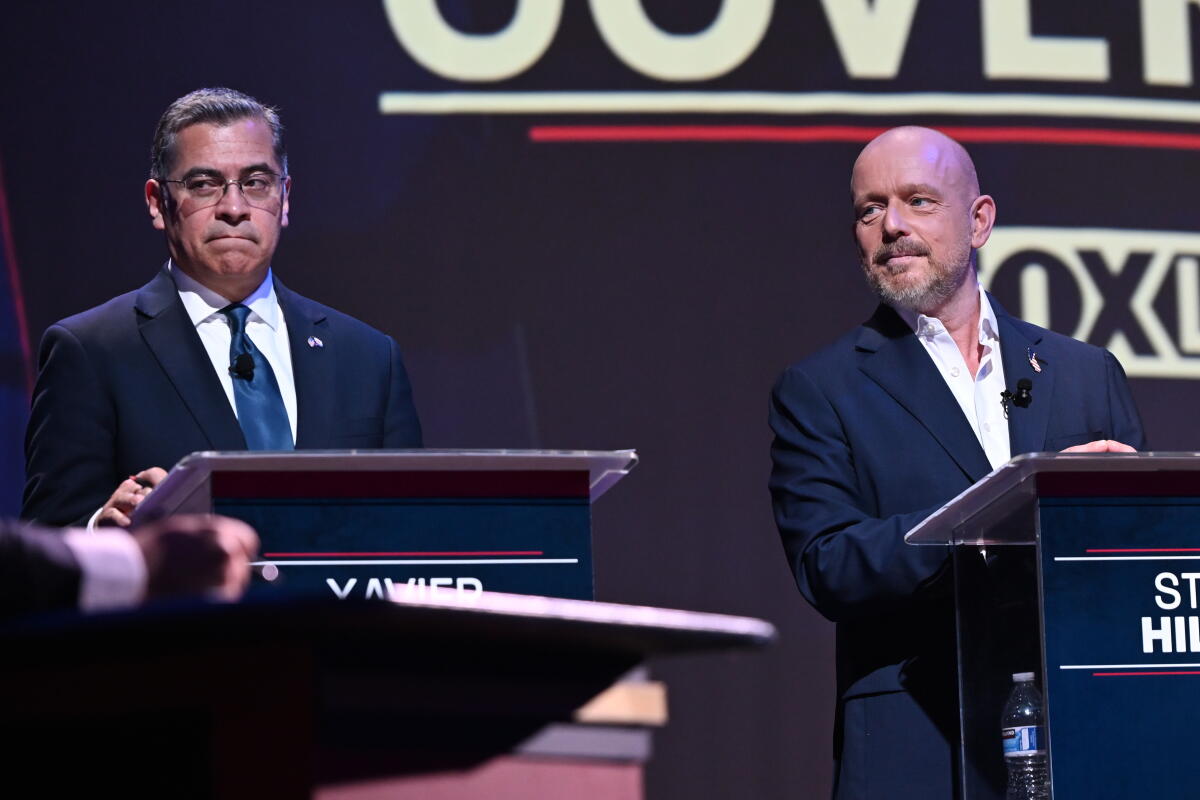
Some L.A. political observers admit they were surprised by Pratt’s performance in a May 6 televised debate with Bass and Raman.

”Spencer Pratt was kind of a laughingstock when he first announced that he was going to run, and he has dramatically exceeded expectations,” said Klink, the GOP strategist. “I think that he surprised people in his ability to come up with solutions. … That’s what’s going to convince people to vote, not the Batman or Star Wars ad.”

As millions of people click on Pratt videos — in some cases more than the 3.8 million people living in L.A. — Klick said there was one question Pratt needs to be asking: “Do views of his ads translate into votes?”

Source link

Cracked L.A. sidewalks are a symptom of a bigger breakdown

When I wrote last week about one of my favorite mountain ranges — L.A.‘s sidewalks — I immediately began fielding questions.

People wanted to know about the scoring system that awarded just 15 points, out of 45, to John Coanda and his wife, Barbara, who uses a wheelchair because of ALS. The Mar Vista couple had applied to the city’s Safe Sidewalks program to have some busted-up sidewalk in front of their home repaired.

With several sidewalk hazards on both sides of their block, Barbara can’t safely make it down her street. So how is it possible that under L.A.’s “Sidewalk Repair Program Prioritization and Scoring System,” their meager 15 points means they could be waiting “in excess of 10 years” for help?

I have the answers.

The Coandas got 15 points for being in a residential zone. But they didn’t meet the requirements for getting two additional awards of 15 points. They do not live within 500 feet of a bus or transit stop. And they had not been in the sidewalk repair backlog queue for more than 120 days.

It is not clear, however, that moving up to a score of 30 will bring out city work crews in less than 10 years. Knowing what I know, I wouldn’t bet on it.

The scoring system exists because in a lawsuit settlement 10 years ago, the city agreed to spend $1.4 billion over 30 years to repair damaged sidewalks and other infrastructure failures that impede the mobility of people with disabilities.

But there’s a backlog. A huge backlog, in the thousands. At my request, the city disclosed on Friday that it’s receiving about twice as many new disability-access repair requests each year as it’s addressing. In addition, the backlog for disability access requests and from residents applying for a sidewalk repair rebate program stands at roughly 30,000, with about 600 repairs being made each year.

As I said in a previous column, L.A. might indeed be all buttoned up by the ‘28 Olympics, but that would be 3028, not 2028.

Cracked sidewalks, to be clear, are but a symptom of a deeper, decades-long breakdown at City Hall. Basic services have been sacrificed to pay for employee compensation and pension costs the city can’t afford, with homeless services adding to the budget crisis.

By the way, I heard from one reader in response to my suggestion last week that if you can’t wait 10 years or more for the city to fix a broken sidewalk, you can apply to the rebate program, which will cover a portion of repairs. Don’t bother, said Lori Lerner Gray, who owns a house in Silver Lake and applied two years ago, but finally gave up.

“There is a massive waiting list and it’s a very complicated procedure just to try to get on it, let alone speak with anyone to help,” Gray said. “Once you finally get into the program, it’s impossible to proceed because of permits, engineering reports and finally you are required to bring the entire area to ADA compliance on your own dime.”

She said she was told she’d have to pay to relocate a utility pole.

And sidewalks aren’t the only infrastructure problem, as other readers noted. The city is way behind on filling potholes, repaving streets, installing curb ramps, making park improvements and replacing broken lights. I recently wrote about all the blight around City Hall, including the graffiti-tagged monument and fountain that has been inoperable for most of the last 60 years.

Oren Hadar, a Mid-City resident who writes about housing and transportation on his The Future Is L.A. website, reported last year in a Times op-ed that city streets were falling apart because the city had switched from repaving entire roads to doing what it called “large asphalt repair.”

With the switch, the city avoided federal requirements to upgrade curb ramps on repaved streets, Hadar said. He told me that when he travels to other cities near or far, “I’m always jealous of everything. Sidewalks are in better shape or there are better bike lanes. … You could go to even Santa Monica or Culver City. You don’t have to go far to see infrastructure that’s better.”

Other major cities have had formal infrastructure plans for years, while L.A. has ducked and dithered. Finally, earlier this month, Mayor Karen Bass introduced the city’s long-awaited CIP (capital infrastructure program), and offered a brutal assessment of what went wrong.

“For too long,” she said in the executive summary, “information has been scattered across departments, buried in lengthy reports and budgets, and difficult to fully understand. These challenges have had real consequences, contributing to decades of underinvestment in our built environment.”

The summary reads like an indictment of City Hall leadership and the manner in which public spaces have deteriorated. With Bass running for reelection, voters have to decide whether her role in those failures is grounds for dismissal, or her campaign-season pitch for a new day should help earn her a second term.

The report, with backing by members of the City Council, cited “fragmented systems and data silos,” “no shared vision across city departments,” “growing maintenance deferrals,” “slow, inefficient capital planning,” no “project intake standards,” “highly decentralized and uncoordinated grants,” “resource planning and staffing misalignment,” and “opaque capital planning process.”

Way to go, team.

You could take many of those same critiques and apply them to the haphazard way in which city and county leaders have addressed homelessness.

However, the city’s infrastructure plan does offer a framework for assessing the damage and prioritizing projects, and using charter reform to create a public works director position with greater authority. None of this will happen quickly, and given the budget crunch, you might be wondering how any of this would be paid for.

The suggestions in the report include bonds, a parcel tax, grants, fees on tickets to concerts and sporting events, fees on taxi and rideshare trips, and much, much more. None of this will be popular, especially if the public is unconvinced that city leaders can be trusted with more money.

Urban planner Deborah Murphy, chair of the city’s pedestrian advisory committee, noted that L.A. has gotten grants or state funding in the past for specific projects and then, because of staffing shortages or other stumbles, failed to hold up its end of the deal.

“It kind of ruins our reputation for getting future money,” Murphy said.

Jessica Meaney, executive director of Investing in Place and a longtime advocate for the infrastructure plan, is thrilled that the city has finally taken this step.

“But the key question is: who is actually in charge of making it happen?” she asked.

It’s critical, Meaney suggested, for city leaders to push for charter reform that puts infrastructure authority under a newly empowered public works director. If the city gets this right, she said, implementation of the infrastructure plan “could finally show Angelenos the true scale of deferred maintenance, make trade-offs visible, and create a road map for better sidewalks, streets, parks, and accessibility.”

If the current fragmented authority remains in place, Meaney said, the headline would be:

“No one is in charge of your sidewalk and City Hall is determined to keep it that way.”

steve.lopez@latimes.com

Source link

For all the chatter by mayoral candidates, can anyone fix L.A.’s enduring problems?

I’m going to start this story on a quiet tree-lined street in Mar Vista, where a couple I met with on Thursday — the day after the L.A. mayoral debate — have a problem.

It’s not an unusual matter, as things go in Los Angeles. On both sides of the street, the sidewalk rises and falls, uprooted and cracked by shallow roots because over many decades, the trees were not properly maintained.

John Coanda, 61, who grew up in Los Angeles, was never bothered by torn-up sidewalks as a kid.

“In fact,” he said when he first emailed me about his predicament, “my friends and I sometimes used the ramping pavement as jumps for our bicycles.”

But his wife, Barbara, was diagnosed in 2024 with ALS, and she uses a wheelchair. When John pushes her, they can’t use the sidewalk if they want to go to the store or meet with friends, or just enjoy a nice pass through the neighborhood without getting into a vehicle.

So John pushes Barbara’s wheelchair in the street, which creates an obvious safety problem. And despite John’s best efforts to get City Hall to fix the sidewalks, he’s not expecting help anytime soon.

I’ll circle back to this story in a bit, but first, about that debate.

I recruited a half-dozen L.A. residents to watch and send me their thoughts about how the candidates tackled the important issues. And then I felt guilty for having done so, because the candidates didn’t do much tackling at all.

Spencer Pratt is shown on a television while journalists work during the 2026 Los Angeles mayoral debate.

Candidate Spencer Pratt is shown on a television while journalists work during the 2026 Los Angeles mayoral debate at Skirball Cultural Center.

(Jason Armond / Los Angeles Times)

They hit their talking points, for sure, and Mayor Karen Bass, Councilmember Nithya Raman and TV personality Spencer Pratt each had their moments. But by the end of the debate, and two straight nights of gubernatorial debates as well, I came away thinking there were no clear winners, but there was a definite loser.

Voters.

This is the fault of the format more than of the candidates themselves. The deck is stacked against meaningful, substantive discussions, especially when moderators ask — as they did several times — for one-word answers.

“Moderator questions are so meaningless … and they make it easy for candidates to take potshots at each other,” said longtime political sage Darry Sragow. “The format is guaranteed to elicit nothing that matters.”

It’d be better to have single-issue debates, and to have candidates pressed for details by journalists who cover those issues and can push back against unrealistic promises and expose a lack of depth.

My debate watchers did some of that themselves. CSUN librarian Yi Ding had praise and criticism for each candidate, but was looking for concrete plans and didn’t get many.

Ding was also disappointed that two other mayoral candidates — Ray Huang and Adam Miller — were not invited to the debate, and I agree with her. Both have been polling low, but with so many undecided voters, and such high unfavorability ratings for Bass, they should have been in the mix.

Mike Washington, a retired pharmacist and West Adams resident, said Bass has done better than previous mayors on homelessness and he didn’t think Raman or Pratt came off as worthy of bumping her out of City Hall.

“The public would have benefited from more questions related to the challenges young people are facing,” said Juan Solorio Jr., president of the San Fernando Valley Young Democrats club. His colleague David Ramirez agreed, saying he was hoping for “more discussion about the cost of living for young adults,” but he and Solorio are both backing Bass.

West L.A. software developer Mike Eveloff asked the million-dollar question in one of his many observations during the debate:

“Why is LA spending record amounts on homelessness, fire, police, and infrastructure while results deteriorate? Streets and sidewalks crumble. Even the city emblem right in front of City Hall is deteriorated. With the World Cup and Olympics approaching, voters need to know: Do these leaders have the financial discipline and operational competence to manage a fourteen billion dollar city?”

Venice resident Dennis Hathaway, author of “An Octogenarian’s Journal,” said he thinks “these kinds of debates are pretty non-edifying.” And, as someone I wrote about two years ago regarding busted sidewalks in his neighborhood, he shared this lament about Thursday’s debate:

“No mention of broken sidewalks, potholed streets, other deteriorated infrastructure. To me, that’s a much more important subject than non-citizens voting in city elections.”

(Bass did say during the debate that there was a new infrastucture plan in place, and that’s a step in the right direction. But there was no discussion, and when you read the details, 2028 Olympics projects will be prioritized, and it’ll take years to figure out how to fund thousands of additional much-needed fixes.)

The Coandas live not far from Hathaway, and their lives have been upended first by Barbara’s diagnosis and then by John getting laid off in February from his job as a data analyst. Barbara still teaches French via Zoom, and John is tending to her needs. They started a Gofundme campaign to help pay their bills.

With Barbara in a wheelchair, John contacted the city’s Safe Sidewalks L.A. program last fall, and I think it’s fair to say that name is somewhere between a misnomer and a bad joke.

The “program” responded by email on Halloween, appropriately enough, informing him that under the City Council-approved “Sidewalk Repair Program Prioritization and Scoring System,” his request for help merits only 15 points out of a possible 45.

“Currently,” he was informed, “the estimated wait time for completion of an Access Request with a score of 15 is in excess of 10 years.”

Happy Halloween.

Over the years, responsibility for sidewalk repairs has shifted between the city and homeowners. There’s a rebate program available to people who repair their own sidewalks, but it’s capped at an amount that doesn’t always cover the costs. And ruptured pavement is keeping lots of lawyers busy with trip-and-fall lawsuits that cost the city millions each year.

Barbara Durieux Coanda and her husband, John Coanda, make their way down the ramp in front of their home in Mar Vista.

Barbara Durieux Coanda, who has ALS, and her husband, John Coanda, make their way down the ramp in front of their home in Mar Vista.

(Genaro Molina / Los Angeles Times)

Coanda told me he doesn’t have the funds at the moment to pay for repairs, and even if he did, there are several more sidewalk disaster zones on both sides of his street, so he’d still have to push his wife’s wheelchair in the street even if he fixed the cracks in front of his own house.

Barbara graciously said she thinks the city has other, higher priorities, but in November her husband contacted the office of Councilmember Traci Park, saying he was told that he would have to wait 10 years for repairs.

“Sadly,” he wrote, “I don’t think my wife will live that long.”

A Park staffer wrote back, saying, “The turnaround time does sound realistic given the budgetary crisis the city finds itself in.” But, the staffer added, maybe the council member’s office could “help move the needle on this request.”

Coanda said he’s been too busy with his wife’s issues to follow up. But Pete Brown, Park’s communications director, told me Friday afternoon that the office is exploring ways to pay for fixes that don’t take 10 years, including the use of discretionary funds.

I don’t know how that might play out, but I do know that L.A. doesn’t need another debate like the last one.

We need a mayor and council members who refuse to accept that it takes 10 years to create safe passage for a wheelchair.

In the national capital of broken sidewalks, we need concrete plans.

steve.lopez@latimes.com

Source link

California under pressure — again — as redistricting wars escalate

When the U.S. Supreme Court sharply curtailed a key provision of the Voting Rights Act last week, Democrats in Washington had a message: The rules of redistricting have changed, and California — the nation’s biggest blue bastion — may have a further role to play.

Rep. Alexandria Ocasio-Cortez (D-N.Y.) said Democrats should “play by the same set of rules” as Republicans. House Minority Leader Hakeem Jeffries (D-N.Y.) vowed to fight in “the Deep South and all over the country.” And Rep. Terri Sewell, an Alabama Democrat, was blunt: “I’ll take 52 seats from California, I sure would. And 17 seats from Illinois.”

The calls for action came as Republican governors in Louisiana, Alabama, Mississipppi and Tennessee called special legislative sessions to redraw congressional maps ahead of this year’s midterm elections. Florida has also approved new maps that could give the GOP four more seats in the House, and President Trump urged other Republican states to follow suit.

The Republican response has intensified the pressure on Democrats to act, including those in California — where the ruling could upend not just congressional maps, but also legislative and local races.

“We can’t allow this national gerrymandering effort of Republicans to go unanswered,” said Rep. Robert Garcia (D-Long Beach). “If Republicans go for it, I think we have to leave all options on the table.”

For now, California’s response is far from settled.

A woman with brown hair, wearing glasses and a dark jacket, gestures while speaking before a microphone

Rep. Sydney Kamlager-Dove (D-Los Angeles) cautioned against “accelerating a race to the bottom.”

(J. Scott Applewhite / Associated Press)

The chair of the California Democratic Party said there are no current plans to redraw maps — just months after voters approved a constitutional amendment authorizing a mid-decade redistricting backed by Gov. Gavin Newsom.

The Democratic consultant who drew the state’s current congressional district boundaries says an all-blue map, while possible to create, would probably hurt Democrats more than help them in the long run. And some of the state’s congressional Democrats are worried the impulse to match Republican partisan efforts would be bad for the American electorate.

“Rather than accelerating a race to the bottom, the next step is to dial it down because you can reach a point of no return,” said Rep. Sydney Kamlager-Dove (D-Los Angeles), one of the state’s most prominent Black lawmakers. “And that’s where we’re headed.”

What California decides — and when — will matter at the national level. With 52 congressional seats, no state has more to offer Democrats in a redistricting war. But experts, lawmakers and party officials say the path forward is more complicated than the calls from Washington suggest.

California could see 48 blue seats, out of 52

That’s in part because California already acted. In 2025, voters approved Proposition 50, which drew new congressional district lines designed to favor Democrats for the 2026, 2028 and 2030 elections. The new maps, which could yield as many as 48 Democratic seats out of 52, are already in effect, and voters have begun receiving their mail-in ballots.

Going farther is not currently on the table — at least not yet.

“We have yet to fully win the seats in the map that was drawn in 2025. It seems a step too far to say we’re going to go back to the drawing board and redraw the map,” said Rusty Hicks, the chair of the California Democratic Party.

Hicks said it doesn’t mean the issue could not become part of a future discussion, but he said Democrats in other states should not look past what California has already done.

“We’re trying to pick up 48 of them. How much more do you want us to pick up? You want us to make it 52 blue? Well, you all should get into the fight,” Hicks said. “You all should pick up some seats. Let’s all do this together, because California cannot do it alone, it will take the rest of the country.”

Others are not convinced the most aggressive option makes the strategic sense in California.

Paul Mitchell, the Democratic redistricting consultant who drew California’s Proposition 50 congressional maps, said the push for a 52-0 delegation reflects a fundamental misunderstanding of how a partisan map would perform in the state over time.

“A 52-to-zero map would have the potential of backfiring,” Mitchell said. “In 2026, we could pick up 52 seats. But then in 2028 or 2030 — a bad year for Democrats, let’s say — Democrats lose 11 of those seats. You’ve drawn these districts so demonically to a Democratic advantage in a good year that in a bad Democratic year, they don’t have the ability to withstand the challenge.”

Ruling could jeopardize state’s voting rights law

The political debate over congressional maps has so far dominated the conversation in Washington. But legal scholars and redistricting experts say the ruling could also have consequences in California’s city hall, school board and county supervisor races.

The justices’ ruling, decided by the court’s conservative majority, says states cannot consider race to create majority-minority electoral districts while allowing them take partisan interests into account.

“A purely partisan map is actually more defensible now than one drawn with racial considerations,” said Rick Hasen, an election law professor at UCLA. “It turns the world on its head.”

The ruling now puts at risk any district drawn at any level of government that relied on the Voting Rights Act to justify its boundaries, Hasen said.

And in California, that uncertainty extends to districts drawn under the state Voting Rights Act, which extends protections for minority voters beyond the federal law, he said. The state law was not directly at issue in the Supreme Court ruling, but Hasen argues the court’s reasoning could provide new legal grounds to challenge the state law as potentially unconstitutional.

Cities including Santa Monica and Palmdale have faced lawsuits alleging their at-large City Council elections diluted the Latino vote. Palmdale settled its case and agreed to switch to district-based elections; Santa Monica’s case is ongoing. Hasen argued that the cities, as well as other bodies, such as school boards, could now return to court to challenge whether district maps drawn as a result of the California Voting Rights Act are unconstitutional.

“That has not been tested yet,” he said, but he fears the same arguments made to challenge the federal Voting Rights Act could be made against the state law.

At the state level, Republican strategist Matt Rexroad sees the ruling affecting the California Legislature as well. He argues the boundaries drawn for the state Assembly and Senate districts are racial gerrymanders.

“Those legislative lines, I would argue, are unconstitutional,” Rexroad said. “And those lines are probably going to change by 2028.”

But Rexroad’s biggest concern goes beyond any single set of maps: It is the future of California’s independent redistricting commission, the nonpartisan body he has spent years defending.

A threat to independent redistricting

Rexroad sees a scenario in which the national political environment gives California Democrats little incentive to return the map-making power to the commission. If Republican states continue to aggressively redraw maps, Democrats will have another justification to keep power in the Legislature’s hands, the same argument made to pass Proposition 50, he said.

“I don’t think the California redistricting commission has ever been in greater jeopardy than it is right now,” he said.

J. Morgan Kousser, a historian who has testified as an expert witness in voting rights cases for 47 years, said California’s commitment to the commission may depend on how aggressive Republican states act in redistricting.

“If we go back to an all-white South in Congress, California may not go back to a fairness standard,” Kousser said. “It may not disarm. It may rearm.”

Mitchell, the redistricting consultant, said that he hopes California and other states choose the path of disarmament and that there is a national push for independent commissions in every state.

“This isn’t good for anybody,” he said. “This was all basically a nerd war over lines that didn’t actually improve any districts anywhere.”

Source link