choose

I stayed at the Algarve holiday resort with private beach, free tours and 18 bars to choose from

AS the glass lift descended the cliff face, green umbrella pines gave way to craggy sandstone  before the epic golden sands of Praia da Falesia were revealed.

My friend Rosie and I were in awe.

Unwind by one of the resort’s seven pools Source: Supplied
The idyllic Pine Cliffs Resort on Portugal’s Algarve coast Source: Supplied

“This place is stunning”, was our first impression — and it was one that held true throughout our three-day autumn sunshine break at the 5H Pine Cliffs Resort on Portugal’s Algarve coast.

From the bottom of the lift, we strolled down the boardwalk to beach restaurant Maré, which serves the freshest seafood.

As we enjoyed shrimp mango tacos and spritz cocktails, then chocolate ice cream, we deliberated over which sunloungers on the private beach we should aim for the next morning.

Despite our early-morning flight, the quick transfer meant we were in the mood for exploring and after lunch, we got back in the lift to head back up to the resort and get our bearings.

WAIL OF A TIME

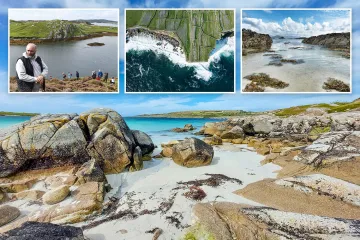
I drove Irish Route 66 with deserted golden beaches and pirate-like islands


TEMPTED?

Tiny ‘Bali of Europe’ town with stunning beaches, €3 cocktails and £20 flights

Across the 178-acre estate there are options for every budget or group size, from apartments and suites to villas and townhouses. But our home for the weekend was the resort’s original focal point, the 217-room Pine Cliffs Hotel.

Strolling from the beach to the hotel we passed under the many pines that shade the cobblestone walkways and gardens and give the resort its name.

The clifftop hotel, unlike the resort’s newer residential zones, has a traditional style. Terracotta floors, hand-painted ceramic tiles and whitewashed archways give way to leafy courtyards, as Moorish-style architecture pays homage to the region’s historic Arabic influences.

It’s a theme that continues into the hotel’s bedrooms. The beds have bespoke headboards featuring more of those hand-painted tiles, in elegant constrast to the rooms’ calm, white walls and all the mod cons you could wish for.

Enjoy a spot of beach dining at restaurant Maré, which serves the freshest seafood Source: Supplied
The resort’s stuning oceanfront golf course Source: Supplied

Guests can join a free Tiles Tour to learn more about the Algarve’s decorative tiles, or azulejos, in the hotel and grounds.

Once you’ve soaked up the back stories, about how this traditional art has survived earthquakes and invaders down the centuries, you head off for a workshop to design your own creations.

Armed with a blank tile, fine brushes and traditional mineral paints, you learn the technique of glazing from scratch.

Your work of art is then fired for you to safely pack into your suitcase.

Meanwhile, across the resort’s grounds, sport is also front and centre.
A scenic nine-hole golf course hugs the cliff edge and features the hair-raising Devil’s Parlour hole, where players must drive a ball straight over a deep ravine.

Then there’s the Annabel Croft Tennis and Padel Academy. We had a fantastic time here, being taught the basics of Padel on one of the resort’s beautiful courts — even though our backhands didn’t quite match the facility.

If you work up a thirst, and appetite, then good: the resort has 18 fabulous bars and restaurants.

The Mirador Champagne Bar was the perfect place for us to sit and watch the sunset with a glass of fizz and bowls of salty snacks before dinner.

We kicked off our first evening at lively steakhouse Piri Piri, one of the Algarve’s top spots for meat lovers, with gourmet cuts from all corners of the globe.

Jess Wilson tries her hand at Padel Source: Supplied
Our Jess and, left, pal Rosie on their girls trip Source: Supplied

We enjoyed fillet steak and fresh lobster salad with local wines and ended the night with a glass of Amarguinha, a local almond liqueur which was dangerously delicious.

On our second night, we went to seafood restaurant O’Pescador, where guests choose their catch from the tank before having it grilled on the barbecue. For lunch, we loved the Corda Cafe and healthfood spot Zest, where we mixed it up with salads, wraps and pizzas.

Day two was all about recharging in the resort’s Serenity Spa where we were treated to massages before sampling the outdoor Jacuzzi and the saunas, ice pool and steam rooms in the spa itself.

It’s pure bliss at the Serenity Spa Source: Supplied
The beds have bespoke headboards featuring hand-painted tiles Source: Supplied

The resort’s health club also features two big gyms, a Pilates studio and an indoor pool.

If you prefer unwinding under the sun, the resort has seven outdoor pools.

There is no adult-only pool but those after a quiet spot should visit the pools near the spa, one of which has a swanky swim-up bar.

Families will find the best areas for kids in the Porto Pirata Children’s Village — the biggest kids’ club in the region.

If you fancy a spot of shopping, there’s a strip of boutiques selling handmade gifts and jewellery or, in the hotel lobby, there are several high-end shops.

Outside the resort, the coastal city of Albufeira is just a 15-minute drive away, with a huge selection of bars, restaurants and nightclubs as well as a pretty old quarter.

But with their clifftop sundowners, world-class dining and golden sands, we were not in a rush to leave our hotel and its glorious grounds and beach.

GO: ALGARVE

GETTING THERE: easyJet flies to Faro from Gatwick, Luton, Manchester, Newcastle, Liverpool, Birmingham and Bristol, with fares this month from £19.99 one way.

See easyJet.com.

STAYING THERE: Deluxe double rooms with balconies cost from £208 per night this month, with breakfast.

See pinecliffs.com.

Source link

‘Expect goosebumps!’: to celebrate Halloween, readers choose the spookiest places in the UK | United Kingdom holidays

Winning tip: an eerie clifftop castle near Aberdeen

Dunnottar Castle, perched on cliffs above the crashing North Sea, is one of Scotland’s eeriest places. The most haunting part is the Whigs Vault, where more than 160 prisoners were confined in dreadful conditions in 1685. Standing in that dark chamber, it’s impossible not to imagine their fear and suffering. With my Fraser ancestry, the castle’s history feels especially poignant. The names of multiple Frasers are recorded, their details written on the wall. The wind whistles through the stonework, the waves thunder below, and there’s a sense that the past hasn’t quite left. It’s beautiful, tragic and wonderfully spooky, especially beneath Aberdeenshire’s brooding grey skies.

Rosie

A Neolithic burial chamber in Pembrokeshire

Pentre Ifan. Photograph: Louise France/Alamy

My dad and I reached Pentre Ifan on a November evening, just before dark. The burial chamber defies explanation: 16 tons of weathered capstone, barely touching three sharp stone points, as though something unseen was holding it up. There was a low hum from somewhere; I hoped it was the wind spilling over the Preseli hills. As the daylight crept away, the chamber beneath grew darker than the settling dusk around us. My dad, who has an explanation for everything, stood silent. I think we walked back to the car a little faster than we had come.

Tom

Haunted by criminals in Somerset

Shepton Mallet prison. Photograph: Keith Stuart/The Guardian

My recommendation is Shepton Mallet prison, or “the Mallet” as it used to be called, back when it was used as a military prison. It opened in 1625, and you can still crawl through a wall into an original cell. The prison has three Victorian blocks and umpteen stories of past prisoners, including the Kray twins. You can have a daytime tour, or a night-time ghost tour, where you’ll hear stories of spooks and ghouls witnessed by many visitors and staff over the years. You can even stay the night in a real, cold, grim prison cell. The staff are friendly and all great characters, I can’t recommend it enough!

Charlie

Hollowed out tower in West Yorkshire

St Thomas à Becket church, Heptonstall. Photograph: Philip Silverman/Alamy

Perched high above Hebden Bridge in the historic hilltop village of Heptonstall lies the roofless shell of St Thomas à Becket church. Raked into ruin by a storm in 1847, this 13th-century structure was left to decay alongside its 19th-century successor, creating a rare site where two parish churches share a single churchyard. Gaunt, towering arches frame open skies, and the hollowed-out stone tower feels like the Tower tarot card made real. Expect goosebumps!

Finbarre Snarey

A pub night you won’t forget in Staffordshire

The Four Crosses Inn. Photograph: Alex Telfer/The Observer

The Four Crosses Inn is the most haunted pub in England – and I should know: it was in my mother’s family for many generations! I grew up hearing about all the ghostly goings on. It was also one of the oldest pubs (it’s only open for tours now), and family lore has it Dr Johnson stayed there. On the edge of creepy Cannock Chase moor in Staffordshire, the scene of many murders, it has dank cellars and creaking attics for you to get really scared in.

Rob

Poltergeist stories in County Fermanagh

Fivemiletown, Northern Ireland. Photograph: Bonzo/Alamy

Cooneen Ghost House, near Fivemiletown, is one of Northern Ireland’s eeriest places. The abandoned farmhouse is private, but it can be glimpsed from the road, which somehow makes its old poltergeist stories feel even more unsettling. Nearby Crocknagrally Forest is perfect for a cold-weather ramble to make a day of it, especially on a misty winter afternoon when the tracks are wonderfully secluded and it all feels very remote and spooky. The kind of walk where folklore seems woven into the landscape: dark trees, lonely roads and an old haunted house just out of reach. There are loads of stories around this place that locals will share.

Christina Hawe

skip past newsletter promotion


Romantic tragedy on Llŷn peninsula

Abandoned works at the Cae’r Nant quarry above Nant Gwrtheyrn. Photograph: Peter Martin Rhind/Alamy

The once abandoned quarrying village of Nant Gwrtheyrn, on Llŷn peninsula, lies at the foot of Yr Eifl, down a terrifyingly steep and winding road. On a misty autumn day, with the crashing waves below you and the unsettling presence of a wild goat peering down at you from the cliffs above, it can be truly eerie. The woods in the valley are home to the tale of Rhys and Meinir – a traditional prenuptial game of hide and seek gone awry, with the skeletal remains of a bride-to-be revealed by a bolt of lightning. The site is free to visit.

Sioned

Crashing waves and call of rooks in Aberdeenshire

Slains Castle. Photograph: Alamy

On a cold grey day Slains Castle on the east coast of Scotland, north of Aberdeen, certainly has a spooky air. Although rumours about the castle inspiring Bram Stoker when writing Dracula are apparently untrue, the castle ruins bring to mind bats pouring out of windows and unsavoury aristocrats lurking around corners. It is precariously located on cliffs above the North Sea and the crashing waves and calls of rooks and jackdaws provide an evocatively eerie soundtrack to your visit.

Joel Rawlings

Unexplained screams on the South Downs

Chanctonbury Ring. Photograph: Veronique Stone/Alamy

Chanctonbury Ring is an iron age hill fort ringed by beech trees, on the South Downs in West Sussex. Folklore claims that by walking or running around the ring seven times you’ll see the devil. Writer Robert Macfarlane certainly had an unnerving experience there while camping, as recounted in his 2012 book The Old Ways: A Journey on Foot, when awakened in the dead of night by terrifying human-sounding screams high above him in the tree canopy, which seemed to divide and converge before swooping down upon him. Accessible only on foot, who dares follow in Macfarlane’s footsteps to check out the myth?

Kirsty McHattie

Gothic atmosphere in Whitby

Whitby Abbey. Photograph: Peter Lopeman/Alamy

My favourite spooky spot is Whitby Abbey, perched high above the Yorkshire coast. Its ruined arches and weathered stone look dramatic in daylight, but imagine them at dusk, with mist drifting in from the North Sea and the wind moving through the empty windows. Whitby’s narrow streets and harbour add another layer of atmosphere, especially when the lamps come on and the town grows quiet. It is easy to see why Bram Stoker found inspiration here for Dracula. I would love to explore the abbey as the light fades, then wander down towards the harbour, listening to the waves and letting my imagination do the rest. The best spooky places are where history, landscape and legend meet – and Whitby has all three. Its magic endures.

Emilio

Source link