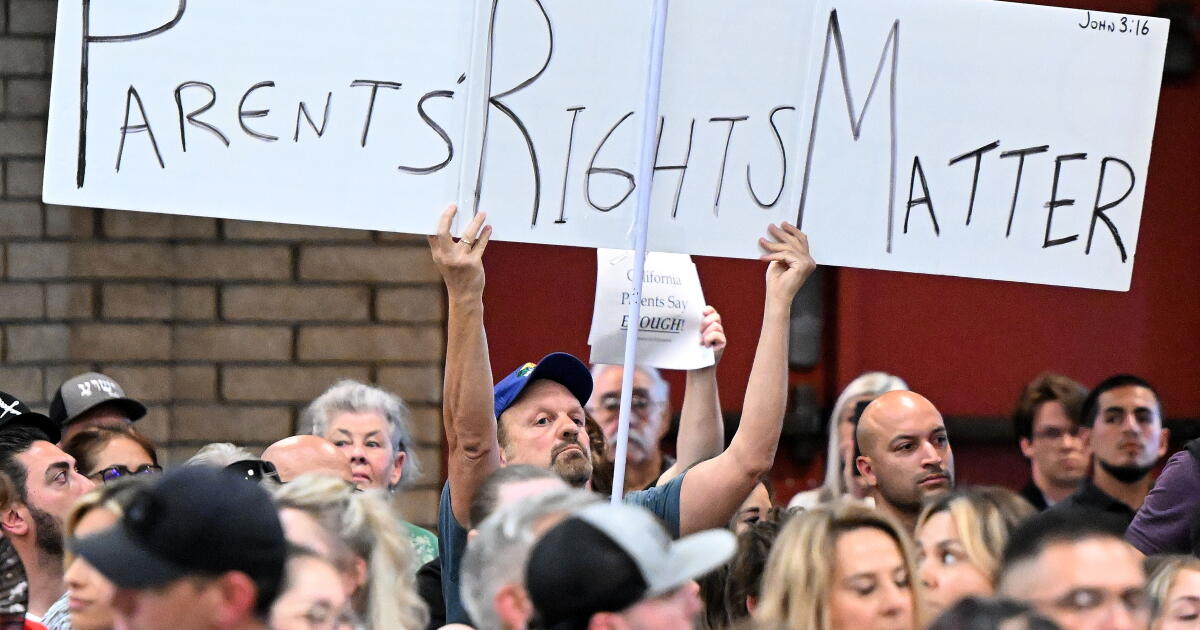
Schools cannot alert parents of child gender identity unless asked, judge orders
It remains illegal in California for a school district to force teachers and other staff to alert parents about their child’s gender identity, but parents must be told when they ask about it, a judge ruled Tuesday in a widely watched case dealing with parental rights.
San Bernardino County Superior Court Judge Michael Sachs, weighing both state law and a Supreme Court order, rejected an attempt by the Chino Valley Unified School District to reinstate its mandatory parent-notification policy.
“There is no requirement that the school district, on its own, after learning of transgender issues, contact parents and let the parents know of them,” Sachs said in court. At the same time, “in the event a parent makes an affirmative inquiry of a minor child regarding their status, whether transgender or not, that will trigger an obligation by the school district to respond.”
Under the Chino Valley policy, approved in July 2023, a school would have to notify parents of any request by a student “to use pronouns that do not align with the student’s biological sex or gender listed on the student’s birth certificate or other official records.” The same notification rules applied to the use of bathrooms or participation in sports.
State Attorney General Rob Bonta immediately challenged that policy in court and it was put on hold. In October 2024, Sachs had ruled that most of the policy was discriminatory — and therefore illegal — because it singled out a group of students for treatment that was different than the treatment of other students.
As an example, he cited the possibility that a student would come out confidentially to a school counselor — and then that counselor would immediately be required to alert the parents, even against the student’s wishes.
A policy that could result in mandated actions by a school employee continues to conflict with the intent of a 2025 California law that barred a school system from forcing teachers to tell parents about a student’s gender, Sachs concluded.
“That’s inappropriate and it’s still inappropriate,” Sachs said Tuesday.
New rules, new rulings
What has changed in the legal landscape, he added, is what happens when a parent requests information about their child’s gender status or sexual orientation or any number of other issues affecting that child.
Trial court rulings — affirmed by a Supreme Court majority in March — said that parents have the right to demand information about their child’s gender identity at school. School staff cannot lie to parents — including matters that a student wishes to conceal from their parents.
Attorney Emily Rae, representing Chino Valley, said Sachs was correct to acknowledge that parents had the right to information about their child, but that his ruling did not go nearly far enough — and that parent notification should be mandatory statewide.
Chino Valley also has a separate pending court challenge to the 2025 California law, contending it is at odds with the direction of the Supreme Court, which should take precedence.
Dept. Attorney General Delbert Tran, representing the state, declined to be interviewed Tuesday, but in his exchanges with Sachs, it was clear that he saw the ruling as about as much of a win as would be possible, given the Supreme Court’s recent directives.
He also said that supporters of parent-notification policies misstate or misunderstand the parent-teacher relationship that exists in practice and under state law. Parents, he said, have the legal right to observe classes and meet with teachers, and the expectation is that teachers will communicate freely and often with parents about a child’s needs and progress.
Chino Valley champions its view of parent rights
Chino Valley, a school district of 26,000 students in San Bernardino County, has adopted and defended a series of policies favored by parent activists, religious conservatives and President Trump under the leadership of school board President Sonja Shaw, a Republican currently running for the office of state superintendent of public instruction.
Under her leadership, the school system has taken a stand for a flag-ban policy in schools and classrooms, widely viewed as targeting gay pride flags; for removing school library books with passages deemed to be sexually obscene, and for working to ban trans athletes from girls sports and girls locker rooms.
Shaw attended Tuesday’s hearing and criticized Sachs’ reasoning.
“When he talks about a parent has a right to know now only if they ask, how do you know you’re being lied to or secrets being kept?,” Shaw said after the hearing. “That absolutely makes no sense.”
Shaw said the judge should have done “what’s right: Upheld parents’ constitutional right to the upbringing of their own child.”
In anticipation of Sachs’ ruling against the original policy, the Chino Valley school board revised the policy, expanding it to all students. Under the current policy, if any student “requests a change to their official or unofficial records, parents/guardians shall be notified to ensure that parents/guardians are informed and involved in all aspects of their child’s education.”
In other words, if a straight male student named William suddenly decided he wanted to be referred to as Robert on the class roll sheet — an official record — his parents would be notified.
In 2024, Sachs accepted this version of notification because students were not singled out for different treatment on the basis of their gender.
That form of the policy remains in effect.
Since that time, Shaw said, the district has been “transparent” with parents regarding important issues in the lives of their children. And Tuesday’s ruling would not change that.
Moving forward, she added, the district could assertively ask parents if they want to be informed about their child’s gender issues and that permission — if given — would continue to apply as the student proceeds through grade school.