Chinas

China’s Xi Jinping and Russian President Vladimir Putin meet in Beijing | Politics News

DEVELOPING STORY,

Xi and Putin hold talks just days after US President Donald Trump made an official visit to China.

A meeting between Chinese leader Xi Jinping and visiting Russian President Vladimir Putin has started in Beijing, Chinese state media report.

Xi welcomed Putin to the Chinese capital on Wednesday, shaking hands with the Russian leader outside the Great Hall of the People before their talks, video by Russian media showed.

Recommended Stories

list of 4 itemsend of list

Before entering the Great Hall, Putin and Xi walked down a red carpet, rolled out to greet the Russian leader, and stood as a military band played their two national anthems.

Putin began the talks by hailing the “strong, positive” momentum in cooperation between Russia and China, according to Russian media.

“Even amid unfavourable external factors, our cooperation and economic cooperation is showing strong, positive momentum,” Putin told Xi.

Addressing Putin, Xi lauded the “unyielding relationship” between China and Russia.

“We have been able to continuously deepen our political mutual trust and strategic coordination with a resilience that remains unyielding despite trials and tribulations,” Xi told Putin, according to China’s Xinhua news agency.

The Chinese leader also addressed war in the Middle East, telling his Russian counterpart that further conflict was “inadvisable” and a ceasefire was necessary.

“A comprehensive ceasefire is of utmost urgency, resuming hostilities is even more inadvisable and maintaining negotiations is particularly important,” Xi said, according to Xinhua.

Russian President Vladimir Putin walks with Chinese President Xi Jinping during a welcoming ceremony at the Great Hall of the People in Beijing, China May 20, 2026. REUTERS/Maxim Shemetov/Pool TPX IMAGES OF THE DAY
Russian President Vladimir Putin walks with Chinese President Xi Jinping during a welcoming ceremony at the Great Hall of the People in Beijing, on Wednesday [Maxim Shemetov/Pool/Reuters]

Al Jazeera’s Katrina Yu, reporting from Beijing, noted that Putin’s visit and that of the recently concluded trip by US President Donald Trump to China were very different.

Putin, she said, is marking 25 years of the Sino-Russian friendship, has visited China dozens of times, and met with Xi on more than 40 other occasions.

“So this visit will really be about deepening existing coordination and cooperation,” Yu said.

“We are expecting that the two sides will update each other on the situation in the Middle East, as well as Ukraine. No doubt, Xi Jinping will also talk to Putin about what was discussed with Donald Trump last week,” Yu said.

Putin is being accompanied by a large delegation of Russian businesspeople and government leaders, and the Kremlin has announced that the two leaders will sign some 40 different agreements, Yu said, covering everything from the economy and tourism to education.

“But I think for Putin, the main topic of discussion with Xi Jinping is going to be on energy security,” Yu said.

“Since the war in Ukraine, any gas sales that were previously heading to Europe – that is all dried up – and Russia is in desperate need of revenue to replace that, especially since we are in the fifth year of the Ukraine war,” she added.

In a video address released before meeting Xi, Putin said Beijing and Moscow are prepared to cooperate with each other on “core interests ‌of ⁠the two countries, including the protection of sovereignty and national unity”, the Reuters news agency reports.

Both countries are actively expanding ⁠ties in economy, politics and defence, Putin said, adding that “a close” and “strategic” connection between Moscow and Beijing ⁠was playing “a stabilising role” in global relations.

“We are not aligning against anyone, but working ⁠for the cause of peace and universal prosperity,” Putin said.

Source link

China’s Complex Relationship With Elon Musk: Hero or Villain?

In China, Elon Musk has gained both admiration and criticism. While he is seen as a visionary, he has faced scrutiny from regulators and the public due to issues with customer complaints. The success of Musk’s SpaceX and its Starlink satellite service has also led to concerns from the People’s Liberation Army, especially as Tesla faces growing competition from Chinese electric vehicle (EV) manufacturers, which threatens Musk’s standing in the market.

Musk recently attended a summit in Beijing with U. S. President Donald Trump, alongside other CEOs like Tim Cook and Jensen Huang, focusing on resolving business issues with China. After a formal welcome, Musk expressed his desire to achieve “many good things” in the country. At the same event, Xiaomi’s CEO Lei Jun, an admirer of Musk, took a selfie with him, which became popular on social media, showcasing the public’s interest in Musk.

Despite facing competition on technology and pricing from local companies, Musk and Tesla remain influential in China. Experts note that Musk’s business goals align with China’s technological priorities, including electric vehicles, AI, and advanced robotics, making Tesla’s self-driving technology the standard in the industry. In 2018, Tesla became the first foreign automaker permitted to operate in China without a local partner, and its sales in the country reached about 626,000 vehicles last year, contributing significantly to its revenue.

Other Chinese carmakers, like Chery, draw inspiration from Tesla’s focus on innovation, blending it with Toyota’s emphasis on quality. However, Musk’s other ventures, particularly SpaceX, provoke concern among Chinese military and government officials due to its dominance in satellite communications, especially in light of geopolitical tensions, hinting at efforts to develop domestic alternatives.

Though Musk’s social media platform, X, is banned in China, he has a significant following on Weibo and has been celebrated as a global icon in the country. His recent visit pertains to an attempt to purchase $2.9 billion in solar manufacturing equipment from Chinese suppliers, although this may be affected by China’s potential export restrictions on advanced technologies to the U. S.

Musk’s company is also seeking regulatory approval for more advanced self-driving technology. However, his relationship with China has been delicate, particularly when Tesla faced backlash in 2021 over its handling of customer complaints, highlighted by a public protest at an auto show. Additionally, Teslas were previously banned from military areas due to security concerns.

Looking ahead, organizations believe that Tesla’s standing might challenge Musk’s popularity in China as local companies continue to progress. However, he is likely to remain an influential figure in China’s tech scene for his achievements in the automotive and technology industries.

With information from Reuters

Source link

Trump arrives in Beijing for talks with China’s Xi on Iran war, trade and U.S. arms sales to Taiwan

President Trump arrived in Beijing on Wednesday for his hotly anticipated talks with Chinese President Xi Jinping on the Iran war, trade and U.S. arms sales to Taiwan.

The meat of the summit doesn’t start until Thursday, when the leaders hold bilateral talks, visit the Temple of Heaven, where Chinese emperors once prayed for bumper crops, and take part in a formal banquet. But the Chinese offered Trump a pomp-filled welcome, literally rolling out the red carpet for him after Air Force One landed in the Chinese capital.

The president was greeted by Chinese Vice President Han Zheng; Xie Feng, China’s ambassador to Washington; Ma Zhaoxu, executive vice minister of foreign affairs; and the U.S. envoy to Beijing, David Perdue.

The welcoming ceremony included a military honor guard, a military band and some 300 Chinese youths waving Chinese and American flags and chanting, “Welcome, welcome! Warm welcome!” as Trump made his way to his waiting limousine. The youth greeters were decked out in white and robin’s egg blue outfits that matched the paint job of the iconic presidential plane.

President Trump walks with China's Vice President Han Zheng during an arrival ceremony

President Trump walks with China’s Vice President Han Zheng during an arrival ceremony Wednesday at Beijing Capital International Airport, as Eric and Lara Trump, Elon Musk, Secretary of State Marco Rubio, Defense Secretary Pete Hegseth and U.S. Trade Representative Jamieson Greer follow.

(Mark Schiefelbein / Associated Press)

“We’re the two superpowers,” Trump told reporters as he departed the White House on Tuesday for the long flight to Beijing. “We’re the strongest nation on Earth in terms of military. China’s considered second.”

While Trump likes to project a sense of strength, the visit occurs at a delicate moment for his presidency as his popularity at home has been weighed down by the U.S. and Israel’s war with Iran and rising inflation as a consequence of that conflict. The Republican president is seeking a win by signing deals with China to buy more American soybeans, beef and aircraft, saying he’ll be talking with Xi about trade “more than anything else.”

The Trump administration hopes to begin establishing a Board of Trade with China to address differences between the countries. The board could help prevent the trade war ignited last year after Trump’s tariff hikes, an action China countered through its control of rare earth minerals. That led to a one-year truce last October.

But Trump is visiting Beijing when Iran continues to dominate his domestic agenda. The war has led to the effective closure of the Strait of Hormuz, stranding oil and natural gas tankers and causing energy prices to spike to levels that could sabotage global economic growth. The U.S. president declared that Xi didn’t need to assist in resolving the conflict, even though Iran’s Foreign Minister Abbas Araghchi was in Beijing last week.

Fellow rescuers carry the coffins of two members of the civil defense who were reportedly killed in Israeli airstrikes

Fellow rescuers carry the coffins of two members of the civil defense who were reportedly killed in Israeli airstrikes in Nabatieh the previous day, during their funeral in the southern city of Sidon on May 13, 2026. Israel hammered south Lebanon with strikes on May 12 ahead of talks between the two countries in Washington, as Beirut reported 380 people killed in Israeli attacks since an April 17 ceasefire took effect.

(Mahmoud Zayyat/AFP via Getty Images)

“We have a lot of things to discuss. I wouldn’t say Iran is one of them, to be honest with you, because we have Iran very much under control,” Trump told reporters Tuesday.

Taiwan high on the agenda

The status of Taiwan also will be a major topic as China is displeased with U.S. plans to sell weapons to the self-governing island, which the Chinese government claims as part of its own territory.

Trump told reporters on Monday that he would be discussing with Xi an $11 billion weapons package for Taiwan that the U.S. administration authorized in December but has not yet begun fulfilling. The arms package is the largest ever approved for Taiwan.

But Trump has demonstrated greater ambivalence toward Taiwan, an approach that’s raising questions about whether the U.S. leader could be open to dialing back support for the island democracy.

The Taiwanese flag at Democracy Boulevard is lowered at the Chiang Kai-shek Memorial Hall

The Taiwanese flag at Democracy Boulevard is lowered at the end of the day as the Chiang Kai-shek Memorial Hall is seen in the background in Taipei on May 13, 2026.

(I-Hwa Cheng/AFP via Getty Images)

At the same time, Taiwan — as the world’s leading chipmaker — has become essential for the development of artificial intelligence, with the U.S. importing more goods so far this year from Taiwan than China. Trump has sought to use Biden-era programs and his own deals to bring more chipmaking to America.

The Chinese Communist Party’s news outlet, People’s Daily, published a strongly worded editorial ahead of Trump’s arrival underscoring that Taiwan is “the first red line that cannot be crossed in China-U.S. relations” and is “the biggest point of risk” between the two nations.

Trump was already portraying the trip as a success before he even left White House grounds. He openly mused about Xi’s planned reciprocal visit to the U.S. later this year, lamenting that the White House ballroom under construction would not be completed in time to properly fete the Chinese leader.

“We’re going to have a great relationship for many, many decades to come,” Trump said of the U.S. and China.

Counter snipers and other security forces watch over Air Force One while refueling at Joint Base Elmendorf

Counter snipers and other security forces watch over Air Force One while refueling at Joint Base Elmendorf during a trip with US President Donald J. Trump in Anchorage, Alaska, on May 12, 2026. Donald Trump was due in Beijing on May 13, 2026 on the first visit to China by a US president in nearly a decade, as he seeks to ramp up trade despite potential friction over Taiwan and Iran.

(Brendan Smialowski/AFP via Getty Images)

Trump embarked on Air Force One for the big meeting with a coterie of aides, family members and business world titans, including Nvidia’s Jensen Huang and Tesla and SpaceX’s Elon Musk. While en route to Beijing, he posted on social media that his “first request” to Xi during the visit will be to ask the Chinese leader to bolster the presence of U.S. firms in China.

“I will be asking President Xi, a Leader of extraordinary distinction, to ‘open up’ China so that these brilliant people can work their magic, and help bring the People’s Republic to an even higher level!” Trump wrote.

Tajikistan's President Emomali Rahmon and China's President Xi Jinping attend a welcoming ceremony

Tajikistan’s President Emomali Rahmon and China’s President Xi Jinping attend a welcoming ceremony at the Great Hall of the People on Tuesday, in Beijing.

(Maxim Shemetov—Pool / Getty Images)

Despite Trump’s outward confidence, China appears to be entering the meeting from “a much stronger place,” said Scott Kennedy, a senior adviser on Chinese business and economics at the Center for Strategic and International Studies, a Washington think tank.

China would like to reduce tech restrictions on accessing computer chips and find ways to reduce tariffs, among other goals.

“But even if they don’t get much on any of those things, as long as there’s not a blow-up in the meeting and President Trump doesn’t go away and look to re-escalate, China basically comes out stronger,” Kennedy said.

U.S. Treasury Secretary Scott Bessent and Chinese Vice Premier He Lifeng met on Wednesday to discuss economic and trade issues at Incheon International Airport, just west of the South Korean capital of Seoul, according to the Chinese state run Xinhua News Agency.

Bystanders are kept back by police tape as they film the motorcade of President Donald Trump as he arrives

Bystanders are kept back by police tape as they film the motorcade of President Donald Trump as he arrives at the Four Seasons Hotel on Wednesday in Beijing.

(Kevin Frayer / Getty Images)

Trump wants 3-way nuclear arms deal

Trump also intends to raise the idea of the U.S., China and Russia signing a pact that would set limits on the nuclear weapons each nation keeps in its arsenal, according to a senior Trump administration official who briefed reporters ahead of the trip. The official spoke on the condition of anonymity under ground rules set by the White House.

China has previously been cool to entering such a pact. Beijing’s arsenal, according to Pentagon estimates, exceeds more than 600 operational nuclear warheads and is far from parity with the U.S. and Russia, which each are estimated to have more than 5,000 nuclear warheads.

The last nuclear arms pact, known as the New START treaty, between Russia and the United States expired in February, removing any caps on the two largest atomic arsenals for the first time in more than a half-century. As the treaty was set to expire, Trump rejected a call by Russia to extend the two-country deal for another year and called for “a new, improved, and modernized” deal that includes China.

The Pentagon estimates China will have more than 1,000 operational nuclear warheads by 2030.

Madhani, Weissert and Boak write for the Associated Press. Boak reported from Washington. AP writers Darlene Superville in Washington, Huizhong Wu in Bangkok, Hyung-jin Kim in Seoul, South Korea, and Kanis Leung in Hong Kong contributed to this report.

Source link

China’s Xi expected to press Trump on Taiwan, tariffs during summit | Donald Trump News

Taipei, Taiwan – Chinese President Xi Jinping is expected to seek concessions on Taiwan and US tariffs when he meets United States President Donald Trump for a high-stakes summit taking place in the shadow of the war on Iran.

Trump will arrive in China on Wednesday evening for a three-day visit that will mark the first trip by a US leader to the country since 2017, when Trump visited in the early days of his first term.

Recommended Stories

list of 4 itemsend of list

Unlike Trump, who is renowned for his mercurial policymaking, Xi is widely seen as predictable in his goals for the summit, particularly as they concern Beijing’s longstanding “core interests” related to national security and territorial integrity.

At the top of that list is Taiwan.

While Taiwan’s government considers itself the head of a de facto sovereign state, Beijing views the island as an inalienable part of its territory.

The US formally cut ties with Taiwan – also known as the Republic of China – decades ago, but is committed to aiding the self-governing democracy’s defence under the 1979 Taiwan Relations Act.

Under the law, Washington has provided Taiwan with billions of dollars in arms and pursued cooperation in areas such as military training and intelligence sharing, which Beijing considers interference in its internal affairs.

The US government officially acknowledges that China views Taiwan as part of its territory, but does not express a stance on whether it agrees.

Washington is also intentionally vague about whether it would intervene to defend Taiwan if China sought to annex it by force.

In a call with US Secretary of State Marco Rubio last month, Chinese Foreign Minister Wang Yi made clear that Taiwan would be raised at the summit, describing the issue as “the biggest risk in the China-US relationship”, according to a Chinese readout of the call.

China’s embassy in Washington, DC, reiterated that message after Trump’s departure for the summit on Tuesday, naming Taiwan as the first of “four red lines” that “must not be challenged”.

While analysts say it is unlikely that the US will change its position on Taiwan due to Chinese pressure, Trump said this week that the summit’s agenda would include US arms sales to the island, raising questions about the future of a stalled multibillion-dollar arms deal.

The US Congress approved the arms package reportedly worth $14bn earlier this year, but the sale still requires Trump’s final approval.

Xi will use his meetings with Trump to “influence and potentially convince Trump to agree to scale back, if not completely suspend, sales to Taiwan,” William Yang, a Taipei-based analyst at the Crisis Group, told Al Jazeera.

If Trump were to make concessions on weapons sales to Taiwan, he would be breaking with a longstanding policy against consulting with Beijing that dates back to former US President Ronald Reagan.

Cancelling or watering down the deal would be a serious blow to Taiwanese President William Lai Ching-te, who is locked in an intense fight with the opposition over defence spending, Yang said.

“They are hoping to first influence Trump’s decision around this issue and potentially create a situation where it will be much harder for [Lai’s] government to request more special defensive spending in the future,” Yang said.

Restoring the US-China framework

Xi is also eager to smooth over US-China relations after a tumultuous 18 months that saw Trump launch a second trade war with the world’s second-largest economy, according to analysts.

The standoff saw each side roll out escalating tit-for-tat tariffs – briefly sending duties well above 100 percent – and other punitive measures, such as export controls, before Washington and Beijing hit pause in May.

During their last meeting in South Korea in October, Xi and Trump agreed to a one-year reprieve in their trade war, while keeping some trade measures in place, including certain tariffs and export controls.

Over the past month, the US has rolled out several rounds of new sanctions targeting Chinese firms, including refiners accused of buying Iranian oil and companies accused of helping Tehran obtain materials to build drones and missiles.

Earlier this month, Beijing issued a “prohibition order” directing firms to disregard the US sanctions on its oil refineries.

“Beijing wants predictability and certainty for the remainder of Trump’s term through January 2029, because Beijing needs to be able to plan its own economic policies,” Feng Chucheng, a founding partner of Beijing-based Hutong Research advisory, told Al Jazeera.

These policy considerations include understanding tariff levels the US will apply to China and its trade partners, Feng said.

Wang Wen, dean of the school for global leadership at Renmin University in Beijing, said China wishes to return to a relationship based on “peaceful coexistence, mutual respect, and win-win cooperation”.

“We hope that this meeting will bring the US policy towards China back to these three principles,” Wang told Al Jazeera.

The stakes are high for Beijing, where the view of Trump has shifted from a “predictable transactional counterpart” to a “more action-oriented and harder-to-restrain opponent,” Hung Pu-Chao, deputy executive director of the Center for Mainland China and Regional Development Research at Taiwan’s Tunghai University, told Al Jazeera.

Restoring the US-China relationship to a stable footing is one way to mitigate these risks, Hung said.

Rather than secure concessions, Hung said, China’s priority is “trying to adjust the current strategic position and negotiating pace that are unfavourable to it, and bring US-China interactions back into a framework that it can better control”.

At the summit, Xi is likely to agree to increase purchases of US agricultural exports and Boeing planes, Feng said, and could also back Trump’s plan to create a “Board of Trade” and a “Board of Investment” to oversee US-China economic ties.

But China is unlikely to make compromises on rare earths – a sector it dominates – unless the US makes major political concessions, Feng said.

Calling for dialogue on the war on Iran

The US-Israel war on Iran will loom large over the summit.

Although not a main player in the conflict, China has been hit by the economic fallout of the war and the shutdown of the Strait of Hormuz, through which one-fifth of global oil and natural gas supplies usually pass.

Beijing has called for negotiations and a comprehensive ceasefire since the start of the conflict, a message Xi is likely to reiterate in his talks with Trump, according to Jodie Wen, a postdoctoral fellow at the Center for International Security and Strategy at Tsinghua University in Beijing.

“Xi will talk about this issue with Donald Trump and say that we all know that the war has a huge impact on the world, on Asian countries and the US, so we must have dialogue,” Wen told Al Jazeera.

Trump said on Tuesday that he does not need China’s “help” resolving the war, though the White House has pressured Beijing to lean on Iran to reopen the strait.

Xi and his top diplomat, Wang, have met more than a dozen global leaders and high-level officials since the start of the war, playing a behind-the-scenes mediating role.

China has had a “comprehensive strategic partnership” with Iran since 2016, and buys more than 80 percent of its oil.

Wen, the postdoctoral fellow at Tsinghua University, said Xi is unlikely to agree to any involvement except as a mediator, which she described as consistent with China’s longstanding approach to global affairs.

“China’s foreign policy principle is non-intervention,” she said. “This is our principle.”

Source link

China’s AI IPO Boom Leaves US in the Dust

Chinese AI firms dominate Hong Kong IPOs with $22 billion in exits, while US tech listings lag amid investor skepticism.

China’s artificial intelligence companies are driving a sharp divergence in global IPO markets, dominating first-quarter listings in Hong Kong and outpacing U.S. tech peers as investor sentiment fractures across regions.

Consider the trend: Chinese AI firms listed in Hong Kong accounted for four of the largest public listings in the first quarter. According to new data from PitchBook, these companies — Z.ai, MiniMax, Biren Technology and Iluvatar CoreX Semiconductor — collectively helped drive more than $22 billion in AI-related exit value during the quarter.

Adding Edge Medical, a surgical robotics company, brings the total for all five Chinese listings to over $24 billion.

The performance stands in sharp contrast to the muted reception many U.S. technology IPOs have faced. Investors have grown increasingly skeptical of richly valued software companies amid concerns that AI could disrupt traditional software business models.

“It’s genuinely a confluence of factors rather than any single driver,” Harrison Rolfes, senior research analyst at PitchBook, told Global Finance. “The DeepSeek moment in early 2025 fundamentally shifted investor perception of Chinese AI capability, and that rerating carried momentum into these listings.”

Rolfes said geopolitical considerations also played a major role, creating what he described as a “national champion premium” among investors in Hong Kong and broader Asian markets.

“Structurally, these companies came to market at more digestible valuations relative to their growth profiles compared to U.S. tech IPOs, which have repeatedly disappointed at high entry multiples,” he said.

Investor enthusiasm surrounding Chinese AI firms has emerged as U.S. IPO performance deteriorates.

A Record Stretch of IPO Underperformance

According to PitchBook data, the median U.S. IPO has underperformed its benchmark by 42 percentage points within 120 days of listing over the trailing 12 months.

“That’s historically the worst stretch in our dataset,” Rolfes said.

PitchBook noted that 2025 already represented a record low, with median IPOs trailing benchmarks by 35.6 percentage points after 120 days. Early 2026 listings are performing even worse, according to the report.

The closest comparison, Rolfes said, was the post-boom correction in 2021, when median U.S. IPOs lagged their benchmarks by 32 percentage points following aggressive pricing during the .

Globally, the median venture capital-backed IPO has underperformed the Morningstar U.S. Market Broad Growth Extended Index—a broad U.S. equity benchmark—by nearly seven percentage points over the past year. In the U.S., the index as a growth-stock yardstick shows that the gap widens sharply to 42 percentage points within 120 days of listing.

Roughly 66% of companies that have gone public since the start of 2025 are currently trading below their IPO prices, PitchBook found.

“The deterioration is progressive, suggesting that initial pricing optimism is giving way to fundamental reassessment as lockup expirations approach and more information reaches the market,” according to the May 5 report.

The divergence in performance has been particularly stark among high-profile tech listings.

SaaSpocalypse to Blame?

CoreWeave, based in Livingston, New Jersey, saw its shares nearly triple since its debut as investor demand for AI computing infrastructure accelerated. But many other venture-backed listings have struggled—badly.

Among the U.S.-listed laggards are shares of eToro, down 45.2%; Netskope, down 61%; Klarna, down 67.1%; Figma, down 85.7%; and Gemini Space Station, down 86.3%.

PitchBook said broader public SaaS markets have also weakened as investors increasingly treat AI as a threat to incumbent software firms rather than a growth catalyst.

“Public markets appear to be treating AI not as a tailwind for existing software but as a displacement risk, which many are calling a ‘SaaSpocalypse,’ in which incumbents are repriced downward even as private AI unicorns command record valuations,” according to the report.

For investors, the divergence raises questions about whether U.S.-listed AI companies still offer the best risk-adjusted exposure to the global AI boom.

“The companies leading Hong Kong’s surge — semiconductor designers, applied AI platforms and robotics-adjacent businesses — are generating real revenue with defensible vertical positioning, and they have outperformed their U.S. counterparts by a wide margin,” Rolfes said.

What’s Next?

Expect investors to take a closer look at how heavily their portfolios are tilted toward specific geographies, considering AI-related valuation premiums are persisting longer in Hong Kong than in New York.

Rolfes also cautioned that some of the highest-valued Chinese AI names could eventually face corrections. Still, the underlying businesses are stronger than many Western investors have assumed, he argued.

“The broader takeaway,” he said, “is that Chinese AI has likely graduated from a risk to monitor to a market to understand.”

Source link

What are China’s surprise gains in the war on Iran? | US-Israel war on Iran

NewsFeed

Iran’s Foreign Minister Abbas Araghchi is in Beijing, seeking support on a deal with the US, while US President Trump will be in China next week, and Iran will be on the agenda.

Why is everyone turning to China? What role is Beijing playing in the US-Israel led war on Iran?

Source link

Egyptian military bases: a strategic linchpin for China’s interests in the Eastern Med and Red Sea

Chinese military and intelligence analyses for 2025 and 2026 indicate that China views the expansion of the Egyptian Armed Forces in establishing numerous naval and air bases, such as the Bernice and Gargoub bases, with strategic interest. Beijing considers this trend, spearheaded by the Egyptian political leadership under President El-Sisi and the Egyptian Ministry of Defense, a vital component of a comprehensive strategic partnership between Egypt and China, aimed at securing shared interests in strategically vital regions. Chinese intelligence and military agencies view the Egyptian expansion in establishing military bases, such as the Mohamed Naguib base, the July 3 base, and bases east and west of the Suez Canal, as part of a comprehensive Chinese strategy to develop the Egyptian Armed Forces and enhance their deterrent capabilities against Beijing’s adversaries in the region. This perspective aligns with Beijing’s view of Egypt as a key strategic partner in Africa and the Middle East. The Chinese military establishment’s vision for this Egyptian military development of air and naval bases up to 2026 can be detailed, as follows: Supporting the Egyptian political leadership’s vision, from a Chinese perspective, of Egyptian military development under President Abdel Fattah al-Sisi, is seen as a serious attempt to modernize the army and transform it into a smart deterrent force capable of protecting national security and the country’s economic interests. This aligns with China’s +1 strategy (localization), as China seeks to leverage the development of Egyptian bases to become centers for localizing Chinese military technology in Egypt, particularly in the areas of unmanned aerial vehicles (UAVs), such as the Wing Loong and advanced air defense systems, such as the HQ-9B.

In this context, China views Egypt’s expansion in establishing military bases, such as the Mohamed Naguib Base, the July 3 Base, and the bases east and west of the Suez Canal, with strategic interest as a crucial element in strengthening the comprehensive strategic partnership between Cairo and Beijing. China considers these Egyptian military bases, especially those located on the Mediterranean Sea and near the Suez Canal. Bases like the July 3rd Air Base serve as vital support points for protecting China’s commercial interests and the routes of its Belt and Road Initiative, which passes through the Egyptian Suez Canal. Egypt represents a cornerstone in China’s 21st-century strategy. Therefore, China aims to bolster Egypt’s deterrent capabilities (a defense partnership). Chinese military officials believe that modernizing the Egyptian armed forces through these naval and air bases and localizing Chinese defense industries in Cairo, in accordance with President Sisi’s vision, enhances the independence of Egyptian military decision-making, paves the way for multipolarity, supports developing countries in the Global South, and contributes to regional stability. Relations between Egypt and China have moved beyond mere arms deals to the localization of Chinese technology within Egypt, enabling Egypt to confront regional challenges more effectively and creating a kind of regional balance of power. Here, Beijing, by supporting Egyptian military expansion through these bases, aims to create a strategic balance in the region amidst a growing Egyptian-Chinese rapprochement seen as an alternative to or complement to traditional partnerships with the West. This can be inferred from the military exercises. The air capabilities and joint military exercises between Egypt and China are reflected here. Joint air exercises, such as Eagles of Civilization 2025, and cooperation at Wadi Abu Rish Air Base are Egyptian-Chinese joint training exercises aimed at exchanging expertise in air combat and protecting maritime routes. This coincides with Egypt’s interest in military and arms deals with China, such as the J-10C. Other Egyptian military negotiations with China regarding the purchase of advanced submarines, known as the Yuan class, are also underway. This reduces Egypt’s military dependence on Washington and the West and strengthens the Chinese presence in the Egyptian military arsenal. This reflects a convergence of military visions between the two countries, with China supporting Egypt’s efforts to modernize its military infrastructure. The new bases are considered a cornerstone for securing shared interests in the Eastern Mediterranean and the Red Sea.

Beijing also aims to strengthen the comprehensive strategic partnership. Here, the Chinese vision extends beyond mere arms deals; it views this as a core partnership aimed at establishing a broad military alliance with Egypt to develop the Chinese military Silk Road. This includes joint operational planning and training exercises, as demonstrated in the Civilization Eagles 2025 maneuvers. China seeks to effect a comprehensive shift in the regional balance of power. Chinese intelligence believes that establishing bases and developing naval and air forces will grant Egypt strategic independence and reduce its dependence on the West. This, in turn, opens the door for China to enhance its influence in the region through defense cooperation, thereby securing shared Chinese and Egyptian military interests. Beijing considers securing Egyptian bases for maritime routes (the Suez Canal) and the Red Sea to be in line with Chinese economic and security interests within the framework of the Belt and Road Initiative. In general, the Chinese military establishment views Cairo as working to build a strong regional pivot point, and Beijing sees this expansion as an opportunity to deepen defense and technological ties with Cairo, paving the way for the formal declaration of a Chinese-Egyptian military Silk Road partnership.

China views the new Egyptian military bases as a means of protecting its strategic interests within the framework of the Belt and Road Initiative. These bases, particularly those located on the Red Sea, the Mediterranean Sea, and the Suez Canal, occupy vital maritime chokepoints, and China considers them a guarantee for the security of its international trade routes. The relationship between Egypt and China has evolved from mere arms purchases to the localization of defense industries, such as the production of unmanned aerial vehicles (UAVs) and electronic warfare systems, increasing Egypt’s military reliance on Chinese technology. These Egyptian military bases, which enhance Egypt’s rapid deployment capabilities, align with China’s interests in establishing a multipolar regional order that reduces American influence in the Middle East. Chinese intelligence, military, defense, and security reports indicate a qualitative shift in Egyptian military doctrine. Chinese military institutions affiliated with the People’s Liberation Army analyze that Egyptian military bases, such as the July 3rd base, provide strategic depth and protection for economic assets (gas fields and the Dabaa nuclear power plant), thus contributing to the economic stability in which China participates. For this reason, the Chinese People’s Liberation Army (PLA) is seeking to train and qualify the Egyptian military elite through the Military Academy for Advanced Studies as an alternative to Western and American training.

The Chinese intelligence and military establishments view the Egyptian army’s expansionist vision in establishing naval and air bases within Egypt as part of the development strategy adopted by the Egyptian Armed Forces and the political leadership of President El-Sisi. This strategy aims to complete the modernization of the Egyptian Armed Forces and advance the Chinese military Silk Road with Egypt’s assistance. China supports the Egyptian Armed Forces’ efforts to modernize Egyptian military infrastructure, considering the new Egyptian military bases a cornerstone for securing China’s shared interests in the Eastern Mediterranean and the Red Sea. China views these new Egyptian military bases, particularly on the Red Sea, as essential for securing Chinese trade routes (the military/maritime Silk Road) and mitigating risks. In addition to the significant role Egypt plays for China as a regional power center and a key player in the balance of power, relevant military circles in Beijing analyze the modernization of the Egyptian army as a center of gravity for stability in the Middle East and Africa. A strong and stable army serves China’s interests in the Eastern Mediterranean. Therefore, China translates its vision into tangible support, including modernizing Egypt’s military infrastructure to align with the Chinese Belt and Road Initiative in its maritime, air, and naval components and equipping it with advanced weapons systems.

Based on the preceding understanding and analysis, we conclude that the new Egyptian military bases (naval and air) are considered, according to the Chinese military and strategic vision, strategic strengths. Their benefits extend beyond Egypt, securing China’s commercial and military interests in the Mediterranean and Red Seas. They also provide a Chinese technological alternative in a region previously dominated by Western and American platforms, paving the way for China’s gradual expansion of its military Silk Road initiative.

Source link

Iran’s Araghchi holds talks with China’s Wang Yi in Beijing | US-Israel war on Iran News

Iran’s foreign minister meets his Chinese counterpart one week before President Donald Trump’s visit to Beijing.

Iran’s Foreign Minister Abbas Araghchi is holding talks with his Chinese counterpart, Wang Yi, in Beijing amid tensions with the United States in the Strait of Hormuz.

Araghchi’s one-day trip on Wednesday comes a week before US President Donald Trump’s scheduled ⁠visit to Beijing for a summit with President Xi Jinping on May 14 and 15.

Recommended Stories

list of 4 itemsend of list

China’s official Xinhua news agency reported the meeting between Araghchi and Wang had begun, without providing further details.

Araghchi’s visit to Beijing marks the first time he has travelled to China, a close ally of Tehran, since the US-Israeli war on Iran began on February 28. Araghchi had spoken with Wang by telephone at least three times following the start of the war.

Earlier in Washington, DC, US Secretary of State Marco Rubio expressed hope that Beijing would reiterate to Tehran the need to release its chokehold on the Strait of Hormuz.

Iran effectively closed the strait, through which major oil and gas supplies passed, after the war began, sending prices of fuel and fertiliser skyrocketing and rattling the global economy.

Following a ceasefire in April, the US imposed its own blockade on Iranian ports in a bid to compel Tehran to agree to Washington’s terms in peace talks.

Al Jazeera’s Katrina Yu, reporting from Beijing, said two things will be front and centre on the agenda of Araghchi and Wang’s meeting – maintaining the ceasefire and reopening the Strait of Hormuz.

“We know that China has been very critical of the US’s naval blockade on Iranian ports, calling it dangerous. But increasingly, Beijing has also been critical of Iran’s decision to continually close that vital chokepoint,” Yu said.

Wang is expected to speak to Araghchi about what kind of support China can continue to offer Iran if it continues to close the strait.

“Iran will need Chinese backing, for example, at the United Nations, to continue to block any action that would put any additional sanctions on Iran because of its closure of the strait,” Yu said.

“Reportedly, the Iranian foreign minister is looking for clarity from Beijing as to what it will put on the table when Xi meets with Trump, and whether Beijing will be making any concessions to Washington that could make Tehran nervous.”

China, in return, “wants its own assurances that Iran won’t act in any escalatory way or any dramatic fashion in the lead up to that very important meeting”, she added.

Araghchi and Wang’s meeting came as Trump announced a pause on a US military operation to escort stranded ships out of the Strait of Hormuz.

The effort, which began on Monday, ratcheted up tensions, with the US military claiming it sank several Iranian boats that attempted to interfere in the operation. The United Arab Emirates also reported coming under missile and drone attacks from Iran, with one assault sparking a fire at an oil refinery. Tehran denies the launching the attacks.

Trump said on Truth Social the pause was based “on the request of Pakistan and other Countries” and because “Great Progress has been made toward a Complete and Final Agreement with Representatives of Iran”.

Pakistan has been leading efforts for a peace deal between Iran and the US.

The two sides held direct talks in Islamabad on April 11 and 12, but the negotiations ended without an agreement. Key sticking points include US demands for Iran to halt all nuclear enrichment and Tehran’s wish to continue to exercise control over the Strait of Hormuz.

Source link

China’s security model blends tech, community, and digital growth

China currently boasts one of the lowest rates of homicide, violent crime, and gun and explosive incidents globally. The Chinese-style sense of security is a comprehensive system integrating advanced technology, community engagement, and continuous improvement in living standards. This has positioned China as one of the safest countries in the world, according to the 2025 Global Security Report, with 98.2% of Chinese citizens feeling safe by 2025, further solidifying its status as a globally stable destination. The pillars of this Chinese-style sense of security are built upon advanced digital technologies, relying on smart networks and modern surveillance systems such as facial recognition and artificial intelligence to enhance the security network within China.

The phrase “Chinese-style security” refers to China’s model for achieving social stability and reducing crime rates. This model is based primarily on three pillars: proactive prevention systems, where, rather than simply addressing crime after it occurs, China focuses on prevention and control through extensive security networks and a constant police presence in key areas; the continuation of the community mobilization system (the Fengqiao model), a historical concept (currently revived) that involves citizens and local committees in resolving community disputes before they escalate into crimes or legal cases, thus promoting the idea of ​​self-regulation and public cooperation with Chinese authorities; and the use of digitalization and artificial intelligence technologies, where China has heavily invested in smart city technologies and the Skynet system. Skynet utilizes millions of cameras equipped with facial recognition and big data analytics to predict suspicious activities and track wanted individuals with high precision. This combination aims to create a secure environment that supports economic growth within China, despite the occasional international debates it sparks regarding the balance between public security and individual privacy.

Data and reports confirm exceptional social stability in China, with citizens’ sense of security exceeding 98% for six consecutive years. This security is attributed to effective governance, advanced digital technologies, and a high standard of living, making China a safe destination for investment and a source of stability. Key features of Chinese governance and the sense of security include increased levels of trust and optimism, with the Chinese people ranking among the world’s highest in trust in the government and optimism about the future, according to trust index reports. A robust safety net exists, built on Chinese-style security through crime prevention systems, community mobilization, and enhanced digitalization. These systemic features, along with numerous other advantages, reflect the stability within China and the state’s ability to fulfill its commitments and provide a safe and stable social environment, earning international praise, particularly in light of global geopolitical conflicts. With the continuation of Chinese-style modernization, ongoing modernization has contributed to raising living standards, thus strengthening the sense of security within China.

Accordingly, the Chinese government and the authorities of the ruling Communist Party of China support several pillars and points that support this approach to enhance the sense of security within the country. Based on current developments, focusing on security as the foundation for development in China, the stability of the situation in China is seen as a key element in boosting investor confidence and building a safe and stable living environment for citizens, which contributes to economic growth. With the intensification of the Chinese-style modernization model, modernization in China is not limited to economic growth but also focuses on improving the quality of life, providing employment opportunities, and upgrading social services, which significantly raises living standards. With the stable sense of security, China, through well-considered social policies, has succeeded in maintaining a high level of social security, which enhances public trust in the government and contributes to long-term stability. This has resulted in continued international praise (amidst crises). At a time when several regions around the world are experiencing geopolitical conflicts, China’s stability stands out as a model attracting the attention and scrutiny of international observers, particularly due to the Chinese state’s ability to effectively manage its internal affairs compared to many systems worldwide, including American and Western ones. This strengthens China’s capacity to lead the developing Global South and strongly promote its model of Chinese governance.

Based on the preceding understanding and analysis, we can see how the development for security strategy can form a fundamental pillar within the Chinese governance system. Improving living standards contributes to consolidating social stability and public security within China. This analysis highlights a delicate equation in the contemporary Chinese landscape, where continuous development (Chinese-style modernization) is linked to social stability, creating a secure environment in a turbulent world.

Source link

China’s Massive Stealth Flying Wings Spotted Together At Secretive Test Base

Satellite imagery has emerged showing China’s two massive stealthy flying-wing high-altitude, long-endurance (HALE) unmanned aircraft at its secretive test base near Malan. TWZ first identified both of the previously unseen aircraft last year in Planet Labs archived imagery of the airfield, which is known to be on the leading edge of the PLA’s unmanned combat aircraft development efforts. However, this is the first time both have been captured outside their hangars simultaneously, or on the main apron at all. Overall, the image, dated March 26th, 2026, underscores the major uptick of very advanced drone testing activity at the installation.

The non-annotated image of the base (seen above) was taken on March 26th. Another image taken later that day (not shown) depicts the massive cranked-kite drone taxiing from the hangar compound to the main runway and apron area. PHOTO © 2026 PLANET LABS INC. ALL RIGHTS RESERVED. REPRINTED BY PERMISSION

The flying wing with the longest wingspan (red arrow in the image at the top of the article), which some have dubbed “WZ-X,” and what we refer to as “The Monster of Malan,” is parked on the main apron next to the runway. The very large flying wing has a span of approximately 173 feet — roughly the width of a B-2 Spirit stealth bomber. You can read more about this impressive aircraft in our previous coverage here and here. Other details about its true designation or its manufacturer remain unknown.

PHOTO © 2026 PLANET LABS INC. ALL RIGHTS RESERVED. REPRINTED BY PERMISSION

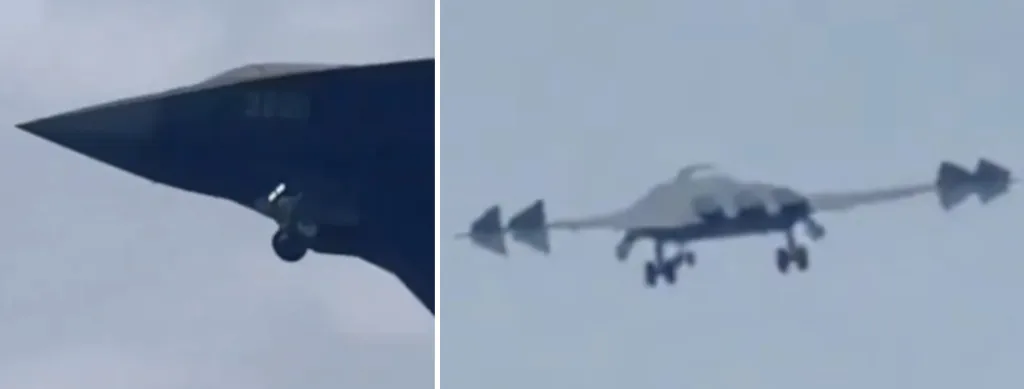
The second large flying wing (green arrow) is seen in the image sitting outside a hangar that is part of the sprawling new high-security facility on the opposite side of the complex. It features a ‘cranked kite’ planform with a wingspan of approximately 137 feet, although it would appear to have a significantly higher gross weight and likely lower operating ceiling than its wider stablemate. Based on our previous analysis, this variant is suited for the intelligence, surveillance, and reconnaissance (ISR) role, but could also work as a supersized unmanned combat air vehicle (UCAV) capable of performing very long-range heavy strike missions.

PHOTO © 2026 PLANET LABS INC. ALL RIGHTS RESERVED. REPRINTED BY PERMISSION

Both of these aircraft appear to have been flying now for a number of months. You can read about this here and here.

There is also what appears to be a stealth fighter-like drone (orange arrow) and a Xi’an Y-20 transport plane on the main apron in the image.

PHOTO © 2026 PLANET LABS INC. ALL RIGHTS RESERVED. REPRINTED BY PERMISSION

China has shown off a very large number of fighter-drone concepts, very loosely similar to the U.S. Collaborative Combat Aircraft initiative, in recent years. A Chinese military parade in 2025 was really Beijing’s major public thrust into this area of advanced fighter-like drone development. Since then, testing of at least one configuration has been ramped up considerably.

Just reviewing Planet Labs archived images of Malan in recent months shows the aircraft configuration seen above to be very active at the base. This relatively large unmanned ‘fighter’, analogous to a manned light-to-medium weight fighter in size, is a tailless design that features a very similar planform as the J-XDS 6th generation manned fighter. It also appears similar in shape to another CCA-like aircraft that has been photographed flying.

{"properties": {"satellite_azimuth": 83.64772013434832, "satellite_elevation": 58.40419858797328, "sun_azimuth": 90.97664616473772, "sun_elevation": 37.12678601431133}}
A Planet Labs image from nearly a year ago showing the same aircraft, which appears in multiple captures that have occurred of the base over the last year or so. PHOTO © 2026 PLANET LABS INC. ALL RIGHTS RESERVED. REPRINTED BY PERMISSION

One drone shown off during China’s big military parade looks very similar to it, in particular. But regardless, this general design appears to be a focus of testing at the base.

Chinese unmanned drone ‘fighter’ with similar planform seen during the 2025 military parade. (Chinese State Media)

Other mysterious aircraft have appeared at the installation as well, which is clearly set up specifically to run many programs within its high-security confines at any given time.

{"properties": {"satellite_azimuth": 134.24255252020987, "satellite_elevation": 70.6858137448926, "sun_azimuth": 218.76018285878664, "sun_elevation": 18.213544187554614}}
© 2026 PLANET LABS INC. ALL RIGHTS RESERVED. REPRINTED BY PERMISSION

Beijing is actively pursuing a range of flying-wing drones of various sizes, including large HALE drones, designed to perform a diverse set of missions, including ISR and strike. For many years, TWZ has assessed that this was an area of the Chinese aviation industry most likely to see an explosion of investment. The WZ-X is still the largest Chinese design in terms of wingspan that we have seen in this category to date. The cranked-kite design is certainly the heaviest.

{"properties": {"satellite_azimuth": 92.78512762121755, "satellite_elevation": 87.22022491740763, "sun_azimuth": 225.52953989924384, "sun_elevation": 17.97966327113246}}
The sprawling test base is used for drone testing but also advanced exercises, often blending drone capabilities and existing fixed-wing tactical airpower. The ramp shot above is from a large scale exercise in late 2025, note the dozens of drones on the east side of the ramp. © 2025 PLANET LABS INC. ALL RIGHTS RESERVED. REPRINTED BY PERMISSION

This new look at China’s two large flying wing combat drones comes as we got our first good look at America’s own RQ-180 HALE stealth drone, which has been flying for some time and is now being used operationally. It also comes as China is rushing ahead on all fronts with its next generation air combat ecosystem, and making impressively quick progress to show for its efforts. Still, a formidable looking aircraft doesn’t mean it can fight as impressively as part of a joint force as it looks, or survive against enemy air defenses. Regardless, China is clearly betting substantially on advanced and large unmanned flying wing designs.

Contact the author: ian.ellis-jones@teamrecurrent.io

Tyler’s passion is the study of military technology, strategy, and foreign policy and he has fostered a dominant voice on those topics in the defense media space. He was the creator of the hugely popular defense site Foxtrot Alpha before developing The War Zone.


Source link

China’s UN Envoy: Hormuz closure will dominate Trump-Xi talks | US-Israel war on Iran

NewsFeed

China’s UN Ambassador Fu Cong says maintaining the ceasefire and reopening the Strait of Hormuz are “urgent” priorities, warning the issue will be high on the agenda if it remains closed during President Donald Trump’s upcoming visit to Beijing.

Source link

US, Latin America countries criticise China’s retaliation over Panama Canal | Shipping News

China has detained nearly 70 Panamanian-flagged ships after a Supreme Court ruling on the Panama Canal, US officials say.

Bolivia, Costa Rica, Guyana, Paraguay, Trinidad and Tobago, and the United States have released a joint statement in support of Panama, while criticising Chinese economic retaliation, after a Hong Kong-based conglomerate lost a legal dispute over the management of ports on the Panama Canal.

Panama’s Supreme Court in late January annulled contracts that had allowed a subsidiary of Hong Kong’s CK Hutchison to administer the Balboa and Cristobal port terminals on the Panama Canal after deeming the decades-old agreements unconstitutional.

Recommended Stories

list of 4 itemsend of list

In their joint statement on Tuesday, the six countries claimed that following the court ruling, China has retaliated against Panama with “targeted economic pressure” on Panamanian-flagged ships.

China detained nearly 70 Panamanian-flagged ships in March, according to the US Federal Maritime Commission, a number “far exceeding historical norms”.

“These actions – following the decision of Panama’s independent Supreme Court regarding the Balboa and Cristobal terminals – are a blatant attempt to politicise maritime trade and infringe on the sovereignty of the nations of our hemisphere,” the signatories said.

US Secretary of State Marco Rubio said separately on X that Washington was “deeply concerned” by China’s economic pressure on Panama.

“We stand in solidarity with Panama. Any attempts to undermine Panama’s sovereignty are a threat to us all,” he said.

China has previously accused the US of “bullying” and trying to smear its reputation in Latin America, while it described the Panamanian Supreme Court ruling as “absurd” and “shameful”.


US Federal Maritime Commission head Laura DiBella said last month that Beijing’s detention of Panamanian ships had repercussions for both Panama and the US.

“These intensified inspections were carried out under informal directives and appear intended to punish Panama after the transfer of Hutchison’s port assets,” DiBella said.

“Given that Panama‑flagged ships carry a meaningful share of US containerised trade, these actions could result in significant commercial and strategic consequences to US shipping,” she said.

‘States know how vulnerable shipping is’

Panama’s decision to invalidate the contracts held by CK Hutchison’s subsidiary Panama Ports Company was made at a time of heightened media attention around the Panama Canal amid threats by US President Donald Trump to seize the strategic waterway.

Trump had made the approximately 80km (49-mile) waterway a focus of his second administration, alleging in his inaugural address in January 2025 that China was “operating” the canal and pledging that the US would “take back” control.

US officials allege that, in addition to targeting Panama and its interests, China has also retaliated against shipping giants Maersk and the Mediterranean Shipping Company (MSC), whose subsidiaries were granted 18-month contracts to administer the Balboa and Cristobal terminals after CK Hutchison was removed.

Representatives of Maersk and MSC were both summoned by China’s Ministry of Transport for “high-level discussions”, the Federal Maritime Commission said in March, while Chinese shipping giant COSCO has suspended operations at the Balboa terminal.

CK Hutchison, through its Panama Ports Company subsidiary, is separately pursuing international arbitration against the government of Panama and seeking more than $2bn in damages.

David Smith, an associate professor at the University of Sydney’s US Studies Centre, said that the Panama Canal dispute and China’s retaliation were the latest example of how shipping has become a political target, from Latin America to the Strait of Hormuz and the Red Sea in the Middle East.

“We have taken for granted that the world runs on container ships just freely sailing around the world,” he told Al Jazeera.

“What we’re seeing now is that states know how vulnerable shipping is. They know they can cut shipping lanes off if necessary. It should not surprise us from now on if ships and shipping in general become pawns in international politics.”

Source link

China’s DeepSeek unveils latest models a year after upending global tech | Technology News

Chinese startup says DeepSeek-V4-Pro beats all rival open models for maths and coding.

China’s DeepSeek has unveiled the latest versions of its signature artificial intelligence-powered chatbot, a year after its flagship model sent shockwaves through the global tech scene.

The Chinese startup launched preview versions of DeepSeek-V4-Pro and DeepSeek-V4-Flash on Friday as it touted its ability to go toe-to-toe with US rivals such as OpenAI and Google.

Recommended Stories

list of 4 itemsend of list

Like DeepSeek’s previous chatbots, V4-Pro and V4-Flash follow an open-source model, meaning developers are free to use and modify the source code at will.

DeepSeek-V4-Pro beats all rival open models for maths and coding, and trails only Google’s Gemini 3.1-Pro, a closed model, for world knowledge, DeepSeek said in an announcement on social media.

The “pro” version’s performance falls only “marginally short” of OpenAI’s GPT‑5.4 and Gemini 3.1-Pro, “suggesting a developmental trajectory that trails state-of-the-art frontier models by approximately 3 to 6 months,” the Hangzhou-based startup said.

The “flash” model has similar reasoning abilities to the “pro” version, while offering faster response times and “highly cost-effective” usage pricing, the firm said.

The release comes after DeepSeek-R1 stunned the tech sector upon its launch in January last year with capabilities broadly comparable with those of ChatGPT and Gemini.

Marc Andreessen, a prominent Silicon Valley venture capitalist with close ties to United States President Donald Trump, hailed the model’s release at the time as “AI’s Sputnik moment”.

The performance of the Chinese-developed model attracted particular attention as its developers claimed to have spent less than $6m on computing costs – a fraction of the multibillion-dollar budgets that are usual in Silicon Valley.

Some tech analysts challenged DeepSeek’s account of working with such scant resources, arguing that the startup most likely had access to greater funding and more advanced chips than acknowledged.

DeepSeek’s arrival on the scene prompted blowback in some countries amid concerns about data protection and Chinese government censorship.

Multiple US states, Australia, Taiwan, South Korea, Denmark and Italy introduced bans or other restrictions on DeepSeek-R1 shortly after its release, citing privacy and national security concerns.

Source link

Ronnie O’Sullivan in control against China’s He Guoqiang in first round of World Snooker Championship

World number one Judd Trump recovered from a slow start to defeat Gary Wilson in their first-round match.

Trump, the 2019 champion, lost four of the first five frames as Wilson, ranked 27th, moved into a 4-1 lead.

But Trump then claimed the final four frames of the session, including superb breaks of 128 and 77, to hold a 5-4 advantage.

However, Wilson, a three-time ranking event winner, made the highest break of the session with a superb 139 clearance in frame five.

In the second session later on Tuesday, Wilson made a break of 58 to make it 5-5, but Trump pulled clear by winning five in a row to seal a 10-5 success.

Trump, 36, has been top of the world rankings since August 2024 and will extend that run if he reaches the quarter-finals.

“I like being number one, it’s going to be difficult to keep it unless I do really well in the next season but I take a lot of pride in it,” he said.

Trump lives in Dubai but, because of the recent conflict in the Middle East, he left the area temporarily.

“I had to stay in Thailand for a month, and I managed to practice for the World Championship, but it has been more back to normal now,” he said.

“Dubai is still my base, I’ve been back there in the last couple of weeks and everything is normal.”

A downbeat Wilson, speaking to BBC Four, said: “It’s just constant disappointment. I am, and always have been since the age of 13, a better player than this.

“It’s a constant struggle. The yips are getting worse and I’m just riding through it.”

Source link

2026 World Snooker Championship draw: Ronnie O’Sullivan to play China’s He Guoqiang in Crucible round one

Seven-time winner Ronnie O’Sullivan will begin his bid for a record-breaking eighth World Snooker Championship title with a match against China’s debutant He Guoqiang at the Crucible.

O’Sullivan, 50, will start his first-round tie at the Sheffield theatre on Tuesday and conclude the match on Wednesday.

Sixteen players came through qualifying this week at the English Institute of Sport and will join the world’s top 16 ranked players at the tournament.

He, ranked 47th in the world, qualified for the Crucible for the first time with a win over England’s Jack Lisowski on Wednesday.

Zhao Xintong became the first Chinese player to clinch the world title when he won the 2025 event and will be involved in the first session of the tournament on Saturday (10:00 BST).

He will face England’s Liam Highfield, who advanced through four qualifying rounds.

The draw was made on BBC Radio 5 Live Breakfast on Thursday.

Elsewhere, world number one Judd Trump will take on Gary Wilson and Masters champion Kyren Wilson will be up against 19-year-old debutant Stan Moody.

Four-time champion John Higgins will take on two-time runner-up Ali Carter, while Mark Selby, also with four Crucible titles, faces 2024 runner-up Jak Jones.

O’Sullivan and Stephen Hendry both have the most world titles in the modern era with seven apiece, with O’Sullivan winning his first one 25 years ago, in 2001.

The 17-day competition begins on Saturday, with the final starting on Sunday, 3 May and concluding the next day – with full coverage of the tournament live on the BBC.

The Crucible has staged the World Championship yearly since 1977 and last month it was announced it would remain there until 2045, with the venue set to be redeveloped to add up to 500 additional seats.

Source link