childcare

The 7 Up kids ahead of final ever episode as they reflect on changing Britain

EXCLUSIVE: There were arguments aplenty and several walkouts – but Jackie Bassett and Peter Davies say they’d still do it all over again, given the choice

In 1964, 14 children aged seven were plucked from obscurity to take part in the TV experiment Seven Up!, which would follow them every seven years to see how their different starts in life would affect them.

The nation has long been fascinated by these kids, who have now (mostly) reached the grand age of 70. Two of them have died, along with the show’s long-term director Michael Apted, who went on to have a career making films in Hollywood.

Two of the most outspoken were Jackie Bassett and Peter Davies – and both say that, despite everything they didn’t like over the decades, they’d do it all again.

Left-wing Peter, from Liverpool, was working as a teacher at a comprehensive in 1984 when 28 Up aired. He was vilified by the right-wing press for calling the Thatcher government “the most incompetent, uncaring bloody shower we’ve ever had” and pulled out for many years after that, not returning until 56 Up, when he realised it was a good way to promote the music he was releasing.

“I think for a long time I felt cynical about the programme and the way in which individual stories were shaped,” he says now. “I’m thinking particularly back to when I did 28 Up – I think one of the headlines was, ‘Would you let this man teach your children?’

“At the time I was quite shocked because I’d never experienced anything like that – the sheer level of vitriol involved in some of the comments. I was quite taken aback.”

He held Michael partly responsible for the way in which he was portrayed. “I actually spoke to Michael and said, ‘You know, you’ve really condensed me there almost to a caricature – the angry young man from the North of England.’”

But “on balance” he’d still do it all again, because of how it turned out. “It’s not a decision I’d have taken lightly because there has been a downside as well.” This downside, in turns out, is the fame that the show has inevitably brought the participants. “I’ve found that intrusion difficult at times,” he admits.

Jackie has now left Scotland, where she brought up her three sons, and moved to the Norfolk coast. “I love my children, I love my grandchildren, but it was time for me to have a life and that’s what I’m doing now,” she declares. “It only took me 65 years to get there, but I’m finally pleasing myself.” She agrees that sometimes the public’s reaction to the show can feel a bit much. “The thing is, they see you for 15 minutes on that screen and suddenly believe they know everything about you. And that’s ridiculous, as most normal people would understand.”

Peter feels the show’s aim of showing the class system evolved into “something much bigger” but still didn’t explore certain areas enough. “I think something they missed was the emergence of a new lower middle class perhaps – people like myself whose parents were working class, but who were able, by virtue of a properly resourced welfare state and state education system, to move out of that background, go to university, change our lives.”

Prior to film-maker Michael’s death in 2021, Jackie enjoyed sometimes putting him in his place, famously challenging him on camera in 2005 for asking the women about marriage and children rather than anything else.

Later, she would point blank refuse to speak about certain topics. “He never saw us, never had contact with us. So he’d come back from America to do a film with me, or Peter, or whoever, and he just sat down and started throwing questions at you. And sometimes he didn’t like the fact that we didn’t want to answer them. I was not going to talk about something that would affect my family, my children – so I basically just told him no. He didn’t like it, but there wasn’t much he could do about it.”

That said, she also had warm feelings for him, and knew he gave her opportunities she wouldn’t otherwise have had. “I probably would do it all over again yes,” she confesses. “Because Michael opened up a whole different world to me with the screenings of his films and things like that. Obviously there’s points on the programme that I’ve not enjoyed, usually because I sort of opened my mouth without engaging my brain, but I think I would do it.”

She thinks it was outrageous to only have four girls alongside ten boys – comprised of herself and two friends Lynn and Sue, all from the same primary school in working class East London, along with solo upper-class Suzy, who liked ballet and thought she’d probably hire a nanny one day.

“The quote wasn’t ‘show me the boy and I’ll give you the man,’ it just says ‘give me the child at seven’,” Jackie points out. “I think it was partly because at that time women were mostly at home looking after children. Women didn’t have careers – you may have had one or two, but they were few and far between. It was just, ‘well, we’ll keep it to a minimum because they’re not going to go very far and they’re not going to do very much.’ But they knew they made a mistake. They really did.”

Peter says Michael actually admitted he’d got that wrong. “It was outrageously sexist, but this was the early 60s and people behaved in outrageously sexist ways all the time.”

They have not yet seen the final films and know that watching themselves for a final time is going to feel emotional. “I’ve been told to take plenty of tissues. I have no idea what to expect, and it’s probably going to feel strange,” Jackie says. Peter believes it will be “momentous”, reasoning: “It’s just the culmination of so much, isn’t it?”

The pair of them enormously enjoyed making the double-bill 70Up finale, with new director Asif Kapadia. “I think it had become a little formulaic,” Peter says. “So having someone new on board was going to shake things up a bit. And I think he did. Some of the questions he asked were difficult to answer, but they were interesting and made me work a bit harder.”

Jackie concurs. “I’ll second that. I think it had got very staid and in its box, and Asif came in like a breath of fresh air. It was far more relaxed, nowhere near as formal. I think it actually should have worked pretty well, fingers crossed.”

They feel that now is the right time to pull the plug. “The last thing we want is us all walking in with Zimmer frames or in wheelchairs or whatever age does to us. I think it’s very appropriate to end on 70,” Jackie says., laughing: “I have no idea why it fascinates people, not really.”

“It can’t go on forever,” Peter agrees. “Two of the cast members have gone, Michael’s gone. So yeah, this feels like the right time to end it.”

Seven Up! launched in 1964 with 14 participants – 10 boys and four girls – picked to represent different elements of the UK’s class structure. They are:

  • Andrew Brackfield – Upper class schoolboy who read the Financial Times aged 7, went to Oxford and became a solicitor
  • Bruce Balden – Schoolteacher who attended a prestigious boarding school and wanted to be a missionary
  • Charles Furneaux – Kensington prep school boy who became a documentary producer and left after 21 Up, returns this time – but only in audio
  • Jackie Bassett – Working class schoolgirl from East London who moved to Scotland and had three sons
  • John Brisby – Upper class schoolboy whose father died when he was nine, he became a barrister and is angry over his portrayal
  • Lynn Johnson – Jackie and Sue’s friend Lynn died from a brain condition in 2013. She thought she would work in Woolworths but was a children’s librarian
  • Nick Hitchon – Yorkshire farm boy who became a nuclear scientist and moved to the US in 1982. He is featured despite his death, from throat cancer, in 2023
  • Paul Kligerman – A carehome resident who moved to Australia and settled in to family life
  • Peter Davies – A middle-class lawyer and musician from Liverpool who dropped out after 28 Up but returned for 56 Up
  • Neil Hughes – Peter’s classmate, wanted to be an astronaut but became a local politician and preacher and has experienced homelessness
  • Sue Davis – Jackie’s schoolfriend who was a single mum in 42 Up and became a university administrator who has remarried
  • Suzy Lusk– Upper class schoolgirl who dropped out of education at 16 and later became a bereavement counsellor
  • Symon Basterfield – Brought up in a Barnardo’s children’s home, he has fostered more than 120 children.
  • Tony Walker – Working class “cheeky chappie” from Essex who dreamed of being a jockey but became a London cabbie.

– 70 Up: The Final Chapter, 15 & 22 September, 9pm, ITV and ITVX

Source link

I stayed at Croatia’s newest mega complex with all-day childcare and hundreds of sunloungers

Collage of an aerial view of Poreč, Croatia, a narrow street with buildings, a hotel pool area, and a balcony view of a resort.

TAKING it easy is a way of life for Croatians.

In fact, slow living is so ingrained in their philosophy that they even have a word for it — “Pomalo”.

Porec harbour and promenade Credit: Getty
Cobbled street in seaside town Credit: Getty

I watch the sun set over 23 miles of unblemished coastline from the balcony of my hotel room in Porec on the Istrian peninsula. It’s not exactly difficult to relax in a place like this.

With its pristine pine-fringed beaches, ancient cobblestone streets and tranquil lagoons, this 2,000-year-old town has become a big hit with holidaymakers seeking a laid-back getaway.

And its newest 5* hotel — Pical Resort by Valamar Collection — takes relaxation to a whole new level. From the moment I walk into the lobby, it’s clear I won’t have to lift a finger during my trip.

The friendly, attentive staff are quick to grab my bags and carry them up to my room, while a brief wave of the hand from a sunlounger sends someone rushing over to take my order poolside.

SAY HOLA

Spain to overtake France as most visited country – our fave holiday spots revealed


SANDS GOOD

I found a UK beach with crystal clear water & no crowds that felt like Greece

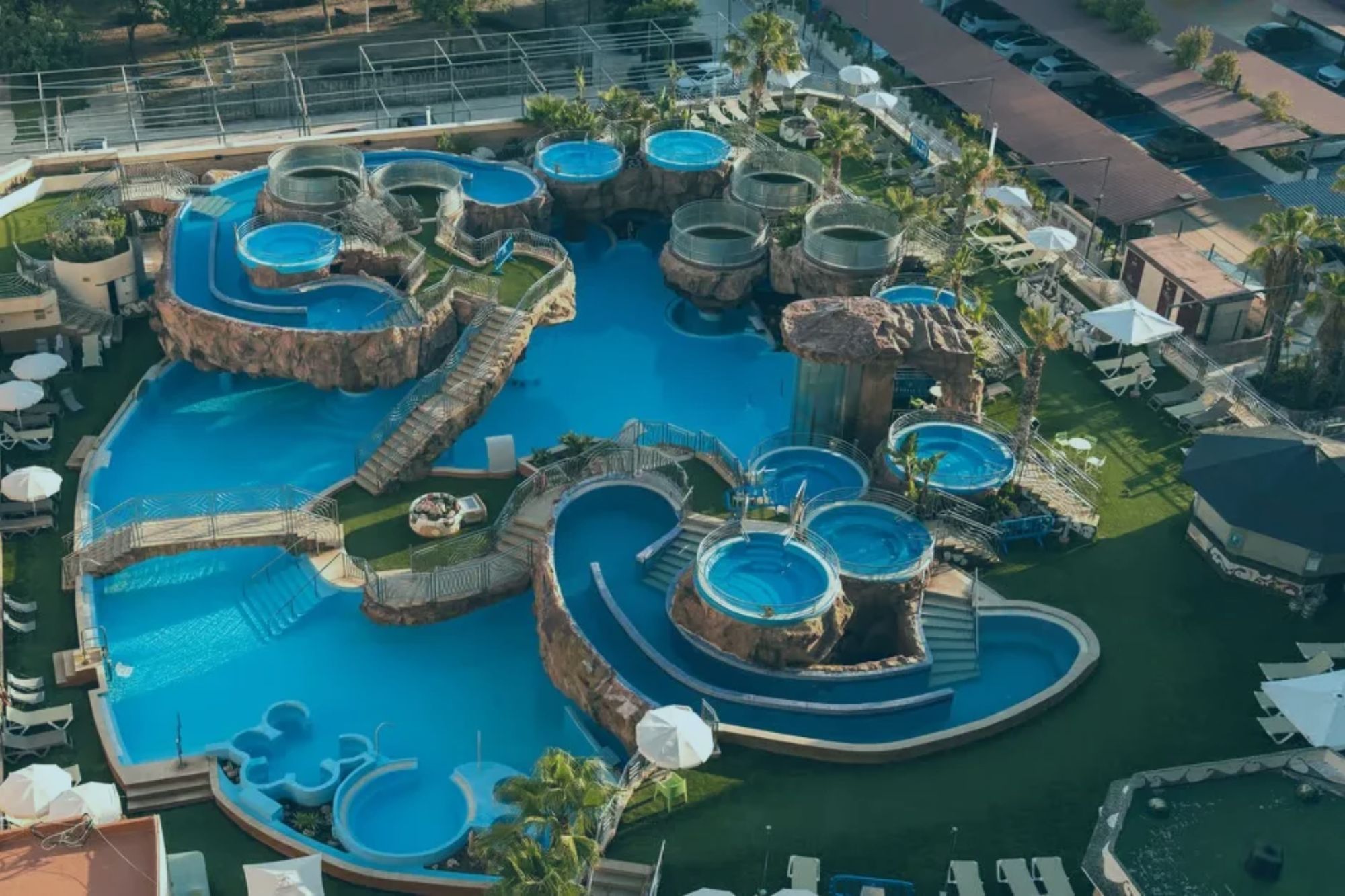
Set in more than ten hectares of Mediterranean greenery and with 514 rooms across three distinct wings, this mega-complex can cater for around 2,000 guests at full capacity.

But if I had any concerns about Pical’s size impacting the quality of its service, these quickly vanish when I learn it employs more than 800 staff members — one for every 2.5 patrons.

Making every guest’s experience personal is clearly something this resort prides itself on.

As I enter my spacious, modern room, one of the first things I notice is a “holiday scent” selection next to the bed.

Infinity pool at Pical resort Credit: Supplied
Outlook from 5* hotel Credit: Unknown

I’m encouraged to pick a fragrance from a scratch-and-sniff card and tick off my favourite so that housekeeping can deliver a reed diffuser during their turn-down service. I enthusiastically opt for Floral Essence with notes of jasmine and violet.

My room is in the hotel’s main building, which is designed for couples and solo travellers.

But it also has a family building with an all-day childcare service and 8,000 square metres of indoor and outdoor play facilities, including ball pits, water slides and a giant gaming room.

For those with more cash to splash, the hotel boasts 113 premium “V-Level” suites which offer dedicated concierge services and special dining perks.

As soon as I am unpacked, my first move is to check out one of the resort’s 11 swimming pools.

There is no risk of sun-lounger wars breaking out here — with hundreds of beds to choose from.

It takes all my strength not to drift off to sleep as I sink into the cushions under the warmth of the sun, the distant noise of the bubbling jacuzzi lulling me into a zen state.

If you prefer a livelier sunbathing setting, however, the Puro Beach club is where to head.

The Sun’s Emily-Jane Heap in Croatia Credit: Supplied
Michelin-star dining at Harry’s Piccolo Credit: Unknown

Before I can even put my bag down, the staff have already laid a towel out on my reserved sunbed and are ready and waiting to take my drink order.

It’s easy to see how this resort has earned its five stars. My elegant sushi platter was top-notch and I couldn’t think of a better way to spend an afternoon than sipping on a hand-crafted mojito while listening to the club’s resident DJ.

That evening I swap my chopsticks for silverware as I head to the hotel’s culinary pièce de résistance — its new Michelin-star restaurant Harry’s Piccolo.

Created under the direction of chefs Matteo Metullio and Davide De Pra, this gastronomic haven is heavily inspired by Porec’s unique geography, close to the borders of Slovenia and Italy.

Its seven-course tasting menu travels the tracks of the famous Parenzana railway which once connected the three nations by blending Italy’s fine-dining flair with Slovenian alpine herbs and world-class Croatian seafood and olive oils.

The result is sensational dishes like L-Astice: Adriatic lobster with pea liquor Bearnaise, asparagus, black truffle and green peppercorn.

The whole affair is rather pricey, at €190, but worth it if you’re celebrating or are really into your food.

And if fine dining isn’t your cup of tea, there are seven more restaurants on site.

The hotel’s main diner, More, offers buffet breakfasts and live cooking stations at dinner, while Quattro Terre focuses on local and Mediterranean cuisine, using locally sourced ingredients.

As my five-day trip nears an end, I save Pical’s crowning glory — its ESPA wellness spa — until last.

I begin my relaxation journey in one of its six Istrian-inspired saunas, infused with local herbs that release a heady scent, before moving into the Mediterranean steam bath, where I’m handed a home-made body scrub.

When the heat becomes too much to bear, I retreat into the aqua sensory room to cool off on one of the many floating water beds, before rinsing off in a sensory shower, which mimics a tropical rainstorm with red LED lighting and aromatherapy smells.

I’m also booked in for a 60-minute massage treatment with one of ESPA’s expert therapists, Sanda. After a lengthy consultation to tailor the treatment to my needs — including picking a scent from a selection of aromatherapy oils — she starts to work her magic on my achy shoulders.

And as I fight the urge to fall asleep yet again, I realise I may have taken “Pomalo” a bit too seriously.

GO: POREC

GETTING THERE: Easyjet flies from Gatwick, Luton and Bristol to Pula from £22.99 each way in September.

See easyjet.com.

STAYING THERE: Rooms at Pical Resort by Valamar Collection cost from £293 per night on a half-board basis in September.

See valamar.com.

Source link