In this week’s episode of The Envelope podcast, Chase Infiniti discusses her meteroic rise, her Emmy nomination for “The Testaments” and nurturing the ambition to become an actor since age 10.
Kelvin Washington: Hello, everyone, and welcome to this week’s episode of The Envelope. You have myself, Kelvin Washington, alongside my usual suspects, Yvonne Villarreal, Mark Olsen as well. It’s been a week, so I’m trusting everybody’s good. Yvonne, we’re coming to you here because you’re going to help us break this down. Don’t bug the eyes. Yes, we’re coming to you. The [TV] Academy, they’re making some changes when it comes to the live broadcast, and it can be a little bit confusing. That’s why we got you here. Tell us more.
Yvonne Villarreal: They announced that they will be moving five categories that are usually handed out during the ceremony, the Primetime [Emmys] ceremony, to a week prior and handing them out during the Creative Arts Emmys’ weekend. They say the decision is sort of to make space to innovate the live show and incorporate new things. You know, viewership is always something that they’re after. But it’s causing a stir in Hollywood because we’re losing some mainstays of the show, and that’s writing for a variety series, but also taking a big hit is the limited series or movie categories. We’re losing supporting actor, supporting actress, but also writing and directing. And people have a lot of thoughts. Mark, I want your thoughts. Kelvin, I want your thoughts.
Mark Olsen: I feel like there’s a disconnect between the people who watch award shows and the people who make and produce award shows, where I feel like those of us who watch them, we just want more sort of genuine moments from the talent, from the nominees. I want more speeches! And so taking away five categories, there’s going to be that much fewer speeches. I just can’t help but think of like Linda Cardellini, who’s one of the people nominated, she was on our roundtable earlier this year and just like a great presence, a stalwart TV actor, and to have to take away that chance for her to potentially get up onstage be really genuine, why would you not want that as part of your show instead having these kind of like canned comedy bits or, you know, hacky reunions plus canned comedy bits that nobody particularly wants.
Villarreal: It’s an awards show.
Washington: True, but maybe I’m Nobody in this case. We were talking about this a little bit earlier, you guys were making fun of the 1990s reunions there. I enjoyed it. I enjoyed seeing, I think it was maybe two years ago, when they had “Martin” up there and they had never been invited; they were kind of joking, “Oh, we never got invited” or “We never won an Emmy.” And so I think it’s been pretty cool. And I will say that this is the challenge for productions, when you’re trying to appease everyone. Is it about the awards? It is about the length of time — just speed this thing up? Is it about having the magical moments? And then you see the Grammys try to get these things right as well. You’re never gonna be able to please everyone. So I think it’s always a difficult balance. So we’ll see how it works out this year. But I’m looking at you, Mark, some people might enjoy those. And you too, those nerdy little reunion shows.
Villarreal: But in a time when it’s already hard to get a show visibility in this marketplace, and so many people don’t know what’s nominated anymore, when you’re taking away an access point for them to discover something or not tell them about a show, it’s a short-sighted change I think.
Washington: The only response I would add to that is that’s kind of where we are. Even if you keep up with television, movies and music, it seems to be a lot more word of mouth than historically where things are plastered everywhere. And even if you didn’t care about the particular thing, you saw it, you heard it. Now it’s like word of a mouth and just watercooler or just the algorithm telling you what to like.
With that being said, somebody who’s having a great run right now, Chase Infiniti. I know you had a chance to speak with her. Of course, “Handmaid’s Tale” did so well. Then there’s the spinoff, “The Testaments.” Tell me a little bit more about your chat with her.
Villarreal: Talk about, like, a breakout nomination this year. Chase has really been a star on the rise. She made her debut in Apple TV’s adaptation of the legal thriller, “Presumed Innocent” playing Jake Gyllenhaal’s daughter. And in recent projects, she’s played this young revolutionary, both in Paul Thomas Anderson’s “One Battle After Another” and now in “The Testaments,” which takes place after the events of “The Handmaid’s Tale.” She’s the daughter of a high-ranking commander, but she’s also the biological daughter of June, who’s Elisabeth Moss’ character. And this show is really about seeing the rebellion of young teenage girls and how they are sort of key to the inside resistance of toppling this regime. And so we talked a little bit about that.
Washington: All right, well, you got me a little nervous. You’re talking about the rebellion of teenage girls. You know, I’ve got a 9, a 7, and a 5-year-old, so that could be my future.
Villarreal: Let’s hope it is. They’re the future.
Washington: You’re right, you’re right. Yvonne and Chase, here they are now.
Chase Infiniti, photographed in late March ahead of “The Testaments” premiere.
(Jason Armond / Los Angeles Times)
Yvonne Villarreal: Chase, thanks so much for being here. Congratulations on your Emmy nomination. What do you want to remember about this moment, this feeling?
Chase Infiniti: Oh. I don’t know. I’m trying to take little pictures in my brain of everything and remember all of the influx of emotions that I felt that entire time, but also throughout the whole journey of making Season 1 of “The Testaments.” There’s so many things about it that I’m like — I just never want to lose that feeling. There’s a lot of [memorable] moments I had on set and also during the press tour and then even finding out about the Emmy nomination, which feels very crazy to say. But even finding out about that, there’s so many little things that I’m like, “I never want to lose that feeling. I want to keep it in my brain forever.”
Villarreal: Is it as thrilling as what you remember feeling when you booked that first role in a local production of “Hairspray,” when you were 10?
Infiniti: It definitely does. I also feel very grateful that with my job and with everything I get to do, I really try to keep intact how much I love the work and how much I love creating. That’s what helps it keep that same energy as me finding out I’m playing Crystal in “Hairspray” versus me finding out that I have an Emmy nomination.
Villarreal: Were you on Cloud 9 getting the news of Crystal?
Infiniti: Oh, yeah. I was so happy because I was it was the first time I ever had a name in a musical. And I remember when I was a kid, I watched the movie version of it every night for six months. Not a lie. Me and my sister would turn it on religiously after school and we would start singing “Good Morning, Baltimore.” It got to the point where we knew almost every line in the movie.
Villarreal: I feel old asking which version of “Hairspray”… Zac Efron? What was it about it?
Infiniti: It’s just catchy — everything about it. It just makes me happy, When I hear “Run and Tell That,” I just want to do twirls in my room. I love musicals so much and they make me so happy. If I’m ever down or need a little pick-me-up, I’ll literally just blast that soundtrack. I blast the soundtrack to “Pippin” or … “Shrek: The Musical.” I remember being in the production and it kind of brings me back to those happy memories I had ,or productions that I saw that I was like, “Oh, my gosh, this really makes me want to work towards being in something like that.” I love musicals.
Villarreal: It was just two years ago where the general public was starting to learn your name with your debut in Apple TV’s “Presumed Innocent.” Since then, you’ve navigated the film award season with “One Battle After Another,” and now the TV awards season with “The Testaments.” How do you make sense of what this moment is? Are there still things you’re getting used to? What have you enjoyed about this part of the job?
Infiniti: There’s a lot of things I’m still getting used to. Especially with “One Battle,” I think the biggest adjustment I had was people knowing me before I walked up to them — people that I’m massive fans of. I met Angela Bassett at something, and she came up to me and said my name, and I was like, “You’re Angela Bassett, and you know who I am?” That was like an “Oh, my gosh” [moment]. I’m still really adjusting to that. I feel like there’s a disconnect in my brain between like what I think people know of me versus what reality actually is. And my friends bring it up all the time and they’re like, “Chase, these people know who you are.” But I can’t wrap my head around that. It’s very strange, especially going from like a 0 to 100 situation. That’s something that I’m still trying to find an adjustment on in my brain.
[What have I] enjoyed about it? I’ve gotten to meet all of my superheroes, in a way. All the people that I’ve grown up watching on the screen and on the stage, [I’ve encountered at] all of these different events and in passing, and everyone could not be kinder and just getting to meet them and just pour into them how much they’ve shaped my life and shaped the creative work I want to do. Another adjustment thing is hearing them pour back into me too. That’s something that I’ve been getting used to. But meeting the superheroes of it all in my brain has been something I’ve really loved. Also getting to meet people who’ve watched “The Testaments”; like younger girls who’ve watched it and then really found a connection point with it, and it’s had an impact on them and their friends. That’s something I really cherish about getting to do what I get to do. I had it with “One Battle.” It’s really cool to see it happening again with “The Testaments.” That’s a very wonderful gift.
VIllarreal: Before we delve further into “The Testaments,” I do want point out this moment onstage at the Academy Awards. When “One Battle After Another” won best picture, Paul Thomas Anderson singled you out, calling you “My American girl” and the “heart of this movie.” Place me in that moment as Chase.
Infiniti: Well, I didn’t hear him. I just heard him say my name. I remember he was going down the list and saying names of different people, and I thought that it was something like that. I was touched that he even mentioned me onstage. Obviously, that movie has quite literally changed my life and that entire cast. And I love Paul so much. So I didn’t hear him onstage, and it wasn’t until afterwards that my parents had sent me a screenshot of the [closed] captions from that night. They were like, “This is what Paul said about you.” I just remember feeling so honored that I got to be a part of something that changed my life, but [it was a film that] also really, I think, changed a lot of people’s lives as well; they connected with it. I can distinctively remember every single day on that job. I just remember feeling such a rush of emotions after reading [what he said] because I love that movie and I love Paul so much. I could not be more grateful for that opportunity and for the opportunity to play Willa, let alone get to be a part of the crazy world that is a Paul Thomas Anderson set. But I learned so much. There’s so much I could say about it.
Villarreal: How did playing Willa inform how you thought about Agnes, who’s also this young revolutionary in the making, as you were putting yourself on tape for “The Testaments”?
Infiniti: I signed on to it with one script in mind. Obviously, I had read the book beforehand, so I had an idea of what she was going to go through, but I didn’t necessarily know how it was going pan out onscreen. The biggest help Willa [provided] beforehand going into that is, I feel like I, by nature, have a little bit of a rebellious spirit, but I really had to turn it up with Willa. I think that being able to access that through Willa and then shape it differently for Agnes, given the circumstances of where she is, was the biggest key between the two. They do share the strong sense of rebellion. Granted, Agnes doesn’t know where it comes from. She doesn’t really know how to handle it, necessarily. But I think that that was a nice way into Agnes and creating her world mentally of where she is and also the inner turmoil of, “I know that there’s this thing happening inside me, but I don’t really understand it.” I think [that] was the biggest cheat code from Willa to Agnes.
Villarreal: What was it about “The Testaments” that spoke to you and made you want to tackle the material?
Infiniti: Just from that one script alone that I read before I signed on, it was hidden that it was “The Handmaid’s Tale,” but you can get a sense of what the world is based off of that initial script. I just fell in love with how detailed it was. It didn’t feel like there were any question marks in the world, and I think that diving into something [like] that felt very interesting because it’s not otherworldly but it feels otherworldy in the sense of the way that they speak and the way Gilead itself looks on paper versus on the screen. That was something that I found to be very interesting. But I think with Agnes specifically, I really love the amount of love that she has for her friends, because that’s something that I feel very strongly about. My friends and my family, but especially my friends, are the people I cherish most in my life. My loved ones are near and dear to my heart, and I will do anything for them. That’s something that I really loved about Agnes. That makes me very happy to see, that even in a world that’s so dark and so dim — even if she doesn’t view it as that, it is dark and it is dim for a young girl in Gilead —she still has so much love and so much hope for her friends. And I found that to be very inspiring.
Villarreal: Did you have any hesitation about the heaviness of this fictional world?
Infiniti: I don’t think that that necessarily terrified me, because I think that I have this very privileged ability to step into this world that seems like it’s so far outside of what we are, I guess, used to — but it’s really not. Nothing that Margaret Atwood writes is fiction. It is all based off of history or things that are happening at the time that she’s written it. I knew that it was going to be very relevant. I’m in this very privileged position where this isn’t my reality, but this is the reality of so many women around the world. And I thought when I read this script that this was a way for people to not, I guess, become desensitized to seeing these things, because I think that we’re in a world where it’s so easy to just turn off your phone, scroll past something, and just ignore what’s actually really happening. With “The Testaments” and with the things that these girls go through, I truly feel heartbroken. But if this in any way can wake people up, can help people continue to ask questions and really question their own environments, that was something that I wasn’t scared of. And I really felt empowered to join something that was doing that. And I am also grateful that on that set, it never felt like the material was too heavy for a day because our entire cast and our entire crew kept the energy on set very light. And if there was ever a point where a day was extra heavy, I knew that I could turn to Lucy [Halliday, who plays Daisy] and she would always be there for me. I know that I can turn to one of the directors and they would always be there, or even one of the [production assistants]. Everybody on set was very forthcoming with kindness and always very open. That was something that helped to keep the heaviness of the subject matter [from] going home with us.
Villarreal: Agnes has only known obedience and repression. She’s very controlled with her emotions. As somebody with roots in musical theater, did you have to curtail some of those instincts that you might’ve had to be a little more expressive? How was it settling into Agnes?
Infiniti: It was honestly pretty easy because you get into the space, you get into the world, and you instantly are transported and you get little context clues based off of the things that you see in Agnes’ room versus the things that you’ve seen in the school — or the absence of things. The absence of things really helped to start to put me in a box in a way — not the negative connotation of that — like putting the costume on. It really helped for me to feel the restriction of the world to understand what Agnes’ mind is, and getting to see that from the outside and then getting to step into it. It wasn’t that hard to shut off that part of my musical theater brain, but I think part of that is also I’ve learned how to maneuver through that just based off of “Presumed Innocent” and “One Battle,” because both of those parts are also very, very much so not musical theater-y at all. So I think that was also something that I had the privilege of learning on both of those sets.
Villarreal: Something that stands out with Agnes is we’re witnessing her awakening. Gilead is all she’s ever known. And she’s very dutiful to the practices of that society. But she’s grappling with coming into her identity and feeling this gap of her internal thoughts and feelings and what society tells her to be. What was important to you in having those two realities live side by side?
Inifiniti: The one thing I never wanted her to lose was her sense of love. She is a character who that is at the root of most of her decisions, especially when it comes to the final episodes with Becka [played by Mattea Conforti]. I think the love that Agnes has in this world is something baseline I never want to lose. I really tried to maintain that throughout.
There’s so much that you keep to yourself — your inner thoughts, your inner personality in a way — versus what you outwardly show the world. I just had to turn up the extremes when it came to Agnes, and really make sure to keep those things that she keeps close to her heart guarded. And put on this almost armor in a sense of what she views to be the most perfect version of herself for the outside world. And then watching that kind of crumble, those layers are peeled apart based off of what happens to her and what she sees happen to her friends. But also, there’s a point in everyone’s life where they realize, “Oh, what I had been raised under the belief of is actually not the reality. Whether it be something like that or whether it be an idea or an ideal that you have about the world or about yourself or your morals, just based off of what you’ve been raised with. I think that everybody has a point in their life where they have to face a version of reality that they’ve been told versus what actually is reality. There’s things that I’m still learning, and there’s still things that I’m questioning just based off of what I see in my personal life, and then also with my friends or what my family goes through.
Villarreal: A key character in the show is menarche and the menstrual cycle. We see how it’s weaponized, but we also see how it gives these young girls their power. What was it like to explore that?
Infinti: The thing I honestly really enjoyed about it is the openness of it. Like, you know when you go to the bathroom — and this is perfect podcast talk — and you’re taking your pad or your tampon to go change, but you’re hiding it because you’re like, “I don’t know if I want anybody to see it” [or hear] the crinkling of everything. But I think that the openness of everything in the show — granted, circumstances are completely different — but the openness that they have with it, I found to be very freeing and refreshing in a way. That was something, especially when we started shooting, that we all talked about, because we were like, “We’ve never been in a place where it didn’t feel like there was a stigma against it.” It felt like we were almost encouraged to talk about it. Getting to put this show out into the world and letting girls see that there isn’t something that they should be afraid of, but also letting them see that this is normal. This is not something that we should be scared of, let alone try to hide, because it’s a part of womanhood. It’s also a part of girlhood and a point of connection between younger girls. Getting to see it on the screen and see the way that these girls talk about it, ignoring the society of Gilead and the amount of pressure that the men put on them in this society, that connection that they have with those few things that span across culture, that is something that we were all very happy to kind of have that openness with something that we’ve felt so scared to talk about, especially at like 14 and 15.
Villarreal: Scared to experience too.
Infiniti: I remember when I got my period for the first time I was like, “What is happening? I don’t know what is going on.” The first person that you call, if it’s not your mom or another maternal figure in your life, is your friends. Because they’re normally the person closest to you in proximity if you’re at school or if you were at an after-school activity or something like that. Getting to have that openness felt very refreshing to have on set.
Villarreal: There was so much openness that there was a menarche playlist curated by director Mike Barker. Tell me the backstory on this.
Infiniti: We did. I’m trying to remember how we found out about this playlist. We were doing a camera test for the costumes, and I remember Mike just putting on this playlist and he’s like, “I like putting up these songs for everyone to listen to” because there was no dialogue in this little camera test between me, Mattea, Rowan [Blanchard], Lucy, Brad [Alexander], Amy [Seimetz] and Mabel [Li] — I can’t remember if I might be forgetting somebody else, and I’m so sorry if I am. But it was a bunch of the cast and then there was also some pinks in there just to see how everything looks on camera. And we were hearing all these different songs playing. We’re like, “Wow, this is great. Thanks for putting together a playlist, Mike.” At some point, Lucy went to grab his phone to look at what the song was and his playlist was open, and she’s like, “Why is the playlist called ‘The Menarche Playlist’? And after that, it just became us trying to get him to approve a song that we would suggest.
Villarreal: I remember you telling me Britney Spears’ ”… Baby One More Time” was on it. But I had wondered who else made the cut.
Infinti: “… Baby One More Time” was on it. I think that was the first song on it, but there would be points in lunch — we’d all eat lunch together — and we’d be like “OK, Mike, what about this one for the menarche playlist, or what about about this one?” We would all secretly hope that they would get added to the show.
Villarreal: Did one of your suggestions get added?
Infiniti: There are songs on there that I don’t even remember. So one of them probably did get added. I just don’t remember what it was.
Villarreal: Agnes is somebody that doesn’t really experience culture. We don’t know what kind of music she likes, what kind of TV or film she likes. And you’re someone that’s very much into culture, at least from what I’ve seen. Were you thinking about what she might like? How did you think about her backstory with that kind of absence?
Infiniti: I was really just relying on what you saw of her in “The Handmaid’s Tale,” and that was the extent of what I would let a part of her backstory be because she doesn’t remember much about her childhood. Once she becomes conscious, in a way, in Gilead, all I did was rely on the things that I knew that she liked and really try to remind myself, “She doesn’t know what a movie is. She knows what ‘Jaws’ is, but she doesn’t really have an understanding of what watching a movie is like. She doesn’t know what YouTube is, she doesn’t know what a phone is.” I had to keep reminding myself, especially at the beginning, to not put those things in the forefront of our minds, unless, of course, like you’re a Pearl girl who has prior knowledge of everything. A lot of it was just reminding myself, “You don’t know what this is, she doesn’t know what this is.” If I were to meet Agnes right now, she would probably think I was crazy because she just doesn’t understand a lot the things I’ve seen, and the things that we use in our day-to-day life, and I really tried to make sure to keep that intact, but also relying on the bits of information that I had from “The Handmaid’s Tale” going back to the show. And also, of course, we had Bruce Miller, so I could ask him anything.
Villarreal: What would you, Chase, expose her to? If she were to come to you, what she should be listening to or watching, what’s the guide you’d give her?
Infiniti: The crash course to being 14? I would show her One Direction. I’m sorry. That is something that is so quintessential to being a 14-year-old, especially me being 14. I would be like, “Agnes, I see the things that you love and you’re obsessed with. I’m going to show you the thing that I was in love and obsessed with when I was your age.” I would be very curious to see how she would react to hearing One Direction for the first time; hearing “What Makes You Beautiful,” that would be interesting to see. I would show her something that is representative of me being her age. I still am a fan. I’ve always been a fan my whole life, but especially One Direction, that’s probably something I would show her.
Villarreal: Who was Chase at 14? You talked earlier about having a little bit of that rebellion in you. And after playing these two characters back to back, what have you sort of learned yourself, about your power or finding your voice, especially in an industry like Hollywood?
Infiniti: Something that I realized when I was probably about 13 or 14 is, I used to be very upset when people would underestimate me. I found a way to, I guess, not make it my superpower … but use it as opposed to [letting it be] something that would defeat me. [I would] use it as something to continue to motivate me to work towards the goal that I already had because there’s always gonna be people that underestimate you. There’s always going to be people in the world that want to pour negativity into you when you’re truly just living your life, working towards the things that you want. That was something that I realized pretty young because I knew at 10 that I wanted to be an actor. And so at that point, I kind of made a shift in my mind where I was like, “OK, I need to start working towards the thing that I want to do.” At 13, people were like, “Why are you so motivated to do this? It’s a bit embarrassing that you want to be an actor. What makes you think you can do that?” And I was like, “Because I want to do it.” I never had a doubt in my mind that this would be the thing that I would get to do because that was something that my parents always told me. They were like, “Dream big because the dreams that you’re imagining can be your reality, especially if you work hard enough towards it.” And I feel very lucky that I get to do the thing I’ve always dreamed of doing.
Villarreal: How does that live side by side with also learning how to deal with rejection so young?
Infiniti: It’s a lot of tears, a lot of sad days, sad weeks, conversations with my friends, conversations with parents. But from being underestimated, I remember my dad being like, “You have to get comfortable with ‘no.’ And it’s not going to be fun. It’s not gonna be something that you’re excited to hear, because no one’s excited to hear that they didn’t get something that they really wanted.” Now I’m at a point where I’ve really learned how to process it and not let a no or a rejection affect my view of myself or affect my view of a performance or my abilities to do anything. It took a long time to learn, and I’m still nowhere near perfect, but I’m definitely at a place that’s better than when I was 13 because it is hard for somebody that young to get that amount of rejection. It’s also hard for somebody at my age to handle that level of rejection, especially when you get so close to something. I have to give that credit to processing those things to my parents because that is all them. I had many tear-filled nights when I was a kid because I was so sad that I didn’t get a solo in something, and they’re like, this doesn’t mean that you’re not talented. I’m also somebody who believes the right things will find you. And they’re [my parents] also the people that kind of instilled that in me too.
Villarreal: Does that reframing of no also give you the confidence to approach Leonardo DiCaprio and Benicio del Toro and say, “Will you make a TikTok with me?”
Infiniti: It honestly was like a lot easier than I thought it was going to be. I was very specific. I did lots of research because I also was like, “I want it to be something that they can look at and also laugh at.” They can enjoy it.
Villarreal: Do you think you’ll get there with Ann Dowd? A TikTok?
Infiniti: I would love to. I don’t know what it would be, but I would love to make a TikTok with Ann Dowd one day. If it could be like all the girls on set making a TikTok, I would be very happy. I do have some planned. So, we’ll see.
Villarreal: Margaret Atwood makes a cameo in the finale of Season 1. How do you even talk to Margaret Atwood when you meet her? What was that experience like for you?
Infiniti: The person who was probably the most shocked was Lucy because Lucy Halliday is the biggest Margaret Atwood fan I think I’ve ever met. I had the gift of getting to witness Lucy meeting Margaret for the first time. But meeting her — she’s so kind. [Producer] Warren Littlefield says this all the time where he’s like, “You can’t talk to Margaret Atwood and not learn something with every conversation.” I just remember being very quiet and listening to her talk and listening to her ask questions of me, ask questions of Lucy, but we would just pour into her and be like, “Thank you so much for your work because you truly have touched millions.” She’s also so funny and so witty and very charismatic. I remember being very nervous beforehand, but she made it very easy for our nerves to go away. The highlight was getting to see Lucy meet Margaret.
Villarreal: You’re about to head out to Canada to start production on Season 2. You’ve seen two scripts. What do you hope to see for Agnes in Season 2?
Infiniti: I hope Agnes is happy, and I hope that she can continue to push and find her happiness. I hope that she doesn’t lose her spark, and I hope that’s something that she continues to explore and understand why she is the way that she is. Those are two hopes that I have.
The path of totality crosses the western part of Iceland and they hope to find a spot in the Westfjords peninsula to witness it.
Although they’ve heard rumours of roads being closed to stop too many people overwhelming the area, so are keen to get there a couple of days before the spectacle.
Samantha, who her husband describes as an “obsessive travel planner”, is all over the Facebook groups and social media pages being used by eclipse hunters to share information and advice.
She’s expecting a good turnout given the number of eclipse glasses she’s seen people with in Iceland. “They’re really trying to prepare everybody,” she says.
“What I expect, as we start inching westward, is we’re going to see more and more of them.”
Andrew Wills is also going to an island to see the eclipse, albeit a much warmer one: Majorca.
The landmark, believed by some to be a Bronze Age bowl barrow, offers panoramic views across the Cornish countryside and out to the Atlantic. It was a cloudy day, remembers Andrew.
“We didn’t see the shadow rushing across the sea towards us, though we did see the dawn appearing and it getting closer very quickly,” he says. “It was awe-inspiring.”
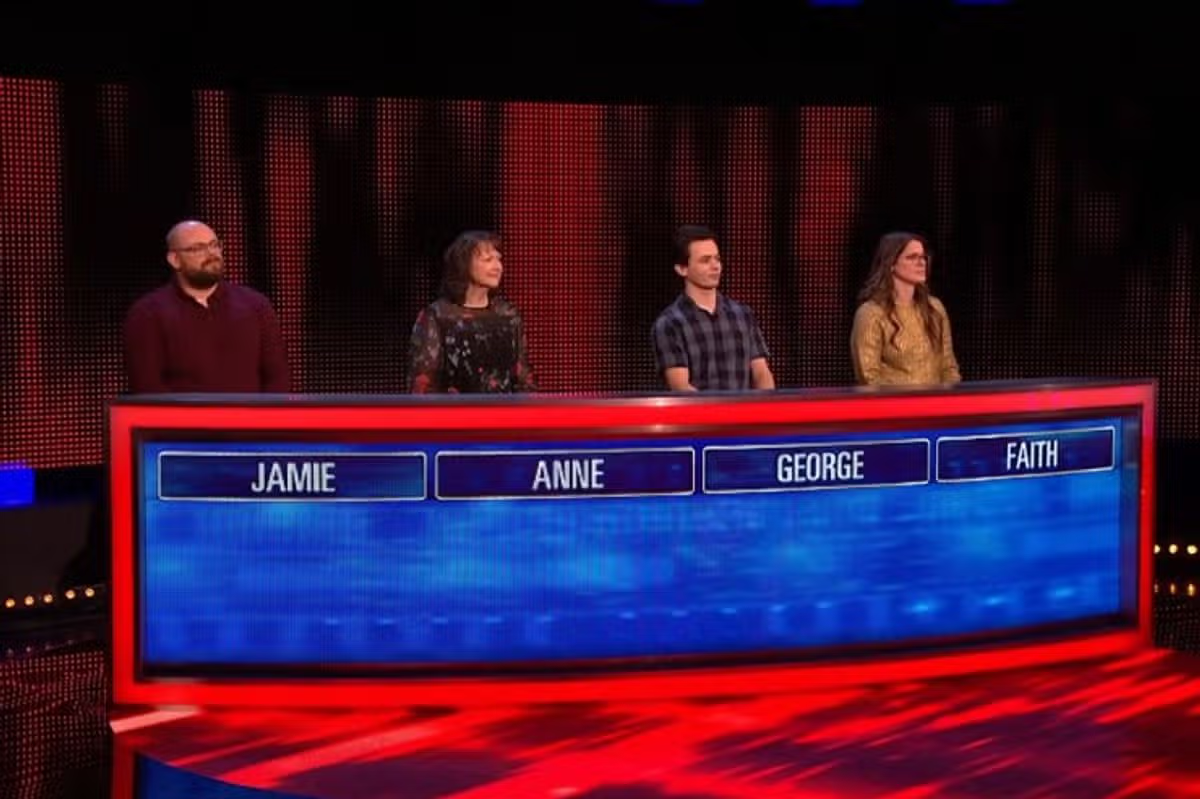
The Chase Around the World contestants went up against each other in Paris in the latest instalment
Bradley Walsh hosts the ITV show(Image: ITV screengrab)
The Chase fans all said the same thing as the ITV show’s spin-off arrived in France.
New series The Chase Around the World started last month and sees six pairs of contestants on a global adventure, where they are tasked with solving a series of questions and challenges in different countries to try and track down the Chasers and host Bradley Walsh. The pair who arrive last in each place will then have to face the Chasers in a quiz.
In the latest instalment, the hopefuls were in Paris, where they had to answer a series of French-themed questions. In one segment two of the pairs had to stay at a classic French brasserie and answer food and drink questions before they could continue on with the race.
However, some viewers felt it wasn’t a fair comparison as one duo was offered snails and the other was offered garlic.
Mother and daughter Nicola and Maddie were first and were told: “Here you’ll need to answer three multiple choice questions correctly. Get one wrong, and you’ll be frozen out of the game for five minutes.
“But there’s a shortcut. Wrong answers can be removed if you have the stomach for it.” They were then told they could “eat a snail or clove of garlic to remove a wrong option”.
Maddie looked horrified, exclaiming: “I am never ever in my life going to try a snail. The thought of it makes me genuinely nauseous.”
But when Nicola decided that she wasn’t confident about the question they’d been given, she decided to tuck in. “It was vile… it was gritty,” she said afterwards.
However, when father and daughter Ashwin and Nikita entered the restaurant, they had a choice of garlic and onions.
“Nikita and Ashwin are vegans – snails are off the menu, replaced by raw onion and garlic,” the voiceover explained.
Some viewers weighed in on X as it aired, with one insisting: “Can’t compare onion to snails.”
“Raw onion is much easier to eat than a snail…. probably,” someone else posted on the platform, which was formerly Twitter.
“Raw onions instead of snails… not a fair comparison,” said someone else. Another likened it to a scene from I’m a Celebrity… Get Me Out of Here, joking: “This snail eating is like watching a Bushtucker Trial.”
MO Gilligan revealed the shock moment he was hunted by SIX police cars and a helicopter – before officers recognised him.
The comedian, 38, recalled the time police mistook him for someone else and tailed him after initially believing the car he was driving was “stolen”.
Mo Gilligan recalled the time he was ‘tailed by six police cars and a helicopter’Credit: PAThe comedian shared the revelation on Louis Theroux’s podcastCredit: Getty
Luckily for Mo, some of the officers were fans of his and recognised him from off the telly, quickly realising they had made a mistake.
Appearing on the latest episode of The Louis Theroux Podcast, Mo said: “One time I got pulled over by the police and there were six cars, and this was when I was doing TV and stuff. I’ll never forget that one.
Sign up for the Showbiz newsletter
Thank you!
“At that point you have to kind of make a joke out of it.
“It was me and a mate of mine, who’s my stylist. They followed us for ages and then they were in an unmarked car and pulled me over and there were probably about six cars and a helicopter.”
A stunned Louis was left shocked and asked: “A helicopter?”
Mo continued: “Swear on my life… I got the video as well,” to which Louis asked again: “You were being tailed by a helicopter?”
The TV presenter went on: ” Yeah. When the helicopter came, it was weird because obviously I hadn’t done anything, but I was like, ‘Ooh, wow, this is a little bit exciting’.
“But also knowing, I’m like, ‘You’re really wasting your time’.
“Then some of the officers, I could tell they was a bit like, ‘Oh, I think I recognise that guy’.”
Mo then explained that the cops thought he was driving a stolen car but failed to give him more information when quizzed.
He shared: “They said that the car that I had was previously stolen. And I was like, ‘Is it the same car, colour, or is it the same number plate?’ I said, ‘They’re two different things’. But they never really gave me an answer.
“In the end, it was like, ‘Oh, it’s just not the same car’. And once they knew, everyone just scattered.
“Every, every car was just like, ‘Oh, well, it’s not him then’. Helicopter gone.”
Documentary-maker and podcast host Louis was keen to know if the police recognised him.
Mo said: “Yeah. I think the officers then started recognising me.
“Things changed massively once they realised it wasn’t me.
“They were like, ‘Okay, cool, yeah, it’s fine’.
“But part of me was thinking, ‘This is a lot. I don’t need six cars and a helicopter’.
“At the same time, it did feel a bit like GTA when you get five or six stars.”
Last September, The Sun revealed that Mo had welcomed a baby with his model fianceeTaia Tulher.
A source said: “Mo and Taia have their baby and are in a bubble of bliss.
“She gave birth quite a few weeks ago now and she has been getting back to normal life.
“They are keeping their baby’s gender and name for just close friends and family but they’ve been sharing the news of the baby’s arrival with people now.
“Mo and Taia couldn’t be happier.”
It is Mo’s second child — he had a son named Rudy with model Selina Christoforou in January last year.
The deal, announced a few minutes before the Angels’ series finale against the Houston Astros, could mark the beginning of an extensive rebuilding process for the Angels, who entered play Wednesday with an American League-worst 42-66 record and 13 1/2 games behind the Rangers in the AL West.
“We know we have to start shaking up this roster, and today was day one,” Angels interim general manager John Mozeliak said. “Clearly, where the Angels are at right now, we need to do things differently.”
Silseth, 26, was one of the Angels’ top relievers, going 3-2 with a 2.72 ERA in 47 games this year. O’Hoppe, 26, appeared in 75 games, batting .209 with 23 RBIs.
Arredondo, 19, hit .247 with eight home runs, 15 doubles and 47 RBIs in 86 games for low-A Hickory this season. He signed with the Rangers as an international free agent out of Mexico in 2024.
Former “The Ring” and “Lilo & Stitch” child star Daveigh Chase, who died while homeless in June after years of battling drug addiction, leaves an estate worth nearly half a million dollars.
Probate documents filed July 8 in Los Angeles County Superior Court say Chase — legal name Daveigh Elizabeth Schwallier — left behind about $400,000 in personal property. The late actor’s mother, Cathy Chase, submitted the documents and filed a petition to become the administrator of her daughter’s estate.
The court filings also note that Daveigh Chase died without a will, is only survived by her parents, and confirm that she was homeless at the time of her death. The last known address for Chase appears to be a home in Chatsworth.
Chase died June 16 in a hospital at age 35. In initial reports, her father, John David Schwallier, and her boyfriend said the actor died of complications from bacterial meningitis and a blood infection. But the medical examiner’s report disclosed that Chase died of AIDS, which is caused by HIV, as the primary cause of death. The report also listed chronic polysubstance use — using more than one drug or substance at the same time or within a short period — as a “significant condition.”
Chase started her acting career in the late 1990s with minor roles in popular TV series, including “Sabrina the Teenage Witch,” “Charmed” and “ER,” and starred in multiple beloved movies at the turn of the century. In 2001 cult classic “Donnie Darko,” she was Samantha, the younger sister of Jake Gyllenhaal’s troubled Donnie Darko. She would reprise the role eight years later for the sequel, “S. Darko: A Donnie Darko Tale.”
In the same year as “Donnie Darko,” Chase lent her voice to the American dub of Hayao Miyazaki’s tender “Spirited Away,” voicing its protagonist Chihiro. The film won the animated feature prize at the 2003 Academy Awards.
Chase was known for her versatility, demonstrated by her roles in “Lilo & Stitch” and “The Ring” in the same year. In the latter, she played ghost girl Samara Morgan.
In the aughts, Chase also appeared in more than 20 episodes of the Fox sitcom “Oliver Beene” and more than 30 episodes of HBO’s Emmy-nominated Mormon family drama “Big Love” as cunning teenager Rhonda Volmer. After the hit series, Chase’s career slowed and she appeared in lower-profile projects. Her final credit was a voice-acting role in the 2016 video game “Let It Die.”
A hearing for Chase’s probate case is set for Aug. 12.
Times editorial library director Cary Schneider and staff writer Hannah Fry contributed to this report.
Delta Air Lines Inc. Chief Executive Ed Bastian said travelers care more about their seat than extras like lounge access or limousine shuttles often thrown into costly tickets, as he defended a stripped-down premium product that has irked some customers.
“Consumers want different value decisions to take,” Bastian said in a Bloomberg Television interview on Monday. “If you can give people the opportunity to sit in first class, they may not want different elements and they may not need to go in the lounge.”
Delta is bringing the basic-economy playbook to Delta First, Delta Premium Select and Delta One, offering passengers the same onboard seats, meals and service at a lower price in exchange for fewer benefits. Depending on the product, restrictions can include reduced mileage earnings, lower checked-bag allowances, fees for changes or cancellations and limits on lounge access and advance seat selection.
“What consumers care more about than anything is the seat,” Bastian said. “All the other things are nice, but it’s the seat and the comfort of the seat that’s most important.”
Bastian’s comments contrast Delta’s recent investments in its ground amenities. The airline has spent years opening and expanding swanky Sky Clubs and Delta One lounges, which remain in such high demand that crowding and lines have prompted tighter access rules.
Delta last month opened the first phase of a second Delta One Lounge at Los Angeles International Airport, a 4,000-square-foot space with table-service dining, showers and a premium bar. By 2028, Delta plans to operate four lounges at LAX spanning 60,000 square feet and seating more than 1,000 guests, part of a global network that now includes five Delta One Lounges and more than 50 Sky Clubs.
“One of the things we’re disappointed about is the continued segmentation of the fare structure,” Jefferies analyst Sheila Kahyaoglu said in an interview with Bloomberg Television, referring to how Delta has refined its premium offering into different, sometimes hard-to-follow groups. “You could accidentally get locked out of a lounge if you don’t pick that main business fare.”
Delta last week reported second-quarter earnings that beat Wall Street expectations despite recording the highest quarterly fuel expense in its history. The airline earned an adjusted $1.56 a share, topping analysts’ estimate of $1.51, while revenue rose 14% from a year earlier and capacity increased just 1%. Delta also reaffirmed its full-year profit guidance.
Bastian said strong demand for premium, corporate and international travel helped offset the surge in fuel prices caused by fighting in the Middle East. Although fuel costs eased as the war in Iran appeared to be winding down, renewed US military strikes have raised the risk of another escalation and kept energy markets volatile.
The CEO reiterated that Delta would continue pricing tickets to recover those higher costs and did not expect airfares to decline. The new basic premium fares give the airline another way to appeal to price-conscious travelers without broadly discounting its most valuable seats.
The strategy also allows Delta to widen the pool of passengers who can afford premium cabins while still charging more to corporate travelers and frequent fliers who value flexibility, loyalty benefits and lounge access. It reflects how airlines are increasingly selling each component of the travel experience separately.
But it risks alienating premium and loyalty travelers by introducing complexity or making it seem harder to get the same level of access.
“Delta’s change to its premium-seating offerings suggests competition is weighing on pricing at the front of the cabin, a negative for earnings,” Bloomberg Intelligence analyst George Ferguson said.
Every morning, Harvard-Westlake tennis player Chase Klugo’s house shakes like it’s in the middle of a small earthquake. His alarm clock, a big and bulky machine that’s Bluetooth-connected to the house’s fire alarm, rattles his room until he finally shuts it off.
Klugo’s moderate-to-severe hearing loss requires hearing aids to navigate life, a daily reminder that he isn’t like his teammates. Instead of forgetting his sneakers or a racket at home, Klugo might mistakenly leave without his hearing aid’s batteries.
In Sacramento, Gov. Gavin Newsom is negotiating with the legislature to pass the 2026-27 budget by a June 15 deadline. Klugo wants to add language to the budget to include hearing aid coverage — an idea that, despite bipartisan support, has stalled on Newsom’s desk multiple times.
“It’s been instilled in me since I was young that it’s important for not only yourself to thrive, but your community to thrive,” Klugo said, sitting in his family’s house in the San Fernando Valley. “I find it insane how someone can be denied one of their five senses, and not only one of their five senses, but one of the most important senses that you could possibly have.”
Off the court, Klugo is quieter, more reserved. His coach at Harvard-Westlake, Robert “Bo” Hardt, described him as a 45-year-old man trapped in a 17-year-old’s body. Hardt reminds Klugo to go to parties and enjoy his high school experience, but it’s the furthest thing from Klugo’s mind.
Instead, he does community outreach for the about 20,000 deaf or hard-of-hearing children in the state whose hearing aids are not covered by their insurance. He works with Michelle Marciniak, the founder of Let California Kids Hear, to share his story.
California’s current $30 million plan, the Hearing Aid Coverage for Children program, had just 314 active participants as of April. The $6,000 out-of-pocket cost every three years of hearing aids can force some parents into debt or to delay or skip treatment, Marciniak said.
An insurance mandate would decrease the taxpayer money spent on the HACCP, reducing the number of children who need the program’s assistance. Instead, more private insurance companies would cover costs associated with hearing aids for children and young adults under 21-years-old, she said.
Harvard-Westlake tennis coach Robert “Bo” Hardt described Chase Klugo as a 45-year-old man trapped in a 17-year-old’s body.
(Courtesy of Harvard-Westlake)
Newsom has cited concerns about the precedent of adding requirements to California’s affordable care act insurance and raising prices for those who don’t need the hearing aid coverage, favoring expanding the state-funded program instead, according to Cal Matters.
Let California Kids Hear and Klugo have been steadfast in their response that insurance costs would be minimal and the state program falls far short of fulfilling needs throughout the state. Thirty-five other states require coverage of children’s hearing aids — through a state mandate for all insurers, their affordable care act insurance or both.
Klugo is persistent for a reason. Those most affected by any legislation can’t knock on state representatives’ doors or write letters to Newsom, he said. Deaf and hard-of-hearing children are more likely to achieve a high quality of life personally and professionally when hearing concerns are identified and intervened with before they’re 6 months old, according to the World Health Organization.
Children who don’t receive treatment for hearing loss are more likely to be at risk for developmental issues in speech perception, language, cognitive and social skills, according to the World Health Organization’s 2021 world report on hearing.
“These babies, they can’t tell their stories about what’s actually happening. I’m sure the parents are obviously furious and they can advocate, but they don’t have that experience of what it’s like to actually firsthand experience it,” Klugo said. “So I think it’s my job to do that.”
Marciniak has worked with hard-of-hearing teenagers like Klugo to spread awareness for nearly a decade.
“It’s a really heavy weight,” Marciniak said. “Every single person, every single year has supported this. It’s not a red, it’s not a blue issue. This is about a child’s ability to hear, and it shouldn’t be dependent on their zip code or their family’s income.”
“It haunts me.”
Tennis has been Klugo’s outlet to release the weight he feels on his shoulders sometimes, he said. An overflowing duffle bag of tennis balls sat by the front door, the only chaos in a tidy house. Klugo’s parents — Karen, a former tennis player in high school, and his father, a Penn State swimmer — each carried the genes that could lead to hearing loss. Neither, though, was affected.
Karen first found out about hearing loss when Klugo’s older sister failed a routine newborn auditory test. Klugo did, too. The family adapted to its new normal, and Klugo and his sister enrolled in athletic programs.
Still, Klugo’s hearing loss couldn’t be brushed away. In fourth grade, he was reading a book and had turned off his hearing aids. He only realized something was wrong when he looked at his teacher, whose face was drained. He looked around. All his classmates had pushed in their chairs, and he was the only one left in the classroom in the middle of a fire drill.
Not every situation is life-threatening, but most that Klugo encountered in school required self-advocacy. Sure, teachers needed to talk louder, especially when they turned around and Klugo couldn’t read their lips. But he also needed his friends to be more patient. Sometimes it took one or two times to understand what they were saying.
When the family moved from Ohio after his freshman year, Klugo’s self-reliance helped elevate the tennis team. In return, Klugo joined a built-in support system.
“He’s intense, but he’s good, and they respect the way he works, and that rubbed off on a lot of the team, too. It’s like a pro in his practice habits and his work,” Hardt said. Take his doubles teammate Aaron Chung, for instance. Chung speaks in a low, hushed tone, but to accommodate Klugo, he becomes a bit louder — though not too loud to give away their attack plans to their opponents.
“I told him that you got to speak up, because I’m not gonna be able to hear if it’s super loud and you’re very quiet,” Klugo said. “He’s typically a pretty quiet person too on the court, which has been cool to see him transform a little bit. He’s been doing a great job helping me out.”
After Chung and Klugo huddle, they line up on the court like two halves of the same body, moving in tandem as the balls ricochet off rackets. It’s a flow of squeaking of tennis shoes and the pitter-patter of the ball hitting the concrete court until either Klugo or Chung scores. The same teenager who drafts op-eds to send to places like the Times plots his next battle attack.
When either of the two scores, Klugo releases a full-chested yell in celebration, and they slapped hands, a rhythm that repeats until the sets are over, until the game is over. From a distance, his mom watches in the shade on the benches. His dad paces in the background.
Every so often, the sun catches on the small, clear wires of Klugo’s hearing aids. Otherwise, they’re shielded from the sun under his white baseball cap and his curly hair.
Klugo’s teammates help out with more than winning sets. Klugo’s Bluetooth alarm clock isn’t portable, and the hotel alarms ring too softly for him to hear. He can’t sleep in his hearing aids. The device will completely block the ear canal and cause a low buzzing noise that makes drifting off hard. So, when Harvard-Westlake travels, one of his teammates wakes him.
Klugo wears his hearing aids while competing, but even then he might miss something. Karen has watched her son accidentally miss his opponents saying something as he turns to get a stray ball.
Nonetheless, Klugo’s leadership as a junior on the team makes him a leading team captain candidate next season, Hardt said.
On the court, the well-spoken, thoughtful Klugo sheds any semblance of the person who takes time to answer questions and lists off numbers about hearing loss.
But, tennis doesn’t change who Klugo is, Karen said. The sport only amplified his personality.
“It’s helped me be a better person off the court,” Klugo said. “On the tennis court, too. It’s a game of who’s going to be better on that day, and I feel like the person who wants the most and is advocating the most for themselves is going to end up winning.”
Alice Capsey hits 82 whilst Heather Knight finishes unbeaten on 70 as England chase down 181, the highest run-chase in women’s T20 history in England, to secure a six-wicket win against India, sealing an impressive 2-1 series win in Taunton.