Gas prices, data centers, Trump: Takeaways from governor’s race debate
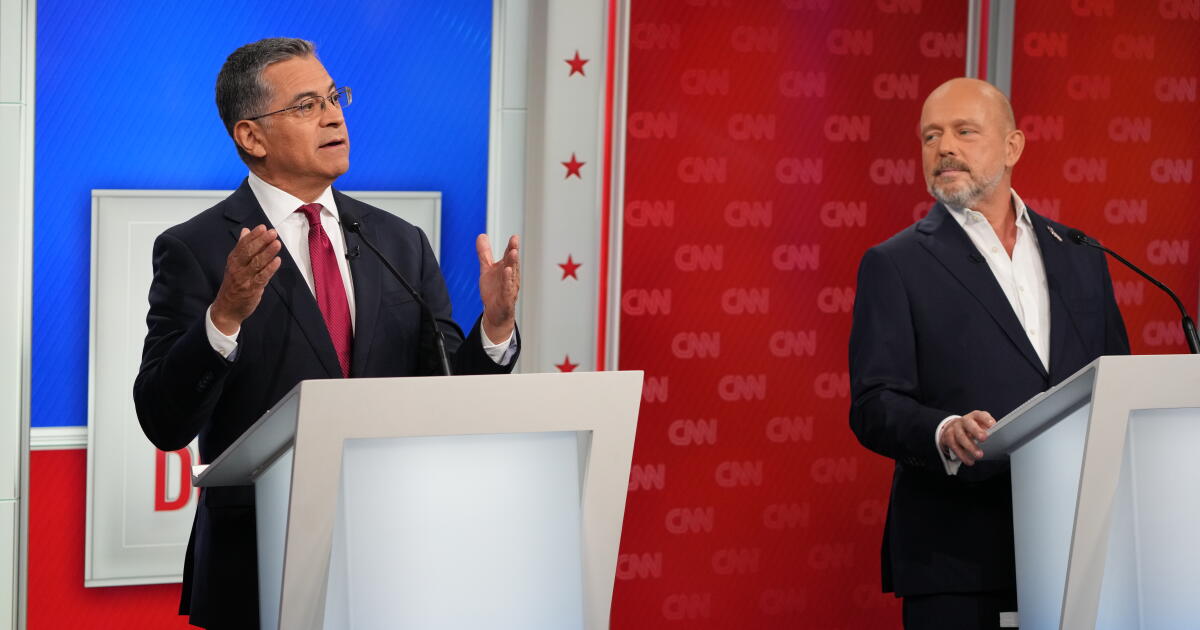
The two candidates to become California’s next governor painted vastly different portraits of the state they want to lead during a televised CNN debate Wednesday night — though they both agreed the state faces tremendous challenges.
Democrat Xavier Becerra, leading in polls, cast the state as an economic engine and a critical bulwark against the disastrous economic policies and creeping authoritarianism of the Trump administration, but also a victim of Trump policies, including tariffs and the war in Iran, that have made life less affordable and the nation less safe.
Becerra said he would work hard to help struggling Californians — including by cutting red tape on housing and regulating AI to ensure it doesn’t destroy jobs — while his challenger, Republican Steve Hilton, would harm them further by backing President Trump’s agenda at every turn.
Hilton, endorsed by Trump, blamed the state’s most entrenched ills on years of Democratic governance, awash in unnecessary state bureaucracy and regulation that have made it wildly unaffordable, and wrongly obsessed with fighting the president instead of bringing down costs and fixing related local issues like homelessness.
Hilton said he would help struggling Californians by cutting taxes, cutting the cost of building new housing, eliminating fraud and bringing common sense back to state policy-making.
Both candidates came out of the gate on offense, and at times it got intensely personal, particularly on immigration — with Becerra accusing Hilton of welcoming white immigrants into the country while rejecting Latino immigrants, and Hilton accusing Becerra of handing migrant children over to sex and labor traffickers during his time as U.S. Health and Human Services secretary.
With ballots soon arriving in voters’ mailboxes and the Nov. 3 midterm election rapidly approaching, the hour-long debate — moderated by CNN anchors Jake Tapper and Dana Bash in Burbank and aired live by the national news network — provided the public with its latest look at two candidates vastly different both in politics and campaign style.
Becerra, a former Congress member from Los Angeles, California attorney general and Health secretary under President Biden, surged past a slate of other Democrats to win the June primary after onetime front runner Rep. Eric Swalwell dropped out of the race amid sexual assault allegations. Hilton placed second after Republican voters and others coalesced behind his message to shake up Sacramento — earning him the right to face off against Becerra in November.
Hilton, a former British political aide, former Fox News host and Silicon Valley entrepreneur, has been crisscrossing the state looking for votes anywhere he can find them — an uphill battle given registered Democrats outnumber Republicans by a nearly 2-to-1 margin, and opposition to Trump is widespread in the state and growing even among Republican voters.
A poll this month by the UC Berkeley Institute of Governmental Studies and co-sponsored by the Los Angeles Times found 58% of likely voters surveyed said they support Becerra, compared with 33% who back Hilton — a slight increase to Becerra’s lead compared with an August IGS poll. California voters identified the high cost of living as their top concern, but that was followed closely by opposition to the Trump administration.
The same poll found found that 76% of Republican voters in the state approve of the president’s performance, down from 83% last year.
Becerra has taken a less visible approach to campaigning, with critics accusing him of intentionally keeping a low profile in an effort to cruise to victory in a state that hasn’t elected a Republican to statewide office in two decades.
“I just want to say thank you to CNN for bringing Xavier out of hiding,” Hilton said at the beginning of Wednesday’s face-off. “He’s barely been seen in public since the primary four months ago; it’s very important we have this debate.”
During the debate, both candidates seemed prepared to focus on the lack of affordability — namely by blaming the other’s political party for it. But they also discussed artificial intelligence and data centers, immigration policy and, of course, Trump.
Tackling gas prices, high cost of living
California has some of the highest housing and energy costs in the nation, and affordability tops the list of concerns for likely voters. It also was the first issue the candidates debated.
Hilton has made the cost of living a central theme of his campaign, with a plan he calls “Califordable” to cut gas prices and end income taxes on earnings up to $150,000. He blamed California’s high costs on Democrats, who have controlled the Legislature and statewide offices for more than 15 years. Hilton says he can lower costs by slashing onerous state regulations on businesses.
Hilton said the “quickest way to get more money in people’s pockets is for the government to take less out” and to reduce regulations to allow more housing to be built — including in “10 new cities” he said he would help build in the state.
Becerra has blamed higher prices on Trump’s tariffs and the war against Iran. In response to attacks from the U.S. and Israel, Iran has for months choked off a major oil trade route, sending global gas prices soaring — to a national average of $4.48 per gallon this month.
Becerra said Hilton’s plan to end income taxes would amount to a massive tax cut for “billionaires and millionaires” that would take money from schools, healthcare and other critical services. “The math doesn’t add up to what he’s talking about. He’s going to have to take it out of somewhere. It will come out of our schools,” Becerra said.
Becerra said he would bring down costs for people by cutting red tape, including on housing, and fighting the Trump administration — which he said is the real driver of cost increases. He also said he has helped create millions of jobs during his career.
Agree but disagree on AI and data centers
Hilton and Becerra both support regulations for data centers and artificial intelligence companies, a sign of growing bipartisan pushback seen across the country.
Hilton said he wants California to take a leading role in regulating AI, given much of the industry is located in the state, and expressed concern about losing AI jobs to other states such as Texas and Arizona. Hilton questioned whether Becerra would have the political courage to rein in the industry, saying his campaign has received funding from it.
When Bash asked Hilton if those companies should be able to “self-police,” as Trump has suggested, Hilton said, “We’ll have to see.” He also said he appreciates the effort by Trump to get assurances from AI companies on safety during a recent summit, and he would work to make sure that those promises are upheld.
Becerra derided Trump’s deal as a meaningless “pinky promise” that does not guarantee a safe path forward. He said he would lead efforts to reach real and meaningful regulations but also work directly with local communities on what they want.
“If someone wants to come in and build a data center that creates more jobs in the community, adds more energy to our grid, and it actually protects and adds more water capacity, then let’s talk,” he said. “But it has to be good for the community.”
Sharp attacks on immigration
Becerra has faced bipartisan criticism of how Health and Human Services cared for the influx of unaccompanied immigrant children during the pandemic.
Hilton has hammered Becerra on it, and at the debate accused him of sending “thousands of young children directly into the clutches of child sex and labor traffickers.”
Becerra was attacked by Democratic rivals in the gubernatorial primary in the aftermath of a Pulitzer Prize-winning series in the New York Times, including an article that said thousands of migrant children who entered the United States between 2021 and 2023 worked in slaughterhouses, factories and other dangerous jobs that violated child labor laws. The investigation also alleged that tens of thousands of the children Becerra’s agency released couldn’t be found because he relaxed screening of relatives and sponsors.
Becerra repeatedly has said that despite a lack of congressional funding for licensed-care facilities dismantled by the Trump administration, his staff worked hard to vet the people who the children would be placed with.
At the debate, he called Hilton’s claims “Trump talking points.” He also said more needs to be done to ensure children aren’t separated from their immigrant parents.
Becerra also has slammed the Trump administration for its mass deportation program and immigration crackdown, which has sent immigration enforcement agents into cities across the country, including Los Angeles.
Hilton said he would work to “lower the temperature” in the immigration debate and “prioritize the removal of dangerous criminals,” which he said is not occurring in California because Democrats are playing “politics” with the Trump administration.
Becerra, the son of immigrants, said California welcomed Hilton as an immigrant, and Hilton “welcomed ICE mercenaries” into California in return. He also accused Hilton of welcoming immigrants that look like Hilton, who is white, while working to remove immigrants who look like Becerra, who is Latino.
“I have fought all my life to make life better for immigrants, to represent them well, to defend them, to let them grow and build like my parents. But here’s the problem I have with your policies: You seem to welcome immigrants who look like you, but deport immigrants who look like me,” Becerra said.
Hilton called that “disgraceful.”
Trump, Trump and more Trump
Hilton repeatedly has praised Trump and his policies and consolidated support among California Republicans after Trump endorsed him before the June primary. But Trump’s endorsement could be an albatross in the Nov. 3 election, given his low approval ratings — particularly in California.
Becerra repeatedly hammered Hilton as a Trump acolyte, so much so that Hilton said that it was Becerra’s only attack line, and that Becerra “takes no responsibility” for Democratic policies that have harmed California for years.
“All you ever say is Trump, Trump, Trump, and that’s nothing but an insult to every Californian who is desperate for something to change in this state, and all you’re offering is more of the same,” Hilton said.
Becerra countered that Hilton embraced Trump during the primary.
“Your words, Trump, Trump, Trump. Because he is your supporter,” Becerra said. “You chased his endorsement.”
Where they stand on billionaire’s tax, schools and other quick hits
- Proposition 40, the billionaires tax: Both Becerra and Hilton oppose the controversial wealth tax proposal on the ballot that would enact a one-time 5% levy on billionaires’ assets to largely replace $100 billion in federal healthcare funding cuts to California.
- Proposition 39, voter ID: Hilton expressed support for the ballot measure, which would require voters to present ID at the polls or write a special pin on their mail-in ballot. Becerra, who opposes the measure, claimed the initiative is part of an effort by Trump and his supporters to interfere in elections.
- Improving schools: Fewer than half of third-grade students read at grade level. Hilton said it’s a “catastrophe” that exemplifies Democratic failure in the state. Becerra conceded that the school system is not “well coordinated” but supports transitional kindergarten, a new pre-K grade created by Gov. Gavin Newsom.