centers

Conditions at California immigrant detention centers worse under Trump

A new report by the California Department of Justice found that conditions at immigrant detention facilities in the state have worsened as surging arrests under the Trump administration’s mass deportation campaign led to overcrowding and insufficient medical care.

For the 175-page report, which was released Friday, California Justice Department staff, along with correctional and healthcare experts, toured all seven facilities that existed in 2025 (an eighth facility, the Central Valley Annex in McFarland, began receiving detainees in April). The team analyzed internal documents and detainee records, and interviewed detention staff and 194 detainees.

“This is the federal government paying for-profit, private companies to run these detention centers, and they are running these detention centers with inhumane, cruel, and unacceptable conditions, “ California Atty. Gen. Rob Bonta said at a news conference Friday.

Department of Homeland Security spokesperson Lauren Bis, in a statement, defended the treatment of those held at detainment centers.

“No lawbreakers in the history of human civilization have been treated better than illegal aliens in the United States,” she said.

Bis added, “This is the best healthcare many aliens have received in their entire lives. Meals are certified by dietitians. Ensuring the safety, security, and well-being of individuals in our custody is a top priority at ICE.”

The inspections were possible because California enacted a law during the first Trump administration requiring state oversight and public reports detailing the conditions of immigrant detention facilities. Bonta said California is the only state in the country with such a law.

Such detailed reports have taken on outsized significance as the Trump administration has whittled down the Department of Homeland Security’s own oversight mechanisms.

The agency said it would respond later to a request for comment.

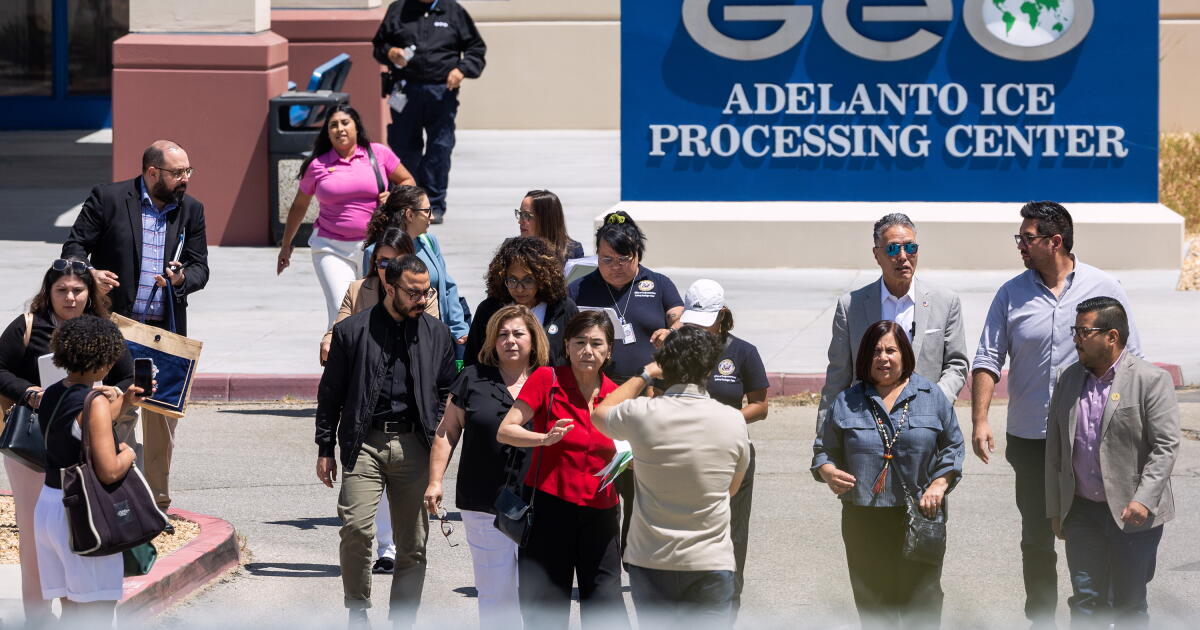
Christopher Ferreira, a spokesperson for The Geo Group, said the company’s services are monitored by DHS to ensure compliance with federal detention standards and contract requirements regarding detainees. The company oversees four facilities in California, including the Adelanto ICE Processing Center north of San Bernardino.

“The support services GEO provides include around-the-clock access to medical care, in-person and virtual legal and family visitation, general and legal library access, translation services, dietitian-approved meals, religious and specialty diets, recreational amenities, and opportunities to practice their religious beliefs,” Ferreira said.

He added that of the company’s immigration facilities are independently accredited by the American Correctional Assn. and the National Commission on Correctional Health Care.

CoreCivic operates the California City Detention Facility north of Lancaster and Otay Mesa Detention Center in San Diego. Spokesperson Ryan Gustin said the company had not been provided a copy of the report or reviewed its findings.

“The safety, health and well-being of the individuals entrusted to our care is our top priority,” Gustin said. He added that the company’s ICE-contracted facilities are “subject to multiple layers of oversight by our government partners” and auditors.

The report notes that CoreCivic did not make requested documents available to investigators, including records on use of force at the California City facility.

“The decision to deny Cal DOJ access to these files was remarkable in light of the serious legal claims that have been made against the facility, which allege that staff routinely engage in abusive behavior and unreasonable use of force against detainees, including deploying pepper spray, hitting a detainee with riot shields and holding him down with their knees on his back, and aggressively pushing a detainee,” the report states.

According to the report, the detainee population in California grew 162%, from 2,300 to more than 6,000 detainees, between site visits in 2023 and those in 2025. Most detainees had no criminal history and were classified as low-security.

Collectively, the facilities have the capacity to hold up to nearly 8,200 detainees.

Six people have died in ICE custody in California since the start of 2025 — four at Adelanto and two at Imperial Regional Detention Facility. In all of the Adelanto cases, family members alleged that the facility’s medical response was inadequate, the report said.

Inspectors found that staffing failed to keep pace with the growing numbers of detainees, particularly at Adelanto and at California City, where they saw “crisis-level healthcare understaffing.”

At Mesa Verde ICE Processing Center in Bakersfield, the report says, “Medical care delays, including specialty care and referrals, were widespread and appeared to be caused by delays in approvals by ICE Health Service Corps and canceled or dropped referrals due to transfers between facilities.”

The intake process for new detainees, which includes a medical and mental health screening, is supposed to take place within 12 hours of their arrival. But detainees at several facilities reported waiting days or weeks before receiving their housing assignment and medical screening, the report says. While waiting, some slept on the floor without access to water.

In its statement, the Department of Homeland Security said detainees undergo medical, dental, and mental health intake screening within 12 hours of arriving at each detention facility, a full health assessment within 14 days of entering ICE custody or arrival at a facility, and access to medical appointments and 24-hour emergency care.

Gustin, the CoreCivic spokesperson, said its facilities adhere to detention standards on staffing and medical care. Emergency care is available 24 hours a day, he said, and the facilities work closely with local hospitals and providers for specialized care.

Ferreira, the Geo Group spokesperson, said detainees have access to teams of medical professionals and off-site specialists, imaging facilities and emergency services.

At the Adelanto facility, detainees said water coolers remained empty for hours. Justice Department staff saw murky drinking water come out of the tap in the women’s housing unit.

At the Golden State Annex in McFarland and at Mesa Verde, detainees said they spent at least $50 per week on commissary items so they wouldn’t go hungry. Across most facilities, detainees reported undercooked food, a lack of dietary or allergy accommodations and irregular mealtimes.

Basic necessities are also an issue, according to the report. At the California City facility, detainees said they got so cold that they cut the ends off socks to make improvised sleeves and covered the air vents in their cells with sheets of paper.

According to the report, Otay Mesa is the only detention center in California with a policy requiring that detainees be strip searched after being visited by anyone other than their attorney. Detained women recounted being told strip in front of male officers, even when menstruating, the report said.

Gustin said CoreCivic follows federal detention standards regarding searches of detainees.

The report did highlight some improvements, including at the Imperial Regional Detention Facility in Calexico, which inspectors said appeared better staffed with medical and mental health care providers compared to their 2023 visit. Still, the review “identified concerns regarding the facility’s management of detainees with severe mental health issues, including two detainees who experienced extended stays in restrictive housing of over 200 days.”

Emily Lawhead, a spokesperson for Management & Training Corp., which oversees the Imperial facility, said the company takes the report seriously. She noted that the report also highlights prompt responses to sick-call requests, meaningful access to programming and recreation and expanded attorney access through 36 private phone booths.

But Lawhead said the company will examine the concerns raised in the report.

“If our review identifies gaps, delays, or missed standards, we will address them,” she said.

The state law requiring the detention facility inspections expires next year. A bill by state Sen. María Elena Durazo (D-Los Angeles) would make the inspections permanent. Another state bill, by Sen. Steve Padilla (D-San Diego), would prevent the excessive markup of products sold at detention center commissaries.

Source link

ICE puts new restrictions on members of Congress inspecting detention centers

A new Immigration and Customs Enforcement policy requires members of Congress to seek advanced approval in order to speak with detainees during oversight inspections at detention facilities.

It’s the latest twist in a months-long effort by ICE to restrict such visits by lawmakers, which have skyrocketed amid the Trump administration’s mass deportation campaign.

California Reps. Mike Levin (D-San Juan Capistrano) and Sara Jacobs (D-San Diego) learned about the new policy when they made a surprise visit on Monday to the Otay Mesa Detention Center in San Diego.

ICE allowed them to enter, Levin said, but when the members asked to speak with detainees, local personnel handed them a memo outlining the new policy — dated the same day and signed by acting ICE Director Todd Lyons.

In it, Lyons calls the visits disruptive and resource-intensive because they pull staff away from law enforcement duties. Lawmakers sometimes request to speak with a particular kind of detainee — for example, people held longer than 90 days — and Lyons said meeting such requests takes up too much time.

“This is an unsustainable burden for ICE employees and a hindrance to ICE operations given the exceptional growth in congressional visits,” he wrote.

Moving forward, members must identify detainees by name at least two business days in advance of a visit and provide a signed consent form from each detainee.

The Department of Homeland Security and ICE did not immediately respond to a request for comment.

Levin said the new policy effectively defeats the purpose of unannounced oversight visits.

“I think it’s a deliberate effort to make sure we don’t hear from people in ICE custody,” he said.

Democratic House members sued the Trump administration last July after they were repeatedly denied access to immigrant detention facilities in California and across the country.

Under federal law, funds appropriated by Congress cannot be used to prevent a member of Congress from entering or inspecting a detention facility operated by or for Homeland Security.

Monday’s unannounced visit was Levin’s first to the Otay Mesa facility since a federal judge in February blocked a previous Trump administration policy requiring members of Congress to give seven days notice before visiting ICE detention centers.

The administration appealed, and on Friday an appellate court in Washington denied the administration’s request to restore the seven-day policy while the case proceeds, saying the government hadn’t provided enough evidence that the visits are harmful.

That win for the lawmakers could be short-lived — the panel of judges who denied the administration’s request also wrote in their order that the members of Congress “have no standing to maintain this lawsuit, so the government is very likely to succeed on the merits of its appeal.”

In the memo on ICE’s new policy, Lyons noted that in the 10 fiscal years before 2025, ICE facilitated roughly 45 congressional visits to detention centers each year.

After Trump took office, the agency facilitated more than 150 visits in fiscal year 2025. As of May 11, ICE had facilitated about 200 congressional visits since the start of this fiscal year.

Levin said the increased visits by himself and other members have become necessary because Homeland Security has slashed the vast majority of staff at the Office for Civil Rights and Civil Liberties, as well as the Office of the Immigrant Detention Ombudsman.

“The volume Lyons is citing is a direct consequence of his own department dismantling all the alternatives,” Levin said. “They gutted the internal oversight and then complained that the external oversight is too active, then issued a memo to restrict it. All of that only makes sense if the goal is no oversight.”

During previous visits, Levin said he would ask for detainees who met specific criteria, such as those held in a unit of the detention center that was the source of complaints to his office. Those detainees would write their names on a sheet of paper if they were interested in speaking with him.

Barred from speaking with detainees, Levin inspected what he could at Otay Mesa on Monday. Levin said he drank the facility’s water (it tasted like regular tap water) and tried the food — chili, salad, corn, chips and cake that won’t “win any culinary awards, but it was fine.”

At one point, Levin said he saw a detainee using a tablet and asked how it works. An employee interjected and reminded him of the new policy, he said.

Observation is a necessary part of any inspection, Levin said, but you don’t really know what’s going on without talking to people in a way that’s unplanned.

The facility held 1,008 ICE detainees — 864 men and 144 women, as well as others in U.S. Marshals Service custody, Levin said. Nearly a third of the detainees were from Mexico, with smaller numbers from Guatemala, China and other countries. On average, they had been detained 130 days.

Levin said he sent the ICE memo to Rep. Joe Neguse (D-Colo.), who is the main plaintiff in the lawsuit over the oversight visits, and lawyers in the case are now reviewing its legality.

Eighteen people have died so far this year in immigrant detention facilities, leaving 2026 on track to be the agency’s deadliest year in more than two decades. Last year, 32 people died in detention facilities.

Since Trump returned to the White House, reports from detention centers have highlighted issues of overcrowding, insufficient medical care and widespread use of force.

Source link

Civil rights groups condemn Southern Poverty Law Center’s indictment and prepare for legal fights

The criminal indictment of the Southern Poverty Law Center this week was met with much outrage but little surprise from civil rights leaders, who have for more than a year prepared for heightened legal scrutiny from the Trump administration, and how to mount a coordinated response.

In rounds of calls immediately following the indictment, civil rights leaders discussed how to support the SPLC, a Montgomery, Ala.-based civil rights group founded in 1971 that has tracked white supremacist groups and been outspoken on voting rights, immigration and policing. Organizers on one call agreed that winning in the court of public opinion would be crucial as judicial proceedings began, leading to dozens of public statements of support and planned rallies.

And legal advisors to civil rights groups urged organizers to prepare themselves for similar criminal indictments, protracted legal action that may exhaust their resources and audits of their staff and internal documents.

The flurry of behind-the-scenes coordination represented a marked escalation and mobilization of plans for activist groups that have been at odds with the Justice Department since President Trump’s return to the White House last year. Organizers say they are prepared to back the SPLC in its legal fight.

“It’s a blatantly obvious attack on civil rights and civil liberties to whitewash the foot soldiers of the great replacement theory and other extremists. This coalition isn’t going silent,” said Maya Wiley, president and chief executive of the Leadership Conference on Civil and Human Rights, an umbrella organization of hundreds of civil rights groups.

Without addressing the indictment, a coalition of more than 100 activist groups on Tuesday published a letter vowing solidarity with groups that are “unjustly targeted” by the federal government. SPLC was a signatory to the pact.

“An attack on one is an attack on all,” the coalition declared. “We will share knowledge, resources, and support with any organization threatened by abuses of power.”

DOJ alleges criminal conduct in SPLC’s longtime informant network

The Justice Department alleges that the SPLC, which rose to prominence for its work prosecuting and tracking hate groups like the Ku Klux Klan, violated federal law through its network of paid informants in extremist groups. The DOJ claims the payments funded hate groups and misled the SPLC’s donors.

The SPLC now faces charges of wire fraud, bank fraud and conspiracy to commit money laundering in the case brought in the federal court in Alabama, where the organization is based.

“The SPLC is manufacturing racism to justify its existence,” said acting Atty. Gen. Todd Blanche at a news conference announcing the charges. Blanche promised the department “will hold the SPLC and every other fraudulent organization operating with the same deceptive playbook accountable.”

Longtime civil rights activists found the claims to be a disingenuous and partisan move that may empower extremist groups.

“The indictment is nakedly political and represents the Justice Department turning on itself,” said Marc Morial, president of the National Urban League. “It places the Justice Department in the posture of, in effect, defending white supremacist groups like the Ku Klux Klan and others.”

Advocates also view the indictment as part of the administration’s broader upending of civil rights law and the Justice Department’s prosecution of Trump’s political opponents.

The SPLC in recent years became a bogeyman among conservatives who resented that the watchdog designated several rightwing organizations that engage in Republican politics as hateful or extremist.

In October, FBI Director Kash Patel canceled the agency’s longtime anti-extremism partnerships with the SPLC and the Anti-Defamation League, which combats antisemitism. Patel at the time called the SPLC a “partisan smear machine.”

The Justice Department and SPLC did not respond to requests for comment.

Indictment represents marked shift for civil rights work

Advocates dispute the DOJ’s characterization of the SPLC’s work, which civil rights activists credit to combating extremist groups across the country.

“The problem is that the indictment essentially claims that it was a fraud on SPLC’s donors to use their funds to fight the Klan, the neo-Nazis and other white supremacist groups, when that is exactly why people gave to the organization,” said Norm Eisen, founder of Democracy Defenders Action, a legal group that works with organizations in legal disputes with the Trump administration.

Eisen added: “The notion that there’s something wrong with using informants and protecting their identities to prevent white supremacist violence is belied by the fact that that is not only what the SPLC did, but it is also the stock and trade of the FBI itself.”

Civil rights organizations are now preparing for further legal action against other organizations that disagree with or actively oppose the Trump administration. Organizations have reviewed their document retention, tax compliance and auditing policies over the last year to safeguard against any probes or lawsuits.

Some civil rights organizations have also floated creating new organizational structures that may better withstand legal scrutiny. On another recent call, activists floated restructuring some groups into for-profit entities, or potentially crafting new financial conduits for donors to give through to ensure that staff could receive pay if an organization’s assets were seized or frozen.

The preparations represent a marked shift for many civil rights leaders, who in recent years counted the Justice Department under both Democratic and Republican administrations as a reliable ally in key civil rights battles.

“What we are seeing in real time is an administration seeking to leverage its position to target individuals and organizations that do not agree with its political thought,” said NAACP President Derrick Johnson, who said the Justice Department has been “weaponized by dangerous forces.”

But for other leaders, the SPLC indictment raised the specter of a return to a previous era, when the Justice Department monitored — and at times prosecuted — civil rights leaders to disrupt their activities.

“We’re not backing down, but we are clear-eyed. Everyone could be in some form of jeopardy if you’re in the crosshairs of this administration,” said Juan Proaño, CEO of the League of United Latin American Citizens, a civil rights group suing the Trump administration over executive orders addressing birthright citizenship and mail-in voting.

“That’s what they’re looking for; they want this to have a chilling effect,” Proaño said.

Brown writes for the Associated Press.

Source link