This is a meditation on my writing life and routine. It follows. It’s also a prayer. I don’t believe I belong to anything. To any man or woman or to my contemporaries. I dive into Hallmark movies that are so American: Thanksgiving and peach cobbler. The love story- what is that? Does it mean taking selfies together? A friend is in love with a young lady. It suits him to be in love. I never hear from him anymore, which I think is a good thing. We were becoming too close, (physically, emotionally and intellectually) and every male and female relationship that is a friendship and is not bound by the confines of intimacy needs a divide. I am a strong believer in the separation of both the soul and the spirit when it comes to friendship between a young man and a young woman. Nothing can and must happen. The friendship, I have decided, between a man and a woman is a very delicate and fragile thing.
What is normal? I don’t know what that is anymore? Why am I filled with fear and this sudden anxiety that floods through me? The books beside my bed have a lonely, resolute air to them. In summer the days are long, sweet and warm, though sometimes unbearably hot. I feel I have stood the test of time so far, not quite. My bones are weary, dripping with exhaustion. Chronic fatigue gnaws at my mind, and so I fall. I have the tickets to get there. Silence comes into view with its glacier walls made of a kind of ice rock. The love affair has come to an end, or whatever that was. The steadfast man was quick to recover, and he has moved on. My brother, my father tells me, wants to leave his teaching job. He wants the greener pasture but can’t afford to get there.
I watch this landscape of events play itself out, not all deft curves, and it definitely does not speak of tranquillity. I think of the man’s lips on mine and his frame folding into me as he takes me in his arms and months later, though it could’ve been weeks or days or hours he leaves me behind to start a new life. My life is immediately permeated with an irrevocable sadness that it seems that I will never completely recover from. How does any woman recover from being humiliated by the man she loves or her mother? I find happiness in moments spent with my brother’s ex-girlfriend’s four small children (his latest girlfriend, who he wants to turn into a fiancée, is unashamedly pregnant). I also accept happiness in bursts. For example, listening to classical music (it’s soothing and gentle, its powers magical, resourceful, imaginative, healing and restorative) and writing down my thoughts.
I found my calling in writing, and the pathetic useless frustration that so oftentimes unnerved me stopped cutting through me at will. It is, of course, natural for the will to have this acute stamina to draw on and superfluous discipline as its framework. My brother and his girlfriend watch provocative Netflix shows. My mother descends upon me and my father in the sitting room and announces she is going for a walk. I had announced to her a few minutes ago that there was money in the joint bank account she has with my father. But off she goes because she has to. She returns about twenty minutes later to inform me that the lights were off at the garage on account of loadshedding.
Stay ahead of the geopolitical week.
MD Briefing delivers expert analysis across five global fronts — the Indo-Pacific, energy, geoeconomics, European security, and the Middle East — every Monday morning. Free.
I look forward to sleeping. At night I settle down and try to read a few pages before calling it a night. Slow and steady wins the race. I wonder what this sense of alarming loneliness that I feel now will be like when I am elderly and what I will look like. Lines on my face where no lines had been before, wrinkles at the corners of my eyes and my mouth, speckled and mottled skin, arthritis, would I walk with a cane or a walker, would I still be capable of smiling, of making conversation at what life or rather what I still had left within me to offer life? I imagined the people at the funeral at the back of my mind. I don’t know anyone that would attend and have no close ties, no bonds with family. But then again so do so many people. My father has his people. Though distant he still has people. Some friends, family and church people in his life. I don’t want to look back on my life with regret but somehow I know there will be a list. I had enjoyed swimming and walking when I was young but now felt no inclination for displays of endurance, athleticism, sports or survival.
I think of how sadness tears into me during the day. I think of sadness as a wound. It’s like an incision is there in my skin. A little fold of broken skin that I have to put a band-aid on. Another man, an editor, tells me to fall in love. To trust that feeling, to become centred in it as if it would make me whole again. I don’t really listen, and I know in my heart that it will go on my list of regrets. Already I have the Athol Fugard writer’s retreat that I wanted to go on (but didn’t) when I was sixteen years old in New Bethesda when I was a learner at Collegiate to put on that “regret” list. I can only think of that now. I feel cold. It’s cold, I realise as I shiver. It has started to rain. It had been raining this morning. I think of how cold it was in Grahamstown. At Robert Berold’s farm. I think of his wife Mindy Stafford’s delicious cooking. That writing retreat I went on,, which was held on that farm, was the highlight of my year and would become one of my most cherished memories. My mother turns to look at me and says, “Can you go and type in your own room?”
I sit here listening to the sound of the rain. Something about the rain always comforts me. It’s soothing and imaginative like the classical music I listen to sometimes. My thoughts are drawn to death these days. You watch it in films, read the obituaries at the back of the newspaper. I know that physically I am not well. I have many problems on a cellular level that are complex in nature. If I had done things differently five or even ten years ago, I would be singing a different tune. But it is what it is. If I had existed in a different era, everything would have been against me. But I stand here now, overpowered by the things I can’t change. These things, health and my financial circumstances, threaten my livelihood but they have given me this wonderful life. This career as a writer. I have all the hours and all the silence I can stand to want. Everybody struggles to a certain extent in life. I can’t argue with that. Some struggle at things and don’t quit. I struggle with so many simple tasks. Getting a SIM card on my cell phone, for one. Making conversation with my mother who looks as if life has nothing left to offer her. I can’t help her. She’s in the autumn of her years, she can’t hide her sadness, her loneliness from me anymore. Did she ever love my father? He tells me that he loved her. I ask him if they ever spoke to one another in the way of deep, meaningful conversation, and he says no, that they never did. He says this quite matter-of-factly.
I remember that inside the cave I am the guest and the jewel is the writing. I meditate, I pray, I write a little, I scratch the pen across the surface of the page and then I go to bed. It is never easy to fall asleep. The older male figures of my past still haunt me but fall asleep I must and the dreams when they come still hold me in their grip when I wake up the following morning.
I want to remember you, the man who was very briefly in my life, how beautiful that period was, followed by the restless nights that separated us. I write this for you even though you will never see it. The love letters I have revised, reworked and reimagined in a sense into a book. I hid you between two women. The female protagonist of the book and an artist. The book is really a novel with a modern setting. I think of the men in my life and how I have failed them and not the other way round. To my beloved, the love of my life, I have this to say. I want you to still think of me as writing, as a writer, as writing to you even if you won’t. You were, of course my last chance at love, whatever that was between us.
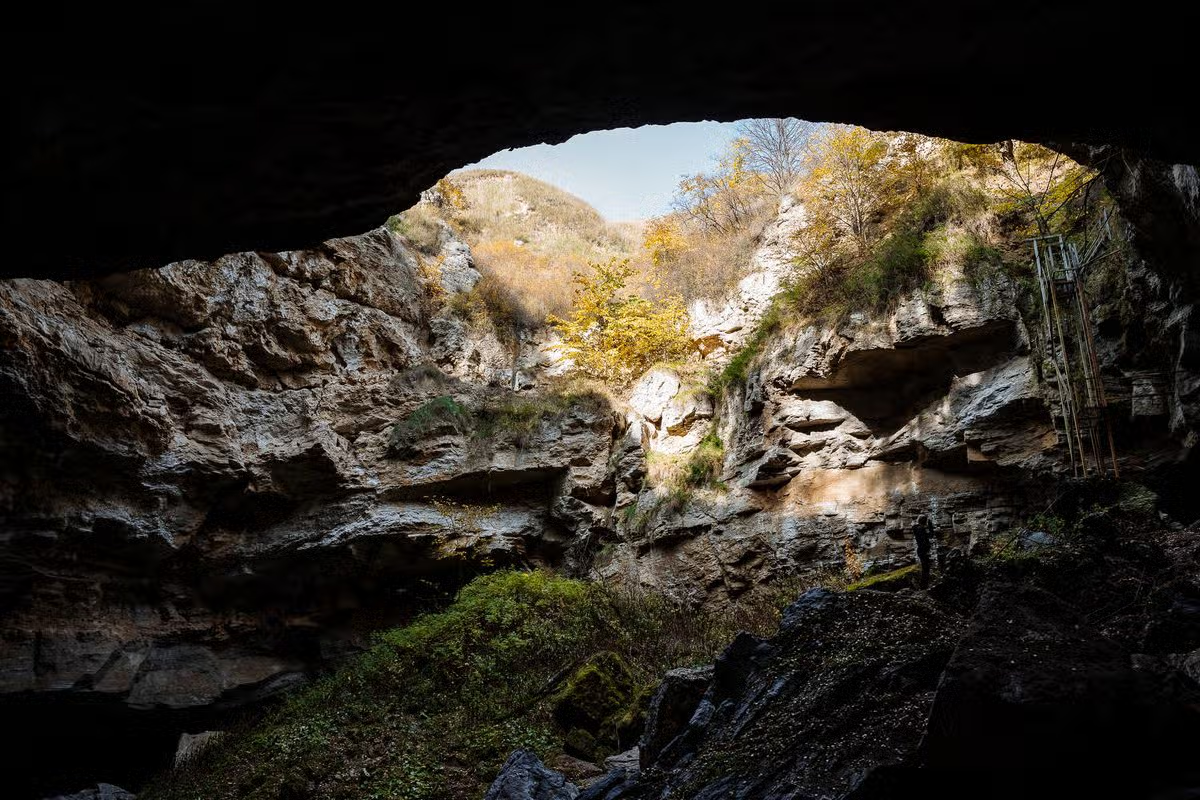
This cave is the deepest in the world(Image: Getty)
Deep beneath a massive mountain range lies a sprawling cave system that spirals beneath the hills, extending more than 2000 metres into the earth. This cave system is the deepest in the world (depending on who you ask), its limestone caverns so huge that you could upend Ben Nevis and place it inside, and still have room remaining.
The Veryovkina Cave lies beneath the Gagra Range of the Western Caucasus within the Georgian region of Abkhazia. This cave is one of two which frequently compete for the title of the deepest cave on earth.
According to Live Science, both Veryovkina and another cave in the same region, Krubera (also known as the Everest of the Deep), alternate as record holders, depending on the most recent research.
Both caves are more than 2,000 metres deep and are frequently explored further by scientists and cavers who are constantly updating the measurements.
The caves are dark, inhospitable and cold with temperatures rarely exceeding 3°C.
As you descend further into the depths, animals begin to change. Many of the species which call these caves home have no eyes or pigmentation and have long antennae, appendages and hairs which help them sense vibrations and move throughout the blackness of the cave system.
As of January this year, Veryovkina is currently in the lead, with a depth of 2,212 metres, or 1.37 miles. Krubera is close behind, at 2,199 metres, or 1.37 miles.
Veryovkina was discovered in 1968 and given the name S-115 and then renamed in 1986 after Alexander Veryovkin, a cave diver who died in a water-filled passage while exploring a nearby cave Su-Akan.
Another major incident in Veryovkina Cave occurred in 2018, and very nearly killed a team of cave explorers.
National Geographic photographer Robbie Shone and his assistant Jeff Wade joined a team of Russian explorers who had descended to the very bottom of the cave over four days.
They were camped in the darkness to undertake a more detailed examination of the cavern.
One morning, the team were eating breakfast when the cavern shook as if an earthquake had struck, and according to Robbie an “enormous torrent” of white water appeared from a hole and began to flood the cavern.
National Geographic wrote about the team’s desperate scramble back up the cave to escape the rapid flooding.
Robbie remembered climbing through the tight passages upwards as they rapidly filled with water.
He said: “All I could see was the white rope in front of me. “And I just kept moving the ascender up a little bit at a time. I was saying to myself, ‘Just keep going. Just keep doing this.’”
The whole team escaped from the cave, barely.
Robbie said: “This team had the strength, the reserves, mentally and physically, to deal with the worst situation. That’s not only why they’re exploring the deepest cave in the world so successfully, but why we all survived.”