UCLA took a cautious approach during its win over Michigan State
The UCLA football team produced its worst quarter of the season Saturday.
After fumbling twice in Michigan State territory, halting offensive momentum, the Bruins were trailing going into the second quarter and tied 7-7 with three minutes left in the second quarter.
But for the third consecutive week, the defense shifted the momentum and ignited the offense.
Powered by a defensive unit that tallied three takeaways, four sacks and limited the opposing offense to 156 yards, UCLA earned its seventh win of the season Saturday afternoon at the Rose Bowl, trouncing Michigan State 28-10.
It is the first time the Bruins have gone 7-0 since 2005. The team moved up to No. 7 in the Associated Press top 25 poll Sunday.
Newsletter subscription change
Starting Sept. 21, this newsletter will be available to Los Angeles Times subscribers only. A free press isn’t free, and we depend on reader support to report on the stories that make a difference. If you’re already a subscriber, nothing will change. If you’re not, there’s never been a better time to sign up. Get started here.
Let’s take a look at the three takeaways from the Bruins’ fifth conference win. UCLA sits atop the Big Ten standings, with its last nonconference game against 3-4 Nevada on Saturday.
Are the Bruins aggressive enough?
The final score did not reflect the Bruins’ dominance over the Spartans.
UCLA ran the ball 48 times compared to 31 passing attempts. And while the ground game was successful, rushing for 245 yards and three touchdowns on 5.1 yards per carry, the Bruins had the opportunity to blow the doors off the game through the passing game.
The Bruins opted to play a clock management game, running out the entire fourth quarter with a multi-score lead instead of taking shots downfield and manipulating the defense through the air. And Michigan State adjusted accordingly, stacking the box and preparing for the run.
With the Spartans focused on stopping the run, UCLA’s offense had the opportunity to take advantage of an already depleted secondary and give quarterback Ty Dieffenbach more opportunities to get comfortable in the passing game.
Dieffenbach’s one deep shot connected with sophomore wide receiver Brian Rowe Jr. for a 63-yard touchdown. But outside of that, Dieffenbach did not connect for a pass of more than 20 yards. And coach Bob Chesney acknowledged that the offense could have opened up more, but that the Bruins decided to run out the clock.
“There were moments there in the fourth, too, and the late third, where that box got pretty loaded, and we should have taken some shots on the outside,” Chesney said. “But at the same point, you’re trying to run this clock out and get out of here with the win, ultimately, and could have taken a little more risk if we wanted to. But I thought we managed it well enough to get a victory here.”
It doesn’t always have to be Wayne
Wayne Knight has been the star of UCLA’s offense so far.
But the Bruins have proven that the backfield is less of a bell cow system and more of a three-headed beast.
And despite a shaky first half, senior Jaivian Thomas and fifth-year Anthony Woods more than illustrated that they could be the featured back on any given day.
Thomas and Woods fumbled in the first half in Spartan territory — their first of the season on 118 combined carries thus far. But the duo refused to let the mistake define them. Thomas ran for 41 yards and a touchdown in 10 carries while Woods rushed for 112 yards and one score in 14 carries alongside three receptions.
Woods and Thomas’ production in the dying embers of the affair became pertinent when Knight went down with a chest/ribs injury. While Chesney said that the injury is nothing overly serious and that the tailback could have returned to the game, the coaching staff decided to keep him sidelined as a precaution.
“I thought [Anthony] Woods was rolling today. To be able to see some of the holes that he found and be explosive and physical was really good,” Chesney said. “But both of those guys put the ball on the ground early. That’s not what we were looking for, but I love their response.”
Linebacker University
All season, the Bruins’ secondary has earned praise.
Defensive coordinator Colin Hitschler’s unit has not allowed a quarterback to gain more than 160 passing yards during its last four games and has given up fewer than 100 yards in two of those games.
But the entirety of the Bruins inside linebacker department has hounded opposing offenses all season — dominating in all facets of defense, from blitzing the quarterback, to finishing off tackles in open space to blanketing pass catchers when tasked in coverage.
And all of that was on display Saturday.
“They understand the run scheme. They do all of the things right. They relate pre-snap. And then they communicate post-snap extremely well,” Chesney said. “And those are all the things that they have to be able to accomplish. But then they play a very physical brand of football. And when you start to blitz them, they get downhill quick, and they pack a punch when they do.”
Headlining the crew is Sammy Omosigho, who has not missed a beat since coming to Westwood from Oklahoma. He ranks first in the nation in forced fumbles with five through seven games, and ranks first in the Big Ten in sacks with five despite playing inside linebacker.
His linebacker partner — fifth-year Jalen Woods — is playing up to Omosigho’s level, with 2.5 sacks, one interception and 59 tackles, which ranks fourth in the Big Ten. Sophomore Scott Taylor, who has been playing as a hybrid inside/outside linebacker, has three sacks and two forced fumbles.
And senior Donavyn Pellot joined the fun Saturday, recording the first interception of his career and returning it 67 yards, flipping the field, and turning the tide of the game.
UCLA alum Natalie Nakase’s strategy change pays off

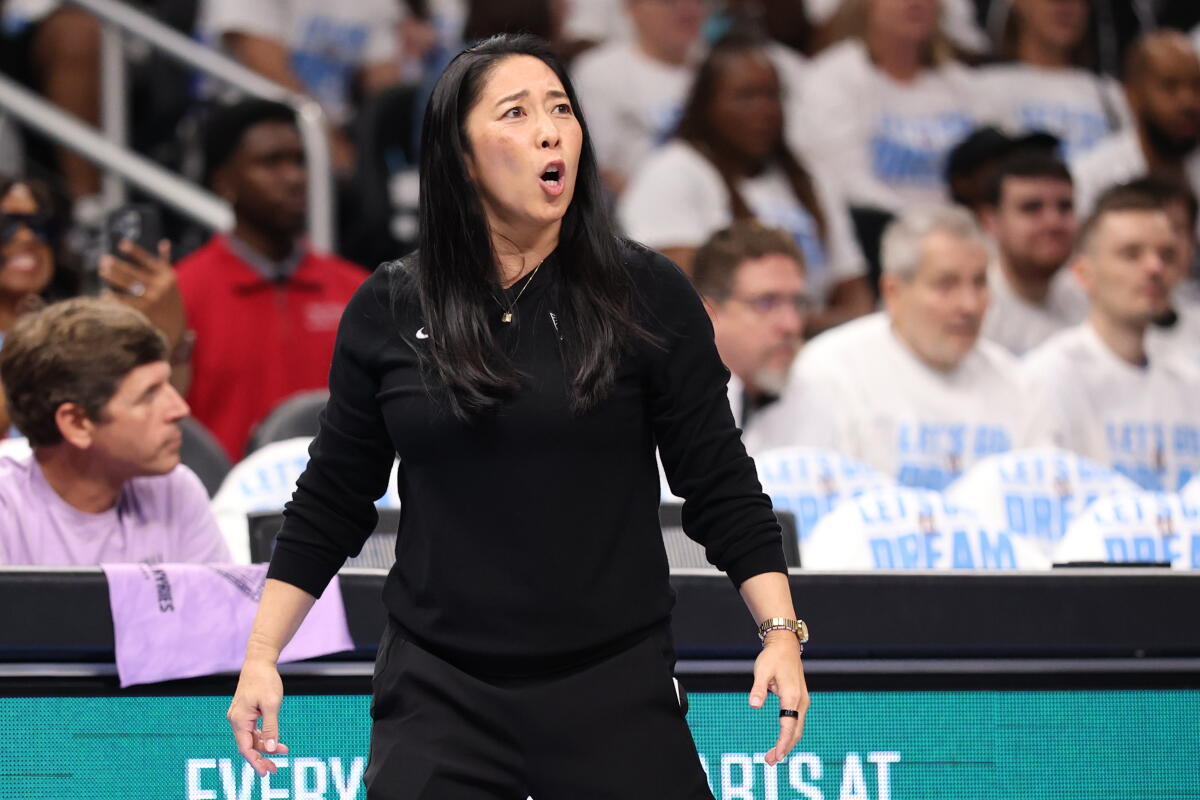
Valkyries coach Natalie Nakase reacts on the sideline during Game 4 of the WNBA Finals against the Atlanta Dream at State Farm Arena in Atlanta on Saturday.
(Kevin C. Cox / Getty Images)
Former UCLA point guard Natalie Nakase shook up her starting lineup and helped spark the Golden State Valkyries’ Game 4 win over the Atlanta Dream during the WNBA Finals, evening the series 2-2.
Guard Tiffany Hayes and Kaila Charles joined the starting five during Golden State’s 67-62 win Saturday in Atlanta. Nakase tightened her rotation to seven players, bringing Kayla Thornton and Cecilia Zandalasini providing a spark off the bench.
“I just wanted to change it up,” Nakase said. “The best thing about our team is no one cares who starts, no one cares. People coming off the bench, it doesn’t matter … because we have a really selfless team, egoless team. So, yeah, I just wanted to change it, and you definitely saw some energy, better fight.”
Nakase said her players have bought into doing whatever it takes to support each other all season.
“We’re about caring for each other,” she said. “We’re about pouring into each other, and I think what’s really big key is they want to see success in their teammates more than themselves.”
Golden State will host Game 5 of the series Monday at 5 p.m. The remainder of the series schedule is in flux as the WNBA negotiates where Atlanta can play its remaining home games.
Bruins on deck
Here is this week’s UCLA athletics schedule. All Times are PDT.
Monday, Oct. 26
Men’s golf at East Lake Cup, All day
Women’s golf at Nanea Invitational, All day
Tuesday, Oct. 27
Men’s golf at East Lake Cup, All day
Women’s golf at Nanea Invitational, All Day
Men’s basketball vs. San Diego (exhibition), 7 p.m.
Wednesday, Oct. 28
Men’s golf at East Lake Cup, All day
Women’s golf at Nanea Invitational, All day
Friday, Oct. 30
Men’s and women’s tennis at Dennis Rizza Intercollegiate Classic, All day
Cross country at Big Ten championship, Time TBA
Women’s volleyball vs. Minnesota, 7 p.m.
Men’s soccer vs. Indiana, 7 p.m.
Women’s soccer at USC, 7 p.m.
Saturday, Oct. 31
Men’s and women’s tennis at Dennis Rizza Intercollegiate Classic, All day
Men’s water polo at Cal, 1 p.m.
Football vs. Nevada, 1:15 p.m.
Sunday, Nov. 1
Men’s and women’s tennis at Dennis Rizza Intercollegiate Classic, All day
Men’s water polo at Stanford, 1 p.m.
Women’s volleyball vs. Wisconsin, 2 p.m.
In case you missed it
Swanson: UCLA’s 7-0 start has one glaring flaw. Bob Chesney is running out of time to fix it
UCLA overwhelms Michigan State as Bruins continue their stunning turnaround season
No. 9 UCLA overcomes sloppy start, improves to 7-0 with win over Michigan State
UCLA star Wayne Knight never lost faith in himself amid a long journey to Westwood
Long frustrated UCLA fans urge others to believe in Bob Chesney
UCLA Unlocked: What we learned from the — bowl-eligible — Bruins’ win over Wisconsin
Have something Bruin?
Do you have a comment or something you’d like to see in a future UCLA newsletter? Email newsletters editor Houston Mitchell at houston.mitchell@latimes.com. To get this newsletter in your inbox, click here.
Sports editor Iliana Limón Romero and the Associated Press contributed to this report.