

Trump refers to Black man from racist 1988 campaign ad while stumping in North Carolina
As President Trump tries to convince voters that Democrats have let crime run amok, he’s digging into the country’s political past to cite one of the most controversial campaign advertisements that relied heavily on racist tropes.
During a campaign stop Wednesday in Gastonia, N.C., to stump for Republican U.S. Senate candidate Michael Whatley, Trump resurrected a 1988 George H.W. Bush presidential campaign ad featuring Willie Horton, a Black man convicted of rape and assault after his release through a Massachusetts prison furlough program.
A grainy black-and-white prison photo of Horton was used in the ad targeting then-Massachusetts Gov. Michael Dukakis, who was ahead of Bush in the polls. On Wednesday, Trump evoked the Horton ad in an effort to convince voters Democratic former Gov. Roy Cooper, Whatley’s opponent in the Senate race, is soft on crime.
“Willie Horton was a bad guy, really bad guy,” Trump said, before comparing Dukakis’s release of Horton to the pretrial release of a Black man who faces a murder charge for last year’s killing of a white Ukrainian refugee in Charlotte, N.C.
But Cooper was not the governor when the man was released or when he was later charged with killing the refugee.
“Same thing as this, same as, same exact thing,” the president told the crowd in Gastonia.
It’s the second time Trump has invoked Willie Horton while campaigning for his party. Last month during a speech in Las Vegas, Trump called the Charlotte killing a “Willie Horton — modern day” tragedy.
“After the Willie Horton ad dropped, Bush established a lead in the polls and never looked back,” said Andra Gillespie, a political scientist at Emory University outside Atlanta. “They showed the picture, and you ascribed race onto it. It wasn’t sufficiently condemned as racism.”
A spokeswoman for the Republican National Committee, which organized the Gastonia campaign rally, defended Trump’s reference to Horton.
“Roy Cooper emptied prisons and released thousands of violent monsters onto North Carolina streets,” RNC National Press Secretary Natalie Baldassarre said in a statement to the Associated Press. “The results had deadly consequences, and every Democrat who supports abolishing or defunding the police, paroling criminals, and implementing lax bail policies will have to answer for their dangerous records in November.”
Trump paints North Carolina as a ‘dangerous state’
Wednesday’s rally cited the Aug. 22, 2025, killing of white 23-year-old Iryna Zarutska on a commuter train in Charlotte.
Decarlos Brown Jr., who is Black, faces murder and other charges in Zarutska’s stabbing, which was captured on video. Court records showed that at the time of the attack, Brown had 14 prior cases in Mecklenburg County, including serving five years for robbery with a dangerous weapon. Doctors had diagnosed him with schizophrenia.
Republicans and other influential voices in Trump’s Make America Great Again movement claimed the attack showed how Democratic elected leaders in large cities across the U.S. failed to protect residents, while some conservative commentators suggested Democrats were ignoring an unfounded “black-on-white” crime problem.
“He should have been locked up for many, many years,” Trump said Wednesday of Brown.
“Nobody used to think of North Carolina as a dangerous state, criminally dangerous,” Trump added while blaming Cooper. “It was apple pie, right? Now, it’s one of the most violent, one of the worst in the whole nation.”
According to 2024 FBI crime data, North Carolina ranked 19th for statewide violent-crime rates in a 50-state comparison.
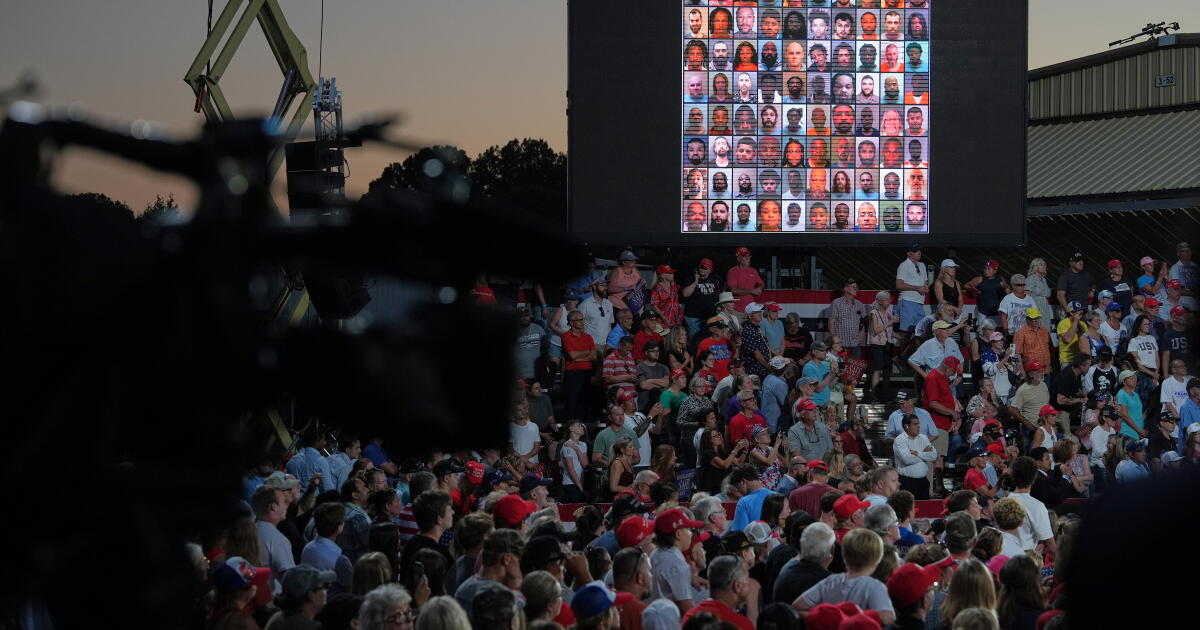
During the Gastonia rally, a mosaic of mug shots was displayed on a large screen for the crowd. Trump claimed Cooper had cut a deal with “radical activists” to release “some of the worst criminals in the nation into North Carolina.”
“He released these people. This is just a small group of them,” the president said, pointing to the mug shots that overwhelmingly featured Black people.
Although it is unclear under what circumstances the people in the mug shots were released, state corrections officials have said Brown was not released early from prison or under Cooper’s COVID-era prisoner-release settlement that Trump referenced.
Before fatally stabbing Zarutska, according to court records, Brown had been on a pretrial release over a misdemeanor offense that was ordered by a magistrate after Cooper left office.
‘Tapping into anger’
Republicans are under pressure to win over swayable voters as the November midterms approach with Democrats pushing to gain control of the House, the Senate, or both. Some political strategists say part of the ploy of adding Horton to the North Carolina Senate campaign is to rile up Trump’s base.
“He’s tapping into the anger to remind Republican voters of what he thinks their first principles are in hopes that will be successful for Republican candidates,” Gillespie said.
“He’s doing this to try and divert attention away from criticism of how he’s governing at the moment,” she added. “Democrats want to make the story of this election Trump’s low approval numbers, the war in Iran, inflation, being preoccupied with things that don’t make a whole lot of sense when there are really serious things going on in the country.”
Dewey Clayton, professor emeritus of political science at the University of Louisville, said Trump and other Republicans may be thinking that what worked before in the 2016 and 2024 elections presumably will work again in this year’s midterms.
“It was very effective,” Clayton said. “You do not necessarily have to look at it as racial, in and of itself, although [race] clearly becomes a component. In 2026, talking about ads going back in the 1980s? I’m sure he had consultants that were basically saying this is tried and true.”
The GOP may need the push in November, Gillespie warns. “I think the motivation by going back to these old strategies is there is real concern about Republican enthusiasm and you might see lower Republican turnout,” she said.
Rhetoric attempts to divert voters’ attention from rising costs
The tactic speaks to desperation by Trump and the Whatley campaign, according to Morgan Jackson, a partner with Nexus Strategies in Raleigh.
“Trump brings up Willie Horton to stoke racial division, something he’s used for the last 10 years,” said Jackson, who is chief strategist for Cooper’s campaign. “It is very clear from the president’s speech last night their only goal is to sow division and hate and lies. Michael Whatley doubles down in support of that effort.”
Jackson also said Trump and Whatley are trying to change the election’s message of “rising inflation and the cost of everything.”
“They want to use inflammatory rhetoric, hate speech and lies to sow division in a chance to win an election,” he said. “By referencing Willie Horton, they are showing their hand very clearly.”
The AP sent an email Thursday seeking comment from Whatley’s Senate campaign.
Williams writes for the Associated Press. Williams reported from Detroit. AP videojournalist Erik Verduzco in Gastonia, N.C., contributed to this report.
G20 finance chiefs gather in North Carolina with Iran sanctions and tariffs in focus
The United States takes its turn chairing the G20 finance track this week under distinctly awkward conditions.

ADVERTISEMENT
ADVERTISEMENT
US Treasury Secretary Scott Bessent and Federal Reserve Chair Kevin Warsh are hosting counterparts in the North Carolina mountains, following a deputies meeting held over the weekend, with the formal agenda covering economic growth, global imbalances, sovereign debt restructuring, banking regulation and energy security.
Asheville was chosen deliberately.
The city was devastated by Hurricane Helene in September 2024, a storm that killed more than 250 people and caused close to $80 billion (€69bn) in damage from Florida to the Carolinas, and Bessent has cited its rebuilding as a fitting backdrop for talks about economic growth.
“We want the rest of the world to come along with our growth agenda, whether it’s deregulation, the energy independence […]” he said, adding that “the world has this mountain of debt, and we do have to grow our way out of it,” confirming public debt will feature prominently in the discussions.
The setting may prove easier than the substance.
Trade friction between the US and Canada escalated after negotiations broke down, hostilities with Iran have resumed through economic rather than military means, and Warsh arrives days after a hawkish first Jackson Hole address that sharply raised the odds of a US rate rise this month.
Both meetings serve as groundwork for the leaders’ summit at Trump National Doral in Miami on 14 and 15 December, and come weeks before Xi Jinping is expected in Washington on 24 September.
Bessent’s push on Iran
The US Treasury Secretary intends to use bilateral meetings to build support for squeezing Tehran, and stated that Washington will sanction another bank this week, though he declined to name it.
“This is going to be financial violence if we have to,” Bessent told AP.
“We are showing people that we know who you are, you know who you are, and this has got to stop,” he added.
The campaign’s opening move came on Friday, when the US Treasury proposed a rule that would cut the Emirati branches of Banque Misr, Egypt’s second-largest lender, off from the American financial system.
By stopping short of full sanctions, the US administration appeared to signal reluctance to punish major trading partners that still deal with Iran, notably China and India.
On Beijing specifically, Bessent said “all options are on the table” over its continued oil purchases, while dismissing suggestions of hesitancy as “a completely false narrative that the media picked up on.”
The meetings are also being held under unusual media restrictions, after the US Treasury barred certain reporters from the New York Times, Wall Street Journal and Bloomberg from covering them.
The New York Times called the move “not just another disturbing effort by the administration to undermine independent journalism, but a blatant attempt to evade public scrutiny.”
The department has not explained its decision, though Bessent told the AP that “it has nothing to do with point of view.”
Who speaks for Europe at the G20
The EU is represented by Ireland’s Tánaiste and Finance Minister Simon Harris, who holds the role by virtue of Ireland’s EU presidency since 1 July, alongside ECB President Christine Lagarde and Economy Commissioner Valdis Dombrovskis.
Harris said he was looking forward to “the first Ministerial meeting of the G20 Finance Ministers and Central Bank Governors since Ireland assumed the Presidency of the EU,” describing the forum as a place where the largest economies “can exchange views and work towards international economic and financial stability.”
The Irish minister’s stated priority reflects the conflict shaping much of the agenda at this G20 meeting.
Among the EU’s concerns, Harris listed “energy security and ensuring we have secure and resilient energy supplies at a time of severe volatility caused by the conflict in the Middle East.”
He will also hold bilateral meetings with counterparts from G20 member states as Ireland has also been invited as a guest for the December leaders’ summit in Miami.
Additional sources • AP