Overseas voters moving to the UK would be prevented from giving more than £100,000 in political donations for a year after their arrival, under new proposals.
Ministers announced the planned restriction alongside tougher checks on company donations, which they believe will help stop foreign money from influencing UK elections.
The government previously announced a £100,000 annual cap on donations from British citizens living overseas backdated to 25 March.
They now want an individual to be based in the UK for a minimum amount of time before their donations can exceed this limit. The change could hit two of Reform UK’s biggest backers, who have previously donated millions to Nigel Farage’s party.
British billionaire Christopher Harborne, a Thailand-based businessman, last year gave a single donation of £9m to Reform – the biggest single donation to a UK political party by a living person.
The cryptocurrency investor and aviation entrepreneur gave £12m in total to Reform in 2025 and a further £3m in January.
Under the government’s planned changes, both Harborne and Delo would be among those donors still covered for a year by the £100,000 cap once they return.
Ministers said other changes will include political donations from companies being assessed against post-tax profits over the previous five years rather than revenue alone.
The government’s aim is to ensure only legitimate UK-linked businesses will be able to donate.
People running for election will also be required to prove that any funding they received before becoming a candidate has come from legitimate sources.
They will have to declare donations above £2,230 received prior to officially becoming a candidate.
The government said the proposals will be introduced as amendments to the Representation of the People Bill, which is currently scheduled to return to the House of Commons for further consideration on 14 July.
Communities Secretary Steve Reed said: “British democracy is not for sale.
“These tough new rules will shut down dodgy funding, stop foreign money influencing our elections and keep our democracy strong.
“By holding overseas donors to tougher standards and requiring candidates to prove where their funding comes from, we are taking world-leading action to protect the integrity of our elections and tackle the threats we face from abroad.”
The review was commissioned last year in response to threats posed by foreign states attempting to meddle in British democracy.
In March, the government announced that donations in cryptocurrency to UK political parties would be banned alongside the move to cap donations of British citizens living abroad at £100,000 annually.
Reform was critical of the changes, with the party’s home affairs spokesman Zia Yusuf accusing Labour of “choking off legal funding for its main rival”.
The Dodgers won the World Series last year, and the year before that. Their lead is the largest in any division this year. That success, and the money that nourishes it, has battalions of fans beyond Los Angeles all but marching outside ballparks with picket signs reading “SALARY CAP NOW.”
It’s a reasonable thought: The Dodgers can’t possibly keep winning if they can’t keep outspending the competition.
Or can they?
“There are a lot of little things that happen behind the scenes that people don’t see,” pitcher Will Klein said. “I understand where people are coming from. It’s easy to be a fan of a smaller team and get mad at other teams outspending you.
“But I think there’s a level of care here, and wanting to win, that exceeds other groups.”
The obvious disclaimer: Any team would be better with Shohei Ohtani and Freddie Freeman and Mookie Betts and Yoshinobu Yamamoto, at a combined price of $1.6 billion. The counter argument: The Angels had Ohtani and Mike Trout and, well, you know.
It takes a roster. In Klein and pitcher Eric Lauer, the Dodgers have done something they do well besides spend: develop valuable contributors out of players discarded by other teams.
The Dodgers grabbed Lauer last month, desperate to fill a hole in their starting rotation. The Toronto Blue Jays had cut him, and he would be joining his seventh major league organization. The logical thought: The Dodgers had found a healthy arm to eat up some innings until they could find someone better.
That still might happen. But Lauer, who is set to pitch Monday, has put up a 3.22 earned-run average in four starts with the Dodgers. Four starts is a small sample size, but in that time, Lauer is a career league-average pitcher performing 28% above league average.
“They got me immediately,” Lauer said. “They figured me out right away, and they knew exactly what was going to help me.”
For Lauer, the changes affected his delivery, but the specifics were not as important as finding a kindred spirit in Connor McGuiness, the Dodgers’ assistant pitching coach.
“I’ve always had a really hard time explaining myself and what I do, because I think a little differently,” Lauer said.
“When I was with the Brewers, it was running joke that it was ‘the language of Lauer,’ because I would describe things so differently and feel things so differently that, if you weren’t close to me and you didn’t know how I operate, it was very hard to understand what I was trying to do.
“Connor just immediately got it. It was like he’s been speaking it forever.”
At one point in his career, Lauer said, he struggled to explain the sensation of catching his heel on the mound as he completed his delivery toward home plate.
“I would describe it as, ‘I was falling backwards and I would catch myself,’ and it’s a really weird concept to think somebody was falling backwards when it doesn’t look like you’re falling at all,” he said. “It looks like you’re just moving forward.
“So they were like, ‘That’s not what you’re doing’ and I was like, ‘That’s what I’m feeling.’ We have to make the connection between the feel and the real so that we can understand each other.”
“I have a hard time saying anybody has done a better or faster job of helping me than the Dodgers.”
— Eric Lauer, Dodgers pitcher, on his development with the team
Klein, who joined his fourth organization when the Dodgers acquired him in a minor league trade last June, is in his first full major league season. He has a 2.37 ERA, and his 0.7 wins above replacement is better than any Dodgers reliever besides veteran closer Tanner Scott.
Klein said other teams had made suggestions on how to improve his game, and with the Dodgers, he has added a sweeper and dumped a slider. But what he needed to do most was throw more strikes, trusting that his lively fastball and curve were good enough to beat the best players in the world.
In the minors, Klein issued 6.9 walks per nine innings. This season, he has issued 3.6 walks per nine innings.
The credit, he said, should be shared with the Dodgers’ mental skills coaches.
“It’s easy to see the guys in the batter’s box — especially when you come up watching baseball and being fans of these guys, it’s easy to see them being above yourself,” Klein said.
“But you’re on the mound with them, so you have to see that too. There’s a lot on the mental side that’s helped me here.”
Dodgers pitcher Will Klein delivers against the Tampa Bay Rays at Dodger Stadium on June 16.
(Eric Thayer / Los Angeles Times)
The Dodgers did not include Klein on their postseason roster for the first three rounds last year, but he said coaches at all levels — in the majors, at triple-A and at the Arizona training complex — never stopped checking in on him, during the season and throughout October.
“When you’re down there, they don’t forget about you up here,” he said. “That kind of commitment and care was levels above what I had experienced.”
When the Dodgers added him to the World Series roster, Klein saved the season, with four scoreless innings to close out an 18-inning victory in Game 3.
Lauer called the communication in the Dodgers’ organization “miles ahead” of any other organization in which he has played.
“The training room, the weight room, the coaching staff, the players to each other,” he said. “Every form of communication is so seamless. Everybody knows what’s going on all the time. There’s no gray area.
“It’s all: ‘This is the plan, this is what we want to happen, this is how we’re going to make it happen,’ instead of: ‘This is the plan, this is what we want to happen, figure out a way to make it happen.’”
Klein raved about how the Dodgers treat player families, and about a high-tech pitching machine so lifelike that he could see what it would be like to bat against him. Lauer reflected on his experience as a first-round pick turned journeyman who went to South Korea to revive his career.
“I have a hard time saying anybody has done a better or faster job of helping me than the Dodgers,” Lauer said.
What Lauer and Klein say substantially echoes what Dodgers president of baseball operations Andrew Friedman said at last year’s World Series about turning the team into a preferred destination for players, and not just because the team wins and spends.
“Communication, being honest, having a really strong player development group in place at the major-league level, and how you treat families and treat the players,” Friedman said then, “I think matters a lot in that.”
To be clear: There is no indication the players’ union is willing to consider, let alone approve, a salary cap.
But, if that were to happen, Klein believes the Dodgers would be just fine.
“Our owners want to win, so they want to get the best product on the field, so they go and spend money,” he said, “and then everyone is mad that they want to win.
“I think they’ll find ways to win more if they can’t spend as much money. Friedman was with the Rays when they weren’t spending as much money and still had success there.
“I think they’re just better at wanting to win than some other people.”
Dalton Rushing was frustrated. He just chased a slider in the dirt — again. And this time, the game was on the line. The Dodgers were down to their last out. He was down to his last strike.
So he took a moment, took a breath, and looked to the Dodgers dugout.
The first person he spotted was Mookie Betts, who had just cut the Orioles’ lead to a run with a solo homer. Betts was locked in with Rushing, brimming with confidence, cheering him on.
“For a guy like that, a guy that’s lived in that moment, he’s succeeded in that moment, he’s failed in that moment, he knows what it feels like, it’s pretty special,” Rushing recounted.
Rushing’s eyes traveled along the railing, noting his teammates all on the top step, all relying on him.
He dug into the box, expecting the slider that Baltimore’s Ryan Helsley threw next — it was high, for a ball. Then Rushing got a fastball he could drive. And he did not miss.
The next moments in the Dodgers’ 6-5 walk-off win Friday were chaos.
Rushing lined a tying single into right field, giving Alex Call time to score from second. Call slid across the plate as the throw from Orioles right fielder Tyler O’Neill took for a long hop to catcher Samuel Basallo.
Basallo misjudged it, taking an unhurried shuffle up the line, before the ball glanced off his glove and rolled toward the Dodgers dugout.
Third base coach Dino Ebel waved home Ryan Ward, who scored standing up.
Manager Dave Roberts, who looked down at his card when the throw was in the air, was already thinking through extra innings when the crowd erupted again. He heard field coordinator Bob Geren shouting something like, “The run counts.”
The Dodgers (49-27) ran onto the field and swarmed Rushing, who had just reached second. They jumped and yelled as the Dodgers Stadium lights flashed around them.
“It was good to get Freddie [Freeman] a night off for being the guy in the middle for a change, you know?” Rushing said with a grin. “No, it’s a great feeling, and I think it honestly just feels great that we won that baseball game.”
For several innings, it looked like they wouldn’t.
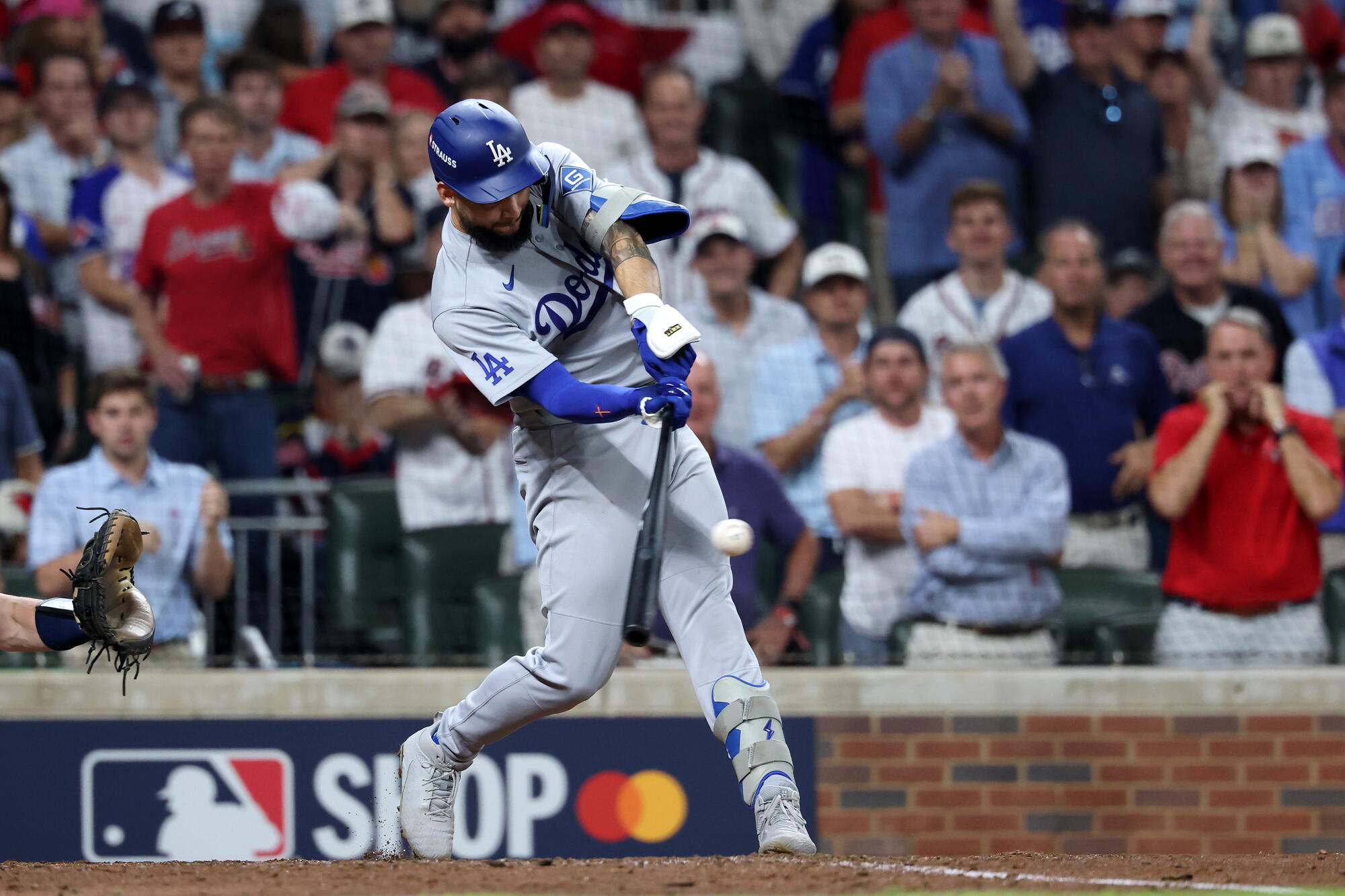
Dalton Rushing celebrates after hitting a run-scoring single in the ninth to help lift the Dodgers to a 6-5 walk-off win over the Baltimore Orioles at Dodger Stadium.
(Gina Ferazzi / Los Angeles Times)
The Dodgers had jumped out to an early 3-0 lead, on a two-run single from Max Muncy in the first inning and an RBI double from Andy Pages in the second. Then their scoring dried up.
Rushing was having as frustrating of a night as anyone, with a line out and three strikeouts.
His first strikeout was part of a brutal sequence. The Dodgers loaded the bases with no outs in the third. Then Ward, Rushing and Alex Freeland, all went down swinging.
Rushing struck out on a slider in the dirt. And Orioles starter Trey Gibson got him to bite on the same putaway pitch in the fifth.
Rushing’s reactions steadily grew more animated, on the field and in the dugout.
Mookie Betts celebrates as he runs the bases after hitting a solo home run in the ninth inning Friday against the Orioles.
(Gina Ferazzi / Los Angeles Times)
Alex Freeland signals safe after sliding past Baltimore catcher Samuel Basallo to score on a double by Andy Pages in the second inning Friday.
(Gina Ferazzi / Los Angeles Times)
“He plays with a fire under his ass,” Freeland said. “He gets after it. He expects nothing but the best for himself day in and day out, and that comes with it.”
Said Roberts: “After he … vents, he does a good job of collecting himself to get back into the next play, the next at-bat, catching.”
On Friday, he was catching Roki Sasaki, who faced just one batter over the minimum through five innings. But during the third time through the order, the Orioles finally figured him out and hit back-to-back home runs.
With two outs and a runner on, Sasaki yanked a splitter to the inside edge of the strike zone to Gunnar Henderson, who lifted it over the wall in right field. Pete Alonso then homered to left-center field on an inside fastball about belt high to tie the score.
“I thought he threw the baseball really well,” Roberts said. “I liked the way he competed. The fastball command was good. He was fantastic tonight.”
The Orioles (35-42) pulled ahead against the Dodgers bullpen. Will Klein surrendered a seventh-inning single to Jackson that sent two baserunners, including one inherited from Dodgers left-hander Jack Dreyer, across the plate.
Kyle Hurt and Blake Treinen threw clean eighth and ninth innings.
Finally, in the bottom of the ninth, Betts ended the Dodgers’ scoring drought. Then Muncy — later replaced by the pinch-running Call — and Ward drew walks.
With two outs, Rushing stepped up to the plate, fell behind in the count 0-2 and reset.
“I look in the dugout, and all those guys care about is that next pitch, and the next pitch after that, and the next pitch after that,” Rushing said. “They just want you to win one pitch at a time.”
Amid the first days of grief after Alex Vesia and his wife lost their newborn daughter last fall, Vesia noticed something as he watched the World Series on television. He paused the broadcast, then checked the video, then texted another player to make sure.
51.
Dodgers teammates wore his number on their caps. So did players from the Toronto Blue Jays.
“It was awesome,” Vesia said. “It was a very heartwarming moment.”
Moving.
Touching.
And, under baseball’s rules, illegal.
Who knew, really, until this week? Three pitchers from the San Francisco Giants wrote the name of a Bible verse on their Pride Night caps and, amid an uproar, Major League Baseball said it had warned the players that “writing of any kind, with any message” on any playing apparel is not permitted. The issue, the league said in a statement, was not what they wrote on their caps but simply that they wrote on them at all.
Said MLB in the statement: “We have given the same warning numerous times in the past to players for messages such as ‘Dad’, ‘Happy Mother’s Day, I Love Mom’ and names of family members.”
To its credit, the league did not enforce the rule when Vesia’s number started appearing on caps in the World Series. But, if you’re going to draw a line on enforcement, where should you draw it?
In San Francisco, the actions of the Giants’ pitchers were widely condemned.
“They were in for a rude awakening with the response, and it wasn’t just from the gay community,” Giants broadcaster and former pitcher Mike Krukow told KNBR, the team’s flagship radio station. “It was from the Northern California community that supports the gay community.”
In response to media inquiries, and as first reported by Outsports, MLB confirmed it had warned the three players. I asked the league whether warnings had been issued in two other instances in which players had written on their caps, including Clayton Kershaw last year writing the same Bible verse on his Pride Night cap that the Giants’ pitchers wrote this year. MLB declined to comment.
“I got chastised by the league when I put Charlie [Kirk]’s name on my hat last year, because a man was murdered in cold blood,” Dodgers pitcher Blake Treinen told me, “and now these gentlemen who are relievers in San Francisco are getting chastised by the league for putting a Bible verse on their hat. It’s crazy to me.”
Treinen said league officials had told him the rule is strictly enforced.
“I straight up asked Clayton last year, ‘Did they call you when you put that on your hat?’” Treinen said. “He said, ‘No.’”
The Pride caps feature team logos decorated in the colors of the rainbow, a symbol long associated with the gay community. In the Bible verse cited by the pitchers (Genesis 9:12-16), the rainbow represents “the everlasting covenant between God and all living creatures.”
Missouri Sen. Josh Hawley fired off a letter to MLB commissioner Rob Manfred, alleging apparent discrimination “against baseball players who profess their Christian faith” and threatening the league’s antitrust exemption. Assistant U.S. Atty. Gen. Harmeet Dhillon said on national television that players might be able to file a claim for employment discrimination.
That is complete nonsense. This is what you want: When employees raise an issue to their employer, the employer listens and addresses their concerns.
“We have told teams, in terms of actual uniforms, hats, bases that we don’t think putting logos on them is a good idea just because of the desire to protect players: not putting them in a position of doing something that may make them uncomfortable because of their personal views,” Manfred said then.
Teammates congratulate Freddie Freeman after his walk-off home run gave the Dodgers a 1-0 win on June 5, when the Dodgers held their annual Pride Night. Blake Treinen, the winning pitcher that night, elected to wear his regular Dodgers cap instead of the Pride version.
(Katelyn Mulcahy / Getty Images)
Manfred said the Pride Night celebrations could go on, however a team wished to stage them — or not, in the case of the Texas Rangers, the only one of the 30 MLB teams that declines to hold a Pride Night. And the league still sells Pride gear on its website for all teams, including the Rangers.
In the cases of the Giants and Dodgers, MLB grandfathered each team’s long-running use of a rainbow logo on the cap, with this accommodation to players: If you don’t feel comfortable wearing the Pride cap, just wear your regular cap.
That is what Treinen and outfielder Alex Call did when the Dodgers celebrated Pride Night. That is also what a fourth Giants pitcher did.
“My job is to abide by the rules,” Treinen said. “Ultimately, the only rule we have is to wear our team-issued uniform. So that’s what I chose to do.”
To Treinen, the decision over whether to wear a Pride cap is not about passing judgment on anyone else but about what he sees as the push “to force something on people that you know that is controversial to their faith — and, in fact, straight up against their faith.”
He expressed his support for the Giants pitchers.
“Kudos to those men over there who are standing strong in their faith,” he said. “It’s a sad thing to corner someone and try to make them feel bad about their convictions.”
I respect Treinen for explaining his viewpoint. To me, wearing a Pride cap for one night does not diminish your faith at all. It might sharpen your convictions. More important, it signals a welcome to everyone in the community that buys the tickets and broadcast subscriptions that help pay your salary.
“I think a few people made it about themselves and not about the community,” San Francisco Mayor Daniel Lurie told the Bay Area Reporter.
We always proclaim the life lessons of sports. One of them: Sometimes you have to put the team’s interests ahead of your own.
Swiss voters reject a proposed population cap that would cap the country’s population at 10 million. The plan, championed by the right-wing Swiss People’s Party, was supported by 45% of voters.
WASHINGTON — After Defense Secretary Pete Hegseth cut nine Navy officers, including all the women, from a promotion list, several female officers say they see the unusual intervention as a sign that their careers now have a ceiling and worry for the future generation of female military leaders.
The Navy had selected 31 sailors to promote from the rank of captain to one-star admiral, but Hegseth recently intervened to strike nine people from the list, including three women and two Black men, according to a Defense official who spoke on condition of anonymity to discuss information not permitted to be released publicly.
As a result, the Navy is not promoting a single woman to the one-star admiral rank this year even though women make up about one-quarter of all Navy officers and nearly one-third of the sea service’s midgrade ranks, according to military data from 2024.
The Associated Press spoke with eight female Navy officers of varying ranks and time in service after Hegseth’s cuts, which were reported earlier by the New York Times, became public. They spoke on condition of anonymity out of fear of retribution from their superiors.
The more junior officers said they saw the development as a sign that their careers would become politicized if they rose too far in the ranks, and some said they felt they now had a limit on how far they could be promoted. Some said it made them feel less valued within the military and wondered whether that wasn’t part of the intent.
The Pentagon has not offered any rationale on why the women, or any of the other six people, were removed from the promotion list.
Sean Parnell, the Pentagon’s top spokesman, said on social media last week that “military promotions are given to those who have earned them” and that the Pentagon “will never consider the color of a service member’s skin or their gender as a factor in promotions.” The Pentagon did not immediately respond to a request seeking further comment.
The Navy’s process for choosing which officers to promote to the one-star rank has been relatively constant and transparent over the years. The service convenes a group of officers, called a promotion board, that examines the records of eligible officers and chooses those deemed to be the most qualified.
The board that selected the initial slate of 31 officers for promotion was directed by then-Navy Secretary John Phelan, an appointee of President Trump, to “recommend for promotion the best qualified officers within their respective competitive category.”
The order from Phelan, who abruptly departed his post in April, said the board should consider an officer’s performance, competence and character, among other traits, as part of those qualifications.
It also said that given China’s prominence in the Trump administration’s National Defense Strategy, “special consideration shall be given to officers who have excelled in their knowledge of the political military affairs and U.S. strategic interests in the Indo-Pacific region, and operational contingency planning for Indo-Pacific war plans.”
Hegseth has long argued, without offering evidence, that women in the military benefit from preferential treatment and are not suited for combat roles.
“For too long, we’ve promoted too many uniformed leaders for the wrong reasons based on their race, based on gender quotas, based on historic so-called firsts,” Hegseth told hundreds of military leaders in September.
The approach, he asserted, made the Pentagon “less capable and less lethal.”
‘A break from tradition’
Phelan’s order said the Navy cannot discriminate based on criteria such as race and sex, and it specifically noted that “this guidance shall not be interpreted as requiring or permitting preferential treatment of any officer or group of officers on the grounds of race, religion, color, sex.”
The full list of 31 people to be promoted was approved by Phelan, other Navy leaders and the chairman of the Joint Chiefs of Staff, Gen. Dan Caine, before it reached Hegseth, who chose to make the changes, the Defense official said.
While Hegseth is within his rights to intervene in the list, “it’s just not the norm” and is “a break from tradition,” said Katherine Kuzminski, a researcher specializing in military recruiting and retention at the Center for New American Security think tank. She said that promotions historically have been seen as “the services’ business.”
Kuzminski noted that “this is a decision that’s not being made by the Navy — it’s being made by the secretary of Defense,” and she said Hegseth’s growing interference in operational aspects of the military services such as promotions is creating “tension” about what “normal” will look like going forward.
Some of the more senior Navy officers who spoke with the AP expressed concerns about the message it sends to the next generation of young sailors.
In addition to pulling the recent promotions of three women to admiral, Hegseth shortly after he took office fired Adm. Lisa Franchetti, the service’s top officer and the first woman to hold the job. He never explained his rationale.
Since then, he also has fired two other female three-star admirals without explanation.
Some of the officers who spoke to the AP said that while they were encouraging female sailors to stick with the Navy, they acknowledged that message is coming at a difficult time.
Kuzminski said the rhetoric and actions surrounding women in the military “affects individual service member decision-making and it also affects family unit decision-making,” including whether people make a career of the military.
Kuzminski said that following the months-long hold on military promotions by Sen. Tommy Tuberville (R-Ala.) during the Biden administration, surveys showed that partisan politics spilling into the day-to-day lives of troops affected their decision-making.
One officer said this impact was not confined to women.
In conversations with other sailors in her unit, she said that male sailors were hesitant to deal with what appears to be a growing politicization of simply following the orders of previous administrations.
Manuel Neuer to start for Germany in World Cup upon his return, despite Oliver Baumann long being labelled team’s first choice.
Published On 21 May 202621 May 2026
Bayern Munich’s Manuel Neuer has come out of international retirement to compete in next month’s World Cup after being named on Thursday as the starting goalkeeper in Germany coach Julian Nagelsmann’s squad for the tournament.
Nagelsmann made the decision after having long labelled Hoffenheim’s Oliver Baumann as his first-choice keeper.
Recommended Stories
list of 4 itemsend of list
“Yes, I plan with that [with Neuer as number one],” Nagelsmann told a press conference. “The main task was to nominate the best three keepers. So we decided that these three are part of that.”
“We contacted Manuel and asked him if he wanted to play for the national team again,” said Nagelsmann.
The 40-year-old Neuer, who last competed for Germany at Euro 2024 before his international retirement, is now set to play in his fifth successive World Cup, joining an elite group of football players with five or more tournaments.
Neuer, a 2014 World Cup winner, enjoyed a solid season with champions Bayern, who could win the domestic double with victory over VfB Stuttgart in the German Cup final on Saturday.
He signed a contract extension with Bayern last week.
There were few other major surprises in Nagelsmann’s 26-man squad for the tournament starting next month. But the coach also called up Bayern’s teenage player Lennart Karl, who enjoyed a meteoric rise this season, as well as Nadiem Amiri and Leroy Sane, who both had outside chances of earning a spot.
“They [players] fit well together. It is a good mix. Many have been playing since their youth together,” Nagelsmann said. “We are happy with our choice, but know others will stay at home who have performed very well.”
Germany, who face Curacao, Ecuador and Ivory Coast in Group E at the World Cup, have set their sights on a fifth title after shock first-round exits in the past two editions in 2018 and 2022.
“The statement stands,” Nagelsmann said. “We want to become world champions. Every player who is nominated needs to show it now every day.”
Germany squad for FIFA World Cup 2026:
Goalkeepers: Manuel Neuer, Oliver Baumann, Alexander Nubel
Defenders: Nico Schlotterbeck, David Raum, Nathaniel Brown, Jonathan Tah, Waldemar Anton, Pascal Gross, Joshua Kimmich, Felix Nmecha, Malick Thiaw, Aleksandar Pavlovic, Antonio Rudiger, Angelo Stiller
Midfielders/Forwards: Leon Goretzka, Maximilian Beier, Jamal Musiala, Nadiem Amiri, Jamie Leweling, Kai Havertz, Lennart Karl, Florian Wirtz, Deniz Undav, Nick Woltemade, Leroy Sane
Starbucks Corporation (SBUX) announced the early results of its cash tender offers for multiple senior notes, amending the terms to increase its total purchasing capacity to $1.3B.
To accommodate the high volume of participation, Starbucks exercised its right to amend and
Members of the Writers Guild of America have officially ratified their newest contract with the Alliance of Motion Picture and Television Producers.
More than 90% of the 11,000 voting members in both WGA East and West registered their support of the new agreement. The voting period closed Friday at noon, after the union first struck a tentative deal earlier this month.
The new contract includes a robust healthcare plan in which studios pay over $320 million to sustain the health fund, higher residual rates — including a provision for a “success bonus” for the most popular streaming shows from 50% of the base residual to 75% — and language on the licensing of work for AI training.
“The first reaction [from members] was relief that we were not going to be going into a period of labor strife or strike authorization vote, in the midst of this contraction,” said John August, the co-chair of WGA’s negotiating committee, referring to the ongoing challenges in the industry. “Members want to work, and they want to get back to doing their job.”
Negotiations between the union and film and TV studios began in March, as the union’s current contract expires May 1. August said that, at the beginning of the negotiations, expanding the healthcare plan was a top priority. The union was able to secure increases that would raise the cap that companies pay to as high as $400,000 by 2028.
Union officials say the current cap has remained unchanged for two decades as healthcare contributions have steadily declined because there are fewer working writers.
But under the new contract, members would, for the first time, have to start contributing to their healthcare costs to the tune of $75 per month. The earnings threshold to get coverage would increase by about $7,000 to $53,773, leaving many members concerned about the higher cost.
“This is all difficult. Healthcare in America is not a good situation. But we were really mindful, as we always are, of trying to make sure the career of writing is sustainable,” negotiating committee co-chair Danielle Sanchez-Witzel said.
Additionally, the contract terms have been extended from the WGA’s usual three years to four — though it is not the first time the guild has added more time to its deal with the studios. Sanchez-Witzel clarified that the four-year period for the new contract ”is, by no means, a standard. This is just what we needed this year and what we agreed to for this cycle.”
“We were here in 2026 trying to get some things that we didn’t get earlier [in previous negotiation cycles] and happy for the progress we made,” she said.
The WGA is the first of the Hollywood unions to strike a deal with the studios. AMPTP congratulated the WGA on the ratification in a statement released shortly after the vote totals were announced.
“This deal reflects a collaborative approach that supports both writers and the industry’s long-term stability,” AMPTP said.
SAG-AFTRA and the Directors Guild of America still need to negotiate new contracts.
Ingle has come a long way since beginning her junior career with Vale Wanderers, a boys’ team in Barry.
She was forced to give up the sport when aged 12 because Football Association of Wales (FAW) rules meant she could no longer play with the boys.
Thankfully for Welsh football, Ingle returned to the pitch when her Vale Wanderers coach set up a girls’ team when she was 14.
She then played for Dinas Powys Ladies and Cardiff City Ladies before joining Chelsea for the first of two spells in 2012.
By that stage, Ingle was an established Wales international, having made her senior debut in a 2-1 World Cup qualifying defeat to Azerbaijan three years earlier, only a matter of weeks after her 18th birthday.
Ward scored Wales’ goal in Baku, with Ingle coming off the bench.
“It was a horrible game, horrible pitch, but this kid just made it look like she’d been doing it her whole life,” Ward remembers.
“She’s just a top player… technique is unbelievable, the way she reads a game, the way she can find a pass.
“She’s my favourite footballer in the world.”
Adrian Tucker was the manager who gave Ingle her first cap, in an era when the landscape was very different in women’s football.
“She was good technically but she was also really good on the physical side, which was a really big thing at that time,” he says.
“Did I think she would go on to win 150 caps? In 2009, I didn’t think Wales would play 150 games. We were struggling to get five games a season.
“But since then there has been a boom in women’s football and Sophie has been on the crest of that wave.”
In this week’s presidential debate, Mitt Romney fleshed out an idea he had previously mentioned briefly as a way to pay for his proposed tax cuts – setting a cap on itemized deductions.
“I’m going to bring rates down across the board for everybody, but I’m going to limit deductions and exemptions and credits, particularly for people at the high end,” the Republican presidential nominee said.
“One way of doing that would be to say everybody gets – I’ll pick a number – $25,000 of deductions and credits. And you can decide which ones to use, your home mortgage interest deduction, charity, child tax credit and so forth. You can use those as part of filling that bucket, if you will, of deductions.”
The cap, Romney said Tuesday night, would ensure that the wealthy would not receive an outsized tax break. “I am not going to have people at the high end pay less than they’re paying now” as an overall share of U.S. taxes, he said.
Moreover, he insisted, the cap would allow him to pay for his proposed tax cuts without increasing the size of the deficit.
“Of course they add up,” he responded when Candy Crowley, the debate moderator, asked him about whether his numbers penciled out.
Politically, a cap on deductions provides an attractive solution to raising tax revenue because it avoids having to wage fights over individual deductions.
Unfortunately for Romney, however, the cap does not come close to covering the full cost of the tax plan he has proposed, according to a new analysis by the Tax Policy Center, a specialized Washington think tank. The Romney tax plan would reduce federal revenue by about $5 trillion over 10 years in addition to the cost of the Bush-era tax cuts that he would extend.
“These new estimates suggest that Romney will need to do much more than capping itemized deductions to pay for the roughly $5 trillion in rate cuts and other tax benefits he has proposed,” wrote Roberton Williams, an analyst at the nonpartisan center, which is a joint operation of the Urban Institute and the Brookings Institution.
The Tax Policy Center analysis suggested that Romney’s proposed cap would raise revenue in a “highly progressive” way because upper-income households benefit more from itemized deductions. The center found that the cap would provide considerable revenue to offset the cost of the tax cut, but would still leave a huge gap.
The center’s staff consists of former government tax experts from both Republican and Democratic administrations. Romney and his aides cited the center as an authoritative source during Republican primary debates but since then have objected to the center’s analyses of shortcomings in their tax plan.
According to the center’s analysis, a $25,000 cap would raise about $1.3 trillion over a 10-year period. That would cover roughly a quarter of the 10-year cost of Romney’s tax plan.
If Romney made the cap tighter – allowing just $17,000 in deductions and credits – he could raise $1.7 trillion. A $50,000 cap would bring in about $760 billion. At various times, Romney has cited each of those figures as a proposed cap.
The tighter cap would hit many more taxpayers. If the cap were $50,000, for example, almost all the revenue that it would raise, about 80%, would come from taxpayers with income above $500,000 a year, and less than 4% would come from taxpayers earning less than $100,000, according to the center’s analysis. That’s because very few taxpayers other than the very wealthy have deductions that total more than $50,000.
By contrast, a cap of $17,000 would get about 40% of its revenue from that top group, and about 17% from the taxpayers earning $100,000 or less.
Romney has said that he expects part of his tax cut would be paid for by additional revenue flowing into the treasury as the result of faster economic growth. Economists disagree about whether a tax cut such as the one Romney has proposed – a reduction of current tax rates by one-fifth – would significantly increase economic growth.
In response to the center’s report, the Romney campaign issued a statement that did not dispute the math, but reiterated Romney’s position that “the President and Congress working together can make the tax code simpler, more efficient, and more pro-growth.”
[For the Record, 9:51 a.m. PST Oct. 18: This post has been updated to include the Romney campaign’s response to the Tax Policy Center’s report.]