Canadian

Moment Canadian politician accidentally reads AI prompt during speech | Politics News

NewsFeed

‘Here’s a more natural flowing version of that section…’
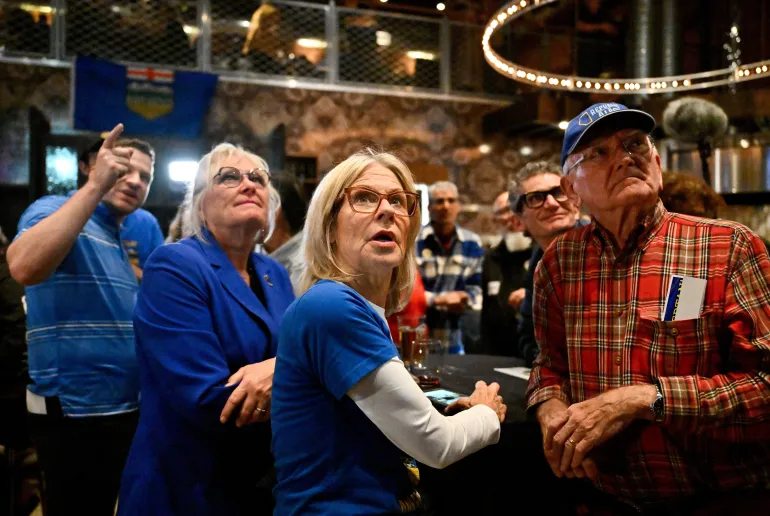
Canadian politician Bill Oliver has gone viral after he appeared to accidentally read AI-generated editing instructions aloud, not once, but twice, during a speech to lawmakers in early June.

Source link

Schedule changes called for after Jannik Sinner and Novak Djokovic withdraw from Canadian Open

The tournament director of the Canadian Open says changes need to be made to the “demanding schedule” of players after Jannik Sinner and Novak Djokovic pulled out of the Masters 1000 event.

Sinner, who beat Alexander Zverev to win the Wimbledon title this month, said he had withdrawn from the ATP tournament, which takes place from 2-13 August in Montreal, to prioritise his health.

Carlos Alcaraz will also be absent from the Canadian Open as he continues his recovery from a wrist injury that has kept him out since April.

“We are obviously very disappointed that Jannik and Novak won’t be joining us in Montreal this year, especially after they also withdrew from last year’s tournament in Toronto,” said the Canadian Open’s tournament director Valerie Tetreault.

“We respect their decisions and understand that, with such a demanding schedule, players’ health must remain the priority.

“That said, we believe the frequency of these last-minute withdrawals in the last few years raises a broader issue for our sport.

“Masters 1000 events are among the flagship tournaments on the tour, and fans rightfully expect to see the world’s best compete.

“We are already in discussions with the ATP to ensure this matter received serious consideration.”

The Canadian Open takes place before the Cincinnati Open, which is also a Masters 1000 event, and prior to the start of the US Open – the final Grand Slam of the year – on 30 August.

Seven of the existing nine Masters 1000 events – the sport’s highest level below the Grand Slams – are now staged over 12 days and concerns over the congested tennis calendar, which stretches across 11 months of the year for the top players, have regularly been voiced.

Britain’s Jack Draper and Emma Raducanu recently pulled out of Wimbledon on the eve of their home Grand Slam because of injury.

Draper, who withdrew with a long-term arm injury, said he felt the amount of injuries suffered by leading players is “pretty worrying”.

In September 2024, Alcaraz said: “They are going to kill us in some way.”

“We firmly believe adjustments are needed in the near future to better protect the integrity of our Masters 1000 events while remaining mindful of the realities players face,” added Tetreault.

Earlier this year, women’s world number one Aryna Sabalenka and Iga Swiatek pulled out of the Dubai Championships, a WTA 1000 event, two days before it started.

Tournament director Salah Tahlak said players who made late withdrawals from tournaments should be docked points, while Sabalenka said criticism of her was “ridiculous” and that she may not play at the tournament again.

Source link

Trump imposes 50% US tariffs on some Canadian goods, citing discrimination | International Trade News

Tariffs apply to Canadian wine, hockey sticks, cement, and other products, sparking fears of escalating trade tensions.

US President Donald Trump will impose new 50 percent tariffs on many Canadian goods, claiming “discriminatory treatment” by Ottawa against US alcohol, automobile and dairy products.

The tariffs, ordered by Trump on Monday, will take effect in 30 days and cover a range of items, including wine, hockey sticks, and cement, according to a White House fact sheet.

Recommended Stories

list of 3 itemsend of list

Trump, who saw many of his tariffs struck down by the Supreme Court earlier this year, is using an untested legal provision for the new duties: Section 338 of the Tariff Act of 1930.

The latest duties will not apply to energy, potash, and goods already impacted by sector-specific tariffs, the White House said.

Crucially, however, they will hit products covered under the US-Mexico-Canada free trade agreement (USMCA).

The tariff announcement quickly raised concerns of escalation among some businesses.

While Trump has slapped sweeping duties on US trading partners since returning to the presidency last year, the orders generally exempted goods entering his country under the North American free trade pact.

His latest actions threaten to further strain ties with the second-largest US trade partner and come just days after he threatened Canada with increased tariffs over a wave of wildfire smoke that descended on the US.

The White House, in announcing the new tariffs, said Canada was one of only two countries – along with China – to retaliate against Trump’s tariffs last year.

It also took aim at the fact that most Canadian provinces have stopped buying US alcohol, boycotting the products over Trump’s tariff threats and repeated calls for annexation of Canada as America’s “51st state”.

“Canada has taken US alcohol products off Canadian shelves, given better market access to dairy products from the European Union, and has put a cap on US vehicle exports to Canada from companies reshoring to the United States,” US Trade Representative Jamieson Greer charged in a statement.

The tariff announcement aims to “hold Canada accountable for its retaliation and discrimination”, he added.

Source link

Trump imposes new 50% tariff on many Canadian imports

The Rainbow Bridge across the Niagara River, connecting the United States to Canada, is shown in 2024. On Monday, U.S. President Donald Trump signed orders mandating new 50% tariffs against some Canadian imports. File Photo by Joe Marino/UPI | License Photo

July 20 (UPI) — President Donald Trump signed orders Monday to impose a new 50% tariff on many Canadian imports, saying it’s because of “discriminatory treatment” of U.S. products.

The tariffs take effect Aug. 19 and affect a wide range of goods including wine, hockey sticks, electrical equipment and concrete.

Trump cited part of the Tariff Act of 1930 that allows a U.S. president to mandate a tariff up to 50% without congressional approval if a country is believed to be discriminating against U.S. goods. However, the law has not been applied this way before, CNN reported.

The Trump administration said the tariffs cover $20 billion worth of imports. They join ongoing tariffs from 15% to 50% imposed by the United States on Canadian steel, aluminum and copper, as well as Canadian softwood lumber, BBC News reported.

Last week, Trump threatened new tariffs on Canada as punishment for the smoke from hundreds of wildfires that drifted over the border and affected some U.S. cities. However, there was no mention of the wildfires in the orders signed Monday.

The tariffs affect all the goods in each category even if they are included under the existing free trade agreement between the United States, Canada and Mexico.

The Trump administration named dairy products, U.S. motor vehicles and alcohol Monday as the three U.S. products it says Canada discriminates against.

“President Trump is taking action to hold Canada accountable for its continued discrimination against and unreasonable and unequal treatment of U.S. commerce that has burdened and disadvantaged hard-working Americans,” a statement released by the White House said.

A few key Canadian imports are excluded from the new tariffs. These include energy products, potash, critical minerals, fish and some other goods.

In February, the U.S. Supreme Court struck down the international tariffs imposed by Trump under the International Emergency Economic Powers Act of 1977. Trump said at the time that he would find other ways to impose tariffs.

Ontario Premier Doug Ford said Monday that Canada should retaliate against the new tariffs.

“If these tariffs proceed, Canada should respond tariff fortariff, dollar for dollar,” Ford posted on social media.

Source link

All to know about Canadian wildfire smoke, air quality and World Cup final | World Cup 2026 News

With the World Cup final less than 24 hours away, an unlikely factor is grabbing the attention of organisers, fans and players alike.

The lingering smoke from the Canadian wildfires sparked earlier this week has engulfed the northeastern region of the United States, raising questions about its impact on the Spain vs Argentina final in New Jersey on Sunday.

A visible haze hung over the twin World Cup host states of New York and New Jersey on Saturday, with inclement weather causing disruptions.

At one point on Friday, New York rated as the city with the worst air quality in the world.

The World Cup final between the European champions and current title holders kicks off at 3pm local time (19:00 GMT) on Sunday in East Rutherford, New Jersey.

Here’s what we know about the smoke, weather and World Cup final:

Is there a haze in New York and New Jersey before the World Cup final?

Smoke from the Canadian wildfires is hanging over the region, reducing visibility and affecting air quality in most northeastern US states.

Warnings of unhealthy air quality remained in effect across a wide area of the US east coast on Saturday.

However, experts predict conditions will improve for the big showdown in New Jersey tomorrow.

The air quality index forecast shows an improvement from unhealthy air to “moderate” air quality for sensitive groups from Saturday to Sunday in East Rutherford, which means little to no health risk for the general public on the day of the final.

How is the weather and what’s the forecast in New Jersey before the Spain vs Argentina final?

A thunderstorm passed through the area on Saturday afternoon, causing heavy rain and loud thunder at the New York New Jersey Stadium, renamed from MetLife Stadium.

State police urged people to leave the stadium seating bowl and field and take shelter. Volunteers and staff dashed inside for cover as ponchos were handed out. The sky was the same thick, soupy grey it had been for days.

New Jersey Governor Mikie Sherrill warned residents about the potential for damaging winds, tornadoes, flash flooding and large hailstones.

FIFA said it was in close contact with local authorities as it continues to monitor the impacts from the wildfire smoke and the storms on the stadium conditions for the final.

Have the weather and smoke disrupted preparations for Spain or Argentina?

Spain’s last training session ahead of the final at a nearby Melanie Lane Training Ground was suspended because of storms and lightning in the area.

The Spanish football federation (RFEF) said that was in accordance with US storm safety protocol.

“The players are currently taking part in a warm-up session indoors,” RFEF added.

FIFA said that there would not be another time slot for the team to train.

Argentina had an outdoor training session at their scheduled time of 1:30pm (17:30 GMT), with players showing no concerns about air quality or the weather.

Argentina's Lionel Messi works out during a training session on the eve of the World Cup final soccer match in Morristown, N.J., Saturday, July 18, 2026. (AP Photo/Ashley Landis)
Lionel Messi and the Argentina squad unaffected by the weather on the eve of the World Cup final, July 18, 2026. (AP Photo/Ashley Landis)

Will the wildfire smoke affect the World Cup final?

The haze will mostly clear from New Jersey just in time for the final, thanks to thunderstorms passing through the area, meteorologists say.

“This storm front will largely move the smoke out of the northeast before the final between Spain and Argentina,” said Tyler Roys, a senior meteorologist at online weather service AccuWeather.

“There could be some lingering smoke that would make things hazy, but very faint,” Roys said. “In terms of the thickest smoke, the smoke that has really been eye-popping and leads to poor air quality, that is not expected across New York City or much of the northeast.”

Jeff Berardelli, chief meteorologist and climate specialist at WFLA-TV, echoed the forecast, saying the storm front would “sweep the atmosphere clean”, leaving only a thin smoke that World Cup spectators may still smell in the air.

“It won’t be dangerous anymore,” Berardelli said. “It’s going to be dramatically better.”

Temperatures are forecast to be around 27C (80F) with light breezes and low humidity for kick off.

“You couldn’t have asked for much better weather for the World Cup,” Berardelli added.

Both experts expect the heavier smoke on Sunday to be concentrated closer to the fires, hanging over parts of the Midwest and Great Lakes region.

Berardelli said they are burning longer and faster because of climate change.

Source link

Canadian wildfire smoke shrouds US, potential risk for World Cup final | Climate Crisis

NewsFeed

Plumes of smoke from wildfires in Canada are pouring into major US cities across the Midwest, Northeast and mid-Atlantic. Polluted air is affecting more than 100 million people and is creating concern ahead of Sunday’s World Cup final.

Source link

Obama hopes hot new Canadian leader will mature into strong ally

The contrast was inescapable. At the top of a local newspaper’s front page here was a huge photo of the new Canadian prime minister, in a trim suit and wind blowing through his hair, captioned “ladies’ choice.” Next to him was a workmanlike headline over a separate story: “Obama to give PH two warships.”

President Obama, once a glamorous figure among world leaders, has been replaced as the “It Boy” of the summit circuit by Canada’s newly elected Justin Trudeau, as heads of state meet up this week in Turkey, the Philippines and Malaysia.

Though Obama came to Manila for the Asia-Pacific Economic Cooperation summit with a new financial commitment to bolster the Philippine maritime fleet, the nation’s hearts and minds seemed won over by the 43-year-old Canadian, who lighted up Twitter with the designation #APECHottie.

NEWSLETTER: Get the day’s top headlines from Times Editor Davan Maharaj >>

If there was any resentment on the part of a president whose hair is more salt than pepper these days, it didn’t show as he and Trudeau sat down here for their first official meeting.

Obama warned him: “If you don’t want to gray like me, you need to start dyeing it soon.”

“So young and yet so cynical,” Trudeau joked in response.

Though Trudeau’s global image as a hip, next-generation leader mirrors Obama’s of seven years ago, Trudeau’s views on some of Obama’s biggest policy priorities provide a more sobering contrast.

Trudeau has been ambivalent on the massive Pacific trade deal Obama is pushing, and he reiterated to Obama on Thursday that he planned to follow through on his campaign pledge to end Canada’s part in the air campaign against Islamic State — though his nation will ramp up efforts to train local fighters in Iraq and Syria.

“Canada continues to be a strong player, doing its part – and more than its part,” Trudeau said.

Differences in viewpoint between two North American leaders is familiar. Canadian leaders have long tried to show independence from the United States in matters of foreign policy. Trudeau’s father, Prime Minister Pierre Trudeau, was one of the first Western leaders to embrace communist China and grew so close to Fidel Castro that the Cuban leader served as an honorary pallbearer at his funeral.

“Canada and the U.S. have not always seen eye-to-eye when there’s a Liberal government in power, something that stems from Trudeau’s own party and parentage,” said Antonia Maioni, a political science professor at McGill University in Montreal who researches and writes about the Canadian political process and social policy. “It stems from the Canadian attitude that emerged under Pierre Trudeau that was about Canada finding its own way in international relations and not just being part of the U.S. orbit.”

But in the budding relationship between Obama and the younger Trudeau, there may be potential for collaboration, given the youth-oriented campaign that Trudeau ran – Obama noted the similarity to his own “hope and change” message – and their shared affinity for progressive social policies, especially on climate change.

Given that common ground, said Maioni, Trudeau may eventually drift more closely toward Obama’s point of view on national security and trade, too.

“A lot of people in Trudeau’s inner circle were inspired by and have taken advice from people around Obama,” she said. “That may open a conversation that would allow for change.”

Obama and Trudeau on Thursday began to explore an area in which they may be able make progress together – the fight against climate change.

Obama’s recent announcement to reject a Canadian company’s request to build the controversial Keystone XL pipeline that would have carried crude oil from Alberta to U.S. Gulf Coast refineries was fortunate for Trudeau, said James Coleman, a legal scholar at the University of Calgary who studies environmental and energy regulation. Even though Trudeau was in favor of the pipeline, he is helped by the timing of the debate over it, which came during the tenure of his predecessor, the Conservative Party’s Stephen Harper.

“Given that President Obama was going to reject the pipeline, sooner was better for him,” said Coleman. “Because now it will be easier for him to pin it on Harper.”

Added Coleman: “It’s not hard to predict a little more friendliness between Obama and Trudeau than there was between Obama and Harper.”

Trudeau, whose graduate studies were in environmental science, emphasized the similarities in his and Obama’s climate doctrines. He noted that Canadians feel that their government hasn’t done enough to protect the environment, and he vowed to set and meet tough targets for carbon reduction.

Obama echoed the sentiment, arguing that transition from fossil fuels “does not happen overnight,” especially by nations that produce and consume a lot of oil and gas. Seated next to Trudeau, the father of three young children, Obama also made an argument about parenthood.

“If we want to preserve this planet for our kids and grandkids, then we’re going to have to shift increasingly away from carbon-emitting energy sources,” Obama said.

“This is going to be a messy, bumpy process worldwide,” he said, “but I am confident that we can get it done.”

michael.memoli@latimes.com

christi.parsons@latimes.com

Memoli reported from Manila and Parsons from Washington.

For more White House coverage, follow @mikememoli and @cparsons

ALSO

Why fewer Mexicans are leaving their homeland for the U.S.

House votes to block Syrian refugees, ignoring White House veto threat

Islamic State presence in the U.S. ‘the new normal,’ FBI director says


Source link

Praise pours in for ‘true Canadian heroes’ after last-minute World Cup win | World Cup 2026

From the prime minister to sport celebrities and fans on social media, Canadians have revelled in their team’s win.

Canada have enjoyed a historic run at the FIFA World Cup 2026, and it will continue thanks to Stephen Eustaquio’s 92nd-minute goal against South Africa, which sent the cohosts into the global tournament’s round of 16 for the first time.

The 29-year-old midfielder’s strike on Sunday rewrote Canadian football history, capping off a narrative that Jesse Marsch has been scripting since taking the reins two years ago.

Recommended Stories

list of 4 itemsend of list

“Think about how we talked about sticking to the plan, sticking to who we want to be, playing aggressive, accessing the quality, you guys showing your character,” an impassioned Marsch told his team as they circled around him on the pitch following their victory.

“You guys are Canadian heroes! Canadian heroes for the future children of this country, who play this sport. This sport has a big future because of you guys.

“You should be so proud of who you are. You should be so proud of this game. You went after it, moment after moment.”

The same words were echoed by Prime Minister Mark Carney, who had barely exited his flight and watched the final minutes of the game on his phone.

“What a game. What a team. What a country,” Carney wrote on social media.

Doug Ford, the premier of Ontario, where Eustaquio was born and raised before his family moved to Portugal, congratulated the team for advancing to the next round, as did Leader of the Opposition, Pierre Poilievre.

Mayor of Vancouver, Ken Sim, wrote to the team, saying: “You wore your hearts on your sleeves, gave everything on the field, and gave all of us a memory we’ll never forget.”

Social media was flooded with footage of Canada fans turning watch parties and fan festivals into a sea of red. Even Los Angeles Stadium, where Canada came down the West Coast to play South Africa, was thronged with fans supporting the World Cup cohosts.

Football enthusiasts and analysts on social media said the victory felt surreal for Canada, where sport like ice hockey, basketball and baseball enjoy far more popularity than football.

Fellow Canadian athletes joined in the social media celebrations. Multiple Olympic champion swimmer Summer McIntosh, tennis star Felix Auger-Aliassime, and Olympic champion runner Andre de Grasse were some of Canada’s top athletes to back the men’s football team after their win.

Famed Canadian astronaut Chris Hadfield also congratulated the team after wishing them well earlier on Sunday.

FC Bayern congratulated Alphonso Davies for returning to international duty after he sustained a hamstring injury with them in May, during the UEFA Champions League semifinal. The game saw a noticeable shift in pace and tactic when Davies was subbed in on the 74th minute.

From the opponent’s side, South African President Cyril Ramaphosa congratulated Canada for winning “with Bafana Bafana breathing down your necks”.

Former German footballer Bastian Schweinsteiger, however, who was called out by Ivory Coast manager Emerse Fae for racist undertones in his remarks on the African team, seemed unfazed by Canada’s historic win.

“Overall, not a convincing performance, but thanks to the clearer chances, progressing is fine. Alphonso Davies brought fresh wind after coming on as a substitute,” he wrote on social media.

“However, against the Netherlands or Morocco, the team will have to improve significantly.”

Source link

U.S. and Canadian refs to have a record-sized presence at World Cup

Brooke Mayo was just 4 when she started playing soccer. She was about 4½ when she started fantasizing about participating in the World Cup.

“I just fell in love with the game,” she said. “Like any soccer player, you dream about the World Cup, you know?”

That dream came true three years ago, though not quite in the way Mayo had imagined. Although she took part in four matches at the 2023 Women’s World Cup, she did so as an assistant referee, not a player, running up and down the field with a flag in her hand, not a ball at her feet.

Yet Mayo made history just the same, joining Tori Penso and Kathryn Nesbitt as the first American officials to work a World Cup final as a trio. More importantly, they performed so well they have been invited to officiate in the men’s World Cup this summer, where they will make more history as just the second all-female crew to work a game in the men’s tournament.

And while Mayo appreciates the barrier breaking, for the three women it’s just another day at the office.

“For us, it’s just business as usual,” she said. “I think there’s still a lot of places in the world that need to see this and that’s why it’s still important. But our colleagues are used to seeing women around.”

Mark Geiger, a two-time World Cup referee who is now general manager of the Professional Referee Organization (PRO), which manages officials for MLS, agrees. After decades of seeing U.S. and Canadian referees given little respect by FIFA — nor by international soccer in general — Geiger says the biggest takeaway from this summer’s tournament isn’t the gender of the domestic officials selected, but rather the number, 11, making it the largest contingent to work a World Cup.

In addition to Mayo, Penso and Nesbitt, the list includes Ismail Elfath, Armando Villarreal, Kyle Atkins, Corey Parker and Drew Fischer, who took part in the 2022 men’s tournament. Nesbitt, Elfath, Parker and Atkins all worked the final of that World Cup four years ago, Elfath as the fourth official, Nesbitt as the reserve assistant referee and Parker and Atkins as video assistant referees.

With Mayo’s team working the 2023 women’s final — alongside Villarreal, who was in the video booth — seven MLS officials have worked the last two World Cup finals and at least one PRO official has been assigned to 19 of the 32 knockout games in the most recent men’s and women’s tournaments.

No other league or country in the world is even close to that.

“Over the past few years I think we’ve shown that the quality of football and the quality of the officiating in the United States and Canada is at a really high level,” said Geiger, who made history of his own in 2014 when he became the first American center referee to work a Round-of-16 match in the men’s World Cup.

“We are in the normal conversation of knockout-stage games, we’re in the normal conversation for Tori to do the final. It’s not out of the realm of possibility.”

Another thing that makes this World Cup special for the PRO officials is that with the U.S., Mexico and Canada sharing host duties, the tournament will be played at home. The only other time the men’s World Cup was played in the U.S., in 1994, Arturo Angeles, a Mexican-born naturalized citizen, was the only American referee selected and he supervised just one group-play game.

“Any World Cup game anywhere is going to be special on some level,” said Fischer, a 45-year-old Canadian who has been a FIFA referee for 11 years. “It’s definitely a special feeling when you get to play host. It’s a little bit of welcoming the world into your backyard.

“There’s a certain hometown pride. So I’m definitely looking forward to that aspect of it.”

Joe Dickerson, U.S. Soccer’s reigning male referee of the year, received the FIFA international badge he needed to work major competitions just three years ago. Yet he will be a replay official in this World Cup, the first one he was eligible to work.

“This kind of happened so fast in the last couple of years,” said Dickerson, who became a professional referee in 2013, then began targeting the World Cup when it was awarded to the U.S., Mexico and Canada in 2018. “To work the biggest sporting event in the world in front of friends and family is really cool. And being a part of the celebration of culture happening in your own country and, as much as we can, celebrate our own culture, is really cool.”

It also makes things much easier on family and friends. When Mayo officiated her first group-stage game in the 2023 tournament in New Zealand, her wife, Falon Catalano, flew in for the match.

Referee Brooke Mayo looks on during a CONCACAF Nations League third place match between Jamaica and Panama.

Referee Brooke Mayo looks on during a CONCACAF Nations League third place match between Jamaica and Panama in March 2024.

(Julio Cortez / Associated Press)

“I told her like hey, it’s our first World Cup. So she came to that and then went home,” said Mayo, 37, who wasn’t sure she’d get another game.

When she was assigned the England-Australia semifinal in Sydney, she called Catalano back.

“I said ‘this might be the biggest appointment in my entire career, in Australia in front of 75,000 fans. You’ve got to come to this,’” she pleaded.

So Catalano came then went before Mayo found out she would be doing the final. That led to another call. “I said, ‘well, you’ve gotta come back.’”

An exhausted and broke Catalano said no to the expense and fatigue of another 38-hour round trip, but after a group of MLS officials passed the hat to buy the ticket, Catalano surprised Mayo by making the match after all.

Making it to the semifinals — much less the final — was far from guaranteed since the World Cup is a meritocracy for officials as well as for the players. In fact, it’s harder to make the final as an official: There will be 170 officials from 50 countries taking part in this summer’s tournament as opposed to 1,248 players — or one referee for every 13 players.

“A lot of people underestimate how difficult it is for us to get there,” said Dickerson.

Referees are graded after every game and those who don’t measure up in their first match don’t work another one. Those who excel, however, continue to advance — as Mayo did in 2023.

“Just like teams try to kind of hit their stride in a tournament setting, that was similar with us. We just went in there focused on only one game in front of us,” she Mayo, who got her FIFA badge in 2018. “Our goal was to earn another game after that, do everything we can to clean up our communication. We’re like micro-managing ‘how could we have done this better?’

“You are just operating in sync. You’re spending every minute together. You’re together at breakfast. You’re together at training. You’re together at lunch. You’re traveling together. By the end, if they even sigh on the field, I know what that means.”

Mayo, like most officials, came to the game as a player — one good enough to play four years at Tennessee Tech. As a teenager she was moonlighting as a referee, raising enough money to fund a trip to South Africa to watch the 2010 World Cup as a fan.

“But I didn’t take reffing seriously,” she said. “Once I finished playing, I missed that competitive edge. When I realized I could do it in reffing, I was like, ‘Oh, this scratches that itch that I miss.”

Taking part in a World Cup remained a dream, however, and she got to scratch that itch three years ago. Now she’s working the tournament at home, where her family, who live in Colorado, will be just a few hours away should there be any frantic last-minute flights to catch.

Having already worked one World Cup final, anything short of the final this summer could feel like a failure.

“It’s a lot of skill, but it’s also a lot of luck. You have to be in the right place at the right time,” Mayo said. “There’s not that much that separates people at the top.

“We’re up against amazing referees. We’re going to fight for every game, one game at a time, knock it out of the park and hope for the best.”

Source link

Canadian Grand Prix 2026: Kimi Antonelli takes control of title battle

The Canadian Grand Prix was the race in which the Formula 1 title battle finally came alive this year.

It was also, however, the race in which it took a potentially decisive turn, putting a huge dent in George Russell’s hopes of beating his 19-year-old Mercedes team-mate Kimi Antonelli to the championship.

Russell’s retirement from the race came after 30 laps of frenetic battling between the pair which lit up the Circuit Gilles Villeneuve on a damp, gloomy day so cold it tempted world champions McLaren into a seemingly inexplicable decision to start the race on a dry track on wet-weather tyres.

Russell’s retirement handed the win to Antonelli, his fourth in a row, and the Italian now has a massive 43-point lead.

Doubtless there are many twists and turns to come in the remaining 17 races. Even so, that will take some recovering.

Afterwards, Russell was stoic but understandably downbeat.

“Right now it’s his to lose,” he said. “He is so many points ahead. It feels like the gods don’t want me to be in this fight, when I look at the safety-car timing in Japan, breaking down in China Q3, fighting for pole, breaking down from the lead here today.

“But, you know, the pressure’s off. Go out, enjoy every single race. Try to win every single race. And I’ve got nothing to lose.

“I don’t want to be stood here talking like that. It is, of course, frustrating, but I want to be in that fight. Hopefully, the luck will turn.”

Source link

Canadian Grand Prix 2026: George Russell takes pole for sprint race

George Russell bounced back after a difficult recent run to beat Mercedes team-mate Kimi Antonelli to sprint pole at the Canadian Grand Prix.

The Briton, who is 20 points adrift of the Italian after four races this season, headed Antonelli by 0.068 seconds after being fastest on both runs in final qualifying.

Lando Norris headed an all-McLaren second row, 0.315secs off pole and 0.019secs in front of team-mate Oscar Piastri.

Ferrari and Red Bull completed a two-by-two top eight with Lewis Hamilton ahead of Charles Leclerc and then Max Verstappen in front of Isack Hadjar.

Russell came to Montreal looking to turn around what he admitted had been a “turbulent” start to the season, in which Antonelli has won three of the four grands prix so far, and he has started the weekend off well.

“It feels great after a tough Miami but I never doubted myself,” said Russell. “I always knew what I could do. This is an amazing circuit, high grip, and feels like you’re driving a proper grand prix car.”

Mercedes have a major upgrade on their car for this race and Russell said it had made a significant difference.

“It’s definitely feeling great,” he said. “The team have done a great job to bring this forward. Pleased to have it on the car and pleased to be back in P1. It’s been a little while but still a big focus for tomorrow.”

Antonelli said he had started his lap with his tyres under temperature and described his session as “messy”.

McLaren also brought an upgrade to Montreal, their second in as many races, but while it kept them within range of Mercedes it was not enough to counterbalance the effect of Mercedes on this track, where the world champions have often struggled.

Norris said: “A good surprise. After this morning, we were a little bit worried about how far off we were. More just the lack of confidence in the car.

“But we changed some things on the car and seemed to make a good improvement. I could have got more out of it, but not enough to close the gap to the guys ahead.”

Hamilton was 0.361secs off pole and 0.084secs ahead of Leclerc on a circuit where he shares the record number of wins with Michael Schumacher.

The seven-time champion was pleased with his performance, saying his decision not to go into the Ferrari simulator before this race, because of a feeling it was leading to incorrect set-up choices, had paid off.

“Probably the best qualifying session we’ve had for some time,” said Hamilton. “Great work with the engineers.

“The car felt really fantastic from P1. We made just subtle changes going into qualifying. Q1 and Q2 was looking good and then I don’t know what the others are able to turn up a bit more, but I am just happy to be in the fight.

“I was having so much fun out there, and the fact I didn’t do the sim and it was the best I felt all year. I chose a set-up we’ve not used before and its transformed the car for me.”

And Verstappen, struggling with a car he said was “jumping” at the rear, was just 0.101secs clear of tea-mate Hadjar.

“My feeling in the car was not very good,” said Verstappen. “I was struggling a lot with the ride. All over the bumps I couldn’t put my foot down. Actually my feet were even flying off the pedals and it made it very difficult to be consistent.”

Source link

Canadian FM: Is the US still a reliable ally? | Politics

Anita Anand discusses Donald Trump, NATO, Israel, China and Canada’s international role.

Canadian Foreign Minister Anita Anand discusses whether Canada can still depend on the United States – as well as defence spending, Arctic security, Gaza, Iran, China, India, and Canada’s push to diversify trade beyond the US.

Source link

South Korean, Canadian leaders discuss Hormuz, energy security

South Korean President Lee Jae-myung engaged in a phone discussion in his
presidential office. Photo by Yonhap / EPA

May 8 (Asia Today) — South Korean President Lee Jae-myung spoke by phone Friday with Canadian Prime Minister Mark Carney to discuss ways to strengthen cooperation between the two countries, the presidential office said.

The two leaders agreed that South Korea and Canada should work more closely with the international community to support a peaceful resolution to tensions in the Middle East, secure freedom of navigation in the Strait of Hormuz and maintain stable energy supplies.

Kang Yu-jung, senior presidential spokesperson, announced the details in a written briefing.

Lee and Carney also reviewed follow-up measures from their bilateral summit held on the sidelines of last year’s Asia-Pacific Economic Cooperation summit in Gyeongju, South Korea, and assessed that the efforts were proceeding smoothly.

The leaders agreed that bilateral relations are expanding beyond security cooperation into the economy, energy, advanced industries and culture. They pledged to deepen strategic cooperation based on that momentum.

“For South Korea, Canada is a key partner,” Lee said. “At a time when the international order is increasingly complex and global energy supply chains remain unstable, I hope South Korea and Canada will further strengthen cooperation in security, the economy, energy, critical minerals and advanced industries.”

Carney expressed agreement and said it was important for middle powers such as Canada and South Korea to strengthen solidarity through a more practical approach.

The two leaders agreed to maintain frequent communication and direct officials at various levels to pursue concrete results across multiple areas of cooperation.

— Reported by Asia Today; translated by UPI

© Asia Today. Unauthorized reproduction or redistribution prohibited.

Original Korean report: https://www.asiatoday.co.kr/kn/view.php?key=20260508010001895

Source link

What’s behind the secessionist movement in the Canadian province Alberta? | Politics News

Secessionists in the western Canadian province of Alberta recently announced that they have gathered enough signatures to launch a referendum on independence from the rest of the country.

Leading secessionists said that they formally submitted about 300,000 signatures to election authorities earlier this week, far more than the 178,000 required for the province to consider a referendum.

Recommended Stories

list of 3 itemsend of list

“This day is historic in Alberta history,” secessionist leader Mitch Sylvestre said.

“It’s the first step to the next step — we’ve gotten by Round 3, and now we’re in the Stanley Cup final,” he added, referring to a hockey championship tournament.

Even if a vote were in favour of independence, an uncertain and protracted process would follow, including possible legal challenges and negotiations with the federal government.

But the possibility of a referendum has brought renewed attention to Alberta’s longstanding frustrations with federal power in Canada and calls for greater autonomy.

What is driving Alberta’s secessionist movement? What are the prospects of success for the referendum, and what could it mean for Canadian politics? Here’s what you need to know.

Separatist leader Mitch Sylvestre speaks to reporters as he leads a rally in front of the Elections Alberta headquarters in Edmonton, Canada, on May 4, 2026, as they submit boxes of signatures in the hope of triggering an independence referendum.
Secessionist leader Mitch Sylvestre speaks to reporters as he leads a rally in front of the Elections Alberta headquarters in Edmonton, Canada, on May 4, 2026 [Henry Marken/AFP]

How many signatures were collected?

Alberta secessionists said on Monday that they had submitted nearly 302,000 signatures, more than the 178,000 required to qualify for referendum consideration.

Alberta Premier Danielle Smith has said she would move forward with the vote if the petition gathered enough signatures, although she does not support independence from Canada herself.

What would the referendum ask voters?

If the proposed measure makes it to the ballot, it would ask voters: “Do you agree that the Province of Alberta should cease to be a part of Canada to become an independent state?”

Does this guarantee a referendum, and could Alberta actually separate from Canada?

Meeting the signature requirement does not in itself guarantee that a referendum will take place.

Elections Alberta, the province’s electoral authority, still needs to verify the petitioners’ names, a process that has been stalled by a court ruling.

Indigenous groups have also filed a legal challenge, stating that separation would be a violation of their treaty rights.

There are also questions about whether the referendum will gather sufficient support among voters to pass. Polls have shown that about 30 percent of residents would support such a measure.

What’s behind Alberta’s bid for separatism?

While secession has never been so close to a vote in Alberta, pro-independence sentiment has been part of the province’s political culture — home to about 5 million people — for decades.

That sentiment is driven largely by the feeling of many in Alberta that the province is distinct — culturally, economically, and politically — from the rest of Canada.

The oil-rich western province has long expressed frustration with political decision-making in Ottawa, the Canadian capital, despite what it sees as its outsized economic contribution to the national economy through its massive fossil fuel industry.

Environmental regulations and efforts to address climate change have become another flashpoint, with secessionist leaders depicting Alberta’s primary industry as hamstrung by regulatory decisions made by bureaucrats with little understanding of the province.

“We’re not like the rest of Canada,” secessionist leader Sylvestre told the news service AFP. “We’re 100 percent conservative. We’re being ruled by Liberals who don’t think like us.”

“They’re trying to shut down our industry,” he added.

FILE PHOTO: Oil pumpjacks operating in a farmer’s field near Calgary, Alberta, Canada, November 26, 2025. REUTERS/Todd Korol/File Photo
Oil pumpjacks operating in a farmer’s field near Calgary, Alberta, Canada, on November 26, 2025 [File: Todd Korol/Reuters]

Have any other provinces considered separating from Canada?

Alberta is not the only region with a complicated relationship with the rest of Canada.

The French-speaking province of Quebec is home to a decades-old nationalist movement that has pushed to separate from Canada, rooted in a desire to recognise Quebec’s distinct linguistic and cultural identity.

The popularity of that movement has ebbed, with a March poll finding Quebecois secessionism at its lowest level of support since voters narrowly rejected a referendum in 1995. Still, the secessionist Parti Quebecois political party is polling high in advance of a provincial election set for later this year.

Has the push for independence attracted criticism?

As with all independence movements, the province’s bid for separation from the rest of Canada has become a source of passionate disagreement.

“It stands for something that most of us Albertans and Canadians don’t stand for,” Thomas Lukaszuk, the province’s former deputy premier and a strong supporter of federalist identity, told AFP. “It’s a form of treason.”

Expressions of support from the administration of United States President Donald Trump, who has angered Canadians by suggesting that the country should become a US state, have also sparked criticism that the secessionist movement is undermining Canadian unity.

Asked about the possibility of independence in January, US Treasury Secretary Scott Bessent said that Alberta would be a “natural partner” for the US.

“Alberta has a wealth of natural resources, but they won’t let them build a pipeline to the Pacific,” Bessent told a US right-wing commentator. “I think we should let them come down into the US, and Alberta is a natural partner for the US. They have great resources. The Albertans are very independent people.”

“The separatists are not elected members. They’re just citizens of Canada residing in Alberta, and they actually formed delegations and are received by the highest levels of US administration,” Lukaszuk said. “That must be very empowering to them.”

Regardless of whether the proposed ballot measure succeeds, the development is likely to serve as a shot in the arm for the province’s secessionist forces.

“I think this is going to be a permanent change in our political culture,” independent historian and supporter of independence Michael Wagner told AFP, adding that the movement “is not going to just disappear”.

What happens next?

A provincewide ballot could take place as soon as October, as part of a larger referendum on several questions relating to constitutional issues and other matters, such as immigration, scheduled for October 19.

Justice Shaina Leonard issued a monthlong stay on the certification of the independence petition on April 10, following a legal challenge from several First Nations groups who say separation would violate treaty rights.

That ruling did not bar the gathering of signatures, and a decision on legal challenges from Alberta First Nations is expected later this week. A decision in favour of the First Nations challengers could render the process academic.

Source link