Canadas

Inside Canada’s ‘troubling’ shift on migrant, refugee rights | Politics News

Toronto, Canada – When Diana Gallego listened to Canadian Prime Minister Mark Carney’s widely touted speech at the World Economic Forum at the start of this year, she couldn’t help but feel a disconnect.

Carney had made an impassioned plea to the world’s “middle powers” to break with a United States-led international order that he said was no longer working, and his words found receptive audiences around the world.

Recommended Stories

list of 3 itemsend of list

But for Gallego, co-executive director of FCJ Refugee Centre, an organisation that supports refugees and asylum seekers in Canada’s largest city, the prime minister’s statements rang hollow amid his government’s hardening approach to immigration.

“We saw the [prime] minister going to Davos [with] this beautiful discourse, saying we should not copy our neighbours … But internally, the policies are telling us another story,” Gallego told Al Jazeera. “Canada is closing the doors now.”

Gallego is among more than a dozen experts – from lawyers to professors, rights advocates and former government officials – who told Al Jazeera that Canada is at a “troubling” crossroads in its policies towards migrants and refugees.

As Canadians have grappled with rising economic and social pressures in recent years, a decades-old consensus on the benefits of immigration has frayed.

Hostile rhetoric blaming newcomers for Canada’s ills has intensified, and Carney’s government has slashed temporary visas and restricted access to asylum. Experts say a “generational shift” is under way.

“The general rhetoric is, ‘We don’t want you here’,” said Gallego.

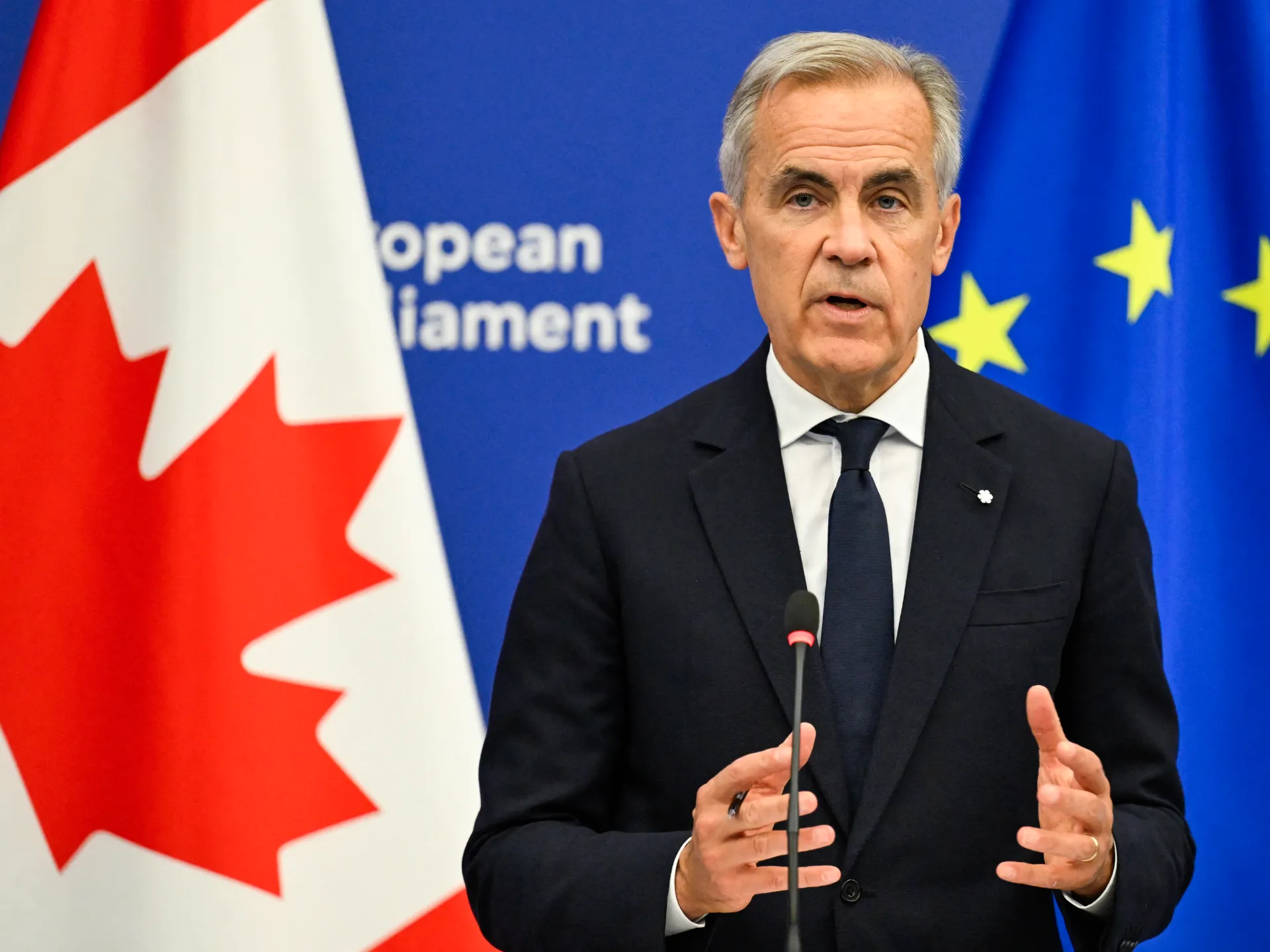
Canadian Prime Minister Mark Carney
Canadian Prime Minister Mark Carney’s Liberal Party won the 2025 elections [File: Christoffer Andersen/EPA]

Influx in temporary migration

A settler-colonial state, Canada has encouraged successive waves of immigration throughout its history, from largely European settlement in the early to mid-1900s to specialised programmes that brought refugees and high- and low-skilled workers to Canadian shores.

For decades, that influx of newcomers was widely viewed as a positive thing: immigration was fuelling the country’s economy, staffing key job sectors and counteracting a rapidly ageing population.

But over the past few years, Canada has seen one of the most dramatic shifts in how the public views immigration – and the government has tapped into increasingly negative sentiment to cut programmes and pass new, restrictive laws.

The policy changes began under former Prime Minister Justin Trudeau, whose Liberal Party government had dramatically increased temporary immigration during the COVID-19 pandemic to fill labour market gaps.

The figures shot up rapidly and, by October 2024, there were nearly 3.15 million non-permanent residents in Canada, accounting for roughly 8 percent of the population, according to official figures.

At the same time, systemic issues – from a shortage of affordable housing to high grocery costs and long hospital wait times – were putting the squeeze on many Canadian households.

Public attitudes quickly hardened, and a 2024 poll (PDF) found a majority of Canadians saying for the first time in decades that there was “too much immigration”.

Since then, several incidents of xenophobic violence have been reported, including in some of Canada’s largest cities, where the influx of migrants has been among the most visible.

Under pressure as angry discourse soared, the Trudeau government promised in 2024 to get immigration back to “sustainable” levels, and the cuts began, including most notably to international student visas.

“The reality is that not everyone who wants to come to Canada will be able to – just like not everyone who wants to stay in Canada will be able to,” Marc Miller, Canada’s former immigration minister, said in September that year.

A major intersection in Toronto, Canada
A major intersection in Toronto, Canada’s largest city [Jillian Kestler-D’Amours/Al Jazeera]

‘Erroneous beliefs’

The numbers of arrivals dropped quickly as student and work visas were cancelled, forcing thousands of people to leave Canada or remain without legal status. By the start of this year, non-permanent residents totalled about 2.67 million, according to government figures, a 15 percent drop from the peak in October 2024.

“I don’t think you can blame the housing crisis in Canada on immigration, but there’s no doubt that the radically increased numbers under Justin Trudeau’s regime had a political effect,” Allan Rock, a former Canadian justice minister and Liberal lawmaker, told Al Jazeera.

The government, Rock explained, has been “reading the room and sensing that Canadians were connecting local economic and financial difficulties with migration”.

At the same time, right-wing politicians have seized on those public attitudes, with the opposition Conservative Party earlier this year pushing the governing Liberals to cut healthcare for people it described as “fake refugees”.

The Conservatives, also, have echoed US President Donald Trump in advocating for changes to “birthright citizenship”, claiming that the “outdated rule” that grants citizenship to anyone born in Canada “presents yet another strain on our immigration system that Canada can’t handle”.

“With over 7 per cent of Canada’s population here on temporary status – and arrivals massively outpacing the capacity of our housing, healthcare and jobs markets – something needs to change,” the party said.

Rights advocates have denounced that rhetoric while accusing policymakers of falsely linking migrants and refugees to social problems to absolve themselves of responsibility for a years-long failure to properly fund healthcare, education and other services.

On the housing issue, for instance, experts have found (PDF) that, while immigration increases demand for housing stock, its effect on prices is far less important than public discourse would have people believe.

“Leadership means not simply caving into public opinion when it’s based on erroneous beliefs,” Rock told Al Jazeera. “We’re buying into, and we’re supporting, a growing international trend to tighten borders and build walls and validate erroneous beliefs about refugees and migrants.”

“It’s a betrayal of values that this country has always stood for, and I find it troubling.”

Carney doubles down

Yet, since taking office in April 2025, Carney – the prime minister – has continued where his predecessor Trudeau left off on immigration.

In late March, Carney’s Liberal government passed a sweeping new law that grants Ottawa the power to cancel visas en masse, including for permanent residents, if it deems it in the “public interest” to do so.

The law, known as Bill C-12, also restricts access to Canada’s refugee status determination system in ways that lawyers told Al Jazeera are “arbitrary” and likely run counter to the country’s constitution, the Canadian Charter of Rights and Freedoms.

The government has justified the measure – which is expected to face a constitutional challenge in court – as part of an effort to streamline a backlogged asylum system and prevent “fraud”.

At the end of last year, nearly 300,000 cases were pending at the independent tribunal that adjudicates refugee claims in the country, known as the Immigration and Refugee Board of Canada (IRB).

A spokesperson for Immigration, Refugees and Citizenship Canada (IRCC), the federal immigration department, told Al Jazeera that it had introduced Bill C-12 “as global migration pressures intensify”.

The law introduces “measures to address challenges such as sudden increases in asylum claims and situations where existing processes may be used to circumvent regular immigration pathways”, the spokesperson said in an emailed statement.

“This means we can provide faster protection for those in need,” they said, adding that Bill C-12 also respects Canada’s obligations under the United Nations Refugee Convention as well as the Canadian Charter of Rights and Freedoms.

But experts say the law will do little to address the backlog at the IRB. They have also accused lawmakers of failing to dispel – and even of playing into – xenophobic rhetoric rather than addressing the real concerns of Canadians or structural problems in the asylum system.

The government is “creating this sense in the public that people are scamming us, they’re taking advantage of the system [and] there’s something broken that needs to be fixed”, said Julia Sande, a lawyer at Amnesty International Canada.

“People’s struggles are real. People are facing a housing crisis, inflation and unemployment, wage stagnation and widening inequality,” she told Al Jazeera.

“Then, instead of taking responsibility or making the changes needed to address these things, governments look for a group to blame – and who’s better to blame than people who don’t have the right to vote and can’t vote you out?”

Activists protest against cuts to refugee health care in Canada
Healthcare workers protest against cuts to a refugee health programme in Toronto, Canada, in April 2026 [Jillian Kestler-D’Amours/Al Jazeera]

Carney’s ‘honeymoon’ phase

Despite such concerns raised by rights advocates, Canada’s changing immigration policies do not appear to have drawn much attention – or pushback – from the wider public.

A wide-reaching effort by civil society groups earlier this year to get the government to make amendments to Bill C-12 failed to secure any meaningful changes.

In addition to that law, the Carney government also has rolled back a healthcare programme for refugees, extended a freeze on refugee resettlement applications, and announced significant funding cuts to several ministries, including the immigration department.

Planned cuts at the IRB – the board that adjudicates refugee claims – have also been reported, fuelling concerns that delays may get worse.

“The fact that there is no real plan in place to deal with this backlog [at the IRB] then contributes to negative opinion by the public about refugees,” said Maureen Silcoff, a refugee lawyer who previously served as a member of the tribunal.

“I think the government has a responsibility to proactively undo some of the myths that are circulating,” Silcoff told Al Jazeera. “This is especially important in times where we see in other countries that there’s a surge of anti-immigrant and anti-refugee rhetoric.”

Nevertheless, Carney continues to enjoy high approval ratings as he has justified government policies during his first year in office as part of an “elbows up” response to pressure from the Trump administration.

“The Carney government still seems to be [enjoying] a honeymoon of sorts,” said John Carlaw, an assistant professor at Toronto Metropolitan University who specialises in Canadian politics and immigration.

“We’re seeing a major withdrawal of social spending and then an investment in militarism and border enforcement,” Carlaw told Al Jazeera, describing it as a “troubling period” in Canada.

“I think C-12 really showed the government is not interested in hearing from communities that work with migrants and immigrants to make policies that are consistent with a human rights framework. They just don’t want to listen to dissent.”

Luisa Ortiz-Garza, a migrant rights organiser at Parkdale Community Legal Services, speaks during an event in Toronto, Canada
Luisa Ortiz-Garza, a migrant rights organiser at Parkdale Community Legal Services, speaks during an event in support of migrants and refugees in Toronto in late April [Jillian Kestler-D’Amours/Al Jazeera]

‘Not immune’ to backsliding on human rights

Despite that, rights advocates say they will continue to push back against the direction Canada is heading on immigration.

“We can’t stop fighting,” Luisa Ortiz-Garza, a migrant rights organiser at Parkdale Community Legal Services, told a packed gymnasium at Trinity-St Paul’s United Church in downtown Toronto in late April.

Several dozen people joined the event, dubbed “No More Divide and Rule”, to denounce xenophobia and urge the government to grant legal immigration status for all migrants and refugees in Canada.

“What [the government is] doing is actually just putting people against each other,” Ortiz-Garza told Al Jazeera in an interview at her organisation’s office a few days before the gathering.

“It’s citizens against migrants [and] migrants against migrants because there is this idea that some migrants did things right and other migrants just jumped the queue or abused the system,” she said.

“We’re trying to have these conversations and bring people together: allies, citizens, migrants … so that we can actually talk about this and remind people about unity.”

That was echoed by Sande at Amnesty International, who warned that Canada is “not immune” to a backsliding on human rights. “Things will just continue to get worse until governments feel they’re held to account,” she said. “Yes, scapegoating may start with migrants, but it never ends there.”

Source link

World Cup 2026: Bayern Munich’s Alphonso Davies to miss Canada’s tournament opener

Injured captain Alphonso Davies is expected to miss co-hosts Canada’s opening World Cup game, but head coach Jesse Marsch believes the full-back will still play a part in the tournament.

Davies, 25, suffered a hamstring injury in Bayern Munich’s Champions League semi-final second leg against Paris St-Germain on 6 May, with the German club saying at the time he was expected to be out of action “for several weeks”.

He only made 13 Bundesliga appearances for Bayern during a campaign heavily disrupted by injuries.

Canada will open their home World Cup campaign against Bosnia-Herzegovina in Toronto on 12 June before meeting Qatar and Switzerland on 18 and 24 June in Vancouver.

“I think Alphonso will play in the World Cup,” Marsch told reporters in Charlotte, North Carolina, where Canada will train this week before their 26-man World Cup squad is announced on Friday.

“I don’t think he’ll be ready quite on June 12… but we’ll see.”

Davies was among 32 players invited to the camp, but Marsch said the Canada skipper would only join the team on the eve of their friendly against Uzbekistan in Edmonton on 1 June.

They will also face the Republic of Ireland in Montreal on 5 June in another World Cup preparation game.

Davies last played for Canada against the United States in March last year, when he suffered an anterior cruciate ligament (ACL) injury.

He missed the March 2026 friendlies against Iceland and Tunisia because of a hamstring strain.

The former Vancouver Whitecaps left-back was part of Canada’s World Cup squad in 2022 and scored in a 4-1 defeat by eventual semi-finalists Croatia in the group stage.

Source link

Canada’s coolest foodie getaway pairs skyscraper city breaks with lakeside wineries, beach saunas and vineyard feasts

PAIR a foodie city break in Canada’s Toronto with vineyards and lakeside luxury in Prince Edward County, says Deputy Picture Editor Antoinette Cumberbatch.

Cocooned in a blanket, I gaze at the yellow hue above the horizon and the colours sweeping across the sky, as the sun sets gloriously over the vast expanse of Lake Ontario.

For fans of elegant pinot noir, Closson Chase is also worth a stop Credit: Steve Elphick
Join the skyline at the CN tower in Toronto Credit: Getty Images/iStockphoto

From my deckchair, all I can hear are the rhythmic sounds of water hitting the pebbled shore as I sip a glass of crisp rosé. This is perfection.  

Feeling vine 

I’m exploring Canada’s Prince Edward County, a 21/2-hour drive east from Toronto, and the eclectic Drake Devonshire in the quaint town of Wellington makes for the perfect base, with its beach-house feel, glass-fronted outdoor sauna and this idyllic lakeside setting.

Airy bedrooms with quirky artwork, plus a ping-pong table and photobooth downstairs complete the vibe.

Double rooms cost from £164 per night (Thedrake.ca/drakedevonshire).  

ISLE HAVE SOME

I visited the new Caribbean private island only open to cruise passengers


JET SET

I’ve flown to 83 places from my local airport – including 3 countries in one day

“The County”, as it’s called by Torontonians, is fast becoming known for its wineries, too.

Less than 10 minutes’ drive from my pad is Huff Estates, where the team has been perfecting its wines since 2002.

I sample a few silky blends – my fave is the Vines Unoaked Chardonnay – and learn how the region’s limestone-rich soil and cooler climate produces a unique blend. Tastings cost from £12 per person (Huffestates.com).  

Meanwhile, it’s a family affair at TerraCello Winery.

Taco about a delicious Mexican feast! Credit: The Washington Post via Getty Im
Hit the Distillery District for foodie heaven Credit: Getty Images

The seven-acre vineyard with Italian heritage is small compared to the others, but it makes exquisite riesling – tastings cost £11 per person – as well as delicious pizza, £10 (Terracellowinery.com).

For fans of elegant pinot noir, Closson Chase is also worth a stop, just a few minutes down the road (Clossonchase.com). 

Top of the crops 

Later that evening, I join a farm-to-table experience that’s as hands-on as it gets, with husband and wife team Luhana and Zach at Littlejohn Farm.

Cooking together in a small group, I’m tasked with rolling and filling fresh pasta for the cheese agnolotti – a skill I vow to continue back home.

But the star of the show has to be tender, home-raised lamb, which is the best I’ve ever tasted. Experiences cost from £122 per person (Littlejohnfarm.com).

I end my night at The Duchess, an elegant art-deco bar just a stroll from my hotel, with a Stay Curious cocktail – a heady blend of brandy, pineapple rum, coconut Campari, bergamot, lime and cucumber, £12 (Barduchess.com).  

Another gem is Base 31, 20 minutes’ drive away. Once a former WW2 airbase, it’s now a creative cultural hub with street food and live gigs.

I wander around the former barracks and gaze up at the restored Lancaster Bomber, before reading poignant love letters from a serviceman to his wife in its Love Notes exhibition. Entry costs £5 (Base31.ca). 

There’s nothing beige about Drake Devonshire Credit: Nikolas Koenig
Pair a foodie city break in Canada’s Toronto with vineyards and lakeside luxury in Prince Edward County, says Deputy Picture Editor Antoinette Cumberbatch Credit: Supplied by Antoinette Cumberbatch

To the tower! 

The sister hotel of my lakeside stay, The Drake, puts me in the thick of Canada’s biggest city and Ontario’s capital, Toronto.

Set in one of the city’s coolest districts – Queen West – indie shops, cafes and restaurants line the pavements, alongside vibrant street art. Double rooms cost from £142 a night (Thedrake.ca/thedrakehotel). 

Of course, my first visit here wouldn’t be complete without whizzing to the top of the CN Tower.

Standing at 533m high, this former communication tower has been a staple of the skyline since 1976. Tickets to the highest platform cost £32 per person (Cntower.ca). 

But for me, Toronto is really about the food. I start at Lakeview diner, in the Dundas West neighbourhood.

You may not know the name, but it’s big-screen famous, having featured in blockbusters including Hairspray and Cocktail.

You can even sit in the booth where Tom Cruise sat, sipping its must-try apple-pie milkshake, £6.50.

Just being here feels like stepping into cinematic history, with autographs scrawled above the bar by actors who have filmed here (Thelakeviewrestaurant.ca).  

Elsewhere, St Lawrence Market, set up in 1814, proves perfect for a crash course in Canadian flavours.

I can’t resist picking up a raspberry-shaped pastry filled with raspberry whipped cream, £2.45, from Future Bakery, and I try the legendary peameal bacon sandwich in its salty, buttery roll from Carousel Bakery, £4.50 (Stlawrencemarket.com).  

Maple matters 

Close to St Lawrence’s, the historic Distillery District oozes character with its industrial red-brick buildings and cobbled streets.

I grab a delicious signature maple latte, £3.25, at Balzac’s (Balzacs.com), before heading to Mexican El Catrin Destileria for lunch.

Guacamole is crushed tableside for the nachos, £11.30, and I devour the fish tacos, £15.50, in seconds.

With tequila flavours including hibiscus and lime, tamarind and pineapple, I opt for a flight of mini margaritas to remove any decision-making, £27 for four (Elcatrin.ca). 

Craving some retail therapy, the next day I head to Ossington Avenue, a 10-minute stroll from The Drake.

Here, I find LoversLand, a stylish concept store selling cute trinkets and excellent socks (Loversland.com), retro fashion heaven Uncle Studios (Unclexstudios.com), and Rotate This, a record shop stacked with nostalgic vinyl (Rotatethis.com). 

The final evening of my trip comes around all too soon, and to mark the occasion I book a table at the achingly-cool Prime Seafood Palace, which is high-end – the chef’s menu will set you back £133 – but without any of the pretentiousness.

The tuna tartare and prime rib are flawless, but it’s the key-lime pie and maple tart that really steal the show for me (Primeseafood palace.ca).  

It makes for a pairing as perfect as Canada’s unofficial capital and the rural haven of Prince Edward County. 

Source link

Carney says Canada’s economic ties with U.S. are a weakness that must be corrected

Canadian Prime Minister Mark Carney said in a video address released Sunday that Canada’s strong economic ties to the United States were once a strength but are now a weakness that must be corrected.

In the 10-minute address, Carney spoke about his government’s efforts to strengthen the Canadian economy by attracting new investments and signing trade deals with other countries.

“The world is more dangerous and divided,” Carney said. “The U.S. has fundamentally changed its approach to trade, raising its tariffs to levels last seen during the Great Depression.

“Many of our former strengths, based on our close ties to America, have become weaknesses. Weaknesses that we must correct.”

Carney said tariffs imposed by President Trump have affected workers in the auto and steel industries. He added that businesses are holding back investments “restrained by the pall of uncertainty that’s hanging over all of us.”

Many Canadians have also been angered by Trump’s comments suggesting Canada become the 51st state.

Carney said he plans to give Canadians regular updates on his government’s efforts to diversify away from the U.S.

“Security can’t be achieved by ignoring the obvious or downplaying the very real threats that we Canadians face,” he said. “I promise you I will never sugarcoat our challenges.”

It’s not the first time Carney, who served as a central bank governor, first at the Bank of Canada and later with the Bank of England, has spoken about a shift in world power.

During a speech in January at the World Economic Forum in Davos, Switzerland, he received widespread praise for condemning economic coercion by great powers against small countries.

His remarks brought a rebuke from Trump.

“Canada lives because of the United States,” Trump said after the speech. “Remember that, Mark, the next time you make your statements.”

There was no immediate White House reaction Sunday to the address.

Carney’s comments came days after securing a majority government following special election wins and as the opposition Conservatives push him to deliver a U.S. trade deal, which was among his promises in last year’s election.

A review of the current version of the North American Free Trade Agreement among Canada, the U.S. and Mexico is scheduled for July.

In his address, Carney said he wants to attract new investments into Canada, double the size of clean energy capacity and reduce trade barriers within the country. He also emphasized Canada’s increased defense spending, reduction in taxes and efforts to make housing more affordable.

“We have to take care of ourselves because we can’t rely on one foreign partner,” he said. “We can’t control the disruption coming from our neighbors. We can’t control our future on the hope it will suddenly stop.

“We can control what happens here. We can build a stronger country that can withstand disruptions from aboard.”

Carney said simply hoping the “United States will return to normal” is not a feasible strategy.

“Hope isn’t a plan and nostalgia is not a strategy,” he said.

Carney said Canada has “been a great neighbor,” standing with the U.S. in conflicts including Afghanistan, plus two World Wars.

“The U.S. has changed and we must respond,” he said. “It’s about taking back control of our security, our borders and our future.”

Morris writes for the Associated Press.

Source link