Actor Julie Hesmondhalgh was a Celebrity Traitors superfan and made some surprising friendships before being the third person out of the show this year
Julie Hesmondhalgh was obsessed with Traitors and made new friends on the series.(Image: Jonty Davies/Good Housekeeping UK/Press Association)
Actor Julie Hesmondhalgh has described her time on Celebrity Traitors as “extraordinary” and revealed a quirk of the show means people become friends faster than usual.
The former star of Coronation Street, 56, admitted she was “obsessed” with the show before signing up to star in the 2026 version.
She says she has made some friends for life and explained to Good Housekeeping UK: “The extraordinary thing is that you’re all on the same footing. There’s no status at all. You have these accelerated friendships because there’s a lot of time off-camera when you’re travelling in cars together and aren’t allowed to discuss the game. People tell you about their lives; I found out so much about people and I was really touched that they trusted me.”
Asked who she became closest to, she added: “Romesh [Ranganathan] is one of the greatest human beings. We were in there right at the start, alongside Ross Kemp. The three of us were a very unlikely little threesome. I adored Ross, too.”
Julie was banished as a Faithful from BBC show early on after being voted out in a round table. She was the third celebrity to leave.
The acclaimed actress is best known for starring as Hayley Cropper in Corrie between 1998 and 2014.
She said: “The short storyline was supposed to be Roy Cropper [David Neilson] falling for Hayley, then running for the hills when she comes out as trans. But everybody loved the relationship. It became a key storyline almost by accident, which was the best way, because it wasn’t an issue that was shoehorned in.”
On her exit, she added: “There’s a photo of me on the floor, foetal. I was like, ‘What have I done?’ I have no regrets about leaving, but when I watch the credits and see that so many of the cast and crew names are the same, it feels a bit strange.
“Had I stayed, it would have become embarrassing. Anachronistic. But I maintain that Hayley and Roy’s love story was important. It got people talking. It’s so upsetting that trans rights have now gone backwards.”
In real life she is married to writer Ian Kershaw and they have two grown up daughters Martha and Lyss.
Julie reflected: “I found a lot of motherhood a struggle. Balancing my own life and work with motherhood was tricky at times. I have a lot of regrets about losing my rag with my kids. I took things too personally; I felt like they were almost trying to make my life difficult, which obviously they weren’t. They were just children.”
Asked by the magazine who she’d invite to a fantasy Christmas lunch, she said: “Patti Smith, because I adore her. Rebecca Lucy Taylor [who performs as Self Esteem]. James Baldwin. Naomi Klein – I loved Doppelgänger and realised she’s funny as well as formidable. Tony Benn. Oh, and AOC [American politician Alexandria Ocasio-Cortez]. Who else? Emma Thompson – I’ve never met her, but I think she’s a good person.”
* The full interview can be read now in the December issue of Good Housekeeping UK.
A quick glance from the sidewalk shows a midsize home in the Valley. Fallen leaves from a large tree scatter across the neatly trimmed front lawn. It’s just like any other house in a suburban neighborhood outside of Los Angeles.
Inside, there’s a whole network TV operation going on.
The three-bedroom chateau is packed with people. Every inch of space in the house is being used to make “Good Night With Ben Gleib” happen. The living room TV displays the multiple angles of cameras spread across the house. The pantry doubles as a control room while the backyard shed was turned into a venue for the musical guest.
It’s not a traditional late-night talk show. It’s not on a legacy network, it isn’t filmed in a studio, and the U.S. president isn’t calling the host a “deranged lunatic.”
Share via
This show is filmed in a room of Gleib’s house that was converted into an 18-seat studio. The host drinks a cocktail as he delivers his topical monologue in front of blue drapes, and after the taping concludes the cameras continue to roll and capture the nightcap, where Gleib mingles with audience members.
Rather than following the traditional path — from stand-up or sketch comedy to eventually landing behind a late-night desk — Gleib built his own opportunity and releases it on YouTube, a trend becoming more prominent in the comedy world.
“The landscape has changed very largely,” Gleib said. “It’s hard to make your mark in TV and a stand-up appearance on late night doesn’t change your career like it use to, you really have to find creative ways to create your dream career.”
Production staff controls the taping of the show “Good Night With Ben Gleib” on Sept. 16.
(Brian Feinzimer / For The Times)
Since “Lazy Sunday” from “Saturday Night Live” hit the airwaves and caught a second wind on YouTube, the comedy landscape “had changed forever,” according to Seth Meyers.
“What made it so great then and still today is that it was an instant hit but also felt DIY in a way things hadn’t for so long,” said the “Late Night” host in an interview with GQ.
Social media platforms like YouTube have helped make it easier for anyone with a camera to create original content and spread it to the masses. The hashtag “comedy” has 20 billion views on TikTok and genres such as stand-up and sketch comedy grow every year, according to Business Insider. Meanwhile, late-night television has taken a dip in audience and ad revenue.
The old guard of comedy is changing and the DIY movement has transformed fame in the comedy world. Comics no longer have to wait to get stage time on a late-night talk show, they just need to get it done, said Nicole Blaine, owner of the Crow comedy club. It is also inexpensive to create digital content. With platforms like TikTok, Instagram and YouTube, the ability to be seen is easier, she added.
“I don’t think you can count on anyone to ‘make it,’” Blaine said. “I think you literally have to make it yourself and I do believe that the industry [is] paying attention behind the scenes in more ways than the artists know.
“You want to be your own showrunner,” she added.
Makeup artist Lisa Lopez gets musical guest Ada Pasternak ready in the kitchen of Ben Gleib’s home, also the set of “Good Night.”
(Brian Feinzimer / For The Times)
Representation comes and goes, but the fan base a comedian creates for themselves stays with them, Blaine said. Creating digital content for social media to back up a career in stand-up demonstrates that success is completely within the control of comics, she continued.
The DIY formula relies on taking advantage of the skills each performer has and using them to self-produce material to build a fan base, a concept that comedian Emmy Browning is putting into practice. Using her background in screenwriting, she pitched “Hands!” to the Elysian Theater and performed it for its Spaghetti Festival, designed to showcase new work, within three months.
“I essentially wrote, cast, directed, produced, got a crew together …,” she said. “It was just a crazy team of people that came together for no money to make this thing happen.”
“Hands!” spoofs FX’s “The Bear,” while satirizing TV conventions, like the will-they-won’t-they romantic plotlines, multicamera operation and filming in front of a live studio audience. Browning’s show was performed live while a camera crew shot different angles that were being projected on screens located on stage.
It made the stream of the show feel like an actual live performance. Now the stream can be seen by anyone, anywhere in the world, at any time. Browning said when her comic friends began to create clips for social media, they were able to travel around the country and perform for the fans they’ve garnered from their content.
“There are so many different ways and opportunities to be seen first,” Browning said. “…If you have the stamina to generate content online that promotes yourself, you can really make a living or create a fan base yourself.”
Self-producing isn’t only about promotion, it’s about creative ownership.
“There’s nothing as creatively freeing as being your own boss and not having to conform to network notes or the comedic ideas and opinions of people who have never been comedians and have never been recognized for their comedy skills,” Gleib said.
Guests are interviewed during the taping of “Good Night With Ben Gleib.”
(Brian Feinzimer / For The Times)
The sentiment is shared by Ron Lynch, a comedian known for voicing Hugo, the neurotic health inspector in Fox’s animated series “Bob’s Burgers,” who’s produced a variety show at the Elysian Theater called “Tomorrow!” for 20 years now.
The show gives participants the opportunity to do whatever they want, within a five-minute time frame. Half the acts are stand-ups, the other half “are just weird.”
“We’re not responsible for sponsors or anything like that,” Lynch said. “We can basically do whatever we want.”
Self-producing allows creators to explore their voice without any limitations.
“What we do is provide entertainment,” Lynch said.
In the new DIY era, it is not a matter of when a performer will make it, but rather how much a performer really wants it, Blaine said. It’s a lot of work that needs to get done, even after a day job, but it will separate the people who want it badly over those not wanting to put in the time, she added.
It isn’t about landing a late-night talk show, it is about creating.
“It isn’t easy,” Blaine said. “But artists will always find a way if we really want to do it.”
The DIY movement also comes with big risks that will not work unless the comedian believes in it, said Gleib. His team is putting a lot on the shoulders of the comedian to reinvent late night and make it a lucrative business.
And if the big swing doesn’t work?
“I’ll have to come crawling back to the traditional entertainment industry, hoping that I still have a place there,” he added.
Both men used NSFW language toward each other that was picked up by Prime Video’s “Thursday Night Football” cameras and/or microphones.
The exchange took during the Steelers’ first drive in their eventual 27-24 road loss to the Cleveland Browns. Before a first down play from the Cleveland 20-yard line, Rodgers could be seen staring at the Pittsburgh sideline with his arms spread out, apparently waiting to receive the play from McCarthy.
Then the four-time league MVP exploded.
“What the f—?” Rodgers screamed toward the sideline. “Call it!”
The broadcast then cut to a shot of McCarthy, who could be seen saying the words, “f— a—hole,” in apparent reference to his quarterback.
Asked about that moment during his postgame news conference, McCarthy expressed regret for the language he used.
“I think what’s said on the field, the way I grew up in this game, usually stays on the field,” McCarthy said. “That’s not the case today, I understand that. But any negative communication on my part, I wish I wouldn’t use those words.”
Later in the same drive, Rodgers appeared to shake his head and roll his eyes while waiting for a play to be called. Speaking to reporters after the game, he indicated that the crowd noise affected the communication between the sideline and field.
“It was loud,” Rodgers said, “so some of the calls, it was hard to hear, for sure.”
The “TNF” cameras did catch a much more pleasant interaction between the two men, after the 42-year-old veteran kept the ball on a 1-yard sneak for a successful 2-point conversion to tie the game at 24-24 late in the fourth quarter.
McCarthy coached the Green Bay Packers from 2006 to 2018 and Rodgers was his starting quarterback for 11 of those seasons. During that stretch, they led the team to one Super Bowl victory (against the Steelers) and four NFC championship game appearances. Rodgers also earned two of his four NFL MVP awards during McCarthy’s tenure.
There was some well-documented tension between the two men during that time as well. But Rodgers has cited the Steelers’ hiring of McCarthy this offseason as a reason he decided to put off retirement for one more year.
“I’d gone into the offseason thinking it was probably going to be it, and I’d be totally fine with it — I feel good about my career,” Rodgers told The Athletic in August. “But once he got hired, then my mindset changed a little bit.”
He added: “Absence makes the heart grow much fonder, in this case.”
McCarthy said in the same article: “Just to be able to take this final lap with him, it’s awesome. You always want to do a great job, but now to do it with him in his last chapter, it’s special.”
After the aircraft touched down in Birmingham, airport police boarded the plane and escorted the four adults off
08:39, 23 Sep 2026Updated 08:40, 23 Sep 2026
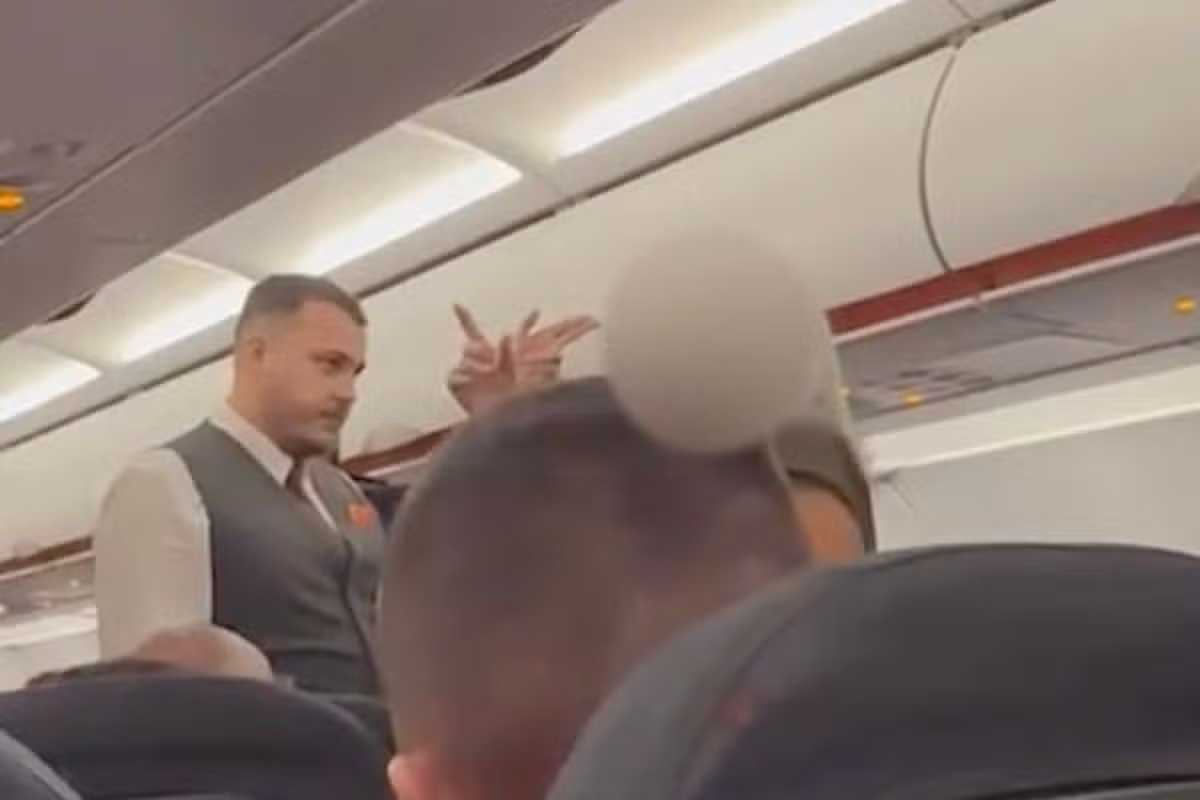
Moment police escort passengers off UK easyJet flight
A group of adults were escorted off an easyJet flight by police after allegedly vaping throughout the five-hour journey. Passenger Annalise Galstaun captured the moment four adults were removed from the plane by airport police after it landed at Birmingham Airport.
Annalise was travelling from Larnaka International Airport in Cyprus to Birmingham on the evening of September 16 when the incident unfolded. Sitting just two rows behind the group, she said she saw EasyJet cabin crew warn them multiple times to stop vaping during the flight.
But despite the repeated warnings, Annalise claimed the passengers continued to vape discreetly, hiding the devices behind their legs while sitting in their seats.
After the aircraft touched down in Birmingham, airport police boarded the plane and escorted the four adults off, causing a 25-minute delay on the tarmac.
Annalise said: “They were warned a few times by EasyJet staff but continued to vape on the sly throughout the journey, hiding the vapes behind their legs on the seat.
“I felt quite annoyed as we were delayed around 20/25 mins grounded on the floor waiting for them to be escorted.
“There were children on board crying as it was about 11pm and we were just stuck on the tarmac.”
EasyJet said in a statement: “Flight EZY6610 from Larnaca to Birmingham on 16 September was met by police on arrival due to a group of passengers behaving disruptively onboard.
“Our cabin crew are trained to assess all situations and to act quickly and appropriately to ensure that the safety of the flight and other customers is not compromised at any time.
“We take these incidents seriously and do not tolerate disruptive behaviour onboard.
“The safety and wellbeing of our customers and crew is always easyJet’s highest priority.”