call-in hearing

Federal judge orders 14-day delay on any work beginning on Trump’s monumental arch

A federal judge late Thursday blocked the Trump administration from breaking ground on a towering memorial arch for 14 days.

The temporary restraining order by U.S. District Judge Tanya Chutkan halting the work represents a major setback for one of President Trump’s most prominent projects in his vision to remake Washington.

The decision followed a series of steps taken earlier Thursday by the government, including the final approval of the arch by the National Capital Planning Commission in an 8-4 vote after a 9 ½ hour hearing where scores of witnesses opposed the construction.

The administration said the work could begin as soon as the approval and the Interior Department issued a final decision authorizing construction and the proper notification was published by the National Park Service.

In approving the temporary stop, Chutkan said Virginia and the District of Columbia had shown that the immediacy of the construction would cause real harm to the plaintiffs.

“The harm is certain,” she wrote. “Defendants initially notified the court that construction could begin as early as November 5, 2026, if the NCPC approves the project at its meeting that day and the Department of the Interior authorizes construction.” In their filing, Virginia and D.C. warned of traffic pattern distortions as well as concerns about the impact on mutual aid emergency calls if the arch were to proceed.

“Second, the District and Virginia will incur significant unrecoverable costs. As soon as construction begins, DDOT will need to expend staff time and operating resources to affirmatively and proactively manage temporary detours, crashes or disabled vehicles,” Chutkan wrote.

The judge ordered the government to provide a status report next Monday to ensure they are complying with the order.

The judge’s decision came just over an hour after the National Capital Planning Commission hearing ended. The vote by the commission broke along federal and local lines. Those in favor work for the administration or are connected to the president, who was pushing for the immediate construction. Opponents represented the city of Washington.

The remote, call-in hearing — which crashed repeatedly in the first few hours and was accompanied by a nearly universally negative comment section — drew witnesses who gave impassioned comments opposing an arch they said will destroy the solemnity of the nearby Arlington National Cemetery, where hundreds of thousands of fallen service members and military veterans are buried.

The panel’s Trump-appointed chairman launched the meeting with a gushing appraisal of the towering monument and lauded Trump for wanting to build it.

“President Trump understands as president and a superb builder that it’s important to our national identity to display who we are through grand monuments,” said Mark Paoletta, the commission’s chairman.

As Trump has often remarked, “the great cities around the world have arches: Paris, Rome, London,” said Paoletta, who also serves as general counsel for the White House Office of Management and Budget.

Commissioner Paul Ingrassia, a lawyer for the General Services Administration, said the arch was “not about politics. It’s about remembrance. It’s about celebrating our history. It’s about commemorating veterans. And it’s really something that’s a noble tribute to our nation and something that we can all rally behind.”

But D.C. City Council Chairman Phil Mendelson, who also serves on the planning panel, said the project has not received required approval from Congress, nor has Congress appropriated any money for it. The plan submitted to the commission does not include a reference to military use cited by Trump and other administration officials, Mendelson said.

“We cannot approve final site and building plans until we have the final site and building plans,” he said.

The commission oversees construction on federal land in the city and began reviewing the arch plan in June.

The arch is one of several projects around Washington that the Republican president has undertaken as he alters the capital to his tastes — from renovating one of its storied public golf courses to threatening to demolish the John F. Kennedy Center for the Performing Arts. Those projects could soon face intense scrutiny after Democrats gained control of Congress in the midterm elections this week.

Rep. Jared Huffman, a California Democrat who is set to chair the House Natural Resources Committee, called the project ill-advised and illegal.

“This arch would dishonor America,” Huffman told the commission. He called the proposed arch “a tribute to Donald Trump,” not veterans as Trump administration officials claim. The monument is similar to those built for emperors or kings, Huffman said, adding that Trump was using veterans as a pretext to build a memorial to himself.

Other critics, including the plaintiffs, argue that the Trump administration must seek congressional approval. The administration maintains that Congress cleared the way for a monument at Memorial Circle decades ago.

Several members of the Planning Commission used that logic in approving the project. Paoletta said it was a “national disgrace” that a memorial arch had not been placed there, despite a 1925 law that designated such a memorial, he said.

Chutkan rejected that argument in her ruling: “The sheer improbability that a 100-year-old statute would contain authority, unknown to every previous administration, to erect a 250-foot arch at a principal location in the Nation’s capital indicates how far defendants must stretch to justify this project.”

Daly and Fields write for the Associated Press. AP videographer Nathan Ellgren contributed to this report.

Source link

Key federal panel is expected to approve Trump’s arch while it’s being challenged in court

A federal panel was expected Thursday to approve President Trump’s proposed memorial arch in Washington at the end of a meeting that drew dozens of opponents to a key part of the president’s push to leave his imprint on the nation’s capital.

The approval would clear a hurdle on the road to breaking ground on the project, and the administration has said it could launch construction within a day of the vote. But the proposed 250-foot tall gilded arch still faced legal challenges.

The remote, call-in hearing — which crashed repeatedly and was accompanied by a nearly universally negative comment section — drew witnesses who gave impassioned, three-minute comments opposing an arch they said will destroy the solemnity of the nearby Arlington National Cemetery.

The Trump-appointed chairman of the commission, however, launched into a gushing appraisal of the towering monument and lauded Trump for wanting to build it.

“President Trump understands as president and a superb builder that it’s important to our national identity to display who we are through grand monuments,” said Mark Paoletta, the commission’s chairman.

As Trump has often remarked, “the great cities around the world have arches: Paris, Rome, London,” said Paoletta, who also serves as general counsel for the White House Office of Management and Budget. In addition to Paoletta, the arch received support during the hearing from Republican lawmakers and a veteran who praised the administration’s efforts to build the monument.

The commission oversees construction on federal land in the city and began reviewing the arch plan in June.

Trump is working to remake Washington

The arch is one of several projects around Washington that the Republican president has undertaken as he alters the capital to his tastes — from renovating one of its storied public golf courses to threatening to demolish the John F. Kennedy Center for the Performing Arts. Those projects could soon face intense scrutiny after Democrats gained control of Congress in the midterm elections this week.

Many of the plans are being challenged in the courts, and three lawsuits have been filed opposing the arch. A judge has been asked to block the construction so long as lawsuits are still being litigated, and she could rule as early as Thursday.

Rep. Jared Huffman, a California Democrat who is set to chair the House Natural Resources Committee, called the project ill-advised and illegal.

“This arch would dishonor America,” Huffman told the commission. He called the proposed arch “a tribute to Donald Trump,” not veterans as Trump administration officials claim. The monument is similar to those built for emperors or kings, Huffman said, adding that Trump was using veterans as a pretext to build a memorial to himself.

Opponents argue the arch is too big for the skyline and would disrupt carefully designed sight lines between landmarks in and around the capital — most prominently the Lincoln Memorial and Arlington National Cemetery — that were meant to symbolize the reunification of the North and the South after the Civil War.

But the opposition has done little to influence the members of the commission, which is led by some of Trump’s closest allies. Trump appointed Paoletta to chair the 12-member panel. Two other commissioners are also White House aides.

Trump wants an arch, but it faces legal challenges

Still, a federal judge on Monday complicated Trump’s efforts to move quickly on the project.

U.S. District Judge Tanya Chutkan, who is overseeing a lawsuit challenging the Trump administration’s plans, said she must be told of any decision by the planning commission within an hour. The order set the same time limits for any decision by the National Park Service and the Department of the Interior.

Before Thursday’s hearing began, attorneys with the Justice Department filed a notice with Chutkan informing her that a contractor had already done site prep work on Oct. 31, with what she said appeared to be no authorization from the National Park Service.

The plaintiffs in the three lawsuits are calling for a halt to work on a monument that is set to be built on a patch of grass off a bridge that spans the Potomac River and connects Washington with Arlington National Cemetery, in Arlington, Va. When complete, the monument would be 100 feet taller than the Statue of Liberty without its pedestal.

Critics, including the plaintiffs, argue that the Trump administration must seek congressional approval. The administration maintains that Congress cleared the way for a monument at Memorial Circle decades ago.

Paoletta said it was a “national disgrace” that a memorial arch had not been placed there, despite a 1925 law that designated such a memorial, he said.

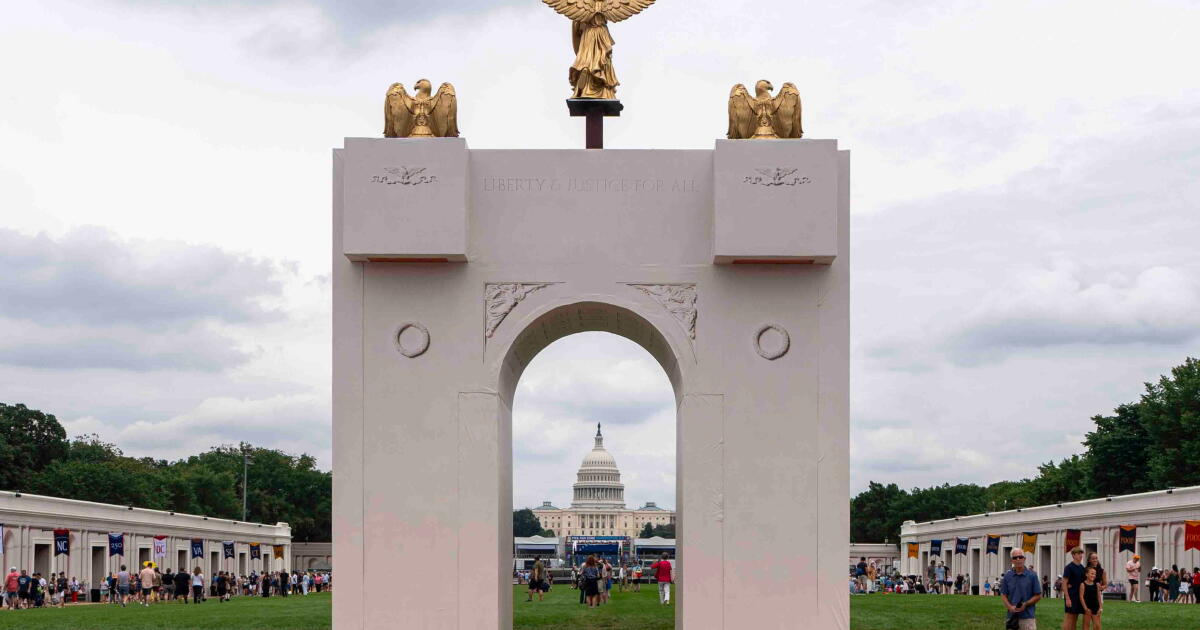
Last week, the government submitted a 106-page plan for the arch that envisions a massive structure more than 12 stories high that includes a huge bronze statue of Lady Liberty with wings and carrying a torch with an eternal flame. The structure would include an observation deck with views to the east and the west and two mezzanines.

Inside the arch are rooms for program space, offices, a staff lounge, circular staircases, multiple elevators and a fire command center. The project proposes significant traffic changes in the area, including rerouting traffic on nearby roads. Administration officials have said the arch also will have a national security function.

In a recent hearing, Chutkan asked why the Trump administration was so keen on moving ahead quickly with the arch despite the ongoing lawsuits, aside from Trump’s “desire to bedazzle the city.”

Administration lawyer Robert Stander said the arch was “absolutely a high-priority project” and that any ruling delaying construction would impede the work of the government.

Daly and Fields write for the Associated Press.

Source link