Trump ousts bipartisan commission in latest effort to reshape elections before midterm
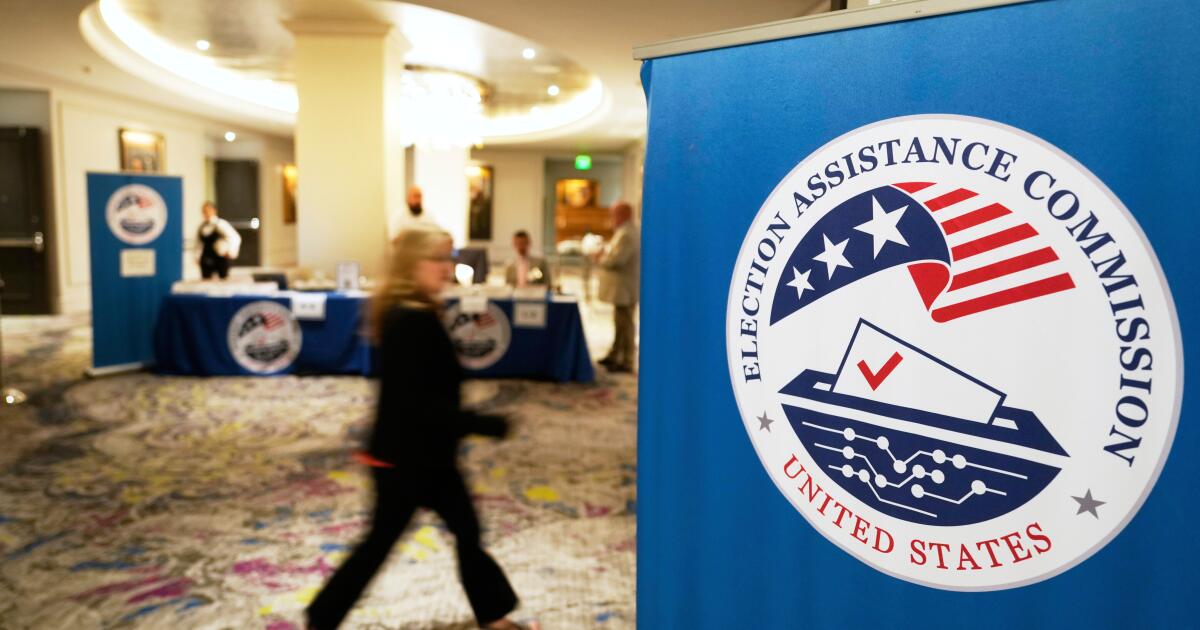
WASHINGTON — President Trump dismissed all remaining members of the bipartisan U.S. Elections Assistance Commission this week, his latest move to assert control over national elections in the final months before midterm voting.
The White House defended the move as justified by a recent U.S. Supreme Court decision handing the president greater authority to reshape independent government agencies, including by replacing appointed leaders.
Democrats and some independent elections experts blasted it as politically motivated, counter to the interests of voters and foolhardy with the November election so close.
“Purging commissioners just months before the midterm elections and further gutting support for our state and local elections officials is a blatant part of his plan to politicize our elections and enable more unlawful and dangerous election interference,” said Sen. Alex Padilla (D-Calif.), the top Democrat on the Senate Rules Committee, which oversees federal elections.
Padilla alleged the dismissals are an attempt by Trump “to dismantle yet another independent guardrail of our democracy designed to keep elections fair and secure.”
A White House official framed the dismissals in starkly different terms, saying the departing commissioners were “not totally aligned with the important task of securing America’s elections and ensuring every legal vote is counted.” It did not say when the president planned to appoint new commissioners.
The four-member commission was created by Congress in 2002 as part of the Help America Vote Act to help states improve their voting systems and voter access. By law, no more than two commissioners may belong to the same political party.
Historically, it has provided voluntary guidance and best practices for voting systems, and served as a sort of clearinghouse for election performance around the country — so that states and localities can learn from each other.
Since 2018, the panel has also disbursed more than $1 billion in election security grants, according to a report by the Bipartisan Policy Center. Those grants are then used to protect IT systems from foreign and domestic cyberattacks, update voting systems, ensure the accuracy of voter rolls and protect the integrity of ballots after they are cast.
Without leadership, the panel cannot take any official action until new members are nominated and confirmed by the Senate.
Benjamin W. Hovland, one of the Democratic commissioners removed by Trump, told NBC News that taking away a key federal agency designed to help state and local election administrators will have a negative effect on already strained elections officials.
“When you’re asking more and more of people without giving them the necessary resources, you know, mistakes happen,” he said.
California Secretary of State Shirley Weber, in a statement to The Times, said Trump was “injecting unnecessary chaos, confusion and instability into the very systems that Americans rely on to make their voices heard,” but that California “will not be intimidated or deterred” from maintaining elections “in which everyone can fairly and securely participate.”
Gov. Gavin Newsom’s office said on X that “Newsom’s election protection efforts become more important by the day” — a reference to his recent push for state legislation that would make it a felony in California for anyone to seize ballots before a vote has been certified.
Newsom had said Thursday that Trump’s efforts to seize control over elections represented a “five-alarm fire” that must be confronted.
“We will lose this country unless we are vigilant about what’s going on in terms of election security,” he said.
Trump’s dismantling of the commission comes as he wages a much broader campaign to rewrite voting rules. He has sought to place new restrictions on mail ballots, to enhance voter ID and proof of citizenship requirements for voters, to subject state voter rolls to federal oversight and purges, and to assert federal control over how and whether the U.S. Postal Service delivers mail ballots.
Much of that agenda, pushed through executive orders and other administrative actions, has been stymied by the courts, while stalling out in Congress, where it lacks support.
Whether Trump’s move to dismantle and reconstitute the commission will prove an effective path to instituting his election agenda — or will face its own court challenges — remains unclear, experts said.
Rick Hasen, an election law expert and director of the Safeguarding Democracy Project at UCLA Law, wrote that Trump could try to illegally direct the commission to “do his bidding” by amending the federal voter registration form to require proof of citizenship.
“If he tries anything like this, it will be high profile and very important litigation that will end up at the Supreme Court on the emergency docket over the summer,” Hasen wrote.
Michael Waldman, president and chief executive of the Brennan Center for Justice at NYU Law, said in a statement that Trump’s terminations were “deeply concerning” in light of his “relentless efforts to try to interfere in elections.”
But he also said that the “guardrails” Congress put on the commission remain intact, require it to be made up of a bipartisan group and preclude Trump from directing it to enforce his voting agenda.
Sen. Adam Schiff (D-Calif.) said Trump’s firing of the commissioners was part of a broader effort by the president to “sow distrust in our voting system so he can contest the results if they are not to his liking.”
Kim Alexander, president of the California Voter Foundation, said the very name of the commission makes it clear that it was “designed to assist states and localities, not dictate what states and localities must do” with elections. She said California has “the most robust standards” for elections in the country, which won’t change with the removal of the commissioners.
Still, she said word of the firings rocketed around a conference of county elections officials in San Diego on Thursday — with some wondering whether the dismissals would threaten federal funding for election administration moving forward, and others lamenting the loss of the current commissioners’ deep experience.
Dean Logan, head of the L.A. County Registrar-Recorder/County Clerk’s office, said in a statement to The Times that “any sudden change to the support structure for elections in the middle of an election cycle is concerning,” but that California “has a strong local and state foundation for election administration and voting systems support, and that will minimize any potential disruption caused by this action.”
In recent months, Trump has leveraged federal agencies to overhaul the nation’s voting rules in ways no previous president has attempted. He has repeatedly pressured Republican lawmakers to pass a federal law that would require voters to provide proof of citizenship when they register, show identification when casting a ballot and force states to send voter data to the Department of Homeland Security.
Republican leaders have said the proposed SAVE America Act does not have enough votes to pass in the Senate. The GOP resistance has angered Trump, who on Friday said he was refusing to sign a bipartisan housing bill in protest.
The housing bill, which Trump called a “yawn” this month, would become law at midnight Friday without Trump’s signature.