california billionaire

A powerful union, the billionaire tax and an alleged bargaining chip

As the architect of a one-time tax on California billionaires, Dave Regan says he’s pushing the measure to raise $100 billion to protect low-income patients, workers and hospitals from President Trump’s cuts to healthcare.

The behind-the-scenes negotiations with Gov. Gavin Newsom’s office in June to pull the measure off the ballot, however, revealed another possible goal, according to two sources familiar with the talks who requested anonymity to share details of the discussions with The Times.

Regan, the president of SEIU-United Healthcare Workers West, asked for union contracts with two hospitals in San Diego and Fresno and a clinic in Imperial County, among a list of sweeping demands to grow his union, in exchange for rescinding the measure, the sources said.

The union leader denied that he asked for concessions for his union in exchange for removing the billionaire tax from the ballot, calling the allegations “categorically false.”

“We are trying to solve a problem,” Regan said. “The problem is to prevent a catastrophe in California’s healthcare system. We put forward a proposal. Nobody else has offered a solution, and none of what you are referencing happened.”

The talks failed to result in a deal and the measure will appear as Proposition 40 on the November ballot, leaving California voters to decide pivotal tax policy that has roiled the Democratic Party and opponents worry could ultimately reduce revenue for the state budget.

The terms Regan allegedly laid out raise the question of whether he intended for the billionaire tax to go on the ballot, or if it was designed as a leverage play to expand his union, which represents more than 120,000 workers and is among the largest healthcare unions in the nation.

Regan, who has been elected to five consecutive terms as union president since 2011, has a record of launching ballot initiatives at the state and local level to use as leverage for union expansion and to thwart his political opponents.

His foes say that this year he went too far.

“It’s no secret in Sacramento that the ballot initiative has been used this way by UHW as a weapon,” said Francisco Silva, president of the California Primary Care Assn., which represents community clinics. “They’ve been very vocal about it and we think it’s a bigger risk to the safety net than any benefit that it brings.”

Known as a stubborn negotiator and a brash personality, Regan has filed multiple ballot initiatives against the healthcare industry.

His opponents say his strategy centers on launching initiatives that would hurt employers, which forces them to come to the table to negotiate. Regan’s union then requests union contracts or other concessions that could pave the way for a collective bargaining agreement. If employers resist, the initiative advances to the ballot. Voters consistently reject his measures, but companies still spend millions of dollars campaigning against them.

Over the years, Regan has proposed multiple measures that would have limited charges and executive salaries at hospitals and dropped the initiatives after landing temporary deals with the California Hospital Assn. that could help his union’s organizing efforts.

This year, UHW agreed to call off an initiative to again cap compensation for hospital leaders, and the hospital association rescinded its dueling proposal to require the union to seek approval from its members to spend more than $1 million on a statewide ballot measure campaign.

Regan led and lost measures against the dialysis industry in 2018, 2020 and 2022 as he struggled to force dialysis companies to recognize his union and negotiate a contract.

Silva accused Regan of using the same playbook in negotiations around another measure on the November ballot, Proposition 44, which would restrict spending at nonprofit community health clinics.

Regan drafted Proposition 44 to require that community clinics spend 90% of revenue on patient services, which he said ensures that money is aligned with the mission of the health centers. But Silva said the measure dramatically reduces funding for other essential services in the community care model, such as community outreach, education, overhead costs, technology and medical equipment investments, and programs that bring people living on the streets into the healthcare system.

About 70% of the patients community clinics serve are insured through Medi-Cal, and the rest are either on Medicare or uninsured, with a small portion on private insurance, Silva said. The measure would result in layoffs and clinics being forced to close, and ultimately reduce access to care for low-income Californians, he said.

“One of the things that stands out that really highlights the abuse of the ballot initiative process in this instance is that the substance of what’s on the ballot has nothing to do with what he wants to negotiate with us,” Silva said. “The request was to guarantee 25,000 workers, or else.”

Regan also denied that he asked the clinics to support his unionization efforts in exchange for dropping Proposition 44.

“We wanted to construct a relationship with the clinic association that prioritized appropriate funding of the community clinics in California, including restoring the healthcare cuts that were introduced by the ‘One Big [Beautiful] Bill,’” Regan said. “It was a strategic relationship where we’re working in a mutually cooperative way to properly fund the healthcare system to respect workers, and they were not interested in that.”

Regan’s opponents say his strategy runs afoul of the purpose of direct democracy and pushes the bounds of legality.

During negotiations on the billionaire tax, essentially put the onus on Newsom to force unrelated private hospitals and clinics to unionize their employees, the sources said.

Despite a desire to call off the tax measure, Newsom’s office couldn’t provide guarantees to satisfy Regan’s demands, according to those sources.

California legislators changed state law in 2014 to provide more flexibility around initiative negotiations and to allow proponents to pull measures off the ballot after they gather enough signatures and qualify for the election, said Mary-Beth Moylan, an associate professor of law at McGeorge School of Law.

State law also prohibits a proponent of an initiative from bargaining for money or a thing of value in exchange for abandoning their measure, which hasn’t been tested in court, she said.

“I think the intention behind the law allowing the ballot measures to be negotiated off was that the negotiation would be for the Legislature to do the thing that you’re bringing about in the measure,” Moylan said. “It is not to use it as leverage for obtaining something else.”

Regan’s wealth measure retroactively applies a one-time 5% tax on the net worth of billionaires who were residing in California as of Jan. 1, 2026.

He and advocates of his proposal cast it as a solution to the healthcare cuts from the Trump administration. It comes as the progressive message on wealth inequality has gained support in California and beyond.

“What’s remarkable about the situation is that everyone — the governor, the Legislature, the healthcare industry — everyone agrees that the ‘One Big Beautiful’ bill is going to result in 3.5 million people losing healthcare coverage, 150,000 frontline healthcare workers losing their jobs, community clinics and hospitals closing, and all of us who buy or receive our healthcare through job-based insurance are spending more on premiums, deductibles, and copays because the legislation defunded healthcare and in return gave yet another round of huge tax cuts to the wealthiest Americans,” Regan said. “That’s why we have put Proposition 40 forward.”

Newsom contends that Regan’s solution won’t work.

Instead of paying more California taxes, billionaires would simply pick up and move to another state with a lower tax rate before the start of the year, the governor warned. The state budget is dependent on income taxes the rich pay on stock market and similar profits.

A report from the Hoover Institution at Stanford University estimated that the tax would generate only $40 billion, not the $100 billion proponents claim, largely because of an expected exodus of billionaires. Overall, the tax would result in an estimated loss for the state of $24.7 billion, with the permanent decline in future income tax revenue due to billionaire migration eclipsing any gains from the one-time levy, according to the report.

Regan rejected the findings of the report and cast doubt on the amount of taxes that billionaires actually pay in California.

Newsom sought to negotiate with Regan to remove the billionaire tax from the ballot before the beginning of the year. At the time, Regan said he wanted an extra $20 billion for healthcare in 2027-28, which is beyond Newsom’s time in office and not something the outgoing governor could promise, according to two sources familiar with the negotiations.

Regan said he never asked for $20 billion in funding for healthcare to remove the billionaire tax from the ballot. He said he was open to hearing alternative solutions that never came.

“But did we ever make a proposal, or did we ever receive a proposal for something different?” Regan said. “The answer is no.”

In the spring, Newsom began working to form a coalition against the initiative that includes Planned Parenthood, doctors and firefighters while billionaires launched a series of counterproposals.

In an unusual split within labor, major unions such as the California Teachers Assn. and the State Building and Construction Trades Council oppose the measure. Teamsters California and AFSCME California joined Regan. The SEIU California State Council and California Federation of Labor Unions have yet to take positions.

Under California law, proponents had until June 25 to rescind measures that earned enough signatures to qualify for the ballot. Negotiations picked up again to remove the measure from the ballot shortly before the deadline. Two sources said Regan’s demands changed and allegedly had nothing to do with raising money to offset federal healthcare cuts.

Sources said Regan said he wanted union contracts with two private hospitals and a health clinic, an organizing neutrality agreement with healthcare clinics statewide, recognition of his union from dialysis clinics and for billionaires to remove measures they launched in response to his tax.

Newsom’s office said they couldn’t force private companies to do anything. The governor’s aides offered an alternative plan to dedicate around $7 billion over several years to healthcare funding in California, which didn’t move Regan.

“There were no negotiations,” Regan said about the billionaire tax.

Days before the deadline to pull the wealth tax measure from the ballot, UHW announced an offer to reduce the billionaire tax from 5% to 2% of net worth that the union said Newsom rejected. Sources said the compromise was first offered in a press release and did not reflect any serious negotiation.

Regan set a goal to add 25,000 new members by this year and has so far added around 8,000, according to the union’s website.

In exchange for removing the billionaire tax from the ballot, sources said one of Regan’s demands was for Newsom’s office to get involved with battles for union contracts at hospitals in Fresno and San Diego and a clinic in the Imperial Valley.

The union is tied up in labor disputes over recent attempts to unionize facilities in two of those places — Rady Children’s Hospital in San Diego and Innercare, a community clinic in El Centro.

The dialysis industry became a ballot target for Regan three election cycles in a row as he attempted to unionize its workers.

The battle is on pause after dialysis companies agreed to not oppose a $25 minimum wage increase for healthcare workers and UHW agreed to not target the industry in legislation or ballot measures through the end of this year, but the fight turned DaVita and Fresenius Medical Care into major political donors in state campaigns.

California’s billionaire class is also increasing its presence in state politics.

Billionaires pushed two measures on the November ballot that seek to neutralize the billionaire tax and block new taxes on personal property and assets and require audits of new programs funded with special taxes.

The billionaire tax has also become a national rallying cry for the political left, drawing the high-profile support of U.S. Sen. Bernie Sanders (I-Vt.) and others who are fed up with wealth inequality. Opponents of Proposition 40 have questioned whether any of the solutions Regan proposed would have been enough for him to remove the measure from the ballot and avoid the wrath of progressives who backed the tax.

Sacramento political observers say the unintended consequences of Regan’s tax measure are already reshaping California politics.

“When he did the billionaire tax, all these people who never engaged in politics finally woke up,” said Jim DeBoo, a Democratic consultant and former chief of staff to Newsom. “And they aren’t going away.”

The measure is causing a rift within the SEIU California State Council, an umbrella organization that represents more than 700,000 workers from all SEIU unions including UHW.

The billionaire tax only benefits healthcare. SEIU, which also represents workers in the public sector, nursing homes, child care and other service industries, has become a target of California’s wealthiest new political players despite most of its union members gaining nothing from the measure.

Billionaires and their companies, including Ripple co-founder Chris Larsen, venture capitalist Tim Draper, Google and Meta have spent nearly $30 million on a successful campaign to oppose SEIU-backed progressive candidates or boost moderate Democrats in legislative races. The same donors spent only $50,000 on independent expenditures in legislative races in the entire 2024 election cycle.

Shaudi Fulp, a political strategist working with Larsen and Draper, said a new governor and lawmakers present an opportunity to build fresh governing coalitions around issues that matter most to Californians.

“California is entering a unique moment of transition,” Fulp said.

The billionaires’ strategy is whittling away at SEIU’s influence in the state Legislature, where the state council has historically used its endorsements and army of volunteers to boost progressive candidates aligned with their cause. Moderates backed by billionaires beat nearly every SEIU-endorsed candidate in more than a dozen races in the June primary, with record spending knocking union candidates out of the top two in places such as Bakersfield and Orange County.

The SEIU California State Council declined to comment for this story.

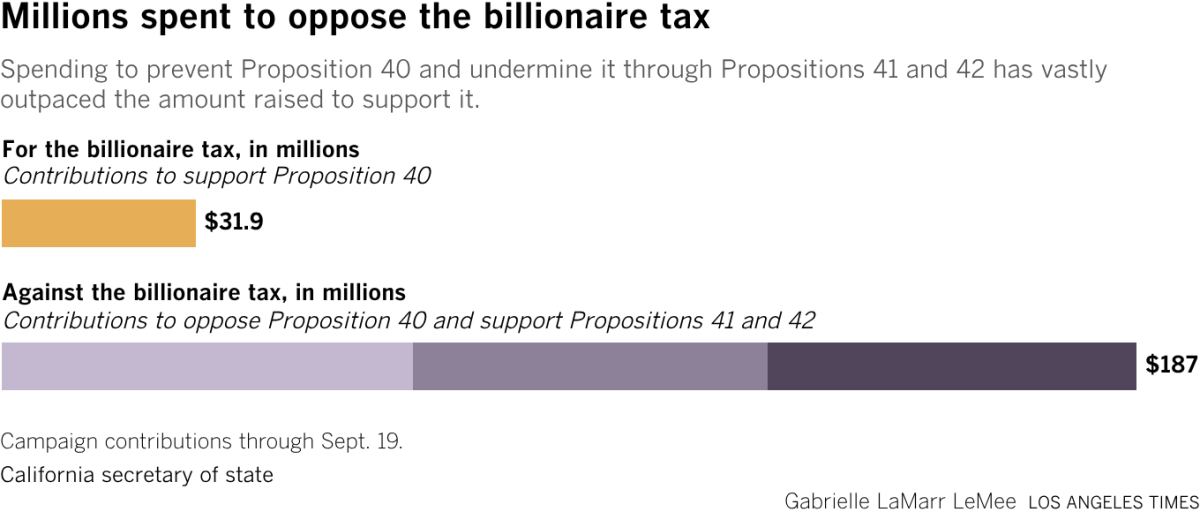
The battle over the billionaire tax is also expected to become the most expensive ballot measure campaign of the election cycle, if not ever. The opposition is poised to exponentially outspend UHW.

“Look, the only thing that stands down a bully is when you punch him in the face,” said Brandon Castillo, a political consultant who has represented healthcare providers against UHW on more than a dozen initiatives. “You can’t sit back and continue to take punches or nothing will change.”

Staff writer Nicole Nixon contributed to this report.

Source link

Controversial billionaire tax will appear on November ballot

Proponents of a tax on California billionaires vowed on Thursday to move forward with their November ballot measure despite mounting opposition from many of the state’s most powerful political forces.

A labor union spent $31 million gathering signatures to qualify the measure for the ballot in an effort to offset federal healthcare funding cuts that will affect millions of California’s most vulnerable residents. A representative for the campaign supporting the ballot measure pushed back at opposition to the effort as self-entitled wealthy Californians and entrenched Sacramento interests.

“While a few morally bankrupt billionaires and their buddies in Sacramento want to see California’s hospitals close, and tax breaks for billionaires protected — I assure you, the vast majority of voters do not,” said Debru Carthan, a spokesperson for the Billionaire Tax Now Coalition, which is funded by the Service Employees International Union-United Healthcare Workers West, the sponsor of the proposal.

The California secretary of state is expected to officially certify the measure for the Nov. 3 ballot on Thursday evening.

Carthan said their effort has support in public opinion polls, and from lawmakers, unions, community organizations and volunteers across the state, “something the billionaires and their buddies will never have.”

However, a coalition of healthcare, education, public safety, housing, business and labor leaders opposed to the proposal warned that it would make the state’s notoriously unstable budget even more unpredictable.

“The dangerous wealth tax directly threatens vital funding for education and schools, healthcare and clinics, public safety, and infrastructure projects by making California’s revenue even more volatile,” the leaders of the California Medical Assn., the California Primary Care Assn. and the California School Boards Assn. said in a statement. “That’s why so many leaders – both Democrats and Republicans – are joining us and saying NO. We look forward to ensuring voters have the facts, know the stakes, and resoundingly reject this reckless experiment in November.”

Supporters of the one-time proposed 5% tax on the assets of the state’s wealthiest residents pitched the effort as a stop-gap measure to offset devastating federal healthcare funding cuts passed by the GOP-led Congress and signed by President Trump nearly one year ago. The federal legislation is expected to result in $100 billion in cuts that would affect California’s most vulnerable residents.

The proposed tax, which would be retroactive to billionaires who lived in the state as of Jan. 1, drew predictable opposition from the wealthy, notably Silicon Valley tech leaders.

But it notably divided liberals. While Sen. Bernie Sanders (I-Vt.) and Rep. Ro Khanna (D-Fremont) supported the proposal, Gov. Gavin Newsom was among the Democrats who opposed it because of fears about the potential impact on the state’s volatile budget.

Despite being the fourth largest economy in the world — the home of Hollywood and Silicon Valley — California’s budget is extremely dependent on the state’s most prosperous residents.

Newsom and others who generally support increasing taxes on the wealthiest Americans also argued that the proposed billionaire tax in California was poorly crafted and that any such levies ought to be enacted nationally, because varying state policies would be ineffective.

Opponents also argued that the political priority in the 2026 midterm election should be squarely focused on efforts to make sure Democrats regain control of Congress to serve as a counter balance during the final two years of Trump’s presidency.

“It’s disappointing. This is a critical election where we need to concentrate on flipping the house and undoing the damage that was done” by Trump’s legislation that led to the healthcare funding cuts, said Jodi Hicks, chief executive and president of Planned Parenthood Affiliates of California. The wealth tax “is short term and doesn’t address what is the long-term problem. And I’m not even sure the policy is a viable solution. It’s so critical to be sending the right message — holding Congress accountable and how we need to find long-term solutions to make sure Californians have access to healthcare.”

Rob Lapsley, co-chair of Californians Against Tax Increases and president of the California Business Roundtable, argued that the proposed wealth tax would ultimately affect every Californian.

“Strip away the spin, and this measure forces every California taxpayer, not just billionaires, to file a sworn declaration of their net worth with the Franchise Tax Board under penalty of perjury,” Lapsley said in a statement. “And it hands the Legislature the power to extend the wealth tax to all Californians and every kind of property, including home equity, retirement savings without ever returning to the voters – effectively gutting” voter-approved caps on property tax increases.

Supporters of the tax submitted nearly 1.6 million signatures in April to qualify the proposal for the ballot, roughly double the number required. However, support for the effort has grown increasingly shaky. Newsom’s team created a broad coalition of opponents, including healthcare and education activists, that undercut the foundational argument for the tax.

The union that crafted the proposal responded last week by proposing a legislative alternative that would create a 2% tax on billionaire’s assets. It was flatly refused by the Newsom administration. No deal was reached by the Thursday evening deadline for the union to withdraw the proposal from the November ballot.

Two efforts that were crafted to sink the proposed billionaire tax — dubbed as poison pills — also qualified for the Nov. 3 ballot, according to the California Secretary of State’s office. One would bar new state taxes on personal property, while the other prohibits any new taxes being exempted from existing state spending rules and to be regularly audited. If the billionaire tax proposal is approved by voters but either of the other proposals receives more votes, the tax measure would be voided.

The proposed billionaire tax would apply to more than 200 Californians, some of whom proactively left the state or moved their companies out of California because of the proposal.

The prospect of the wealthy fleeing the state is among the reasons that prominent Democrats such as Newsom opposed it, given California’s budget being so reliant on the state’s most prosperous residents.

Sergey Brin, a co-founder of Google, is among the billionaires who have reportedly moved out of California because of the tax proposal. He donated at least $82 million to an organization that is funding efforts to invalidate the proposed billionaire tax.

Ballot measure proponents had a Thursday evening deadline to withdraw their proposals.

Other policy proposals that will appear on the Nov. 3 ballot include:

  • Requiring government-issued voter identification to cast ballots in elections.
  • Reforming the California Environmental Quality Act, once a third-rail in Democratic politics that has become increasingly scrutinized in the rebuilding in the aftermath of the Palisades and Eaton wildfire.
  • Creating a $11.3-billion affordable housing bond.

Two notable proposals were pulled off the ballot after negotiations between the California Hospital Assn. and labor unions:

  • An effort to limit healthcare executives’ compensation.
  • A union proposal by the same union backing the billionaire tax that would have required many healthcare clinics to spend 90% of their revenue to serve low-income and underserved residents.

Source link