Feds move to dismiss case over 20,000 California ballots after Supreme Court denied appeal
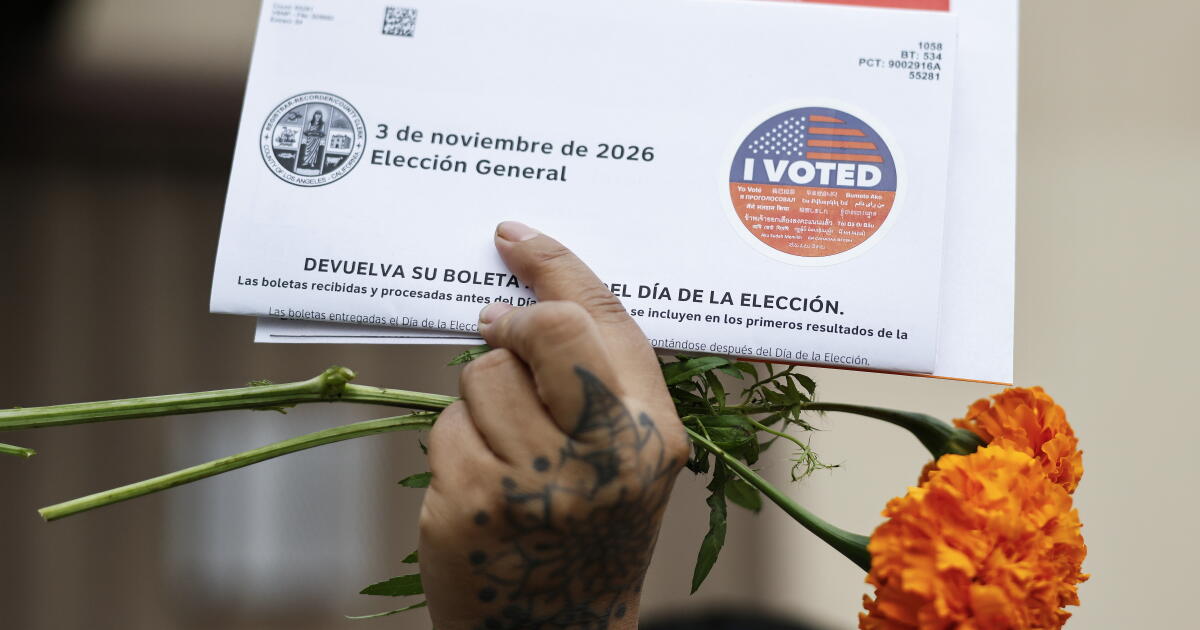
The U.S. Justice Department moved Friday to voluntarily dismiss its lawsuit challenging the counting of 20,000 ballots in California, arguing the relief it sought is now impossible given Tuesday’s midterm election has concluded.
The Justice Department had sought a court order requiring state and Los Angeles County election officials to set aside the ballots, which it alleged could be from noncitizen voters. U.S. District Judge David O. Carter and a three-judge panel of the U.S. 9th Circuit Court of Appeals had both rejected that request, and the U.S. Supreme Court denied a Trump administration appeal to those lower court rulings — with no noted dissents.
Carter had ruled that the government’s request was probably unconstitutional, given the Constitution gives states and Congress power over elections, not the executive, and probably ran afoul of federal law barring sweeping vetting of voter rolls in the immediate run-up to an election.
However, he had set a schedule moving forward for additional fact-finding in the case — including by appointing a special master to dig into the data the federal government was relying on to assert the 20,000 voters were potentially noncitizens.
In a filing before Carter on Friday, Assistant U.S. Atty. Julie Hamill in Los Angeles wrote that that court process was no longer necessary, as it would not provide the relief that the federal government was seeking by filing its lawsuit.
“In light of the Supreme Court’s denial, the United States is evaluating how to best ensure that American votes are protected, including by preventing vote dilution by noncitizens. In addition, by the time of this Court’s hearing on Nov. 13 in this matter, California will have already commingled the challenged ballots with lawful ones,” Hamill wrote. “There is then no way to get the challenged ballots segregated. As a result, the relief the United States sought and needed is no longer available — rendering voluntary dismissal necessary.”
Hamill wrote that the Trump administration had sought to “protect American voters and to prevent the irreparable harm of state and local election officials including illegally cast votes in the final vote tabulation,” but had “exhausted its appeals to obtain timely relief” by going to — and being denied by — the Supreme Court.
First Assistant U.S. Atty. Bill Essayli’s office in Los Angeles — where Hamill works — referred questions about the filing to the Justice Department.
Kiersten Pels, a Justice Department spokesperson, said the litigation at issue was “moot” but that the Trump administration “is not backing down” in its targeting of alleged noncitizen voters, including in a separate case in which it is still demanding that California “conduct proper list maintenance, including removing noncitizens from the state’s voter rolls — which will be crucial to ensure fair elections in the future.”
Secretary of State Shirley Weber, a defendant in the case, did not immediately respond to a request for comment Friday.
L.A. County Registrar-Recorder/County Clerk Dean Logan, another defendant, said he was “pleased that the administration has accepted the clarity of the court findings” against it and ended its lawsuit.
“At each stage of this election, and in response to the Department of Justice, we have been clear that state and federal law sets well-defined standards for verifying and challenging voter eligibility,” Logan said. “Our commitment and focus remain on the fair, secure, accurate, and legal processes we are engaged in to complete and certify the election.”
California Atty. Gen Rob Bonta, in a statement, said that after losing in every court it tried, including the Supreme Court, “the Trump Administration has given up its latest unlawful effort to interfere with California’s elections and disenfranchise eligible voters.”
Bonta added: “Rest assured: California has and always will defend your fundamental right to vote.”
Tricia Webber, president of the California Assn. of Clerks and Election Officials, said state election officials “are very pleased” with the voluntary dismissal of the case — which she said “affirms that our elections are administered with the utmost integrity and care.”
“At the same time, we are under no illusions. We recognize that this issue is unlikely to go away permanently, and we remain fully prepared to continue defending California’s election administration against future challenges,” she said. “We will always stand ready to protect every eligible voter’s right to participate in a fair and secure election process.”
The administration’s filing — three days after President Trump’s party took a drubbing in the midterms — marks a sudden and unremarkable conclusion to an unprecedented court battle in the days leading up to the election, when the federal government sought permission from the courts to force state and local elections officials to set aside votes during an ongoing election.
Carter had rejected the administration’s request for immediate intervention in a blistering Oct. 28 ruling, calling its allegations about the ineligible voters “not credible” and warning that the proposed action could disenfranchise eligible voters and sow chaos in the ongoing midterm election.
“This request violates longstanding constitutional principles mandating that states have control over their elections,” Carter wrote. “If [the Trump administration’s] last-minute request for relief were granted, either party could create chaos for their own political purposes to disrupt the election process.”
While Justice Department officials characterized the relief it had requested from the court as “targeted and modest,” Carter had reached a sharply different conclusion — writing that the administration’s demands would “wreak havoc” on an ongoing election and “create a chilling effect on election workers and voters alike, and discount the votes of United States citizens.”
The reliability of the government’s list became a central issue in the litigation. Logan’s office said its review of about 200 flagged voters found that a substantial portion appeared to have been born in the United States, a finding Homeland Security officials disputed.
Election officials elsewhere in California also reported problems with the lists, including names of people who did not appear to live in their counties or to be registered voters. Justice Department officials sent letters to election officials across the state, demanding that they sequester flagged ballots and warning of potential criminal penalties if they failed to comply.
The three-judge 9th Circuit panel that heard the federal government’s appeal to Carter’s ruling — composed of two appointees of President Trump and one of President Biden — came to some of the same conclusions Carter did in a 2-1 ruling. One of the Trump appointees dissented, writing that he would have ruled for the administration.
Carter ordered an expedited hearing on the state’s and county’s motions to dismiss the case and the government’s motion for a preliminary injunction. He ordered all parties by Nov. 6 to submit witness lists, including experts, regarding the reliability of the list of voters and the methodology behind it. He ordered both sides to appear at the Nov. 13 hearing, with submitted witnesses prepared to take the stand.
Ending the litigation now will forestall that process to detail the origins of the administration’s list — which is still being used by federal prosecutors in California to target individual voters for criminal prosecution.