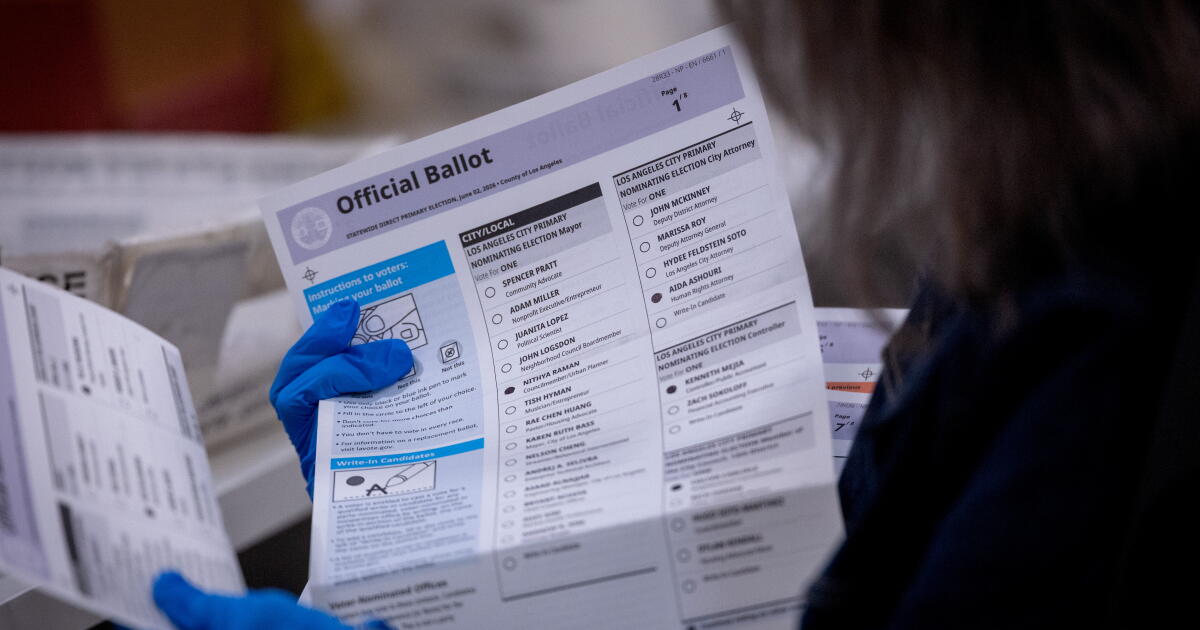
With the deadline for mailing out millions of California ballots nearing, Los Angeles County’s top election official welcomed the U.S. Postal Service’s recent assurance that it will process those ballots as normal — not under the untested new vetting system backed by President Trump and rejected as unworkable by the U.S. Supreme Court.
“That certainly serves as a stabilizing force, as we’re literally weeks away from mailing the ballots,” said Dean Logan, head of the L.A. County Registrar-Recorder/County Clerk’s office.
Still, there are other Trump administration challenges to deal with, he said — including unsubstantiated public claims of widespread voter fraud, refusals by top-ranking officials to rule out deployments of armed federal agents to polling places, and behind-the-scenes criminal probes into local voter lists.
Since March, Logan’s office has received a series of federal grand jury subpoenas demanding voter registration and other information on dozens of individuals who the Trump administration says may not be U.S. citizens, Logan confirmed to The Times.
Logan said his office is now in the “interesting place” of having to comply with the subpoenas despite suspecting that the Department of Homeland Security relied on inaccurate or outdated voter information to compile the names to investigate.
“We’re responding appropriately as directed through a subpoena, but that doesn’t afford the dialogue for us to get the background on what they’re looking for and how they came up with the names that they did,” Logan said. “There’s really no information being provided to us on that.”
The subpoenas appear to mirror others received by elections officials elsewhere in the country as part of a new Homeland Security effort to identify noncitizen voting, which Trump has long alleged without evidence is widespread.
In July, Homeland Security Secretary Markwayne Mullin publicly claimed, again without evidence, that there may be more than 190,000 such voters on California rolls. On Friday, the Justice Department announced it had charged 16 noncitizens in six states with illegal voting and other election-related crimes following investigations alongside its Homeland Security partners.
California Secretary of State Shirley Weber dismissed Mullin’s claims. Independent elections experts and Democratic officials say voter fraud should be taken seriously, but is exceedingly rare. California has more than 23 million registered voters.
Mullin’s remarks and the subpoenas appear part of a much larger and unprecedented federal effort to bolster allegations from Trump that the upcoming Nov. 3 elections are unsafe and corrupted by noncitizen voters.
Trump issued two executive orders, one requiring voters to provide additional identification and proof of citizenship, and one ordering the Postal Service to refuse mail ballots it deems illegitimate. The Justice Department has sued California and other states for their voter rolls, and Homeland Security has threatened state elections officials with criminal sanctions if they don’t purge noncitizens from their rolls.
Trump gave a speech in July alleging that the American election system is “so vulnerable that no one can possibly defend it.” Earlier this month, he encouraged his supporters to “cheat like hell” to keep Republicans in power, and told them they would receive $5,000 each if they succeed — which many experts derided as a “bribe.”
Last week, FBI Director Kash Patel refused to rule out sending federal agents to polls.
Despite all that, California officials and independent elections experts have maintained the election will be safe — in part because Trump’s executive orders and the Justice Department’s many lawsuits seeking state voter rolls have all been blocked by the courts.
“The bottom line for voters in California right now is nothing has changed. We’ve had safe and secure elections, and we will continue to do so,” said Sen. Alex Padilla (D-Calif.).
Logan said it “is clear that the administration is aggressively pursuing their narrative” about voter fraud being widespread as part of Trump’s old “playbook” of questioning votes he expects to lose — but that the election in California will nonetheless “be fair and secure and transparent.”
The fight over fraud
At least three subpoenas have been issued to Logan’s office — one in March, one in July and one this month — including from the U.S. attorney’s office for the Southern District of California, The Times confirmed.
U.S. Atty. Adam Gordon, who leads the federal prosecutor’s office in San Diego, did not respond to a request for comment. First Assistant U.S. Atty. Bill Essayli, who leads the federal prosecutor’s office in Los Angeles and has announced two voter fraud cases in recent weeks, also did not respond to questions about his office’s election work.
Essayli did say Saturday, in response to Gov. Gavin Newsom touting new state laws aimed at safeguarding California elections from Trump administration interference, that no state law can prevent the Justice Department from investigating voter fraud and that his office “will continue to investigate, arrest, and prosecute all violations of federal election laws.”
Additional information, including how the subpoenas may relate to Mullin’s claims, wasn’t immediately available.
Mullin in July alleged in a letter to Weber that a federal review of unspecified data found “as many as 190,832 non-citizens registered to vote in California.”
Weber responded in writing that she had “serious doubts about the reliability” of that analysis, as California election officials “work every day to maintain accurate voter rolls” and have never shared their rolls with the Trump administration — despite the administration’s failed lawsuit demanding them.
Weber criticized Mullin for having made such claims with “no detail whatsoever that my office can use to evaluate the veracity of your allegations,” and asked that he provide a “detailed description” of the data and methodology used to reach such conclusions.
Weber’s office said Mullin’s letter was “part of a broader effort to intimidate Californians and make it burdensome to participate in our democracy.”
In a statement to The Times, a Homeland Security spokesperson said the department offered to meet with Weber and her staff “to engage in a collaborative good faith discussion” about identifying noncitizens on state rolls, which she declined.
The spokesperson said Mullin’s count of potential noncitizens on California rolls was based on “publicly available data from states’ voter rolls” that was cross-referenced with its own lists of “known” noncitizens. “It’s not rocket science; it’s an easy step to secure our elections.”
Independent experts also have questioned Mullin’s claims, pointing to investigations elsewhere — including in Texas — that found Homeland Security data on alleged noncitizen voters were substantially inaccurate. A federal judge recently blocked the use of a Trump administration database known as the Systematic Alien Verification for Entitlements program based on the likelihood that it could lead to legitimate voters being purged from rolls.
Last week, Padilla and Senate Majority Leader Chuck Schumer (D-N.Y.) released a Homeland Security whistleblower report alleging that department leaders, under a new “Unlawful Voter Initiative,” were requiring poorly trained employees to identify at least five potentially illegal voters per hour — one every 12 minutes — using questionable data the department said it compiled using “magic.”
In a letter to Mullin, the senators demanded the initiative be halted, arguing that work at such a “breakneck pace” is bound to produce errors and that agency officials appeared to be circumventing court orders blocking their access to state vote rolls by gathering such information “by any means, regardless of state laws.”
Padilla on Friday asked California Atty. Gen. Rob Bonta’s office to investigate the whistleblower’s claims. A spokesperson for Bonta’s office said the allegations “describe yet another fishing expedition by the Trump Administration to uncover evidence of widespread voter fraud despite repeated findings that there is none,” but otherwise declined to comment.
The Homeland Security spokesperson rejected the whistleblower claims, saying its work has been “conducted diligently and professionally” as part of a “commonplace law enforcement” effort. The spokesperson said that the agency cannot comment on active investigations, but that its investigative branch — Homeland Security Investigations, or HSI — is “actively rooting out and investigating election fraud wherever it can be found.”
“There is no quota on criminality. DHS will pursue each and every illegal voter to the fullest extent of the law,” the spokesperson said.
Fears and reassurances
Recent polling has shown that fewer than half of Americans expect the midterms to be “free and fair,” and that Californians are more concerned about Trump administration interference than voter fraud.
Election experts said some of the worst threats have already been blocked, but acknowledged remaining worries.
Rick Hasen, director of the Safeguarding Democracy Project at UCLA Law, said he is concerned the Trump administration will try to deny the outcome or seize ballots in close congressional races — but only if control of the House or Senate rests on them.
Brendan Nyhan, a political scientist at Dartmouth College and co-director of Bright Line Watch, said he worries that isolated incidents of federal agents intimidating voters or seizing ballots in key races will throw the legitimacy of the entire election into question — and that the Trump administration will capitalize on that to serve its own agenda.
Sen. Adam Schiff (D-Calif.), part of a Democratic task force preparing for such issues, said that Trump and other administration officials are trying to interfere in the election because they know they have “failed to deliver for the American people” and the Republican Party stands to lose power as a result.
Schiff said that Democratic leaders are fighting back “and largely succeeding,” but that “the best way to uphold the integrity of our elections” remains voters making their voices heard.
Padilla said the attempt by Homeland Security to push its way into elections has been “shoddy” in part because “they don’t have the expertise [and] it’s not their charge,” but also because Trump has put Mullin and other election “conspiracy theorists” in charge.
“If you install a conspiracy theorist into these roles, then they’re gonna come out with these claims that are not based on facts, not based on evidence, not based on any data,” he said.
Padilla said Trump and his supporters are “absolutely laying the groundwork” to question November election results they don’t like, but voters should know that “there’s even more of us standing up and fighting back and protecting their right to vote.”