Business

BLS reports job openings trended downward in December

Feb. 5 (UPI) — The number of U.S. non-farm job openings trended downward to 6.5 million in December, while hiring and job separations remained steady, the Bureau of Labor Statistics reported on Thursday.

The number of job openings in December was down by 386,000 in December and 966,000 for the year, while hiring and job separations remained steady at 5.3 million each in December, the bureau reported.

While the number of job openings was down in December, the rate remained steady at 3.9%.

Openings among the professional and business services sector decreased by 257,000, while retail trade jobs decreased by 195,000 and finance and insurance by 120,000.

The rate for new-hires stayed steady in December at 3.3%, as hiring rose by 28,000 in the real estate and rental and leasing sector and by 36,000 in state and local government — but not including education — and decreased by 11,000 in the federal government.

December’s rate of job separations, which the bureau defines as those quits, layoffs, discharges and other separations, also remained steady at 3.3%, while the number and rate of quits were steady at 3.2 million and 2%, respectively.

Within the professional and business services sector, the number of quits decreased by 151,000, while those in the education services sector declined by 19,000.

The number of quits in the retail trade sector rose by 87,000, while information-sector quits increased by 28,000.

Layoffs and discharges in December changed little, at 1.8 million and a rate of 1.1%, while transportation, warehousing and utilities sectors recorded 103,000 layoffs and discharges in December.

Finance and insurance reported 20,000 fewer layoffs and discharges for the month, and other separations stayed unchanged at 285,000.

Among the size of respective job providers, those with between one and nine employees and those with 5,000 or more reported virtually no change in numbers and rates of job openings, hirings and separations, according to the bureau.

The federal agency also adjusted November’s reported job openings down by 218,000 to 6.9 million, while the number of hirings was revised up by 6,000 to 5.1 million.

Total separations in November also were revised, with 64,000 more than initially reported for a total of 5.1 million, including 32,000 more quits, 14,000 more layoffs and discharges, and 17,000 more other separations reported.

The November changes for quits, layoffs and discharges, and other separations increased the month’s totals to 3.2 million, 1.7 million and 249,000, respectively.

The bureau’s report comes a day after the ADP National Employment Report indicated private sector employment reportedly rose by 22,000 in January, which was about half the anticipated number.

President of The NewsGuild-CWA John Schleuss speaks during a rally held by Washington Post guild members and supporters outside the Post office building in Washington on February 5, 2026. Photo by Bonnie Cash/UPI | License Photo

Source link

White House to announce launch of TrumpRX Thursday night

Feb. 5 (UPI) — The White House is expected to launch its new prescription drug platform, TrumpRx, on Thursday evening, showcasing the president’s new “most favored nation” drug pricing policy.

President Donald Trump initially announced his plan in September with the launch of the TrumpRx website.

The idea is to sell prescription drugs at lower prices via the website, so that people without insurance can pay less. But users have to pay in cash because the site will not accept insurance.

The White House said at the time in a fact sheet, “foreign nations can no longer use price controls to freeride on American innovation by guaranteeing MFN prices on all new innovative medicines Pfizer brings to market.”

At the time, Pfizer was the only company on board. Since then, Eli Lilly, Novo Nordisk, Bristol-Myers Squibb, Merck, Amgen, Gilead, GSK, Sanofi, Roche’s Genentech, Boehringer Ingelheim, AstraZeneca, EMD Serono and Novartis have joined.

White House press secretary Karoline Leavitt announced the event on X.

“TONIGHT AT 7PM: President Trump, Dr. Oz, and National Design Studio Director Joe Gebbia will be officially unveiling TrumpRx — a state of the art website for Americans consumers to purchase low cost prescription drugs. This historic announcement will save millions of Americans money. You won’t want to miss it! Tune in.”

House Minority Leader Hakeem Jeffries, D-N.Y., speaks during a press conference with other congressional Democrats on funding for the Department of Homeland Security and calls for reforms at the U.S. Capitol on Wednesday. Democratic leaders presented a list of 10 reform demands for immigration enforcement in response to aggressive tactics used by agents that resulted in the deaths of U.S. protesters in Minneapolis last month. Photo by Bonnie Cash/UPI | License Photo

Source link

The detention of New Jersey kebab shop owners sparked change. Deportation still looms

The shawarma, falafel wraps and baklava at Jersey Kebab are great, but many of its patrons are also there these days for a side of protest.

A New Jersey suburb of Philadelphia has rallied around the restaurant’s Turkish owners since federal officers detained the couple last February because they say their visas had expired.

In fact, business has been so good since Celal and Emine Emanet were picked up early in the Trump administration’s immigration crackdown that they have moved to a bigger space in the next town over. Their regulars don’t seem to mind.

The family came to the U.S. seeking freedom

Celal Emanet, 52, first came to the U.S. in 2000 to learn English while he pursued his doctorate in Islamic history at a Turkish university. He returned in 2008 to serve as an imam at a southern New Jersey mosque, bringing Emine and their first two children came, too. Two more would be born in the U.S.

Before long, Celal had an additional business of delivering bread to diners. They applied for permanent residency and believed they were on their way to receiving green cards.

When the COVID-19 pandemic began and the delivery trucks were idled, Celal and Emine, who had both worked in restaurants in Turkey, opened Jersey Kebab in Haddon Township. Business was strong from the start.

It all changed in a moment

On Feb. 25, U.S. marshals and Immigration and Customs Enforcement officers arrested the couple at the restaurant. Celal was sent home with an ankle monitor, but Emine, now 47, was moved to a detention facility more than an hour’s drive away and held there for 15 days.

With its main cook in detention and the family in crisis, the shop closed temporarily.

Although the area is heavily Democratic, the arrests of the Emanets signaled to many locals that immigration enforcement during President Trump’s second term wouldn’t stop at going after people with criminal backgrounds who are in the U.S. illegally.

“They were not dangerous people — not the type of people we were told on TV they were looking to remove from our country,” Haddon Township Mayor Randy Teague said.

Supporters organized a vigil and raised $300,000 that kept the family and business afloat while the shop was closed — and paid legal bills. Members of Congress helped, and hundreds of customers wrote letters of support.

Space for a crowd

As news of the family’s ordeal spread, customers new and old began packing the restaurant. The family moved it late last year to a bigger space down busy Haddon Avenue in Collingswood.

They added a breakfast menu and for the first time needed to hire servers besides their son Muhammed.

The location changed, but the restaurant still features a sign in the window offering free meals to people in need. That’s honoring a Muslim value, to care for “anybody who has less than us,” Muhammed said.

Judy Kubit and Linda Rey, two friends from the nearby communities of Medford and Columbus, respectively, said they came to Haddon Township last year for an anti-Trump “No Kings” rally and ate a post-protest lunch at the kebab shop.

“We thought, we have to go in just to show our solidarity for the whole issue,” Kubit said.

Last month, with the immigration crackdown in Minneapolis dominating the headlines, they were at the new location for lunch.

The Emanets desperately want to stay in the U.S., where they’ve built a life and raised their family.

Celal has a deportation hearing in March, and Emine and Muhammed will also have hearings eventually.

Celal said moving back to Turkey would be bad for his younger children. They don’t speak Turkish, and one is autistic and needs the help available in the U.S.

Also, he’d be worried about his own safety because of his academic articles. “I am in opposition to the Turkish government,” he said. “If they deport me, I am going to get very big problems.”

The groundswell of support has shown the family they’re not alone.

“We’re kind of fighting for our right to stay the country,” Muhammed Emanet said, “while still having amazing support from the community behind us. So we’re all in it together.”

Mulvihill writes for the Associated Press.

Source link

South Korea’s bitsensing launches aftermarket driver assistance kits

South Korea’s radar solutions provider bitsensing has launched an aftermarket advanced driver assistance system kit. Photo courtesy of bitsensing

SEOUL, Feb. 5 (UPI) — South Korean radar solution company bitsensing said Thursday it launched an aftermarket advanced driver assistance system kit that can be installed in existing commercial vehicles.

The company said that the kit, which is composed of radar sensors and cameras, would enhance safety and driving awareness by providing real-time alerts for collision risk and blind-spot hazards.

bitsensing is targeting commercial vehicles such as buses and trucks, which the firm claims are more prone to road accidents due to longer braking distances and larger blind spots compared to passenger cars.

Commercial vehicles account for 14% of all fatal road crashes in the European Union and 9% in the United States, according to data from transportation authorities in those regions.

The Korean company said that it has been conducting pilot tests of the new product since November in partnership with Koreawide Express Group, the country’s bus operator.

Under the collaboration, bitsensing’s driver assistance kits were installed across Koreawide’s fleet of intercity and city buses in real-world road environments, with plans to expand deployment to more than 500 buses.

“Commercial vehicles operate in some of the most demanding road environments, yet many fleets still lack access to modern driver warning systems,” bitsensing CEO Lee Jae-eun said in a statement.

“The ADAS kit was developed to close that gap, delivering a complete, system-level ADAS solution that can be deployed on existing vehicles without redesigning the vehicle platform,” he added.

Observers point out that aftermarket safety systems continue to gain traction as fleet operators seek cost-effective ways to upgrade older vehicles.

“Newer commercial vehicles tend to be equipped with advanced safety features, but many conventional vehicles lack such systems, making them more vulnerable to accidents,” Daelim College automotive professor Kim Pil-soo told UPI.

“To deal with such problems, aftermarket solutions are necessary to help commercial vehicles navigate increasingly complex urban driving environments more safely,” he said.

Kim said he expects an increasing number of ADAS kits to compete in the market, including LiDAR sensor-free solutions, such as bitsensing’s products that can be competitively priced.

Short for Light Detection and Ranging, LiDAR is a costly sensing technology that enables vehicles to perceive their surroundings in three dimensions with very high precision.

Source link

New U.S. envoy to Vietnam will inherit $144B trade standoff

Vietnamese shrimp and several other items from that country are under scrutiny by U.S. regulators seeking to avoid dumping of products at lower prices. File Photo by Duc Thanh/EPA

Feb. 5 (UPI) — Though still awaiting Senate confirmation, Jennifer Wicks McNamara is preparing to land in Hanoi not with a ceremonial bouquet, but with a tariff ledger in hand instead.

The ambassador-designate steps into a newly minted “comprehensive strategic partnership” now defined less by warship visits and more by a $144 billion trade gap, market-economy disputes and rising economic friction between Washington and one of its most pivotal Asian partners.

Her posting follows the Trump administration’s unusual mass recall of career diplomats, a move that rattled U.S. embassies worldwide and signaled the White House impatience with the slow, methodical pace of traditional diplomacy.

McNamara’s mandate appears blunt: recalibrate a relationship the administration views as fundamentally lopsided. While security cooperation has expanded in response to shared concerns over China’s maritime pressure in the South China Sea, trade has become the gravitational center of U.S.-Vietnam relations — and it is pulling both sides toward confrontation even as they speak of partnership.

At her December confirmation hearing, McNamara adopted a notably hard line. She told the Senate Foreign Relations Committee that the trade relationship is “imbalanced” and pledged to press for “equitable market access” for U.S. goods and services.

The phrasing echoed the administration’s “America First” doctrine, which treats tariffs not as economic distortions, but as instruments of leverage — diplomatic tools by other means.

“In my view, this rhetoric reflects McNamara’s political calculations and a sober recognition that she had better adapt to the administration she is being nominated to serve in order to succeed in her post,” said Hunter Marston, a foreign policy analyst at the Center For Strategic &International Studies Southeast Asia Program.

Marston said he believes this single-minded attention to the trade dispute risks eroding trust upending the extraordinary progress in bilateral relations which brought the United States and Vietnam to the level of a Comprehensive Strategic Partnership under the Biden administration.

That philosophy is already in motion. Since August, most Vietnamese exports have faced a 20% tariff, with a 40% duty imposed on goods deemed to be transshipped from third countries such as China.

U.S. officials describe these measures as necessary to prevent Vietnam from becoming a backdoor for Chinese manufacturing, but in Hanoi, they are widely seen as collective punishment that risks undermining two decades of economic integration.

Yet, the coercive power of tariffs has, so far, produced little correction. Vietnam’s trade surplus with the United States surged to $144.2 billion between January and October 2025, at times rivaling — and even surpassing — China’s surplus in key sectors such as electronics, textiles and consumer goods.

The data suggest that U.S. demand for Vietnamese production remains stubbornly inelastic, a reflection of deeply embedded supply chains that cannot be easily rerouted.

“Vietnam and the U.S. will have to navigate the trade issue to propel the relationship forward,” said Khang Vu, a visiting scholar in the Political Science Department at Boston College.

For McNamara, the test will be whether she can translate tough rhetoric into tangible changes in market access, investment rules and industrial policy, or whether she will preside over a continuing cycle of tariffs, retaliation and rhetorical sparring that leaves the underlying imbalance largely intact.

“Jennifer Wicks is a very senior and respected official within the State Department. U.S. tariff policies have been central to the U.S.-Vietnam relations since President Trump announced tariffs last April, so [she] will likely continue efforts to complete a U.S.-Vietnam trade agreement,” said Ambassador Brian McFeeters, president & CEO of the US-ASEAN Business Council.

At the core of the dispute lies Vietnam’s designation as a “non-market economy” by the U.S. Department of Commerce. That label allows Washington to calculate anti-dumping duties using surrogate prices from third countries — often higher-cost economies, such as Bangladesh or India — that inflates the “fair value” of Vietnamese shrimp, furniture and steel in the American market.

Hanoi has long argued that the classification is outdated and politically motivated. In September 2023, Vietnam formally requested a review of its status, pointing to reforms in pricing, competition policy and state enterprise governance.

But in August 2024, Commerce reaffirmed the non-market economy designation, citing continued “significant government involvement” in the economy despite acknowledging “substantive reforms.”

McNamara steps into an escalating legal and diplomatic standoff. While Hanoi has floated concessions on U.S. autos, medical devices and farm goods, Washington has made clear that limited tariff adjustments are not enough. Commerce Secretary Howard Lutnick has called for broader structural reforms that would steer Vietnam toward a more market-driven system – a demand that challenges the core of its state-led economic model.

For Vietnam, shedding the non-market ecomony label is a matter of prestige and a multibillion-dollar economic imperative.

In practical terms, U.S. officials are expected to press Hanoi on several politically sensitive fronts. Currency policy is emerging as another point of tension. The officials question Vietnam’s management of the dong, citing limited convertibility and opaque reserve practices they say bolster export competitiveness.

Labor policy presents another fault line. A key metric for market economy status is whether wages are determined by free bargaining between independent unions and employers.

While Vietnam has introduced a revised Labor Code that allows more space for worker representation, U.S. officials question whether unions are truly independent from the ruling Communist Party. McNamara will almost certainly raise these concerns, even as Hanoi insists its model is evolving.

Equally contentious is the role of state-owned enterprises, which dominate sectors such as energy, telecommunications and transportation. Washington is likely to demand a faster pace of “equitization” — Vietnam’s term for partial privatization — along with tighter limits on state-backed financing.

U.S. negotiators also argue that government controls over land and energy prices distort production costs, giving Vietnamese manufacturers an unfair advantage. Addressing this would require Hanoi to relinquish a degree of control over core economic inputs — a politically fraught move that could unsettle domestic constituencies and state-linked elites.

Aware of the stakes, Vietnam appears to be preparing its own strategy: concessions rather than confrontation.

Diplomats in Hanoi say officials are preparing limited market-opening steps to ease pressure from Washington without reshaping Vietnam’s state-led economy. The measures could include selective tariff cuts and increased purchases of U.S. goods, offering visible trade concessions, while leaving core political and economic structures intact.

Vietnam is weighing major purchases of U.S. liquefied natural gas as it expands energy capacity to fuel industrial growth. Long-term LNG deals worth billions could help narrow the trade gap with Washington, while tying Hanoi more closely to U.S. energy supplies.

Agriculture could become another friction point. Vietnam enforces strict health standards on U.S. pork, poultry and grain imports, citing food safety concerns. McNamara is expected to press for science-based regulatory changes to expand access for American farm exports – a sensitive issue in a country where small farmers wield political influence.

Aviation is emerging as a highly visible battleground. Vietnam Airlines, VietJet and Bamboo Airways are all in the midst of fleet expansions. U.S. officials are keen for these multibillion-dollar orders to go to Boeing rather than European manufacturers, viewing aircraft sales as a concrete way to offset the trade deficit and demonstrate goodwill.

If Vietnam resists deeper reforms, it risks entrenching itself under punitive U.S. trade barriers that could discourage investment and slow export growth. If it moves too far, too fast, it could destabilize its own state-led development model and alienate domestic power centers that benefit from the current system.

For Hanoi, the challenge is even more delicate: proving it can behave like a market economy while remaining a one-party state — a contradiction that Washington is now probing with far sharper tools than before.

How McNamara navigates this dilemma will not only shape her legacy in Hanoi, but could redefine the future trajectory of U.S.-Vietnam relations in an era in which geopolitics and geo-economics are increasingly inseparable.

Source link

Epstein’s help sought in bid to meet Chuck Schumer, files reveal | Business and Economy News

Email exchange shows Epstein sought to arrange meeting between top Democrat and US Virgin Islands representative.

An associate of the United States Virgin Islands’ sole representative in the US Congress asked Jeffrey Epstein for help to arrange a meeting between the politician and Senate Minority Leader Chuck Schumer, according to documents released by the US Justice Department.

The outreach to Epstein was made on behalf of Stacey Plaskett, the islands’ delegate to the House of Representatives, as the politician sought to lobby Schumer for relief after two hurricanes ripped through the Caribbean in 2017, according to the documents.

Recommended Stories

list of 4 itemsend of list

“We have to help Stacey get a meeting with Schumer. Any thoughts?” Erika Kellerhals, a tax lawyer in the US Virgin Islands, wrote to Epstein in an email on January 24, 2018.

“[S]hould not be a problem need to know the reason and subject,” Epstein wrote back a few hours later.

“She has been unable to confirm a meeting with him. He is driving the disaster relief bill and has only been talking about Puerto Rico and not the [Virgin Islands]. She’s concerned we will be ignored,” Kellerhals told Epstein in response.

After his exchange with Kellerhals, Epstein sent an email to Kathy Ruemmler, a former chief counsel to US President Barack Obama, asking for help in setting up a meeting with Schumer.

“schumer is driving the puerto rico . virgin islands relief=bill. the VI congressional rep Stacey plaskett , h=s not been able to get a meeting. confirmed with him. ca= you help?” Epstein wrote to Ruemmler, who is now the chief lawyer to Goldman Sachs.

“I do not have any relations=ip with him, but let me see whether I can get to his COS,” Ruemmler said in response, referring to his chief of staff.

The emails are among some 3.5 million pages of files released last week that relate to US authorities’ investigations into Epstein, who died by suicide in 2019 while awaiting trial on sex trafficking charges.

It is not clear if a meeting between Schumer and Plaskett went ahead, though Congress ultimately approved emergency funds for the US Virgin Islands as part of a two-year budget package passed in February 2018.

There is no public record of Schumer meeting or directly communicating with Epstein.

Schumer, Plaskett and Kellerhals did not respond to requests for comment. Ruemmler could not be reached for comment.

The email exchange with Epstein, which has not been previously reported, is the latest among numerous examples of how the disgraced financier continued to exert influence at the highest levels of politics and business long after his 2008 conviction for soliciting prostitution with a minor.

Plaskett’s ties to Epstein have been a source of controversy for years.

Plaskett narrowly escaped censure by the House of Representatives last year over revelations that Epstein had coached her over text during a Congressional hearing in February 2019.

Shortly after Epstein was arrested for a second time in July 2019, Plaskett announced that she would donate a sum to charity equivalent to several campaign donations she had received from Epstein and his associates.

While Plaskett is a non-voting member of Congress, the Democrat participates in floor debates and sits on several influential committees, including the House Permanent Select Committee on Intelligence.

Plaskett has previously denied enabling Epstein, calling him a “demon” and saying she was “disgusted by his deviant behavior”.

Source link

Nike accused of discrimination via DEI programs

The Equal Employment Opportunity Commission on Wednesday asked a federal court to grant a subpoena forcing Nike to provide information related to complaints of systemic discrimination against the shoemaker’s white workers. File Photo by Wu Hong/EPA-EFE

Feb. 4 (UPI) — The Equal Employment Opportunity Commission filed a federal lawsuit seeking information regarding allegations of discrimination against athletic shoemaker Nike Inc.

The EEOC has received complaints of systemic race discrimination against white workers via Nike’s diversity, equity and inclusion programs and other mechanisms, the federal agency said in a news release on Wednesday.

The EEOC filed its request for a court order for information on the matter in the U.S. District Court for Eastern Missouri, which is located in St. Louis.

“When there are compelling indications, including corporate admissions in extensive public materials, that an employer’s Diversity, Equity and Inclusion-related programs may violate federal prohibitions against race discrimination or other forms of unlawful discrimination, the EEOC will take all necessary steps — including subpoena enforcement actions — to ensure the opportunity to fully and comprehensively investigate,” said EEOC Chairwoman Andrea Lucas.

“Title VII’s prohibition of race-based employment discrimination is colorblind and requires the EEOC to protect employees of all races from unlawful employment practices,” Lucas said.

The federal agency is investigating claims that accuse Nike of engaging in a “pattern or practice of disparate treatment against white employees, applicants and training program participants in hiring, promotion, demotion or separation decisions,” the EEOC said in a news release.

The alleged discrimination includes selections for layoffs, internship programs and mentoring, leadership development and other career development programs, according to the EEOC.

The agency’s investigation and subsequent subpoena seek information involving allegations dating back to 2018, including the criteria used when choosing which workers would be laid off and the company’s tracking and use of worker race and ethnicity data.

The EEOC wants information on 16 Nike programs that are said to have provided race-restricted mentoring, leadership and career development opportunities.

Agency officials initially sought voluntary cooperation from Nike while undertaking the investigation.

Lacking cooperation, the EEOC filed the legal action seeking a federal court subpoena that compels Nike officials to provide the sought-after information.

Source link

Hyundai Rotem inks $220 million train contract in Canada

Hyundai Rotem CEO Lee Yong-bae (L) poses with Sarah Nichols, deputy city manager of Edmonton, Canada, after signing a $220 million rail vehicle supply contract in Edmonton on Tuesday. Photo courtesy of Hyundai Rotem

SEOUL, Feb. 4 (UPI) — South Korea’s Hyundai Rotem said Wednesday that it has signed a $220 million contract to supply high-floor light rail vehicles to Edmonton, Canada.

Under the agreement, Hyundai Rotem is scheduled to deliver 32 trainsets, each composed of three cars, to operate through the city center at a maximum speed of 50 mph.

The company noted that the fleet would replace aging rolling stock, with safety and passenger comfort as top priorities.

Because of the city’s harsh winter climate, the trains will feature customized designs that can withstand extreme cold and heavy snowfall.

Hyundai Rotem previossly has sign train deals in Canada.

In 2021, the Hyundai Motor Group subsidiary secured a separate contract to provide trams for Edmonton. Deliveries of those vehicles started last August, according to the company.

In 2005, it also struck an agreement to supply automated people movers for Vancouver International Airport as part of preparations for the 2010 Vancouver Winter Olympic Games.

“We will keep strengthening our relationship to contribute to Canada’s efforts to build environmentally friendly rail infrastructure,” Hyundai Rotem said in a statement. “The country is speeding up the replacement of diesel-powered rail vehicles with electric and hydrogen hybrid trains.”

In addition to rail systems, Hyundai Rotem also operates in the defense sector. It is best known for producing the K2 main battle tank for the South Korean military and overseas customers.

Over the past few years, the defense giant exported 180 K2 tanks to Poland. Last year, it finalized a second major contract to ship another 180 tanks to the European country in a deal valued at about $6.5 billion.

Source link

PayPal appoints new CEO and independent board chair

Enrique Lores will be the new chief executive officer of digital payments processor PayPal Holdings Inc., and David Dorman its new board chairman, PayPal announced on Tuesday. File Photo by Andrew Gombert/EPA

Feb. 3 (UPI) — Enrique Lores will be the new chief executive officer of PayPal Holdings Inc., and David Dorman is the digital payment processor’s new independent board chairman, the company announced Tuesday.

Lores previously was the tech firm’s chairman and served on the independent board for five years, and he replaces Alex Chriss as its chief executive officer, PayPal announced.

Lores won’t immediately take the reins as PayPal’s top executive. Instead, Chief Financial and Operating Officer Jamie Miller will serve as interim chief executive until Lores is ready to take the helm.

While Lores won’t immediately become PayPal’s chief executive, Dorman immediately becomes chairman of its independent board.

“Enrique is widely recognized as a visionary leader who prioritizes customer-centric innovation with demonstrable impact,” Dorman said.

“His strong track record leading complex transformations and disciplined execution on a global basis will ensure PayPal maintains its leadership of the dynamic payments industry now and into the future,” Dorman said of Lopes.

“I look forward to continuing to work with the board and supporting Enrique as he takes on the CEO role,” he added.

“We will further strengthen the culture of innovation necessary to deliver long-term transformation and balance this with near-term delivery, executing with greater speed and precision and holding ourselves accountable for consistent delivery quarter on quarter to further assert PayPal’s industry leadership position,” Lores said.

“The payments industry is changing faster than ever, driven by new technologies, evolving regulations, an increasingly competitive landscape and the rapid acceleration of AI that is reshaping commerce daily,” he explained.

“PayPal sits at the center of this change, and I look forward to leading the team to accelerate the delivery of new innovations and to shape the future of digital payments and commerce,” Lores said.

PayPal’s board of directors evaluated Lores’ qualifications for the new position before appointing him as the new chief executive.

PayPal officials said the change is needed to enable the company to better address industry-wide changes and competition.

Lores has more than 30 years of technology and commercial experience and “is widely recognized as a visionary leader who prioritizes customer-centric innovation with demonstrable impact,” Dorman said.

“His strong track record leading complex transformations and disciplined execution on a global basis will ensure PayPal maintains its leadership of the dynamic payments industry now and into the future,” he added.

PayPal’s board said the company’s future success will be as a global services provider whose strengths are its consumer, merchant and partner relationships.

The chief executive position opened when Chriss vacated the position after 2.5 years.

Source link

Seoul stocks soar nearly 7 pct to fresh high on bargain hunting

The Korea Composite Stock Price Index, which reached a new high, is shown on a screen inside the dealing room of Hana Bank in central Seoul on Tuesday. Photo by Yonhap

South Korean stocks shot up by the most in six years Tuesday, rebounding from the previous session’s deep trough, as investors brushed off concerns over the newly nominated Federal Reserve chair and went bargain hunting. The Korean won also rose against the U.S. dollar.

The benchmark Korea Composite Stock Price Index (KOSPI) climbed 338.41 points, or 6.84 percent, to close at a new high of 5,288.08, a sharp upturn from the previous day’s plummet.

It marked the steepest daily increase since March 24, 2020, when the index rose by 8.6 percent, according to data provided by the Korea Exchange (KRX), South Korea’s main bourse operator.

Trade volume was heavy at 666.5 million shares worth 29.3 trillion won (US$20.3 billion). Winners outnumbered losers 825 to 75.

Strong buying demand triggered the KRX to temporarily suspend stock purchases in early trading.

The temporary halt in trading, also known as a “sidecar” in Korea, came a day after the bourse operator issued a sidecar for sell orders, with the KOSPI plunging by more than 5 percent.

The last time when the KRX consecutively issued a sell-side and a buy-side sidecar was on April 7 and 8, following U.S. President Donald Trump‘s announcement of sweeping tariffs, Lee Kyoung-min, an analyst from Daishin Securities, said.

“As there was no change in the market’s fundamentals, the benchmark index recovered on bargain hunting,” he said.

On a similar note, JP Morgan raised its target for the KOSPI to a range of 6,000 to 7,500 in a report released Tuesday, citing strong delivery in other sectors, such as defense and shipbuilding.

Foreign and Institutional investors turned net buyers, scooping up 703.3 billion won and 2.2 trillion won of equities, respectively. Retail investors sold off a net 2.9 trillion won.

Large-cap shares ended higher across the board.

Market top-cap Samsung Electronics soared 11.37 percent to 167,500 won, while its rival SK hynix advanced 9.28 percent to 907,000 won.

Defense giant Hanwha Aerospace rose 4.84 percent to 1,299,000 won, top carmaker Hyundai Motor added 2.82 percent 491,500 won, and major financial group KB Financial closed up 3.81 percent to 138,800 won.

The local currency was quoted at 1,445.4 won against the greenback at 3:30 p.m., up 18.9 won from the previous session.

Copyright (c) Yonhap News Agency prohibits its content from being redistributed or reprinted without consent, and forbids the content from being learned and used by artificial intelligence systems.

Source link

UK police to review misconduct claims after Mandelson’s leaks to Epstein | Business and Economy News

Prime Minister Keir Starmer says ex-envoy Peter Mandelson should no longer hold a seat in the upper house of parliament.

Police in the United Kingdom have announced they are reviewing allegations of misconduct in public office following revelations that London’s former ambassador to Washington leaked confidential government information to the late financier and sex offender Jeffrey Epstein.

The announcement by the Metropolitan Police on Monday came after investigative files released by United States authorities revealed that Peter Mandelson shared government plans with Epstein while serving as a UK minister.

Recommended Stories

list of 4 itemsend of list

Mandelson, who served as business secretary under former Prime Minister Gordon Brown, told Epstein about asset sales and tax changes under consideration by London in 2009, as well as plans for the 500 billion euro ($590bn) bailout of the single currency in 2010, according to emails released by the US Department of Justice on Friday.

“Following this release and subsequent media reporting, the Met has received a number of reports relating to alleged misconduct in public office. The reports will all be reviewed to determine if they meet the criminal threshold for investigation,” Metropolitan Police Commander Ella Marriott said in a statement.

“As with any matter, if new and relevant information is brought to our attention we will assess it, and investigate as appropriate,” Marriott added.

The Metropolitan Police did not name Mandelson, but its statement came after the leader of the pro-independence Scottish National Party said he had written to the police commissioner urging him to investigate the former ambassador for alleged misconduct in public office.

Earlier on Monday, Prime Minister Keir Starmer announced an inquiry into Mandelson’s ties to Epstein.

Starmer, who sacked Mandelson as London’s top diplomat in Washington last year after the emergence of correspondence detailing his ties to Epstein, also said the former minister should lose his lifelong appointment to the UK’s upper house of parliament.

On Sunday, Mandelson resigned from the governing Labour Party, whose return to electoral dominance he helped to engineer in the 1990s, citing his wish to avoid causing further embarrassment to his colleagues.

In further fallout in the UK on Monday, the charity launched by Sarah Ferguson, the ex-wife of Andrew Mountbatten-Windsor, announced that it would close “for the foreseeable future” amid revelations about her friendly relationship with Epstein.

“Our chair Sarah Ferguson and the board of trustees have agreed that with regret the charity will shortly close for the foreseeable future,” a spokesman said in a statement, without elaborating on the reasons for the closure.

Separately on Monday, the US Justice Department said it had removed thousands of Epstein-related files from the internet after lawyers representing some of his alleged victims said their identities had been exposed due to insufficient redactions in the latest release of documents.

Source link

What is the US strategic minerals stockpile? | Business and Economy News

United States President Donald Trump has announced the launch of a strategic minerals stockpile.

The stockpile, called Project Vault, was announced on Monday. It will combine $2bn of private capital with a $10bn loan from the US Export-Import Bank.

Recommended Stories

list of 4 itemsend of list

It is the latest move by the White House to invest in rare-earth minerals needed in the production of key goods, including semiconductor chips, smartphones and electric car batteries.

The aim is to “ensure that American businesses and workers are never harmed by any shortage”, Trump said at the White House.

The move to develop a strategic stockpile is the latest in a slew of efforts by the Trump administration to take control of the means of production for critical rare-earth materials to limit reliance on other countries, particularly China, which has held up its exports to gain leverage in negotiations with Trump.

Here’s a look at some of the investments the US government has made in this space.

What are the investments?

In 2025, the Trump administration acquired equity stakes in seven companies by converting federal grants into ownership positions. Among the investments is a 10 percent stake in USA Rare Earth, which plans to build rare-earth element and magnet production facilities in the US.

The project is supported by $1.6bn in funding allocated under the CHIPS Act, legislation passed during the administration of former Democratic President Joe Biden, aimed at reducing dependence on China for semiconductor manufacturing.

USA Rare Earth announced the investment last week and expects commercial production to begin in 2028.

The US government also acquired a roughly 10 percent stake, valued at about $1.9bn, in Korea Zinc to help fund a $7.4bn smelter in Tennessee through a joint venture controlled by the US government and unnamed US-based strategic investors, who would then control about 10 percent of the South Korean firm.

The venture will operate a mining complex anchored by two mines and the only operational zinc smelter in the US. Construction is set to begin this year, with commercial operations expected to start in 2029.

In October, the government announced a $35.6m investment to acquire a 10 percent stake in Canadian-based Trilogy Metals to support the Upper Kobuk Mineral Projects (UKMP) in Alaska. The investment backs the development of critical minerals, including copper, zinc, gold, and silver, in Alaska’s mineral-rich northwest Ambler mining district.

Also in October, the US announced a 5 percent stake in Lithium Americas as part of a joint venture with General Motors (GM) to fund operations at the Thacker Pass lithium mine in Nevada. The project will supply lithium for electric vehicles and has attracted significant interest from the Detroit-based automaker.

In August, the White House acquired an almost 10 percent stake in Intel. The government’s investment in the semiconductor chip giant was an effort to help fund the construction and expansion of the company’s domestic manufacturing capabilities.

In July, the White House announced a 15 percent investment in MP Materials, which operates the only currently active rare-earth mine in the US, located in California. The largest federal stakeholder in the investment is the Department of War, then called the Department of Defense, which committed $400m.

The US is also reportedly exploring an 8 percent share in Critical Minerals for a stake in the Tranbreez rare-earths deposit in Greenland, underscoring Trump’s unsolicited attempts to acquire the Danish self-governed territory, the Reuters news agency reported.

Amid news of Trump’s stockpile plan, sector stocks are mixed. MP Materials and Intel are up 0.6 percent and 5 percent, respectively. Others finished out the day trending downwards. Lithium Americas is down 2.2 percent. Trilogy metals is down almost 2 percent, USA Rare Earth is down by 1.3 percent, and Korean Zinc finished down 12.6 percent.

Is this unusual?

The government buying equity stakes in large companies is unusual in US history, but not unprecedented.

During the 2008 financial crisis, the US government temporarily acquired equity stakes in several major companies through the Troubled Asset Relief Programme (TARP). In 2009, TARP provided federal assistance to General Motors, ultimately leaving the government with a more than 60 percent ownership share. This intervention began in the final months of the administration of former President George W Bush. The government fully sold its stake in GM in 2013.

Through TARP, the government also acquired a 9.9 percent stake in Chrysler, which it exited in 2011.

The programme extended beyond car makers to the financial sector. The US government took a more than 73 percent stake in GMAC (General Motors Acceptance Corporation, now Ally Financial), exiting its ownership in 2014. It also acquired nearly 74 percent of the financial services insurance giant AIG, selling its remaining stake in 2012, and took a 34 percent stake in Citigroup, which it fully exited by 2010.

“This isn’t like 2008, when there was an urgent need to shore up critical companies. There’s a much more measured approach here. They [the US government] want these investments to generate returns, and they need to be seen as good investments in order to attract other forms of capital,” Nick Giles, senior equity research analyst at B Riley Securities, an investment banking and capital markets firm, told Al Jazeera.

During the Great Depression, the government bought stakes in several large banks. Before that, at the turn of the 20th century, it bought an equity stake in the Panama Railroad Company, which was responsible for building the railway that would be used during the construction of the Panama Canal. That equity stake was attached to a specific project rather than a more open-ended challenge, such as foreign dependence on critical minerals.

“There may not be a defined end date, but they’re clearly looking to make a return, and it sends an important signal that more is coming. I don’t think they [the government] are going to let this fail,” Giles added.

Political divide on the approach

Interest in providing funds to critical mineral projects was shared by Trump’s predecessor, Biden, who brought in the CHIPS Act for that purpose. Biden was focused on providing grants for projects rather than buying equity stakes.

Trump’s approach to buy stakes is actually more aligned with progressive Democrats than with members of his own party. Vermont Senator Bernie Sanders has long been a proponent of the US government buying equity stakes in companies.

In August, after the White House bought an equity stake in Intel, Sanders applauded the move.

“Taxpayers should not be providing billions of dollars in corporate welfare to large, profitable corporations like Intel without getting anything in return,” Sanders said at the time.

Kentucky Senator Rand Paul, a Republican known for his libertarian stances, called ownership a “terrible idea” and referred to it as a “step towards socialism” on CNBC. North Carolina’s Thom Tillis likened the Intel investment to something that countries like China or Russia would do.

For Babak Hafezi, professor of international business at the American University, the investments are a step to remove any reliance on China.

“Without domestic control and resiliency in both extraction and production, we are dependent on China, which extracts nearly 60 percent of global rare-earth minerals and produces 90 percent of it. This creates a major global chokepoint, and China can use this chokepoint as a means to dictate American Foreign policy via supply chain limitations,” he said.

“Thus, establishing free and open markets for US consumption is critical to remove any dependency.”

Source link

Trump to launch $12 billion rare earth mineral stockpile ‘Project Vault’

Feb. 2 (UPI) — President Donald Trump plans to launch a $12 billion stockpile of rare earth minerals to curb U.S. dependence on China.

The project is called Project Vault and it will be funded by a $10 billion loan from the U.S. Export-Import Bank and about $1.67 billion in private capital.

Trump’s plan seeks to procure and store rare-earth minerals that are critical to the automotive, defense, and tech industries. Minerals would be stored for use by U.S. manufacturers.

Some critical minerals that are of interest to tech companies and electric vehicle manufacturers include cobalt, lithium, titanium, silicon, nickel and graphite.

Rare earth minerals have been a focus of Trump’s during his second term. The White House said the United States was reliant on imports of minerals in 2024. Trump has since used mineral acquisition as a key point of international negotiations.

The president has also eyed Greenland for its mineral deposits. He recently alluded to invading Greenland and raising tariffs but walked back that rhetoric at the World Economic Forum last month.

Some companies that are expected to be involved in the Project Vault stockpile include General Motors, Stellantis, Boeing and Google.

Source link

Iran’s economy falters as internet shutdown hits people, businesses hard | Business and Economy News

Tehran, Iran – Iran’s economic outlook appears increasingly grim more than three weeks after the start of what became one of the most comprehensive and prolonged state-imposed internet blackouts in history, impacting a population of more than 90 million people.

Iranian authorities abruptly cut off all communications across the country on the night of January 8, at the height of nationwide protests that the United Nations and international human rights organisations say were suppressed with the use of deadly force.

Recommended Stories

list of 3 itemsend of list

Most of Iran’s internet bandwidth, local and international phone calls and SMS text messages have been restored over recent days. But most of the country is still unable to freely connect to the global internet amid heavy filtering by the state.

The increased bandwidth allows more people to circumvent state restrictions using a variety of proxies and virtual private networks (VPNs), but solutions are often costly and temporary.

Last week, Information and Communications Technology Minister Sattar Hashemi told reporters his ministry estimates that the Iranian economy suffered at least 50 trillion rials (about $33m at the current exchange rate) in damages on a daily basis during the blackout.

But the minister admitted that the true toll is likely much higher, and said that other ministers and economic officials have privately offered heftier estimates that he did not expand upon.

‘Can’t do anything without the internet’

The government of President Masoud Pezeshkian has said the decision to fully block connectivity was taken outside of its control by the Supreme National Security Council.

Pezeshkian, who had made scaling back internet filtering a main campaign promise, has refrained from talking about Iran’s largest internet blackout to date, instead focusing on economic reforms and cash subsidies.

The administration has promised to offer online businesses financial support, but the losses have already been sudden, acute, and too heavy to bear for many.

Simin Siami, a travel agent working in Tehran, told Al Jazeera that her company lost most of its income and had to lay off a number of employees.

“Most international flights were cancelled, and there was no way to purchase tickets or compare existing flights,” she said, adding that her company was also unable to book hotels for customers, who were initially even unable to renew their passports.

“Unfortunately, that limited our services to selling tickets for local flights and booking local hotels, and cancelled all our previous international tickets and bookings.”

Saeed Mirzaei, who works at an immigration agency in the capital, said 46 employees at his company had to go on mandatory leave for weeks amid the shutdown.

He told Al Jazeera that they suddenly lost all contact with foreign counterparts, were unable to get updated information from embassies, and missed deadlines to apply for universities on behalf of their customers wishing to leave a heavily sanctioned Iran for better opportunities.

“We can’t do anything without the internet because our work deals directly with it,” Mirzaei said.

National internet a ‘bitter joke’

During the blackout, Iran’s theocratic establishment even struggled to sustain basic services using the so-called National Information Network, a limited nationalised intranet.

The connection to the intranet was slow and patchy, many companies remained disconnected from it, and those that were allowed to connect retained only a fraction of their customer base amid general economic stagnation across the country.

Hashemi, the communications minister, said a demand by hardliners within the establishment to move away from using the international web in favour of a domestic connection was a “bitter joke” that is not feasible to enforce.

He said his ministry estimates that the country’s online businesses could survive under a blackout for roughly 20 days, signalling that the state had no choice this week but to gradually restore internet bandwidth.

Figures for economic damages incurred by the blackout published by officials reflect only the visible costs and do not account for hidden losses, according to Abazar Barari, a member of Iran’s Chamber of Commerce.

“In the import and export sector, processes are heavily dependent on the internet from the very initial stages – such as price negotiations, issuance of pro forma and other invoices – to coordination with transportation companies and the verification of documents. As a result, the internet shutdown effectively disrupted foreign trade,” he told Al Jazeera.

“During this period, customer attrition also occurred, with the damage being particularly severe in certain food commodities, as many countries are unwilling to tie their food security to unstable supply conditions.”

‘They have no right to do this’

In a tumultuous country with one of the highest inflation rates in the world, numerous Iranians who tried to make money online to stay afloat are now deeply anxious as well.

From owners of small online businesses to teachers, chefs, crypto traders, gamers and streamers, people are taking to social media to ask others for extra support after the gradual reconnect this week.

Mehrnaz, a young video editor in Tehran, said she only went back to work this week after her company put her on forced leave without pay from the start of the protests in the city’s business district in late December.

“I was on the verge of having to move back to my parents’ house in another city. I’m only 25, and I hit near-zero for the second time this year. There might not be another time,” she said, pointing out that the first time was during the 12-day war with Israel and the United States in June.

Iran’s National Post Company announced on Sunday that postal deliveries experienced a 60-percent fall at the height of the blackout, mainly damaging small and home-based businesses that depended on mailing their products.

But beyond livelihoods, many in Iran are also angered by the fact that the state can cut off communications on command, violating the people’s right to benefit from the internet.

“They had the nerve to create a tiered internet and decide which type of use is ‘essential’,” said a woman who asked not to be identified for safety reasons.

“My child wants to search about his favourite animation movies, my mom wants to read news on Telegram, and my dad wants to download books. I want to go online and write that they have no right to do this.”

Source link

Seoul stocks dip over 5 pct on Fed chair nomination, drop in gold prices

The closing benchmark Korea Composite Stock Price Index is seen on a screen inside the dealing room of Hana Bank in central Seoul on Monday. Photo by Yonhap

South Korean stocks nosedived by more than 5 percent Monday, due largely to a risk-averse sentiment following the nomination of the new Federal Reserve chair, and a sharp decline in silver and gold prices. The Korean won plunged against the U.S. dollar.

The benchmark Korea Composite Stock Price Index (KOSPI) tumbled 274.69 points, or 5.26 percent, to close at 4,949.67, snapping a four-session winning streak.

The country’s main bourse operator, the Korea Exchange (KRX), issued a sell-side circuit breaker for 5 minutes around noon.

Trade volume was heavy at 568.8 million shares worth 32 trillion won (US$21.9 billion). Losers outnumbered winners 795 to 116.

Foreign and institutional investors offloaded a net 2.5 trillion won and 2.2 trillion won, respectively. Retail investors, on the other hand, went bargain hunting and snapped up a net 4.6 trillion won.

Local stocks came under selling pressure following the nomination of Kevin Warsh, seen widely as a hawkish figure, as Fed chair, and sharp declines in silver and gold prices, according to Lee Kyoung-min, an analyst from Daishin Securities.

“A sharp drop in precious metals triggered the liquidation and margin call of derivatives holding them. This in turn led to the forced liquidation of other assets, as investors went to preserve margins, further amplifying the stock market’s decline,” Lee said.

International gold prices have experienced a sharp decline of over 10 percent in the past few days, while sliver prices plunged over 30 percent.

The local gold market was affected, too, with gold traded on the KRX falling to its lowest permissible limit of 10 percent Monday. It marked the first time KRX gold prices fell to the floor since the market opened in March 2014, according to the bourse operator.

“There is a possibility the benchmark KOSPI could take a breather, considering its sharp gains recently, but a daily decline of 4 to 5 percent seems excessive,” Han Ji-young, a researcher at Kiwoom Securities, said.

Shares closed lower across the board.

Market top-cap Samsung Electronics declined 6.29 percent to 150,400 won, while its chipmaking rival SK hynix tumbled 8.69 percent to 830,000 won.

Top car marker Hyundai Motor retreated 4.4 percent to 478,000 won, bio firm Celltrion lost 3.33 percent to 203,000 won, and defense giant Hanwha Aerospace closed down 4.69 percent to 1,239,000 won.

Financial shares were among the few winners.

Hana Financial Group added 3.2 percent to 103,300 won, and Meritz Financial Group inched up 0.69 percent to 117,400 won.

The Korean won was quoted at 1,464.3 won against the U.S. dollar at 3:30 p.m., down 24.8 won from the previous session.

Bond prices, which move inversely to yields, closed lower. The yield on three-year Treasurys rose 1.4 basis points to 3.152 percent, and the return on the benchmark five-year government bonds rose 1.2 basis points to 3.448 percent.

Copyright (c) Yonhap News Agency prohibits its content from being redistributed or reprinted without consent, and forbids the content from being learned and used by artificial intelligence systems.

Source link

India’s budget bets on infrastructure, manufacturing amid global trade war | Business and Economy News

Modi’s government presents annual budget, focusing on sustaining growth despite volatile financial markets and trade uncertainty.

Indian Prime Minister Narendra Modi’s government has unveiled its annual budget, aiming for steady growth in an uncertain global economy rocked by recent tariff wars.

Finance Minister Nirmala Sitharaman presented the budget for the 2026-2027 financial year in Parliament on Sunday, prioritising infrastructure and domestic manufacturing, with a total expenditure estimated at $583bn.

Recommended Stories

list of 3 itemsend of list

India’s economy has so far weathered punitive tariffs of 50 percent imposed by United States President Donald Trump over New Delhi’s imports of Russian oil. The government has sought to offset the impact of those duties by striking deals, such as its trade agreement with the European Union.

Despite the past year’s challenges, the Indian economy has remained one of the world’s fastest growing.

The budget for the new financial year, which starts on April 1, projects gross domestic product (GDP) growth in the range of 6.8 to 7.2 percent, according to the government’s annual Economic Survey presented in Parliament. It is a shade softer than this year’s projected 7.4 percent but still outpaces estimates by global institutions such as the World Bank.

To keep growth strong, the government said it will spend 12.2 trillion rupees ($133bn) on infrastructure in the new fiscal year, compared with 11.2 trillion rupees ($122bn) last year. It will also aim to boost manufacturing in seven strategic sectors, including pharmaceuticals, semiconductors, rare-earth magnets, chemicals, capital goods, textiles and sports goods while stepping up investments in niche industries like artificial intelligence.

Despite plans to prop up growth with state spending, the government is aiming to bring down the federal government debt-to-GDP ratio from 56.1 percent to 55.6 percent in the next financial year and the fiscal deficit from its current projected level of 4.4 percent of GDP to 4.3 percent.

Sitharaman offered no populist giveaways, saying New Delhi would focus on building resilience at home while strengthening its position in global supply chains, marking a departure from last year’s budget, which wooed the salaried middle class with steep tax cuts.

Before the budget presentation, Modi on Thursday said the nation was “moving away from long-term problems to tread the path of long-term solutions”.

“Long term solutions provide predictability that fosters trust in the world,” he said.

Modi’s government has struggled to raise manufacturing from its current level of contributing under 20 percent of India’s GDP to 25 percent to generate jobs for the millions of people entering the nation’s workforce each year.

It has also seen a sharp decline in the value of the rupee, which has recently weakened to all-time lows after foreign investors sold a record amount of Indian equities. Those sales have added up to $22bn since January last year.

“Overall, this is a budget without fireworks – not a big positive, not a big negative,” Aishvarya Dadheech, founder and chief investment officer at Mumbai-based Fident Asset Management, told the Reuters news agency.

Source link

New restaurants and pop-ups to try in Los Angeles in February 2026

Josef Centeno, who once dominated the corner of 4th and Main streets in downtown L.A. with his “Centenoplex” of restaurants, all centered around cozy Bäco Mercat, closed his Tex-Mex-ish restaurant Bar Amá in December to open Le Dräq, which brings the most popular dishes from the two restaurants onto one menu, including cheesy bäco bread, a mushroom coca made with vegan dough and green chicken enchiladas. Expect the menu to rotate often but to consistently feature eight dishes from Bäco Mercat, eight from Bar Amá and eight from Takoria, a new market-driven concept. The house burger is a standout, with pillowy milk bread from Centeno’s Orsa & Winston restaurant next door, a thick beef patty, Havarti cheese, and iceberg lettuce and raw red onion for crunch.

Source link

Argentina privatizes natural gas imports, ends government role

Argentina has authorized private companies to import and sell liquefied natural gas — a move that removes the state from those operations. File Photo by Olivier Hoslet/EPA

BUENO AIRES, Jan. 30 (UPI) — The Argentine government authorized private companies to import and sell liquefied natural gas — a move that removes the state from those operations and accelerates the privatization of Enarsa, the country’s public energy company.

The decision was formalized through a decree signed by President Javier Milei and published in the Official Gazette this week. The decree also extends through December 2027 a state of emergency in natural gas transportation and distribution, underscoring continued strain on the system.

Enarsa has historically handled production, transportation and marketing of oil, natural gas and electricity in Argentina. With the new policy, the government begins dismantling that role and shifting functions long overseen by the state to the private sector.

The decision addresses a long-standing structural problem. According to the Secretariat of Energy, Argentina lacks sufficient pipeline capacity to move all gas from producing areas to major urban centers.

That limitation becomes acute in winter. As heating demand rises, domestic supply falls short and the country must import liquefied natural gas by ship.

Until now, the state managed that process. Enarsa bought LNG on the international market at high prices and sold it domestically at well below cost, with the gap covered by taxpayer-funded subsidies.

“This change is part of the decision to move forward with privatizing Enarsa’s assets and activities and to remove the state from its role as an entrepreneur and intermediary in the energy market,” the Energy Secretariat said.

Officials said the state should focus on regulating the market, ensuring clear rules, promoting competition and guaranteeing supply rather than directly buying and selling gas.

Under the new framework, Enarsa will stop importing and marketing LNG, and private operators will take over under a competitive scheme.

The system eliminates the implicit subsidy that existed until now and transfers the entire operation to the private sector, subject to competition rules and state oversight.

To implement the plan, the government will sell access to the Escobar terminal on the outskirts of Buenos Aires. It is the country’s only operational facility where imported LNG is regasified for distribution.

The Secretariat of Energy will set the tender conditions. If no bids are received or the process fails, Enarsa may intervene temporarily to avoid supply disruptions.

Because only one terminal is operating, the government also said it will set a maximum gas price for the upcoming winter to prevent abuse of a dominant position.

Juan José Carbajales, a former undersecretary of hydrocarbons, told UPI that privatization basically means giving a private company the job of buying LNG shipments and then selling that gas inside Argentina.

He said the operation is purely commercial and does not include physical management of the Escobar terminal.

“The scheme will be based on requests the awardee receives from power generators and gas distributors, and sales will be capped by a maximum price set by the Energy Secretariat at least for the next two periods,” Carbajales said.

He said the decision reflects the government’s view that the function failed under state management — a stance rooted in broader distrust of public-sector economic activity, in this case Enarsa.

He said the position is ideological and supported by the so-called Bases Law, which prioritizes private initiative in the economy.

The former official added that large budget allocations to Enarsa did not prove a system failure, but rather a political decision by successive administrations to channel residential gas subsidies by buying fuel at international prices and selling it domestically at far lower levels.

He said the measure also aligns with reforms in the electricity market aimed at gradually returning to a system of free contracting between supply and demand.

Carbajales warned gas prices in Argentina could rise if international conditions push LNG costs higher.

“Although the government will cap that value for two years, uncertainty will remain about what happens once the ceiling is lifted,” he said.

The authorization for private companies to import natural gas is part of a broader privatization agenda promoted by Milei. Since taking office in December 2023, his administration has moved to sell or prepare for sale several state-owned companies.

Source link

BLS: U.S. wholesale prices rose 0.5% in December

Jan. 30 (UPI) — The Bureau of Labor Statistics on Friday said the Producer Price Index rose by a half percent in December, which raises concern that inflation could rise as a result.

The index measures the cost businesses pay for wholesale goods and is among the factors that potentially affect inflation and unemployment rates.

The nation’s inflation rate currently is 2.7%, while unemployment was 4.4% in December.

“On an over-year-ago basis, core final demand PPI goods rose 3.7%, which points to ongoing pipeline pressures for consumer inflation that appears to be bolstered in part by tariffs,” JPMorgan analysts said in a statement.

National Economic Council Director Kevin Hassett told CNBC that the higher Producer Price Index is not matched by the Consumer Price Index, which decreased in December.

“The CPI over the last three months, the annual rate, was lower than 2,” Hassett said.

“I think that right now we’re seeing materials prices like gold and so on are up quite a bit, in part because of all the investment that’s happening for artificial intelligence and data centers and so on,” he added.

December’s half-percent rise in the Producer Price Index was more than double its 0.2% rise in November and 0.1% increase in October, the BLS said.

For the year, wholesale prices, not including foods, energy and trade services, rose by 3.5%, which is slightly less than the 3.6% increase in 2024.

“Over 40 percent of the December increase in prices for final demand services can be traced to a 4.5-percent rise in margins for machinery and equipment wholesaling,” the BLS reported.

The cost of nonferrous metals also rose by 4.5% in December.

Also posting cost increases were the “indexes for guestroom rental; food and alcohol retailing; health, beauty and optical goods retailing; portfolio management; and airline passenger services also advanced,” the bureau said.

“Prices for residential natural gas, motor vehicles, soft drinks and aircraft and aircraft equipment also increased.”

While such costs rose, others declined by significant margins, including the cost for bundled wired telecommunications access services, which declined by 4.4%.

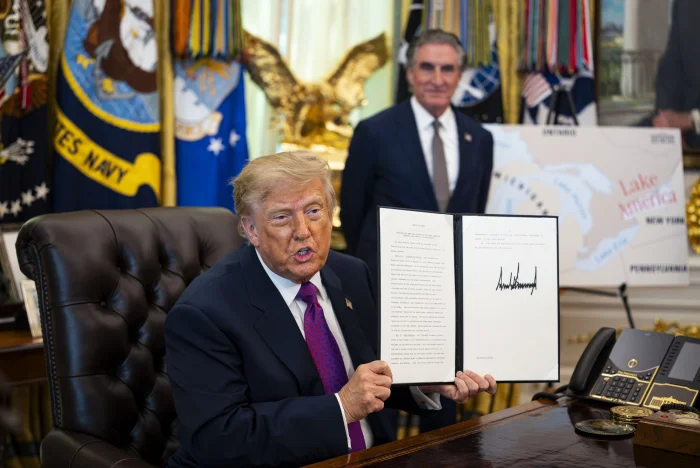
President Donald Trump poses with an executive order he signed during a ceremony inside the Oval Office of the White House on Thursday. Trump signed an executive order to create the “Great American Recovery Initiative” to tackle drug addiction. Photo by Aaron Schwartz/UPI | License Photo

Source link

Seoul stocks renew record high on AI confidence amid U.S. tariff woes

South Korea’s KOSPI index closed at a record high on Friday, as seen on a board at the dealing room of Woori Bank in Seoul. Photo by Yonhap

South Korean stocks closed a tad higher Friday to extend their winning streak to a fourth session to a new record high as investors scooped of artificial intelligence (AI) shares despite concerns over a bubble. The local currency fell against the greenback.

The benchmark Korea Composite Stock Price Index (KOSPI) inched up 3.11 points, or 0.06 percent, to close at 5,224.3, after rising as high as to 5,321.68.

Trade volume was heavy at 852 million shares worth 34.7 trillion won (US$24.1 billion). Losers outnumbered winners 602 to 278.

Individuals bought a net 2.2 trillion won, while foreigners sold a net 1.9 trillion won. Institutions sold a net 425 billion won.

Investors continued to purchase tech shares despite concerns over a bubble, as their performance has already been proven for robust earnings amid the AI cycle.

“For the time being, AI hardware and software companies need to overcome concerns over their profitability,” Han Ji-young, a researcher at Kiwoom Securities, said.

“During the period, the market’s preference for chipmakers that sell memory products to such companies will remain strong,” Han added.

The market advance was limited after U.S. President Donald Trump vowed to raise “reciprocal” tariffs and auto duties on South Korea back to 25 percent this week.

Top-cap Samsung Electronics edged down 0.12 percent to 160,500 won, while SK hynix set a fresh high at 909,000 won, up 5.57 percent.

Brokerage houses closed bullish amid the market rally, with Mirae Asset Securities rising 4.65 percent to 42,750 won and Kiwoom Securities increasing 4.11 percent to 443,500 won.

Top mobile carrier SK Telecom rose 4.32 percent to 72,500 won on the back of improved business outlook, and its rival KT added 1.43 percent to 56,900 won.

Samsung SDI rose 0.52 percent as the company said it has won a battery supply contract without disclosing details, with the deal widely believed to be related to Tesla Inc.’s energy storage system business.

The Korean won was quoted at 1,439.5 won against the U.S. dollar at 3:30 p.m., down 13.2 won from the previous session’s close.

Bond prices, which move inversely to yields, closed lower. The yield on three-year Treasurys rose 3.2 basis points to 3.138 percent, and the return on the benchmark five-year government bonds added 4.1 basis points to 3.436 percent.

Copyright (c) Yonhap News Agency prohibits its content from being redistributed or reprinted without consent, and forbids the content from being learned and used by artificial intelligence systems.

Source link

Trump targets Canadian aircraft; reports surface of U.S. talks with Alberta separatists

Jan. 30 (UPI) — President Donald Trump on Thursday night said he was decertifying all Canada-made aircraft and threatened a 50% tariff on all planes sold to the United States, further deepening the fissure in U.S.-Canada relations created under Trump’s second term in office.

Trump made the threat in a post on his Truth Social platform, stating the threat was in response to Canada’s alleged refusal to certify several Gulfstream jet series.

“We are hereby decertifying their Bombardier Global Expresses and all Aircraft made in Canada, until such time as Gulfstream, a Great American Company, is fully certified, as it should have been many years ago,” Trump said.

“Further, Canada is effectively prohibiting the sale of Gulfstream products in Canada through this very same certification process. If, for any reason, this situation is not immediately corrected, I am going to charge Canada a 50% Tariff on any and all Aircraft sold in the United States of America.”

By law, aircraft certification, which includes safety and airworthiness determinations, is governed by the Federal Aviation Administration, and it was not clear if the president has the power to decertify already approved aircraft by presidential action.

UPI contacted the FAA for clarification and was directed to speak with the White House, which has yet to respond to questions about decertification and its process.

Bombardier, the Montreal-based aerospace company, said it has “taken note” of Trump’s social media post and is in contact with the Canadian government.

“Our aircraft, facilities and technicians are fully certified to FAA standards and renowned around the world,” Bombardier said in a statement.

Bombardier said it employs more than 3,000 people across nine facilities in the United States and creates “thousands of jobs” there through its 2,800 suppliers. It said it is also “actively investing” in expanding its U.S. operations.

Relations between the United States and Canada have precipitously dropped since Trump returned to the White House in January 2025.

Trump’s threats to annex Canada, impose unilateral tariffs and take Greenland — territory of a NATO ally — by force if needed has prompted Ottawa to pivot toward Europe and Asia.

The announcement comes on the heels of reports stating that the Trump administration has been in talks with the Alberta Prosperity Project separatist organization.

According to The Financial Times, the first to report on the development Thursday, separatist leaders in the western Canadian province met with U.S. officials in Washington three times since spring.

The APP has said that its leadership has taken “several strategic trips” to Washington, D.C., to foster discussions on Alberta’s potential as an independent nation.

Jeffry Rath, a separatist supporter who participated in the talks, said U.S. officials are “very enthusiastic about Alberta becoming an independent country,” according to the APP.

The meetings were swiftly and widely condemned in Canada.

“I expect the U.S. administration to respect Canadian sovereignty,” Prime Minister Mark Carney of Canada told reporters on Thursday.

“I’m always clear in my conversations with President Trump to that effect, and then move on to what we can do together.”

Premier David Eby of British Columbia called the meetings “treasonous activity.”

“I’m not talking about debates that we have inside the country among Canadians, about how we order ourselves, our relationships between the federal government, the provinces, referenda that might be held. I’m talking about crossing the border, soliciting the assistance of a foreign government to break up this country,” Eby said during the same press conference.

“And I don’t think we should stand for it.”

Source link