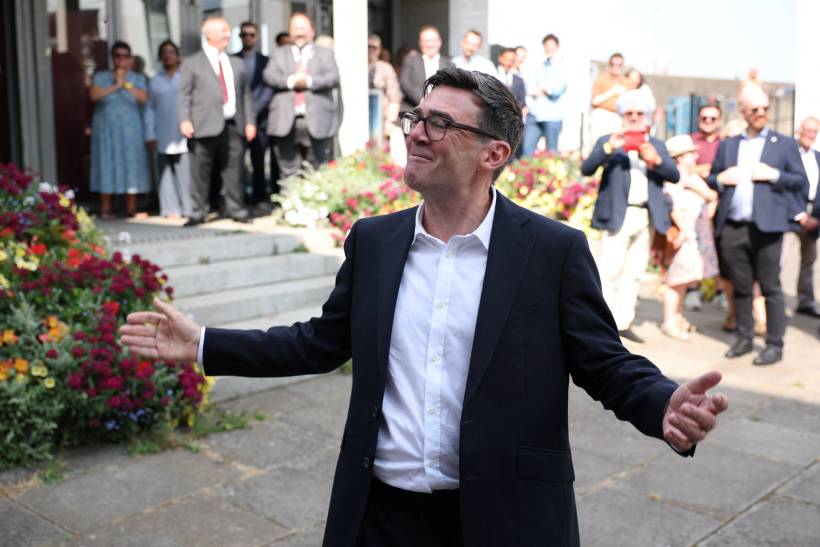
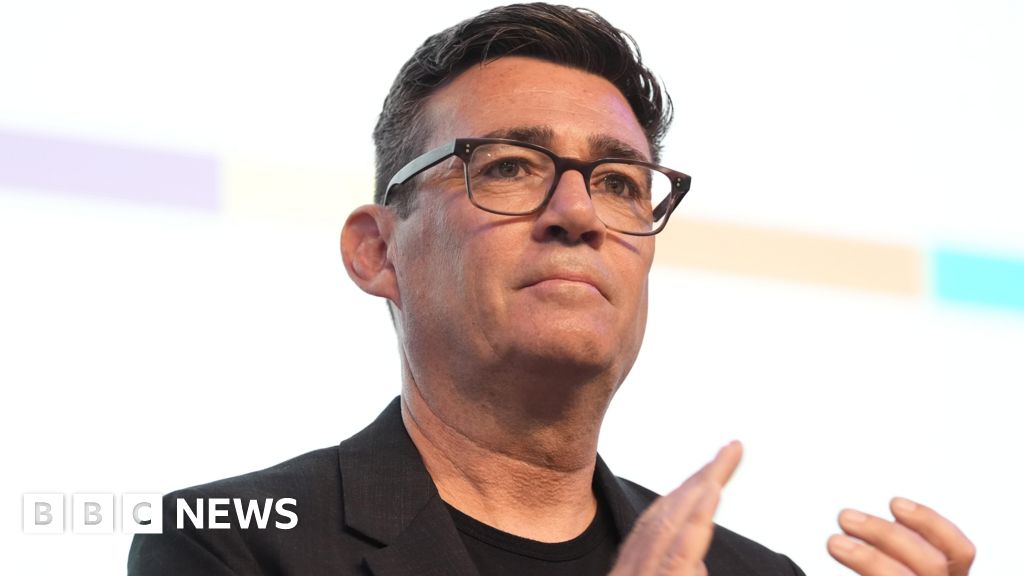
Britain’s new Prime Minister Andy Burnham is using social media to reshape Labour’s public image and challenge the growing online influence of populist parties, particularly Reform UK. By combining informal, relatable content with government messaging, Burnham is seeking to connect with younger voters while projecting a more approachable leadership style.
A New Digital Approach
Since taking office, Burnham has rapidly expanded his presence on TikTok, X, and Instagram through light-hearted videos, behind-the-scenes content, and policy announcements packaged in an accessible format.
Unlike traditional political messaging, Burnham’s posts often feature humor and everyday topics, ranging from debating popular pub snacks to joking about his own appearance. Communications experts say this approach presents him as relatable without undermining the seriousness of his office.
Labour Seeks to Close the Digital Gap
Burnham’s strategy reflects Labour’s effort to compete in an online space where Reform UK and its leader Nigel Farage have built significant audiences over several years.
Political analysts argue that while former Prime Minister Keir Starmer struggled to connect through digital platforms, Burnham’s communication style is more natural and engaging. Early polling suggests Labour has narrowed Reform UK’s lead since Burnham became prime minister, although the next general election remains years away.
Stay ahead of the geopolitical week.
MD Briefing delivers expert analysis across five global fronts — the Indo-Pacific, energy, geoeconomics, European security, and the Middle East — every Monday morning. Free.
Positive Messaging Over Polarisation
Communications specialists describe Burnham’s strategy as one focused on inclusion rather than confrontation. Instead of relying on divisive rhetoric, Labour is attempting to broaden its appeal through optimistic messaging and accessible political communication.
Videos highlighting government policies such as tax relief for hospitality businesses have attracted millions of views, demonstrating how policy announcements can gain wider attention when presented through social media trends.
Building a Professional Digital Operation
The government has expanded its investment in digital communications, recruiting specialists in content production, strategy, and social media engagement.
Burnham’s online campaign is being coordinated by experienced digital strategists, reflecting a broader recognition that political influence increasingly depends on platforms where younger audiences consume information.
Analysis: Social Media Is Becoming a Core Political Battleground
Burnham‘s early success illustrates how political communication is evolving beyond traditional speeches and television appearances. Social media has become a central arena where leaders compete not only on policy but also on personality, authenticity, and accessibility. While Burnham’s informal style may help Labour regain ground against populist rivals such as Reform UK, digital popularity alone is unlikely to determine long-term political success. As analysts note, sustained public support will ultimately depend on whether the government delivers tangible improvements on the economy, living standards, and public services. If policy outcomes fail to match the positive online narrative, social media momentum could prove difficult to maintain.
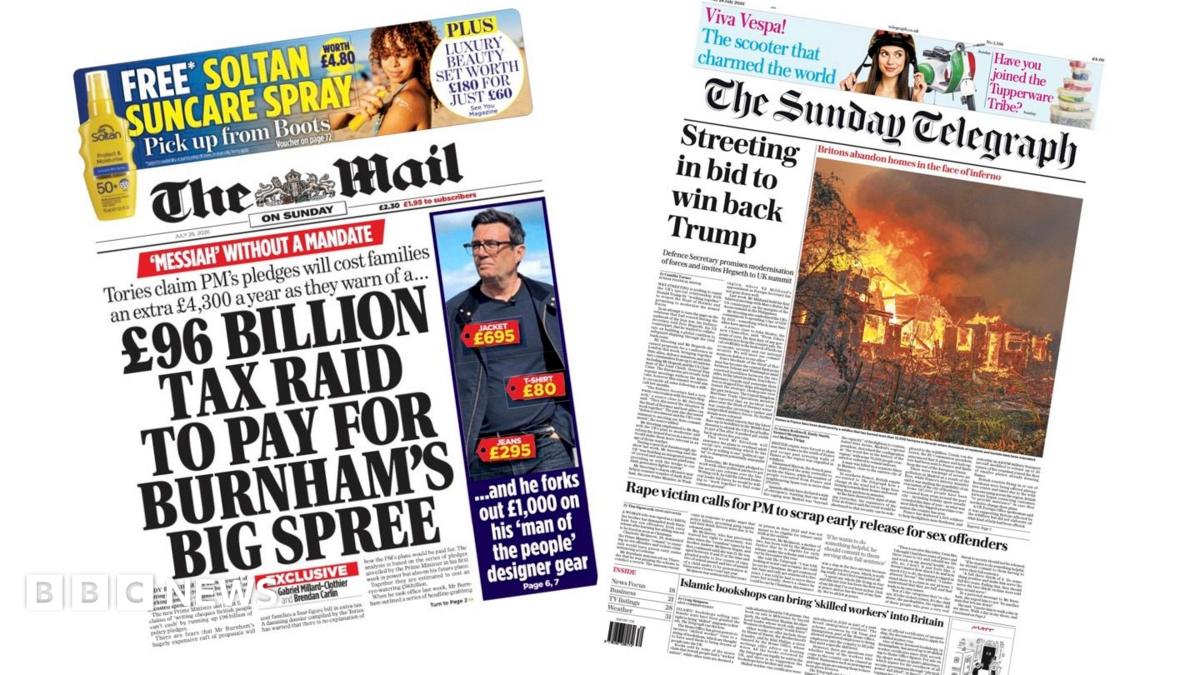
The Sunday Times says, external Prime Minister Andy Burnham will give England’s metropolitan mayors a share of income tax to spend in their cities, in devolution plans to be announced next week. It says the policy will be driven from the new Number 10 North office in Manchester.
Writing in the Sunday Mirror, external about his government’s priorities, Burnham says “if I’ve learnt anything from my time in politics, it’s that ‘it can’t be done’ is usually just another way of saying ‘we’ve stopped trying’.” In an article justifying policy decisions that have been taken so far, he adds, “our job will only be done when people aren’t just living, they’re living well.”
The Sunday Telegraph claims, external that the new Defence Secretary, Wes Streeting, has offered in a call with his US counterpart, Pete Hegseth, to collaborate on a global effort to re-open the Strait of Hormuz. The paper says a conference may be held in London to bring together representatives from more than 40 countries to discuss the issue. It describes the efforts as an attempt to “turn the page” on the divergence between the US and UK over the Iran war.
The wildfires raging across Europe feature on the front page of the Observer, external. It carries a stark full page image of a bather walking into the sea, with billowing smoke causing the sky to blacken. The headline reads: “Baptism of Fire.”
The Sun on Sunday reports, external that a group of migrants who arrived in the UK this week may include suspects wanted for questioning in connection with the fatal stabbing of another migrant. The incident is alleged to have happened in the seaside resort of Berck-sur-Mer in northern France on Thursday.
The Sunday Express claims, external that Sarah Ferguson, the former wife of Andrew Mountbatten-Windsor, is close to agreeing to a deal with broadcasters for a documentary series about her life. It says Netflix is one of the broadcasters she has been negotiating with. Those negotiating on behalf of Ferguson have stipulated that her contributions would have to be filmed outside the US because of the risk of being subpoenaed by the Congressional House Oversight Committee, which is investigating the crimes of her former husband’s friend, Jeffrey Epstein.
London, United Kingdom — On his fourth day as prime minister, Andy Burnham did not stay at Downing Street in London. Nor did he go to Manchester, the home of Number 10 North. He went to Glasgow.
Hours before King Charles and Queen Camilla opened the 2026 Commonwealth Games, Burnham held his first in-person meetings with Scotland’s First Minister John Swinney and Wales’ First Minister Rhun ap Iorwerth. The talks were meant to demonstrate, in Burnham’s own words, that growth is needed “in every postcode across the whole of the UK”. A meeting with Northern Ireland’s First and Deputy First Ministers, Michelle O’Neill and Emma Little-Pengelly, is pencilled in for a wider UK tour in August.
Notably absent from the agenda, at Burnham’s insistence, was any discussion of a second Scottish independence referendum.
Just days after being appointed prime minister, Burnham is testing a proposition that will define his premiership. He’s selling a vision that the office itself can be partly relocated out of London to Manchester, the city he governed as mayor from 2017 until his return to UK Parliament in the Makerfield by-election last month.
What Number 10 North actually is
Stripped of rhetoric, Number 10 North is a written ministerial statement. On July 21, Baroness Smith of Basildon, Leader of the House of Lords and Lord Privy Seal, confirmed on the government’s behalf that devolution and local growth policy functions are moving out of the housing ministry and the Treasury and into a new Manchester-based operation. There, civil servants will work inside a restructured Office for the Prime Minister and the Cabinet, led by Cabinet Secretary Dame Antonia Romeo.
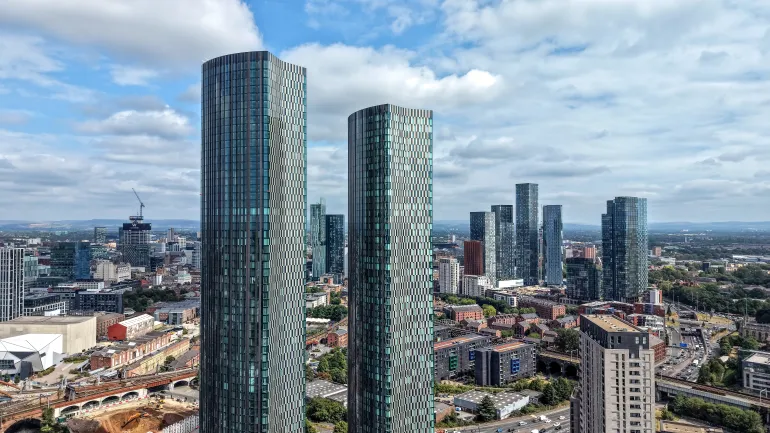
Number 10 North will be based at Manchester’s Heron House in the interim and the government “Digital Campus” once it’s completed in 2032, as the new government under Prime Minister Andy Burnham seeks to establish No 10 North as “the dominant driver of the UK’s economy” [Christopher Furlong/Getty Images]
The interim headquarters is Heron House, in the New Islington area of Manchester, chosen partly for its proximity to a planned Manchester Digital Campus.
Caroline Simpson, the outgoing chief executive of the Greater Manchester Combined Authority, has been named Burnham’s deputy chief of staff, and will be in charge of day-to-day office operations. Downing Street says Burnham himself expects to work from Manchester “at least one day a week”, though officials caution his diary may change, and insists the arrangement carries no additional cost to taxpayers.
Burnham calls it “the nerve centre of a rewired Britain” and rejects suggestions it is symbolic. “Not a gimmick,” he told his first Cabinet meeting about Number 10 North.
Plumbing, but no water
Number 10 North “establishes the plumbing, but the water isn’t flowing yet”, said Mirte Boot of the Institute for Public Policy Research (IPPR) North. The institutional architecture is firming up, but fiscal devolution – ie, the transfer of money and tax-raising power – that would make such a policy meaningful doesn’t yet exist, she added.
Still, she calls it “a step in the right direction” after what she describes as “too much power condensed into one postcode”. Leaving Westminster isn’t enough; Number 10 North will need “strong political leadership aside from the prime minister”, she added.
The verdict that Number 10 North contains vision and ambition but currently lacks a detailed plan and delivery mechanism is a recurring response from independent voices.
Jonathan Carr-West of the Local Government Information Unit calls Burnham’s devolution agenda “the most ambitious statement … from a senior politician in a generation”, while warning that English councils are so financially hollowed out that the vision “requires a vehicle” it does not yet have.
Malcolm Morgan, a transport researcher at the University of Leeds, puts it more bluntly: genuine devolution means spending, taxation and regulatory power, not just relocated functions, and “devolution does not create more funding”.
That funding question sits unresolved alongside the national one. The 2026 English Devolution and Community Empowerment Act expanded mayors’ control over transport, planning and housing, but left fiscal devolution to a separate Treasury “roadmap” due alongside the autumn budget. According to Centre for Cities, a UK urban policy think tank, the UK remains the most fiscally centralised country in the G7: some 95 percent of tax revenue flows straight to Whitehall.
Devolution, or recentralisation?
For Scotland’s SNP government, the Number 10 North framing is beside the point. First Minister Swinney responded that “rhetoric alone will not cut it” and argued that four consecutive Holyrood elections have handed his party a mandate for Scottish self-determination, something Westminster keeps ignoring, he said. In Glasgow, Burnham declined to engage with that argument directly.
Meanwhile, Wales’ Ap Iorwerth struck a more cooperative note but still said he expected “that Number 10 North would not become Whitehall with a different postcode”.
He also used the meeting with Burnham to press for a new Wales Bill granting policing and justice powers, and a replacement for the Barnett Formula funding mechanism, which Westminster uses to calculate annual changes to the block grants allocated to the UK’s devolved governments, so Wales would have funding parity with Scotland.
Reform UK’s Nigel Farage, from the opposite political direction, warned that a Number 10 in the south and one in the north would simply “fight against each other”.
What it means in Manchester
In Bury, Greater Manchester, Scottish-born Debe Conway sells children’s books at markets and has lived in the area for 56 years, but remains unconvinced about the new prime minister.
Her biggest concern is immigration, which she called Burnham weak on. And as for Number 10 North, she wants to know how it’s being paid for, and asks how long it will last, considering that the UK has had seven prime ministers in the last 10 years.
Rich Carver, who has run pizza restaurants in Manchester for 15 years and is currently “soaking up the energy in the city”, says he cares more about what will happen in the next 10 years.
He’s also tired of the succession of governments and wants this one to last. He likes Burnham and is optimistic enough about the city’s trajectory that he is opening a new restaurant in the coming weeks, something he would not have done five years ago.
“We are all one country,” he says, hoping the rest of the UK (and the media) give the new prime minister time and the chance to implement his vision. Whether that time produces growth, or just relocated offices, is the question Number 10 North still has to answer.
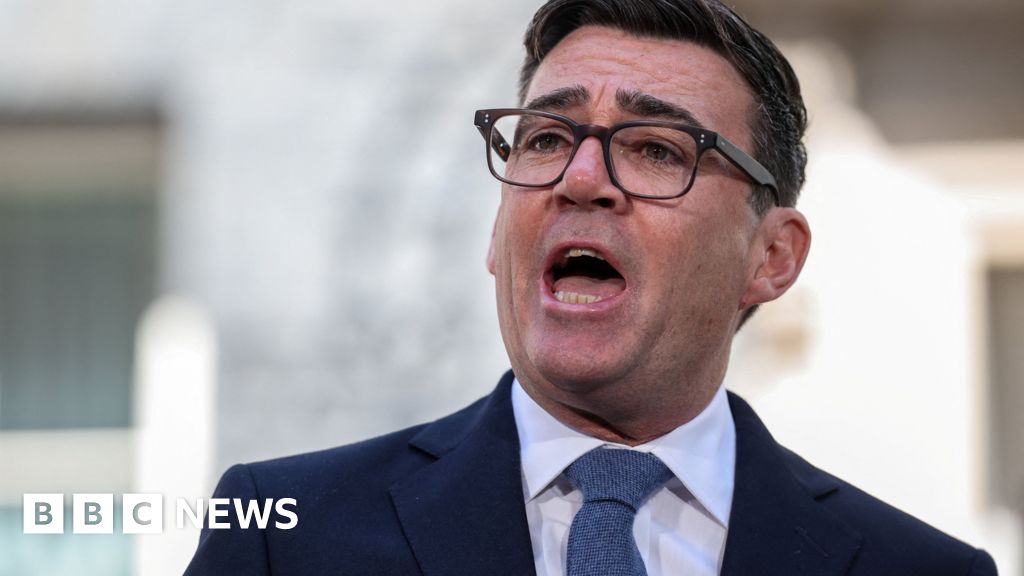
Former Mayor of Greater Manchester Andy Burnham gave his first speech as prime minister outside No 10 today, after he replaced Sir Keir Starmer as leader of the Labour party.
In his speech he promised to give the public “more breathing room”, and said he would set out a new 10-year plan for Britain by the end of this year.
He also announced that his first instruction as prime minister would be to end rough sleeping, which was met with cheers from his supporters who’d gathered outside Downing Street.
His predecessor Starmer gave a farewell speech in the same spot this morning, before formally offering his resignation to the King.
Andy Burnham, who becomes the United Kingdom’s next prime minister on Monday, faces a roster of challenges as the country’s seventh leader in a decade.
Burnham was overwhelmingly backed as Labour leader on Friday after current Prime Minister Keir Starmer resigned last month.
It has been a whirlwind month for the former Greater Manchester mayor, with his vision for the country and his cabinet still unclear.
“This has gone faster than he thought. It’s only been four weeks since he won the by-election. I don’t think he knows all of the answers yet; he hasn’t had the thinking time,” Sunder Katwala, director of the British Future think tank, told Al Jazeera.
Experts say the incoming prime minister will inherit an economy that has barely grown in two decades and a challenging geopolitical environment. He also has to deal with a marked decrease in Labour’s popularity, with the party trailing the right-wing Reform UK in the polls for 18 months.
“Burnham has relatively little fiscal room for manoeuvre,” said Anand Menon, director of UK in a Changing Europe.
New spending will have to be raised via taxation rather than borrowing, though there may be scope for “hypothecated spending” tied to a clear purpose, such as defence bonds, Menon said.
“If you make it absolutely clear what these things are for, the markets will be more permissive. But the fiscal situation is tight,” he noted.
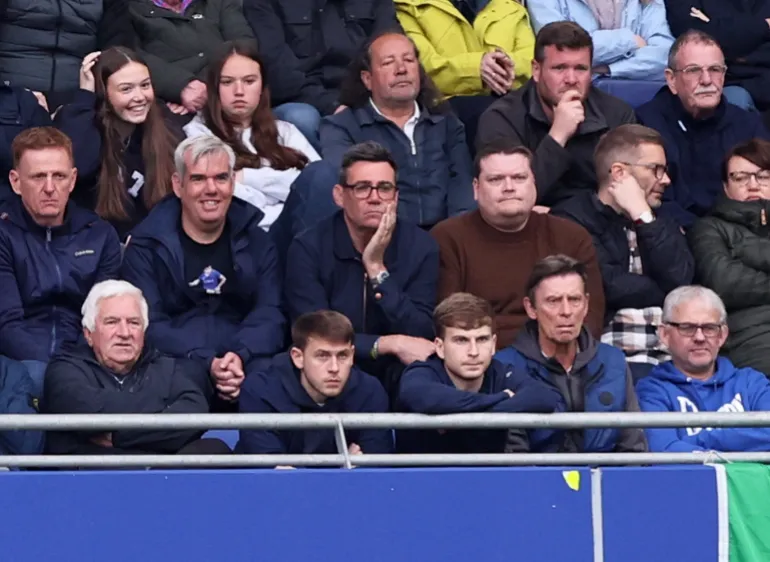
Andy Burnham, mayor of Greater Manchester, in the stands during a football match [David Klein/Reuters]
Manchester model
The government spent around 110 billion British pounds ($148bn) on debt interest in 2025-26 alone, about eight percent of all public spending. Borrowing has run higher than planned this year, and taxes are forecast to reach their highest share of the economy since World War II by the end of the decade.
Gareth Dale, associate head of Social and Political Sciences at Brunel University, points to Burnham’s record in Manchester, including the city’s fare-capped bus network, as proof that “meaningful reforms needn’t always come with a big price tag”.
Whether that scales up nationally will hinge on his willingness to confront the bond markets.
“What Burnham did in Manchester might be harder to do at a national level,” warned Menon. “He’s got to get the balance right between showing he’s aware of the fact that there’s a country outside of London and that isn’t just Manchester.”
Menon doubts fiscal manoeuvring alone will shift the public mood. He says that living standards have stagnated and services have eroded since 2008 so “people don’t just want to listen to what you’re saying, they want to see changes for the better in their lives”.
Burnham’s in-tray is complicated further by a diplomatic dispute that flared days before he is slated to take office. The government fully nationalised British Steel’s Scunthorpe works, a year after taking control of the loss-making plant when Chinese owner Jingye Group said it planned to close it.
Jingye has vowed to pursue “full compensation through legal means,” while China’s Ministry of Commerce accused London of undermining Chinese investor confidence.
It leaves Burnham managing a strained relationship with China from day one, after Starmer went to great efforts to reset relations between the two countries.
The United Kingdom’s government announced this morning that it was taking British Steel into public ownership in a bid to ‘protect UK steelmaking’ [Christopher Furlong/Getty Images]
Beyond borders
Menon argues that much of what shapes a prime minister’s fortunes lies outside their control and outside Britain’s borders.
“Sometimes the drivers of political success and failure are utterly out of your hands,” he said. He cited the war in Ukraine, Brexit and the COVID-19 pandemic as reminders that a “medium-sized open economy” is exposed to forces it cannot direct.
That extends to Washington, where personal chemistry with US President Donald Trump will matter “at least for a while, until he goes off people”, Menon said.
Dependence on the US for defence and technology rules out any dramatic reconfiguring of British-US ties.
Menon expects European Union relations to get less attention than under Starmer, predicting Burnham to be “more avowedly domestic” focused.
This could still be tested by Gaza, where Burnham has apologised for the previous government’s stance. Menon cautions that turning words into policy “depends heavily on events”.
“He’s given some hints he’ll be less knee-jerkly supportive of Israel than Starmer was, but whether that carries over into power, we’ll have to wait and see,” explained Menon.
He also doubts whether Burnham would risk a rupture with Washington regarding US bases in Britain, which could be used, indirectly, in US-Israel war on Iran.
Andy Burnham, right, shakes hands with Neil Kinnock, former Labour Party leader in the 1980s and 1990s, as he arrives before being confirmed as the Labour Party’s new leader and the country’s next prime minister during ‘Labour’s Special Conference’ in London, England, the United Kingdom, July 17, 2026 [Henry NIicholls/Pool/EPA]
Defence first
Reports suggest that Burnham is likely to put defence above welfare spending, which will again rankle some in his party.
“He’ll probably prioritise arms spending over welfare… while dialling down the ‘net zero’ programme,” warns Dale, with Burnham expected to allow for new North Sea oil and gas drilling.
“And he voted to make the asylum system more brutal. If he does set policy in these directions, it’ll put wind in the sails of the far right, and probably accelerate the shift of voters from Labour to Green,” Dale said.
Burnham has moved from Labour’s Blairite wing to its soft left, but “commands widespread support among Labour MPs” and “gets on with various factions”, he noted.
But that unity masks deeper erosion: Labour’s vote fell from 12.9 million in 2017 to 9.7 million under Starmer.
The centre-left party’s support base is also “narrowing towards wealthier, less diverse parts of the electorate, with the Greens now drawing disillusioned voters on the left”, said Dale.
Political divides
That erosion is bound up with a wider polarisation in the country that Katwala says no government can avoid.
“I don’t think it’s enough to say we’d like to talk about jobs and devolving power and therefore we won’t talk about identity, immigration, race,” says Katwala.
A woman holds a placard outside Downing Street during a ‘National March for Palestine’ calling on Britain’s next prime minister, Andy Burnham, to stand up for the Palestinian people, in London, Britain, July 18, 2026 [Jack Taylor/Reuters]
He argues that fairness should be framed as universal rather than a concession to certain groups of society.
“Whether it’s tackling anti-Semitism, Islamophobia or racism generally, these are issues for everybody in society. It’s not for the minority group itself to work out how to challenge the prejudice it faces,” Katwala said.
“The people who are hostile to Muslims are the people who know the least Muslims and live furthest away. It’s the government’s job to get to that really tough end of attitudes and perceptions that are making people feel less safe.”
Menon sees a narrow opening on the right-wing narratives popularised by the Reform UK party.
Labour entered government in 2024 with 33 percent of the vote against Reform’s 14 percent, a gap that has since collapsed following the right-wing party’s links to George Cottrell, a convicted fraudster.
Recent polls put Reform around 24-26 percent and Labour close behind it, a marked turnaround from polling earlier this year.
By-election results also suggest a broad anti-Reform coalition and tactical voting exist, which should strengthen Labour.
“Even if 30 percent of people are willing to vote Reform, almost 70 percent are willing to do whatever it takes to stop them being elected,” Menon noted.
Whether that holds, he said, depends on how Burnham performs once the difficulties of government set in.
“It becomes a very different game when things are going badly, and if he ends up being a lucky general, then Reform self-destructs,” Menon said.
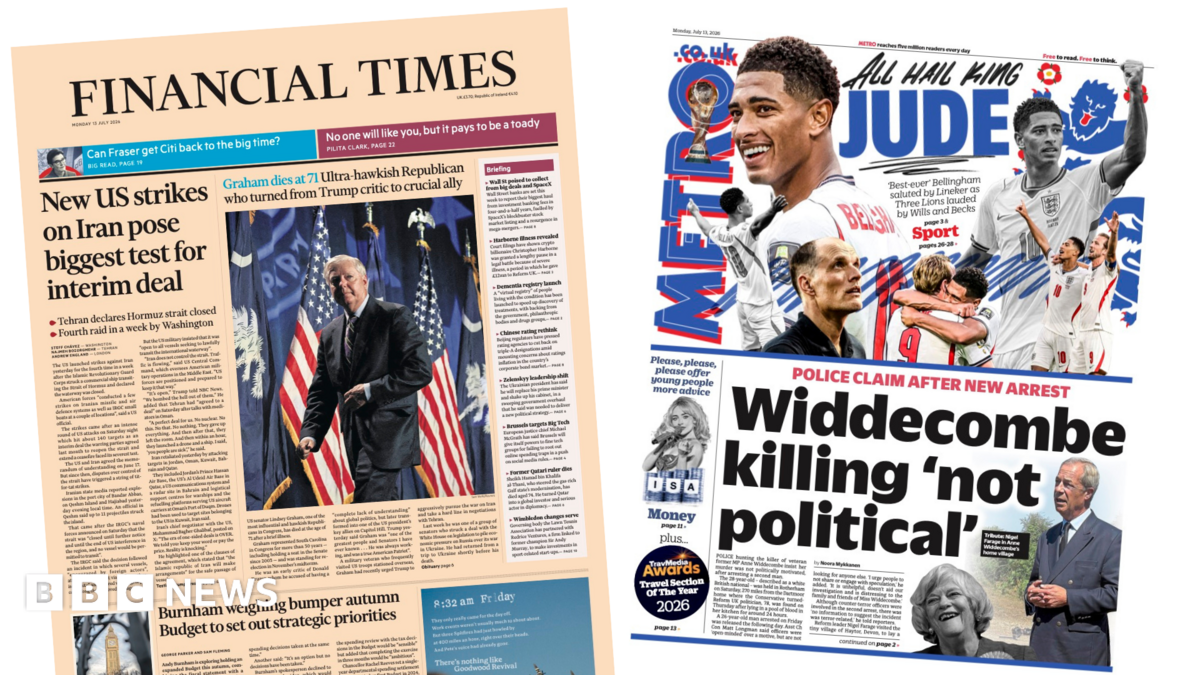
The Daily Mail also recounts the details of the suspect in Widdecombe’s murder, describing him as a “loner” who “left his house with a pole”. The paper’s Bryony Gordon has written about “why so many women like me have fallen for Jude Bellingham”. Meanwhile, Prince George and Princess Charlotte are pictured in the royal box at Wimbledon.
If he becomes PM, Burnham has already ruled out an early election, telling an online forum last week: “I’m going to work to the 2024 manifesto.”
By September at the latest, the UK will have had seven prime ministers in the past decade.
Four prime ministers took over mid-term without having fought and won a general election: Theresa May in 2016, Boris Johnson in 2016, and Liz Truss and Rishi Sunak, both in 2022.
In each of these cases, there have been questions from opposition parties about their legitimacy in office.
But the next prime minister, like their predecessors, is under no obligation to call a general election before the scheduled end of the Parliament in 2029.
The current system sees the electorate vote for their MPs and a party, and those MPs and that party choose their leader.
The last general election was held on 4 July 2024, with Labour winning a landslide majority, meaning the next election must legally be held by August 2029, though a prime minister can choose to call one at any point before this.
A PM calling an early election depends on a number of factors – how the party is performing in the polls, and whether the prime minister wants to seek a new mandate from the electorate to set out his own agenda in government.
So while Burnham has ruled out an immediate election, there may still be one before the end of 2029.
UK minister says Starmer considering ‘political realities’ after Labour rival Andy Burnham secured decisive by-election win.
British Prime Minister Keir Starmer is weighing whether to resign within days, according to media reports, amid mounting pressure from his own Labour Party following a decisive by-election win by his rival, Andy Burnham.
Expectation is growing that Starmer could announce a resignation timetable as soon as Monday, the same day Burnham is sworn in as a lawmaker after winning Thursday’s vote by a wide margin – a result that has reportedly emboldened Labour figures, including Foreign Secretary Yvette Cooper, to call for Starmer to step aside.
Recommended Stories
list of 4 itemsend of list
A resignation would lead to the United Kingdom’s seventh prime minister in a decade, a rapid rate of churn in the country’s modern history.
Starmer has been under growing pressure to step down after months of declining popularity, policy missteps and scandals.
In February, the premier came under fire when revelations from the Epstein files about Peter Mandelson, whom Starmer appointed as the UK’s ambassador to the US in December 2024, came to light.
Burnham, Greater Manchester mayor since 2017, has made clear he intends to challenge to lead the slumping centre-left party, warning in his by-election victory speech that it had a “final chance to change”.
If successful, he would become prime minister by default, given that the governing Labour has a huge parliamentary majority.
Starmer is deeply unpopular with voters, according to polling.
YouGov, a global public opinion and data analytics firm, reports that only 19 percent of British people have a positive opinion of the prime minister, and he ranks as the ninth most popular Labour politician.
Starmer has insisted he will fight any attempt to oust him.
But the emphatic nature of Burnham’s win in the Makerfield constituency in northwest England, where he nearly doubled Labour’s majority, has increased the internal pressure on Starmer to quit.
Business Secretary Peter Kyle said on Sunday that Starmer was “making time to reflect on the political realities, challenges and opportunities that he finds himself in”.
“He has been engaging in conversations with a wide, wide range of people,” Kyle told the Sky News broadcaster after having what he said was a “frank” conversation with Starmer on Friday.
The Observer newspaper headlined on its cover on Sunday that Starmer was “expected to resign” the following day, while the Sunday Telegraph also reported he was “ready” to go, citing allies of the embattled British leader.
The Observer said Starmer would “set out a timetable for his departure”, noting he had been holding weekend talks at Chequers, the countryside retreat for prime ministers.
Labour’s drubbing in local and regional polls in England, Scotland and Wales last month intensified the pressure on him.
The fallout from the polls saw Makerfield’s previous Labour MP resign to allow Burnham to stand there.
Burnham, a former MP and government minister under ex-prime ministers Tony Blair and Gordon Brown, is due to be sworn back into parliament on Monday.
From the so-called soft-left wing of Labour, he reinforced his reputation as the party’s most popular figure by easily beating the hard-right populist Reform UK party’s candidate in this week’s by-election.
Reform, led by Brexit architect Nigel Farage, had won all of Makerfield’s wards in last month’s local elections.
Granted the Makerfield parliamentary seat has elected Labour MPs for yonks, but just a matter of weeks ago, at the local elections, Reform UK were dominant in this collection of towns broadly to the south of Wigan – places like Abram, Hindley, Orrell and Winstanley.