Emmerdale’s Joe Tate takes a sickening revenge on Caleb and Ruby Miligan next week, as spoilers reveal the moment he buries Ruby alive in a coffin, leaving her facing death
Emmerdale spoilers: Joe buries Ruby alive
Ruby in Emmerdale could die next week, as Joe Tate’s extreme revenge plan sees her buried alive.
Caleb Miligan and his wife face danger as Joe wants payback, blaming them for the death if his partner Dawn Taylor. So when Joe asks Graham Foster for a favour, we later see exactly what Joe has planned for them.
Spoilers for next week reveal that Joe struggles to deliver the eulogy at Dawn’s funeral, so Kim steps in. As Kim vows to keep the family together, a grieving Joe walks away. As Joe approaches a grave, it becomes apparent he’s buried Ruby alive.
As Joe torments a weakened Caleb about his wife Ruby, she wakes up in a coffin, unable to escape. As Ruby slips unconscious, Caleb begs Joe to release her but he refuses.
Vinny admits to Nicola and Joe that he was responsible for the car accident that killed Jimmy and Dawn. As Nicola heads to the pub to confront Gabby, she publicly reveals how Vinny caused the fatal crash while on the phone to Gabby.
Cain tells Moira that Sadie opened up to him about the loss of their child. Sarah and Jacob are relieved when Ross confirms he has no intention of fighting for custody of Leyla.
Lewis worries about his future with Vinny, while Kev panics that Nicola will find out he knew about Vinny causing the crash. It comes as scenes this week sparked death fears for Charity.
In the latest episode, Charity was struggling with Sarah refusing to change her statement – the police statement that had her charged with murder. Things came to a head when drugs were found in Charity’s cell, and she was told she would need to undergo a full body search.
Charity experienced a panic attack as memories of her horrifying assault at the hands of Dr Todd came flooding back, as the police prepared to force the search. Charity was placed in segregation after lashing out, where she was clearly traumatised.
As Mack feared for his wife’s safety and feared how she would cope if she remained in prison, Mack warned Sarah that she could have another death on her hands, meaning Charity, if she didn’t tell the truth. But will Charity be released?
Fort Portal, Uganda – When King Oyo Nyimba Kabamba Iguru Rukidi IV of Tooro was buried on September 12, the ceremony unfolded under the shadow of a bitter dispute over who should succeed him.
Prince Edward Rukidi Kijanangoma, a 56-year-old news anchor and editor at Uganda Broadcasting Corporation, had been selected by the royal clan to succeed Oyo. During the burial at the Karambi Royal Tombs in Fort Portal, he formally assumed power by casting nine coffee berries into the king’s grave, part of the traditional handover ritual.
But the succession remains contested.
Oyo’s mother, Queen Mother Best Kemigisa, and his sister, Princess Ruth Komuntale, have opposed Kijanangoma’s selection, saying the late king’s will named a son as his heir.
Oyo never married and was not publicly known to have children. After his death, Tooro’s Prime Minister Calvin Armstrong Rwomiire Akiiki announced that the king had left a son whose identity would be revealed at an appropriate time. The child has not been publicly identified.
Oyo’s family says a 2022 will named a son whom he described as his lawfully recognised biological son as heir to the throne. But Babiito clan elders, who are responsible for guarding the Tooro royal lineage, determining succession and safeguarding the kingdom’s traditions, say Oyo had not introduced the child through the customary process and instead backed Kijanangoma as his successor.
“The will is not a determinant of who is supposed to be a king; it is a document that expresses one’s wish,” said Reverend Father Charles Oyo, a Babiito clan elder. “The Musuuga [Babiito clan leader] is above the will.”
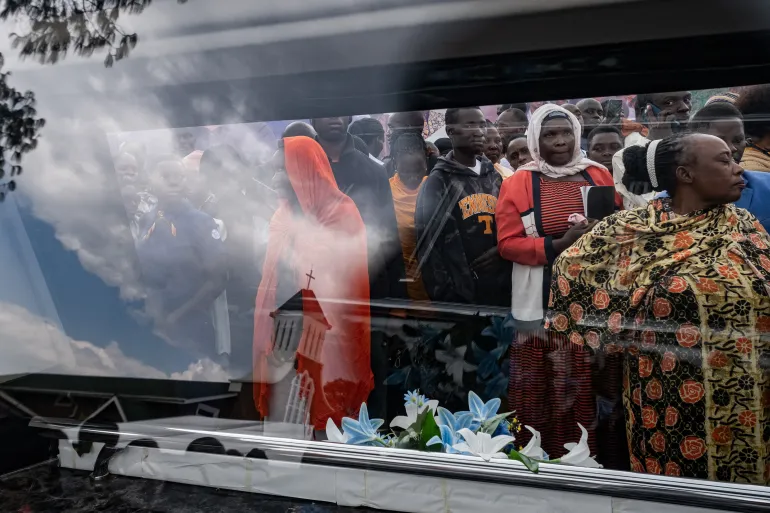
Members of the public react as the body of the late King Oyo Nyimba Kabamba Iguru Rukidi IV makes its way to Karambi Royal Tombs for burial in Fort Portal, Uganda, on September 12, 2026 [AFP]
Princess Komuntale has accused the elders of trying to take over the throne.
“King Oyo was a very peaceful man, a very humble man,” she said. “I just don’t want these evil vultures to come and steal what he worked so hard for. I continue to stand with my brother.”
The dispute has divided opinion over who should be regarded as Oyo’s legitimate successor. The Ugandan government also became involved in talks aimed at resolving the dispute before the burial.
The child king
Oyo’s own path to the throne began when he was just three years old.
He became king in 1995 after the death of his father, Patrick David Matthew Kaboyo Olimi III, and was recognised as the world’s youngest reigning monarch.
A coffin containing the body of the Late Oyo Nyimba Kabamba Iguru Rukidi IV is loaded onto a cortege after leaving the Karuziika Royal Palace before the burial at the Karambi Royal Tombs on September 12, 2026, in Fort Portal, Uganda [Hajarah Nalwadda/Getty Images]
As a child, Oyo was homeschooled, with the palace serving as his classroom. When he later joined primary school, childhood friends remember him as a kind and warm person.
During school holidays, he sometimes sneaked out of the family’s private residence in Buziga, Kampala, to play football in the neighbourhood.
Martin Odong, a radio journalist and childhood friend, remembers him as “friendly, social and compassionate”.
Oyo would stop football games to check on an injured player, regardless of which side they were playing for, Odong said.
His love of football continued into adulthood. He promoted local tournaments, including the Tooro Kingdom MTN Masaza Cup, which was suspended as his health deteriorated.
Oyo died on August 27, aged 34, in the United States while receiving cancer treatment. His body was returned to Uganda for nine days of mourning before his burial at the Karambi Royal Tombs, which coincided with Empango, the anniversary of his coronation.
At St John’s Cathedral, Queen Mother Best Kemigisa remembered her son as someone who had always protected her.
“He was my shield who always stood for me,” she said.
Mourners escort the cortege with the body of the late Omukama of Tooro, King Oyo Nyimba Kabamba Iguru Rukidi IV, for his burial at the Karambi Royal Tombs, in Fort Portal, Kabarole district, Uganda, September 12, 2026 [Abubaker Lubowa/Reuters]
She recalled praying for his life when she was in hospital.
“When I was in the hospital, I said, ‘God, please leave my son alone; take me first,’” she said. “He [God] decided to take him [King Oyo] first. I said, ‘Why? Because he was closer to You than me.’”
Princess Komuntale described her brother as a “funny person” who “always brightened my day”.
Although he was younger than her, she said, he often behaved like the older sibling and protected her and their mother after their father “left to be with the Lord”.
Father Charles Oyo remembered him as a “handsome king who loved his kingdom so much”.
He said Oyo died just as he was “beginning to demonstrate his abilities and capacity as a king”.
A king without political power
Uganda is a constitutional republic, and its traditional kings have no formal political authority. But the kingdoms retain cultural influence and command loyalty among many of their communities.
Queen Mother, Best Kemigisa (R), and her daughter (L), Princess Ruth Komuntale, attend a requiem mass for the late King Oyo Nyimba Kabamba Iguru Rukidi IV of Tooro, at the St John’s Cathedral before the king’s burial at the Karambi Royal Tombs, on September 12, 2026, in Fort Portal, Uganda [Hajarah Nalwadda/Getty Images]
Uganda abolished its traditional kingdoms in 1967. They were restored in 1993 under President Yoweri Museveni.
Oyo was guided by regents while he was a child and took on the full responsibilities of the monarchy as an adult.
His unusual position meant he met presidents, royalty and other world leaders from a young age. Among them was former South African President Nelson Mandela, who reportedly wanted to meet the young king during a visit to Uganda. Oyo, however, was more interested in playing with his toys behind the VIP tent.
As an adult, he used the platform of the throne to promote issues beyond the kingdom.
In 2020, he climbed the Rwenzori Mountains to draw attention to climate change and the retreat of the glaciers there.
He also supported a campaign to plant 10 million trees across Tooro over five years.
He promoted healthy living and took part in cancer awareness runs. Komuntale called him her “best workout partner”.
Before his death, Oyo had allocated land and begun fundraising for a paediatric hospital in Kyenjojo district. Clan elders have since appealed to the government to complete the project and establish a specialised cancer facility and an international stadium in his memory.
His final months
Oyo’s illness was kept largely private.
According to his sister, he began experiencing pain in his back and rib cage last year. The family initially thought it might be linked to strenuous exercise or ulcers.
He later travelled to Kenya, where he was diagnosed with angiosarcoma, an aggressive form of cancer, before travelling to Germany for treatment and eventually to the US.
Members of the public react as the body of the late King Oyo Nyimba Kabamba Iguru Rukidi IV makes its way to Karambi Royal Tombs for burial in Fort Portal, Uganda, on September 12, 2026 [AFP]
“He told us to keep it private, and we respected that,” Komuntale said.
She said that shortly before his death, Oyo spoke to key workers in Uganda about returning home. He wanted to celebrate Empango, the anniversary of his coronation, with his people.
He never made it home.
For Komuntale, the king remained her younger brother even after he became one of Africa’s most recognisable traditional rulers.
She remembered playing dodgeball with him and his love for his three dogs.
“Even though you were crowned a king, you were still a kid who loved to play,” she said.
“I will keep your legacy, what you loved, and we will talk about you every day.”
Nepalese Army officers load an injured worker onto a helicopter at Trishuli air base after he was rescued early Friday, nine days after becoming trapped in the tunnel of a hyrdropower project. Photo by Narendra Shrestha/EPA
Sept. 4 (UPI) — Rescuers pulled two workers alive from hydropower project tunnel in Nepal nine days after devastating flash foods in the central Bagmati region and across the border in Tibet killed thousands of people, with as many 4,000 still unnaccouted for.
The two men, a supervisor on the Trishuli 3A Hydropower Station who was in a critical condition and a foreman, were taken by helicopter to the hospital in Kathmandu. At least one body was also pulled from the tunnel.
Tunnelling expert Arnold Dix told the BBC the rescue was the result of a highly complex and painstaking effort using engineering processes, old maps and aerial and satellite imagery to find the entrance of the tunnel, on a mountainside before the floods but now underground, and blast their way ahead, foot by foot.
At the same time they had to clear the tunnel at the Trishuli 3A Hydropower Station of water, using pumps and excavators to dig channels to drain the water to the river on the outside.
The team eventually reached two men more than 550 feet beneath the ground after digging “a tiny” person-sized tunnel, pulling foreman Sanjaya Shah and project supervisor Kabir Maharjan early on Friday, local time, and now hope to rescue more people.
Shah who was conscious but dazed, said he had been in the control room with 40-45 others when disaster struck and that he became trapped as he ran up and down the tunnel telling workers to get out.
“It’s like layer upon layer of miracles. We got two people out. If we were playing at a casino, some might say it’s time to walk away, but we say game on, time to take on the house,” said Dix, who credited Nepalese Army engineers for their expert assistance, particularly with the explosives used.
Dix said rescuers were 200 feet into the tunnel with another 500 feet to go where he said he believed there was a “Goldilocks zone” where he anticipated they may find more people alive from among dozens of people believed to remain trapped.
The “Goldilocks zone,” a space with conditions supporting life, is located on the uppermost level of the hydropower station.
“We got two people out. If we were playing at a casino, some might say it’s time to walk away, but we say game on, time to take on the house,” said Dix.
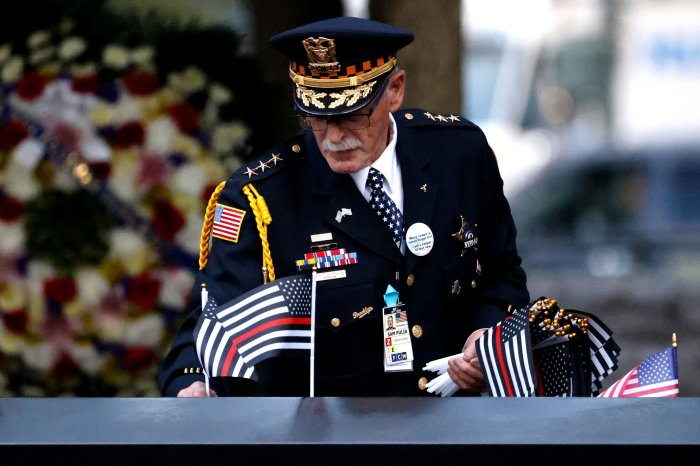
Retired Deputy Police Chief Sam Pulia places American flags at the 9/11 memorial south pool before the start of the 9/11 Commemoration Ceremony at the National September 11th Memorial and Museum in New York City on September 11, 2025. Nearly 3,000 died in the September 11 attacks. Photo by Peter Foley/UPI | License Photo

![TOPSHOT - Members of the public react as the body of the late King Oyo Nyimba Kabamba Iguru Rukidi IV makes its way to Karambi Royal Tombs for burial in Fort Portal, Uganda, on September 12, 2026 [AFP]](https://i0.wp.com/www.aljazeera.com/wp-content/uploads/2026/09/afp_6aa5b63bb446-1789244987.jpg?w=640&ssl=1)