burgum

U.S. cancels protections for imperiled animals as critics warn of extinctions

The U.S. Interior Department on Friday canceled a rule meant to protect plants and animals that are determined to be threatened with extinction, the latest step by the Trump administration to dismantle key provisions of the landmark Endangered Species Act at the behest of industry.

Instead of receiving automatic protections, imperiled species will need individualized protection plans once they are added to the threatened species list. That’s a potentially lengthy process in which companies could seek exemptions for oil and gas drilling, mining and other development where those species live.

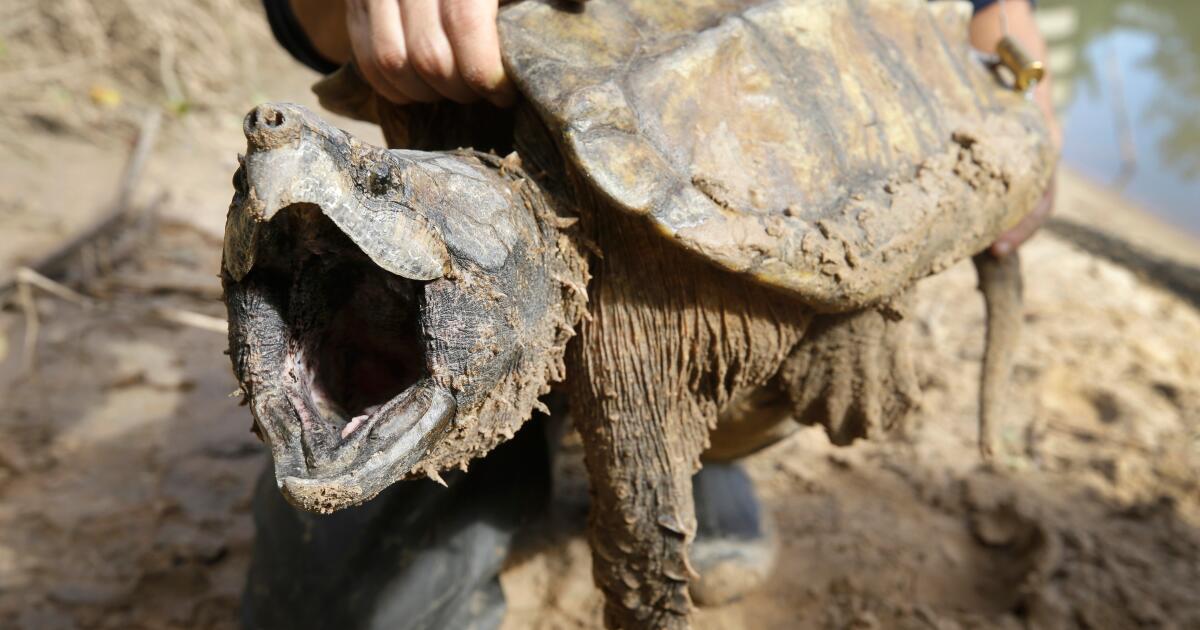
Opponents said it would make it harder to save wildlife awaiting federal protections and in danger of disappearing, such as monarch butterflies and alligator snapping turtles.

Interior Secretary Doug Burgum said in a statement that the Endangered Species Act had been used for too long “to stop almost any new project in America, driving up costs for families, weakening our competitiveness, and undermining our national security.”

“Success should be measured by species recovery and delisting, not by adding more species to the list,” Burgum added.

A second change finalized Friday requires officials to analyze economic effects when deciding whether habitat is critical to a species’ survival. Critics say it gives corporations an opportunity to put their thumb on the scale so officials will allow development in those areas.

“If you’re exempting certain industries that cause habitat destruction, in many instances you’ll be exempting the main threat to those species,” said Noah Greenwald with the environmental group Center for Biological Diversity.

Officials made similar changes during Trump’s first term, but they were reversed under the Biden administration.

The rules that gave what some consider “blanket protections” to threatened species were first adopted for wildlife in 1975 and for plants in 1977.

Two groups, the Rocky Mountain Elk Foundation and the Property and Environment Research Center, sued the Biden administration in 2024 after officials restored the blanket protections rule. They argued the rule unfairly imposed the same restrictions on landowners when a species’ status improves from endangered, which is more dire, to threatened.

That removed incentives for landowners to participate in species recovery, said Jonathan Wood, vice president at the Montana-based research center.

Wood said the Trump administration’s approach allows officials to “better reward progress and encourage proactive conservation.”

There have been no species added to the endangered or threatened lists in Trump’s second term. By comparison, more than 20 species were added in Trump’s first term, and about 60 under President Biden.

About 30 species are currently proposed to be listed as threatened. Besides monarchs and alligator snapping turtles, they include California spotted owls and various snakes, fish, clams and insects.

Changes to government policies for endangered plants and wildlife have come faster and extended further in Trump’s second term than in his first.

The administration in March exempted oil and gas drilling in the Gulf of Mexico from the Endangered Species Act after Defense Secretary Pete Hegseth said environmentalists’ lawsuits threatened to hobble domestic energy supplies as the U.S. wages war against Iran.

A week before the latest rule change, Interior officials sharply narrowed the definition of what constitutes “harm” to a species. The change would allow development in critical wildlife habitat so long as the animals themselves are not immediately killed or injured.

Officials this week sharply reduced the amount of critical habitat in the Rocky Mountains designated for Canada lynx, forest-dwelling wildcats that are threatened by climate change and other pressures.

Also this week, Burgum said in a visit to Montana that the U.S. Fish and Wildlife Service would turn over more management authority for grizzly bears to states where the bruins live. That’s been a long-standing priority for the Republican governors of Wyoming, Idaho and Montana.

The Endangered Species Act is credited with bringing back animals including the California condor, the bald eagle and the American alligator from the brink of extinction.

Burgum noted Friday that 97% of the species that have been given protections still have them. That’s a frustration for Republican lawmakers who say species should be taken off the endangered and threatened lists more quickly once they’ve recovered.

Brown writes for the Associated Press.
Source link

Crews are draining the Lincoln Memorial Reflecting Pool again as part of Trump’s troubled revamp

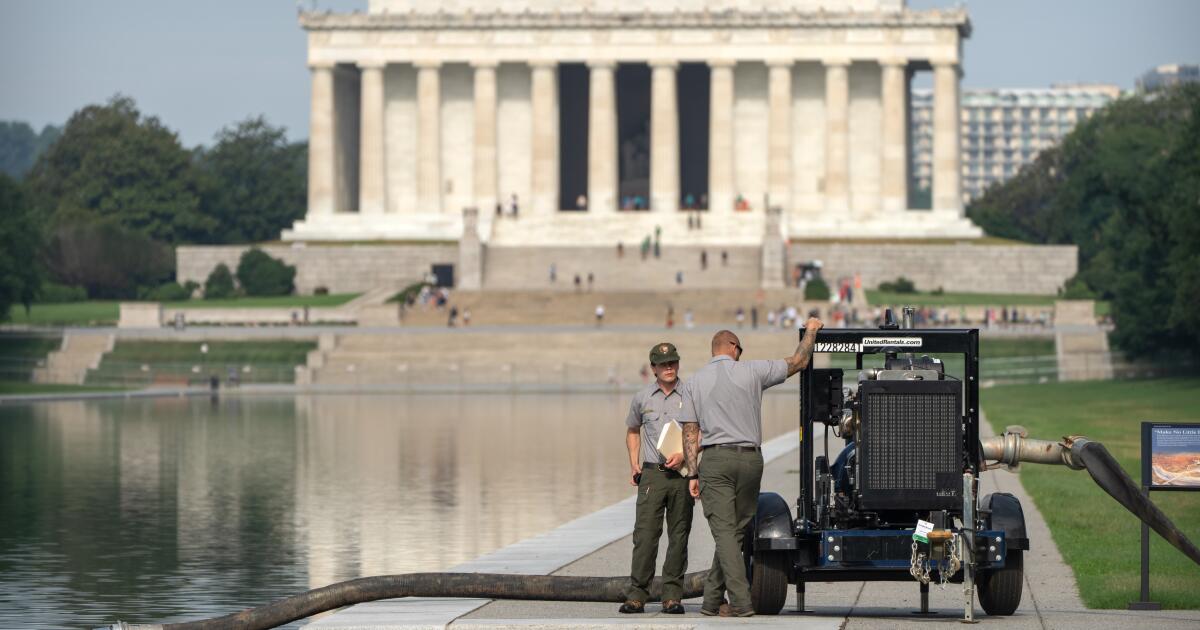
Crews are again draining the Lincoln Memorial Reflecting Pool as President Trump’s problem-plagued efforts to revamp the waterway pushes well past his initial goal of having it ready by July 4 to mark the nation’s 250th birthday.

The president at first suggested his renovations would last a century. But within weeks of the project originally reaching completion last month, the water was beset by an algae bloom and pieces of the new coating appeared to be peeling off the bottom.

Trump has blamed the peeling on vandals, though critics allege it’s from shoddy repair work.

Interior Secretary Doug Burgum, whose agency oversees the National Park Service, told conservative podcaster Katie Miller in an interview released earlier this week that the new round of draining was planned. He also said that the water might still contain debris from an extensive Independence Day fireworks display over the National Mall.

“Drain the water, clean up the fireworks stuff,” Burgum told Miller, who is the wife of deputy White House chief of staff Stephen Miller. “Repair the vandalism that was done. Fill it back up again.”

The work on the Reflecting Pool is just one of a number of projects Trump has spearheaded across the nation’s capital. Most prominently, he demolished the White House’s East Wing to build a $400-million ballroom and plans to build a towering arch between the Lincoln Memorial and Arlington National Cemetery.

He initially announced his intentions to beautify the Reflecting Pool this spring, saying he wanted it completed before the nation’s 250th birthday celebrations.

Water was drained and Trump directed that the bottom be painted what he called “American flag blue.” In May, the president posted on his social media site of the pool: “The goal is to have it done, at this higher level, prior to July 4th — We are ahead of schedule!”

But problems began quickly after the initial work was finished. Trump blamed vandals, and court documents later showed that the National Park Service reported to the U.S. Park Police a June 9 incident in which a sharp knife or razor cut the pool’s new liner.

On Thursday, former Olympic canoe racer David Hearn pleaded not guilty in D.C. Superior Court to deliberately damaging the Reflecting Pool. Hearn has said he reached inside the pool to examine the peeled sealant and let go of a chunk when he was told to by a park worker.

His attorneys and other Trump administration critics have derided the case as an abuse of prosecutorial power and maintain he is being scapegoated for the poor job done fixing up the Reflecting Pool.

At least three other people have been charged in the same court with misdemeanors for allegedly removing pieces of paint from the Reflecting Pool, according to online court records. All three pleaded not guilty during their initial court appearances Wednesday.

The pool was closed for the Independence Day celebration, which featured what Trump said was the largest fireworks display in the world. The president had said that the pool would have to be drained anew as part of the new round of repairs.

Burgum has also said that the Trump administration won’t seek bids for the new rounds of repairs. He told CNN’s “State of the Union” last weekend: “We’ll use the same company because they did a fantastic job.”

Ohio-based Green Water Solutions, also known as Greenwater Services, was given a $1.7-million contract to install a water-purification system in the Reflecting Pool, while Virginia-based Atlantic Industrial Coatings was awarded $14.7 million to repaint and waterproof the pool’s concrete floor.

Democratic senators and House members are investigating the pool project, including seeking answers about how much taxpayer funding is involved.

Weissert writes for the Associated Press.

Source link

National parks brace for summer surge as Trump administration proposes more staff cuts

When families flocked to Yosemite National Park during their recent spring breaks, some met two-hour waits at the entrance gates. At a lakeside spot in the North Cascades in Washington state, there hasn’t been enough staff to open the visitors center. And in Death Valley, water was shut off at two campgrounds.

National parks staff and advocates fear that such issues could only worsen this summer, as the park system faces the busy season with a dramatically reduced staff. At Yosemite, concerns are compounded by the National Park Service’s recent elimination of the park’s timed-entry reservation system, which led to the long spring-break lines.

“We’re definitely really nervous and anxious about the upcoming season, especially with the staff shortage we already have,” said a National Federation of Federal Employees union member at Yosemite who requested anonymity to speak candidly.

The National Park Service has lost nearly a quarter of its staff to buyouts, early retirements and other departures since the Trump administration took office last year, according to an estimate by the National Parks Conservation Assn. This month, the administration proposed cutting nearly 3,000 more positions in its 2027 budget. It also offered a recent new round of buyouts.

The push to cut the park system even further — ahead not only of peak season but of America’s 250th birthday, which the Trump administration has promoted in relation to national parks — has underscored ongoing questions about how smoothly parks can operate as warm weather and summer vacations draw tourists.

Interior Secretary Doug Burgum defended the budget proposal on Capitol Hill last week, telling senators that the visitor experience to parks can be improved even while spending and staff reductions are made.

He said the agency plans to hire 5,500 seasonal workers and asked Congress to approve funding for those employees to work for nine-month stints rather than six months.

“All of that’s going to help us get this thing in shape, even with an overall reduction,” Burgum said Wednesday.

He was met with skepticism by Democrats, who confronted him over the spending proposal.

“That is just a recipe for disaster,” Sen. Patty Murray (D-Wash.) told Burgum.

Congress will have the final say on the proposed cuts, but in the meantime, the reductions that have already occurred presented challenges last season and appear likely to do so again, said Cheryl Schreier, a retired superintendent of Mount Rushmore National Memorial and chair of the Coalition to Protect America’s National Parks.

Whether the parks will get enough qualified candidates to hire the number of seasonal workers needed is also “a really big concern,” she said. “It’s really important to have all of those individuals to be able to operate a park in a good fashion.”

Campers prepare food in Yosemite Valley last December. 9, 2025 in Yosemite, CA.

Campers prepare food in Yosemite Valley last December. 9, 2025 in Yosemite, CA.

(Eric Thayer/Los Angeles Times)

The lower staffing has prompted worry about parks’ capacity for emergency response, protection of the natural landscape and custodial maintenance. Fewer rangers could mean, for instance, fewer people to reach dehydrated, stranded or lost hikers, said Chance Wilcox, California desert director for the National Parks Conservation Assn.

A park service spokesperson said Friday that staffing decisions are made based on local conditions at each park and that the agency is “focused on ensuring parks remain open, accessible, and safe for visitors.”

About 323 million people visit America’s national parks annually, according to the Interior Department. While the parks can expect heavy traffic, a drop in international tourism and the rise in gas prices has injected additional uncertainty into the tourism industry this year.

The number of Canadians visiting the United States has dropped since Trump took office, according to the Canadian government — with the number of Canadians making car trips to the United States this March declining by 35% compared with March 2024.

The Interior Department also instituted a new $100-per-person fee for non-Americans entering 11 of the most popular parks, a move to raise money for the parks but an extra squeeze for Canadians coming across the border and other international visitors.

At the Senate and House hearings on the Interior budget, Burgum presented a vision of the national parks system as one where most employees should be working at a park and interacting with visitors, and said he was more focused on filling those roles than jobs in regional offices.

“Our goal is to have more people actually working in the parks,” he told senators.

An Interior Department spokesperson said the agency was “advancing high-priority improvements” across the system.

“Secretary Burgum has been clear that resources should be prioritized toward visitor-facing services, public safety, maintenance, and projects that improve the experience for the American people,” an Interior Department spokesperson said in a statement Friday.

Critics say that strategy displays a misunderstanding of how the 109-year-old agency functions. Employees who work on contracts, human resources, IT, communications and other organizational and administrative jobs are essential to keeping the parks running, Wilcox said.

“If everything were visitor- or front-facing, the entire agency would collapse from behind,” said Wilcox, of the National Parks Conservation Assn.

The decision to discontinue the reservation system at Yosemite — as well as at Arches and Glacier national parks — is another part of Interior’s mission to bring more people into the parks. The concept was “designed to expand public access” this summer, the park service said in announcing the policy in February. It kept the timed-entry reservation system in Rocky Mountain National Park for the peak season.

Visitors take pictures while walking through Muir Woods

Visitors take pictures while walking through Muir Woods National Monument on July 24, 2025 in Muir Woods National Monument, California.

(Justin Sullivan / Getty Images)

In addition to causing long lines, cramming too many people into the parks at once could lead to environmental damage, particularly if people park cars in natural areas, said Don Neubacher, a retired Yosemite superintendent and member of the Coalition to Protect America’s National Parks.

“It’s going to be mass chaos,” he said.

On a Saturday at the end of March, Jon Christenson of Coarsegold, Calif., drove to the park with his 38-year-old son. They were surprised to encounter a two-hour wait to get into the park, plus at least a half-hour hunt for parking after they made it through the gates, he said.

“It was almost like Disneyland. It was really uncomfortable from the standpoint of just so many people,” said Christenson, 82. “It’s kind of troubling to see that they’ve opened up the floodgates and now it’s kind of ruining the experience for everybody.”

Rangers there are doing multiple jobs, and last summer they helped clean bathrooms in the absence of custodial staff, the Yosemite union member said. Now they, too, are concerned about the potential for gridlock.

The worker asked summer visitors to bring patience: “The folks at the National Park Service … they will be grateful for any compassion and empathy.”

Source link