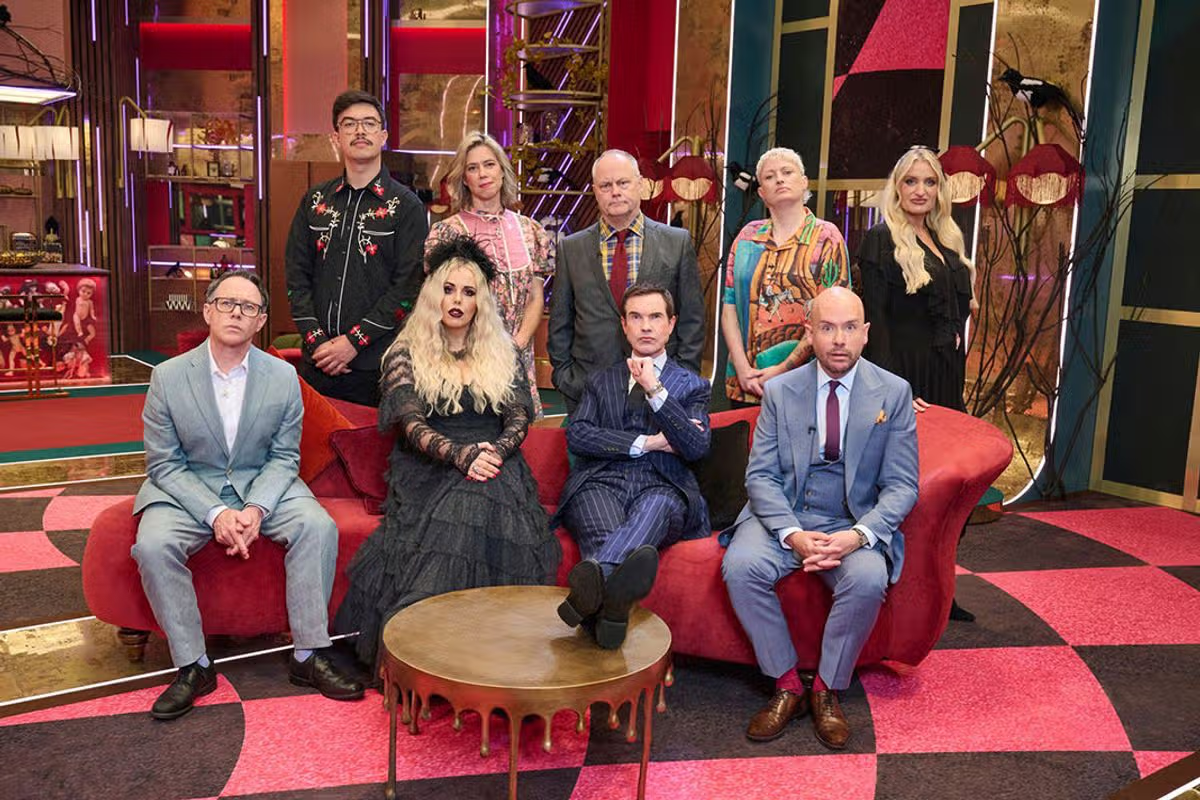
Murder 24/7 has returned to screens for its third run, once again plunging viewers into real-life murder investigations in the UK. Following West Mercia Police, viewers have so far witnessed chilling murders as detectives work against the clock in their pursuit of justice.
Last night (August 4), the first of a two-part special aired on BBC One at 9pm delving into the murder investigation of Jamie Gawler. Jamie was found dead by police in an armchair in a flat, with a towel draped over his face.
Officers were stunned to hear the horrific post-mortem results as their investigation led them miles away in South Wales and a potential suspect.
The second episode will air tonight (August 5) on BBC One at 9pm, with episodes also available to stream on BBC iPlayer. However, viewers have been left sickened by the latest instalments.
Taking to TikTok, one true crime fan admitted their “jaw was on the floor watching this show”. In the video, they added: “Wow. Absolutely brutal…. I couldn’t believe them episodes, they were brutal.”
One person commented: “Omg I’m addicted to this one bet my leccy bill sky high.” Another replied: “It was horrific”, as a third said: “It was a hard watch.”
A fourth wrote: “Just watched them both this afternoon absolutely shocking.” A fifth added: “I love watching this programme but those two were brutal.”
Another branded the latest instalment as “sickening” as one person said: “It was absolutely horrendous.” One viewer echoed: “It was about the worst of that series.”
The second part of the two-parter, titled Natural Born Killer, will return tonight at 9pm as detectives continue to build their case against suspect Matthew Jonathan.
A BBC synopsis reads: “A critical forensic breakthrough comes when analysts match an incomplete, bloody footprint from the scene to Jonathan’s rare boots via a national database. Soon after, investigators recover a series of phone videos that reveal the true extent of the assault.”
A separate case featured also sees a woman fighting for her life after a brutal assault with a meat cleaver as her partner is arrested on suspicion of attempted murder.
Spain is in the grip of a major heatwave in summer 2026, with temperatures forecast to reach up to 47C in some parts of the country as UK tourists on holiday in Spain are warned to take precautions against the ‘brutal’ heat
Spain is currently experiencing an intense heatwave(Image: xavierarnau via Getty Images)
Spain is currently in the grip of an intense, official heatwave. The country’s State Meteorological Agency (AEMET) has issued strict weather warnings as its third significant heatwave of the summer builds across the Iberian Peninsula. The extreme weather event officially commenced on Tuesday, 21 July 2026, and is predicted to reach its peak on Thursday, 23 July 2026. Some respite is anticipated from Friday (24 July) onwards, with milder weekend conditions expected.
Temperatures are forecast to locally hit or surpass 44C to 45C (and possibly reach 47C) across southern and southeastern mainland Spain. A comprehensive network of weather warnings has been issued nationwide. Red Alerts (extreme danger) remain in force for the worst-affected areas in Andalusia and Extremadura, while Orange Alerts blanket major regions including Madrid, Aragon, Catalonia, and Castile-La Mancha.
The heatwave is being fuelled by an enormous “heat dome” drawing dry, scorching air straight from the Sahara Desert. This has triggered a severe Calima (Saharan dust storm), producing murky skies, locking in elevated temperatures overnight (“tropical nights”), and substantially degrading local air quality.
Content cannot be displayed without consent
TikTok user Leanne, from Belfast, recently documented her experience in the sweltering conditions during her holiday to Majorca.
The DJ, who has amassed more than 19,000 followers, informed them in a video: “So, if you’re coming to Majorca on holiday in the next few days, you might be thinking, ‘What’s the weather like?’.
“We arrived on Monday and the last two days were really overcast, but very, very warm. It’s 8:35pm and it’s 34C.”
Leanne, who was perched on her hotel balcony at the time, explained she was beside the sea, yet even with the coastal breeze, it’s “still boiling”.
Nevertheless, she pointed out that all the hotels have excellent air conditioning, so you can always retreat indoors if you’re concerned about the outdoor temperatures being too intense.
She also revealed that she’s been “drinking loads of iced cocktails” to help stay refreshed.
Leanne continued: “So yeah, if you’re coming out in the next few days, be prepared – it is hot – but you can cool down, and enjoy your holiday.”
Other holidaymakers currently in Spain confessed they were finding the heat challenging in the comments section.
One person posted: “We are here now too and never felt anything like it! The strawberry daiquiris are medicinal at this point.”
While another shared: “I left on Sunday, it was so hot we were in Alcudia and there was no air. Was 34C but feels like 41C. Could only wear factor 50.”
A third remarked: “Got back from Cala Bona yesterday, the humidity has been brutal.”
With parched and scorching conditions taking hold, authorities have issued urgent warnings about an extreme risk of wildfires, with blazes already breaking out in areas including Zaragoza and Guadalajara.
Safety guidance for tourists and locals
Health officials are strongly urging people to take immediate steps to protect themselves:
Avoid direct sun exposure during peak afternoon hours (12pm to 5pm).
Drink plenty of water continuously to avoid heat exhaustion.
Shelter in air-conditioned public spaces or indoor cultural venues during peak heat hours.
Ben Earl has called for a change to the Nations Championship format after England’s “brutal” schedule in the summer leg of the inaugural competition.
England had to play three Tests in three different continents on successive weekends and accumulated 25,000 miles of travel.
Victory over Argentina on Saturday keeps Steve Borthwick’s team in the hunt for a place in the final on 29 November at Twickenham’s Allianz Stadium.
However, four long haul and four short haul flights in the past four weeks have contributed to players losing sleep and a reduced training schedule.
“It’s been brutal, there’s no two ways about it,” England number 8 Earl said.
“We’ve been speaking about it – why would we not all be playing in one country? So you just don’t travel, you go to one nation and have that festival feel.
“I’m not paid to make those decisions but it has been tough. It’s been tough coming at the end of what’s been quite a long season anyway for most of us.
“It’s been back and forth, coming back to England, seeing your families and then going away again.
“It has seemed a bit weird but it’s just something we’re going to have to get used to because I think it’s just the beginning.”
The competition resumes later in the year for the autumn leg with England next in action against Australia on 8 November.
The problem is, having our President butt in here was a joke. Unfunny and out of bounds, offsides, an own goal — all of the things.
It put the U.S. team at the center of a geopolitical maelstrom, which is exactly what they did not need in the hours before the biggest match of their lives and the biggest match in the history of the U.S. men’s soccer program.
Some 40 or 50 million viewers were expected to tune in; how many of them watched for the first time? And what sort of impression did Monday’s 4-1 blunder-filled meltdown against Belgium make? That we stink at soccer — still?
If you were one of them, please, believe your soccer-fan friends when they tell you the Americans played much better in previous matches.
But so much for a magical run. On their home turf, the Americans pulled up lame before the finish line (aka, for the U.S. team’s purposes, its first quarterfinals since 2002).
To their credit, after the debacle, members of the U.S. team didn’t complain about anything being rigged. They didn’t use the distraction as an excuse. And they didn’t point fingers at anyone — anyone at all.
U.S. striker Folarin Balogun (20) walks to the locker room at halftime against Belgium in the World Cup on Monday at Lumen Field in Seattle.
(Allen J. Schaben / Los Angeles Times)
“We’re playing on home soil,” defender Chris Richards said. “So the only pressure we put on ourselves is to perform for our country, and ultimately didn’t feel the way we wanted to today. But I don’t think the antics of the last 24 hours had anything to do with it.”
No, they said the “debate,” or “outside noise” or “political manipulation” — as Tim Ream, Alex Freeman and coach Mauricio Pochettino described what others are calling “Balogate” — were not to blame for the gut-punch that answered the question: Why not us?
Because the U.S. is not yet good enough to beat the world’s great teams. Especially not when their pregame preparation includes having to try to block out an international uproar.
To have any hope against the Belgians in the round of 16 — a matchup between FIFA’s Nos. 9- and 17-ranked sides — the Americans needed to be going full-tilt, to be focused and ferocious and probably also a little bit lucky.
Instead, they looked shook, rattled. And they got rolled.
They were the worst version of themselves at the worst time, which was so weird from a team that had been on its front foot from the first whistle against Paraguay.
Not Monday. Against Belgium, they were on their heels from the outset. Heavy touches, slow afoot, playing like they had the weight of the World Cup on their shoulders.
And all that White House maddening meddling — for what?
Balogun started and played most of the match, but it could just as well have been reserve striker Ricardo Pepi. Or you or me, Balogun was that ineffective.
His play of the day came postmatch, when he approached Belgian coach Rudi Garcia and the two had a respectful exchange. A real diplomat, that Brooklyn-born, Britain-raised American by birthright.
This loss was a real team effort, of course. Christian Pulisic came off in the 59th minute after twisting his right ankle — leaving this World Cup without a goal in the four matches he appeared.
Matt Freese, the Harvard-educated starting goalkeeper, had a brain cramp of epic proportions when he stepped outside of the box and failed to corral a ball. Belgium’s Charles De Ketelaere kicked it loose and set up Hans Vanaken, whose shot traveled behind Ream for an easy score that made it 3-1 in the 57th minute.
There was a lot of poor decision-making with this match, on and off the pitch.
In the end, Trump’s appeal to Infantino did more harm than good. But what if some good could come from it?
Hey, FIFA, what about giving teams a process to appeal cards, like our American athletes in the NBA, NFL and MLB have?
Offering a suggestion box wouldn’t be opening Pandora’s box, not if it were a transparent and regular part of the game that would, hopefully, offer increasingly fair outcomes in a tournament where every match is so monumental — as our President recognized, much too enthusiastically.
U.S. coach Mauricio Pochettino waves to the crown after a 4-1 loss to Belgium at the World Cup on Monday.
A woman died in a brutal plane crash that killed over 100 people after “missing her original plane”. After a sudden flight change, everything altered in an instant
09:29, 07 Jul 2026Updated 09:29, 07 Jul 2026
The woman plunged to her death in a plane crash (stock image)(Image: Getty)
A woman missed her flight and, due to a drastic turn of events, ended up dying with dozens of people in a brutal plane crash. It’s reported the simple act of being late dramatically changed the course of her life, and she ended up plummeting to her death.
The woman’s story was recently highlighted on Reddit when a family member shared the travel tragedy in a heartfelt post, and people can’t believe what happened. A simple change in her schedule led to altering her path completely, and the devastating story has left so many people in total sadness and shock.
The story emerged after someone asked: “We’ve heard stories of people escaping death by being late. What are some tragic examples of people dying because they were late?”
To this, one person replied: “My aunt missed her flight out of Denver on July, 19 1989. She took United flight 232 instead, dying in a fiery crash in Sioux City, IA.”
To this, one person replied: “I am so sorry for your loss. That is a brutal way for things to happen.”
Another added: “I actually had a ticket on that flight when I was a kid, but I had gotten pretty sick the day before we had to leave, and my parents decided to cancel the tickets to Chicago. What is crazy is that we did an analysis of the emergency response to this crash when I was in college.
“It is a small world. I am sorry for the loss of your aunt.”
A third also replied: “My dad was on that flight. He fortunately survived and flew home to Chicago later that night and was at work first thing the next day.”
One more also noted: “I was supposed to be on that plane! Travel plans changed but, had they not, I would have been flying home on this flight.”
For those unaware, the United Airlines Flight 232 was a regularly scheduled flight from Stapleton International Airport in Denver to O’Hare International Airport in Chicago, going on to Philadelphia International Airport in Philadelphia, United States.
However, on July 19, 1989, the McDonnell Douglas DC-10 serving the flight crash-landed at Sioux Gateway Airport in Sioux City, Iowa. This was due to suffering what has been described as a catastrophic failure of its tail-mounted engine.
It’s reported this led to the loss of all flight controls. Over 100 people died in the crash but the majority are reported to have survived.
The incident was said to be deemed “unprecedented” at the time and, though many people sadly lost their lives, the team onboard worked with professional calmness and extreme skill to pull off something some would have believed “impossible” to land the aircraft.
In fact, it has since been termed “The Impossible Landing“, as it’s often considered one of the most impressive landings carried out in the history of aviation.
Nick Pasqual, an actor who appeared in “How I Met Your Mother,” has been sentenced to 32 years to life for the attempted murder of his estranged girlfriend, L.A.-based makeup artist Allie Shehorn.
Following a jury trial, Pasqual was also convicted of counts of injuring a spouse or partner, first-degree burglary and rape, according to court documents. During the trial, Shehorn had visible scars on her hands and neck when she testified, per ABC.
The incident occurred in May 2024, when Pasqual repeatedly stabbed Shehorn in her Shadow Hills home. Prosecutors said that the actor broke into Shehorn’s home just before 4:30 a.m. on May 23, attacked her with a knife and fled California.
Days before the attack, Shehorn had filed a restraining order against Pasqual, detailing acts of sexual and physical assault. While the judge approved the order, it was unclear whether Pasqual had been served prior to the stabbing.
Christine White, Shehorn’s friend and roommate, discovered the makeup artist lying in a pool of blood and called emergency services. Friends believe Shehorn was stabbed more than 20 times. Following the attack, Shehorn underwent emergency surgery and spent days in intensive care.
Pasqual was ultimately stopped by authorities at a border checkpoint in Sierra Blanca, Texas, and extradited to Los Angeles.
The former couple met on the set of Zack Snyder’s film “Rebel Moon,” where Pasqual worked as a background actor and Shehorn worked as a makeup artist.
Last week, Shehorn sued the actor for sexual battery, assault and negligence, among other counts, according to a lawsuit submitted in Los Angeles County Superior Court.
The 17-page complaint echoes details about the May 2024 stabbing that led to Pasqual’s arrest two years ago and his attempted murder conviction.
Staff writer Alexandra Del Rosario and former staff writer Nathan Solis contributed to this report.
Rachel Nickell’s horrific death sent shockwaves across the UK, but it took the police more than 15 years to solve her murder. As the case is explored in a new Netflix documentary, we speak to the expert who found a breakthrough clue after years of investigation failures
The Murder of Rachel Nickell teased in Netflix trailer
Rachel Nickell had her whole life ahead of her when it was cruelly stolen in a sickening attack – leaving her toddler son as the sole witness.
In July 1992, the 23-year-old mum was strolling through Wimbledon Common with her two-year-old son Alex Hanscombe, and their dog Molly. In a quiet, wooded area, she was ambushed, sexually assaulted and stabbed dozens of times.
Alex was later found by a passerby, desperately clinging to his mother’s body. In a heartbreaking attempt to help, the toddler had placed a piece of paper on her forehead as a makeshift bandage after pleading with her to wake up. Even at that tender age, Alex later revealed, he knew instantly that his mother was never coming back.
The brutal murder shattered the life of Alex and his father André Hanscombe. Yet, it would be 16 years for anyone to face justice. The haunting case is now the subject of a new three-part series for Netflix dramatisation, The Witness, alongside an accompanying documentary featuring never before seen archive footage, and deeply personal accounts from those who lived through the tragedy.
Among those interviewed is legendary forensic scientist Angela Gallop, whose work has helped solve many of the UK’s most high-profile murders, including the killings of Stephen Lawrence and Damilola Taylor.
Her team was handed the case in 2002, a decade after the murder, when the investigation had gone completely cold. They had agonisingly little to work with: a microscopic trace of male DNA recovered from the crime scene. To make matters even more difficult, forensic technology at the time was ill-equipped to handle such a minute sample. In order to find the killer, they had to pioneer an entirely new methodology to examine the sample.
Reinvestigating the decade-old DNA required immense precision. Describing the pressure and the patience required to manipulate the tiny shred of evidence, Angela said: “The technique that had been used at the time was a very new, sensitive method, but we had never particularly liked it in my laboratory.
“For Rachel’s case, we got hints of male DNA using our standard test, but we wanted to see if we could squeeze out some more information. By concentrating and purifying the DNA, we managed to achieve it, but it took two years to develop the technique properly.”
After a painstaking process, the team eventually got a strong enough DNA profile to add to their database – and it matched with a man named Robert Napper, a paranoid schizophrenic and serial rapist.
To ensure the case was ironclad, they raced back to the crime scene and analysed all the sample items that had been collected. Angela and her colleagues then went on to uncover footwear marks and forensic paint evidence linking Napper directly to Wimbledon Common.
His footwear was matched directly to the mud profiles taken from the area, and microscopic paint flakes matching Napper’s toolbox were discovered trapped in the hair of two-year-old Alex. The box, found in Napper’s flat, contained knives and other weapons.
The new DNA breakthrough was enough to convict Napper and exonerate Colin Stagg, the innocent man wrongfully targeted by a flawed police honey-trap operation. A new Netflix documentary will examine the botched investigation, which led to Stagg – a local resident who walked his dog on the common – spending 13 months behind bars in custody, and facing rampant speculation that he killed Rachel.
He was freed by an Old Bailey judge in 1994, who criticised officers for using a ‘honeytrap’ undercover policewoman to try to make him confess to the murder, branding the entrapment evidence as “reprehensible”
Mr Justice Ognall, who halted the trial, described officers actions as “deceptive conduct of the grossest kind” after undercover officer “Lizzie James” tried to seduce Stagg, promising a relationship in the hope of getting a confession. Stagg later received £700,000 compensation from the Home Office.
In 2008, Napper admitted manslaughter on the grounds of diminished responsibility and was detained indefinitely at Broadmoor. He was already incarcerated at the psychiatric unit, having been convicted in 1995 for the equally depraved double killing of single mother Samantha Bisset, 27, and her four-year-old daughter Jazmine.
Discovering the match provided a profound sense of justice for Angela’s team, particularly regarding the human toll of the investigation. “We had a DNA result that hit a match on the National DNA database, so the police have got something to investigate,” she said.
“There was an added level of satisfaction because Colin Stagg had been professing his innocence for all those years. We were able to show that he was telling the truth,” she said.
The new documentary about the 1992 murder features Alex describing the moment that he knew his mother had died after being stabbed 49 times.
A home video video captures him describing the moment his mother was killed on Wimbledon Common to his dad André, who gently discusses what his son saw on the day.
Now 36, Alex describes seeing Napper, telling his dad: “I saw him first,” he says, telling Andre that the man was carrying a bag which he opened. Asked what he took out, he replies simply: “A knife.”
He then tells his dad that the man “knocked me over” and that he witnessed his mum being stabbed. “There’s his knife,” the little boy tells his dad, indicating the picture he is drawing of his mother. “I saw the knife. I saw it, Yeah, I saw it all.”
Speaking in the trailer for the film, André explains: “My son saw his mother’s murder but nobody could have possibly known how long it was gonna take to find the person who did this.”
Ahead of the Netflix show, Angela is keen to emphasise that DNA evidence is rarely a simple “magic bullet.” Television would make people think that experts can simply swab a crime scene and receive a clear-cut result just 30 minutes later, Angela said, adding: “If it was going to be really straightforward, the original scientists would have discovered the truth a long time ago.
“You have to be much more clever. Sometimes you have to look for one type of evidence to find another. In the Stephen Lawrence and the Pembrokeshire Coastal Path murders, it was analysing textile fibres that led us to finding blood traces and therefore DNA.”
As well as the archive footage, the documentary will explore how Angela’s work led to justice for Stagg after her breakthrough solved the case.
The three part drama, The Witness, will follow Alex and André as they deal with the devastating impact of losing Rachel. Jordan Bolger plays André, while Max Fincham is the teenage Alex. Both men acted as consultants on the series.
The story aims to show how a father and son “moved through the aftermath of unimaginable tragedy, from darkness into light.”
The other cast include Kevin Eldon as DCI Mick Wickerson, Neil Maskell as DI Keith Pedder, Mark Stanley as DS Ivan Agnew, Jon Pointing as DC Nick Sparshatt, James Dryden as DC Paul Miller, Kerry Godliman as André’s mother June, James Bradshaw as DCI Tony Nash and Claire Rushbrook as Dr. Jean Harris-Hendriks.
In a joint statement released last month, André and Alex Hanscombe said: “Our life has been a battle. We can never express how indebted we are to everyone that’s been a part of this, for the kindness and generosity they’ve extended to us, for the chance they took with us in bringing our story to the screen, and for the care they have taken.
“Our journey has all been by the grace of God and a promise to go on together, and we feel incredibly blessed to be able to share our story in this way.
“We hope that audiences will be left with a testament to the tough battle of life we all face and to the power of faith, hope, love – and never giving up.”
Documentary The Murder of Rachel Nickell has been made to accompany the new drama about what happened that day, called The Witness. Both will be released on Netflix on June 4.
Reform has stood by Robert Kenyon, a plumber and the candidate for the party in the upcoming Makerfield by-election, after comments he made about TV star Carol Vorderman resurfaced
Carol hit back at resurfaced social media comments by a Reform candidate(Image: Dave J Hogan/Getty Images)
Reform UK candidate Robert Kenyon, who is standing to be the next MP for Makerfield in the upcoming by-election, backed up a degrading comment about the TV star along with other comments directed at women. Hitting back, Carol branded Nigel Farage’s candidate a “disgusting online abuser”.
The campaign group HopeNotHate found Kenyon had two X accounts. One has been deleted and the other was suspended by X, HopeNotHate said.
Reform has stood by Kenyon, a plumber, and has said his lack of “polish” could make him an effective MP.
“Fundamentally, Rob Kenyon is a misogynist,” Carol told The Mirror. “I wouldn’t let him in my house if he was a local plumber in my area, not with what he’s been posting online. There is always a pattern.”
In 2021, an X user who wrote a degrading sexual message about Carol, which drew criticism from another person. To this, Kenyon responded by saying “he’s only saying what we’re all thinking”.
And another of the posts from the accounts referenced being blocked by the Sky Sports Rugby League account on X for comments about women’s rugby.
Carol added: “He’s been talking about how female rugby players ‘handle their knockers’, saying if it’s not ‘t**s, and a**e’, and he’d been blocked by the Sky Sports Rugby League Twitter page for his online behaviour.
“It’s a torrent of abusive and vile language. Nobody knows why his X account was suspended. X has a very low bar for suspension, and the public should know and Reform should tell us why his account was suspended. What were his actions for this to have happened?
“Last year the Victim’s Commissioner said ‘misogyny normalises violence against women and girls, normalises illegal harms such as harassment, abuse and stalking. And these harms manifest in both online and offline spaces’.”
Carol emphasised the comments are not just Kenyon “being a lad”, adding he is “being a disgusting online abuser who became a Reform councillor three weeks ago”.
In response to HopeNotHate’s investigation, a Reform UK spokesman said: “We fully back Cllr Kenyon. He is an excellent, local candidate who we are confident will be a superb MP for Makerfield.
“These comments were made before he was in politics. Rob isn’t a polished, professional politician and doesn’t speak like one. That’s precisely why he’ll be a straight-talking, effective voice for normal working people in Makerfield.”
After being read Reform’s response, Carol said: “So basically, it doesn’t matter how misogynistic or otherwise he has been as far as Reform are concerned. And they didn’t care that their MP James McMurdock had been put in jail for kicking his girlfriend outside a nightclub and that it hadn’t been declared. They simply don’t care at all.”
A Labour Party spokesman said: “Robert Kenyon’s comments online are disgusting and show that he’s not fit to represent Makerfield.
“From creepy remarks about women, to peddling baseless conspiracy theories, this is appalling stuff from a parliamentary candidate – on top of being Facebook friends with a fascist campaigner. Nigel Farage needs to explain why Reform UK selected him in the first place.”
The first weekend of campaigning in Makerfield, meanwhile, got underway.
Andy Burnham, who is viewed as a challenger to Sir Keir Starmer in a potential Labour leadership race, launched his by-election campaign on Friday and promised he was not offering “more of the same”.
Allies of Mr Burnham have suggested he may not launch a bid for the party leadership immediately if he is successful in his attempt to return to Parliament in the June 18 contest.
But Wes Streeting, who resigned from the Cabinet earlier this month, has openly talked about launching a campaign to oust Prime Minister Sir Keir.
The MP and former health secretary told reporters on Friday that he held off triggering a leadership race to give Mr Burnham time to tread a path back into the Commons.
In a pitch to voters, Greater Manchester Mayor Mr Burnham said: “I know my own party needs to change. We need to be better than we have been.
“A vote for me in this by-election is a vote to change Labour.”
Mr Burnham, who is also a former health secretary, later told reporters Labour has “space to be more radical” while honouring the party’s 2024 general election manifesto.
Casualty returned to screens on Saturday night, after being pulled from BBC schedules last week
Casualty fans were left in tears(Image: BBC)
Long-running medical drama Casualty returned to screens on Saturday, with fans left in tears.
The hit BBC series focuses on staff at the Accident and Emergency department of the fictional Holby City Hospital, as they deal with serious and often emotional cases.
Now, the beloved drama has returned, much to the delight of fans. However, a heartbreaking twist was in store for two beloved characters.
During the latest episode (May 23), Stevie Nash (Elinor Lawless) discovered that Matty Linlaker (Aron Julius) had covered for her previous mistake.
Stevie notably administered too much morphine to a young girl who was saved from an explosion by Teddy Gowan (Milo Clarke).
As her confidence was given a further blow by a troubling letter, Stevie feared that revealing the truth could bring other secrets to light.
Meanwhile in the NICU ward, Faith Dean (Kirsty Mitchell) was hopeful that her baby, Pearl, could be discharged soon, but Rash Masum (Neet Mohan) warned that she still needed to learn how to feed properly.
Later, as Rash performed a lumbar puncture on another baby, Faith alerted him to the fact that Pearl was choking. After a few moments, Pearl stopped breathing, with Rash and the fellow doctors quickly springing into action.
Faith’s husband, Iain (Michael Stevenson), eventually made it to the NICU to find his devastated wife in tears. Rash then confirmed that Pearl had suffered a cardiac arrest, but was stable.
Viewers were quickly left feeling emotional, with one X (formerly Twitter) user writing: “Poor Pearl omg.”
Another wrote: “Pearl!” alongside several crying emojis. A third said: “Iain [sad emoji]. Faith [sad emoji]. Thank Goodness Pearl’s okay!”
Someone else commented: “The sigh of relief when they said Pearl was okay,” with a fifth viewer saying: “Looking forward to Kirsty shattering my heart into pieces.”
Meanwhile, another viewer shared their concerns about another new mum called Mia Stern (Macadie Amoroso).
“Got a horrible feeling we’re going to have a Baby Snatching Storyline,” they wrote, with another adding: “Yeah that Mia was a bit sketchy.”
Someone else added: “Why do I have a HORRIBLE feeling Faith is walking out of that hospital with no intention of coming back soon after what just happened to Pearl. I hope I’m VERY wrong.”
Does newcomer Mia have an ulterior motive, and has Faith walked out on her family? We’ll have to wait and see.
The award winning series will air another intense episode tonight that is not to be missed
999: Critical Condition is an award winning Channel 5 series(Image: Channel 5)
A fly on the wall medical series that is not for the faint of heart returns with another brutal episode.
Titled 999: Critical Condition, the medical series has returned for its sixth run, this time filmed in the Birmingham Queen Elizabeth Hospital.
Airing on Channel 5, the show follows patients and staff at a major trauma hospital as cameras are given unprecedent access to film what most people do not see.
Viewers witness an intense and unfiltered look at what doctors and nurses do to save lives. Having returned to screens last week, tonight (May 19), Channel 5 will air yet another brutal instalment at 9pm.
Tonight’s episode (Tuesday, May 19) will take viewers into another high stakes environment as one farmer is airlifted to hospital after crashing head first into a tree. Elsewhere, one woman is rushed to hospital with life threatening stab wounds as medical teams fight to save lives.
A Channel 5 synopsis reads: “A farmer faces potentially life-changing injuries after an accident shatters his skull.”
999: Critical Condition was previously filmed in Stoke for the first five instalments as it has become a firm favourite for those who enjoy medical TV programmes, especially 24 Hours in Police Custody.
The Channel 5 show does not shy away from the realities faced by staff in the hospital and the life saving work they do for patients.
Spanning across one hour, new episodes will be released weekly, with instalments then being made available to stream online.
Previously, one viewer praised: “Watching 999: Critical Condition. Very fascinating.” Another said: “#999CriticalCondition about to start on C5, this is a brilliant TV show.”
A third added: “Watching last night’s #999CriticalCondition, not for the squeemish (sic) but the operation to rebuild the guys head & face after his quad bike crash is fascinating, proper ‘face off’ shit to reveal his damaged skull. The 3d printed skull showing the extent of his fractures was amazing.”
A fourth echoed: “Watching #999CriticalCondition and this guy has landed on his face and his eyeball is hanging out of the socket. HIS ENTIRE EYEBALL. I’ve never been squeamish with programs like this, but I actually felt sick.”
In a previous article, the Guardian confirmed it was a “hardcore” documentary series in which every case “will stick with you”.
999: Critical Condition airs tonight at 9pm on Channel 5.