British

British expat in Tenerife says there’s 1 key thing to do before moving there

Tenerife is a top holiday destination for countless Brits and one man, who made a permanent move there, has shared a key step for any Brits considering moving to the Spanish island for good

Any Brits weighing up a move to sunny Tenerife have been advised to do key one thing before committing to a permanent decision. The Spanish island is a hugely popular holiday spot for many UK residents.

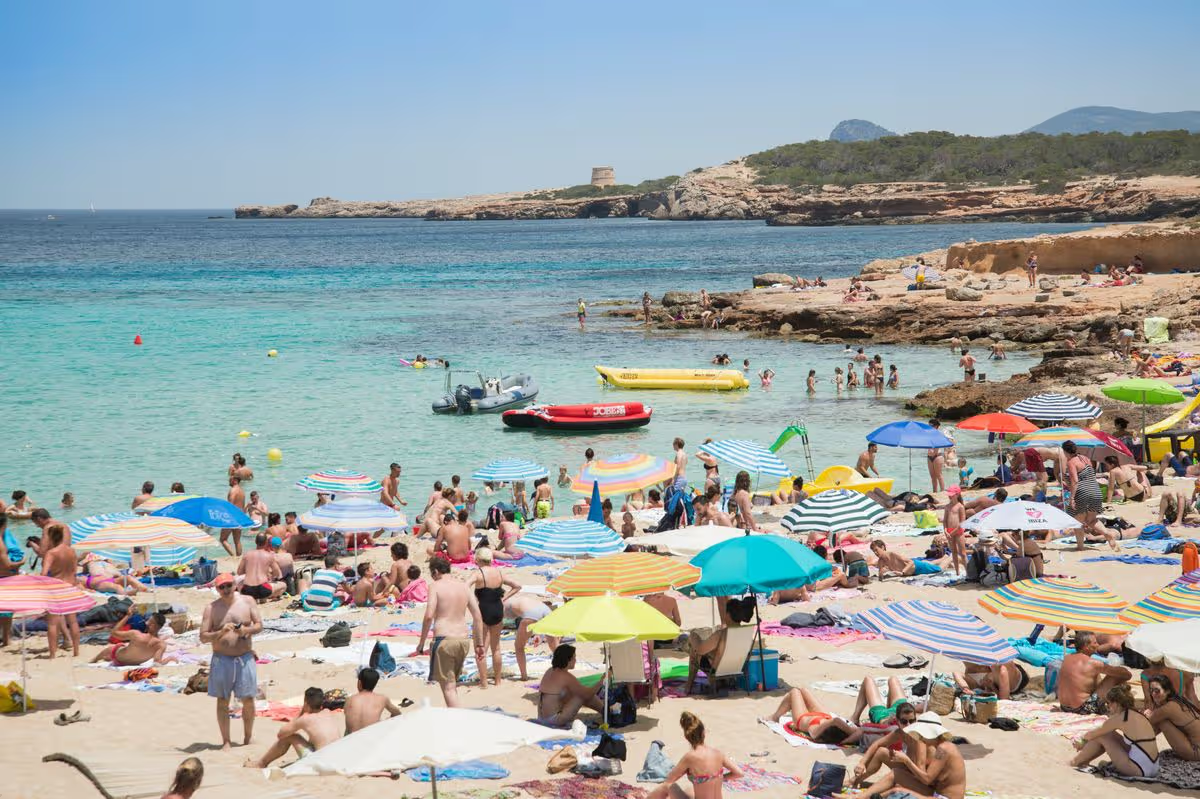
As the largest of the beloved Canary Islands, Tenerife is celebrated for its sweeping beaches, extensive resorts, eclectic bars and restaurants, and much more – all of which provide locals and holidaymakers alike with no shortage of things to do.

Additionally, nature enthusiasts can make the most of the island’s breathtaking scenery, which includes volcanic peaks, vast and diverse national parks, dramatic coastal cliffs and even lush forests. Tenerife’s appeal is enhanced by its status as the “Island of Eternal Spring”, earned thanks to its year-round warm and stable temperatures, typically ranging between 20-28 degrees.

The island’s charm has plenty of Brits eager to move there permanently. A man, who posts content online under the username Mattie Baarnett, is currently living in Tenerife and took to TikTok to offer his guidance for those considering a permanent move to the Spanish island.

Speaking directly to the camera, he began: “These would be my tips if you’re wanting to move to Tenerife – before we get the video started, hang on a second.”

He then turned around to capture the sun setting behind him, bathing the evening sky in a warm glow. Mattie went on: “That tip alone is ‘just do it’ because you’ll get sunsets like that.

Content cannot be displayed without consent

“I would always recommend, if you’re wanting to come to Tenerife and you don’t really know if you want to actually live in Tenerife, go on Airbnb, rent an apartment for a month, see if you like it.

“Try and get a job, get all your legal paperwork in order and then, after you’ve done that, then source a long-term rental on one of the Facebook pages for an estate agent and then just go from there.”

Mattie reiterated his advice and continued: “Come for a month, rent an Airbnb, that’s gonna cost you £1,500 to two grand for the month – Airbnb, tourist prices – get here, get a job, see if you like it, get a job contract, make yourself legal then go for the long term, and then that’s it.”

He added: “You can do it in a month. Piece of p**s, mate.”

What Brits need to do if they want to move to Spain

Brits can move to Spain, but post- Brexit regulations have made the process significantly more complex. A visa isn’t required for short visits to the EU or countries in the Schengen area, which is a vast, border-free zone in Europe allowing more than 450 million people to move freely between 29 countries, including Spain, without internal border checks.

If you’re planning to spend 90 days or less in Spain over a 180-day period, a visa isn’t required. You also won’t need one if “you’re visiting as a tourist or for certain other reasons”, or you’re “studying a short course, getting medical treatment, travelling for business for your UK employer, for example to attend a business meeting or conference”, or if you’re visiting for “journalism or other media activities”, according to UK government advice.

Government guidance states: “The type of visa you need depends on the length of time you’re carrying out the work. You need to apply for a:

  • C-type EET visa if you’re working up to 90 days
  • long-term D visa if you’re working for more than 90 days

“If you’re staying for longer than six months, you will need to apply for a residence card once in Spain.”

Countries in the Schengen are include Austria, Belgium, Bulgaria, Croatia, Czechia, Denmark, Estonia, Finland, France, Germany, Greece, Hungary, Iceland, Italy, Latvia, Liechtenstein, Lithuania, Luxembourg, Malta, Netherlands, Norway, Poland, Portugal, Romania, Slovakia, Slovenia, Spain, Sweden, and Switzerland.

Source link

British Airways cancels hundreds of flights ‘until later this year’ with major cities impacted

The scale of the disruption to aviation caused by the US and Israeli attack on Iran has been enormous. Of the 38,193 flights that were scheduled to fly out or into the Middle East since February 28, 21,915 have been cancelled

British Airways has cancelled hundreds of flights to countries across the Middle East as the war in Iran rages.

This afternoon, the UK’s flag carrier announced it would reduce its flight schedule across the region and cancel flights to certain cities. BA bosses have decided to ground all flights to Abu Dhabi in the United Arab Emirates until “later this year”.

Although the airline hasn’t said how many services have been cancelled, given its daily services to Abu Dhabi prior to the war, the total number of flights grounded comfortably stretches into the hundreds.

“Due to the continuing uncertainty of the situation in the Middle East and airspace instability, we’ve had to temporarily reduce our flying schedule in the region. We’ve cancelled all flights to and from Amman, Bahrain, Doha, Dubai and Tel Aviv until later this month and to and from Abu Dhabi until later this year. We’re keeping the situation under constant review and are in touch with our customers to offer them a range of options,” the statement from BA reads.

READ MORE: US military has ‘lost’ six nuclear bombs and there are fears they could fall into enemy handsREAD MORE: Iran war travel expert Simon Calder issues Emirates ‘flights will be resuming’ update

“We have limited seats remaining on our repatriation flights from Oman (Muscat) to London Heathrow on 11 and 12 March for customers with an existing booking. Following these dates, the flights will pause due to reduced demand but will be kept under continuous review.”

The scale of the disruption to aviation caused by the US and Israeli attack on Iran has been enormous. Of the 38,193 flights that were scheduled to fly out or into the Middle East since February 28, 21,915 have been cancelled. The latest figures show that most routes are getting back to close to normal. Of the 4,783 flights scheduled for today, 1,107 were or are expected to be cancelled.

If you are due to fly from or to the Middle East in the coming days, make sure you check your airline’s website for instructions and the Foreign Office website for the latest advice.

What have the airlines said?

  • Aegean Airlines – Greece’s largest carrier cancelled flights to Tel Aviv until March 20; Beirut, Erbil and Baghdad until March 25; Dubai and Abu Dhabi until March 19; and Riyadh until March 14.
  • Air France–KLM – Air France cancelled flights to Tel Aviv and Beirut through March 13, and to Dubai and Riyadh until March 12. KLM suspended flights to Dubai, Riyadh and Dammam until March 10, and to Tel Aviv for the rest of the winter season.
  • Cathay Pacific – Cancelled all flights to and from Dubai and Riyadh until March 31.
  • Delta – Cancelled flights from New York to Tel Aviv until March 22 and from Tel Aviv to New York until March 23.
  • Emirates – Operating a reduced flight schedule but expects to return to full operations within days, depending on airspace availability and operational requirements.
  • Etihad Airways – Resumed a limited commercial flight schedule between Abu Dhabi and several key destinations.
  • Iberia Express cancelled all flights to and from Tel Aviv through March 10.
  • Lufthansa Group – Lufthansa, Austrian Airlines, Swiss and Brussels Airlines suspended Tel Aviv flights through April 2 and Beirut flights through March 28. Flights to Tehran are suspended until April 30, and to Amman, Erbil, Dammam, Dubai and Abu Dhabi until March 15.
  • Norwegian Air – Now plans to start flights to Tel Aviv and Beirut on June 15, instead of the previously scheduled April 1 and April 4.
  • Qatar Airways – Operating a limited schedule to and from Doha, with some flights resuming from March 9 following temporary authorisation from Qatar’s civil aviation authority.
  • Saudia Airlines – Suspended flights to Amman, Kuwait, Abu Dhabi, Doha and Bahrain until March 10, and to Moscow and Peshawar until March 15. Limited operations to Dubai have resumed.
  • Wizz Air – Suspended flights to Israel until March 29, and flights from mainland Europe to Dubai, Abu Dhabi, Amman and Jeddah until mid-September.

Source link

Stunning British island with ‘dreamy’ coastlines, rare wildlife and dark skies

This stunning island has been dubbed the UK’s own Tasmania

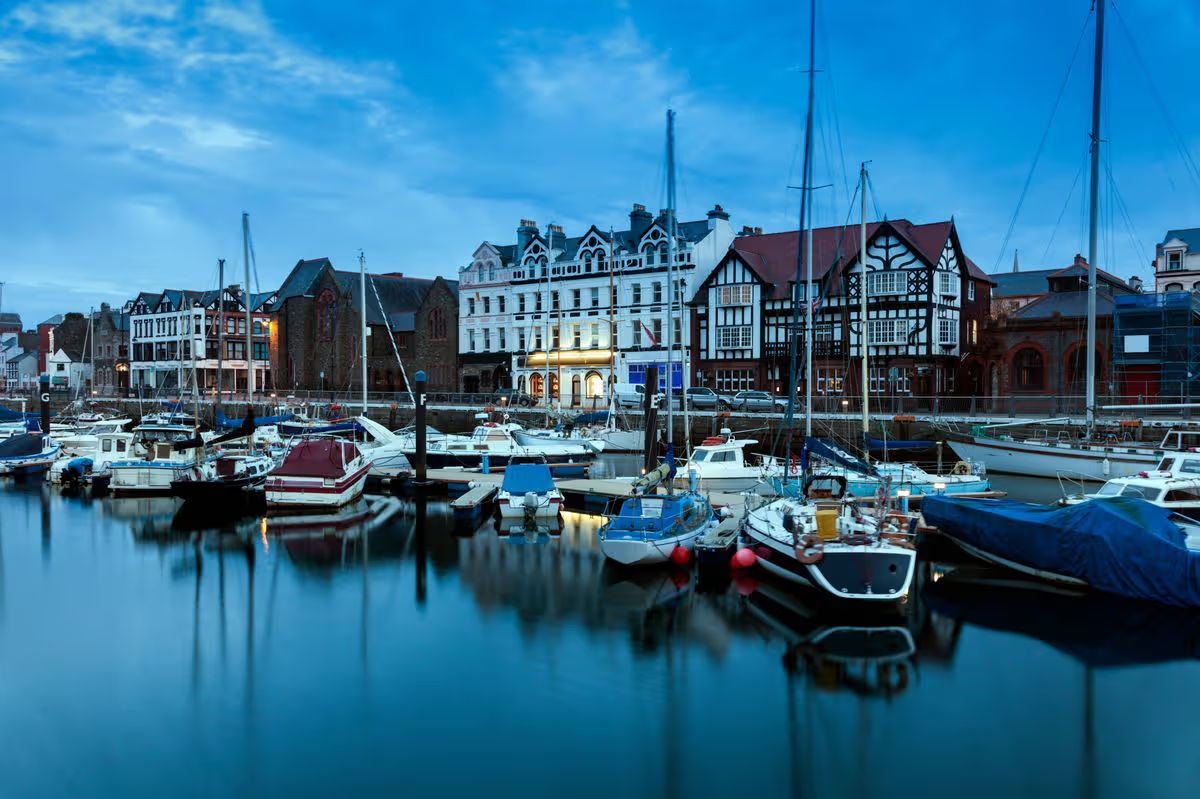
Located just 40 minutes from the UK is the Isle of Man, the first complete nation to receive UNESCO Biosphere status. Described as Britain’s answer to Tasmania, the island boasts rare wildlife, dramatic coastlines and unspoilt beaches, making it ideal for a peaceful retreat.

With only 85,000 residents and a thoughtful mix of community and countryside, the island offers plenty of space, even at peak times of year. Situated in the waters between the UK and Ireland, the Isle of Man is accessible by either aircraft or ferry, meaning even those fearful of flying can experience this stunning destination.

Walkers can follow the entire coastline along the Raad ny Foillan coastal path, marking its 40th anniversary this year, passing through cliffs, coves and fishing hamlets with ocean vistas at every point.

Meanwhile, the wild coastlines of Niarbyl Bay and the Calf of Man bear more resemblance to the Australian island of Tasmania than somewhere in the Irish Sea.

Writing on TripAdvisor, one recent guest to Niarbyl Bay said: “Niarbly Beach offers an idyllic setting for walking and exploring, perfect for both relaxation and adventure.

“The beach’s unique rock formations provide an intriguing landscape to discover, with plenty of tide pools and hidden nooks.”

Meanwhile another commented: “A real dreamy gem on the island with picturesque scenery of the coast and Irish Sea, there is also a walk along the coast that heads south and a little stone pebble beach, complete with a sea cave and a lovely old thatched cottage on the shoreline.”

The island’s wildlife represents another major draw for any visit, featuring the tailless Manx cat and the uncommon four-horned Loaghtan sheep, as well as seals, seabirds, and the occasional basking shark.

The Isle of Man is also a haven for stargazers, boasting 26 official Dark Sky Discovery sites and remarkably low light pollution. On occasion, the Northern Lights can even be spotted from the island.

Source link

Spain, Greece and Portugal travel warning as rule changes for British tourists

Holidaymakers could face major delays this summer

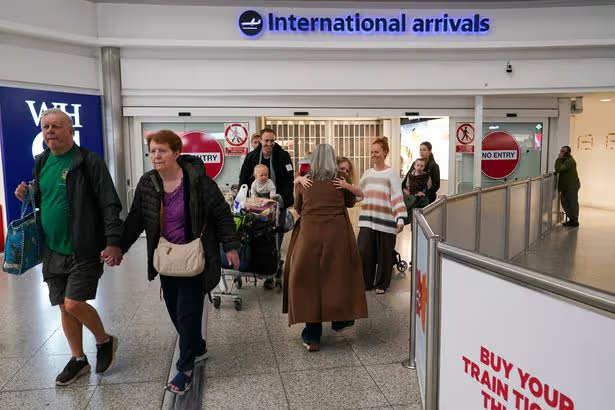
A new border control system is being rolled out at all European airports, including those in Spain, Portugal and Greece, from April 10. The new Entry Exit System (EES) requires British travellers to provide fingerprints and photographs when entering the Schengen Area.

British holidaymakers have been cautioned about potential queues due to the new biometric system, which was first introduced in October at some EU airports. All 29 Schengen countries are now expected to have it fully operational by April.

Some airport organisations have called for an “immediate review” of the Entry Exit System (EES) rollout as it “continues to cause significant delays,” and cautioned that queues for non-EU passengers could stretch to four hours during the summer months.

The Foreign, Commonwealth & Development Office (FCDO) stated: “EES checks are being introduced in a phased way across external borders, with full operation expected from April 10, 2026.”

The Foreign Office suggested that EES might take each passenger a “few minutes extra” to complete and advised they “be prepared to wait longer than usual” at border control, reports the Express.

The new checks at European airports follow the recent announcement that dual British nationals could be refused entry at the UK border unless they possess a British passport. The new regulation could impact holidaymakers returning to the UK from their European trips.

Full list of countries with the new Entry Exit System

  1. Austria
  2. Belgium
  3. Bulgaria
  4. Croatia
  5. Czech Republic
  6. Denmark
  7. Estonia
  8. Finland
  9. France
  10. Germany
  11. Greece
  12. Hungary
  13. Iceland
  14. Italy
  15. Latvia
  16. Liechtenstein
  17. Lithuania
  18. Luxembourg
  19. Malta
  20. Netherlands
  21. Norway
  22. Poland
  23. Portugal
  24. Romania
  25. Slovakia
  26. Slovenia
  27. Spain
  28. Sweden
  29. Switzerland

Source link