The Great British Bake Off left fans in a state of panic as the show suffered technical issues which disrupted the viewing of fans across the UK who vented their fury on social media
Sam Thompson on Great British Bake Off but the episode was interrupted by technical issues(Image: Channel 4)
Viewers of The Great British Bake Off were left unimpressed during Sunday night’s episode for Stand Up To Cancer, as the show was interrupted by technical issues.
As fans of the Channel 4 show sat down to settle in to watching the baking show, they were met with flickering screens. The stars on this year’s show include Sam Thompson, Vicky Pattison and Molly Mae Hague.
And to make matters worse, the show was interrupted multiple time, leaving viewers taking to X to vent their frustration. One person said: “What’s going on? @Channel4 how can we watch #Bakeoff with it breaking up all the time.”
Another person asked: “Anyone else have signal issues while watching Bake Off this evening? We’ve had several shaky screeners tonight. #bakeoff.” Meanwhile, a third person questioned: “Anyone else getting a stuttering broadcast and the occasional pixel madness of an 80s top of the pops episode??”
In response to the tweets coming through, a fourth person agreed with the general sentiment: “Me on Sky. I’ve recorded it and only just started watching it.” They added: “I’ve stopped and started it again, thinking it might have been weather-related, so I’m glad it’s not just me ! #GBBO”.
And this sparked a flurry of people coming forward complaining of the same issue. The technical glitch appears to have affected viewers to the point where they had “given up” watching the show.
Other celebrities who took part in that episode also included Alex Brooker, Ambika Mod and Rose Ayling-Ellis, who were all competing against one another to be awarded the Star Baker apron.
They were given three challenges. One of which was to make mini rolls, another was to bake a syrup sponge pudding and a choux pastry.
And it was EastEnders star Rose who impressed the judges the most, and she was crowned winner of their round. Last week, Molly-Mae won her episode.
Judge Paul Hollywood was most impressed with Molly-Mae. One hearing that she had won her segment, she screamed with joy and said: “That has made my life, you don’t understand! Thank you so much!”
And after leaving the show, the mum of one, who is pregnant with her second child with fiancé Tommy Fury, took to her Instagram.
She wrote: “Still trying to process that this even happened! Taking part in Bake Off for Stand Up To Cancer was honestly one of the most insane experiences of my life.”
She added: “Just so grateful to have been part of something so special for such an incredible cause… I’ll truly never get over it @su2cuk @britishbakeoff.”
For the remaining episodes, the stars taking part include JLS singer Aston Merrygold, Rag’N’Bone and Celebrity Traitors’ Joe Wilkinson.
Celebrity Bake Off judge Celebrity Bake Off judge Cherish Finden made her debut on the Channel 4 show. And when asked by Noel Fielding how she found her time on the show, she replied: ” ‘I’ve had a great time. He is a master-baker.”
This comes after it was announced that Prue Leith was stepping down from her judging role after nine series. Replacing her, will be TV chef Nigella Lawson.
The undercard for Sunday’s London show is stacked with four female world-title fights featuring British fighters, all of whom made weight successfully.
Londoner Ellie Scotney, 28, has the chance to become Britain’s youngest ever undisputed champion – male or female – in the four-belt era when she faces Mexico’s Mayelli Flores for the undisputed super-bantamweight title.
Both fighters came in under the 8 st 9 lb limit, with Scotney towering over the 4 ft 11 in Flores by five inches at the face-off.
Flores vowed to bring “war to the ring,” citing Mexican legends Julio Cesar Chavez Sr and Saul ‘Canelo’ Alvarez, while Scotney responded: “I’m more than ready. All the belts, all the marbles.”
Northampton’s Chantelle Cameron weighed in for her WBO light-middleweight world-title challenge against unbeaten Czech fighter Michaela Kotaskova.
The fight will feature three-minute rounds, longer than the usual two in women’s boxing, and a win could set up a bout with three-division champion Mikaela Mayer, who was ringside.
“I’ve been working hard in the gym, getting ready for the three-minute rounds. I’ve got the engine,” said the 34-year-old Cameron.
Norwich’s Emma Dolan, 27, aims to claim her first world title against IBF super-flyweight champion Irma Garcia.
Dolan, unbeaten in eight fights, will face the experienced 44-year-old Mexican, who has had 35 professional bouts. Dolan promised she will “go in there and take over”.
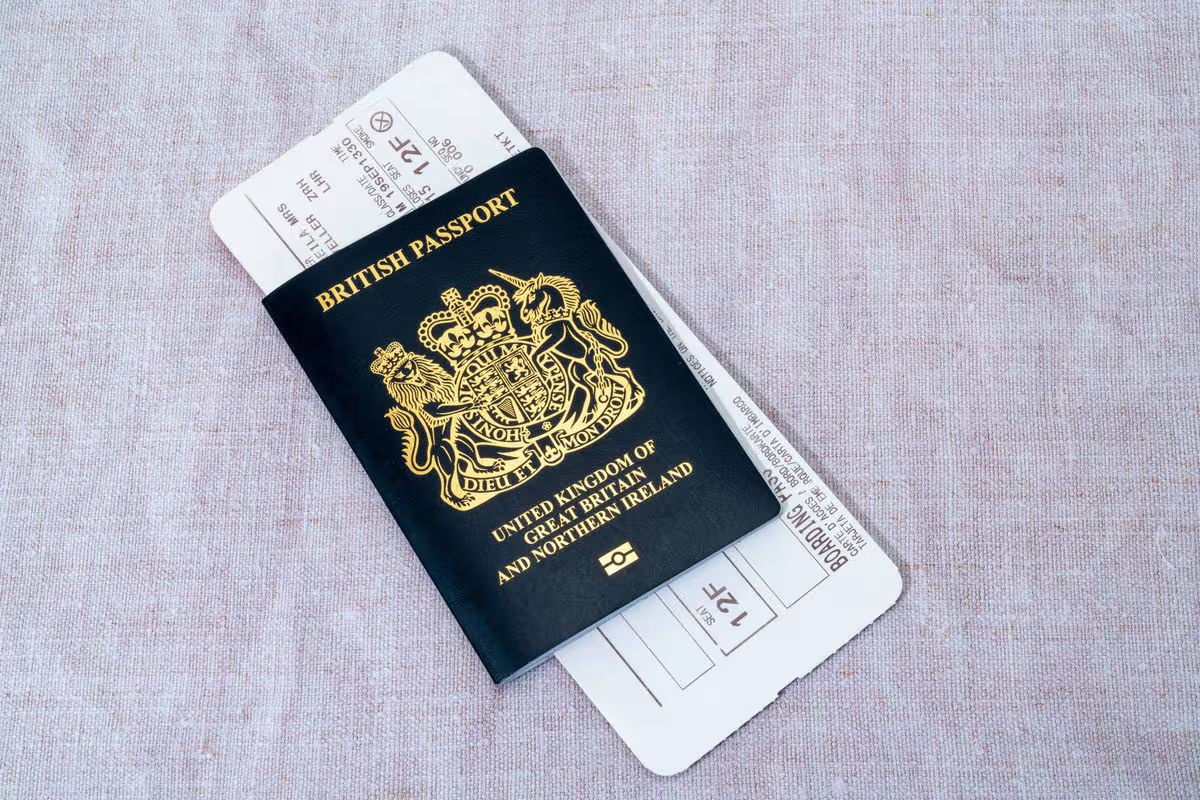
Selen Ozcan, who has dual citizenship, claims that, despite finally obtaining a British passport, she still puts it to one side while travelling as her original passport is ‘stronger’
Alan Johnson Social News Reporter
13:00, 31 Mar 2026Updated 13:00, 31 Mar 2026
A woman claims her first passport is ‘stronger’ than her British one (stock image)(Image: clubfoto via Getty Images)
A woman who endured a seven-year battle to secure a British passport has shared her clever airport time-saving technique. Selen Ozcan, who splits her time between London and Bahrain, used TikTok to showcase her trick in a brief video.
The travel content creator now possesses dual citizenship, and always keeps her native Romanian passport to hand as well. While navigating security at an airport, Selen posted footage with the caption: “When the immigration line is too long so I have to pull out the stronger passport.” Brandishing her blue British passport, she swiftly moved it aside to display her maroon Romanian one beneath.
During Britain’s membership of the European Union, UK nationals enjoyed the freedom to visit, reside, work, or study in member states without requiring a visa. However, this privilege ceased when the Brexit transition period concluded on December 31, 2020.
Consequently, British passport holders can no longer access the – typically faster – EU citizen border control lanes at airports.
“British citizens also usually need to have their passport stamped upon entry/exit to the EU unless they are family members of EU citizens and resident in the EU,” the Government clarifies online.
Content cannot be displayed without consent
Writing in response to Selen, one TikTok user remarked: “Got my British kid a Romanian passport and now she’s my fast track pass through EU airports haha. My missus is Romanian.”
Another person recounted a similar scenario, saying: “All my UK boys had to wait 15 minutes in a queue at Amsterdam Airport. I skipped all that with my Romanian passport.”
A third commenter argued: “Romania passport is just stronger than UK when entering Schengen and EU. But UK has more access than Romania worldwide.”
While a fourth TikTok user pointed out to Selen: “Travel to USA with Romanian passport and you’ll see the difference between British and Romanian. No offence intended.”
The Henley Passport Index evaluates the world’s passports based on how many destinations holders can enter without needing to obtain a visa beforehand.
“The index is based on exclusive data from the International Air Transport Association (IATA) – the largest, most accurate travel information database – and enhanced by Henley & Partners’ research team,” Henley & Partners clarify.
Covering 199 passports and 227 travel destinations, the index receives monthly updates. Based on Henley & Partners’ figures, Singapore claims the top spot with the “strongest” passport, granting visa-free entry to 192 countries.
Japan, South Korea, and the United Arab Emirates share second position with 187, while Sweden occupies third with 186.
Britain sits in joint sixth alongside Malaysia and Poland, offering access to 183 destinations – actually ranking higher than Romania, which shares 11th place with Bulgaria, at 177.
Russia’s intelligence agency accuses the second secretary at the British Embassy in Moscow of espionage.
Published On 30 Mar 202630 Mar 2026
Russia’s Federal Security Service (FSB) has ordered a British diplomat to leave the country within two weeks over allegations of economic espionage, which the United Kingdom rejected as “unacceptable” amid tensions over Russia’s war on Ukraine.
The FSB, the main successor to the Soviet-era KGB, on Monday said its counterintelligence officers had expelled Albertus Gerhardus Janse van Rensburg, the second secretary at the British Embassy in Moscow.
Recommended Stories
list of 3 itemsend of list
“The FSB uncovered signs that the diplomat was carrying out intelligence and subversive activities that threaten the security of the Russian Federation,” the agency said.
It added that the diplomat had attempted to “obtain sensitive information during informal meetings with Russian experts in the field of economics”.
“In order to avoid negative consequences, including criminal liability, the FSB of Russia recommends that compatriots refrain from holding meetings with British diplomats,” it said.
The Russian Ministry of Foreign Affairs said it had delivered a protest to Britain’s charge d’affaires over the alleged spy.
The British Foreign Office responded by saying that Russia’s accusations against its diplomats were “completely unacceptable” and that it would not tolerate “intimidation” of its embassy staff or their families.
Russia-UK discord
Russia has claimed British intelligence launched espionage activities at a level unseen since the depths of the Cold War to sow discord within the country, and it has long complained that its own diplomats are routinely harassed in key Western capitals.
The UK, which supports Ukraine with money and weapons, sees Russia as its biggest immediate threat and accuses its intelligence of mounting cyberattacks, killings and sabotage campaigns across the Western world.
Since Russia launched its full-scale military invasion of Ukraine on February 24, 2022, Russian authorities have sought to suppress opposition to the war while aiming to rally support for the war among Russian citizens.
Last week, Russia declared the teacher and main protagonist of the Oscar-winning documentary Mr Nobody Against Putin a “foreign agent“. Pavel Talankin spent two years documenting pro-war propaganda at a school in the Chelyabinsk region in west-central Russia while working as the school’s videographer.
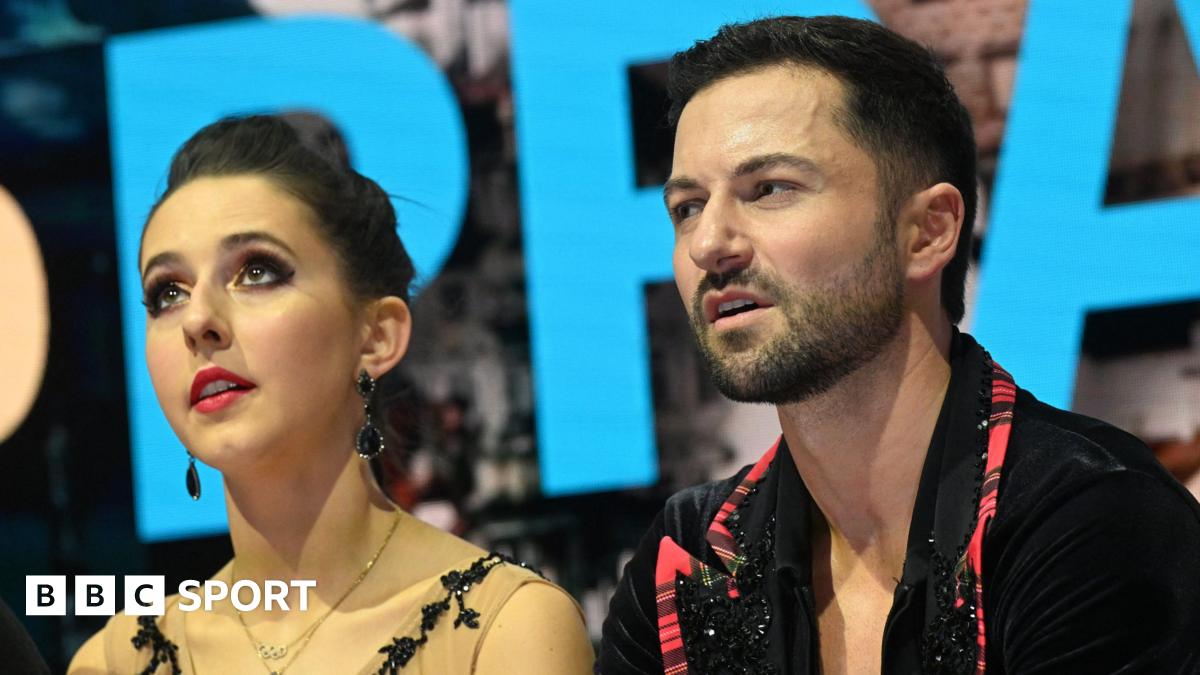
Olympic champions Guillaume Cizeron and Laurence Fournier Beaudry of France won gold, with 230.81 points. They are the fourth pair to win Olympic, world and European titles in the same season.
They finished 19.29 points ahead of the field, which is the biggest winning margin in worlds history.
Canada’s Piper Gilles and Paul Poirier, who took bronze at Milan-Cortina 2026 won the silver medal, ahead of Zingas and Kolesnik, who finished on 209.20 points, with Fear and Gibson ending on 208.98.
The British pair, who won bronze at last year’s World Championships, missed out on a medal at the Winter Olympics last month because of a costly mistake in their free dance routine.
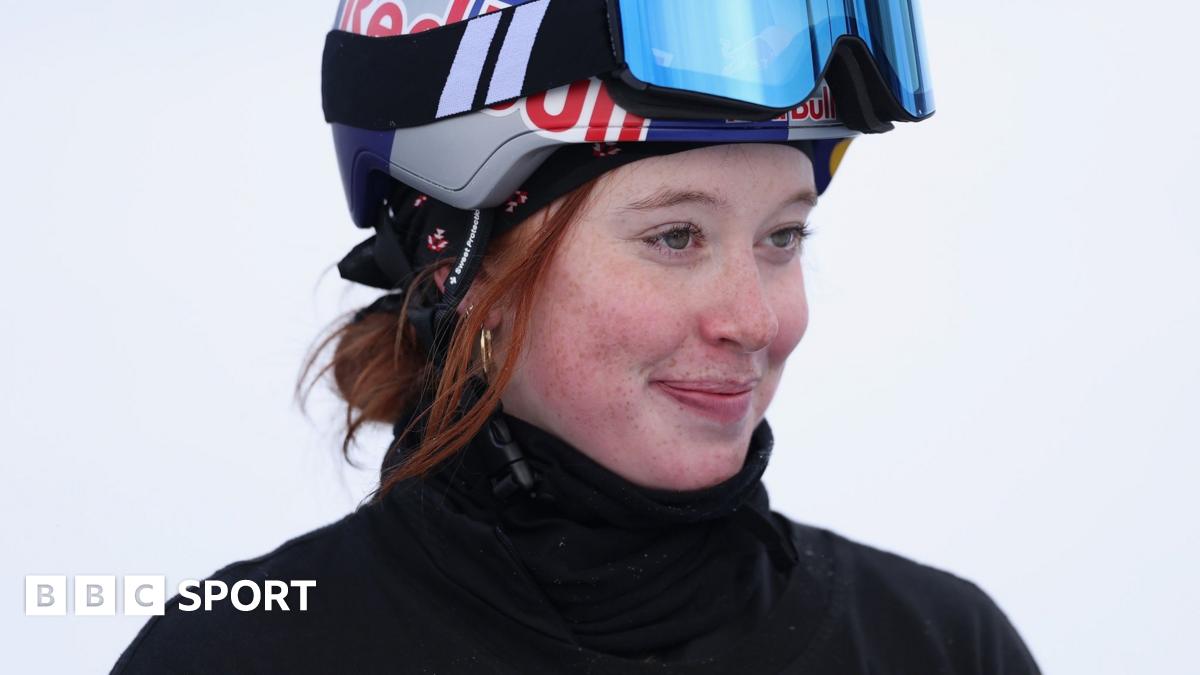
Kirsty Muir has become the first British woman to win World Cup titles in both freeski slopestyle and overall park and pipe.
The 21-year-old Scot finished second on Saturday, behind home skier Sarah Hofflin, in the final slopestyle event of the 2025-26 season in Silvaplana, Switzerland.
Muir’s score of 75.54, behind 35-year-old Olympic bronze medallist Hofflin (80.07), was enough for her to claim a third consecutive podium, following wins in Aspen and Tignes.
It pushed her season score to 280 points to clinch the first slopestyle Crystal Globe of her career, by 69 points from Canada’s Elena Gaskell.
Muir also finished third in the big air season standings, on 219 points, giving her a combined total of 470 in the overall competition – which includes slopestyle, big air and halfpipe – to beat nearest challenger, Canada’s Naomi Urness, by 78 points.
After coming so close to a medal, the X Games champion told BBC Sport after the Olympics that it just motivated her to go on and achieve more in the sport.
“I am really excited to go and try and learn some new tricks. I am excited to see where I can push myself and where I can push the sport,” she said.
“For the next two years I will go and do everything that I would like to do and forget about the Olympics, and then when it comes round to qualification again I will get stuck in.”
THERE’S no better way to make the most of the sun coming out than heading off on a beach holiday.
2026 is shaping up to be a record year for staycations, with Brits keen to stay close to home and explore the coastal gems across the UK.
Sign up for the Travel newsletter
Thank you!
You could stay at Sandaway Beach or Combe Martin Beach resort with Hols from £9.50Credit: Alamy
Plus with thousands more breaks being added to the Hols from £9.50 website, including dates in the spring and summer, its not too late to bag that last-minute holiday.
Hols from £9.50 are set to be restocked this Tuesday, with thousands of new holidays AND new holiday parks – and you can get priority access with Sun Club.
If you fancy signing up to Sun Club to access the £9.50 Hols deals early, head tothesun.co.uk/club and join for £1.99 a monthor £12 for a year.
Once you’re a member, go to the Sun Club Offers huband find the Hols From £9.50 page.
Follow the link from the offers page, and you can book your break from midnight on Tuesday, March 31.
If you’re looking for some inspiration on where to book, here’s some of our favourite beach resorts across the UK, plus our pick of £9.50 holiday parks nearby…
Combe Martin, Devon
Combe Martin is a small seaside resort in North Devon, home to Combe Martin Bay.
Combe Martin Bay is split into two main beaches: the sandy beach by the harbour, and the stony Newberry beach. Both are beautiful, with calm shallow waters protected by the cove.
As an Access for All beach, Combe Martin Bay is fully accessible. There’s plenty of parking, loos and even beach wheelchairs to rent with easy access down to the shore if needed.
This village also sits on the edge of Exmoor National Park, where wild horses roam the rolling hills and moorland.
Bring your bikes and cycle one of the many paths, go fishing in the rivers, or rent a canoe at Wimbleball Lake.
In the village itself, take your pick of cosy pubs like The Dolphin and The Pack O’Cards – pub culture is very big here, and you’ll be welcomed in to enjoy a local pint.
The coastal town of Looe is a working fishing port split into two halvesCredit: Getty
Looe, Cornwall
If you’re looking for a classic Cornish escape, Looe is the ultimate catch.
This traditional fishing town is split into two by a large arched bridge. The east side full of shops and pubs, and the west has a quieter feel with rockpools and beach walks.
Over in East Looe you can walk the Banjo Pier (named after its shape) and laze out on East Looe Beach, the main and largest beach in the area.
Or for somewhere quieter, head towards Hannafore Point in West Looe.
On the way you will come across a small stretch of sand which is also home to Nelson, the bronze seal statue that overlooks the village.
Popular pubs include The Jolly Sailor Inn and The Fishermans Arms, both of which serve local pints and food with a home-cooked feel.
The pink, thatched-roof cottage in Shanklin Old Village is the Old Thatch TeashopCredit: GettyThe beach at Shanklin in the Isle of Wight is accessible via a giant lift down from the townCredit: Getty
Shanklin, Isle of Wight
Shanklin in the Isle of Wight is popular for its pretty Old Village with thatched roof houses, as well as picturesque beach with dramatic cliffs.
Shanklin Beach sits on the south east coast of the Isle of Wight, and has a bustling seafront with arcades, fish and chip shops and an ice cream parlour.
Here you can have a go at the colourful Caddyshack 18-hole mini golf, which costs £8.50 per adult, £7.50 per child or £30 for a family of four.
The beach is just as colourful as the village behind it, lined with colourful beach huts and blooming flowers.
You can get up to the Old Village from the beach via a giant lift. Here you can wander its famous old-fashioned streets – plus the famous pink thatched-roof cottage which you’ll see on postcards.
The pink cottage is a tearoom called the Old Thatch Teashop, where inside you can sit down to traditional afternoon tea or cream tea starting at £7.95. Plus there’s even a fairy garden inside.
Tenby in Pembrokeshire, Wales is a coastal gem that offers boat trips to a nearby islandCredit: Getty
Tenby, South Wales
Tenby is a walled Welsh seaside town, famous for its rows of pastel-coloured houses and three soft sand beaches.
There’s several beaches to pick from at Tenby, from the two-mile long golden stretch of the South Beach to the smaller Castle Beach, which is popular for watersports.
There’s lots of family attractions here too, like the Folly Farm Adventure Park with its vintage fairground, and go-karting or bumper boating at Heatherton World of Activities.
For something more relaxing, you can wander the historic harbour, which runs regular boat trips to Caldey Island from April through to October.
It’s well worth taking a day trip to the island, where you’ll find forests with red squirrels and the magnificent Caldey Abbey.
Food and drink in Tenby is both budget-friendly and tasty. Tuck into a Neopolitan pie at Top Joe’s Pizza, or listen to live music with sea views at Salty’s Beach Bar and Restaurant.
Dumfries is a coastal resort with plenty to do for both adults and childrenCredit: Alamy
Dumfries, Scotland
In south west Scotland, Dumfries is a Scottish seaside town with plenty of activities for kids and fascinating history for grown-ups.
Southerness beach is a vast stretch of sand overlooked by a striking white lighthouse, which is one of the oldest in Scotland.
The shallow waters are ideal for paddling or swimming, and at low tide plenty of rockpools are revealed, which make for fun family explorations.
Another option in Sandyhills Bay, a quiet, sheltered cove surrounded by greenery. The giant rock arch here, called the Needle’s Eye, makes for a great photo spot.
For families, Dumfries is a total playground.
Dalscone Farm Fun (admission £10) and (£12) offer soft play and animal feeding, while the nearby Dino Park (adults £6, kids £12) lets kids hunt for fossils among life-sized dinosaurs.
If you want to take in the history of the town, you can wander down the River Nith past the 15th-century Devorgilla Bridge, or explore the Robert Burns House to see where the famous writer penned his last works.
Whitley Bay has a long sandy stretch of beach overlooked by St Mary’s lighthouseCredit: Alamy
Whitley Bay, North Tyneside
Whitley Bay is a traditional North East seaside town, with an unspoilt Blue Flag beach where you can paddle, swim or surf.
The beach is the star of the show here, and runs from the main promenade north to St Mary’s Lighthouse, which sits on a tiny island.
You can visit the lighthouse by walking across a causeway – just make sure to check the tide times so you don’t get stranded!
For a bit of local history, head into Spanish City. Once a fairground, it’s now a beautiful building full of restaurants and tea rooms.
Inside you can grab try award-winning fish and chips at Trenchers, or enjoy an ice cream looking out over the sea.
Families will love the dinosaur-themed Lost World Adventure Golf, which is £5 per adult and £6 for children. There are also plenty of traditional arcades along the seafront to dip into.
If you like a coastal walk, follow the coastal path south to the trendy coastal village of Tynemouth to see the historic Priory and Castle.
Book online: Simply collectcodewords printed in The Sun paper up until Wednesday, April 1. Then enter them at thesun.co.uk/holidays to unlock booking from April 1.
Book with Sun Club: Join Sun Club at thesun.co.uk/club for £1.99 per month or £12 for the year. Go to the Sun Club Offers hub and click through to the Hols from £9.50 page. You do not need to collect any codewords or Sun Savers codes. Booking opens for Sun Club members onTuesday, March 31.
Book with Sun Savers: Download the Sun Savers app or register at sunsavers.co.uk. Then go to the ‘Offers’ section of Sun Savers and click ‘Start Collecting’ on the ‘Hols From £9.50’ page. Collect TWO Sun Savers codes from those printed at the bottom of the Sun Savers page in the newspaper up until April 1. Then enter or scan the codes on Sun Savers to unlock booking.
Book by post: Collect TWO of the codewords printed in The Sun each day up until Wednesday, April 1. Cut the codeword out and send it back with the booking form – found in paper onApril 1 or online at thesun.co.uk/holidays.
Book with The Sun Digital Newspaper: Sign up to The Sun Digital Newspaper at thesun.co.uk/newspaper. Then download the Sun Savers app or sign up at sunsavers.co.uk, log in to Sun Savers with your Sun account details (the same email and password you use for your Digital Newspaper) and enjoy automatic access to Hols, without the need to collect Sun Savers codes daily. Booking opens onApril 1.
British holidaymakers in Tenerife admit they have “booked early flights home” recently. A specific issue seems to have impacted their holidays over the past few weeks
12:05, 27 Mar 2026Updated 12:06, 27 Mar 2026
Brits in Tenerife admitted to booking early flights home (stock image)(Image: Gabriel Mello via Getty Images)
UK holidaymakers visiting a beloved travel hotspot say they’ve been “booking early flights home” after their breaks were disrupted by an unexpected issue. While many jet off abroad hoping to bask in the sunshine, unwind and enjoy some well-deserved rest, things don’t always go according to plan – no matter how much we’d like them to.
Brits in Tenerife recently discovered this first-hand, with some suggesting their holidays were “ruined” due to an unlikely problem. A string of videos have gone viral on TikTok, with visitors expressing their frustration after trips to the destination over recent weeks, catching many completely off guard.
A man, known online as Gazza, posted a video of his recent getaway, stating: “Come here every year and this is the first bad downpour experience.” He also described the weather as “brutal” for four days due to the relentless rainfall.
The clip has since racked up thousands of views, sparking hundreds of responses. It appears many fellow travellers have encountered similar situations.
Content cannot be displayed without consent
One commented: “Had wind, clouds and cold one year for four days out of the seven. Never went back.” Another added: “I was there last week and got an early flight home.”
Gazza responded to this remark, saying: “Was debating it too.” While a third chimed in: “I just got back. It was mental.”
A further user wrote: “It’s been almost a week!!! Everywhere/everything closed!!!” While another remarked: “That’s pretty unlucky. I would feel gutted.”
Others, however, claimed to have had a wonderful time during their visit, with some reporting an entirely different experience.
One holidaymaker shared: “It’s heaven. Chill.” Another added: “Here at the moment and not that bad. People need to chill out.”
Someone else also weighed in with: “Still rather be there than here. It’s the getting away that matters.”
What’s actually been going on?
While heavy rainfall is uncommon in Tenerife during March, a powerful storm has recently battered the Canary Islands. Storm Therese is reported to have wreaked havoc on the Canary Islands, particularly Tenerife and La Palma, with an unexpected mix of heavy rain, 100 km/h (62 mph) winds and even snowfall at high altitudes.
Authorities confirmed it was amongst the most devastating storms to strike the archipelago in over 10 years, which may well explain why so many visitors encountered such dreadful weather during their stays.
The silver lining, however, is that conditions appear to be on the mend. Current forecasts predict sunny spells over the coming days, with temperatures potentially reaching highs of up to 26 degrees, which could explain why some travellers have recently reported a marked improvement in the weather.
One visitor said: “It’s sunny now.” Another wrote: “I’m just back yesterday. Was there for a week. We had a ball even with the storm and rain.”
March 26 (UPI) — Britain’s armed forces and law enforcement have been authorized to board sanctioned vessels of Russia’s so-called shadow fleet, Prime Minister Keir Starmer announced Wednesday, as London targets a key revenue source funding the Kremlin’s war against Ukraine.
In an effort to hinder Russian President Vladimir Putin’s ability to wage war, Britain, along with other European nations, has focused on his fleet of semi-clandestine tankers used to evade sanctions to ship and sell oil.
Russia’s shadow fleet is estimated to consist of anywhere from several hundred to more than 1,000 vessels, according to the Center for Strategic and International Studies. In September, this fleet transported a seasonal high of 3.7 million barrels of oil a day, real-time intelligence, analytics and data-tracking firm Kpler said.
Britain’s armed forces will be able to interdict vessels London has sanctioned and found transiting its waters, Starmer said a day before he is to arrive at the Joint Expeditionary Force Summit in Helsinki, Finland, where leaders will discuss regional security amid the U.S.-Israel war with Iran and how they can combat Russia’s escalating aggression.
“Putin is rubbing his hands at the war in the Middle East because he thinks higher oil prices will let him line his pockets,” Starmer said in a statement.
“That’s why we’re going after his shadow fleet even harder, not just keeping Britain safe but starving Putin’s war machine of the dirty profits that fund his barbaric campaign in Ukraine.”
According to 10 Downing Street, a suspect vessel will first be reviewed by law enforcement, military and energy specialists, who will then make a recommendation to ministers before an operation is carried out.
After the ship is detained, criminal proceedings may be brought against the vessel’s owners, operators and crew on allegations of breaching British sanctions, it said.
Starmer said that Putin and those in his inner circle “should be in no doubt: We will always defend our sovereignty and stand with Ukraine for as long as it takes.”
The announcement comes months after Britain aided the United States in seizing Bella 1 on Jan. 7. Following the operation, British ministers ordered the development of plans for London to carry out future, similar operations targeting Russia’s shadow fleet, resulting in Wednesday’s announcement, according to 10 Downing Street.
Storm Therese has wreaked havoc across the Canary Islands, but a British expat is urging holidaymakers not to cancel as he claims big changes are coming at the start of April
Alice Sjoberg Social News Reporter
15:21, 25 Mar 2026
Holiday paradise Tenerife was recently hit by severe weather in Storm Therese (stock image)(Image: Getty Images)
Weather chaos has been wreaking havoc across Spain recently as Storm Therese sweeps through the Canary Islands, particularly Tenerife and La Palma – prompting numerous holidaymakers to abandon their plans after anticipating days basking in the sunshine.
The storm is currently bringing an unusual mix of torrential rain, 100 km/h (62 mph) winds, and significant snowfall at higher elevations. Authorities have issued a full-scale emergency in Tenerife, calling it one of the most serious storms to strike the archipelago in more than a decade. Despite this, it appears locals are beginning to see light at the end of the tunnel, as they’re encouraging people to maintain their holiday plans.
Taking to TikTok, one British expat named Mattie Barnett posted on the Tenerife First Excursions account, where he works, to reveal that a major shift is anticipated to arrive in Tenerife in April.
“Bollocks to the rain in Tenerife,” Mattie declared at the opening of the video, before briefly outlining that they’d been forced to endure days of rainfall in the Spanish holiday hotspot. But now, the sunshine had finally returned.
Content cannot be displayed without consent
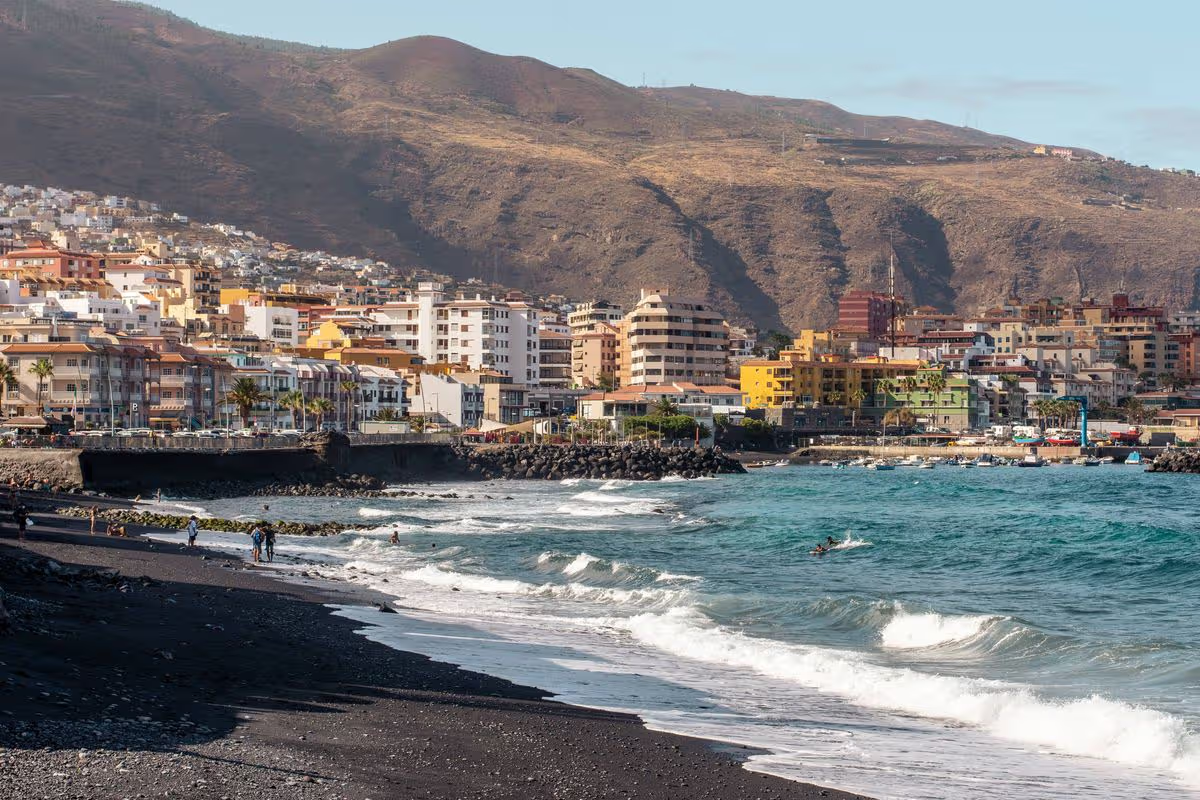
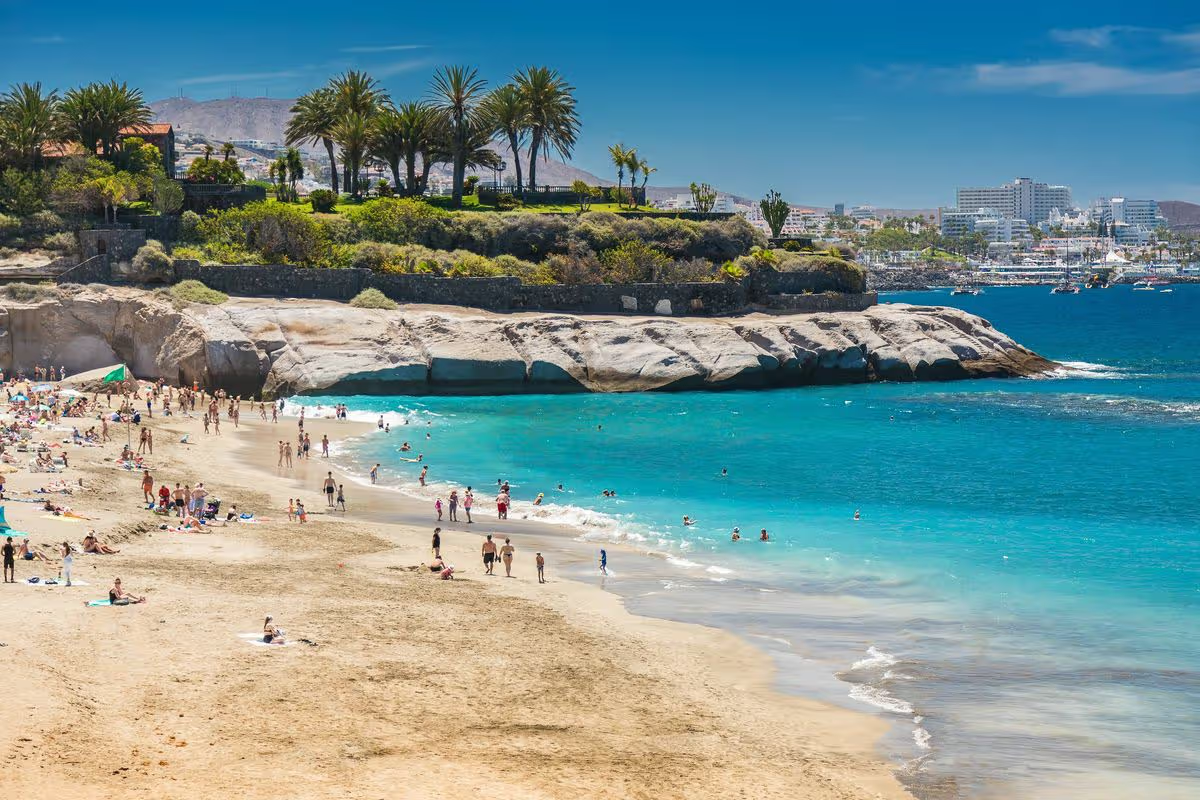
Gesturing towards the popular Playa del Camisón beach, he remarked: “There were people queuing at eight this morning to get the sun beds after half a day of rain.”
Mattie, who hails from Lincolnshire, went on to predict that the weather will likely remain sunny with pleasant temperatures of around 24 degrees through to the weekend. While early April may bring some overcast conditions, Mattie expressed optimism that the warm summery weather would return shortly afterwards.
It appears holidaymakers are placing their trust in Mattie’s forecast, as numerous people confirmed they’re pressing ahead with their travel plans.
“Coming next Wednesday. Need to be seeing blue skies, palm trees and everything in between,” one person commented. Another user stated: “I come on the 28th hopefully still good weather.”
Spain’s meteorological agency, AEMET, is forecasting that the rainfall will cease by Friday, 27 March, when sunshine will return, with temperatures hovering around 21 degrees for the remainder of the week and throughout Easter weekend, which is typical for this period.
Meanwhile, weather maps from WXCharts suggest that portions of the UK could be battered by heavy snowfall and temperatures plummeting to -9C between April 3 and April 5 – Easter weekend.
Weather charts indicate the snow zone stretching approximately 480 miles from the Scottish Highlands across northern England and the Midlands down towards areas of southern England.
At least 12 major cities could find themselves in the trajectory of the wintry conditions, which may trigger worries about travel chaos, school closures and hazardous driving conditions.
FAMILIES are facing a whopping £1.6billion tax blow on the “great British holiday”, a new report has warned.
The findings from industry body UKHospitailty, with figures crunched by Oxford Economics, show that a proposal to slap a five per cent levy on accommodation could “decimate” the industry.
Sign up for the Travel newsletter
Thank you!
A holiday tax could slap holiday goers with a £1.6billion tax hell and lead to 33,000 jobs being axedCredit: Alamy
It comes as Labour Government has been proposing to allow local authoritiesthe right to tax overnight staysin holiday parks, campsites, B&Bs and hotels as part of a new holiday tax.
UK Hospitality claim the proposed levy would slash GDP – a benchmark for the country’s economic health – by £2.2billion.
It also warned it would result in a £1.8billion reduction in hospitality spending.
The group also claimed that it would lead to the loss of 33,000 job roles in areas of the UK where there are few alternative employment opportunities.
Allen Simpson, chief Executive of UKHospitality, said the tax would make staycations “more expensive and decimate tourism.”
“There are no winners from a holiday tax. From coastal communities and city centres to local guesthouses, pubs and taxi firms, the impacts are stark and indiscriminate.
He added: “Taxes up, jobs lost and our high streets hit once again. Holidays are for relaxing, not taxing. The government should keep it that way and stop the holiday tax.”
The charge, which could be applied to hotels, Airbnb-style accommodation and short lets, could amount to a whopping £1.6billion holiday tax on tourists by 2030, according to the figures
Meanwhile, Simon Palethorpe, chief of Haven, said it would mean fewer UK holidays resulting in “less investment and fewer jobs, often in areas where there are few alternative employment opportunities”.
He added: “In the UK, visitors are already paying double the VAT rate of the most popular overseas holiday hotspots. The UK is a great place to visit and we should be encouraging people to do so, not adding extra taxes.”
The government launched a consultation on the tax, with final views submitted last month.
Other measures that also could be introduced include a £2 tax per person per night on staycations.
However, it is worth noting that it will be up to individual mayors to decide whether or not to propose a charge for visitors to their towns or cities.
Government has previously said the charge will help improve local tourism infrastructure, public services.
After 50 years of being practically synonymous with New York City, “Saturday Night Live” has opened the door to London with “Saturday Night Live UK,” following in the steps of “Law & Order UK” and possibly nothing else. Of all the cities in the world that might conceivably replicate the spirit of the NBC original, the British capital, with its urban dynamism, media concentration and 20,000 comedians, feels like the obvious, and perhaps only, choice. (“Saturday Night Live Italia” might prove me wrong, if that day ever comes.) And, of course, we’ve been in a reciprocal comedy arrangement with Britain — or at least we have been nicking their ideas for shows — for years.
The show premiered in the U.K. this past Saturday on Sky One and NOW, and began streaming stateside Sunday on Peacock, with our own Tina Fey as the first guest host. (“It’s an absolute honor and kind of historic,” she said to studio audience. “Guys, I am the youngest person to ever host ‘SNL UK!’”)
As a “Saturday Night Live” star, writer and head writer; and the co-creator of “30 Rock” — her show about a sketch show set in the very same building as “SNL” — they couldn’t have appointed a better ambassador. Lorne Michaels doubtless has her on speed dial.
Here’s the short review: In the course of a single episode, “SNL UK” managed to feel very much like its parent show — which is to say, some of it worked well and some of it worked less well, but very little of it didn’t work at all. There were sketches that ran too long, or ended weakly, but were generally redeemed by a young(ish), confident 11-member cast that made the most of them. Some will already be recognizable to British viewers. Many have had notable, or anyway noticed, careers in stand-up; in the sort of stand-up that amounts to theater; in straight theater (including Shakespeare, naturally) and/or in television and film. Fey promised to “stay out of their way as much as possible,” but she came to play, and appeared in most every sketch.
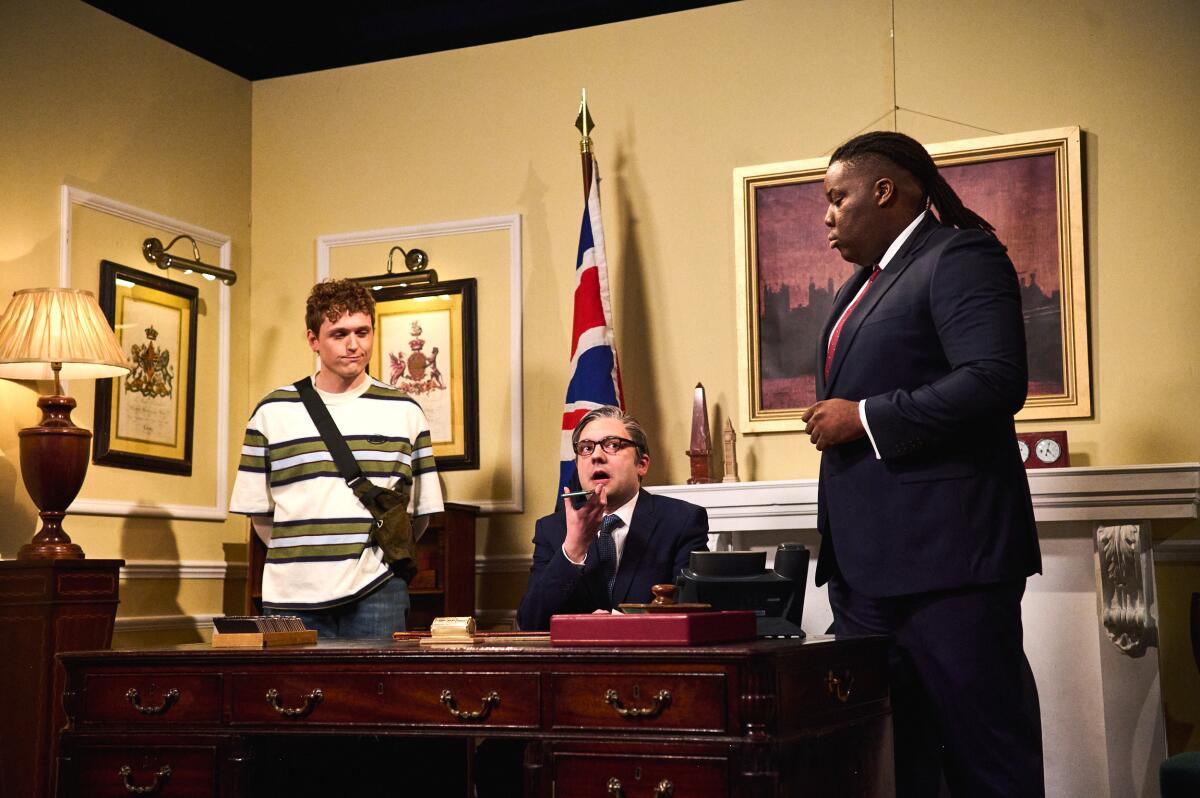
The evening followed established protocol. Cold open. (Prime Minister Keir Starmer, played by George Fouracres, is afraid to tell President Trump, whom he regards as a sort of bad boyfriend, that he’ll send no more ships to the Strait of Hormuz: “I know how badly you want to start World War III, and that’s great. You absolutely do that but we can’t be part of it.”) Hammed Animashaun and Jack Shep accompanied Fouracres in the sketch and shared the glory of shouting, “Live from London, it’s ‘Saturday Night!’” They would continue to dominate the episode.
Jack Shep, George Fouracres and Hammed Animashaun in the “SNL UK” cold open, set at 10 Downing Street, in the prime minister’s office.
(NBCUniversal)
Next: Opening credits featuring the cast members out and about in the city. Monologue, with guest appearances from Nicola Coughlan, Michael Cera and Graham Norton. (The set is very much in the style of various American iterations over the years, clock included, with the band onstage.) Film bits and sketches. Musical guest. (Wet Leg, surly.) “Weekend Update.” More skits. Musical guest returns. More comedy. Whole cast onstage at the end, ready to party.
Among other things: A Shakespeare skit found the Bard (Fouracres again) returning to Stratford from London between plays, each time more affected, beginning with an earring and finishing with an electric scooter, sunglasses and a bag of ketamine. A Paddington Bear immersive experience, with an actual bear, turns bloody, recalling Dan Aykroyd’s 1978 classic Julia Child sketch. As a bra salesperson giving an ego boost to Fey‘s customer, Emma Sidi was funnier than the sketch she was in. (It did include a cameo by Regé-Jean Page, from “Bridgerton.”) In another, David Attenborough (Fouracres again, again), using “Jurassic Park” technology, hosts a “last supper” featuring great dead Britons including Winston Churchill, Isaac Newton, Agatha Christie (Fey), “Freddie Mercury, from Queen, Elizabeth the First, from being the Queen,” and Shep’s Princess Diana, pulling focus at Attenborough’s right shoulder; all they manage to discuss is how many starters to get for the table. It had the added bonus of getting the entire cast, and guest host, onstage.
The film bits were first-rate. (Not being live has its advantages.) One advertised an anti-aging cream — Undérage, with a soft “g” — “that works so well everyone will think your man is a nonce.” (That is, a pedophile.) “My skin looks so fresh,” says a happy customer, “my husband can’t go anywhere without being hunted by right-wing pedophile-catching militias.” “My husband lost his record deal and, some, but not all of his fans.” Another concerned a sort of command center where workers labored “to make the internet as bad as we can possibly get it.”
There are, to be sure, tonal differences to British and American comedy; just compare the respective versions of “The Office,” or “Ghosts,” or “Doc Martin” with its domestic remake, “Best Medicine”; the former tends to be darker, more cutting, more absurd. (A “Weekend Update” joke about the former Prince Andrew’s new home, Marsh Fair, “of course named after the nearby marsh where his body will be found.”) Despite that, and the old saw that Britain and America are two countries separated by a common language, the show translated well transatlantically. Apart from some local topical and cultural references, and an occasional unfamiliar word whose meaning was in any case obvious from context, and some swearing, most of it could have been played with few adjustments by the American cast.
“While we may not agree with everything America does,” Fouracres’ prime minister says at the end of the cold open, “we can still be civil and embrace their wonderful, unproblematic culture.” Back at you, buddy!
The season has been extended to eight episodes from the originally ordered six. (Riz Ahmed and Jamie Dornan are scheduled to host.) Why not 10?
Muchova broke 29-year-old Boulter’s serve twice in the first set and only needed one more in the second set to go 6-5 ahead before she wrapped up the victory.
Elsewhere, British number four Fran Jones also exited the tournament, retiring in the second set of her match with American Jessica Pegula through illness.
Jones, 25, had knocked out Venus Williams in the first round despite feeling under the weather but struggled against Pegula.
Pegula had won the first set 6-1 and despite a medical timeout Jones, who was seen coughing several times during the match, decided at 3-0 down in the second set she was not well enough to continue.
“I didn’t want to lose the opportunity to play Venus, but it’s a whole different ball game playing Jess,” Jones said.
“You need to be 10 out of 10 to compete against her and I’m probably a four out of 10 today. If I’m not able to give my everything out there, I don’t see the point when I’m already battling my general fitness as it is.”
British holiday firms are reporting a boom in bookings up to 235% compared to this time last year, as the Iran war forces people to cancel far-flung destinations and look closer to home instead
10:30, 21 Mar 2026Updated 12:51, 21 Mar 2026
The Great British seaside holiday is undergoing a revival thanks to the Iran war(Image: PA)
Brits are looking again at holidays closer to home this summer as fears grow that the Iran war could ground flights and spike plane ticket prices by up to 50%.
Contingency plans being drawn up would see holidaymakers hit by airlines ‘rationing’ their operations, including a reduced schedule, higher prices and cancellation of less profitable routes.
It comes as other destinations beloved by British tourists have ended up Iran’s crosshairs.
Cyprus, Turkey and Abu Dhabi are some of the destinations thrown into doubt this year thanks to the Middle East crisis – but holidaymakers are already making ‘staycation’ bookings instead for the likes of Norfolk, Pembrokeshire and the Isle of Wight as they eye up a safer, more certain getaway.
David Land, who works at the University Technical College in Durham, was forced to cancel upcoming stays in Dubai and the Maldives for his wife Barbara’s birthday – and has lined up “sunny Cornwall” as an alternative.
“I’m a bit of a foodie, so I quite like the idea of seeing how many restaurants I can go to, in terms of Paul Ainsworth’s, Rick Stein’s”, he said, aiming to spend four or five days “at least” in the Land of Saints.
David and his wife, who are both in their 70s and tied the knot in 1979, went on one of their first holidays together on the beaches of Northumberland – and he’s also considering a return there this year.
“I would say the majority of our holidays have been abroad, in Europe, the Middle East, the Indian Ocean – but we’ve been saying ‘Why can’t go on a holiday more in the UK’?”, he told the Mirror. “Apart from the need to pack appropriate clothing, it’s a lovely place to go – as long as the people doing it don’t try to rip us off, as happened a bit around Covid.”
‘We’re not going to listen to Donald Trump’
Asked why he hasn’t chosen to simply reschedule his existing foreign holidays, he said: “We’re not going to listen to Donald Trump when he says the war’s going to be over in ‘three or four weeks’. There’s no confidence that we would be able to go back, not until the war stops, and even then we’d have to know that it’s not going to start again.”
Businesses across the UK tourism industry are already reporting a boom in bookings not seen since the pandemic, with Google searches for ‘best staycations’ up 40% since Trump launched his bombardment of Iran.
Business is booming, say British travel firms
Samantha Evans, founder of Humphreys of Henley, said her luxury travel firm has experienced the “busiest start to the year on record”, with the “safe and deeply enriching” surrounds of the English countryside attracting both domestic guests and those from further afield, particularly the United States.
She told the Mirror: “Luxury hotels are reporting an increase in domestic demand over the next three months. British guests are choosing to stay closer to home, but still want exceptional, experience-led travel – so they’re trading airports for the countryside rather than cancelling plans altogether.”
Rental agency Habitat Escapes told the Mirror that their bookings are up 235% this week compared to the same date last year, with the majority for Silverlake Estate in Dorset and the remainder for Lower Mill Estate in the Cotswolds.
And industry expert Emily Keogh, a former judge for The Hotel Magazine Awards, said there was renewed interest in “spontaneous countryside escapes and coastal getaways that can be booked at relatively short notice” because of the new difficulties in international travel.
Others believe this is part of a movement back towards British holidays that began well before the Middle East crisis, as Matthew Price, CEO of travel firm Awaze, said: “This trend of staying closer to home is part of a broader pattern of behaviour we’ve seen in the UK for a number of years, where holidaymakers are choosing staycations over going abroad. From coastal to countryside getaways, the quality and variety on offer in the UK means a domestic break can feel just as exciting as going overseas.
He revealed bookings were up 26% for Cottages.com, alongside a 10% rise in summer bookings for Hoseasons. While the South West remains a popular destination, regions like the North West and Southern Scotland are seeing “the strongest year-on-year growth for the peak summer period”, Mr Price said.
And the Great British holiday may benefit too from rising jet fuel prices, which experts have warned could push up the cost of plane tickets very soon.
Jet fuel shortages threaten cancellations and price hikes
European jet fuel prices reached an all-time high of $1,698 per tonne this week – more than double the $830 per tonne before the air strikes on Iran – and the closure of the Strait of Hormuz is sending alarm bells ringing among airline bosses.
While European airlines have stressed that they are currently operating with normal levels of fuel, Scandinavia’s SAS became the first this week to admit it had introduced a “temporary price adjustment” in response to the soaring prices, with more expected to follow.
Experts now predict a potential 30% to 50% hike in plane tickets for European summer holidays if the fuel crisis drags on, potentially costing an extra £600 for a family of four heading to the Canary Islands, Greece or Morocco.
Long-haul flights would see even steeper price increases, with a family trip to Australia going up by an eye-watering £2,400.
James Noel-Beswick, head of commodities at market intelligence firm Sparta Commodities, told the BBC: “I think we’re weeks away from maybe flight cancellations or delays due to lack of jet fuel, rather than months.”
An end to the age of cheap foreign holidays is likely to help tip the balance back in favour of domestic holidays when it comes to cost, as ‘staycations’ have long been criticised for poor value for money – especially when it comes to accommodation.
You can expect to pay at least £500 for five nights in a budget holiday let near St Ives – but in Malaga, the equivalent would set you back just £350.
Air travel chaos threatens holiday favourites
British holidaymakers preparing to head to Spain on their Easter getaways have meanwhile been warned to expect chaos at airports, with a national baggage handler strike threatening to cause missed connections and delayed boarding.
And there’s mounting uncertainty around Turkey, where three Iranian missiles have been intercepted since the beginning of the conflict, and popular Brit destination Cyprus, which saw the RAF base on the island’s southern coast come under drone attack.
Foreign Office chiefs currently advise anyone travelling to either country to be aware of the risks of ‘regional escalation’.
The Citizens Advice Bureau say holidaymakers who are unsure over a trip they have booked in the months ahead should get in touch with their travel provider – but don’t cancel before speaking to them, as you may lose your right to a refund.
Top 10 destinations for British summer holidays:
The top 10 UK destinations for summer staycations, based on consumer research of 2,000 UK adults by Sykes Holiday Cottages:
Coast Guard officials inspect the area in the aftermath of a fire at the POSCO steel factory in the city of Pohang, South Korea. Photo by YONHAP / EPA
March 20 (Asia Today) — South Korea’s steel industry faces mounting pressure as Britain moves to tighten import restrictions, adding to growing trade barriers in the United States and Europe. Britain said it plans to cut steel import quotas by 60% and raise the tariff on volumes above the quota to 50% from 25%, with the new measures set to take effect July 1.
The tougher British measures have raised concerns about weaker exports and shrinking profitability for South Korean steelmakers. South Korea exported 640,000 metric tons of steel to Britain last year, accounting for 2.3% of its total steel exports, according to the industry ministry.
South Korean companies including POSCO and Hyundai Steel have shipped products such as heavy steel plate to Britain. POSCO said it is reviewing the situation and plans to respond after Britain releases more details on the affected products and volumes. The industry ministry said the move could violate World Trade Organization rules and the Korea-Britain free trade agreement, which provides for tariff-free steel trade, and pledged to work with London to limit damage to Korean companies.
The British action comes as other major markets also harden their trade defenses. The United States raised tariffs on imported steel and aluminum to 50% in June 2025. The European Union is also pursuing a tougher steel regime that would cut tariff-free import volumes by 47% and double out-of-quota duties to 50%.
The broader protectionist shift has already hurt Korean producers. Industry officials say companies are increasingly reliant on government trade talks as barriers rise across major export markets.
March 17 (UPI) — Speaking to the British Parliament on Monday, Ukrainian President Volodymyr Zelensky warned that the rise of artificial intelligence and inexpensive drone technology has made “mass drone warfare” quicker and more common across the globe.
“The evolution of threats never stops,” he said in a speech touting Ukraine‘s advances in technology allow the country to defend against and monitor attacks by Russia.
During his visit to Britain, Zelensky also met with King Charles III and Prime Minister Keir Starmer, with whom he agreed to a partnership to boost global defensive capabilities across Europe to protect against a rise in low-cost, high-tech military technology. The agreement capitalizes on Ukraine’s technological expertise and Britain’s industrial ability to manufacture and supply resources, the British government said.
Britain plans to invest $667,000 in an AI center in Kyiv.
Zelensky told Parliament that Ukraine faces nearly nightly attacks from Russia and uses nearly 1,000 interceptor drones each day to protect the country. He said Ukraine can produce interceptors on that scale, but the country needs a system in place to stop the attacks by Russia and Iran, which is using weaponry made from Russian supplies.
Zelensky pointed to the military bases in Cyprus as an example, The Guardian reported.
“This is what our security proposal could look like. Our experts would place interception teams and set up radars and acoustic coverage, and these would all work if Iran launched a large-scale attack similar to Russian attacks,” he told Parliament.
“We would guarantee protection. This is the kind of reinforcement we offer, and it may soon be needed across Europe.”
During their meeting at No. 10 Downing Street, Starmer told Zelensky that “the focus must remain on Ukraine” despite new conflict in Iran, the BBC reported.
Russian President Vladimir Putin “can’t be the one who benefits from a conflict in Iran, whether that’s oil prices or the dropping of sanctions.” He was referring to the United States’ recent easing of sanctions on Russian oil to combat rising gas and diesel prices.
Zelensky offered his thanks to Starmer for the support from Britain.
“You have stood with us all through this difficult winter,” Zelensky said.
Ukrainians march together through the streets of London to the Russian Embassy to mark the first anniversary of the Russian invasion of Ukraine on February 24, 2023. Photo by Hugo Philpott/UPI | License Photo
Dubai Airport has seen substantial flight disruption as British Airways announces it will halt all flights into Dubai until June as Iranian attacks on airports across the region continue
19:18, 17 Mar 2026Updated 19:38, 17 Mar 2026
Passenger planes are parked at Dubai International Airport in Dubai (file photo)
British Airways (BA) has cancelled all flights into Dubai until June as Iran continues its attacks on the UAE.
BA confirmed that flights to Amman, Bahrain, Dubai and Tel Aviv were now cancelled up to and including May 31, and flights to Doha were cancelled until April 30, the airline said in a new update.
“[The cancellations are] due to the continuing uncertainty of the situation in the Middle East and airspace instability, and to provide more clarity to our customers,” a BA spokesperson said.
Ensure our latest headlines always appear at the top of your Google Search by making us a Preferred Source. Click here to activate or add us as your Preferred Source in your Google search settings.
In 2025, Dubai International Airport was the world’s busiest airport for international passengers, accommodating nearly 90 million travellers.
December 2025 alone saw around 8.7 million passengers, the busiest single month in the airport’s history, The Express reports.
The airport connects travellers to 291 destinations across 110 countries.
The UK Foreign Office currently advises caution or against all but essential travel to the UAE and other Gulf states due to regional tensions.
Those already in the UAE are advised to follow local authorities’ instructions, register your presence with the UK government and be prepared for sudden changes in the security situation.
Despite Dubai being on the UK Foreign Office’s “No go” list, many travellers were still choosing to take the risk and fly there, Travel journalist Simon Calder told BBC Radio Scotland’s Breakfast programme.
BRITISH AIRWAYS is launching two exciting new long-haul routes from the UK.
The airline is launching a route to Melbourne in Australia and Colombo in Sri Lanka.
Sign up for the Travel newsletter
Thank you!
British Airways is launching two new long-haul flights and one is to Melbourne in AustraliaCredit: AlamyThe flights to Melbourne will be daily and launch on January 9, 2027Credit: Alamy
The Melbourne route will be launching on January 9, 2027 in time for the Australian Open and the Melbourne Grand Prix.
The flights will operate year-round from London Heathrow, via Kuala Lumpur, on a daily basis.
It will take off from Heathrow at 9:10pm and land in Kuala Lumpur at 6:05pm the next day.
The flight will then take off again at 7:45pm and land in Melbourne the following morning at 6:40am.
The return leg will start on January 11, taking off each day at 4:35pm and landing in Kuala Lumpur at 9:35pm.
The flight will then take off from Kuala Lumpur at 11:15pm and land back at Heathrow the following day at 5:20am.
Return flights will cost from £1,130 and go on sale on March 17.
Melbourne is the capital of Victoria and is Australia‘s second-largest city.
It was recently named the world’s best city by Time Out, with it scoring high among younger residents as well as for its food scene, art and culture scene nightlife.
When you are there you can explore the city’s lively arts scene in Fitzroy, where there are a number of vintage shops, record stores and cosy cafes.
The city often hosts major sporting events as well, such as Formula One.
Melbourne also loves its coffee, with a large café culture including hidden bars and restaurants.
Flights to Colombo in Sri Lanka will launch sooner, on October 23, 2026.
Flights to Colombo in Sri Lanka will also launch in October, operating three times a weekCredit: Alamy
The flights will operate three times per week on Mondays, Wednesdays and Fridays from London Gatwick to Colombo.
The route will only operate during the winter though.
The flight will depart at 5:30pm each time, landing in Colombo the following day at 9am.
And the return leg – which starts on October 24 – will depart at 11am and land back at Gatwick at 5pm.
Return fares start from £620 and also go on sale on March 17.
Colombo is the capital of Sri Lanka and is known as a vibrant and bustling city.
Top things to do include heading to Pettah Market, which features different ‘zones’ for specific goods, including spices and textiles.
Make sure to explore the colonial-era buildings in the Fort area as well.
British Airways is also increasing flights to a number of other destinations including Cape TownCredit: Getty
Tuk-tuks are popular in the city too and are an experience in themselves.
In addition to the two new routes, BA is also boosting capacity on several routes including Cape Town in South Africa; Tokyo in Japan; Bridgetown in Barbados; Kingston in Jamaica and San Jose in Costa Rica.
Neil Chernoff, British Airways’ Chief Planning and Strategy Officer, said: ”We’re delighted to announce sizeable growth to our flying schedule for winter 2026, including two notable new destinations that I’m confident will prove popular with our customers.
“We’re also increasing services across several high-demand routes around the world.
“Together, these changes represent a significant investment in our long-haul leisure network, adding even more options and choice for our customers.”
1 of 8 | On March 17, 1776, the Continental Army under Gen. George Washington forced British troops to evacuate Boston. The historic moment was depicted in the 1911 painting The Evacuation of Boston by William James Aylward. File Image courtesy of the New York Public Library
March 17 (UPI) — On this date in history:
In 1762, New York City staged its first parade honoring the Roman Catholic feast day of St. Patrick, the patron saint of Ireland. It was led by Irish soldiers serving in the British army. In 2002, President George W. Bush became the first sitting U.S. president to take part in the event, more than six months after the Sept. 11, 2001, terror attacks on the city.
In 1776, the Continental Army under Gen. George Washington forced British troops to evacuate Boston. The Boston area marks Evacuation Day along with its St. Patrick’s Day parade each year.
In 1901, 71 paintings by the late Dutch painter Vincent van Gogh were shown at the Bernheim-Jeune gallery in Paris and caused a sensation across the art world.
In 1974, the oil-producing Arab countries agreed to lift a five-month embargo on petroleum sales to the United States. The embargo, during which gasoline prices soared 300%, was in retaliation for U.S. support of Israel during the October 1973 Middle East War.
In 1990, Lithuania rejected the Soviet Union’s ultimatum to renounce its declaration of independence a week prior. The Soviets implemented sanctions against Lithuania and conducted a military operation in 1991 before other Soviet republics eventually declared their independence.
In 1992, South African Whites, by a margin of 68.7% to 31.2%, voted to end minority rule. Nelson Mandela was elected two years later as the first president in a fully representative democratic election.
In 2003, as war with Iraq seemed a certainty, U.S. President George W. Bush gave Iraqi President Saddam Hussein and his sons 48 hours to leave the country. The ultimatum was rejected.
In 2024, Russian President Vladimir Putin won a fifth term in office, making him the longest-serving leader of the country in about two centuries. A Russian election watchdog called the election unconstitutional.
The popular airline has made the big announcement to relaunch the daily flights as part of its winter expansion, serving travellers and residents of both countries
07:05, 17 Mar 2026Updated 07:06, 17 Mar 2026
British Airways are launching new flights (Image: Mrkit99 via Getty Images)
British Airways have made a huge announcement that they are relaunching daily flights to a popular city for UK passengers – ahead of a couple of huge worldwide sporting events.
The airline will be returning to Melbourne after a 20-year hiatus.
Ensure our latest headlines always appear at the top of your Google Search by making us a Preferred Source. Click here to activate or add us as your Preferred Source in your Google search settings.
The flights will commence flights to Melbourne from January 9, 2027, launching in time for the Australian Open and the Melbourne Grand Prix. Flights will operate year-round from London Heathrow, via Kuala Lumpur, on a daily basis.
Passengers will be able to choose from First, World Traveller (economy), World Traveller Plus (premium economy), and Club World (business class) in both directions.
Return fares start from £1,130 (including taxes and carrier fees) and are on sale from today.
The UK airline halted all services from Melbourne Airport in March 2006 with other companies being relied on for people to make the London-Melbourne journey.
Melbourne Airport Chief Executive Officer Lorie Argus said the announcement underscored Melbourne’s place as Australia’s largest and best connected 24-hour gateway.
“We are thrilled to welcome British Airways back to Melbourne Airport and we’re incredibly excited about what this extra choice means for travellers and exporters,” she said.
“British Airways is one of the world’s most recognisable airlines and in its more than 100 years of flying has earned a well-deserved reputation for excellence and reliability.
“With the largest choice of airlines flying to the UK and Europe, 24-hour operations and the shortest minimum connection time of any Australian airport, Melbourne Airport is now the clear choice for Europeans heading to Australia or Australians looking to travel abroad.
“London is one of the world’s great global cities and a critical hub for business, tourism and education, while Melbourne was last week voted Time Out’s “best city in the world” as well as being home to the largest British expat community in Australia, so there will be no shortage of two-way demand.”
The move is part of a significant planned expansion to BA’s network for winter 2026, with the addition of Colombo in Sri Lanka as well.
Emma Raducanu has withdrawn from this week’s Miami Open as she continues her recovery from a recent illness.
The British number one became unwell while playing in the Middle East last month, and is still suffering with post-viral symptoms.
Raducanu decided to play last week’s event in Indian Wells, and reached the third round before losing in just 52 minutes to the world number six Amanda Anisimova.
The 23-year-old has 215 ranking points to defend from reaching the quarter-finals in Miami last year, but has decided it would be best to take a break to recover fully.
Raducanu beat both Anisimova and the then top 10 player Emma Navarro before losing to Jessica Pegula in three sets in last year’s quarter-finals.
This year she had a first-round bye, and could have played British childhood rival Sonay Kartal in the second round.
Raducanu had already decided not to play in Great Britain’s Billie Jean King Cup tie in Melbourne next month, but is currently scheduled to return to the tour in three weeks’ time.
She has entered the WTA event in Linz, which would be her first clay-court tournament of the season.
Have fun with the family or unwind your mind with TUI deals for March and April
This article contains affiliate links, we will receive a commission on any sales we generate from it. Learn more
Feel the sand beneath your toes with a last-minute holiday(Image: TUI)
Getting away for a beach break in March or April is a great way to enjoy sunny skies and mild temperatures before the summer crowds arrive, as well as ditch the British rain. It’s the perfect time to relax on golden sands, explore charming coastal towns and soak up the early-season Mediterranean vibes.
As one of the UK’s best-known holiday companies, TUI uses Gatwick to offer direct flights to some of Europe’s best resorts, making it ideal for a spring break. Right now, TUI is offering couples the chance to save up to £250 on selected holidays, departing from Gatwick Airport in March and April.
This offer applies to 7-, 10-, 11- and 14-night stays in 2026, making it the perfect time for an early-season getaway. Even before the first flourish of summer, beach breaks in Lanzarote, Turkey and Portugal offer the perfect mix of sun, sand, and family-friendly fun.
READ MORE:
From stunning coastal locations with pools and entertainment to panoramic Portuguese views and spa treatments, we’ve picked just three of our favourites from TUI that can be booked today.
TUI BLUE Flamingo Beach, Lanzarote
Perched on the sun-drenched coastline of Playa Blanca, Lanzarote, TUI BLUE Flamingo Beach sits just steps from soft sands and calm, turquoise waters, ideal for safe swimming. Designed to look like a charming whitewashed Canarian village, a scenic seafront promenade connects the resort to Rubicon Marina and the town centre with stunning Atlantic views.
The resort is perfect for families, offering multiple pools, a splash park and professional childcare and teen hangouts. Dining is varied, from international buffets to local specialities, while fitness classes and evening entertainment ensure a lively mix of relaxation and fun under the Lanzarote sun.
For the best value break at Flamingo Beach, sunseekers looking to getaway after Easter can enjoy a 7-night break for £642.42* per person. Departing on April 13, this price is based on two people sharing on an all-inclusive basis and includes a whopping £1082.16* discount. Alternatively, a 14-night stay departing on April 14 is also available for the higher price of £1619*.
One visitor left a five-star review on TripAdvisor that said: “This hotel is excellent for families with children 0-10. The location is perfect, right next to Flamingo Beach. The children enjoyed the main pool, where activities took place, and the quiet pool, which was heated. The apartments were clean and spacious with a bedroom and lounge/kitchen”
Another added: “Great Location. Our room was very quiet. Our rate included an excellent breakfast so good value for money.”
A different guest, however, agreed that the location is “brilliant”, but they also felt “let down by amenities not being open. Pool snack bar, pool bar in another area closed. And only one evening bar with no other areas to sit.”
A returning guest highly recommends the Flamingo Beach resort, saying: “Best Place. The location is fantastic, near lovely beach, rooms are fine and clean and the staff are so friendly, the area is very clean and not too much noise. We been coming here nearly every year, the last 25 years. This is where we feel like home.”
Lanzarote is always popular with holidaymakers and there are plenty of deals to choose from. One the Beach is offering a 7-night stay at the five-star Iberostar Selection Lanzarote Park with prices from £1605*, a saving of £425. An upscale all-inclusive resort, guests love the location just a little further along the bay.
For sunseekers on a budget, a last-minute break at the Blue Sea Costa Bastian in Costa Teguise is available for £519* per person through Love Holidays. With flights from Gatwick, accommodation and breakfast included, the hotel is surrounded by beautiful Canary gardens and offers magnificent views over the Atlantic Ocean.
Blue Bay Platinum, Marmaris, Turkey
Blue Bay Platinum in Marmaris blends modern style with central convenience, just 70 meters from the beach with its own private sandy stretch and clear waters. The lively local area, including shops, bars, the marina and old town, is all within easy walking distance.
The resort offers four outdoor pools, including waterslides and a dedicated adult “chill pool,” plus a full-service spa for ultimate indulgence. Guests can enjoy international and local dining, sunset cocktails and stylish ocean-themed rooms with live music and shows, creating the perfect vibrant Mediterranean getaway.
Offering excellent value for money, a seven-night stay at this contemporary hotel in a central location could cost as little as £418* per person. Departing on Wednesday, April 18, the deal includes flights and accommodation on an all-inclusive basis.
With hundreds of five-star reviews on TripAdvisor, one visitor called it a “Stunning, luxury stay”, adding: “Blue Bay Platinum Hotel in Marmaris was absolutely exceptional from start to finish. The hotel itself is beautiful – modern, stylish, and perfectly maintained with a luxurious atmosphere throughout. Room was very comfortable and always clean. Will definitely stay here again.”
Another added: “Booked again for April this year. This will be our 10th visit to Marmaris. We have stayed at the supposedly other top hotels nearby. None of them beat the Blue Bay for overall experience.”
While one visitor did note that they felt uncomfortable at the resort due to the “expectation that tips should be given,” another loved it, saying: “It’s a very nice place to stay. I like this hotel and especially the relaxing swimming pool. There is a great bar.”
Turkey appeals to Brits with its mix of sunny beaches, rich history, delicious cuisine and excellent value for money. Another favourite Marmaris resort for upscale holidaymakers is the five-star Green Nature Diamond Hotel that sits within easy striking distance of the beach.
With a wide range of facilities and comfortable accommodation, this luxurious hotel can be booked through Love Holidays for a seven-night stay in April from £429* per person. Elsewhere, the nearby Prime Beach Hotel has pools with waterslides and a private stretch of beach with prices starting from £490* per person on April 2.
Longevity Health & Wellness Hotel, Portugal
Perched on a hillside with panoramic views over Alvor Bay and the Atlantic, the Longevity Health & Wellness Hotel is a state-of-the-art retreat in the charming village of Alvor. Guests are perfectly placed to enjoy golden beaches, scenic boardwalks and nearby world-class golf courses, all while staying in a serene, high-tech sanctuary.
The hotel is a pioneer in wellness, featuring a rooftop infinity pool and a world-class spa and wellness centre. With sunrise yoga, detox treatments, and healthy Mediterranean cuisine at the rooftop Pure Cafe, every detail is designed for ultimate relaxation and rejuvenation.
While the thought of complete rest and relaxation may be priceless, a stay at the Longevity Resort is worth every penny. For a 10-night stay, departing on March 23, prices start from £891.12* per person, on a bed and breakfast basis. Shorter stays are also available with a seven-night break costing £663* departing on the same day.
Guests who have already found their zen with a stay at the Longevity Health & Wellness Hotel have shared their experiences online. One said: “Absolutely superb place for relaxing stay, very modern, clean, quiet location with 5 mins drive to local beaches and town of Alvor… Fantastic breakfast with great choice. Access to spa facilities included. Would definitely recommend.”
Another added: “A lovely, relaxing stay in a beautiful hotel. We came back feeling revitalised. The cleanliness and the staff at the hotel were everything.”
While one less impressed visitor said: “The restaurant is very expensive for portions,” another was far more impressed exclaiming: “This hotel is truly exceptional, I cannot say enough about this wonderful place only that we cannot wait to return.”
Alternatively, the Falesia Hotel is a sophisticated adults-only retreat in Albufeira, offering elegant rooms, a full-service spa, and both indoor and outdoor pools. Perfectly positioned for relaxation, it sits just a short walk from pristine beaches and the Pine Cliffs Golf Course, and prices for a seven-night stay start from £439 with Love Holidays.
For those who want a family holiday, Portugal is a perfect location for this too. Offering waterslides, a kids club, a water park and plenty of entertainment, theJupiter Albufeira Hotel has something for everyone. Located in the popular resort of Albufeira, prices start from £630* per person, departing on April 21.
Find out more about deals on spring holidays with TUI as well as the full T&Cs here.