Bradley

Competing Bradley Fighting Vehicle Replacement Prototypes Delivered To The U.S. Army (Updated)

American Rheinmetall and General Dynamics Land Systems have now delivered the first prototypes of their proposed XM30 Mechanized Infantry Combat Vehicle (MICV) designs to the U.S. Army. The XM30 program is the Army’s latest attempt to replace its fleet of Bradley Fighting Vehicles. The competing MICV designs are set to be put to the test alongside early prototypes of the next-generation M1E3 Abrams tank in the spring.

The U.S. subsidiary of Germany’s Rheinmetall has been developing a version of its Lynx family to meet the Army’s MICV requirements, and announced the delivery of the first example today. General Dynamics Land Systems (GDLS), which is offering the Wolf, a further evolution of the company’s Griffin III, itself derived from the ASCOD 2 infantry fighting vehicle, said last week that its first prototype had arrived at the Aberdeen Proving Ground in Maryland. Variants and derivatives of the Lynx and ASCOD 2 are already in service with several countries, which we will come back to later on.

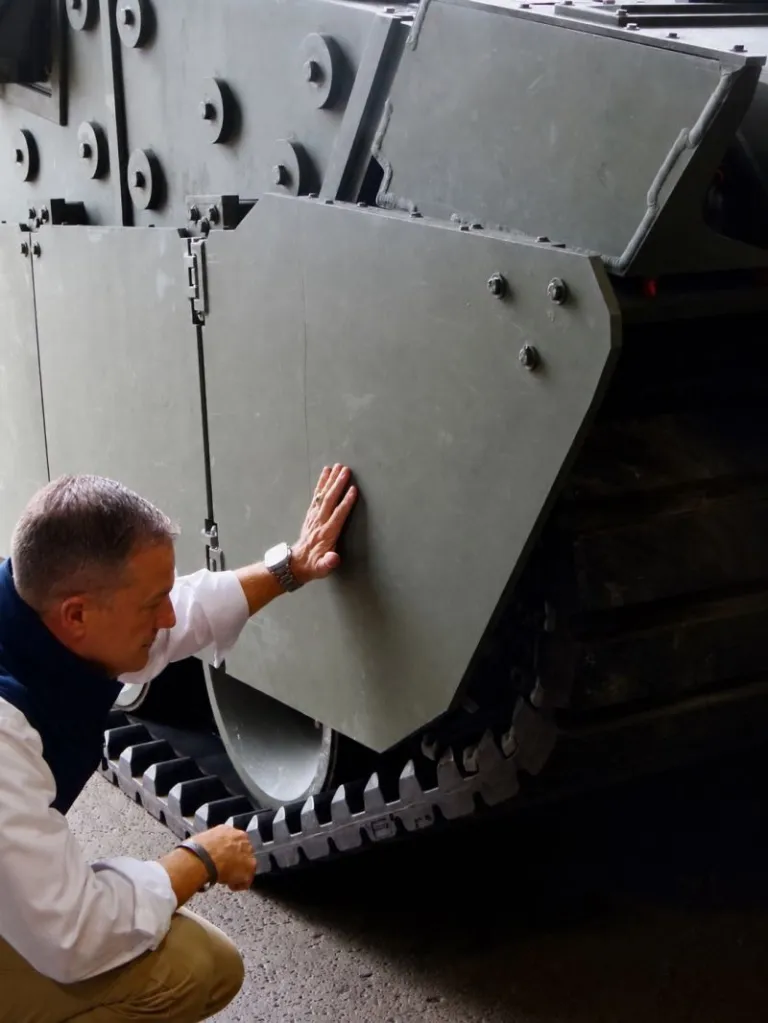
Geoffrey Norman, Director for U.S. Strategy & Growth at General Dynamics Land Systems, shared this picture of him kneeling beside a Wolf prototype in a post on LinkedIn last week. That same post said that the first prototype had been delivered to the US Army. Geoffrey Norman/LinkedIn

The press release today from American Rheinmetall says the company will eventually deliver eight prototypes to the Army for further testing. It is very likely General Dynamics Land Systems will be supplying an equivalent number of vehicles, but the company does not appear to have confirmed that explicitly at the time of writing. Army budget documents released earlier this year show the service is planning to acquire at least 108 XM30s through Fiscal Year 2031. The Army has some 2,500 Bradleys in service today, a figure that includes multiple variants and subvariants.

“Delivering our first prototype to the Army is an important step as the XM30 Combat Vehicle program enters a more visible phase,” Matt Warnick, CEO of American Rheinmetall, said in a statement accompanying the release. “Team Lynx now has the opportunity to show the Army that we can deliver on the promise of a modern replacement for the Bradley.”

“I could not be happier to be part of the GDLS team that is delivering this incredible new capability on schedule to the Army – they need it now,” Geoffrey Norman, Director for U.S. Strategy & Growth at General Dynamics Land Systems, had written last week in a post on LinkedIn. “The work continues as this first vehicle gets into the Army’s hands.”

The Lynx and Griffin III-based XM30 designs both feature hybrid-electric propulsion. This will offer improved fuel economy, added electrical power generation, and other benefits compared to the Bradley with its traditional diesel engine. The vehicles both have remotely operated turrets, with their two-person crews, as well as up to six passengers, all riding in the hull.

General Dynamics Land Systems’ Wolf is based on the Griffin III, an earlier configuration of which is seen here. GDLS

The Army expects the winning XM30 to provide significant boosts in lethality and other capabilities compared to any existing version of the Bradley. The main weapon on both competing designs is an XM913 50mm automatic cannon, offering a significant increase in firepower compared to the 25mm M242 on the Bradley.

The XM30 will also be able to launch loitering munitions. AeroVironment’s Switchblade 300 has been integrated onto General Dynamics Land Systems’ design. American Rheinmetall’s entry is designed to be able to fire versions of Raytheon’s Coyote Block 3, but whether it can launch other munitions is unclear. The launchers on the Lynx-based XM30 are known to also be capable of firing anti-tank guided missiles, such as the TOW and Javelin. The Army has demonstrated the ability to fire a version of the Coyote from the TOW missile launcher on the Bradley, as well.

A Bradley Fighting Vehicle launches a Coyote LE SR loitering munition from its TOW missile launcher during a test exercise in 2025. US Army

Next-generation fire control, sensor, and networking/communications capabilities are also key to the Army’s current Bradley replacement plans. With its improved network connectivity, the service envisions XM30s acting as controllers for uncrewed ground vehicles, as well. The Army has already been working to prove out future crewed-uncrewed teaming concepts using the Bradley.

Overall, the Army sees the XM30 as a future “cornerstone of the Armored Brigade Combat Team (ABCT), designed to enhance lethality, survivability, and maneuverability in high-intensity combat against near-peer adversaries,” according to the Army’s Fiscal Year 2027 budget documents. “The XM30 is versatile in its operational roles, capable of leading the charge, scouting ahead, or providing overwatch while Soldiers dismount and maneuver. Its ability to control robotic systems and semi-autonomous platforms adds another layer of capability, allowing the formation to extend its reach and maintain dominance across the battlefield.”

“The XM30 program is not just a replacement for the Bradley Fighting Vehicle – it represents a transformative leap in ground combat vehicle development. The XM30 is more than a vehicle; it is a software-defined platform designed for interoperability and adaptability, ensuring it evolves with changing technologies and operational demands,” the budget documents continue. “By leveraging digital engineering and modular open systems architecture (MOSA), the XM30 ensures infantry units always have the cutting-edge tools they need to outmaneuver and outgun the enemy. The XM30 also achieves a level of logistical efficiency that ensures sustained operational readiness while reducing costs and complexity.”

The Army now plans to put the XM30 prototypes to the test during a regular rotation at the sprawling National Training Center (NTC) at Fort Irwin in California next spring, according to a report last month from Breaking Defense. Soldiers assigned to the 1st Brigade Combat Team, 1st Cavalry Division out of Fort Hood in Texas, will operate the vehicles. 1/1st Cavalry is one of the Army’s so-called Transformation In Contact (TIC) units, which are supporting the service’s broader modernization objectives. The brigade is expected to bring prototypes of the next-generation M1E3 Abrams tank to the NTC, as well.

The first ‘pre-prototype’ of the next-generation M1E3 Abrams tank. US Army

The Army has talked in the past about aiming to field a winning XM30 design by Fiscal Year 2029. However, it remains to be seen when it might make a final selection and when the first of those vehicles actually enter operational service.

“We have a plan to carry two vendors as long as we possibly can. It becomes a question about resourcing the money, because you’re not paying necessarily double, but you’re kind of paying double,” Army Brig. Gen. Troy Denomy, Program Acquisition Executive of Maneuver, told Breaking Defense for its story in August. “We’re absolutely trying to keep our options open as long as we can, but money matters.”

That being said, “if there’s not a clear winner at the end of the NTC rotation, ‘then it may be worth not selecting at that point,’ Denomy said,” per Breaking Defense.

This is hardly the first time the Army has attempted to replace the Bradley since it first entered service in the 1980s. Cost, weight, and other factors have derailed several previous attempts, including the Optionally Manned Fighting Vehicle (OMFV) effort that directly preceded the current MICV program. In February, another report from Breaking Defense had raised questions about the XM30’s future after at least a temporary program pause within the last year. That was followed by a new request for information for a different, but very similar-sounding vehicle.

As mentioned, the two competing XM30 designs are based on vehicles that are in operational service today. Hungary became the first operator of a Lynx variant last year, and Ukraine is also in the process of procuring versions of that design. Today, Spain is the primary operator of the ASCOD 2, with Latvia also working to field a fleet of those vehicles. The British Army’s much-troubled Ajax is also derived from the ASCOD 2. The U.S. Army’s now-cancelled M10 Booker ‘light tank’ is another member of this broader family.

The M10 Booker, one of which is seen here, is another member of the larger family of vehicles from General Dynamics Land Systems that also includes the Wolf. The Army cancelled this program in 2025. US Army

It is worth noting here that there has been much debate in recent years about the utility of heavy armored vehicles like the Bradley, as well as the Abrams tank, in future conflicts. Armored and unarmored vehicles face a growing multitude of threats, including more and more capable anti-tank guided missiles and especially kamikaze drones. Reporting earlier on in the conflict in Ukraine had underscored the continued value of heavy armor, including of the Bradley, even if its place as a decisive factor on the battlefield was diminishing. However, a report just last week from The New York Times indicated that tanks, in particular, have become increasingly sidelined, largely due to the threat of drone attacks.

The Army is also now in the midst of a new leadership shakeup with the resignation of Army Secretary Dan Driscoll. Reports say Driscoll’s departure follows growing friction with Secretary Pete Hegseth, including over modernization efforts.

In the meantime, examples of both of the designs competing to become the future XM30 are now in Army hands and are set to be tested alongside the M1E3 next year.

Update: 5:23 PM ET –

GDLS has now put out a brief press release regarding the delivery of the first Wolf prototype to Aberdeen Proving Ground, which it says occurred on August 21.

“This on-time delivery will allow Soldiers to start putting the Wolf through its paces, with the ultimate goal of getting it fielded into armored brigades as quickly as possible,” GDLS’ Norman said in a new statement accompanying the release. “I would like to congratulate our XM30 team on the successful design and production of this game-changing solution. The Wolf is the most technologically advanced combat vehicle ever assembled.”

The release also included the picture below, showing the Wolf prototype entirely under wraps on a trailer.

GDLS

Contact the author: joe@twz.com

The post Competing Bradley Fighting Vehicle Replacement Prototypes Delivered To The U.S. Army (Updated) appeared first on TWZ.

Source link

Bradley Barcola: The ‘grasshopper’ whose family helped him reach the top

There was a moment, not so long ago, when Bradley Barcola’s career appeared to have stalled.

Having earned rave reviews after nailing down a regular starting place in Lyon’s starting XI under Peter Bosz, the 20-year-old winger was out of favour and in the reserves by the time the Dutch coach was replaced by Laurent Blanc in October 2022.

According to L’Equipe,, external Barcola was close to joining Swiss club St Gallen in January 2023 in order to get more game time before an act of petulance by a team-mate helped pave his return to the side.

Fans were unhappy with the team’s poor form – making first-choice forward Karl Toko Ekambi a target for their frustrations.

The relationship between the Cameroon international and Lyon’s ultras fractured further when he stormed down the tunnel and kicked a rubbish bin in frustration after being substituted during a 2-1 home defeat by Strasbourg.

The incident was caught on camera and Toko Ekambi never played for Lyon again.

That presented Barcola with an opportunity which he seized. He started the majority of the remaining matches that season, scoring five times, including a winner at champions-in-waiting Paris St-Germain in April 2023.

Five months after that goal at the Parc des Princes, Barcola was a PSG player.

His reported £38.5m move – two weeks after Brazil forward Neymar swapped Paris for Saudi Arabia – came with Lyon struggling in the table and also unable to sign replacements because of financial restrictions.

“Barcola’s first game for PSG was back at Lyon,” Pierre-Etienne Minonzio, football journalist for L’Equipe, told BBC Sport.

“He was booed by the Lyon fans because it was just after the transfer. PSG boss Luis Enrique asked Barcola, who was very young at the time, if he was ready to play.

“He said yes, came on as a substitute, and it was impressive.”

Barcola, nicknamed the ‘grasshopper’ because of his speed, agility and slight frame, has since gone on to win three Ligue 1 titles and back-to-back Champions Leagues in his three seasons in the French capital. He broke into the France side two years ago, and scored three times as this summer’s World Cup as they reached the semi-finals.

With Liverpool having now completed a £123m deal to sign him, Barcola is on his way to the Premier League.

It has been quite the journey from kicking a ball about as a schoolboy on the playing fields of Vaulx-en-Velin – situated to the east of Lyon – to becoming a superstar worth nine figures. But the path has not been without challenges.

“Barcola is hugely ambitious,” added Minonzio.

“He is from a generation of young French talent who are prepared to work hard and want to be a better version of themselves.

“They will do whatever they have to do to get there. They don’t ask questions – they just do it.”

Source link

Bradley Fighting Vehicle Lugging Load Of Swarming Ground Drones Is A Sign Of What’s To Come

U.S. Army soldiers used a Bradley Fighting Vehicle as a carrier for FireAnt uncrewed ground vehicles (UGV) during a recent test exercise. The small 4×4 UGVs can be configured as one-way attack munitions, as well as for electronic warfare, surveillance and reconnaissance, and other missions. Bradleys acting as transports and controllers for swarms of UGVs like the FireAnt could open up important new operational possibilities.

Swarmbotics AI, the developer of the FireAnt, shared a video on its LinkedIn page yesterday showing the Bradley with five of the UGVs attached to its side. The post says the footage was taken during Pegasus Charge 3, the third iteration of a 1st Cavalry Division-led test exercise series. The division is one of the operational formations supporting the Army’s larger Transformation In Contact (TIC) modernization initiative. Units assigned to the 1st Cavalry have been testing and evaluating various new weapon systems and other capabilities through Pegasus Charge events and other exercises.

“The US Army has picked Swarmbotics AI (SBAI) to build swarming, attritable, small unmanned ground vehicles (sUGVs) to advance Transformation in Contact (TiC) with the 1st Cavalry Division,” the company announced in a press release back in February. “The award results from successful participation at last year’s xTech Overwatch competition.”

xTech is an in-house Army technology accelerator that regularly hosts “innovation challenges” to support new developments that could be of interest to the service.

“During xTech Overwatch evaluations, soldiers from the 1st Cavalry Division assessed several contractor’s autonomous capabilities that spanned from ground, airborne, payload, and mission planning,” Swarmbotics AI’s release added. “This competitive assessment, facilitated by T2COM [the Army’s Transformation and Training Command] and key stakeholders, aimed to accelerate the adoption of autonomous systems in line with the Chief of Staff of the Army’s directive.”

From what is seen in the video from Swarmbotics AI, it is not immediately clear whether or not the FireAnts can be released remotely from within the Bradley, or if personnel have to unload them manually. Where the UGVs are seen stowed on the side is space that is often taken up by explosive reactive armor (ERA) blocks. A Bradley could carry additional FireAnts internally and deploy them via the rear ramp.

A stock picture of a current-generation US Army M2A4 Bradley Infantry Fighting Vehicle with explosive reactive armor (ERA) blocks fitted on the side, as well as on the front of the hull. US Army

How the roughly 70-pound FireAnts were controlled and otherwise employed during Pegasus Charge 3 is also unclear. Swarmbotics AI has said in the past that human operators are responsible for directing groups of the UGVs. In its press release in February, the company said a squad-sized Army unit had operated 10 FireAnts during the xTech Overwatch competition.

Swarmbotics AI has also said that FireAnt has a significant degree of artificial intelligence (AI) driven autonomy to carry out assigned tasks. When networked together in a swarm, the UGVs are capable of “coordinated behavior across mixed teams and missions,” the company said previously, according to a story from Interesting Engineering.

TWZ has reached out for more information.

As already mentioned, FireAnt is designed to be readily reconfigurable for different missions using modular payloads. The anti-armor configuration, which arms the UGV with an explosively formed penetrator (EFP) warhead, has received the most attention to date. In this role, FireAnt has to get close to its target to be effective. Swarming capability would be very beneficial here for overwhelming defenders, as well as just launching attacks on large groups of tanks and other armored vehicles across a broader area.

FireAnt UGVs armed with explosively formed penetrator (EFP) warheads. Swarmbotics AI
Screen captures from a previous Swarmbotics AI video showing a FireAnt launching a kamikaze attack on a test target. Swarmbotics AI captures

With sensor and electronic warfare payloads, FireAnts could also help scout ahead, provide added general situational awareness, and even launch non-kinetic attacks. Swarmbotics AI has also raised the possibility of a counter-drone role for its UGVs. FireAnts could also conceivably act as signal relay nodes, which would also be especially useful when employing the UGVs in semi-autonomous swarms and/or for pushing them further forward of the main body of a friendly force.

“Mass is our objective, by employing swarms of heterogeneous small sUGVs [small UGVs] we create multiple dilemmas for our adversaries at fractions of the cost of exquisite platforms,” Stephen Houghton, Swarmbotics AI’s CEO, said in a statement accompanying the company’s February release.

It is worth noting here that the Army has previously demonstrated the ability of the Bradley to serve as a forward control node for UGVs. Bradleys could also bring groups of FireAnts or similarly-sized designs to the front lines and hand off control to other nodes.

Previous Army-sponsored testing has also involved FireAnts deployed from larger UGVs, as seen in the video below. This demonstrates an additional layer of crewed-uncrewed teaming capability that could push the entire chain further forward on the battlefield. This, in turn, would help keep human personnel even further removed from potential threats.

U.S. Army Tests New Robotic ‘Tank Killer’ Swarm Vehicles thumbnail

U.S. Army Tests New Robotic ‘Tank Killer’ Swarm Vehicles


UGVs have already become a notable fixture in the ongoing conflict in Ukraine. This includes types in the same general size category as FireAnt configured for kamikaze attacks, as well as large ones armed with various anti-tank guided missiles, automatic grenade launchers, and machine guns. Various UGVs and other uncrewed capabilities were the centerpieces of the annual Independence Day parade in the Ukrainian capital Kyiv just on Monday, as seen in the video below.

On the battlefields of Ukraine, UGVs are generally being employed via links with an operator, either in first-person direct or a third-person semi-autonomous mode, with the help of cameras on the vehicle. In that conflict, uncrewed ground systems face the same electronic warfare threats as their aerial counterparts, and designs with hard-wired fiber-optic control links have been developed in response. TWZ has also previously highlighted the impacts, in general, that the continued development and proliferation of AI-enabled automated target recognition capabilities and new autonomous technologies are already having on aerial one-way-attack drones. This applies, in broad terms, to uncrewed platforms on the ground, as well.

“The key takeaway is that robot swarms are here to stay,” Drew Watson, Swarmbotics AI’s CTO, said in a statement in the February press release. “Working with 1st Cav in 2026 we’ll baseline concepts for hundreds of robots deployed on the X and at the breach.”

It is still to be seen how FireAnt, specifically, may slot into the Army’s future force structure, overall. That being said, the image of the Bradley at Pegasus Charge 3 carrying a load of the UGVs does look to be a sign of things to come.

Special thanks to user @lfx160219 on X for bringing Swarmbotics AI‘s video from Pegasus Charge 3 to our attention.

Contact the author: joe@twz.com

Joseph is TWZ’s Deputy Editor, helping to oversee the site’s highly experienced and dedicated team, while also writing informative and impactful defense and national security content. He lives right in the thick of it in the Washington, D.C. area.


Source link

Olivia Attwood’s devastating move to cut final ties with ex Bradley Dack revealed as pals says ‘she can finally breathe’

AFTER months of speculation, Olivia Attwood and Pete Wicks finally hard-launched their relationship last week.

But while from the outside it looks like the 35-year-old is happier than ever following the collapse of her marriage to Bradley Dack earlier this year, we can reveal the niggling issue that has been holding her back.

Olivia Attwood has made the final move to crack on with her life Credit: Getty
The star has decided to cut ties with Bradley’s mum and sister Credit: Shutterstock Editorial

Insiders tell us that the Love Island alumni finally feels ready to move on after taking a huge step and getting rid of ex Bradley from her life once and for all. 

Our insider explained: “Olivia finally decided to unfollow Brad’s mum.

“The unfollow feels like Olivia’s final act of cutting herself off from Bradley’s world completely.

“She’d already started emotionally detaching, but removing his mum feels far more symbolic because that was a relationship she genuinely valued in its own right.

“For Olivia, it’s less about being petty and more about drawing a line under that entire chapter. She knows keeping those connections alive would make it harder to properly move on.

“There’s a real sense of finality to it — almost like she’s accepted she can’t keep one foot in the family while trying to build a life away from Bradley. Olivia feels like she can finally breathe.”

Over the years, Olivia had grown very close to Brad’s family, particularly his mum and sister.

She first started dating the footballer in 2015, when Olivia was 24 and he was just 21. 

While it was an on and off relationship – thanks to Olivia taking part in Love Island – they ended up marrying.

His mum and sister even appeared in Olivia Meets Her Match and fans saw an unusually emotional side to Olivia as she thanked Brad’s mum for accepting her. 

In moving scenes she told her: “It means a lot to me to be welcomed into your family. 

“I’m being serious, it does. Throughout loads of periods of my life people haven’t got who I am. I can be misunderstood. It’s a lot. A lot of hair, a lot of boobs and I just love your son a lot.”  

But when the marriage came crashing down, Olivia’s relationship with his family was put to the test and we’re told that for some time, the star still felt very tied to them all.

Bradley has since been pictured with ex Emily Rose Moloney and she has started afresh with Pete, but being estranged from her in-laws has hit her hard.

Our insider continued: “It hurts because she didn’t just lose a husband, she lost a whole extended family dynamic she’d become attached to.

“But after seeing Bradley pictured with another woman and Olivia already exploring her new relationships, Olivia seems to have decided she needs a clean break, even if that means cutting ties with people she still cares about like his mum.”

Olivia had grown very close to Bradley’s mum over the years Credit: ITV
The couple’s marriage came crashing down at the start of this year Credit: Instagram

Olivia has often been outspoken about her harrowing split from footballer Brad back in January.

She’s taken a series of savage swipes at her former man after claiming he cheated on her multiple times over the course of their 10-year relationship.

The TV star told fans she “stood by him” through the “lies” and “cheating” and hasn’t held back since. 

Just this week, she shared a post which many assumed was directed at Brad.

Olivia is now dating Pete Wicks – after years of friendship Credit: Getty
Pete has been keen to show off his relationship with Olivia Credit: Instagram

It read: “Stop being so f**king forgiving, people know exactly what the f**k they’re doing.” 

And when Brad reunited with his former flame  Emily Rose Maloney, Olivia’s outrage was almost palpable.

She couldn’t resist taking a swipe and remarked: “I have definitely beat up myself over my poor judgement over the past decade.

“But I guess I could have spent 10 years as the bit on the side / professional bench warmer… so silver linings I guess.”

Olivia has been busier than ever after the split Credit: Getty
Olivia showed her more sensitive side when she appeared with Brad’s mum on Olivia Meets Her Match Credit: ITV

The star has found happiness of her own though; her eight-year-long friendship with Pete recently developed into a romantic relationship.

Only weeks after splitting from Brad she was spotted snogging Pete on a night out – and they have been joined at the hip since.

Insiders suggested that Olivia would be keen to keep this relationship more under wraps, but both her and Pete haven’t been able to resist sharing snippets of their romance.

She gushed: “We tick a lot of the boxes that are really important.

“Our friendship group is nauseated by us – we’re one PDA away from being exiled. I’m like, ‘who are we?’ We’re bringing out a [new] side of each other.”

Up until now, Brad has clearly still been a thorn in her side, but could she be rid of it at last?

Our source added: “Those around her feel this was the last emotional cord she needed to cut before she could genuinely start looking forward rather than backwards. She can finally move on properly now.”

Source link

Bradley Beal returns to Clippers after season derailed by injury

Bradley Beal is returning to the Clippers after missing most of last season because of a left hip injury.

The 33-year-old guard signed a new deal, the team said Thursday. No terms were announced. ESPN’s Shams Charania reported it’s two years for $13.2 million.

In his first season with the Clippers, Beal averaged 8.2 points, 1.7 assists and 20.2 minutes in six starts before sustaining the season-ending injury on Nov. 8.

The three-time All-Star has averaged 21.4 points, 4.3 assists and 4.0 rebounds during his 14-year NBA career, including stints with Washington and Phoenix.

Source link