Anthony Bourdain’s love for L.A. and what he’d say about this election
How would the late Anthony Bourdain have responded to our political climate in the United States with less than a week before the midterm elections of Donald Trump’s second term?
This speculative thought bubble emerged for me as I watched the last of two Los Angeles episodes Bourdain did through 12 seasons of his CNN food and travel series “Parts Unknown.” It aired just over a year before his death by suicide in France on June 8, 2018.
Set in our Pacific immigrant metropolis, the program predicts Season 2 of Trumpism, if you will. In another way, Bourdain’s ode to L.A. suggests a framework on how to think about the state of our nation as we head to the polls on Tuesday.
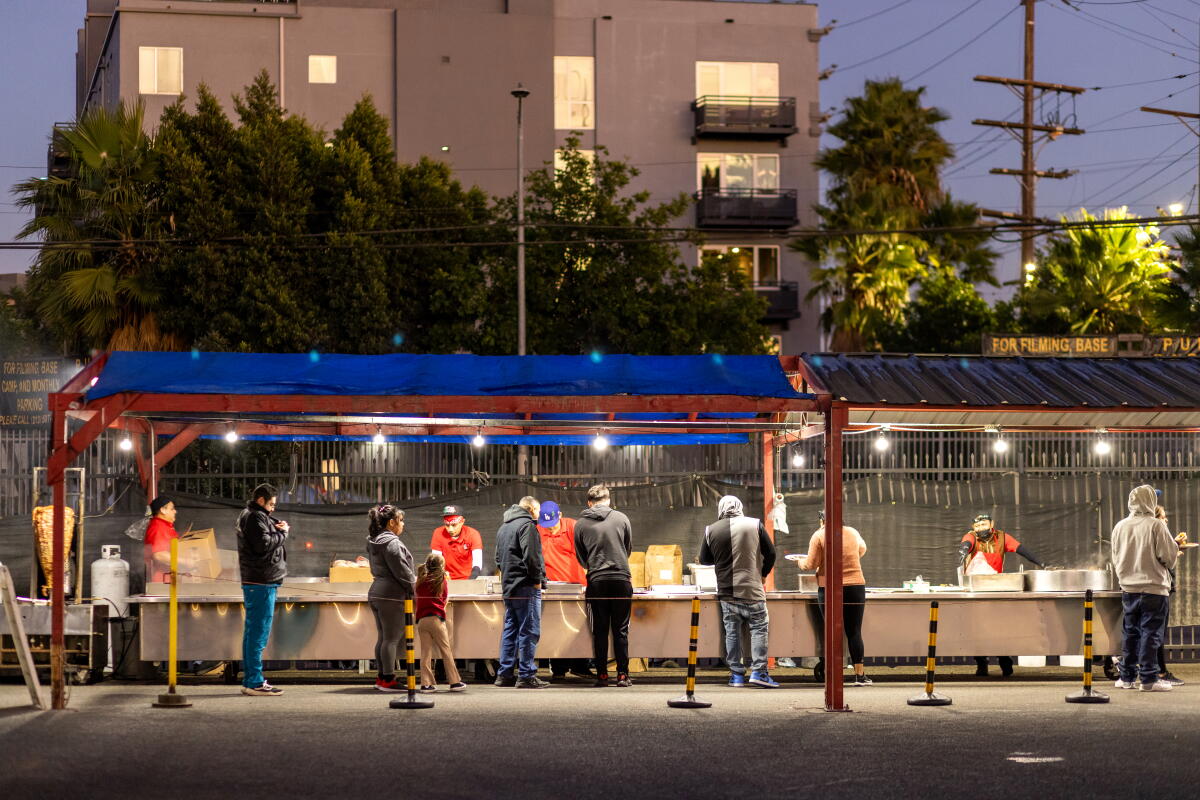
The universal glee of getting tacos

Customers line up at Ave 26 Tacos stand in a parking lot next to the Little Tokyo Galleria in 2024.
(Silvia Razgova)
Picture the moment when a taquero hands you a warm paper plate heaping with warm tortillas and meats on a street in Los Angeles. Do you also get that giddy, kid-like feeling for half a second? There’s nothing like it, right?
Halfway through the Season 9 opener of “Parts Unknown,” Bourdain experiences just that. In a moment you might miss without looking closely, that familiar look flashes on his face, an unbridled glee, as a taquero in downtown L.A. hands him tacos. In that moment he’s not some mythical man known to his best friends as “Tony.” He’s just a guy getting tacos. It’s super cute.
I came upon this episode recently, and it struck me as potently relevant for today, just before the midterm elections. Bourdain’s taco happiness reminded me that even when some sectors of U.S. society are calling for an effective de-browning of this country, everyone everywhere still really loves Mexican food.
Trump does. ICE agents likely do. Even the white ethnonationlists in the government and those cheering on the ICE surge happening right now across L.A. and California, all love to eat tacos, the unofficial culinary emblem of Los Angeles.
It’s worth pointing out that I’m not a Bourdain superfan. I’ve not seen every episode of TV he made. I didn’t read “Kitchen Confidential” until this year. But lately I’ve been studying him. In the past month I finally watched the biopic “Tony” about his coming of age, and I’ve started reading the entertaining memoir “Care and Feeding” by Laurie Woolever, Bourdain’s former long-term assistant and co-author.
I’m catching up on Bourdain because I’ve noticed that as we pass eight years since his death, the author’s cultural influence upon chefs, cooks and food lovers in general does not seem to be waning. It might even be growing.

“He taught me that being a rebel lets you enjoy life,” said Evil Cooks chef and co-owner Alex Garcia, who has an image of Anthony Bourdain tattooed on his leg.
(Daniel Hernandez / Los Angeles Times)
A multitude of chefs or cooks in L.A. have a depiction of Bourdain hanging somewhere in their restaurants, kitchens or homes. Some even on their skin. At least six portraits of Bourdain are on display along the black-clad walls of restaurant Evil Cooks in El Sereno, for example. Chef Alex Garcia has a Bourdain tattoo on his lower leg.
“I love Anthony Bourdain for his rebellious way of being, but also for his love for Mexicanos because he worked for many years with people from Puebla,” Garcia told me after I had dinner there Tuesday night. “He taught me that being a rebel lets you enjoy life, because the end of the day, being yourself, being happy, is the purpose of this journey that we call life.”
This enduring passion for Bourdain also springs from what so much of his television and writing do: Demonstrate an unflagging empathy for almost anyone he met anywhere in the world. Well, almost anyone — he said pretty clearly he’d never share a meal with Donald Trump.
His 2017 episode “Los Angeles” (currently streaming on HBO Max) proves it more than most. It was filmed in 2016, just before the election that took Trump to the White House. It is worth a rewatch before you cast your ballot anywhere.
The program delves into cultural identity, racism, police abuse and corruption and gentrification. Its whole thesis points to the fallacy of being anti-immigrant or anti-Mexican in 21st century America. “Los Angeles, like much of California, used to be part of Mexico,” Bourdain says in the intro. “Now, Mexico, or a whole lot of Mexicans, are a vital part of … us.”
The episode follows Bourdain dining at Indigenous mole specialists Gish Bac with UCLA professor Raul Hinojosa-Ojeda; going for mulitas with photographer Estevan Oriol and tattoo artist Mister Cartoon at the former diner La Reyna (which later became Guerrilla Tacos) on 7th Street downtown; tasting the taquitos at Cielito Lindo on Olvera Street with comedian Al Madrigal and Times columnist Gustavo Arellano; visiting Danny Trejo at Trejo’s Tacos; going to Mariscos El Chente in Inglewood with the Stockton-raised Diaz brothers, and sharing in street tacos with runners from the Boyle Heights Run Club.
“This show will air long after the election,” Bourdain tells Hinojosa-Ojeda at Gish Bac. “There is actually a national conversation now, unthinkable in my lifetime, where the notion of rounding up however many millions of undocumented workers in this country all at once … and then kicking them out. I mean, it seems unthinkable. But, you know, they said that in Europe in the ‘30s.”
In his characteristic tone, grumpy yet hopeful, Bourdain showed he believed in a shared human dignity that superceded all ethnic, national, religious or ideological boundaries.
Listening to him, the prospect of total MAGA Republican rule in all branches of government becomes something like a nightmare that we’ve seen play out in real life. It is a long list of gross constitutional violations targeting immigrants and brown-skinned people, and their supporters like slain U.S. citizens Renée Good and Alex Pretti of Minneapolis, on a daily basis in this country.

People gather at a memorial for Alex Pretti and Renée Good, both shot and killed by ICE agents in Minneapolis.
(Stephen Maturen / Getty Images)
Loving immigrants
On Tuesday, voters nationwide are expected to be thinking first of their pocketbooks and of corruption in Washington when they vote. On another level, this election along with the 2016 and 2024 results are also about litigating by the ballot box what it means to “be” an American.
Sandra Zweig, one of the executive producers on the show, told me Bourdain set out to highlight Latino Los Angeles from the very beginning in 2016. In March of that year, she recalled in an interview, he sent producers the initial list of the cities he was thinking of for Season 9, to start the production conversation.
From that first brainstorming session, Zweig found these notes about a second episode in L.A.: “All-Mexico edition.”
“This time we pretend nobody lives in L.A. who isn’t Latino,” the notes continued. “We live, play in that world without leaving it, we will explore Mexican and Central American immigration, how vital this population is to the SoCal economy.”
Those notes show Bourdain wanted to avoid a recycling of the pastoral mainstream modern narrative on L.A., which isn’t inaccurate but can sometimes feel stale: hyping its multicultural, polycentric, polyethnic etcetera identity. No. This time would be all brown.
“He worked in kitchens and restaurants for so long, he knew as well as anyone that a huge portion of that work staff were immigrants from Mexico and Central America,” Zweig told me. “He also knew that being an immigrant wasn’t a bad thing, to use the word pejoratively was just anathema to him.”
Pop figures like Bourdain and Trejo, despite his recent stumble (he was cast in a film by alt-right extremist Ben Shapiro’s film company), have arguably done a lot more to shape Americans’ perceptions of immigrants and Mexicans than any political leader.
“He would always say, ‘Travel allows you to see people, where they live, and understand where they’re coming from, and reducing that fear for the other.’ For the audience, you’re opening up a world that they may not be able to travel to yourself,” Zweig said. “In 2016, there were things being said about immigrants and immigration that he felt strongly about, and this was one way to discuss that.”
Zweig added: “I can’t predict exactly what he’d say, but it’s clear to me that’d be appalled by the whole sort of immigration enforcement and ICE tactics that’s happening now. That’s not a leap to assume that.”
When I look at the audacity and cruelty of the MAGA right’s stance on immigration, the killings of citizens and immigrants at the hands of ICE agents, I always turn back and remind myself how out-of-step with the nation it is to be anti-immigrant.

Alfonso Lira, 61, a dishwasher and busser from Michoacan, Mexico, sweeps the entrance at Chapter One restaurant in downtown Santa Ana during a double shift in 2024.
(Allen J. Schaben/Los Angeles Times)
Gallup polling is a reliable benchmark on weighing Americans’ views on immigration. At its highest point just last year, the trend line showed 79% of Americans believe immigration is a good thing overall to the country by far. Currently that figure is 73%. Only 21% of Americans believe immigration is a bad thing, its second lowest point since 2002.
Polls and sentiments vary widely from there on how to reform and manage the immigration system — although certainly most people in the U.S. are against current ICE raids, roughly by 2-to-1 — but the basic truth is sitting there before us: The country loves and appreciates immigrants. For most of us, it’s always been about welcoming the stranger, honoring hard work, and contributing to the pursuit of social harmony.
Most of us believe anyone can join the party. There just has to be a better process for it. Political leaders therefore must offer a clear plan not for “mass deportations” but for normalizing people who are here and contributing to society, the economy and the tax base. And more than anything, offer as many people as possible a pathway to citizenship.
If anyone ever tells you they are opposed to any version of this notion, remind them that they are in the minority. Americans favor immigrants by 7-out-of-10, Gallup says. And remind them that as his last love letter to L.A. shows, Anthony Bourdain would have tried to snap them out of it if he’d ever gotten the chance.