Russia has sent a pair of Tu-95MS Bear bombers for a rare visit to Vietnam. Unusually, the aircraft appear to have briefly intruded into Japanese airspace and passed through Taiwan’s Air Defense Identification Zone (ADIZ) along the way. The activity unfolded just 48 hours before Chinese President Xi Jinping, Russian President Vladimir Putin, and U.S. President Donald Trump are due to hold an unprecedented trilateral meeting in Shenzhen, China.
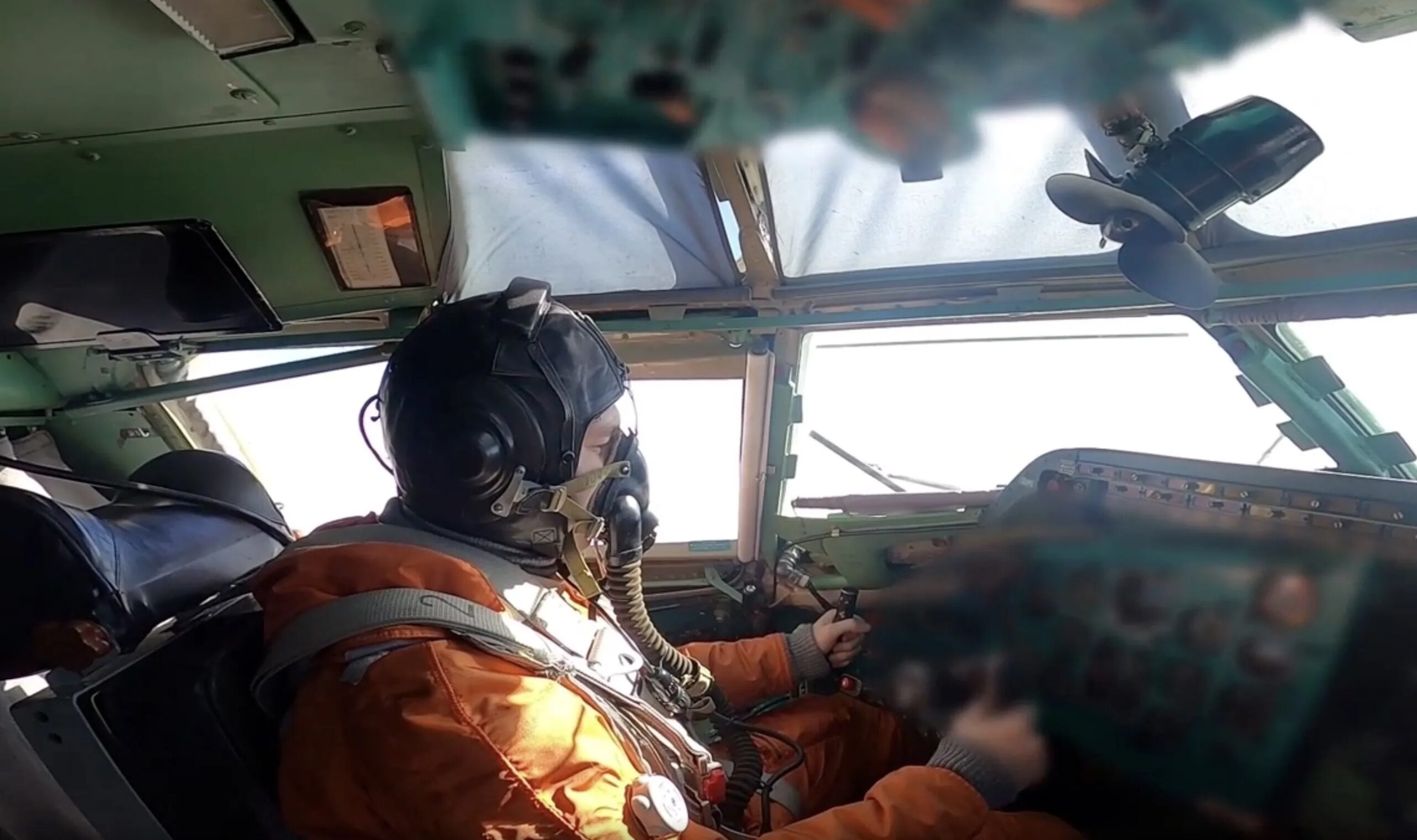
A screen grab from a video shows the pilot of a Tu-95MS during a previous flight over the Sea of Japan on January 21, 2026. Photo by Russian Defense Ministry/Anadolu via Getty Images Anadolu
The Tu-95MS bombers were among several Russian military aircraft conducting extensive maneuvers across Northeast Asia on November 16-17, prompting air defense responses from three regional governments.
According to analyst AviVector, a total of five of the turboprop-powered bombers departed their home base of Ukrainka in Russia’s Far East on November 16.
Three of the bombers reportedly conducted an approximately 11-hour training flight over the Sea of Japan, supported by three Il-78M Midas aerial refueling tankers. An A-50U Mainstay airborne early warning and control aircraft was also reported operating over the Sea of Japan.
Meanwhile, the other two Tu-95MS continued south towards Vietnam.
Today, three Tu-95MS and three Il-78M from Ukrainka Air Base conducted an 11-hour training flight over the Sea of Japan.
An A-50U (RF-94268, 41 Red) from Vladivostok Airport conducted a reconnaissance flight over the Sea of Japan.
Neither Japan nor Taiwan officially identified the aircraft types involved in their respective airspace incidents.
Japan’s Ministry of Defense confirmed that two separate aircraft believed to be Russian violated its territorial airspace northwest of Okinoshima, in Fukuoka Prefecture, early on November 17. The first aircraft entered at approximately 4:07 a.m. local time and departed at 4:10 a.m. A second aircraft entered at approximately 4:09 a.m. and departed at 4:12 a.m.
Two aircraft Japan believes are Russian entered Japanese territorial airspace northwest of Okinoshima, off Fukuoka, early Nov. 17, per Japan’s Ministry of Defense. The first was inside from about 4:07 to 4:10 a.m. local time and the second from about 4:09 to 4:12 a.m. The Japan… https://t.co/Sj7vHUFDMQpic.twitter.com/wYbdE7GWTH
— Taiwan Security Monitor (台灣安全觀測站) (@TaiwanMonitor) November 17, 2026
The Japan Air Self-Defense Force (JASDF) scrambled fighters from its Western Air Defense Force to issue warnings and take other measures, according to the country’s Ministry of Defense. Tokyo subsequently lodged what it described as a strong protest with Moscow over the incident.
Japan also provided details of the aircraft’s subsequent route. After passing through the Tsushima Strait, the planes flew between Yonaguni Island and Taiwan before continuing into the Pacific Ocean.
Flight path of the presumed Russian aircraft on November 17, 2026. Japan Joint Staff Office
The route placed the aircraft through several strategically important maritime approaches connecting the Sea of Japan, East China Sea, and western Pacific.
The Russian aircraft then reportedly entered South Korea’s Air Defense Identification Zone (KADIZ). However, there was no violation of South Korean airspace, according to the South Korean Joint Chiefs of Staff.
Finally, Taiwan’s Ministry of National Defense reported detecting two Russian military aircraft entering its ADIZ from the northeast.
Overall, 2 sorties of Russian military aircraft were detected early this morning. The aircraft entered #Taiwan‘s ADIZ from the northeast, flew through airspace east of Taiwan, and exited the ADIZ south of Taitung. The #ROCArmedForces have monitored the situation and responded…
— 國防部 Ministry of National Defense, ROC(Taiwan) 🇹🇼 (@MoNDefense) November 17, 2026
The aircraft proceeded through airspace east of Taiwan before exiting south of Taitung. Taiwan’s armed forces monitored the activity and responded accordingly, the Ministry of National Defense said.
The incident is notable because Taiwan’s defence ministry publicly identified the aircraft as Russian, rather than simply reporting unidentified military aircraft activity.
As we have reported in the past, Chinese aircraft commonly fly into the southwestern part of Taiwan’s ADIZ. It is, however, worth noting that the ADIZ declared by Taiwan covers not only the entirety of the Strait but also portions of mainland China.
In terms of Russian aircraft operating in Taiwan’s ADIZ, there are historical precedents, but such activity has been greatly reduced since the end of the Cold War. Taiwanese military analyst Chieh Chung told Focus Taiwan that Soviet and Russian military aircraft had previously operated inside Taiwan’s ADIZ in 1986 and January 2010.
The two remaining Tu-95MS aircraft continued south towards Vietnam and were subsequently reported at Da Nang on November 17. They were accompanied by a pair of Il-76MD Candid transports, one of which was a modernized -90A variant, to support the deployment.
[Russie Vietnam] 2 Tu-95MS des forces aérospatiales russes sont arrivés à l’aéroport international de Da Nang (DAD/VVDN), au Vietnam. 2 avions de transport militaire IL-76 (MD et MD-90A) les accompagnaient. (c) AviaNews pic.twitter.com/4bWfFXFOik
The flights took place against the backdrop of preparations for the November 19 meeting between Trump, Xi, and Putin in China. The summit is set to be held on the sidelines of meetings of the Asia-Pacific Economic Cooperation (APEC), which kick off tomorrow. Putin arrived in Shenzhen today. Trump has traveled first to the Philippines as part of a short tour of Asia before heading to China.
The proximity of the Russian operation to the Shenzhen meeting raises questions about the strategic signaling of the Russian flights, particularly as the three governments prepare to discuss nuclear arms control, regional security, and other major international issues.
Trump has indicated that he wants to discuss reducing nuclear arsenals and addressing the war in Iran. The expiration of the New START treaty in February 2026 removed the remaining bilateral limits on U.S. and Russian strategic nuclear forces, adding urgency to the question of future arms-control arrangements.
U.S. President Barack Obama, at left, and Russian President Dmitry Medvedev, at right, shake hands after signing the New START treaty in 2010. Government of Russia
Washington has tempered expectations of an immediate agreement, describing the gathering as an initial opportunity for the three nuclear powers to begin a conversation.
Putin, meanwhile, is expected to seek discussion of Russia’s war against Ukraine and the possibility of a negotiated settlement. Moscow has signalled that Ukraine will remain a priority in its discussions with Washington.
Beijing’s position is more cautious. China has resisted joining trilateral nuclear arms-control negotiations at this stage, arguing that its nuclear arsenal remains substantially smaller than those of the United States and Russia. Xi is also seeking to present China as a central diplomatic actor capable of facilitating dialogue between the other two powers.
An apparent new field of Chinese intercontinental ballistic missile silos identified by Matt Korda and Hans Kristensen from the Federation of American Scientists (FAS) and located near the city of Hami in the eastern end of Xinjiang province, in the northwest of China. Kristensen/Korda/FAS 2021
The timing of the Russian aviation activity is therefore difficult to ignore.
The operation demonstrated the geographic reach of Russian long-range aviation, with aircraft moving from Russia’s Far East through the approaches to Japan and Taiwan before continuing towards Vietnam. The Southeast Asian nation was a regular late Cold War operating location for Soviet naval Tu-95 Bear reconnaissance aircraft.
Of course, as well as strategic signalling, flights of this kind provide valuable long-range training and intelligence collection, including assessment of regional air defense responses.
The November 19 meeting may not produce an agreement on nuclear weapons or other major disputes. Still, the Russian flights underscore the fact that strategic stability in the Indo-Pacific also involves the security concerns of the regional states operating along the approaches to the western Pacific.
The U.S. Air Force is exploring options for adding air-to-air combat capabilities to its bombers as part of efforts adjacent to its latest fighter force structure plans. The service has raised the possibility of the B-21 Raider, specifically, taking on an air-to-air role, and potentially doing so in cooperation with Collaborative Combat Aircraft (CCA) drones, in the past. As TWZ has explored for years, the B-21’s inherent attributes – size, extreme range, high operating ceiling, broadband low-observability (stealthiness), and advanced sensors – could actually make it especially well suited to taking part in air-to-air combat missions. The Air Force’s other bombers could also be part of these future plans.
Aviation Week was first to report on the potential for bombers to help bolster the Air Force’s air-to-air combat capacity after obtaining a copy of a new long-term fighter force structure report submitted to Congress last week. Media coverage of this report first began to appear earlier this week following a roundtable on Tuesday with Lt. Gen. David Tabor, the service’s Deputy Chief of Staff for Plans and Programs. The full report, which is unclassified, was not disseminated to reporters at that time.
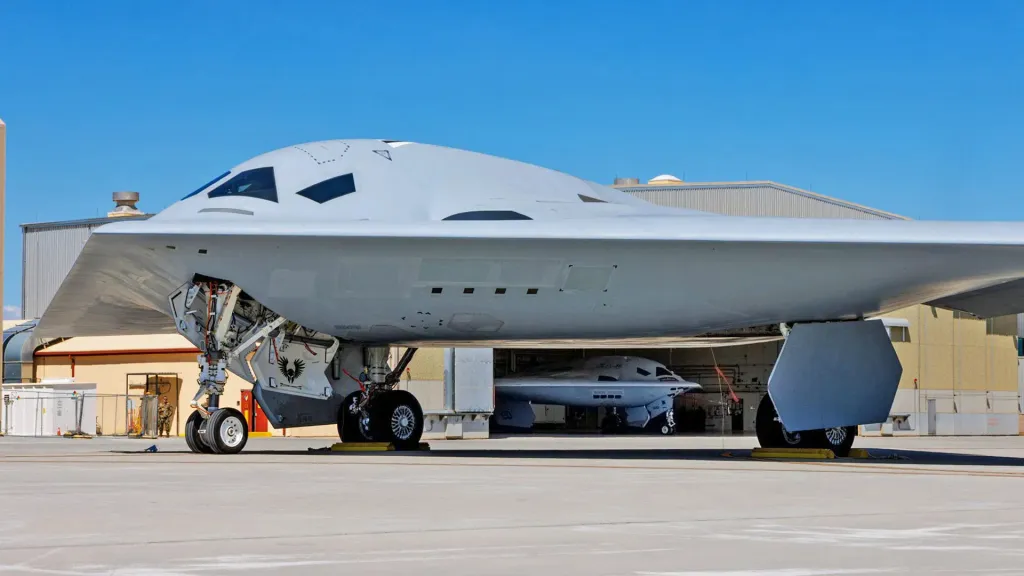
Pre-production B-21 Raider bombers at Edwards Air Force Base in California. USAF
The Air Force’s central goal now is having 1,509 combat-coded fighters in inventory by 2035, which is hundreds more than it has in service today. This will come from the acquisition of new F-35As, F-15EXs, and F-47s. There are already questions about how realistic this plan might be, and the service has acknowledged several hurdles it will need to overcome. You can read more about this in our initial reporting here.
The F-47, a rendering of which is seen here, is a critical component of the Air Force’s current future fighter force structure plans. USAF
“Accordingly, the USAF is also evaluating additional recapitalization options, including a new capacity fighter, increased reliance on CCAs [Collaborative Combat Aircraft], and developing air-to-air capabilities on bombers,” the latest fighter force structure report says, per Aviation Week.
The possibility of the Air Force buying a version of the current-generation Block 70 F-16, an example of which is seen here, has been raised. USAF A Bahraini Block 70 F-16D flown by members of the 416th Flight Test Squadron pulls away after receiving fuel from a KC-135 tanker with a crew from the 370th Flight Test Squadron during asortie out of Edwards Air Force Base in California on March 7, 2024. USAF
At the roundtable on Tuesday, Tabor also made clear that the introduction of CCAs would influence future fighter force structure plans, but the expected scale and scope of those impacts remain unclear. He does not appear to have addressed the role bombers could play in this equation at that time. The new fighter report itself does not elaborate further on the potential use of bombers, based on Aviation Week’s story. TWZ is seeking more information.
When it comes to the possibility of Air Force bombers, and the B-21 more specifically, taking on an air-to-air role, this is not the first time the possibility has been raised, as mentioned earlier.
“As the NGAD [Next Generation Air Dominance] review goes forward, like, is it possible that what that ends up with could be the B-21 taking a larger role?” reporter Stephen Losey, working at the time for Defense News, asked then-Air Force Chief of Staff Gen. David Allvin at the Military Reporters & Editors (MRE) Conference in 2024.
“We have not taken that off the table,” the Air Force’s top officer said in response to Losey’s question, but did not elaborate.
B-21 Takeoff and Landing
At that time, the Air Force’s NGAD program was undergoing a deep review, and the future of the sixth-generation fighter component of the effort had come into question. The decision was ultimately made to continue pursuing plans for what has now become the F-47.
For years now, TWZ has been highlighting how the B-21 could serve in multiple roles beyond just that of a traditional bomber, including in an air-to-air capacity. Air Force officials have themselves described the Raider as having multi-mission capabilities, which could extend into the realm of air-to-air combat.
“If we were to characterize it [NGAD] as a fighter, we would be… thinking too narrowly about what kind of airplane we need in a highly contested environment,” then-Air Force Maj. Gen. Scott Pleus told what was then just Air Force Magazine back in 2019. This could be “a B-21 that also has air-to-air capabilities” and can “work with the family of systems to defend itself, utilizing stealth – maybe that’s where the sixth-generation airplane comes from.”
Pleus’ comments had tied in with adjacent discussions at the time and thereafter about how the B-21 might operate together with future CCA drones. Pleus, who was subsequently promoted to lieutenant general and whose lasting posting was as Director of Staff at the Air Force’s top headquarters at the Pentagon, retired in August of this year.
A composite image showing the two drones – General Atomics FQ-42 Vengence and Anduril’s FQ-44 Fury – that the Air Force is acquiring now under the first phase of its CCA program. USAF
It remains unclear how the Air Force might be considering employing the B-21, or any of its other existing bombers, in air-to-air combat. This could entail loading out bombers for direct air-to-air engagements, or the integration of new capabilities to help them find targets or to otherwise enable new supporting roles, or a mix of all of the above. The process of achieving air superiority is not limited to neutralizing aerial threats, either.
As TWZ has written in the past in the context of an air-to-air role for the Raider in particular:
“The Raider has the potential to serve as a launch platform for air-to-air missiles, especially outsized very long-range types. Its payload capacity would give it the ability to carry a large volume of smaller air-to-air missiles, as well. B-21s could also employ air-to-ground munitions in support of the suppression and destruction of enemy air defenses mission (SEAD/DEAD), which is also part of the air superiority equation.”
“Maybe most significantly, the B-21s could also act as airborne nerve centers in support of counter-air missions, especially for controlling drones like the Air Force’s planned fleets of Collaborative Combat Aircraft (CCA), and have the ability to do so even in the most heavily contested of airspaces. Uncrewed aircraft, in turn, could feed targeting data back to Raiders with air-to-air loadouts. B-21s might even be able to launch some of those drones themselves.”
A head-on view of the first pre-production B-21 Raider. USAF
Deeply networked ‘kill webs’ that bring together distributed arrays of sensors and other supporting elements across vast distances and multiple domains, coupled with very-long-range air-to-air missiles, open up new operational possibilities more generally. This applies to Air Force bombers beyond the B-21.
When it comes to longer-range air-to-air missiles, the Navy has notably already fielded the AIM-174B air-launched version of the Standard Missile-6 (SM-6). The service more recently disclosed another such missile in flight testing now, the AIM-424 Malice.
A US Navy Super Hornet fighter seen carrying a load of AIM-424 missiles during a flight test. USN
There is also the Defense Advanced Research Projects Agency (DARPA) LongShot program, which the Air Force, as well as the U.S. Army and Navy, have been involved with over the years. The aim of that effort is to demonstrate the concept of an air-to-air missile-carrying drone to help extend the reach and reduce the vulnerability of tactical fighters and bombers.
A rendering depicting LongShot drones being launched from a B-52 bomber, as well as F-15 fighters. General Atomics
On top of all this, tactical fighters are generally ill-suited to, and in some cases outright incapable of, carrying the kinds of outsized payloads being discussed here. This underscores the potential value of incorporating bombers into this equation as a means to engage targets at extreme ranges.
Even in a closer proximity support role of fighter aircraft, B-21s, as well as B-52s, could contribute to air-to-air fight as arsenal ships for longer-range weapons, firing on demand from the rear in coordination with crewed and uncrewed platforms operating at the tip of the tactical edge. B-21s could also use their penetrating capabilities to command drones of their own that provide penetrating fighter-like capabilities.
New air-to-air capabilities on Air Force bombers could include self-protection systems, too. Years ago now, the B-21’s prime contractor, Northrop Grumman, patented an anti-missile defense system for stealthy aircraft designed to fire hard-kill interceptors. The Air Force, as well as the Navy, have openly expressed interest in similar defensive capabilities for aerial refueling tankers and other larger planes. Just being able to provide localized close-in defensive ‘bubbles’ around individual bombers could impact the calculus when it comes to future air-to-air combat requirements.
Drawings from Northrop Grumman’s aircraft anti-missile defense system patent. USPTO
Speaking more broadly about Air Force future fighter force structure demands, as we wrote previously:
“In recent years, sustainment costs, broadly, have only become an increasingly serious concern for the Air Force, as well as the other branches of the U.S. military, especially when it comes to complex manned platforms, such as the F-22 Raptor and the F-35 Joint Strike Fighter. Fleet size and the readiness of those fleets are also highly pressing issues. So, at least in the near term, it’s not surprising that NGAD may end up focusing more on exploring available lower-cost options with distributed capabilities as alternatives to traditional air combat assets with highly centralized capabilities, such as manned fighter jets packed with ‘exquisite’ technologies.”
Despite the decision in the end to proceed with the more exquisite F-47, these points have only become more pronounced as time has gone on. How many F-47s the Air Force ultimately intends to buy is another question that looks to remain unanswered by the latest fighter force structure report. At the same time, there are clear signs that the Air Force is planning to significantly increase its planned B-21 fleet size. The official acquisition target has long been at least 100 Raiders, but the Air Force and Northrop Grumman have said a new topline figure is expected to come in the Fiscal Year 2028 budget proposal next year. The service is now explicitly aiming to have at least 500 CCA drones in service by 2032, too. All of this will compete for funding and other resources, at least to a degree.
A pre-production B-21 seen during a test flight. USAF
In the meantime, there has been a “persistent decline in AA [aircraft availability] rates across the USAF tactical fighter fleet,” which “is the direct mathematical consequence of operating an inventory with an average age exceeding 31 years,” the Air Force’s latest fighter force structure report says, according to Aviation Week. “As legacy platforms – such as the F-16C/D, F-15E, and A-10C – operate well beyond their original engineering service lives, they experience compounding structural fatigue, widespread corrosion, and subsystem degradation.”
“Achieving the mandated AA rates required for a peer-conflict scenario necessitates aggressive divestment of the oldest airframes to fund the procurement of highly available, modernized platforms like the F-35A and F-15EX,” the report adds, per that outlet. Furthermore, “to counter the [Chinese] industrial capacity and numerical advantage in fielding fighters like the J-20 and J-16, the USAF must embrace a hybrid force of manned and unmanned systems.”
A Chinese J-20 fighter. PLAAF
With all this in mind, active consideration of new air-to-air roles for bombers, as well as the possibility of “increased reliance on CCAs” and the potential to acquire new current-generation F-16s, at least seems to reflect a hedge strategy on the part of the Air Force.
If nothing else, the door clearly remains open to bombers being a key part of the Air Force’s ‘fighter’ vision in the future.