body

Infantino must go by 2027 in FIFA overhaul, Dutch football body says | Football

KNVB invites associations and confederations to a summit to discuss the overhaul of FIFA and how it runs football.

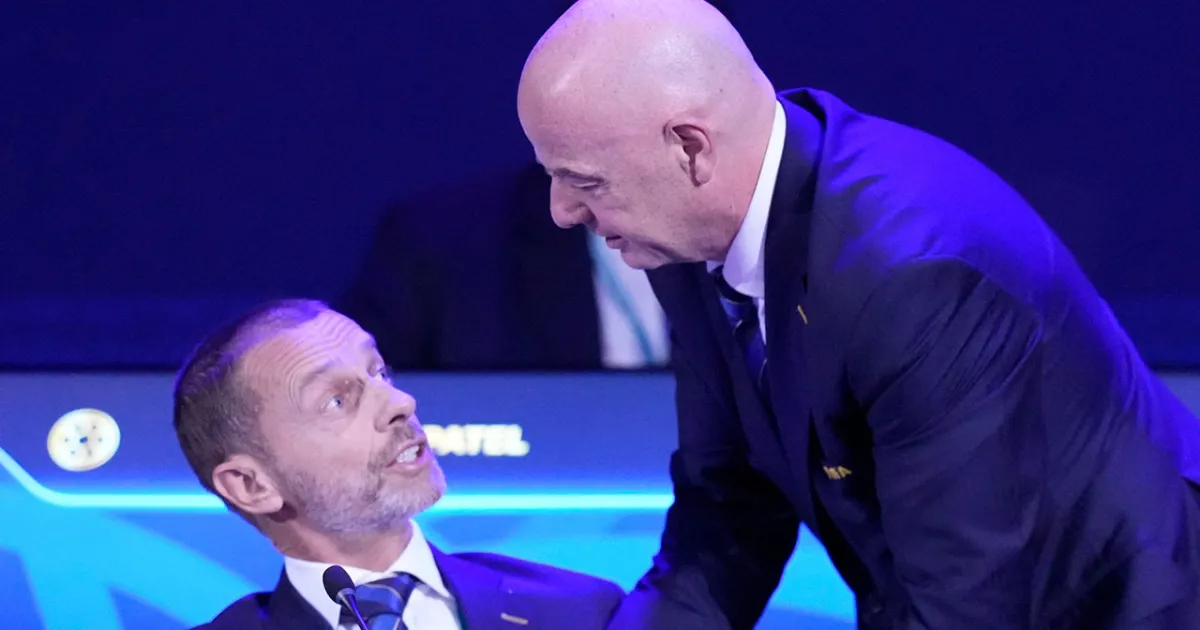
FIFA president Gianni Infantino must be replaced by 2027, along with an overhaul of football’s global governing body, the Dutch football association (KNVB) has said.

The KNVB, one of FIFA’s ⁠⁠founding members in 1904, issued a scathing statement on Sunday, saying it had lost confidence in Infantino and wanted to reshape the body rather than just change leadership at the top.

The Dutch body wants to host ⁠⁠an international summit in Amsterdam and has invited football associations and confederations from around the world to participate.

Infantino is expected to run for re-election to the FIFA presidency in March, but world regional football bodies have considered a vote of ‌‌no confidence after his aborted proposal to sell a stake in FIFA events like the World Cup to private equity investors.

“The KNVB no longer has confidence in the leadership of FIFA President Gianni Infantino. We believe FIFA needs new leadership from 2027 onwards,” it said in the statement.

“But a new president alone is not enough. The way FIFA is governed must change as well.

“The KNVB supported Infantino in the most recent presidential election. That support was never ⁠⁠unconditional.”

The KNVB proposed an “International Summit on the Future of FIFA”, ⁠⁠emphasising it should determine “what kind of FIFA we want” before identifying new leadership.

“We see too much power concentrated around the FIFA president and insufficient separation between the President and the FIFA administration,” they added.

FIFA did not respond to Al Jazeera’s request for a comment on KNVB’s statement and proposed plans for a summit.

Calls to revamp FIFA’s power structure

Among KNVB’s key demands was a revamp of the decision-making process in the organisation. It called for FIFA’s congress to take the call on key decisions under the governance and supervision of its council.

It proposed a shift of power, whereby the organisation’s secretary-general leads and the president plays the role of representing FIFA globally.

The Dutch body outlined three reform priorities: better governance with stronger checks and balances, putting human rights and sustainability at the heart of ⁠⁠decision-making and stronger international cooperation.

It also wants FIFA to work towards ⁠⁠reinvesting up to 90 percent of its distributable revenue in football development.

Infantino said last week it was FIFA’s job to close the gap between its wealthy members and those that have few financial resources.

“This should not be a European plan for the ‌‌rest of the world,” the KNVB said.

“We want to develop this new direction together with FIFA’s 211 Member Associations and the confederations from all parts of the world.”

The KNVB is part of ‌‌UEFA, ‌‌which asked a United States federal court for permission to obtain testimony and documents from FIFA entities in Florida for use in a planned criminal complaint in Switzerland against Infantino.

Source link

Shohei Ohtani still ‘not 100%’ and remains uncertain to pitch Sunday

Shohei Ohtani is not feeling “100%,” manager Dave Roberts revealed before the Dodgers game against the Tigers on Saturday. And that will be at the center of the team’s conversation about whether to start him Sunday.

It would be Ohtani’s first pitching start since July 3. He’s been just serving as the designated hitter in the meantime, while managing lingering inflammation and soreness in his left knee, primarily aggravated by pitching. But it’s not just his knee that’s ailing him, Roberts said after talking to the Dodgers training staff. His biceps issue from earlier in the year is part of the concern as well.

Ohtani threw a 20-pitch bullpen — shorter than his customary between-starts session — on Friday to tentatively set him up to throw the first inning Sunday.

“The knee, the body, just throwing, pitching, not 100%,” Roberts said. “What percent it is, I don’t know the answer.”

Roberts said he wanted to have clarity after the game Saturday, so he could notify Tigers manager A.J. Hinch and right-hander Tyler Glasnow, who is set to pitch Sunday either way. If Ohtani pitches Sunday, it would be opening for Glasnow.

“I’m not going to ambush those guys, and I’m not going to ambush Glas,” Roberts said. “So I think I would say that after the game, we’ll know definitively.”

If Ohtani doesn’t pitch Sunday, Tuesday, likely before left-hander Eric Lauer, could in theory be an option. But if Ohtani doesn’t feel good enough to start Sunday, two extra days of rest probably aren’t to resolve the issue, making a longer leadup more likely.

“We’re still thinking about potentially the buildup and what that would mean, which is fair,” Roberts said. “But at the end of the day, it’s what’s best for Shohei, what’s best for us, what makes the most sense. That’s kind of where we’re at.”

The longer it takes for Ohtani to return to the mound, the fewer starts he’ll have to build up before the postseason.

“I wouldn’t bet against Shohei,” Roberts said. “But I still think that five innings to the end of the season is aggressive for anyone.”

Though Roberts said the question is more “when,” rather than “if,” Ohtani will return to the mound, the fact that Ohtani’s knee issue (and apparently biceps as well) has not yet resolved calls into question whether it makes sense for him to resume two-way duties this late in the year.

“To be quite frank, I just don’t see everything getting to 100% by the end of the season,” Roberts said. “But there’s a lot of pitchers that are not 100% and still viable. So again, it’s just not an exact science.”

If that holds true, the concern is twofold: both how Ohtani’s health could affect his performance on the mound and at the plate.

“Obviously, where we’re at right now with the pitching, the starting pitching certainly being a strength, his value offensively is hugely important, and so we can’t compromise that in any fashion,” Roberts said. “So, if throwing potentially cuts into that, that’s not worth the squeeze. So that’s something, for me, I’m very bullish on making sure we don’t compromise the hitting.”

Ohtani entered Saturday with a .218 batting average since Aug. 8, when he resumed playing catch. But Roberts pushed back on the impulse to draw a line between Ohtani’s recent offensive dip and his side work on the pitching side.

“It just hasn’t been a whole body of work on the throwing side,” Roberts said. “Honestly, for me, I think the pitch selection hasn’t been good.”

Regardless of Ohtani’s status for Sunday, the superstar’s feedback will continue to play a large role in the Dodgers’ decision-making.

“I think that as the competitor, he wants to do both, and I respect it,” Roberts said. “But nothing I’m saying changes his identity as a two-way player.

“I think in the moment, he still feels that there’s still an opportunity, and I’m not trying to say there isn’t. But I do think that at the end of the day, he’s very aware of our roster, strengths, weaknesses, and his value to the ball club, and whatever that means.”

Source link

One Shot: After the music, this was Lee Sung Jin’s favorite part of making ‘Beef’

“Other than the needle drops, this is probably my favorite part about making ‘Beef,’” says creator Lee Sung Jin of the show’s episodic title cards, which in Season 2 marry historical paintings with abridged quotations from authors and poets. For the finale, which sees its two feuding couples (Carey Mulligan, Oscar Isaac, Cailee Spaeny and Charles Melton) swept up in a seemingly inescapable fight for survival, the paintings of Giuseppe Arcimboldo’s “The Four Seasons” matched with the title “It Will Stay This Way And You Will Obey,” a reference to a passage in Marion Woodman’s “Coming Home to Myself: Reflections for Nurturing a Woman’s Body & Soul.” “It’s almost prisonlike because these very prominent faces of literally nature have created this wall that the title is stuck in. We wanted to express the cycles and how the four seasons come for you no matter what,” Lee says, alluding to the season’s central idea that people often repeat the same destructive habits. “The final shot is homage to the Buddhist concept of samsara. It was important for us to allow the audience to take a moment after all the craziness of the season to think about their own lives, think about society at large … and depending on where you are, come to your own conclusion.”

Source link

Dua Lipa shows off her incredible bikini body on girls holiday

DUA Lipa has shown off her incredible figure as she shared a slew of bikini snaps from a girls trip abroad this week.

The singer has been spending the last few days in Portofino on a girls’ trip to celebrate her pals’ engagement.

Dua Lipa has shown off her toned abs in new bikini snaps from her girls’ trip to Portofino Credit: Instagram.
The star soaked up the sun in a striped two-piece, posing for the camera Credit: Instagram.

And sharing pictures from the getaway, Dua showed off her toned torso as she posed in a striped colourful bikini.

In the carousel of snaps, the singer lay on a sunbed while smoldering to the camera.

She also shared selfies with her pals as they soaked up the sun at the five-star Splendido, A Belmond Hotel.

The trip comes after she tied the knot with Callum Turner over the summer in a stunning Italian wedding.

VICK’S VERDICT

Vicky Pattison hits out at ‘millionaire’ trad wife influencer


SHARON’S FURY

Sharon Osbourne accuses ‘dry old c**t’ rocker of giving Kelly drugs as a teen

Dua captioned the post ‘Baci’, which means ‘kisses’ in Italian Credit: Instagram.
It comes as her husband, Callum Turner, opened up on their wedding for the first time this week Credit: dualipa/Instagram

The smitten couple legally tied the knot at Old Marylebone Town Hall

They later celebrated their wedding with a huge three-day celebration in Italy, attended by stars including Elton JohnCharlie XCX and Mark Ronson. 

And Callum spoke out on the nuptials for the first time this week, telling Esquire of the first legal ceremony: “It was amazing, and it was… it was the most beautiful day of my life.”

He added that it’s a “weird feeling” that so many people across the world are talking about them getting married. 

Callum said: “We went to the park yesterday, and everyone who walked past said, ‘Congratulations’. It was pretty surreal.”

On the subject of having children, he continued: “Obviously, yeah, I’m 36. I’d like to have a family and raise some kids.”

Source link

Strictly’s Motsi Mabuse, 45, shows off her curves as she reveals how she transformed herself after a full body check-up

STRICTLY Come Dancing judge Motsi Mabuse covers herself in glory as she poses for a magazine.

The 45-year-old is on the cover of the new edition of Women’s Health UK.

Motsi Mabuse stuns on the cover of Women’s Health UK Credit: Ian Harrison / Women’s Health UK
Motsi Mabuse reveals she was at risk of type 2 diabetes after a full body check-up Credit: Ian Harrison / Women’s Health UK

She tells how she transformed herself after a full body check-up, saying: “My doctor said, ‘Mrs Mabuse, you can’t continue like this.’

“My parents and grandparents have type 2 diabetes and I had gestational diabetes when I was pregnant, and my doctor said, ‘The numbers show that you’re at risk.’

“He said, ‘If you want to stay healthy in the long term, we need to make some changes.’”

The full interview is available in the September issue of Women’s Health UK.

THIS MORNING MAKE OVER

This Morning star reveals different look as he watches The Weeknd


TOUGH TIME

Great British Bake Off winner reveals ‘frightening’ health diagnosis

Motsi has previously spoken about her health routine.

While many celebrities have been reaching for the fat jabs to drop the pounds, Motsi has opted for good, old-fashioned nutritious food and exercise.

And it’s not just looking her best on TV that has sparked her motivation to get fit. She has another unusual reason for wanting to get in shape, too.

“The main one is menopause,” she says.

Motsi stuns in the magazine shoot Credit: Ian Harrison / Women’s Health UK
The full interview is available in the September issue of Women’s Health UK Credit: Ian Harrison / Women’s Health UK

“I hate the fact that every podcast or everything I see online about it is based on fearmongering. I’ve never heard anyone say, ‘Don’t worry, it’s not that bad!’

“I even asked Shirley Ballas. ‘Will it be OK?’ and she shook her head, saying, ‘No, it’s going to be a ride!’

“I am preparing for what may come,” Motsi explains. “I want to be ready. I’ve done an overhaul of my diet. I’m doing weights and building muscle. I’m eating nuts, fruit and salad.

“I’m going to the sauna three times a week, as it helps reduce your cortisol levels. I find ice baths are good for my mental health, too.”

Source link

The warming climate is forcing marathons to consider changes to keep runners cool

Paul Grinvalds has completed 114 marathons in all 50 states, but he still wilts when he races in temperatures beyond 60 degrees.

It’s the same for most runners, as the body can’t cool down during exertion, and heat makes that even harder.

“One thing about marathoners is typically we’re kind of stubborn,” said Grinvalds, 68, from West Des Moines, Iowa, who finds even temperatures in the 50s a bit warm. “So if we have a goal and it’s hot, a lot of times we’re still going to try to do that goal, which is just stupid because you’re almost guaranteed to have a very painful experience.”

Such an experience can also be dangerous, a reality that marathon organizers are having to confront as climate change, caused mostly by the burning of fuels like coal and gasoline, pushes temperatures up. To improve the chances of having the 26.2-mile race in cooler weather, organizers are shifting race dates, starting earlier and even giving options for participants to cut their runs short.

Starting in 2027, the Twin Cities Marathon in Minneapolis-St. Paul will shift its more than 40-year tradition of holding the race on the first Sunday in October to later in the month. That decision comes after cancellation of the marathon in 2023 because of record heat and humidity, and starting temperatures near 70 for the 2025 race.

Organizers of the Sioux Falls, South Dakota, marathon last year similarly moved their annual race from August to September after canceling the 2024 race due to hot conditions. And other races, including the Air Force Marathon in Dayton, Ohio, the Little Rock Marathon in Arkansas, and the Long Beach Marathon in Southern California, all moved their start times to earlier in the morning in search of cooler temperatures.

In Los Angeles in March, warm conditions prompted race organizers to give runners the option of stopping after 18 miles and still receiving a finishers medal. Less than 5% of participants opted for the shorter finish and only 14 of roughly 27,000 runners were treated at a hospital, with all released the same day. Still, the move led to some online derision.

“We welcome the feedback and it’s certainly something that caused a lot of discussion, but when we’re grading ourselves on it, it has to do with how safe our runners were on the day of the event and we’re very happy with the outcome,” said Meg Treat, a spokesperson for the marathon.

At the Twin Cities Marathon, race director Ed Whetham called the decision to cancel the 2023 marathon “devastating” for runners and the organization. Whetham said it prompted an extensive analysis of weather patterns that resulted in the decision to permanently delay the race by a couple weeks.

That analysis showed that by holding the race later in October, runners would have a far greater chance of optimal conditions. Given that snow sometimes falls in the Twin Cities in late October, there is a greater chance of chilly conditions, but Whetham said, “We’ll take a 39-degree start over a 70-degree start.”

Temperatures are expected to keep rising

The contiguous U.S. just had its warmest July ever recorded, and the Earth had its hottest year on record in 2024. The World Meteorological Organization forecasts that between 2025 and 2030 the Earth’s average global temperature will likely rise by more than 2.7 compared to the 1800s.

The warming is already making conditions worse for most marathons, according to a study of 221 races by the climate research group Climate Central. By 2045, optimal conditions for recreational runners — in the low 40s — would be less likely at 46 of the 51 U.S. marathons analyzed.

“The ability to go outside, to exercise, to take advantage of your human body and being healthy, that’s something that’s getting challenged by climate change,” said Andy Pershing, who led the Climate Central research.

Jessica Murfree leads a University of North Carolina-Chapel Hill lab studying climate change’s effect on sports. She said organizers of marathons, bicycle races and other competitions — from tennis to college football — increasingly must consider changing event dates and times and adopting other safety measures, as climate change makes the weather hotter and more volatile.

Murfree said the concern extends beyond organized sports to whether people can even get outside on increasingly warm days, pushing people to exercise indoors or opt for activities like swimming.

“If we can’t walk, if we can’t exercise or go for runs, it’s too hot, can we still stay physically active while remaining cool?” she asked.

Marathons are especially hard in warm weather

Any kind of exercising in the heat can be challenging, but running a marathon in warm, humid conditions is especially difficult because it’s hard to prevent overheating when a person keeps pushing themselves for hours. And the faster a person goes, the more heat their body produces.

Chris Minson, a University of Oregon professor who researches how people can adapt to extreme heat and other environmental conditions, said the optimum temperature to run a marathon is about 50 degrees. As the temperature creeps into the upper 50s and 60s, the body has a tougher time supplying blood to muscles while also keeping the body cool.

“As you get to warmer temperatures you end up having a bigger competition between blood supplying your muscles to keep running, to keep nutrition going, and blood flow to your skin for thermal regulation,” Minson said.

Minson said it takes a tremendous amount of energy to run quickly. But of that energy, only about 25% is used to move the body forward. The rest goes to deal with the heat that is created by rapid movement.

Even worse than high temperatures is high humidity, which prevents sweat from evaporating and cooling the body.

Minson adds, though, that by regularly exercising in warm weather, people can acclimate to high temperatures and perform better in the heat, though likely not as well as they would in cooler conditions. Athletes who acclimate to high heat also can perform better in lower temperatures than if they hadn’t exercised in warm weather, he said.

Some athletes like John Seals even run in the midday heat and endure a sauna after a workout to acclimate their bodies. That all forms part of Seals’ training for an annual 135-mile ultramarathon held in July in Death Valley, California.

“We had a heat wave this week and for me, that’s a great thing,” said Seals, of West Des Moines.

Still, running in the heat can be dangerous without taking precautions.

Douglas Casa, a kinesiology professor who leads the Korey Stringer Institute, which studies sudden deaths in sports, said the Twin Cities Marathon’s change was prudent, especially considering the way in which many runners approach races.

“If someone was smart enough to say, ‘OK, it’s a little hotter today than usual, I’m going to run a 7 minute mile instead of a 6:30 mile,’ then they won’t get any hotter than normal,” Casa said. “It’s just that runners are sometimes very locked into what they normally do and what their goals are.”

McFetridge writes for the Associated Press. The Associated Press’ climate and environmental coverage receives financial support from multiple private foundations. AP is solely responsible for all content. Find AP’s standards for working with philanthropies, a list of supporters and funded coverage areas at AP.org.

Source link

EastEnders star Shaheen Jafargholi unveils body transformation eight years after exit

Former EastEnders star Shaheen Jafargholi, who played Shakil Kazemi on the BBC soap, shocked fans when he took to social media and posed topless to show off his ripped appearance

Former EastEnders star Shaheen Jafargholi has shocked fans with his appearance – almost a decade after he left the BBC soap. The actor, 29, played Shakil Kazemi from 2016 until 2018, with his alter-ego leaving Walford in explosive scenes which saw him stabbed to death as part of a hard-hitting knife storyline.

The former soap star recently took to Instagram to share a series of snaps of himself topless whilst attending a music festival, and, in one photo he posed confidently as he looked to his left and showed off his toned physique.

In another snap, the TV star was seen rolling on the grass as he cuddled his dog. He did not caption the post, but fans were taken aback by his appearance.

One wrote: “Well then [fire emoji],” and another said: “Phoaar!” A third wrote: “You’re looking very nice and slim in this Photo,” and a fourth said: “gorgeous!!”

Following his time on EastEnders, he enjoyed a five-year stint as Marty Kirkby on Casualty and later this year, he will be seen in Sky legal drama War.

When Shaheen left EastEnders, he said: “It’s going to be weird – I’ve been there for two years now and made so many incredible friends and family.

“Like anything all good things come to an end, it’s the nature of these kind of shows, characters come and go I feel so blessed to be able to leave with such an incredible storyline that means so much.”

Shaheen initially found fame when he competed on Britain’s Got Talent in 2009 alongside Susan Boyle and Diversity, and has so far released two albums. Shortly after impressing Simon Cowell, Amanda Holden and Piers Morgan on the ITV1 talent show, and reaching the final, he was selected to perform at Michael Jackson’s funeral.

He sang Who’s Lovin’ You again and, according to the late US talk show host Larry King, the founder of Motown Records, Berry Gordy, said “If I were still in the business, I would sign him tomorrow.”

Shaheen previously recalled: “When I was walking I wasn’t thinking about anything other than the way to get there. So I just walked out and did it. When I opened my mouth to sing, I was fine.

“When I sing I go into a totally different world. I feel invincible. I feel nobody can touch me and I can do whatever I want to do. It wasn’t until I’d finished that I realised what I’d just done.”

Like this story? For more of the latest showbiz news and gossip, follow Mirror Celebs on TikTok , Snapchat , Instagram , Twitter , Facebook , YouTube and Threads .


Source link

ICE will release body camera video only when in its ‘best interests’

Immigration and Customs Enforcement is moving to equip officers with body cameras in the next two months, but the agency’s policy gives it broad control over what footage will be made public by specifying any releases must be in its “best interests.”

After years of delays, ICE said its field officers nationwide will have body-worn cameras by the end of September. The rollout comes after recent fatal shootings by officers enforcing President Trump’s immigration crackdown have intensified pressure for accountability that the cameras could provide.

But the agency’s policy could mean taxpayers who are pitching in tens of millions of dollars to pay for the cameras may be kept in the dark about some high-profile confrontations — at least in their immediate aftermath.

The policy says ICE will promptly release video of shootings and other encounters in which its agents cause death or serious injury only after determining “it is in the best interests of the agency” to do so. That gives its director discretion to release recordings that reflect well on the agency’s image while working to keep others secret, experts on body camera policies said.

Such selective releases are routine in some law enforcement agencies but usually not stated so clearly in policy, according to Christopher Schneider, a professor at Brandon University in Canada and a co-author of the book “Police Body-Worn Cameras: Media and the New Discourse of Police Reform.”

“In some ways, ICE is saying the quiet part out loud,” he said. “Body-worn cameras are being used as contemporary image-work tools to present the police to the public in the most favorable way possible.”

The policy requires officers to activate cameras during routine enforcement activities, including while making arrests, executing search warrants and responding to emergencies.

After shootings or other serious confrontations, a committee that includes top ICE officials and lawyers will review footage and recommend whether to release it promptly, according to the body camera policy issued in February 2025.

If the answer is yes, the recording could be released within 72 hours. But if the ICE director finds that “specific and compelling circumstances” justify withholding the video, they have the authority to block or indefinitely delay the release, the policy says.

The policy does not elaborate on such circumstances, and ICE did not respond to a question about how it would make such decisions.

Practices vary widely in the U.S. In Chicago, a police watchdog agency routinely releases body camera video of shootings and other serious use-of-force incidents within 60 days. In Philadelphia, the police department very rarely uses its discretion to release video of specific incidents and has no policy for when to do so.

Even when footage is released, ICE’s policy will require the redaction of all officers’ identifying features such as their faces, names and badge numbers to preserve their privacy.

Schneider, who has studied body cameras since their use began spreading a decade ago, said he does not expect ICE to release footage of fatal shootings like those last month in Houston and Maine.

He noted ICE’s sister agency, Customs and Border Protection, has not released footage of the January shooting of Alex Pretti in Minneapolis even though it was captured on agents’ cameras. CBP Commissioner Rodney Scott told lawmakers in February that the video and other materials were under investigation and would be made public “when it’s appropriate.”

ICE spent $30.9 million in July to purchase body camera equipment from Axon, the Arizona-based company that also manufactures Tasers, according to federal spending records.

The spending began one day after the fatal shooting of a 25-year-old motorist in Maine by an ICE officer with a history of violent behavior. Days earlier, another ICE officer shot and killed a home-builder in Houston who was driving to work.

Neither shooting was recorded with body cameras. That news angered members of Congress, who had given ICE $20 million to purchase body cameras in a bill passed to end a partial government shutdown April 30.

ICE said body cameras have been sent to more than half its field officers and the rest will receive them by the end of September. That timeline pushes back estimates from earlier public statements. Maine Republican Sen. Susan Collins, who backed funding for cameras, said last month that the agency informed her they would be deployed by the end of August. ICE had said earlier that they would be issued by mid-September.

ICE officers working in the Houston area, where the agency sent more than 800 cameras, are among those who have started training, according to Rep. Henry Cuellar, a Texas Democrat and member of the House Appropriations Committee.

At least one member of every arrest team will be required to have a camera, the agency said.

“I think the American people need to see what that officer sees and hears,” said White House border czar Tom Homan on July 19 on CBS News’ “Face the Nation.” “And if you look at the data, body cameras actually exonerate agents more than they, you know, provide evidence of wrongdoing.”

ICE began testing body cameras in 2021 during the Biden administration and distributed 1,400 devices three years later, saying use would expand as funding became available.

After returning to office in 2025, President Trump rescinded a Biden order that required federal law enforcement agencies to use body cameras.

ICE did not buy body cameras even after it received a historic $75-billion infusion in Trump’s signature policy bill in 2025 and began hiring thousands of new officers. The two July purchases from Axon were made through an existing government contract that began in 2023, records show.

“This is not hard to deploy, but they’ve slow-rolled it,” said Jason Houser, who was ICE chief of staff under President Biden and helped implement the agency’s pilot program.

Houser said the Trump administration should have equipped officers with body cameras when it expanded mass arrests and traffic stops. Doing so only after several shootings and pressure from Congress “is clearly a political response” that will not make officers or the public safer, he said.

“This doesn’t fix the problem of putting officers in a place where they’re not trained or equipped to carry out the style of operations that the administration is asking them to do,” he said.

Foley writes for the Associated Press. AP reporter Valerie Gonzalez contributed to this report.

Source link

Israeli forces kill one in Gaza as another body recovered from rubble | Benjamin Netanyahu News

Gaza Health Ministry says hospitals receive bodies of two Palestinians as Netanyahu rejects Trump plan to end war.

Israeli attacks on Gaza have killed at least one person as Palestinian health authorities have confirmed another death after a body was recovered from beneath the rubble in the war-shattered enclave.

Israeli forces shot and killed one Palestinian east of Deir el-Balah in central Gaza on Saturday, the Qatar News Agency (QNA) reported, quoting medical sources.

Recommended Stories

list of 3 itemsend of list

The Gaza Ministry of Health confirmed on Sunday that hospitals had received the bodies of two Palestinians killed in Israeli attacks, including one recovered from the rubble.

At least five people, including children, were wounded in Israeli attacks in the southern cities of Khan Younis and Rafah on Saturday, QNA reported.

Local sources said several people were wounded when an Israeli tank opened fire on tents sheltering displaced people in Khan Younis. Among them was a woman who was critically wounded. A girl was seriously wounded by Israeli army fire in the al-Mawasi coastal area of Rafah.

Israeli artillery also shelled areas east of Khan Younis, and Israeli fire wounded several more people in the al-Mahatta area of Gaza City’s Tuffah neighbourhood.

Gaza’s Health Ministry said the overall death toll since Israel launched its genocidal war against Palestinians in Gaza in October 2023 was 73,386 with 174,250 wounded.

The remains of many people killed in Israeli attacks are still buried under rubble, and those deaths are uncounted, the ministry added. Ambulance and Palestinian Civil Defence crews remain unable to reach them.

Since a “ceasefire” took effect in October, the Health Ministry has recorded 1,258 people killed by Israel, 4,139 wounded and 807 bodies recovered from the rubble of destroyed buildings.

Israeli Prime Minister Benjamin Netanyahu said on Sunday that Israel has rejected United States President Donald Trump’s 15-point plan for Gaza, telling a cabinet meeting that Israeli forces “will not carry out any withdrawal until Hamas is genuinely disarmed”.

The rejection follows a similar position taken last week by the US-led Board of Peace, which said an Israeli withdrawal would only proceed once Hamas’s disarmament is complete, leaving both the ceasefire’s terms and any timeline for Israel’s exit from Gaza unresolved even as casualties continue to mount.

Source link