CORON, Philippines: The bodies of passengers killed in a ferry fire off the Philippines arrived at a port near the resort town of Coron, Palawan on Saturday morning, as the country’s coast guard warned the death toll of 35 would grow.
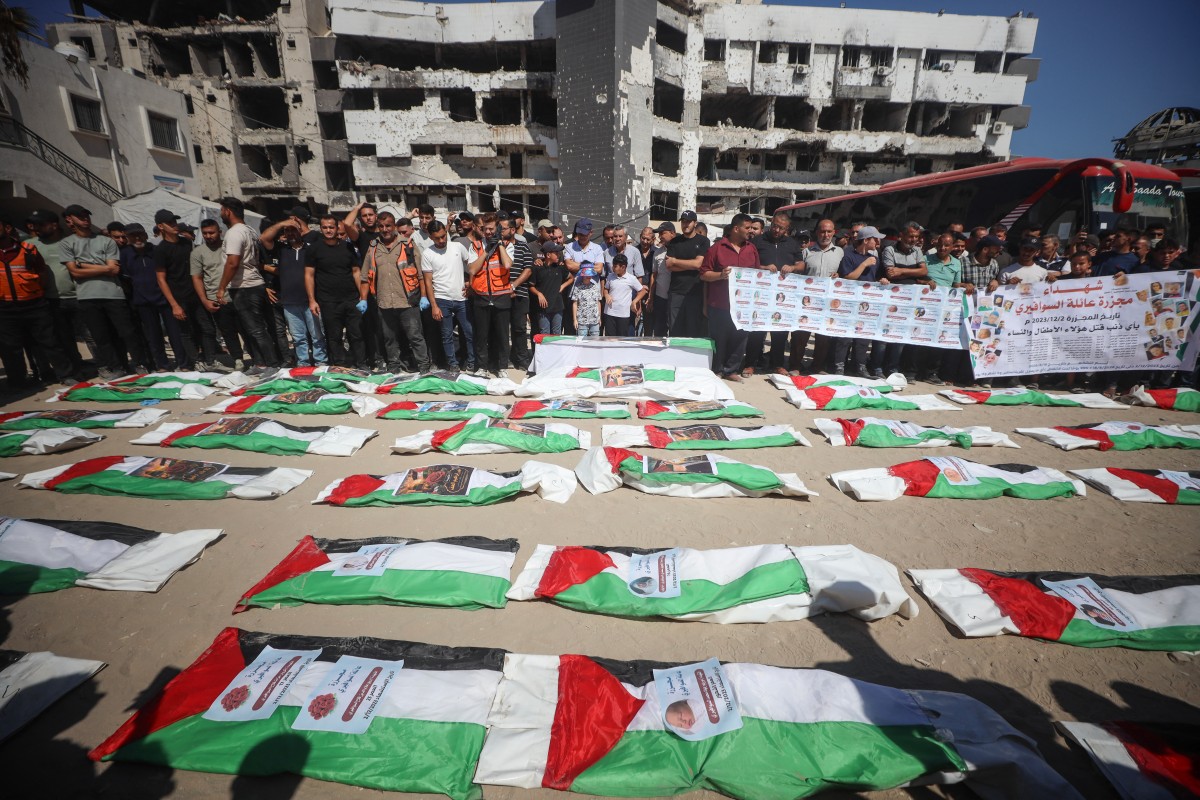
AFP watched tents being set up to accept 30 bodies brought from the M/V June Aster, which ran aground near the tourist hotspot after a fire erupted Wednesday evening and tore through the vessel “in seconds”.
Coast guard spokeswoman Noemie Cayabyab told a Saturday press conference the remains would be turned over to police forensic investigators for “proper disposition and identification” before allowing local authorities to inform family members.
“Currently, we are focused on the retrieval, and after that we will proceed with the investigation,” she said, confirming the bodies had been found in the ship’s economy accommodation area.
Police investigators were seen arriving at the port shortly after the press conference ended.
Asked how many bodies remained aboard the ship, she said authorities would provide an update later in the day.
Cayabyab told AFP on Friday evening that the first transfer had been capped at 30 bodies due to the capacity of the patrol vessel transporting them and that additional cadavers remained on the ferry.
Five others had been confirmed dead in the immediate wake of the fire.
Photos released by the coast guard showed rows of body bags being placed into a small ship alongside men in hazmat suits.
Thirty passengers and 13 crew have so far been rescued, while 54 people remain unaccounted for.
On Friday, Cayabyab had told a radio station the fire had begun in the cargo hold, then tore through the ship within seconds.
“From the time that they heard the loud explosion, the appearance of smoke, and then fire. It spread very quickly,” she said of survivors’ accounts.
“Everything happened in seconds,” she said, adding that those who made it off the ship had not even had time to put on life jackets.
‘Lost hope’
Myra Cabilan told AFP she had flown to Coron to find her missing brother, 40-year-old Rammel Gonzaga, who had taken the ferry from Manila on a business trip with his brother-in-law.
“His wife had just given birth a month ago. He was so happy he was given a daughter,” Cabilan said, fighting back tears.
“At dawn, I still believed he survived. But he’s still missing. I have lost hope.”
Hundreds of people desperate for news about the incident have taken to leaving comments on the Facebook page of a local mayor, searching for relatives, friends and even a dog.
The ferry’s manifest listed 134 crew and passengers, but two had not boarded, according to the coast guard. The ferry was also carrying goods, an electric vehicle, a pickup truck, and motorcycles.
The archipelago nation of 116 million has a long history of disasters involving the inter-island ferries that ply its seas.
Many rely on cheap and poorly regulated boats and ships for transport between the country’s more than 7,000 islands, despite regular accidents.
In January, a triple-decker ferry carrying more than 340 people sank off the southern Philippines, killing at least 52 people.
The M/V Trisha Kerstin 3 sank along nearly the same route where 31 people died in 2023 after a fire broke out aboard the Lady Mary Joy 3 ferry.
On Thursday, the company that owns the M/V June Aster, Atienza Interisland Ferries Inc, said it was fully cooperating with the investigation.