blunder

Mum begs passengers after airline blunder leaves two-year-old daughter next to stranger

A family were left ‘defeated and frustrated’ after their two-year-old daughter was assigned a plane seat next to a stranger, despite ‘paying to book seats together’

A mum was forced to ask passengers to swap seats on a plane after her toddler was seated next to a stranger, leaving both parents frustrated and upset by the ordeal.

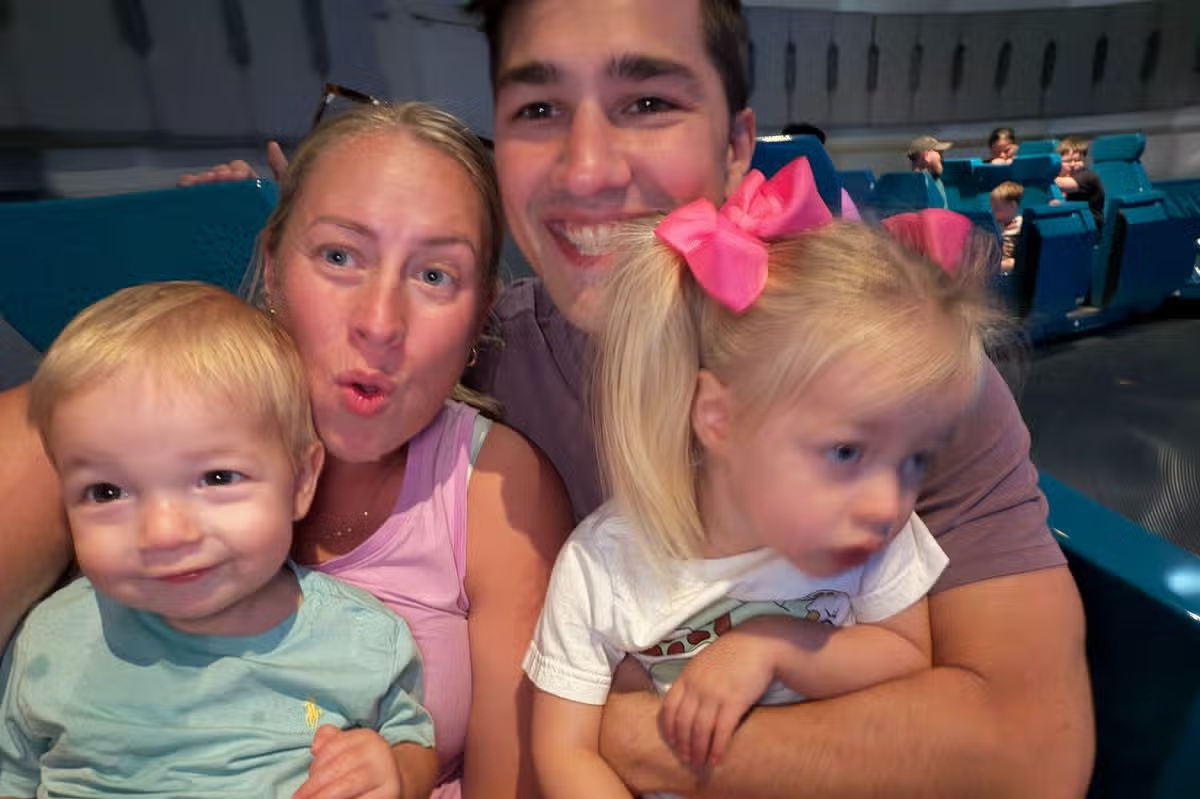
Laura and her husband, Nate, were returning home from a family holiday to Walt Disney World Resort with their two children, a two-year-old daughter and a one-year-old son, on Sunday, 15 November, 2026, when they encountered issues with their assigned seats. Flying from Orlando to Atlanta with Delta Air Lines, the family specifically booked Comfort+ in January, a fare above standard economy that allowed them to choose their allocated seats together in advance, with their son as a lap infant.

When the original flight they had booked was changed, the family were reassigned different seats. However, their two-year-old daughter was left “without either parent directly beside her”, Laura told the Mirror. “I first realised we’d been split up at check-in, when I saw the new seats the day before departure.”

Laura said she flagged the issue to Delta employees, and they “all reassured” her the “gate agent would fix it”. The family headed to the gate, but were met with more uncertainty. “The gate agent had no solutions and refused to help, telling me to ask other passengers to switch after boarding,” the mum of two claimed.

“The gate agent kept rattling off seat numbers and explaining why she couldn’t move anyone. I was starting to panic and said, ‘The seat numbers you keep rattling off don’t mean anything. I just need to sit next to my two-year-old; please find a solution,’ and she replied, ‘There is no solution.’

“When I asked what she suggested, she told me to ask another passenger to move. I asked what the plan was if nobody agreed and raised whether this was even allowed under Delta’s own policy. I got no answer or escalation plan, just blank stares and zero empathy.”

Laura said she became “so overwhelmed” that she needed to walk away for five minutes as she fought back the tears. “My husband and I were flying home with two very tired kiddos, so getting everyone home was already a lot.”

Laura said another gate agent, who was also a parent, was “actually really kind” and said they’d “feel exactly the same way”. Regardless, Laura claimed that they weren’t given any solutions before boarding.

“I boarded the plane ready to negotiate with whoever was seated next to my daughter,” Laura said. “Waiting there for the stranger to board and for me to ask them to give up their seat made me feel sad and defeated. I knew this wasn’t right. I was the one who had to ask for a favour and feel like I owed someone an apology, all so I could sit next to my toddler, whom I had originally paid to sit next to.”

Thankfully, a passenger agreed to move so Laura could sit beside her daughter. And while Laura was grateful for the fellow passenger, she said: “My biggest concern is how a child this young could be assigned a seat away from both parents after we had booked seats together.

“I am deeply concerned that a child this young could be left without a parent beside her unless a stranger volunteers. She cannot independently manage her needs or respond to an emergency. What would have happened if nobody had agreed?”

Nate told the Mirror: “From my perspective, I was both confused and frustrated as to how Delta would A) expect a two-year-old to sit by herself on a plane and B) seemingly had no solution for us other than to go figure it ourselves with other passengers.

“It felt very unprofessional that they weren’t able to offer more support or do more to help us. I also question how this is even legally allowed, as to me it feels like it could be a huge liability for the airline should anything happen to a minor when they aren’t sat next to their parent or guardian.”

Delta had emailed the family about the schedule change on 26 July, but unfortunately they didn’t see it. “Maybe I should have caught the seat change on the July 26 email, but my husband and I both work full time with two very small children, and, transparently, I missed it. It also never crossed my mind that I’d need to be monitoring for this in any way, shape, or form. I also mainly use the Delta app and didn’t get a notification of seat changes,” Laura said.

The airline confirmed to Laura that the reassigned seats were due to an aircraft change prior to departure, which resulted in their daughter being assigned a seat away from both parents. They said it was “especially concerning given her age” and that Laura had “selected her seats months in advance” when making the booking.

In an email to the customers, Delta said it understood Laura’s “frustration” at the airport, and recognised that it “should not have been placed in the position of having to coordinate a seating solution”. “We understand the importance of seating young children with a parent or accompanying adult whenever possible and regret that this did not occur as intended in your case,” the email continued.

In the email, Delta promised it would “continue evaluating our processes related to family seating and the impact operational changes can have on existing seat assignments”. Delta also apologised for the “stress and uncertainty” the situation caused to the family.

The Mirror has contacted Delta Air Lines for comment.

The U.S. Department of Transportation (DOT) encourages all airlines to ensure that young children are seated next to an accompanying adult without charging an additional fee. However, there is no US rule requiring airlines to automatically seat parents next to their children, and most airlines charge an additional fee to do so.

Do you have a travel story to share? Email webtravel@reachplc.com

Ensure our latest travel stories always appear at the top of your Google Search by making us a Preferred Source. Click here to activate or add us as a Preferred Source in your Google search settings.
Source link

I got caught out by the EU-wide blunder threatening innocent Brits with travel bans

AFTER a summer of lengthy European airport queues while signing up to the new EES system, Brits were beginning to hope they could look forward to a calmer summer next year.

But it turns out there’s a whole host of new problems on the horizon – as computers are failing to log when a British holidaymaker returns to the UK.

There has been lots of bother at border control with the introduction of EES Source: Getty
I was wrongly recorded as being in the Schengen Area for over 200 days Source: Alamy

On my recent trip to Sweden, I was stopped at the border and told I had overstayed my stay in the Schengen Area by 145 days – automatically, I was facing a travel ban and potential fine.

I was blissfully unaware of the EES error until I handed my passport to border control who to my horror said: “Your passport says you’re still in France“.

I was pretty floored because I hadn’t been to France recently. But it turned out my exit hadn’t been recorded from when I took the Eurostar to Paris back in March.

Considering I was entering Sweden in early November, that took me well over the allowance of 90 days within any rolling 180-day period.

TOP TOWIE

Forget Cornwall and Devon – why our beachfront county is just as good


SUNSATIONAL

Jet2 reveals short-haul holiday destinations ALREADY getting booked up for 2027

It totted up to 235 consecutive days.

If I was unlucky like some, I could have been turned away at the gate and put straight back on a plane to the UK or fined up to €10,000 (£8,300).

However, the lovely staff member at Stockholm Arlanda Airport simply asked me how long I had stayed for and luckily for me, took my word for it.

I had only stayed for two days in Paris, rather than the over 200 it had recorded.

With a few clicks the border control officer corrected my online EES record and sent me through without so much of a second look.

The entire situation could have been so much worse – as experienced by lots of Brits whose exits have been wrongly recorded by EES machines… or in some cases, not recorded at all.

In one recent case, famous author Jojo Moyes was threatened with a fine and ban on travel into Europe after being labelled an ‘overstayer’.

I was allowed into Sweden – but not everyone has been so lucky Source: Alice Penwill
Collage of travel items including a plane, sunscreen, passport, suitcase, and plane tickets, advertising The Sun's travel Instagram account.

Jojo Moyes’s ordeal happened on her way home from a five-day trip to Marseille in October.

She was stopped at the border and told she had overstayed in the Schengen Area.

However, the writer had only spent 23 days in Europe in the last six months – what had happened is that her departure from Portugal in May had not been logged.

She told Which?: “The clock had been ticking ever since. Under Brexit rules, I was now an overstayer.

“The border control senior officer at Marseille warned me that I should not attempt to re-enter Europe until it is sorted out, or face a €10,000 (£8,300) fine and a two-year ban.”

Another British woman I know professionally was also stopped from entering Finland after a trip to Rome.

She told me: “I was stopped at the border in Finland last November by border control who said my record was showing I was still in Italy.

“While I had registered with EES going into Rome, it hadn’t recorded me leaving.”

She added: “After a lot of back and forth with border control officers and around 45-minutes of waiting, it was recognised as an error and I was let into the country.”

One of the worst cases though, was of Mrs Paula Pugh – who was essentially deported from Italy shortly after arriving on a family holiday.

Brits who ‘overstay’ can be fined up to £8,300 or banned from travelling in Europe Source: Getty
If you spot an error, you’ll need proof of when you exited the country Source: Alamy

Paula had just landed in Italy when she was told at border control that she had overstayed her 90 day limit and as a result she was escorted out of Italy.

Talking to The Telegraph, Paula explained that she had only taken three short visits to Spain and one to France before her Italy break – which totted up to 22 days.

However, the system hadn’t recorded her last exit from the Schengen Area, and Paula was put back on a plane by police on the same day.

Her passport was even given to the captain for the duration of their flight.

How can you avoid these problems?

If you’re worried that you’ve not been logged out of the EU’s Schengen Area properly, there is a way to do so.

Before travelling, I’d advise you to check the days left on your record with an EES online tool from The European Commission.

You just need to fill in the details from your passport, where you’re headed next, and it will reveal how many remaining days you have left.

But note: this does not include any stays recorded before April 10, 2026.

If you have spotted an error in the number of days, you will need to contact the Data Controller for the country in which you believe the error was made.

Your email explaining the mistake will need to include a passport scan and proof of your exit which can be a boarding pass for a flight, train or bus ticket from the Schengen zone.

The list of Data Controllers is available here.

Has this happened to you? Get in touch by emailing alice.penwill@thesun.co.uk

What’s the issue with EES?

EES was fully rolled out on April 10, 2026 – the system was designed to make travel for Brits quicker and easier through the Schengen Area.

The electronic system replaces the need for passport stamps by recording entry and exit through fingerprint scanning instead.

When you arrive at the destination the scan will record your entry, and when you leave, it will record the exit – or it should.

However, the issue with EES is that at the moment, Brits are still registering at the special machines which have resulted in huge queues at airports.

On occasion, EES machines have been turned off entirely to ease congestion – but this means that not everyone will then be recorded correctly.

In some cases glitches with the EES system means it could be turned off – passengers could then be manually stamped out, but this won’t appear on the system.

What’s the latest on EES?

The UK Foreign Office altered its advice to Brits, asking them to carry evidence of when they last left the EU, to avoid being wrongly refused entry.

Advice from the Foreign, Commonwealth & Development Office (FCDO) reads: “If you believe you have been incorrectly entered into EES or your record of time spent in the Schengen area is incorrect, approach border officials when you next cross the Schengen border and request a correction.

“If you are exempt, carry documentation confirming your status. If you believe your time spent in the Schengen area has been recorded incorrectly, raise this with border officials and be prepared to provide supporting evidence if requested.”

If you are going on holiday to any of the following 29 countries, you will be required to follow EES.

  • Austria
  • Belgium
  • Bulgaria
  • Croatia
  • Czech Republic
  • Denmark
  • Estonia
  • Finland
  • France
  • Germany
  • Greece
  • Hungary
  • Iceland
  • Italy
  • Latvia
  • Liechtenstein
  • Lithuania
  • Luxembourg
  • Malta
  • Netherlands
  • Norway
  • Poland
  • Portugal
  • Romania
  • Slovakia
  • Slovenia
  • Spain
  • Sweden
  • Switzerland


Source link

BBC News viewers left distracted by unexpected blunder

There was a very awkward moment during a BBC News segment which was spotted by viewers

Viewers of BBC News were taken aback by an unexpected error.

Those tuning in to the latest update on the channel were left distracted by the blunder. One of the latest updates which aired from the broadcaster over the weekend, left more than a few people rubbing their eyes in disbelief.

It came during a bulletin which reported on the key midterm elections over in the United States. Americans are set to go to the polls this week as they choose to elect members of Congress.

The results could have a huge impact on Donald Trump’s presidency, of which he has two years remaining in his term. However, during the segment, the channel unintentionally broadcast an unrelated word.

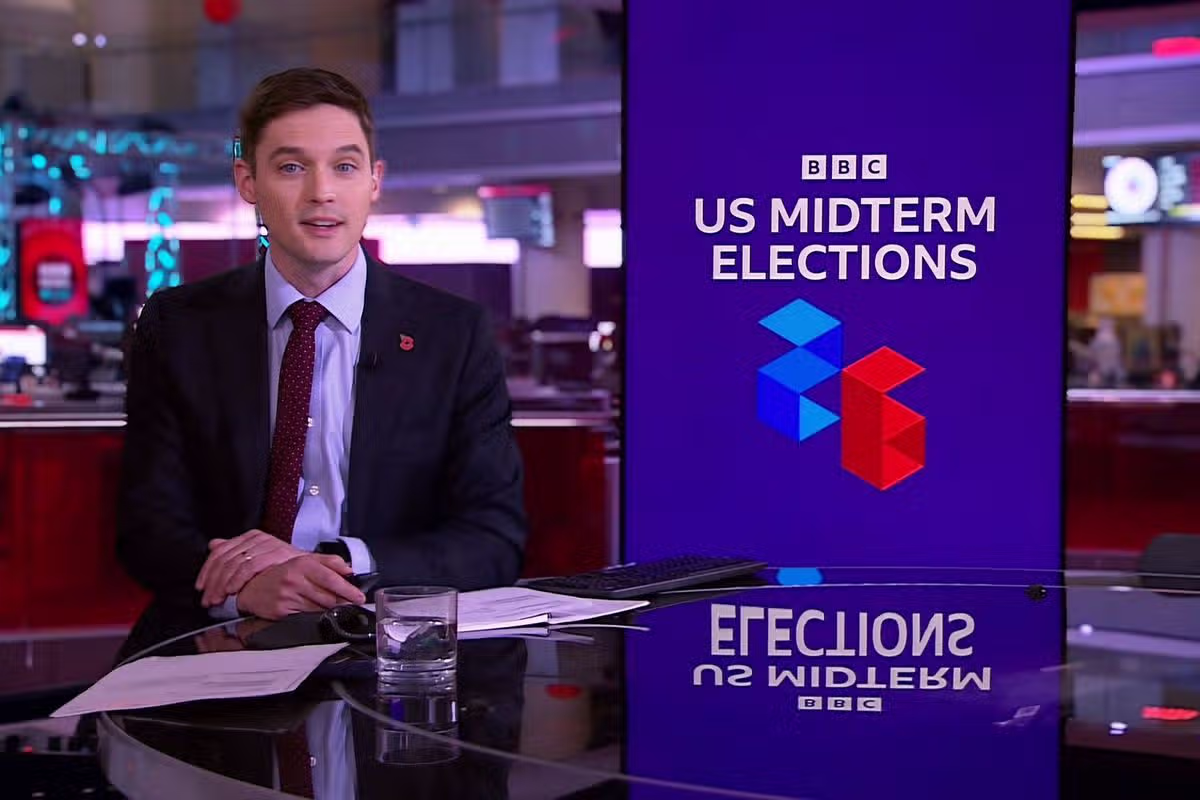
It was pointed out on Tuesday, November 2 by TV critic, and co-host of BBC podcast Must Watch, Scott Bryan. He shared a screengrab of the moment on social media and said: “BBC News errrr… you might want to check the reflection.”

Ensure our latest TV stories always appear at the top of your Google Search by making us a Preferred Source. Click here to activate or add us as Preferred Source in your Google search settings

While the graphic read: “US Midterm Elections” accompanied by a US flag, the reflection of it on the newsreader’s desk made it look very different. The upside down ‘L’ made it look more like an unconventional letter ‘R’.

As a result, it appeared to many watching along that the word ‘erections’ was being plastered over the reflective surface. Scott’s original post gained several responses.

Content cannot be displayed without consent

Many of them were from people who just could not help themselves but poke fun at the situation. One person immediately asked: “Will they face stiff competition from Sky News?”

Another added: “They’re going to have to open up a Department for Reflections Corrections at this rate.”

Someone else said: “Is that a seismic shift in Congressional voting intentions, or are you happy to see me?!” Others predicted that the incident could well form the inspiration of a sketch on SNL UK in the near future.

Not everyone was as amused or even convinced that the reflection accurately portrayed what was suggested. Someone argued against the idea and noted: “I’m willing to accept a TOYS”Я”US-style backwards ‘N’, but an upside-down T ruins it for me.”

Mirror has approached BBC for a comment

Source link

Ballon d’Or blunder causes confusion – Harry Kane, Lamine Yamal and Kylian Mbappe articles published

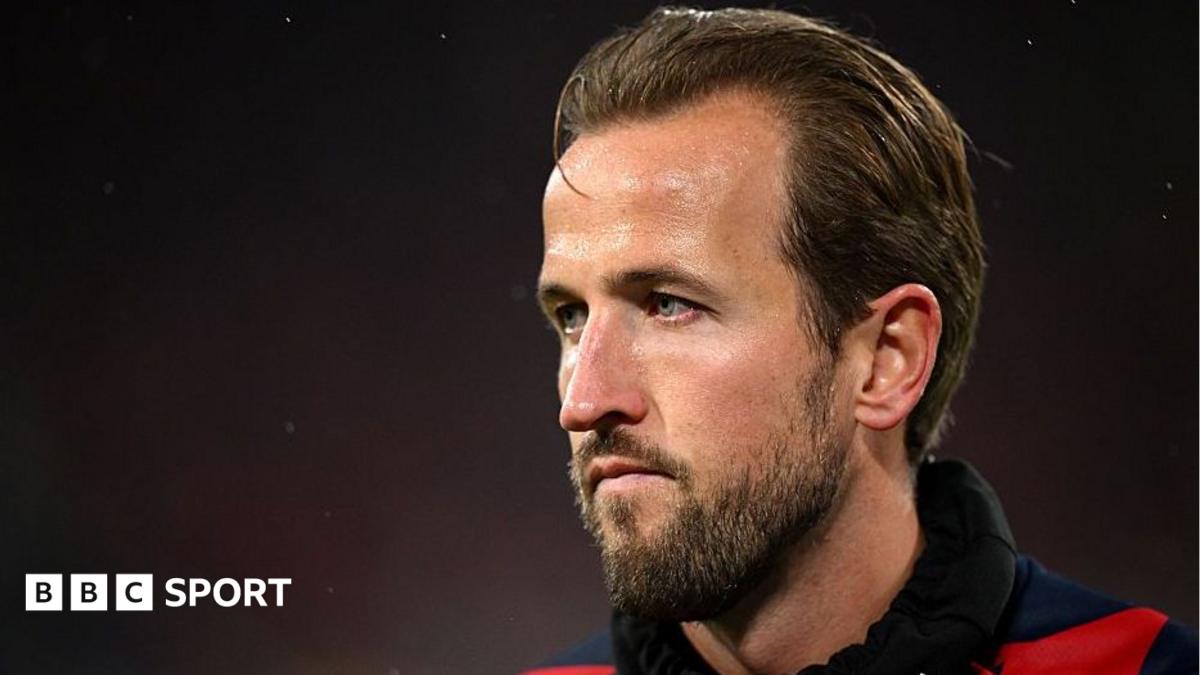
Harry Kane was crowned winner of the men’s Ballon d’Or on Monday night, but a few hours earlier that confirmation appeared to have been announced prematurely.

At 17:15 GMT, an article from the award’s official website titled ‘Harry Kane wins the 2026 Ballon d’Or’ began to circulate online.

The widespread sharing of the article caused confusion online, with some wondering whether France Football – the organisers of the award – had fallen short at the final hurdle of keeping the winner, who was voted for by journalists at the end of September, under wraps.

That was until further digging on the Ballon d’Or website revealed that some of the other favourites to win the award – including Barcelona’s Lamine Yamal, Real Madrid’s Kylian Mbappe – also had similar pieces penned and published about them.

When asked about the articles by BBC Sport, a Ballon d’Or spokesperson said: “Some profiles of nominees prepared by BallonDor.com were inadvertently published online.

“These articles had been prepared for all nominees and should in no way be considered as an indication of the final results or rankings.”

By 17:40, the articles about Kane and Mbappe had been removed from the website.

Similar articles were also written about London City Lionesses star Alexia Putellas and Barcelona’s Ewa Pajor. Putellas went on to be officially confirmed as the winner of the women’s Ballon d’Or.

That premature announcement may have sparked some excitement in Kane that this could be his year, but he only had to wait a little longer to find out for sure.

Source link