One of the biggest stories of this month’s Democratic sweep in the midterms is that a very red Texas elected a Democratic U.S. Senator and governor.
Pundits cite many theories for the surprising results: Anger over the Iran war, high gas prices, Trump fatigue and data centers.
But did California’s high home prices and the state’s historic exodus play a role?
Experts doubt it. In fact, some Californians who moved to Texas are actually concerned about the blue wave.
Many presume that those arriving from California must be much more liberal than the average Texan, said Joshua Blank, research director of the Texas Politics Project at the University of Texas at Austin.
But “a significant share of the Californians transplanting to Texas tend to be moderate to conservative in their views,” he said.
For years, Californians fled to Texas in droves. About 100,000 people made the move in 2022 alone, and many were looking not just for a lower cost of living but also a state that reflected their conservative political outlook.
Nearly half of those Californians who moved to Arizona or Texas during the California exodus in recent years identified as conservative or very conservative, according to a Stanford University study.
The Public Policy Institute of California found that those who leave the state often go to states that share their political beliefs: “Californians leaving for Republican states are much more likely to be Republican than Democratic, compared to Californians as a whole, while those leaving for Democratic states are more likely to be Democratic than Republican,” the PPIC wrote.
In all, hundreds of thousands of conservative Californians have relocated to Texas since the 2020 pandemic emergency, studies suggest.
Marie Bailey, 44, moved from El Segundo to a Dallas-Fort Worth suburb in 2017. She and her husband built a home for $750,000, while a “tiny fixer upper” in El Segundo would’ve cost upward of $1 million.
The couple quickly figured out that they could capitalize on the niche in the real estate market for California migrants to Texas.
For years, Bailey has administered the Facebook group where 45,000 users swap recommendations on how to make the move. She runs a real estate firm that places Californians all over the state.
“Ninety-nine percent of our clientele are people moving from California,” Bailey told The Times in 2023. As for why people make the move, “No. 1 is cost of living and No. 2 is politics.”
Banners for politicians are shown Oct. 27, 2026, in Edinberg, Texas.
(Gabriel V. Cardenas / For The Times)
Texas’ red politics were a big reason she made the move.
Bailey’s husband, who was previously employed by the UCLA medical system, “wouldn’t even talk about his politics because he was afraid of losing his job,” she said.
“Nowhere is perfect,” Bailey said in 2023, “but we fit in a lot better here.”
Now, just three years later, Bailey is confronting a seismic shift in her state.
“I’m actually thinking of moving to Oklahoma because of this,” she said in an interview Thursday. “Or Florida.”
In the Facebook group ‘Move to Texas from California,’ most posts since Tuesday concerned the new state of affairs in the Lone Star State.
“If I have to tolerate blue I might as well have good weather so maybe back to CA? Or give FL a try?” one commenter wrote.
“I am literally closing on a house in Texas next week! I am so pissed,” wrote another.
Blank sees some upsides to the Texas blue wave for those who moved from California.
“They get the benefit of having left what they see as a too-liberal state, and they get a place that is conservative but is unlikely to get much more conservative any time soon,” he said.
Blank thinks many California transplants were primarily motivated by housing costs, with politics being secondary.
“They don’t have to move back,” he said of Californians who moved to the Lone Star state. “And if they do, I’m gonna tell them they’re silly. It’s not a good way to make decisions.”
The “blue tsunami” in the 2026 midterm elections flipped control of both the House and the Senate last week, bringing a wave of Democrats, some with backgrounds in the arts.
The influx of newly elected officials — artists, musicians, dancers and even a former Prada model among them — comes just weeks before Congress will take another look at the Trump administration’s proposed 2027 budget, which requests $1.5 trillion in defense spending and, once again, seeks to nix funding for the National Endowment for the Arts and the National Endowment for the Humanities, as well as the Institute of Museum and Library Services.
Last year, Congress intervened against some of the arts cuts, but that didn’t stop the administration from terminating hundreds of NEA grants worth more than $27 million nationwide.
Next year’s massive reconfiguration of power, however, brings with it a number of elected officials with creative backgrounds, some of whom even incorporated music, dance and art into their campaigns and promises to constituents.
U.S. Representative-elect Claire Valdez, says art is the first language she knew. “It is a language that crosses all kinds of divides and gives voice to something that is otherwise inexpressible and has tremendous power to change,” she said. “I think that transformation is needed now more than ever.”
Here’s a look at some of the elected officials who have a little razzle-dazzle on their resumes.
Iowa Governor-elect Rob Sand
Then-model Rob Sand walks the runway in the Prada menswear spring 2003 ready to wear runway show in Milan, Italy.
(Davide Maestri / Penske Media via Getty Images)
It’s been 20 years since Iowa chose a Democrat to govern the state, but Iowans just elected a former Prada model to strut into office next year. The New York Times profiled Sand in 2019, noting that the Brown University and University of Iowa College of Law graduate doesn’t like to talk about his days modeling in Paris and Milan. Back then, he worked his way through college and ultimately earned a J.D. degree.
The cat’s out of the bag, though, and Sand seems to have surrendered to the social media attention and even leaned in. “I’m disappointed to learn images of me modeling for Prada are circulating,” he wrote alongside a grayscale fashion editorial. “Because this shot from Italian Vogue is much better.” He also launched a “My Model Governor” tee, featuring a chic twenty-something Sand showing off his sought-after bone structure.
It’s been about two decades since Sand, repped by IMG Models at the time, graced the catwalk for Giuliano Fujiwara and other high fashion designers. After college, he traded the runway for a courtroom, and in 2018, was elected state auditor as a Democrat, serving two terms. The now 44-year-old governor-elect appealed to Iowan voters using a campaign centered on public education, affordable living, anti-corruption and bipartisanship. His campaign slogan is: “Not redder or bluer, but better and truer.” He’s a Jesus-loving hunting enthusiast whose first job was catching chickens, and he insists that he’s more interested in public service than two-party politics.
Texas’ new Attorney General-elect Nathan Johnson
Texas state Sen. Nathan Johnson speaks against a bill that would add new abortion restrictions in Austin, Texas.
(Eric Gay / Associated Press)
From the top of the ballot to the bottom, Republicans lost their long-held grip on Texas last week. Democrat Nathan Johnson was elected Texas attorney general, an office held by Republicans for 28 years. This isn’t the first time Johnson flipped Texas either. Back in 2018, he was elected to the Texas state Senate, and while he’s impressed Texans with promises to root out corruption, restore traditional consumer protection and shift away from the high-profile culture wars of prior officeholders, he claims glory for something else:
“In the 2000s, I wrote the musical scores wall-to-wall of 67 episodes of ‘Dragon Ball Z’ and five of the movies,” he told Texas Sen. Taylor Rehmet in a video posted to Facebook. “It was a lot of fun … And even then, it got me street cred with my kids’ friends, and it gave me a creative outlet and a cultural connection that very few people had the opportunity to have.”
The Texas Attorney General-elect worked on “Dragon Ball Z: The World’s Strongest,” “Dragon Ball Z: The Tree of Might,” “Dragon Ball Z: Broly — Second Coming,” “Dragon Ball Z: Fusion Reborn” and “Dragon Ball Z: Wrath of the Dragon.” He also ran a music production company and composed classical stage music.
Speaking to Texas Standard after the midterm results were in, Johnson chalked up the blue wave to a “national revolt against meanness, against hateful speech and divisiveness.”
“People indulge in those sorts of things when everything else is feeling great,” he said. “But at a time when corruption is confronting us in the face and people are super anxious about their economic future, there was a whole-scale rejection of Republican leadership.”
U.S. Representative-elect Bobby Pulido
Bobby Pulido, a Latin Grammy winner, sings during his last concert, La Última Desvelada, at the Bert Ogden Arena.
(Gabriel V. Cardenas/For The Times)
Another Democrat elected in the Lone Star state is the Latin Grammy-winning Tejano music star Bobby Pulido, who will represent Texas’ 15th Congressional District. Pulido said he’s willing to trade his three-decade stage career and take a hefty pay cut to step into public service. He won 62% of the total vote of Texans across the Rio Grande Valley and central Texas on a platform of affordability, healthcare access, immigration reform and reconnecting with working-class Latino voters.
“I give you my word tonight that I will never forget where I came from,” Pulido recently said during an Oct. concert, “La Última Desvelada” (The Last Restless Night), in his hometown of Edinburg, Texas, per TejanoNation. “I did music for me, but I’m running for Congress for you … Because I’m not going to Washington to serve a political party, I’m going to serve you.”
Pulido defeated Republican incumbent Monica De La Cruz, who took jabs at his showbiz background during her campaign. “This election isn’t about who you want performing at your niece’s quinceañera,” she said earlier this year, according to the Texas Tribune.
The Tejano star responded by performing at quinceañeras across the congressional district, which only boosted his popularity in the region. “In south Texas, a quinceañera isn’t just a pachanga. It’s a rite of passage that brings family and neighbors together,” said Pulido in a TikTok clip in March. “And honestly, that’s exactly what this campaign is about. We want to bring people together, not tear them apart.”
U.S. Representative-electClaire Valdez
Congressional candidate Claire Valdez won her race against Brooklyn borough President Antonio Reynoso in the New York 7th District to succeed retiring Rep. Nydia Velazquez (D-N.Y.).
(Michael M. Santiago / Getty Images)
Valdez, a visual artist and union organizer, was elected to represent New York’s 7th Congressional District with a campaign message that espoused the need for artists to “change our political, our economic, and our social order.” Valdez’s political aspirations are personal: She moved to New York to pursue a career as an artist and quickly realized the financial realities of making art under capitalism. Art should never be a luxury for the rich, she argues, but a necessity for all.
“This district represents more artists than almost any other district in the country, and yet we live in a city where it’s almost impossible to have the studio space, the time off, the money, the resources, the healthcare to make the art that we need in our society to shine,” Valdez said in a campaign speech earlier this year.
“I did not come to politics through electoral ambitions … I came to this place via my union. My union taught me that when people come together, we can organize for incredible things. We can move literal mountains, and we can beat back all the other people who make our lives a living hell, who have made this city unaffordable and impossible to thrive in, impossible to be an artist in. We deserve and demand a life of dignity, beauty for every single person, no matter where you are from. That’s what’s on the table, my friends.”
Valdez worked as a program assistant in the visual arts department at Columbia University, where she became a union leader. In 2024, she was elected to the New York State Assembly to represent the 37th District in Queens. Last week, New York Mayor Zohran Mamdani backed the candidate, who won 83% of the vote.
Los Angeles Mayor-electNithya Raman
Los Angeles Mayor-elect Nithya Raman arrives with supporters standing nearby to claim victory in the Los Angeles mayoral race.
(Mario Tama / Getty Images)
Los Angeles Mayor-elect Nithya Raman was first elected to the L.A. City Council in 2020, and last week, she became the first challenger to defeat an incumbent Los Angeles mayor in more than two decades. While Raman didn’t turn L.A. blue, the democratic socialist did beat Mayor Karen Bass, a more moderate Democrat, turning the city a deeper, more progressive shade of blue.
Raman campaigned on a platform centered on housing affordability, public transit expansion, street safety, and a major overhaul of how the city approaches homelessness, but she also has a unique inside perspective on issues that plague Angelenos who work in entertainment. Her husband, Vali Chandrasekaran, is a television writer and producer, with a resume stacked with popular shows including “Modern Family” and “30 Rock.” The two met as undergrads at Harvard, where Raman was active in the university’s arts scene, and contributed to student productions as a designer and choreographer. The two broke up but reconnected on the picket line during the 2007-08 Writers Guild Strike.
According to a profile in the Harvard Crimson, Raman studied classical dance with renowned Bharatanatyam dancer Leela Samson in Chennai, India, and toured with her dance company after she graduated in the early aughts. The mayor-elect told the outlet that she still follows dance when her schedule allows.
“I don’t just watch Indian classical dance, I watch all kinds of dance,” Raman said. “I’m a dance aficionado, and when I’m not busy on the campaign trail, I try and attend dance programs and performances.”
Raman took the stage late on election night during her party on the plaza outside the Greek Theatre, and asked the crowd: “Will you all get on the dance floor with me?” In response to the applause, she said, “Yes, we will dance. We will dance!”
WASHINGTON — Americans are heading to the polls Tuesday in a historic set of midterm elections that will determine which party controls the chambers of Congress for the remainder of President Trump’s time in office.
Democrats appear poised to make significant gains, with polling showing the party up between 7 and 11 points on the generic ballot. Republicans are braced for losses but hoping to hang on to Senate control.
The night’s big question is whether a true wave will materialize for Democrats and how sizable it might be — how many U.S. House seats the party can flip, whether it can secure a Senate majority and whether Democrats take control of a majority of governorships.
The first polls close at 3 p.m. PST in parts of Kentucky and Indiana, and more Eastern states follow at 4 p.m. Here’s a rundown of the possible outcomes and what to watch as Tuesday unfolds.
Who could control Congress?
Blue House, red Senate: Democrats could win a House majority — either substantial or modest — while Republicans retain the Senate.
Split control of Congress would give House Democrats the ability to launch investigations into the Trump administration and block Republican legislative priorities. Senate Republicans would be able to scuttle legislation coming out of the House and continue approving Cabinet and judicial appointments, including to any openings on the Supreme Court. Legislative gridlock — and possible government shutdowns — would be likely.
Total Democratic control: A larger “blue wave” could occur, sweeping up House seats for Democrats and tipping key Senate races in their favor to hand Democrats a majority in both chambers. The Senate majority would likely be very narrow and could come down to a single race.
Democrats would be able to block Senate confirmation of Cabinet and judicial appointments. They would be able to pass legislation, but Trump would hold veto power and the Democrats would be unlikely to secure veto-proof majorities on partisan priorities.
Wild cards: Most analysts agree there is very little chance that Republicans will keep House control.
The potential for civic unrest looms over the election. If results in one or more races are contested by a losing party — as Trump and his allies have suggested is possible — the potential exists for prolonged uncertainty or a constitutional crisis.
When will we know the outcome?
The House majority could become clear before the night is over. The Senate majority could require a longer wait, particularly if it comes down to Alaska, which along with Hawaii is the last state to close polls, at 9 p.m. PST.
If the Democrats take the House, their full margin of victory likely won’t be clear Tuesday night. Some key swing races are in states that have slower ballot counts, including California and Pennsylvania.
If a blue wave does not materialize and the race for the House majority narrows, how each party makes out could take longer to ascertain.
Which races will provide early clues?
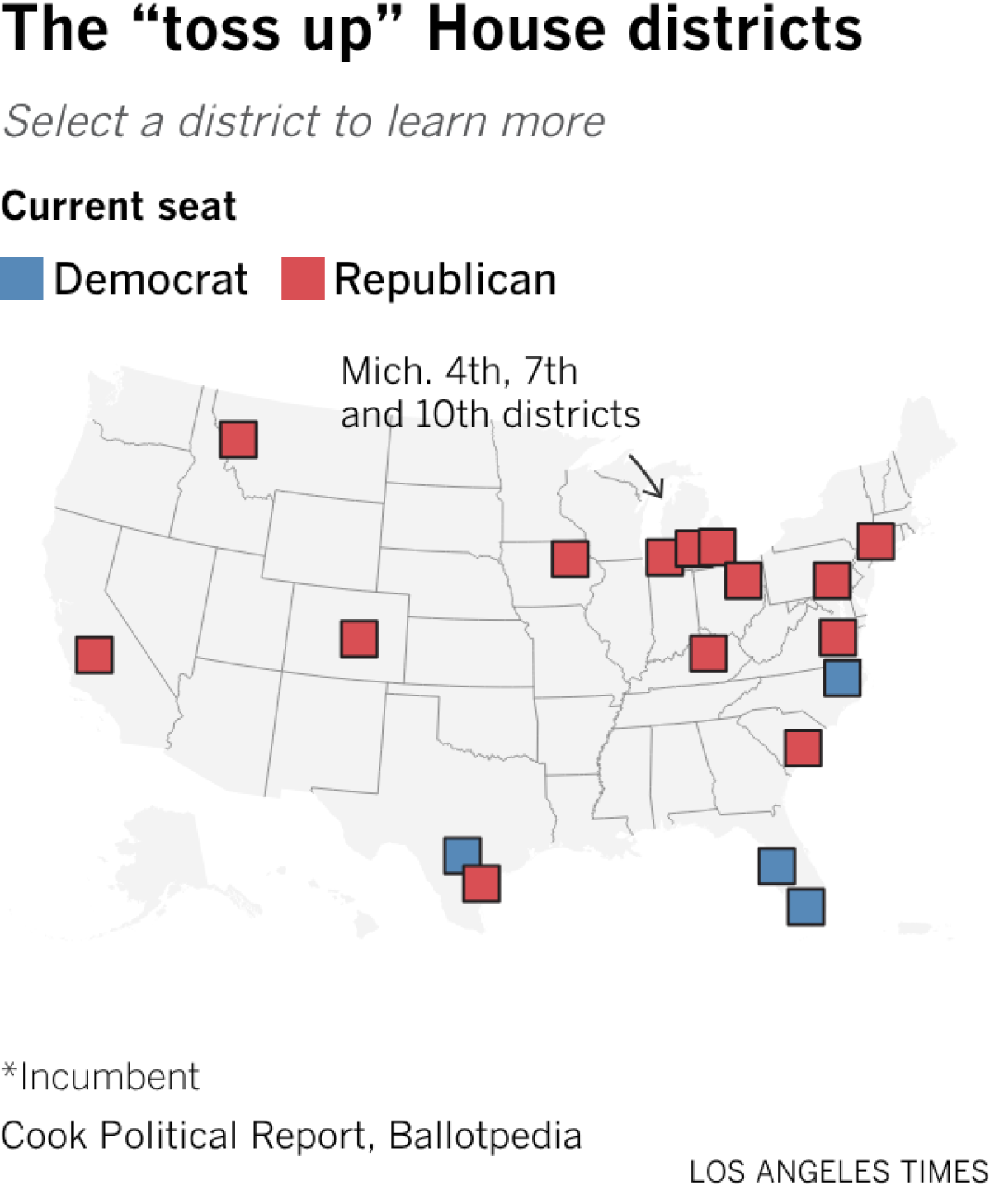
More than four dozen House races are competitive, including 18 that are considered tossups by election forecaster Cook Political Report. The additional 35 races are considered competitive but leaning towards one party. Whether additional, less competitive seats flip unexpectedly will be one indication of how much of a “wave” election this is.
Seven Senate seats are tossups: Alaska, Iowa, Kansas, Maine, Michigan, Ohio and Texas. Three more are potentially competitive: South Carolina, which leans Republican, and Minnesota and New Hampshire, which lean Democratic under Cook’s ratings.
North Carolina and Georgia, originally viewed as competitive seats, are now both seen by forecasters as fairly safe bets for Democrats.
The swing states could largely tip for Republicans or for Democrats, or the majority could come down to just a single race.
Experts say they’re watching a handful of races that could provide early indicators for how the night may go, though predictions are always dicey and outliers are possible. Among the races to keep an eye on:
Kentucky’s 6th: This Lexington-area U.S. House district has become an unexpected tossup, and with the nation’s earliest poll-closing time, it could be a bellwether. “If Democrats win that district, then it’s a Democratic tsunami,” said Christopher Warshaw, a Georgetown University public policy professor. “Even if it’s close, that would be pretty telling.”
Iowa’s 2nd: Forecasters have shifted this race to a tossup amid a difficult environment for state Republicans. If Republicans lose this seat — which belonged to Rep. Ashley Hinson, the party’s Senate nominee — it could signal a blue wave on the bigger side.
New York’s 17th: One of just three districts with a Republican incumbent that went blue in the 2024 presidential election, the outcome of this close race could “tell us a lot,” said Todd Belt, a George Washington University political science professor.
Texas’ 15th: This district offers a bellwether for Latino voters who moved right in 2024 but, signs indicate, may be shifting back to the left. The 34th and 35th districts in Texas could also be indicative.
Michigan Senate: If the Democrats lose Michigan, their path to Senate control becomes difficult. A win in Michigan is a best-case scenario for Republicans seeking to retain Senate control. Without Michigan, Democrats would have to flip five out of six swing seats in Alaska, Texas, Ohio, Iowa, Kansas and South Carolina.
Maine Senate: If Democrat Troy Jackson wins in Maine, that will likely be a good sign for his party’s chances at the Senate majority and their races in Michigan, Ohio and Iowa. Without it, Democrats could still take the majority, but Republicans’ path will become easier.
Other states: If Democrats pull off wins in purple or red districts in Florida, Virginia and Pennsylvania, those could also signal a blue-leaning night.
WASHINGTON — An acutely contentious and historically expensive midterm campaign barrels to a finish Monday, on the eve of elections that will set the nation’s course for the remaining half of President Trump’s second term.
Republicans are bracing for a backlash from voters as Democrats prepare for gains — but the magnitude of any “blue wave,” and whether it could sweep not only the U.S. House but also the Senate into Democratic control, will be the key question as Americans finish casting ballots Tuesday.
Early voting had already seen strong turnout, including among influence blocs such as Latino and Black voters. Candidates spent the weekend crisscrossing their states and pulling in surrogates to make a final push for voters still on the fence.
Capping a turbulent first half of Trump’s second term, the campaign has been defined by affordability and economic issues that have created headwinds for Republicans and spurred a possible turn toward Democrats by voters. And as Trump has pushed the limits of executive power, the midterms could act as a consequential check on his presidential reach.
In recent polls, voters have consistently put Democrats several points ahead on the generic ballot and given a historically low approval rating to Trump.
Eyes are now on Senate control, as an unexpected competitiveness by Democrats in a handful of red states has put the majority into play. It would require a “massive” wave for Democrats, but the fact that it is a possibility at all reflects an “extraordinary situation,” said Thaddeus Kousser, a UC San Diego political science professor.
With seven toss-up seats, tough math for Democrats and tough polling for Republicans, the outcome is far from certain. There may not be a large difference between the Democrats eking out enough seats for the majority or Republicans succeeding at holding it, said Charles Franklin, director of the Marquette Law School Poll.
“Just a little bit better night for the Democrats, and they pick up quite a number of these very close seats,” Franklin said. “Just a little bit better night for the Republicans, and Democrats fall slightly short in several of these competitive seats.”
The outcome in competitive races will not only set the dynamic between Trump and Congress for the next two years, but also hold signs for the 2028 presidential campaign. Both parties are closely watching how well Democrats can do in red states, how Republicans perform in Michigan and how far to the left Trump-voting districts swing.
The party out of power typically wins House control in midterm elections. This year, fatigue with Trump — fueled by the war in Iran, immigration policy, tariffs and other issues — merged with concern about prices, housing and AI issues to drive that movement toward the minority party, analysts said.
“This is an opportunity for the American people to try to put some brakes on the government,” said Todd Belt, a professor of political management at George Washington University.
The midterms are designed to function as a potential check on every presidency, said Christopher Warshaw, a Georgetown University public policy professor.
“The reason we have a democracy is in part because the out party does well in midterm elections,” Warshaw said. “That function of midterms is really important regardless of who’s in power.”
In many races, the quality of individual candidates also is poised to be a deciding factor, including in Texas, where Republican Atty. Gen. Ken Paxton has struggled to gain traction, and in Maine, where Democrat Troy Jackson has labored to confront Republican Sen. Susan Collins’ staying power.
The campaign has held significant twists, among them the unexpected death of Republican Sen. Lindsey Graham of South Carolina; the dropping out of Democrat Graham Platner from Maine’s Senate race; and the questions about the alleged involvement of operatives aligned with Democrat Mary Peltola’s campaign in the presence of a spoiler candidate on the Alaska ballot.
And Trump gambled on a largely dismissive approach toward voters’ affordability concerns; in recent days, he has also drawn attention with off-script comments at his rallies about Republican candidates’ rear ends and for lashing out at a reporter who questioned why he had canceled his final two rallies, which Trump later rescheduled.
Voter turnout could also have a significant effect on results; both parties have worked to reach independent voters while turning out their bases.
Across the country, nonpartisan groups are holding last-minute voting events, encouraging people to fill out their ballots. A hotline run by a nonprofit coalition organized by the Lawyers’ Committee for Civil Rights Under Law is receiving hundreds of calls a day about how to vote.
Brandon Waithe, 42, an Air Force veteran who has organized get-out-the-vote events through Project HALO, a voting initiative, said he hoped to help raise turnout.
He hosted a line dancing event in a Cleveland public plaza last month aimed at reminding people to vote — and to “tie some positive emotion to the act of voting,” he said.
“It’s like, ‘Ah, cool, all right, voting’s not so bad,’” Waithe said. “There’s no pressure. … We’re not telling you which party to vote for or which candidate. We’re just like, ‘Thank you for participating in voting.’”
The speed with which results are known Tuesday will partly depend on how large a blue wave might occur. The House majority could become clear Tuesday night, but the margin could take a little more time with swing races in slower-counting states such as California and Pennsylvania.
If the Senate majority comes down to Maine or Alaska and if those races are very close, the outcome will probably take some days to verify, Kousser said.
“What I’ve been telling people is you’re going to have to buckle up and wait,” he said.
And, of course, one of the few certainties of an election is that no one knows exactly what will happen. The electorate is volatile, said Sonoma State University political science professor David McCuan, and there are always wild cards.
“There will be a surprise on election night,” McCuan said.
Two decades ago, political scientists identified a certain breed of self-defeating gerrymander that backfired on mapmakers who tried to rig congressional district lines for partisan advantage.
They called it a “dummymander.”
“A dummymander is a gerrymander by one party that, over the course of the decade, benefits the other party, and actually looks as if it was designed by that party rather than the party in power,” Bernard Grofman and Thomas Brunell wrote in “The Art of the Dummymander.”
The phenomenon came out of Democratic legislatures in the Deep South in the 1990s. Attempting to protect incumbents amid a political realignment toward Republicans, they spread what was left of their voting strength across too many districts after the 1990 census.
Grofman and Brunell compared their situation to a lifeboat. “The carrying capacity of any lifeboat is limited,” they said. “If you try to overload it, the boat may sink, or at least tip over, washing a number of people overboard.”
Over the last two years, Democrats and Republicans have battled to redraw House districts, in a process kicked off by Texas Republicans’ adoption of a new map — at the direction of President Trump — that shifted as many as five seats their way. Other states joined in, including retaliation by Democrats in California. Courts blocked some of both parties’ efforts, with the resulting national map tilted toward Republicans by about nine seats, on net.
Now, as analysts forecast a potential “blue wave” of support for Democrats, election watchers are studying whether Republicans’ efforts could backfire. The upshot? Probably not this year. But the election will test just how much partisan advantage mapmakers can squeeze out before a gerrymander starts working against them.
‘A perfect storm’
The Democrats’ 1990s dummymander wasn’t apparent immediately: For one election, in 1992, the Democratic maps worked. Across North Carolina, South Carolina and Georgia, Democrats won 18 of 29 House seats. Their only misstep: In trying to gerrymander Republican Newt Gingrich out of his district, they forced him to move to a new district where he won narrowly.
Two years later, the weather turned. Gingrich led the “Republican Revolution” during President Clinton’s first midterm and was rewarded with the speaker’s gavel. The 18 dummymandered Democratic seats were reduced to 10.
Today’s potential dummymanders are different. For starters, House districts are meant to be redrawn once a decade, following the U.S. census. The Democratic dummymanders in the ‘90s came after constitutionally required reshuffling. The mid-decade gerrymanders of 2025 and 2026 were purely opportunistic. Republican-led states such as Texas and Florida redrew maps at Trump’s urging, not to protect vulnerable seats, but to extend their partisan advantage.
These gerrymanders are also different in that they could conceivably backfire in their first election, rather than producing the delayed reaction of the Southern Democrats’ earlier dummymander.
“We are in a perfect storm for dummymanders,” said Brunell, now a political science professor at the University of Texas at Dallas. The formula: extreme partisan gerrymandering — mostly by Republicans — and a midterm election with an unpopular president and economic headwinds.
Margin for error
Some dummymanders are dumber than others. The real test isn’t whether Republicans lose seats in Tuesday’s elections — it’s whether they’re left worse off than if they had left the old districts in place. “There can be degrees of dummyness,” Brunell said.
Republicans drew their maps to withstand a blue wave that crests at about a 10- to 12-point margin. The RealClearPolitics average of generic congressional polls now gives Democrats an advantage of just over 8 points — meaning that if the polls are broadly right, Republicans will still likely end up benefiting from the new maps.
Jonathan Cervas, a Carnegie Mellon University professor who has drawn his own maps as a court-appointed special master, said a true dummymander seems unlikely and is “wishful thinking” by Democrats.
And even if it happens, Cervas argues, it won’t be bad mapmaking that loses the House for Republicans, who now control the chamber by just a few seats.
“Everything is so nationalized that the shifts that happen in Texas are the same shifts that happen everywhere,” Cervas said.
Assuming that voters move toward Democrats in roughly equal measures across the country, Republicans will have lost dozens of competitive districts in states that weren’t redrawn — such as Michigan, Pennsylvania, Arizona, Iowa, Wisconsin and Colorado — before any blue wave gets to Texas and Florida.
“At that point,” said Cervas, “it would not have mattered because they would have lost so many seats anyway.”
Korte writes for Bloomberg. Adrienne Tong of Bloomberg contributed to this report.