Emergency teams are searching for 7 missing crew after two chemical tankers were attacked in the Black Sea. Fires broke out on the ships after they were hit by suspected Russian drones.
Sikorsky is aiming to start offering a new modular and readily swappable nose for the venerable H-60 family of helicopters within the next year or so. The noses will be made available on new-production H-60s, as well as be retrofittable to helicopters in service now. The ‘nose jobs’ will help operators relatively quickly reconfigure their H-60s for very different missions, from cargo-carrying to serving as gunships, as required. It also opens new avenues to integrating autonomous capabilities and other advanced functionality.
Our Howard Altman had a chance to speak with representatives from Sikorsky, now a subsidiary of Lockheed Martin, about the plans for the new nose for the H-60-series at the Association of the U.S. Army’s (AUSA) main annual convention today. This is part of a larger vision for keeping the design operationally relevant into the 2070s, which also includes uprated engines and increased total payload capacity. You can read more about the overall Black Hawk 2070 strategy here.
Inside Sikorsky’s UH-60 “Black Hawk 2070” Plan
Of the different elements of Black Hawk 2070, “the nose is a good one, and it’s one that’s on a pretty accelerated timeline. Within the next, I would say, year or so, the nose will be available to be retrofitted or to be coming off the line,” Jason Wrigley, Sikorsky’s director of business development for Black Hawk, said. “We’ve gone through a design cycle with it.”
As it stands now, the new nose structure will offer roughly double the physical space of the standard nose on current-generation H-60s today.
“We’ve done the design. We then 3D-printed the noses, and we did that so that we can physically interact with it, because the whole point of this is for maintainability and access to be able to integrate these different sensors and comms gear,” he continued. “We’ve gotten some feedback from the engineers, from operators, from maintainers, and that goes back into the next cycle of the design.”
Exploring ways to optimize accessibility to areas of the new nose was a major focus of this ‘test print,’ according to Wrigley. Sikorsky has a scale model on the show floor at AUSA this week that highlights how the current design opens from the top, as seen below. Ensuring that it will be possible to keep any systems inside sufficiently cooled has also been an important design consideration already.
Jamie Hunter
Overall, “we just are kind of confirming, can we reach everywhere we need to? What are the different configurations?” he added. There’s been “a lot of work with the [U.S.] Army around what do you envision potentially could go in here?”
“This is one of those cases also where our whole engineering team gets more comfortable. It’s not something where the Army came to us and said, ‘this is exactly what I want. Here’s my spec,’” he also noted. “It was more, ‘here’s what I want to achieve. Here’s what I want to be able to do.’ And so we went off and designed that.”
Another look at the long-nosed Black Hawk model on display at AUSA. Jamie Hunter
“I like to highlight this, because it’s part of the way we’re also changing the way we design and deliver the Blackhawk,” Wrigley added as an aside. “So we’re very much in a model-based environment.”
While Wrigley mentioned sensors and communications equipment as possible payloads to fit into that extra space initially when talking with us today, he made clear later on that these are just some of the potential options.
“It’s using the old term, but it’s open architecture, and so the whole point is whatever the mission requires” can go into these new extended noses, he explained. “There’s always a demand for real estate up front.”
A head-on look at one of the 160th Special Operations Aviation Regiment’s MH-60s, with a nose absolutely crammed with sensors and other systems. USNA look at the distinctive nose on the HH-60W Jolly Green II packed with sensors and other gear. USAF
“There’s a big focus on open architecture and that ability to quickly plug-and-play,” Wrigley also told TWZ earlier this month in the context of the larger Black Hawk 2070 plan. “The new modular nose will change the look of the Black Hawk up front to provide even more space for equipment that will work directly with the new digital architecture.”
In terms of swapping out modular noses on individual helicopters, Wrigley said that it is still too early in the design process to know exactly how that would be done and how long it might take to do so in practice.
“Part of the design process is to also write up the documentation for the retrofit, but we don’t see this one as very invasive,” he explained.
It is not hard to imagine use cases for long-nosed H-60s, especially ones that can then be reconfigured between missions, and not just for the U.S. Army. As Wrigley already underscored, there is long-standing demand for H-60s with longer and larger noses to accommodate additional mission systems. Modular noses, in general, have been becoming more and more common in aviation design for some time now.
The ability to readily swap modular noses could also allow operators of even relatively small H-60 fleets to gain a valuable new degree of multi-mission capability. As one example, cargo-carrying helicopters could be converted into gunships, and back again, as required, using a small common pool of noses with the requisite sensors, laser designators, and other equipment. All of this could offer cost benefits when it comes to sustainment and logistics, as well as added operational flexibility.
The long-nosed Black Hawk model on display at AUSA is notably configured as a gunship. Sikorsky has also talked previously about leveraging the new nose to reconfigure H-60s for search and rescue, airborne drone control, and other missions.
A full view of the model of the gunship-configured H-60 with the new modular nose on display at AUSA. Jamie Hunter
Just being able to install a radar for one series of missions, and then quickly switch over to an electro-optical wide-area surveillance system or another kind of sensor for the next run of sorties, would bring new adaptability to the already very flexible Black Hawk. Defensive systems could also be readily swapped from aircraft to aircraft, as well as more quickly upgraded, as needed.
The modular nose also opens the door to a new way to integrate advanced capabilities, including autonomy packages, which Wrigley said is also driving demand for more space at the front end of the helicopter. Sikorsky has been developing various tiers of autonomous capabilities for the H-60 family for years now, including artificial intelligence-driven ‘copilots’ designed just to help reduce the workload of human crew members and increase safety margins. Autonomous flight capabilities require additional sensors, such as LIDAR and cameras, to help with navigation and to provide additional situational awareness. At least some of those components could be hosted within new modular noses.
At the same time, integrating higher degrees of autonomy could require more substantial modification. Sikorsky is now developing a fully uncrewed version of the H-60, and has been doing so with an eye toward converting older Black Hawks to this configuration as they are retired from service, as you can read more about here.
Introducing the S-70UAS™ U-Hawk™
In line with the Black Hawk 2070 vision, the modular noses could be part of a broader equation for modernizing existing H-60 fleets, as well.
“In our conversations with the Army, I think they’ve been using a phrase that they call targeted modernization,” Wrigley told us, speaking more generally. “There’s a daunting task that says there’s 1,000-1,500 Black Hawks in inventory. If you literally tried to upgrade every one of them, it’s a very expensive proposition, and it probably takes a long time.”
“I don’t think that’s the way they’re thinking about it. I think they’re thinking about it more on a battalion basis or a unit basis,” he continued. “Like, what’s the mission, and maybe certain Black Hawks get upgraded with autonomy, and other Black Hawks get upgraded with sort of the expanded launched effects capability, the engine, the structural upgrades, the [stub] wings, stuff like that.”
“Maybe some of them become ‘Superhawks’ or whatever, [and] get the whole package,” he added.
There is certainly still work to be done on the development of the new modular nose and then actually integrating it onto the H-60 platform. At the same time, Sikorsky clearly already sees demand for this new feature, which could lead to a breadth of new opportunities for new and old helicopters in the H-60 line.
BROOKS Nader oozed confidence as she took to the stage in Cannes to promote the upcoming Baywatch reboot, just as its trailer dropped.
The model-turned-actress rocked an all-black corset and leggings, teamed with sky-high knee-high boots and chic black gloves.
Brooks Nader stunned in an all-black outfit at the Baywatch panel in CannesCredit: GettyThe model teamed her corset and leggings with towering boots and black glovesCredit: Getty
The 29-year-old plays Selene, captain of the Zuma Beach lifeguards, and features in the newly released trailer.
Brooks, who The Sun recently revealed is enjoying a steamy romance with Brit actor Taron Egerton, 36, made sure her latest outfit clung to her curves in all the right places.
Sign up for the Showbiz newsletter
Thank you!
She was in Cannes for MIPCOM, a TV industry event where broadcasters and producers showcase and sell shows, attending a Fox panel promoting Baywatch’s return.
The iconic lifeguard drama is set to return to screens in January 2027, airing on Sky and NOW in the UK.
Brooks Nader joined Baywatch co-star Stephen Amell at the Cannes eventCredit: GettyBrooks and Stephen are gearing up for the lifeguard drama’s return in JanuaryCredit: Getty
The trailer drew a mixed reaction from fans, with some sceptical about the reboot.
One wrote: “Another reboot, it ain’t touching the original.”
Another added: “Looks like another cheese fest that nobody asked for.”
But one viewer hoped the new series would recapture the original’s appeal, pleading: “Please bring back that 90s magic!”
Brooks stars alongside Livvy Dunne, Stephen Amell and Shay Mitchell in the series.
Aside from modelling for Sports Illustrated, Brooks is known for her TV appearances.
These include a stint on Dancing With The Stars and her reality show Love Thy Nader.
The UH-60 Black Hawk has been the rugged workhorse of U.S. Army aviation for nearly 50 years, with around 4,000 examples currently in service with 36 nations worldwide. Many of these helicopters, and new aircraft coming off the line, are set to fly as far out as 2070, and Sikorsky is curating a suite of upgrades to keep them valuable assets for the future fight. A new “digital backbone” is designed to underpin swift technological insertions such as launched effects, with related initiatives including the provision of more power to lug greater payloads, and the fully-autonomous U-Hawk cargo drone variant.
“As part of an overall “Black Hawk 2070” modernization effort we’re developing a number of complementary capabilities, including our U-Hawk uncrewed cargo variant, which we plan to fly later this year,” Jason Wrigley, Sikorsky’s director of business development for Black Hawk, told TWZ at the company’s Stratford plant in Connecticut.
Sikorsky plans to fly its U-Hawk uncrewed cargo version of the Black Hawk this year. Sikorsky
“A new digital backbone for the Black Hawk is at an advanced design phase in our labs and it’s designed to provide interfaces throughout the aircraft that will provide power, data, a network, cooling and most importantly, open architecture interfaces that enable the easy integration of new equipment, such as sensors. We see this as a core building block for the next generation of Black Hawk, along with new engines and other airframe improvements designed to futureproof the platform.”
The new digital backbone is designed to work in concert with a modern, software-driven strategy that meets the Army’s Modular Open Systems Approach and the desire to add technologies cheaper, faster, and more easily. Wrigley says that as customers identify new capabilities and needs for their Black Hawks, the digital backbone will be sufficiently efficient to permit customization even on a mission-by-mission basis. Sikorsky is also introducing a new modular nose to the H-60, which is reconfigurable with sufficient volume to support even more sensors and electronics.
“There’s a big focus on open architecture and that ability to quickly plug-and-play,” says Wrigley. “The new modular nose will change the look of the Black Hawk up front to provide even more space for equipment that will work directly with the new digital architecture.”
The new modular nose will give the Black Hawk more than twice the internal volume of the original nose section and it’s designed to provide space for internal electronics and an integrated mount for external sensor pods. It is designed to provide sufficient space to accommodate electronics that enable roles such as search and rescue, drone control, and flying in degraded environments, and it will also house some of the equipment required as the Black Hawk’s autonomous capabilities expand.
Sikorsky plans to introduce a new modular nose to the UH-60M. Sikorsky
Joshua Powers spent 22 years as an Army Aviation officer flying the Black Hawk, and he’s well qualified for his new role with Sikorsky handling business development for rapid capabilities insertions. “Army units know the Black Hawk inside out; how to fly it, maintain it, and use it to maximum effect. The upgrades we are developing will bring new capabilities faster, without time-consuming and complex changes to sustainment, training, and operations, plus we are adding more range, more payload, and more power to meet the demands of the Indo-Pacific region.”
“I find it amazing to pair new technology with a rugged platform like the Black Hawk. These new innovations are needed to meet the needs of the new complex battlefield. The fight I fought in Iraq is very different from the current operating environment and what future warriors are going to go up against, and what we’re asking them to do is very different from what came before.”
Bringing autonomous co-pilots to the Black Hawk
Autonomy is a central pillar of Sikorsky’s strategy for the future Black Hawk. The company’s MATRIX autonomy software is now being matured on a UH-60M variant, and while it’s not necessarily designed to completely replace pilots, MATRIX will assume some of their workload, making flying safer and simpler as mission sets grow increasingly complex and dangerous. “Pilots that are controlling collaborative drones, for example, need to be able to focus on the drone mission, and autonomy will help lighten their cognitive load,” explains Wrigley.
“The standard Black Hawk crew operates with two pilots. Adding our MATRIX autonomy system gives the operator options – a single pilot could fly without an unbearable workload and still fulfil a mission commander role, for example. The Army could then operate the Black Hawk with no pilots at all when that’s the appropriate option.”
The U.S. Army received its first UH-60MX Optionally Piloted Vehicle (OPV) on March 20, 2026. Sikorsky
“We delivered the first UH-60MX to the Army earlier this year,” says Wrigley. The delivery marked the first full authority fly-by-wire and optionally-piloted UH-60 in the Army fleet. “They are using it for testing and soldier feedback to develop tactics, techniques and procedures for the autonomous Black Hawk. We have since received a contract to deliver three more MX aircraft to the Army.”
MATRIX autonomy kits have now been installed on all three U.S. Army Black Hawk models; the UH-60A, UH-60L and UH-60M. Sikorsky plans to incorporate autonomy options into all Black Hawks as they are built, plus the MATRIX system will be able to be retrofitted to existing examples.
Powers is well aware of the benefits autonomy will provide from complex combat operations to more mundane day-to-day missions. “Flying at night and seeing the tracer fire coming up at you, things like that, I honestly feel that’s not the big threat. It’s when you’re going to land and there’s just a big dust cloud. When you’re tired, you aren’t as focused. Having MATRIX, whether that’s with one, two, or no pilots, it’s about that reduced workload on the mission. Pilots won’t be as fatigued, plus they have the safety net of a fully autonomous aircraft that can, if needed, land in all of those difficult environments. It will give commanders more operational flexibility and the ability to mitigate risk in less-than-ideal conditions dictated by the enemy or weather.”
The first UH-60MX during testing alongside Sikorsky’s UH-60A Optionally Piloted Black Hawk. Sikorsky
“The Black Hawk operation isn’t just about pilots, it’s also that integrated four-person crew. As a pilot, you’re relying on your senses and also on the guys in the back to watch out and tell you where you’re going. MATRIX is just going to help that team effort and put you in a better position to bring the crew back safely. It integrates all the systems and sensors and uses altitude, airspeed, radar altimeter, drift indications, and puts the fly-by-wire technology to where it can make rapid adjustments and changes based on what it’s seeing with the sensors.”
The volume of testing, the maturity, and the confidence in MATRIX helped Sikorsky to develop the S-70UAS, or U-Hawk, which was unveiled in 2025. The U-Hawk project essentially removes the cockpit and its associated equipment from a Black Hawk and replaces the front end with cargo doors to provide a huge internal space as a supply drone.
“We acquired a used UH-60L Black Hawk as the template for our initial U-Hawk. We added the clamshell doors and that was the actual aircraft that we showed at AUSA last year,” says Wrigley. “Since then we’ve been adding the fly-by-wire and integrating the MATRIX autonomy. It’s currently in our innovations hangar in Bridgeport, Connecticut, getting the final work done and it will make its first flight as a U-Hawk later this year.”
The first U-Hawk is based on a modified UH-60L. Sikorsky
Sikorsky sees the U-Hawk as a natural evolution for the Black Hawk in contested logistics missions, when cargo needs to be moved but the threat is sufficiently high that it drives a need for uncrewed platforms to tackle the mission.
“We’re spending a lot of time on the U-Hawk and its roles. As well as being an uncrewed cargo helicopter, it can also be a truck that can carry a large volume of launched effects,” explains Wrigley. “There are Black Hawk models on the market right now that are being divested, and we see those as being an ideal option for conversion to U-Hawk configuration to affordably introduce this capability to the market.”
Drone dispenser
The integration of small drones dubbed ‘launched effects’ into rotary-wing operations is a major initiative from the Army as a new means to collect intelligence for commanders on the battlefield, relay communications, jam and distract enemy emitters, and act as loitering munitions. These mini air-launched drones can be carried and fired from stub-wing-mounted launchers, with other concepts seeing larger volumes of them carried inside the cabin as a “mega-pack,” with Sikorsky seeing both as being highly-applicable to both the Black Hawk and the U-Hawk.
This is exactly the kind of capability that the digital backbone in the Black Hawk is intended to open the door to; installing plug-and-play drone command kits, which could enable the Black Hawk to act as a “drone mothership” to launch, task, and command swarms of multi-mission launched effects.
A Launched Effect-Medium Range is fired from a UH-60M Black Hawk during Project Convergence-Capstone 6, in July 2026. U.S. Army
The Army tested its latest operational concepts for launched effects during the Project Convergence Capstone 6 demonstration event this summer. This annual exercise is designed to develop concepts and tactics as well as gather soldier feedback, as it works to transition new systems into service. The latest exercise built on previous launched effects testing on the Black Hawk, when a UH-60M deployed Anduril’s Altius-700 launched effects that then operated as an autonomous hunter-killer team to locate targets, share data on those targets, and then strike them, without the need for the Black Hawk to expose itself to threats.
“As a young Black Hawk pilot, the OH-58 Kiowa Warrior was the primary scout platform, but it was limited by range and its ability to be detected,” explains Joshua Powers. “Today, we launch small drones that can remain unseen and they can give us real-time feedback. Launched effects make our lift assets more capable.”
“We see the Black Hawk as the aircraft capable of carrying, deploying and then acting as an airborne mission command node for launched effects,” adds Jason Wrigley. “In the operational environment of the future, it’s really about the mass of those launched effects. This isn’t about carrying one or two of them, this is about carrying and controlling a large number of them.”
A “quiver” of launched effects inside the U-Hawk shown at the AUSA 2026 trade event. Jamie Hunter
“We’ve tested them on the stub-wings, but we are also exploring what we call “quiver” – that large number of launched effects inside the cabin in that “mega-pack.” This creates additional opportunities for mass that we think is going to be really critical. We’ve done a lot of operational analysis in concert with the Army on what the right mix of launched effects might be to extend the standoff range of the aircraft to improve survivability – which is of course what it’s all about – but the right mix will ultimately come down to the mission. We have seen a lot of testing over the past few years, so we do believe this is a capability that can be introduced operationally soon on the Black Hawk.”
More power for more missions
To support the increased lift that might be needed for a missionized Black Hawk lugging large payloads, including an arsenal of launched effects, Sikorsky is well along in development of a new engine that is designed to create over 1,000 pounds of increased payload capacity and increased range for the Black Hawk. The T901 Improved Turbine Engine (ITE) from GE Aerospace provides 50 percent more horsepower over the existing T700 engines in the UH-60M.
“One of the key building blocks of the future of the Black Hawk are the twin ITEs as we look to expand the mission capability and the utility of this aircraft for decades to come,” explains Wrigley. Sikorsky began initial testing of the first UH-60M with ITE in January 2025. “We are actively in the test program right now at our test facility in West Palm Beach, Florida. The twin ITEs in each Black Hawk and that additional power translates into some pretty significant operational opportunities. Since our first flight with ITE in May 2025 we’ve flown the aircraft with the new engine for over 50 hours and up to 17,000 ft above sea level.”
A UH-60M fitted with twin GE Aerospace T901 Improved Turbine Engines (ITE). Sikorsky
Sikorsky is accompanying the addition of the new engines with a significant expansion of the fuel tank to increase capacity and range. This is being done without impinging on cabin volume and thus retaining the important ability to transport 11 combat troops, while increasing range by around 100 nautical miles. “The T901 also improves fuel efficiency and eases maintenance – so overall we are really improving the payload capacity of the aircraft. We’ll be getting to the milestone C production decision on ITE within the next couple of years, and at that point it will become a core element of the Black Hawk program going forward,” Wrigley explains.
Inside Sikorsky’s “Black Hawk 2070” Plan With Drones, Autonomy, And The Pilotless U-Hawk.
Building Black Hawks
Touring the Black Hawk production line in Stratford, Connecticut, it’s a hive of activity. Many of the major components for each helicopter are manufactured here. The long final assembly line sees teams of workers busily constructing UH-60M and HH-60M medevac Black Hawks for both domestic and foreign military sales customers, along with new HH-60W Combat Rescue Helicopters for the U.S. Air Force and MH-60R Seahawks.
“We’re designing all of these upgrades with the intent that they will all be available off the production line in new build aircraft, as well as in kit form for upgrades to existing assets in the field,” notes Wrigley. “Here in Stratford in what we call the “back shop” we build all the rotor blades, gearboxes, and many other components that go into each aircraft. We are already thinking ahead and we’ve invested significantly into additive manufacturing, with 11 parts on the Black Hawk today that are additively manufactured. It’s a great place to start, but there’s a long way to go and we’re working on qualifying more challenging components and load-bearing parts.”
A brand new UH-60M in pre-delivery testing. Sikorsky
Cohesively, the digital backbone, larger fuel tank, new engines, and the new modular nose will all be introduced on the production floor in the coming years to pave the way for that increased payload capacity to carry fully-equipped combat troops, supplies, and all the new kit needed for the future fight and the Black Hawk’s role as a multi-mission forward battlefield node. The autonomous U-Hawk and the optionally piloted flexibility afforded by MATRIX – all of these pieces of the future Black Hawk are presently coming together under an overarching effort.
“The future Black Hawk will be that complement to the future long-range MV-75 Cheyenne II,” says Powers. “These won’t be a one-for-one replacement for every Black Hawk currently in the fleet – the MV-75 has a specific purpose and function that the Black Hawk isn’t designed to do. What the Black Hawk can do with these new upgrades is shape the battlefield and with its autonomy be out there flying missions into contested environments.”
U.S. Army UH-60 Black Hawks assigned to 4th Ranger Training Battalion. U.S. Army
“Those homeland missions are equally necessary. I recall talking about this in flight school when choosing an aircraft to fly, how it’s one thing to be deployed on combat missions, but it’s also about being back in the homeland on disaster relief when you need the Black Hawk to go out and save lives, those kinds of missions the Army National Guard does – it really underlines the importance and versatility of the Black Hawk.”
Over the past 50 years and looking ahead to the next 50, continuing the proven legacy of the Black Hawk will mean constant evolution to meet new missions and needs. Sikorsky’s task is for all of these new elements to meld into a future Black Hawk that’s ready to roll off this production line soon, that still also provides the same dependable, rugged capability for the Army at home or overseas, well into the future.
Syrian authorities questioned why search and rescue operations were called off before the fate of 10 sailors was known.
Published On 8 Oct 20268 Oct 2026
Syria has called for an “independent and transparent” investigation into the sinking of a cargo ship in the Black Sea, demanding answers over the fate of the ship’s 10 crew members, including nine Syrians and an Egyptian, who remain unaccounted for.
The Togolese-flagged Alfa Watan, went down in Bulgaria’s exclusive economic zone early on Tuesday, amid a rising number of drone strikes hitting Black Sea shipping during the Russia-Ukraine war.
Recommended Stories
list of 3 itemsend of list
It is unclear who carried out the attack.
Mazen Aloush, from the Syria’s port authority asked the International Maritime Organization (IMO) and Bulgarian authorities to find out why a search and rescue mission was called off, before the missing sailors were found.
“Their fate is still unknown” said Aloush, adding that “the reasons that led to the suspension of search and rescue operations” had to be established.
The attack on Tuesday also hit the Palau-flagged Able, setting it ablaze. Eighteen Turkish and Indian crew members were rescued from the burning vessel, while the Alfa Watan sank.
Both commercial ships were managed by Turkey-based companies, according to the Equasis merchant shipping database.
The Syrian sailors’ union said contact with the ship’s crew had been lost and no survivors had been found after search operations were halted.
The fire-damaged “Royad Mammadov” ship in the Black Sea after a fire aboard the vessel outside Romania’s territorial waters left two people dead on October 5 2026 [Reuters]
Aloush condemned the targeting of a civilian commercial vessel saying it was a serious breach of maritime security and a threat to sailors.
He said Syrian General Authority for Ports and Customs was closely monitoring the incident.
He urged authorities to use all available technical means to locate and inspect the wreckage to help establish what caused the ship to sink.
He called for international and maritime bodies to strengthen measures to help commercial shipping as attacks in the Black Sea rise.
A Togo-flagged merchant ship sank off Bulgaria after a drone attack, with its crew missing. A second ship was also hit and its crew was rescued. Bulgaria’s prime minister called the attacks a ‘flagrant violation’ of international and maritime law.
Many of us own one of these common colours for a suitcase but it is worth following simple advice that will stop any problems from arising
09:56, 06 Oct 2026Updated 09:56, 06 Oct 2026
This article contains affiliate links, we will receive a commission on any sales we generate from it. Learn more
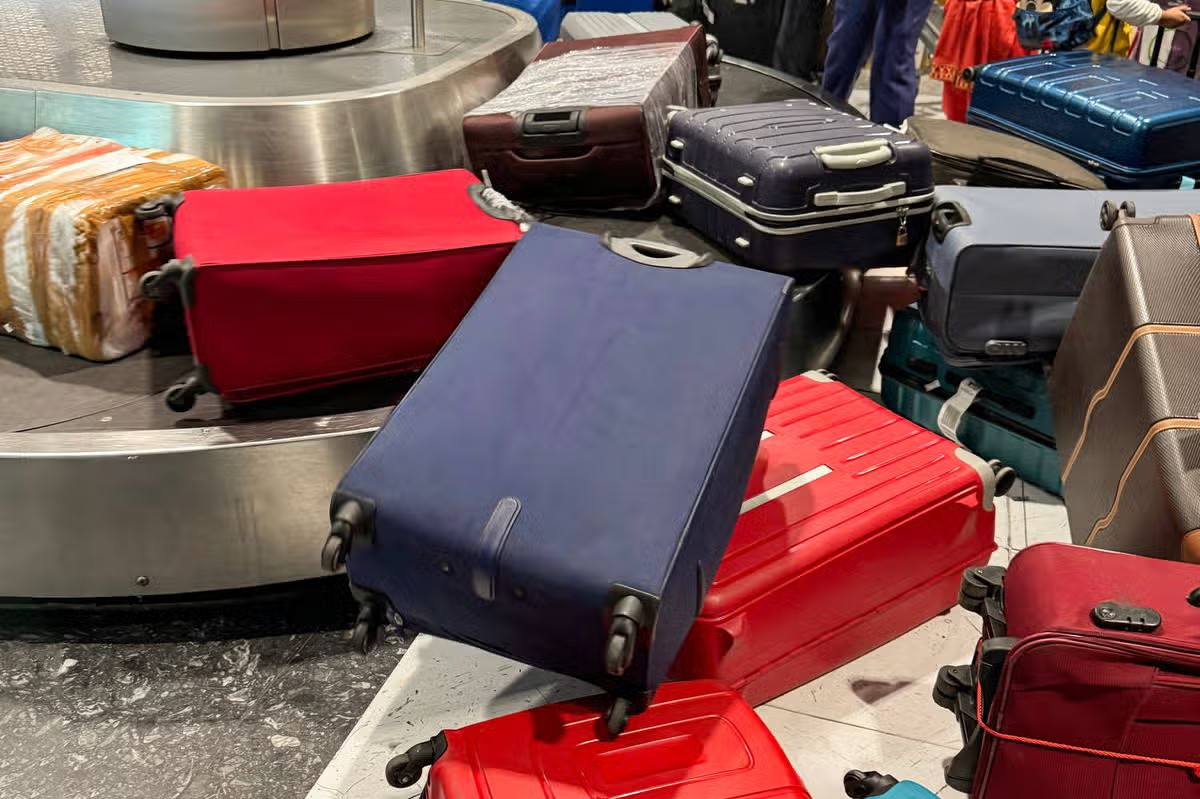
Many of us think they can spot their suitcase when it is on a baggage carousel(Image: mtreasure via Getty Images)
Ryanair continues to grow, with the airline carrying a record 208.4 million passengers in its latest full financial year – a four per cent increase on the previous year. However, the budget airline has also been cutting back at some European airports, with Ryanair withdrawing or reducing flights in certain locations.
The airline has pointed to factors including aviation taxes and airport charges. Despite this, the UK remains a key part of Ryanair’s expansion plans.
Its winter 2026 schedule includes 435 routes, with three new services from London Stansted and a new route between London Luton and Venice. A further 18 new routes have also been added from other UK airports.
As Brits gear up to the October half term holidays and winter, Ryanair has issued a warning to passengers who typically fly with black, navy or grey suitcases, urging them to ‘change’ their luggage to avoid any confusion when they land.
The budget carrier advised travellers to make their checked-in bags more distinctive on the carousel given the prevalence of these colours.
What Ryanair says
As reports the Express, Ryanair said: “Make it easier to spot your checked-in luggage on the carousel, especially if your luggage is black, navy or grey (like 99.9 percent of the population). Add a colourful luggage tag or ribbon to the handle so that there’s no confusion on arrival.”
Ryanair also recommends passengers create copies of their passport, driving licence, and/or ID card and email them to themselves.
It’s also suggested to photograph these documents and store them on your phone for offline access at your destination,
The well-known budget carrier transports an impressive 52 million passengers to and from the UK annually with its fleet of 107 UK-based aircraft.
In June, Ryanair experienced a spike in passenger numbers with 19.3 million people opting to fly with them across one of their 106,000 flights. This marked the first occasion the airline transported more than 19 million travellers and an 11 per cent rise compared to June 2023.
The airline also pulled out all the stops for England fans during the Three Lions’ Euro 2024 run, laying on over 1,500 extra seats to and from Berlin for the cup final.
On a separate note, if you’re on the hunt for stylish cabin bags and suitcases, Antler is well worth a look. Their Iconic Stripe Case, retailing at £175, is available in seven gorgeous colours, including mist blue.
Brooks Nader went braless in a plunging black suit during Paris Fashion Week for an appearance at the Muger showCredit: GettyThe model looked incredible in a plunging jacket with shoulder pads, which she teamed with a thigh-split skirtCredit: Getty
She paired the outfit with strappy heels, a big bouncy blow dry and glamorous make-up.
The actress has recently been filming scenes for the Baywatch reboot in Malibu, where she plays a character called Selene based on the iconic series that made Pamela Anderson a global sex symbol in the 1990s.
Sign up for the Showbiz newsletter
Thank you!
The actresshas become known for herrisque red carpet style that leaves little to the imagination.
She paired the outfit with strappy heels, a big bouncy blow dry and glamorous make-upCredit: GettyThe actress has become known for her risque red carpet styleCredit: GettyThe model often shares photos on her social media accountsCredit: Instagram/BrooksNaderBrooks is starring in the upcoming remake of BaywatchCredit: Hulu
The model shared photos from her stay at the swanky Splendido hotel, posing for a cleavage baring snap.
And in one photo, she pushed together her cleavage underneath her sexy zebra-print bikini.
Brooks, who is best friends with British singer Ellie Goulding, got married to advertising exec Billy Haire in 2019 after four years together.
They split in 2024 and she went on to have short-lived relationships with former Strictly Come Dancing star Gleb Savchenko and Greek Prince Constantine-Alexios.
MEGAN Thee Stallion has stripped down to a tiny black thong and bra top while announcing she’s performing at the Victoria’s Secret Fashion Show.
The racy rapper, 31, will soon show her recent ex-boyfriendKlay Thompson, 36, what he’s missing when she performs at the very sexy fashion show.
Megan Thee Stallion wore a tiny thong and fishnetsCredit: Victoria’s SecretShe showed off her incredible figure in the processCredit: Victoria’s Secret
“Hotties, my dream has finally come true,” Megan told fans Tuesday when announcing the news on social media.
She added: “I’m in thee Victoria’s Secret Fashion Show.
Sign up for the Showbiz newsletter
Thank you!
“Tune in October 18 to see me get my wings.”
Fans can tune into the live fashion show on October 18 via YouTube, TikTok, and Instagram.
The singer previously tweeted about wanting to be a VS AngelCredit: Victoria’s SecretFans have gone wild over the announcementCredit: Victoria’s Secret
In the video accompanying her announcement, Megan could be seen rocking black thong panties and white bra top as she danced around.
Reacting to Megan’s news of her VS Fashion Show performance, one person said: “REAL LIFE ANGEL IS GETTING HER WINGS.”
Another added: “Sexy & sensual moment.”
While a third wrote: “GO MEG.”
Most read in Entertainment
And a fourth said: “ITS BEEN OVER DUE QUEEN!!!! You’ve been on a run! Cultural ICON.”
Megan previously said she was keen to become a Victoria’s Secret angel.
Back in 2011, the rapper took to X, formerly Twitter, and penned: “I swear ima b a victoria secret model when I grow up.”
Megan is keen to show ex-boyfriend Klay what he is missing, following theirrecent break-up, which was plagued by cheating rumourson his part.
In June, the star took to Instagram and appeared to call out her unfaithful ex.
Megan wrote: “Cheating, had me around your whole family playing house… got ‘cold feet’.
“Holding you down through all your HORRIBLE mood swings and treatment towards me during your basketball season now you don’t know if you can be ‘monogamos’ ????
“B**** I need a real break after this one.. bye yall.”
Ireland scored a 3-0 victory over Israel in a politically-charged UEFA Nations League match played in Hungary. The game went ahead despite calls for a boycott with the Irish players wearing black armbands in support of the people of Gaza.
Taylor Swift showed off her newly-chopped hair in a stunning, slinky gown as she prepares to accept the first-ever Artist Director Honors awardCredit: GettyCharli xcx leaned into the vamp with a velvet two-piece setCredit: Shutterstock EditorialBebe Rexha wore an all-black lace look with lace up knee high bootsCredit: GettyActress Teyana Taylor wore a feathered Zuhair Murad gownCredit: Splash
Taylor Swift, who is set to accept the inaugural Artist Director Honors award, wore a slinky Tamara Ralph gown.
The pop star paired a sparkly silver skirt with a form-fitting black bodice and mesh side cutouts.
Sign up for The Sun newsletter
Thank you!
She also showed off her new collarbone length haircut with long, cascading earrings.
Presenter Charli xcx stepped out in an all-black velvet ensemble from Saint Laurent with dramatic, billowing sleeves.
The low-rise column skirt and tiny top showed off her toned stomach, an a mesh insert covered her chest.
Lisa from Blackpink brought the drama in a floor-length, furry red capeCredit: Shutterstock EditorialPop star Sombr rocked a bedazzled belt as he’s nominated for three awardsCredit: Shutterstock EditorialSinger PinkPanthress, nominated for five awards, wore a Nina Ricci gownCredit: GettyTyla brought her signature glam look in a two piece snakeskin set from MowalolaCredit: Shutterstock Editorial
Other stars kept up the black theme.
One Battle After Another actress Teyana Taylor wore a plunging feathered gown from Zuhair Murad, while Bebe Rexha wore an all-black lace look with over the knee boots.
Lisa from the K-pop group Blackpink turned heads in a form-fitting red gown and a dramatic furry red cape.
Most read in Entertainment
The star is up for four awards tonight and will perform her single SaWaDiKa during the ceremony.
Presenter Rachel Dratch donned a structured metallic dressCredit: GettySisters Paris and Nicky Hilton twinned in silverCredit: Getty
Sombr also kept up the fur theme with an oversized striped jacket over his bare chest.
The pop star accessorized with layered necklaces, black sunglasses, and a bedazzled belt that reads “sex”.
She paired the burgundy and polka dot dress with light, blushing makeup and a fishtail braid.
Singer Troye Sivan wore a high-necked Erdem suitCredit: Shutterstock EditorialSinger Normani opted for a full golden metallic gown with full flower embellishmentCredit: Getty
Presenter Tyla brought the heat in a blue snakeskin two-piece bra and skirt set from Mowalola.
SNL alum Rachel Dratch wore a structured metallic dress, while sister duo Paris and Nicky Hilton twinned in silver, with presenter Paris rocking tall bedazzled boots and a sparkly mini dress with cut-outs.
Troye Sivan brought the drama in a high-necked Erdem suit with a draped black sash with white feathers.
Singer Normani also went for a metallic look with a large flower embellishment.
Singer Chloe Bailey left little to the imagination in a mirrored gownCredit: Shutterstock EditorialActress Ella Bright wore a corseted black gown that matched her new dark hairCredit: ReutersReality star Lisa Rinna rocked a wild blonde pixie and gown with fake nipplesCredit: Shutterstock EditorialSinger JoJo also wore a black column skirt paired with a braCredit: Getty
Singer Chloe Bailey wore a body-hugging silver dress with intricate beadwork and mirrored embellishments.
The tight bodice on the dress left little to the imagination – including her nipple peeking out the top.
Off Campus star Ella Bright stepped out in a black corseted gown that matched her new dark hair.
Real Housewives star Lisa Rinna debuted a wild new hair look coupled with a white gown with fake nipples.
Singer JoJo paired a black column skirt and bra top for her VMAs appearance.
SHOWBIZ star Amanda Holden takes it nice and kneesy in a little black dress — as she plots her own wellness empire.
She has filed papers to trademark her name for future use on beauty products and websites.
Amanda Holden looks glamorous in a black dress as she plans her next career moveShe has filed paperwork to trademark her name for future use on beauty products and websitesCredit: Getty
The Intellectual Property Office application also covers cosmetics and perfumes.
Britain’s Got Talent judge Amanda, 55, is hoping for the same success as Hollywood star Gwyneth Paltrow’s £323million Goop brand.
Sign up for the Showbiz newsletter
Thank you!
She has previously admitted that her beauty regime before her Heart Radio breakfast show is rather rushed.
The mum of two said: “I get up at 5am . . . and get ready in 20 minutes.
The Intellectual Property Office application also covers cosmetics and perfumesBritain’s Got Talent judge Amanda, 55, is hoping for the same success as Hollywood star Gwyneth PaltrowCredit: Getty
“I sleep in my lashes and have all my make-up set out.
“I have my outfit laid out and leave my shoes at the door.”
Police in the US state of Mississippi have said that they believe a black woman was already dead before her body was “staged” and placed hanging in a tree.
The disclosure was made in court by a detective on Friday, who also said they believed Tasia Fortune, a mother of four, had been killed in a dispute related to drugs.
The 29-year-old’s body was found hanging from a tree at an abandoned home in Jackson in August.
The discovery sparked widespread fears in the majority-black city, due to the state’s deep history of racial violence and lynchings. After weeks of speculation and demands for information, police made multiple arrests.
In a news release, police said that the medical examiner had determined that Fortune’s death was a homicide and that “the scene and the hanging were staged”.
Officials have not stated the exact cause of death or shared why they believe the hanging was staged.
Fortune’s mother told the BBC that she remembers the coroner telling her: “we’re not treating this as [an] actual hanging.” Her daughter, they told her, was dead before being placed in the tree.
Spivey also recalled police telling her the incident was “drug related”.
Speaking to reporters outside the Jackson Police Department on Friday, Spivey described how she knows her daughter fought for her life till the very end.
“I know she did. I know my daughter,” Spivey told reporters. Fortune leaves behind four young children, ages 7, 5, 4 and 1, she added.
Dressed in a shirt that reads “Justice for Tasia Fortune”, Spivey stressed that she does not want to see any innocent people going to jail.
“I just hope they have the right people,” she said.
Three people have so far been arrested in relation to the case,all of whom are black, including Jarques Ratliff, 51, who has pleaded not guilty. He remains in custody in without bond.
A second person, Earnest Lloyd Jr, 25, was arrested in the case this week.
A third, 45-year-old Eric Clark, turned himself in to authorities on Friday and was charged with murder. He is scheduled to appear in court on Monday.
The 29-year-old’s death is one of several cases in recent years that has prompted lawmakers to call on the justice department and the FBI to investigate all hanging deaths of black people in the country.
Representative Ayanna Pressley, Democrat of Massachusetts, cites at least 10 documented incidents in her September letter to Congress, external, which contained over 50 signatures from US lawmakers.
The most recent incident happened in Prince George’s County, a majority-black suburb near Washington DC, on Sunday. It has been ruled a suicide.
HEIDI Klum has showcased her curves in a stunning see-through black gown at Milan Fashion Week.
The supermodel turned heads with her breathtaking appearance in Italy on Tuesday.
Heidi Klum stunned in a completely see-through black dress in new photosCredit: GettyThe supermodel attended the Milan Fashion Week’s Womenswear Spring/Summer 2027 eventsCredit: Getty
Photos obtained by The U.S. Sun captured Heidi, 53, smiling and waving to onlookers during a Womenswear Spring/Summer 2027 event.
The German beauty wore a completely sheer ankle-length, long-sleeved dress that left little to the imagination.
Sign up for the Showbiz newsletter
Thank you!
She strutted down the sidewalk in the racy outfit that exposed her bare butt through the thin fabric.
Heidi’s long legs were also on display with the gown’s super high slit at the bottom.
The former America’s Got Talent judge completed the look with black high heels, black sunglasses, and her long blonde hair in loose waves.
She also shared several videos of herself walking through the city in the daring outfit on Instagram.
Heidi returned to her old spot on the AGT panel earlier this month to fill in for her ex-co-star Simon Cowell.
She served as a guest judge for the last Golden Buzzer episode of the season while Simon undergoes back surgery.
Most read in Entertainment
The TV star previously served as a main judge on the talent competition series from Season 8 to Season 13.
She returned in 2020 for Season 15 and continued through Season 19 in 2024.
Since leaving the show, Heidi has been focusing on her many other endeavors, including hosting and judging the Project Runway reboot.
The mom of two is also preparing to host her infamous Halloween bash next month, which is always a star-studded affair.
Heidi showcased her curves in the daring dress that exposed her bare backsideCredit: Instagram/heidiklumHeidi recently returned to America’s Got Talent to fill in for Simon Cowell as a judgeCredit: Getty
Before her schedule picked up, she took some time off to enjoy multiple lavish getaways.
The runway model attended an Oktoberfest event earlier this week, sporting a skintight pink corset that could barely contain her breasts.
Before that, Heidi shared numerous photos on Instagram from her trip to St. Barts, where she wore an array of super skimpy swimsuits.
The reality star went completely topless while soaking up the sun on the island with her husband, Tokio Hotel guitarist Tom Kaulitz, 37, and friends.
She made the same move earlier this summer, ditching her bikini top while swimming in the ocean with her dog.
Heidi also freed her bare breasts while sunbathing on a swanky hotel balcony during a vacation to Cannes in May.
Wolverhampton Wanderers v West Bromwich Albion. The Black Country derby. A fixture that goes back to the very dawn of English footballing time itself.
Now it’s back as a league fixture for the first time in more than five years, and in front of fans at Molineux since 2012.
It was first contested as a league game in December 1888 – the very first season of the Football League – when Wolves won 2-1. However, Albion had already won their first two meetings, in 1886 and 1887, both in the FA Cup.
Since then, there have been so many derby memories, both magic and tragic at opposite ends of the emotional scale.
And, since the explosion of televised football, so many of those moments captured on video to be relived – or mentally erased depending on your allegiance – over and over again.
It’s a fixture that the Black Country never stops talking about, the first the fans look for when the sides are in the same division.
And the pre-match banter begins earlier with every staging – and every look back at all those derby highlights from the past 40 years.
Steve Bull’s first derby goal in 1989, a toothlessly grinning Iwan Roberts’ Hawthorns hat-trick in 1996, George Ndah’s double on the back of an inspired Keith Andrews performance in 2001 and two-goal Steven Fletcher’s matchwinning efforts in May 2011 to help keep Mick McCarthy’s side in the Premier League.
For Albion, there was Darren Bradley’s 35-yard screamer in 1993, Bob Taylor’s late Hawthorns clincher in 1995, Jordao’s Molineux matchwinner in December 2001, the season when Albion pipped Wolves for promotion by three points, and Carlos Vela’s injury-time equaliser in Roy Hodgson’s first game in charge in 2011.
As President Trump tries to convince voters that Democrats have let crime run amok, he’s digging into the country’s political past to cite one of the most controversial campaign advertisements that relied heavily on racist tropes.
During a campaign stop Wednesday in Gastonia, N.C., to stump for Republican U.S. Senate candidate Michael Whatley, Trump resurrected a 1988 George H.W. Bush presidential campaign ad featuring Willie Horton, a Black man convicted of rape and assault after his release through a Massachusetts prison furlough program.
A grainy black-and-white prison photo of Horton was used in the ad targeting then-Massachusetts Gov. Michael Dukakis, who was ahead of Bush in the polls. On Wednesday, Trump evoked the Horton ad in an effort to convince voters Democratic former Gov. Roy Cooper, Whatley’s opponent in the Senate race, is soft on crime.
“Willie Horton was a bad guy, really bad guy,” Trump said, before comparing Dukakis’s release of Horton to the pretrial release of a Black man who faces a murder charge for last year’s killing of a white Ukrainian refugee in Charlotte, N.C.
But Cooper was not the governor when the man was released or when he was later charged with killing the refugee.
“Same thing as this, same as, same exact thing,” the president told the crowd in Gastonia.
It’s the second time Trump has invoked Willie Horton while campaigning for his party. Last month during a speech in Las Vegas, Trump called the Charlotte killing a “Willie Horton — modern day” tragedy.
“After the Willie Horton ad dropped, Bush established a lead in the polls and never looked back,” said Andra Gillespie, a political scientist at Emory University outside Atlanta. “They showed the picture, and you ascribed race onto it. It wasn’t sufficiently condemned as racism.”
A spokeswoman for the Republican National Committee, which organized the Gastonia campaign rally, defended Trump’s reference to Horton.
“Roy Cooper emptied prisons and released thousands of violent monsters onto North Carolina streets,” RNC National Press Secretary Natalie Baldassarre said in a statement to the Associated Press. “The results had deadly consequences, and every Democrat who supports abolishing or defunding the police, paroling criminals, and implementing lax bail policies will have to answer for their dangerous records in November.”
Trump paints North Carolina as a ‘dangerous state’
Wednesday’s rally cited the Aug. 22, 2025, killing of white 23-year-old Iryna Zarutska on a commuter train in Charlotte.
Decarlos Brown Jr., who is Black, faces murder and other charges in Zarutska’s stabbing, which was captured on video. Court records showed that at the time of the attack, Brown had 14 prior cases in Mecklenburg County, including serving five years for robbery with a dangerous weapon. Doctors had diagnosed him with schizophrenia.
Republicans and other influential voices in Trump’s Make America Great Again movement claimed the attack showed how Democratic elected leaders in large cities across the U.S. failed to protect residents, while some conservative commentators suggested Democrats were ignoring an unfounded “black-on-white” crime problem.
“He should have been locked up for many, many years,” Trump said Wednesday of Brown.
“Nobody used to think of North Carolina as a dangerous state, criminally dangerous,” Trump added while blaming Cooper. “It was apple pie, right? Now, it’s one of the most violent, one of the worst in the whole nation.”
According to 2024 FBI crime data, North Carolina ranked 19th for statewide violent-crime rates in a 50-state comparison.
During the Gastonia rally, a mosaic of mug shots was displayed on a large screen for the crowd. Trump claimed Cooper had cut a deal with “radical activists” to release “some of the worst criminals in the nation into North Carolina.”
“He released these people. This is just a small group of them,” the president said, pointing to the mug shots that overwhelmingly featured Black people.
Although it is unclear under what circumstances the people in the mug shots were released, state corrections officials have said Brown was not released early from prison or under Cooper’s COVID-era prisoner-release settlement that Trump referenced.
Before fatally stabbing Zarutska, according to court records, Brown had been on a pretrial release over a misdemeanor offense that was ordered by a magistrate after Cooper left office.
‘Tapping into anger’
Republicans are under pressure to win over swayable voters as the November midterms approach with Democrats pushing to gain control of the House, the Senate, or both. Some political strategists say part of the ploy of adding Horton to the North Carolina Senate campaign is to rile up Trump’s base.
“He’s tapping into the anger to remind Republican voters of what he thinks their first principles are in hopes that will be successful for Republican candidates,” Gillespie said.
“He’s doing this to try and divert attention away from criticism of how he’s governing at the moment,” she added. “Democrats want to make the story of this election Trump’s low approval numbers, the war in Iran, inflation, being preoccupied with things that don’t make a whole lot of sense when there are really serious things going on in the country.”
Dewey Clayton, professor emeritus of political science at the University of Louisville, said Trump and other Republicans may be thinking that what worked before in the 2016 and 2024 elections presumably will work again in this year’s midterms.
“It was very effective,” Clayton said. “You do not necessarily have to look at it as racial, in and of itself, although [race] clearly becomes a component. In 2026, talking about ads going back in the 1980s? I’m sure he had consultants that were basically saying this is tried and true.”
The GOP may need the push in November, Gillespie warns. “I think the motivation by going back to these old strategies is there is real concern about Republican enthusiasm and you might see lower Republican turnout,” she said.
Rhetoric attempts to divert voters’ attention from rising costs
The tactic speaks to desperation by Trump and the Whatley campaign, according to Morgan Jackson, a partner with Nexus Strategies in Raleigh.
“Trump brings up Willie Horton to stoke racial division, something he’s used for the last 10 years,” said Jackson, who is chief strategist for Cooper’s campaign. “It is very clear from the president’s speech last night their only goal is to sow division and hate and lies. Michael Whatley doubles down in support of that effort.”
Jackson also said Trump and Whatley are trying to change the election’s message of “rising inflation and the cost of everything.”
“They want to use inflammatory rhetoric, hate speech and lies to sow division in a chance to win an election,” he said. “By referencing Willie Horton, they are showing their hand very clearly.”
The AP sent an email Thursday seeking comment from Whatley’s Senate campaign.
Williams writes for the Associated Press. Williams reported from Detroit. AP videojournalist Erik Verduzco in Gastonia, N.C., contributed to this report.
WASHINGTON — The House approved a resolution Wednesday holding billionaire Leon Black in contempt of Congress, referring the matter to the Department of Justice after he defied the Oversight Committee’s subpoenas in its investigation into disgraced financier Jeffrey Epstein.
The action was swift and without a formal vote, and now leaves it to the Justice Department to decide whether to seek criminal prosecution. Black has refused to respond to the subpoenas’ requests to appear and to turn over any potential nondisclosure agreements involving the investigation into Epstein.
Republicans and Democrats from the Oversight Committee joined in a bipartisan effort to advance the resolution forward.
“No one is above the law,” Rep. James Comer (R-Ky.), the Oversight Committee chairman, said in a statement. “We will continue to seek transparency for the American people and justice for survivors in our investigation of the federal government’s handling of the Jeffrey Epstein and Ghislaine Maxwell criminal cases.”
California Rep. Robert Garcia, the panel’s top Democrat, called the vote “an important step toward justice and accountability.”
Black’s lawyers have denounced the Oversight Committee’s pursuit of the former head of a private equity firm as an abuse of congressional power. They said he “had no knowledge of any of Epstein’s heinous conduct.”
“The Committee has continued to insist on looking for information that does not exist,” attorneys Susan Estrich and Aaron Cutler said in a statement. They called the action “politically motivated” and have sued the committee and asked the Office of Congressional Conduct to open a probe into Comer’s tactics.
“This an outrageous action that ignores the facts and the truth about Mr. Black,” they said.
Epstein investigation churns in Congress
Black is the latest among several prominent figures, including former President Clinton and Bill Gates, who have been asked to appear as part of the Oversight Committee’s long-running probe of Epstein. Survivors of Epstein’s alleged sexual abuse have told personal stories of being young women in a trafficking enterprise organized by Epstein and his colleague Maxwell.
In June, Black did appear for a voluntary interview at the committee. Lawmakers said later that he refused to answer their questions about the nondisclosure agreements.
The committee issued two subpoenas seeking to compel Black to produce the NDAs and to appear for a deposition July 16. The committee said it had accommodated Black’s request to delay the deposition to Sept. 3, but he refused to appear.
On Tuesday the Oversight Committee voted unanimously to approve the contempt recommendation, sending it to the full House.
Black co-founded the private equity firm Apollo Global Management and stepped down in 2021 during the fallout over his ties to Epstein. Lawmakers have alleged that Black paid Epstein $180 million during their years-long relationship.
A 2021 review commissioned by Apollo found that Black paid Epstein $158 million from 2012 to 2017, after Epstein pleaded guilty in 2008 to soliciting prostitution from a minor. The review said the payments were for “bona fide tax, estate planning and other related services.”
WASHINGTON — A nonprofit run by Black federal lawmakers launched a multimillion-dollar effort Tuesday to engage lower-propensity voters in key districts in the midterm elections, following years of dissatisfaction over traditional efforts to reach such voters.
The Congressional Black Caucus Institute’s “SO VOTE” campaign will seek to register and mobilize young voters, as well as voters in majority-Black and rural communities, across the South, Midwest and West. The campaign involves partnerships with dozens of local organizations, the institute said, with in-person and online outreach to voters often sidestepped by major political campaigns.
“For decades, as far as I can remember, there are those of us who have always complained about the fact that neither party spends the significant and requisite time with Black and brown and poor and rural communities,” said Marcia Fudge, a former Democratic congresswoman from Ohio who served as the secretary of Housing and Urban Development during the Biden administration.
“So we finally decided to take it upon ourselves to do something that we didn’t think anybody else in the industry was doing,” said Fudge, who is spearheading the new effort alongside former Black Caucus colleagues.
Effort blends old tactics with new technologies to boost turnout
Voter engagement efforts will cover outreach across Georgia and Mississippi, as well as target voters in 16 congressional districts that are likely to determine control of the House.
Instead of traditional television advertising, the campaign will convene local civic groups and houses of worship, as well as fraternities and sororities. The effort will also use some now-widespread techniques in political campaigns, such as geotargeting online ads and partnerships with local content creators for audiences who mainly receive their news online.
While the voter engagement efforts are officially nonpartisan, the Black Caucus’ targeted races are in many regions where Black voter turnout could prove key to whether a Democratic candidate prevails in closely divided House districts. Cedric Richmond, a former Louisiana Democratic congressman who served as a senior adviser to President Joe Biden, said the effort would focus on repeatedly engaging voters in rural communities who feel alienated from Democratic campaigns.
“If you’re not happy with the way things are going, then voting is part of the solution, but it takes constant communication,” Richmond said.
The Black Caucus’ institute has raised about $1 million for the campaign, primarily from individual donors, and plans to spend at least $4.5 million in the midterm election cycle.
Campaign responds to GOP redistricting and disappointing turnout in the past
The new outreach effort follows years of disappointment and frustration among some in the Black Caucus at the broader Democratic Party’s efforts to court Black, rural and younger voters.
Rep. Jim Clyburn, an influential South Carolina Democrat who decried the lackluster voter turnout in the 2024 election, said the campaign “allows us to put to practice that which we have been proposing, and we have never had the resources to do it. But this year we do.”
The effort is also a response to Republican-led redistricting efforts in multiple states, said Rep. Bennie Thompson, a Mississippi Democrat.
“These Southern states are trying to minimize Black political participation and ultimately Black political strength,” he said. “So what we have to do is take that low-propensity voter and elevate their participation so they become an additional voice to be reckoned with.”
HELEN Flanagan has put on a busty display and risked popping out of her racy black dress on a night out.
The former Coronation Street star, 36, took to Instagram to share some new snaps as she enjoyed a meal out at Gaucho restaurant in Manchester.
Helen Flanagan has put on a busty display on a night outCredit: Instagram/hjgflanaganShe threatened to spill out of her black dressCredit: Instagram/hjgflanagan
She wore a long ribbed black dress as she showed off plenty of cleavage in the revealing outfit.
Helen threatened to spill out of her attire as she only had three small gold clasps holding her boobs in.
Sign up for the Showbiz newsletter
Thank you!
The figure hugging dress perfectly cinched her waist as she displayed her hourglass figure.
She wore her blonde locks in a curly hairstyle and opted for a chic make-up look, complete with false eyelashes, eye shadow and a pink gloss.
Helen appeared to be in great spirits as she beamed from ear to ear and enjoyed some beverages.
The actress simply used a kissing lip emoji as the caption.
Her followers rushed to the comments section to compliment her as one gushed: “The most gorgeous woman ever.”
Another person enthused: “Stunning and classy.”
She’s no stranger to showing off her assetsCredit: InstagramIt comes after she joked about selling her knickers to pay for solicitor feesCredit: Instagram/hjgflanagan
Somebody else commented: “Sydney Sweeney ain’t got nothing on you.”
Yet another joked: “I mean…..come on, give the other women a chance.”
While a fifth follower added: “You are so gorgeous.”












![The fire-damaged “Royad Mammadov” ship in the Black Sea after a fire aboard the vessel outside Romania’s territorial waters left two people dead on October 5 2026 [Reuters]](https://i0.wp.com/www.aljazeera.com/wp-content/uploads/2026/10/2026-10-05T150002Z_1974670076_RC22XNAQIP2B_RTRMADP_3_ROMANIA-INCIDENT-1791231511.jpg?w=640&ssl=1)