billionaire tax

Billionaire tax ballot measure trails; California voters reject voter ID

The fate of a controversial ballot measure to impose a new tax on California billionaires, proposed as a lifeline for the needy and castigated as a threat to the state’s fragile economy, appeared headed for defeat in early election results Tuesday night.

California voters also rejected another hotly contested measure, Proposition 39, which would have required voters to show identification when they cast ballots and elections officials to verify that all registered voters were U.S. citizens.

The billionaire tax, Proposition 40, would impose a one-time 5% tax on the assets of billionaires to raise an estimated $100 billion to assist millions of Californians destined to lose healthcare coverage under federal funding cuts. Two separate ballot measures, Propositions 41 and 42, were crafted to nullify the wealth tax and remained too close to call Tuesday evening.

While supporters of the billionaire tax did not concede Tuesday evening, they acknowledged facing tough odds in the race because of the avalanche of spending against them and warned that people will die if the measure fails.

“In the event that we don’t succeed with Prop. 40 tonight, if Sacramento fails to deliver a real solution to the healthcare crisis instigated by the [federal government], one that actually makes billionaires pay their fair share, then California’s healthcare workers intend to be back on the ballot in 2028 to correct the damage, and to overcome all of the lies and deception, and just completely outrageous campaigning that we’ve seen,” said Dave Regan, president of SEIU-United Healthcare Workers West, which crafted the proposal.

Voters rejected the Republican-led Proposition 39 at a time of growing distrust in the integrity of the electoral process nationwide, a wariness intensified by President Trump’s baseless claims that the 2020 election was stolen from him and false assertions that droves of undocumented immigrants, notably in California, are swaying elections.

On Monday, the Supreme Court rejected an emergency appeal by Trump’s attorneys to set aside 20,000 ballots in the state that the White House argued could be cast by people who are not citizens.

The proposals were among the 14 state ballot measures that California’s 23.3 million registered voters were asked to decide Tuesday in addition to congressional, statewide and local elections.

The billionaire tax was proposed in response to legislation signed by Trump last year that could result in millions of Californians losing Medi-Cal coverage, rural hospitals shuttering and other healthcare services being slashed unless a new funding source is found. The proposal would retroactively apply to billionaires who lived in California as of Jan. 1, prompting some to preemptively move out of the state. Ninety percent of the revenue would fund healthcare programs, and the remaining funds would be spent on education programs and food assistance.

Proposition 40 divided Democratic leaders because of concerns about its impact on the state’s volatile budget that is highly dependent on the wealthy. Gov. Gavin Newsom opposed the measure, while the state Democratic party endorsed it.

The effort supporting and opposing the tax and two ballot measures designed to nullify it came close to breaking a state campaign finance record. About $425 million had been donated to the three commingled ballot measures as of Tuesday.

The vast majority of that money was provided by California billionaires, including some of the state’s most powerful tech barons, opposing the wealth tax. The campaign was centered on three interwoven ballot initiatives: Proposition 40 and Propositions 41 and 42, both of which would undercut Proposition 40 through a series of strategic changes to state tax laws and new spending restrictions.

Neither explicitly stated that it would nullify the billionaire tax if Proposition 40 passed and either of the counter measures received more votes.

Proposition 41, which trailed slightly Tuesday evening, is framed as an effort to cut wasteful government spending and require audits of new special taxes. But it also would bar new taxes that are exempt from state spending limits. Proposition 42, which was slightly ahead, is presented as protection from state lawmakers taxing everyday Californians’ retirement funds, personal savings and home equity.

In polling leading up to election day, voters appeared to differentiate between the billionaire tax proposal and Proposition 3, which was approved by voters on Tuesday. . It would make permanent a temporary tax increase on wealthy Californians that largely funds education. The tax adds 1% to 3% to the state income tax of single filers who earn more than $360,000, joint filers who make more than $721,000 and heads of household who earn more than $490,000. Voters passed the tax in 2012 and extended it in 2016, but it is set to expire in 2031.

Voters cast ballots on several other proposals about local taxes, public financing of political campaigns, a landmark environmental law, housing, the state’s recall process, state lawmakers’ ability to redirect taxpayer money to the state’s “rainy day” fund, immunology and immunotherapy funding, and restrictions on how community healthcare clinics spend money:

Several ballot measures were decided Tuesday evening:

  • Proposition 1, which proposed a $11.25-billion bond to boost the construction of affordable housing, was approved by voters.
  • Proposition 2, which would gave state lawmakers more flexibility over state spending by exempting certain tax revenue from a state spending limit, allowing them to place it into a “rainy day” fund, was approved by voters.
  • Proposition 37, which would create a down-payment assistance program to help middle-class Californians buy a home, was approved by voters.
  • Proposition 44, which would require certain health centers to spend 90% of their revenue on patient care rather than overhead and executive compensation, failed.

Among those that remained too close to call:

  • Proposition 4, which would allow state and local candidates to receive public campaign financing if they demonstrated broad support and agreed to expenditure limits.
  • Proposition 5, a constitutional amendment that would alter the state’s recall process by limiting it to the question of whether to remove an elected official from office, and no longer including the cadre of candidates hoping to replace the politician.
  • Proposition 38, which would create an $8.4-billion bond to support the immunology and immunotherapy fields.
  • Proposition 43, which would bar local governments from imposing special taxes unless two-third of voters support the effort. Current law requires a simple majority vote.
  • Proposition 45, which would amend the California Environmental Quality Act to speed up certain housing, water, energy, transportation and other projects deemed essential.

Source link

California Propositions 40, 41, 42 last-minute guide: The billionaire battle

The so-called billionaire tax has become one of the most contested California propositions in years, generating national interest and massive spending by opponents. It also has spawned two rival ballot measures.

Here’s a cheat sheet for sorting it all out.

Proposition 40

The basics

Proposition 40 would impose a one-time 5% tax on California billionaires’ assets. The tax applies to people with a net worth of at least $1 billion who resided in California on Jan. 1.

Impact

Ninety percent of the tax would fund healthcare, and 10% would go toward education and food assistance.

The tax would affect hundreds of billionaires whose net worth includes assets such as their businesses, stocks and other investments. Real property, pensions and retirement accounts generally would be excluded.

Proposition 41

It’s called the Improving Transparency, Effectiveness and Efficiency in California Government Act. But it is deeply connected to Proposition 40 and is funded by foes of the billionaire tax.

The basics

Proposition 41 requires the state auditor to review programs funded by proposed special taxes before they appear on the ballot. More importantly, it also prohibits new state taxes from being exempted from a voter-approved state spending limit.

Impact

The Legislative Analyst’s Office says passage of Proposition 41 could prevent Proposition 40, the proposed billionaire tax, from becoming law even if voters approve it. This could happen if Proposition 41 receives more “yes” votes than Proposition 40.

Proposition 42

Proposition 42 would limit the state’s ability to impose certain new taxes. But it’s more complicated and far-reaching than that description might sound. And, yes, it’s also backed by opponents of Proposition 40.

The basics

Proposition 42 would prohibit new taxes on “retirement holdings, individually owned assets, and other forms of personal savings” that take effect after Jan. 1, 2026. It also would bar retroactive taxes on past earnings unless the state is using revenue from the tax to respond to emergencies such as a fire or a flood.

Impact

The Legislative Analyst’s Office says Proposition 42 could nullify Proposition 40 because the two measures conflict with each other. If voters approve both, the one with the most “yes” votes generally would become law, the office says.

Dig deeper

The billionaire tax was pushed by the Service Employees International Union-United Healthcare Workers West and has some labor and progressive support, including from Sen. Bernie Sanders (I-Vt.) and the state Democratic Party. They say the tax is needed to help the less fortunate and that the super-rich can afford it. But key Democrats and some key unions are not supporting it.

Critics include some of California’s richest people, and they are spending a fortune to defeat it. They say it will hurt innovation and drive the wealthy out of the state, hurting the treasury.

More reading

A powerful union and the birth of the billionaire tax (L.A. Times)

Why unions are divided over Prop. 40 (L.A. Times)

The Google co-founder fighting the billionaire tax (L.A. Times)

Inside the massive spending to defeat Prop. 40 (L.A. Times)

How the billionaire tax could spark national movement (The New Yorker)

The academics behind Prop. 40 (Sacramento Bee)

Will Prop. 40 reallly bring an exodus? (L.A. Times)

Why healthcare is divided by Prop. 40 (Bloomberg)

Taxing the “ultrarich,” a guide (New York Times)

Source link

California Prop. 3 last-minute guide: The other tax-the-rich measure

There has been much debate about efforts in California to tax the rich. But almost all of it centers around Proposition 40, the heavily contested billionaire tax, and two countermeasures, Propositions 41 and 42.

But there is another ballot measure that also would tax California’s wealthiest citizens that is getting far less attention — and has even garnered support from some billionaires who oppose Proposition 40.

The basics

Proposition 3 would make an expiring state income tax on high earners permanent.

The impact

Tax rates for the top 2% of earners would remain as they are. Income brackets rise with inflation, but last year the top 2% of taxpayers earned at least $371,000 for single filers and $743,000 for joint filers. Money generated by Proposition 3, like the current tax, would flow to education, with 89% going to K-12 schools and 11% to community colleges.

Dig deeper

In 2012, California voters approved a temporary increase in the income tax rate for the top 2% of California earners. In 2016, voters approved another extension through 2030. Proposition 3 would make the additional levy permanent.

Backers say the measure is crucial to maintain education funding levels and predict there would be grave problems if the measure is not approved. The state could expect to lose $5 billion to $15 billion annually in tax revenue starting in 2031, according to estimates from the Legislative Analyst’s Office.

Opponents say taxes are already too high and the state should focus on cutting waste.

More reading

What to know about Prop. 3 (L.A. Times)

How Prop. 3 fared in Berkeley poll (L.A. Times)

Prop. 3 ballot language (California secretary of state)

Inside the Prop. 3 campaign (EdSource)

Source link

More than $351 million spent on wealth tax on November ballot.

More than $351 million in political donations has been poured into a high-stakes contest about a proposed wealth tax on the November ballot, making it one of the most costly campaigns in California history.

About 90% of the money is being spent to defeat a statewide initiative to impose a new tax on the assets of billionaires, a multifaceted opposition effort bankrolled primarily by ultra-rich Californians being targeted by a measure that supporters call an economic reckoning.

The billionaire tax, Proposition 40, would levy a one-time, 5% tax on many assets of California billionaires who lived in the state as of Jan. 1.

Millions of dollars continue to flow into the campaigns of three intertwined ballot initiatives at the center of the debate: Proposition 40, and Propositions 41 and Proposition 42, which would neuter the Proposition 40 through strategic, esoteric tax law changes.

“The pro-40 campaign picked a fight and then came to that fight with a butter knife against a nuclear arsenal,” said GOP strategist Rob Stutzman, who is not involved in any of the wealth-tax-related ballot measures. “Because they’re so well funded, in today’s multifaceted media world, they are able to show up everywhere from network TV to inside video games. That is a very, very large advantage few campaigns ever get to have.”

But, Stutzman warned, money does not guarantee a win.

In the most expensive ballot measure fights in California history, $463 million was spent on two gambling proposals 2022. The initiatives pitted some of California’s most successful Native American tribes with gaming interests against gambling corporations, including online sports gaming companies DraftKings and FanDuel. Both side’s measure failed.

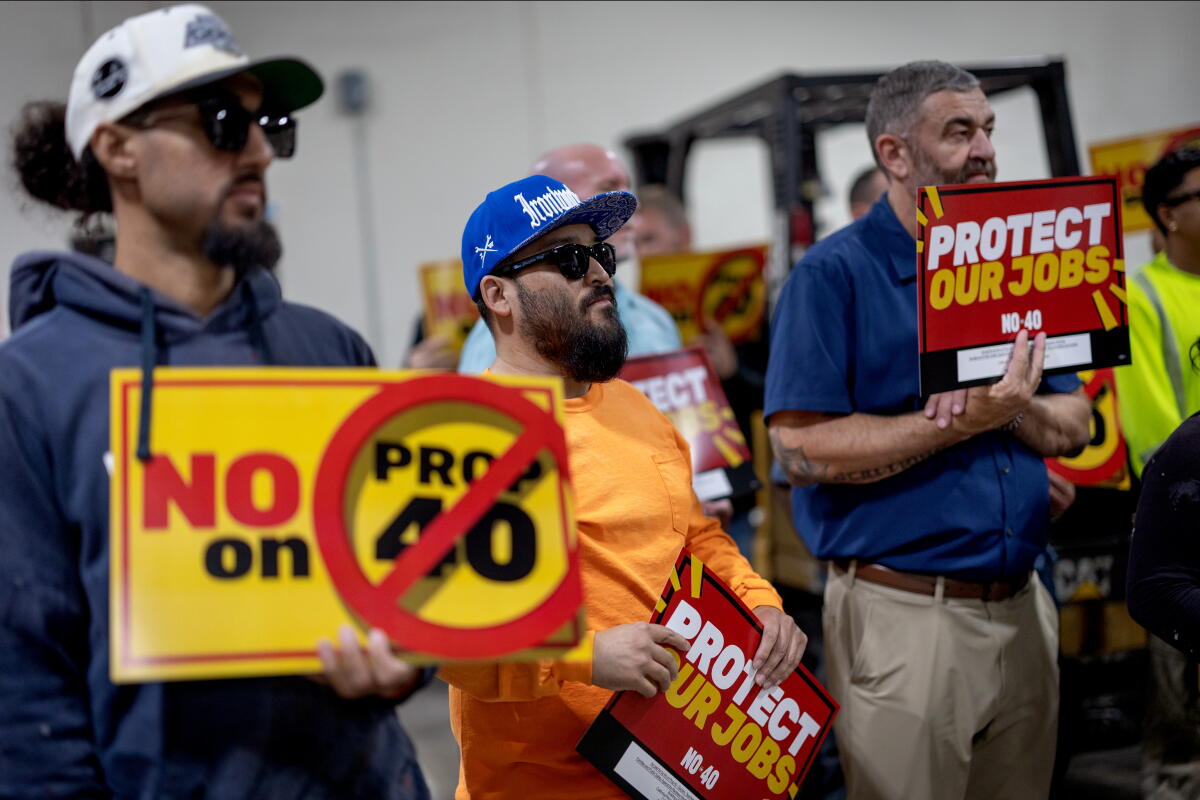
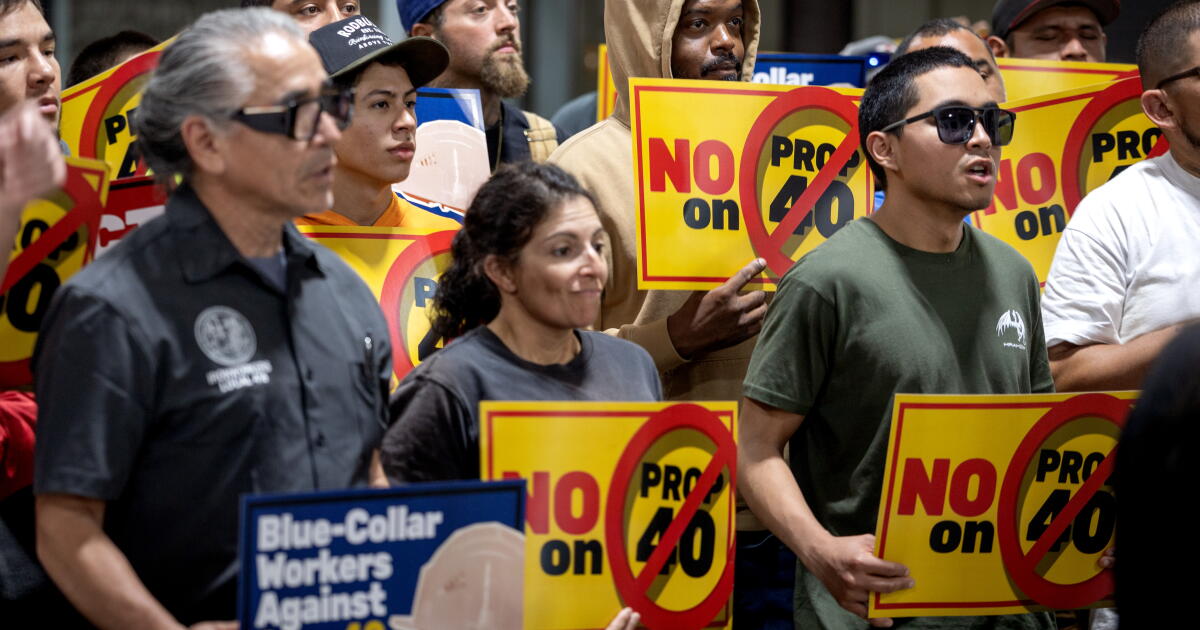
People attend a rally against Proposition 40 at the Iron Workers Apprenticeship Training Center

People attend a rally against Proposition 40 at the Iron Workers Apprenticeship Training Center on Oct. 5 in La Palma.

(Eric Thayer/Los Angeles Times)

The tax measure was crafted by Service Employees International Union-United Healthcare Workers West in response to federal healthcare funding cuts signed by President Trump last year that are expected to reduce California’s healthcare budget by $100 billion, burdening the state’s most vulnerable residents.

“Trump’s ‘Big Beautiful Bill’ slashes healthcare funding, with major coverage cuts scheduled to hit after the midterms,” said Suzanne Jimenez, the union’s chief of staff. “More than 3 million Californians could lose their health insurance. Hospitals and emergency rooms face closure. Patients will die unnecessarily when the care they need is no longer there. Proposition 40 is an emergency response to that looming disaster.”

The proposition’s supporters raised $34.3 million, nearly all of it from Jimenez’s union.

The two other measures, Propositions 41 and 42, would nullify the billionaire tax if either receives more votes.

Proposition 41 supporters say the measure aims to cut wasteful government spending by requiring audits for new state special taxes and would bar new state taxes that exempt their revenue from a state spending limit. Backers of Proposition 42 argue it would prohibit new taxes on retirement holdings, individually owned assets and other forms of personal savings.

Advocates for the billionaire tax say both are well-financed smokescreens to undercut Proposition 40.

Opposition campaigns to the wealth tax as well as the two countermeasures have received enormous donations from several of the state’s billionaires. But Building a Better California, the main funder of efforts to defeat the wealth tax, noted that its allies included Democratic and Republican politicians, prominent labor groups and business leaders.

“It’s rare for such a broad coalition to unite around any single cause in California, but it reflects the potentially devastating impact of this measure on healthcare, education, and our state’s economy,” the group said in a statement.

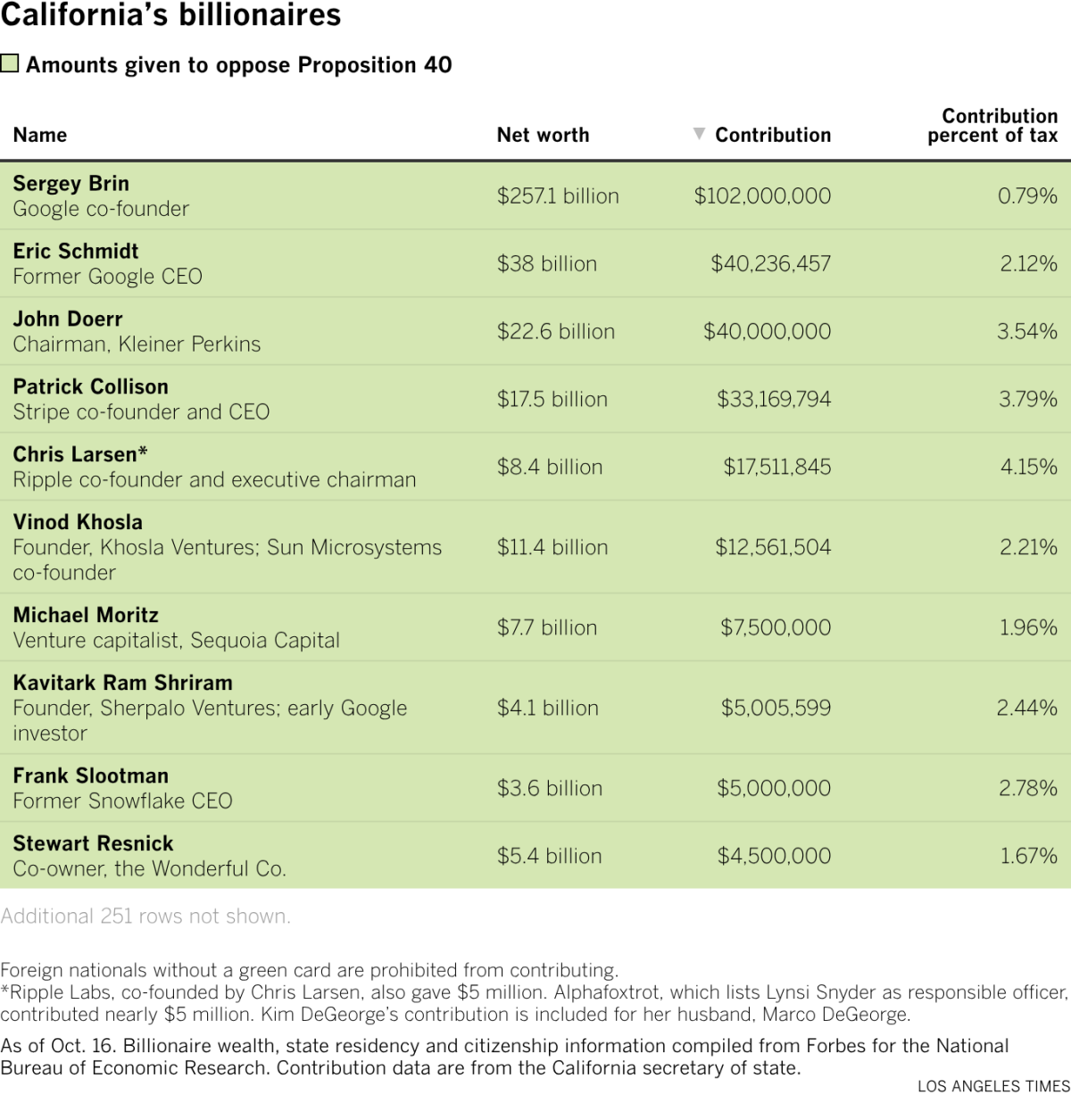
Among the largest donors opposing the wealth tax are billionaires Sergey Brin, a co-founder of Google who has donated more than $100 million to anti-wealth-tax efforts, and former Google leader Eric Schmidt and venture capitalist L. John Doerr, who each kicked in $40 million.

Brin, Schmidt and Doerr did not respond to requests for comment.

US tech entrepreneur Sergey Brin and Gerelyn Gilbert-Soto arrives for the 2026 Met Gala

US tech entrepreneur Sergey Brin and Gerelyn Gilbert-Soto arrive for the 2026 Met Gala celebrating “Costume Art” at the Metropolitan Museum of Art in New York in May.

(ANGELA WEISS/AFP via Getty Images)

The spending disparity also reflects a divide among Democrats and their allies, many of whom support wealth taxes, but argue that the way Proposition 40 was written is disastrous to California’s volatile budget, which is dependent on the state’s wealthiest residents.

Jodi Hicks, chief executive and president of Planned Parenthood Affiliates of California, said that while her organization would support a nationwide or a California wealth tax, their primary concerns are about 40’s impacts on the state budget and healthcare in the state.

“We are opposed to this particular proposal because we think it does more harm than good,” she said, adding that after what her organization “faced last year having to scramble for dollars because of [federal funding cuts] we are committed to work with the stakeholders facing cuts and not harming the budget and finding revenue in a smart way.”

The cash imbalance between supporters and opponents of the billionaire tax is vast. Those opposed to the measure raised $316.7 million, while proponents raised nearly $34.3 million.

protesters

The Fair Games Coalition, made up of community leaders, labor organizations and advocates, announce the launch of the Overpaid CEO Tax Initiative in front of the Tesla Diner in West Hollywood in January.

(Genaro Molina/Los Angeles Times)

The supporters of the wealth tax spent nearly all of their money gathering signatures to place the measure on the ballot. They had $1.6 million on hand as of Oct. 17.

Now, as voters cast ballots, their campaign appears reliant on public events and media coverage, such as of Sen. Bernie Sanders’ (I-Vt.) recent rally in support of Proposition 40 in downtown Los Angeles.

“What you are showing people from coast to coast and all over is that, yes, we can take on the greed of the oligarchs,” he said, calling it the most important ballot measure in the country. “Yes, we can create an economy and a government that works for all of us, not just the 1 percent.”

Facebook creator and Meta chief Mark Zuckerberg was among the California billionaires Sanders name-checked in his remarks. After Zuckerberg told company leaders that he planned to leave the state to avoid his control over the company substantially reduced by being forced to sell enough of his stock in the social media giant to pay the proposed levy, the company on Wednesday announced the creation of a new, non-voting type of stock that would allow Zuckerberg to sell enough shares to pay the proposed tax while retaining his voting power in exchange for him agreeing to remain in the state for eight years.

Meta CEO Mark Zuckerberg listens as President Donald Trump speaks to reporters

Meta CEO Mark Zuckerberg listens as President Trump speaks to reporters at the White House on Sept. 29.

(Jacquelyn Martin / Ap Photo/jacquelyn Martin)

The pro-wealth-tax campaign is sending voters emails and texts and has an online presence.

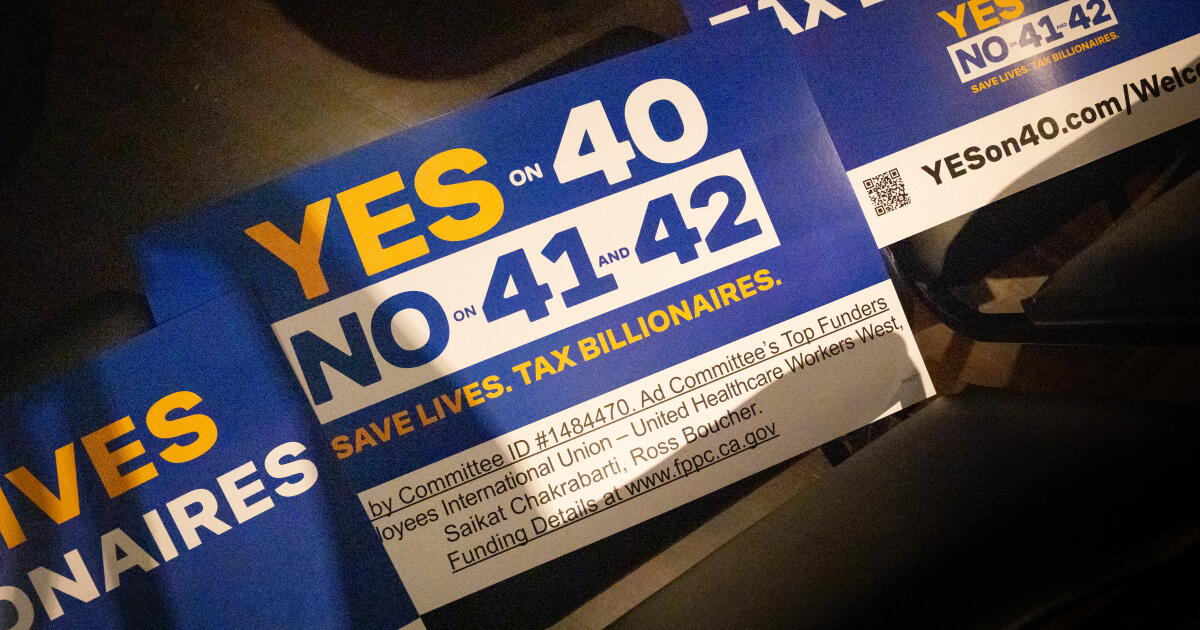
“Remember: it’s not enough to vote YES on 40. You also need to vote NO on 41 + 42,” read an email sent to voters on Tuesday. “Don’t be fooled: Props 41 and 42 are billionaire-funded initiatives designed specifically to undermine Prop 40, the California Billionaire Tax.”

Meanwhile, the anti-40 and pro-42 campaigns are inundating voters on television, streaming services, in mailboxes, through online influencers and even in digital video games such as Sim City.

Jimenez said voters will see through the blizzard of campaign messaging.

“The billionaires think voters are stupid. They think they can bury the facts under millions of dollars in advertising and disguise Prop. 42 … as protection for ordinary taxpayers,” she said. “Their spending also makes our case for us. When billionaires can afford to spend millions a day protecting their fortunes, voters can see that billionaires have plenty of money to spare.”

Sheri Sadler, a veteran Democratic media buyer, questioned how much voters were hearing about the rationale for the proposed billionaire tax.

“The yes side is severely lacking in getting their message through while the no side is dipping into different kinds of pockets,” she said.

Jessica Levinson, an election law professor at Loyola Law School, said that beyond voter confusion about the competing ballot measures, it is certain to face legal challenges, notably about the retroactive nature of the tax, which would apply to any billionaire who lived in California as of Jan. 1. She described that as “the biggest legal pressure point.”

“It’s kind of a mess,” she said.

Times staff writer Gabrielle LaMarr LeMee contributed to this report.

Source link

These Californians spent 0.07% of their billions to oppose Prop. 40

About 260 California billionaires would be subject to Proposition 40’s one-time 5% wealth tax according to the Forbes Real-Time billionaires list. Just 30 of those billionaires or their spouses, or 1 in 8, spent money opposing Proposition 40, the billionaire tax, according to a Times analysis of recent campaign filings.

Billionaires have individually contributed $293 million to oppose the tax measure and to support Proposition 41 and 42, which would nullify the billionaire tax if either receives more votes, according to a Times analysis. Sergey Brin, co-founder of Google, has given $102 million, more than a third of all billionaire money against the measure. But this is less than 1% of his estimated tax bill.

Several billionaires also contributed to the political action committee of the California Business Roundtable, which is spending to oppose Proposition 40 and support Proposition 43. Peter Thiel gave $3 million, Eric Schmidt gave nearly $2.6 million, Marco DeGeorge’s wife, Kim, gave $1.9 million, Chris Larsen gave $750,000 and Douglas Leone and his wife gave $500,000.

Proposition 40 would apply the tax to billionaires who were California residents on Jan. 1, 2026, and the taxable amount would be based on their net worth on Dec. 31. The tax is payable over five years.

Altogether, these individuals would owe at least $107 billion in taxes, according to an analysis by economists Jasper Boll, Emmanuel Saez and Gabriel Zucman. Their research was published in the National Bureau of Economic Research in August. Saez and Zucman are also architects of the tax proposal.

This amount is 5% of their combined estimated wealth by Forbes as of Oct. 16 and factors in a certain amount of tax avoidance and evasion. Spread across all 39 million Californians, the $107 billion would be roughly $2,700 per person. The Public Policy Institute of California estimates that the median household net worth in California was $303,000 in 2023.

The four richest Californians — Sergey Brin, Jensen Huang, Larry Page and Mark Zuckerberg — would owe 40% of the estimated taxes to be collected from the billionaire tax, according to a Times analysis. Their wealth largely comes from ownership of stock in extremely high-value technology companies.

Their net worth would increase 5% in about four months if their stock investments continues to grow as they have since December.

California billionaire wealth grew nearly threefold from 2022 to 2026, according to Times analysis of Forbes data collected by Boll and his colleagues, and much of that growth was not taxed. Billionaires’ taxable income is small compared with their wealth, because most of that wealth is invested in public stocks, and gains aren’t taxed until the stock is sold.

Page and Brin disclosed no taxable income in three of the years since 2019. Many others had similarly no publicly disclosed income. For that reason, Boll and his colleagues estimate that the Proposition 40 one-time tax would raise more than $100 billion, “with comparatively minor impacts on income tax revenue” from some billionaires leaving the state.

Based on Meta’s filings, the economists estimated that Zuckerberg’s taxable income was about $947 million in 2025, just 0.4% of his net worth.

Over the summer, Zuckerberg shared with Meta advisors his plans to relocate outside California to avoid the possibility of a significant reduction in his control over the company as a result of selling enough stock to fund a 5% tax. The advisors determined that Zuckerberg’s leadership presence at Meta headquarters was essential to the company’s success. On Wednesday, Meta announced the creation of new, nonvoting Class C common stock, which will allow Zuckerberg to sell the amount he needs to pay his potential tax bill while maintaining his voting power in exchange for his commitment to remain in the state for eight years.

Researchers at the Hoover Institution estimate the revenue to the state to be closer to $40 billion based on reports of billionaires’ residential purchases outside the state before and after Jan. 1 and their estimate of unannounced residency moves.

Chris Hoene, executive director at the California Budget and Policy Center, a nonpartisan group, said the residency question hinges on the amount of time spent living in the state. “Purchasing property in another location does not mean that they have changed their residency,” he said.

Ultimately, the state’s Franchise Tax Board, responsible for administering the tax, will have to assess residency. Hoene says this task is “easier for them to do than people realize.” The board will also calculate the amount of wealth subject to the tax using publicly available stock information and private assessments of personal property, such as artwork and jewelry. Real property, pensions and retirement accounts would be excluded.

Opponents of Proposition 40 are concerned that the threat of wealth taxes will lead to billionaires continuing to leave the state, resulting in a long-term decrease in state income tax revenue. Forbes recently reported that Brin registered to vote in Nevada last year. Peter Thiel disclosed Dec. 31 that he opened a new office in Miami; Florida has no wealth tax or income tax. But in July, he purchased a $130-million mansion in Bel-Air.

“The reality is the income tax loss can never get anywhere near the scale of what the wealth tax gain would be,” Hoene said.

Ninety percent of that gain would be spent on healthcare services to fill a gap in Medi-Cal from losses in federal funding that the measure’s authors estimate would total $190 billion over the next 10 years. Medi-Cal provides healthcare coverage for one-third of low-income Californians, according to the Legislative Analyst’s Office.

Gov. Gavin Newsom opposes a California-only tax and has instead called for a national wealth tax. Democrat Xavier Becerra and Republican Steve Hilton, who are running to replace Newsom, have spoken out against the tax. Other opponents include the California Teachers Assn., the California Medical Assn., and Planned Parenthood Affiliates of California. Supporters include Service Employees International Union, U.S. Sen. Bernie Sanders (I-Vt.), the California Democratic Party and the California Federation of Labor Unions AFL-CIO.

Times staff writer Queenie Wong contributed to this report.

Source link

Sanders boosts wealth tax; labor argues it would devastate economy

Sen. Bernie Sanders, a hero among the nation’s progressive voters, stumped in Southern California on Monday for a wealth tax on the California ballot in November that has drawn hundreds of millions of dollars in campaign spending.

“What you are showing people from coast to coast and all over is that, yes, we can take on the greed of the oligarchs,” said Sanders (I-Vt.), who called Proposition 40 the most important ballot measure in the country. “Yes, we can create an economy and a government that works for all of us, not just the 1 percent.”

Sanders name-checked billionaire tech founders including Elon Musk of SpaceX, Mark Zuckerberg of Meta and Google co-founder Sergey Brin, whose mentions were repeatedly met with boos from the crowd gathered at the Novo in downtown Los Angeles.

Labor leaders, speaking earlier on Monday at a union training facility in La Palma, argued that although the billionaires tax is billed as a one-time tax on the assets of the state’s wealthiest residents, it includes a loophole that would allow state lawmakers to tax the savings and retirement accounts and home equity of all Californians.

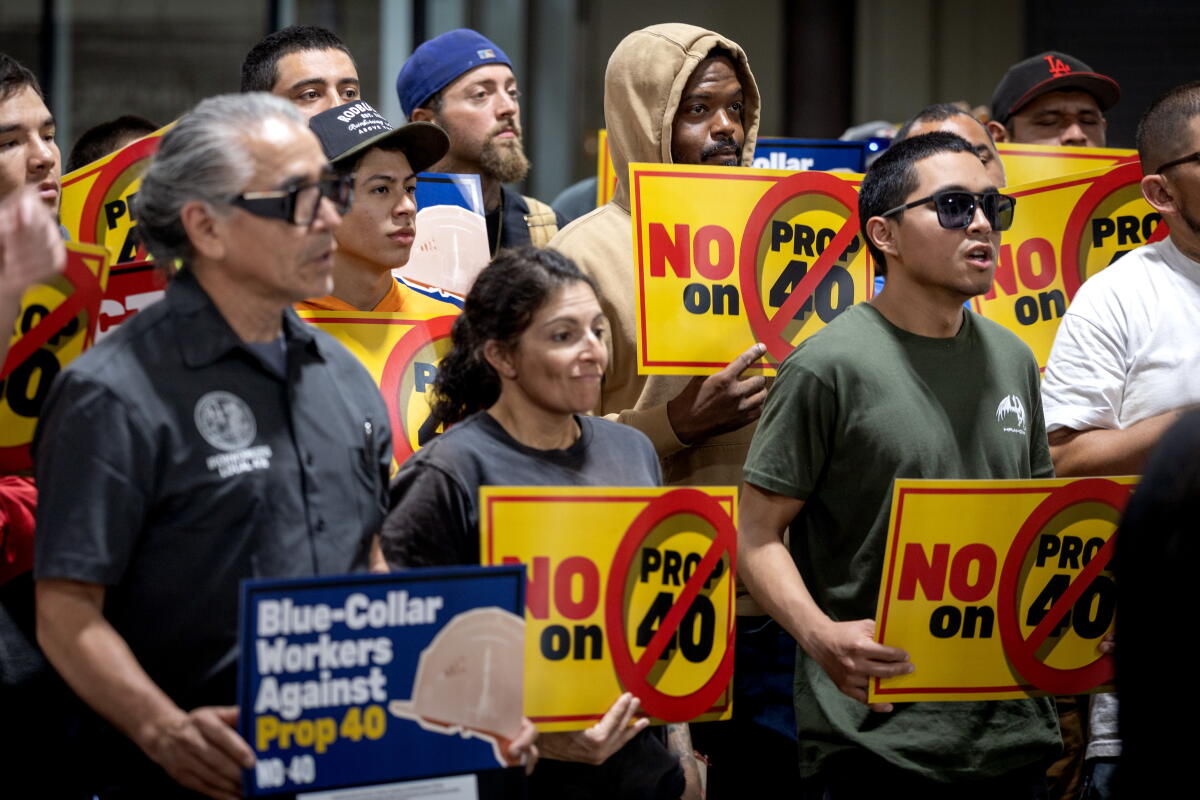
“In the trades, we know you always read the blueprints and you always read the fine print,” said Xochitl Medrano, the political director for the district council of the Ironworkers of the State of California and Vicinity. Medrano was surrounded by union workers chanting, “No on 40!”

“Our workers are not billionaires; they are working people. After 20, 30, or even 40 years of breaking their backs on the job sites, our members have the opportunity to have a decent pension, some retirement savings, and equity in a home that they’ve been working to pay off,” she said. “That’s not wealth handed to them. That’s sweat equity. … We won’t stand by and let a tax that’s supposed to target billionaires turn into a trap door for working families.”

Proposition 40 is among the most contentious issues on the Nov. 3 ballot. The measure was crafted by a healthcare union to offset $100 billion in impending federal healthcare funding cuts approved by congressional Republicans and signed by President Trump last year. Millions of Californians could lose their healthcare coverage because of those cuts.

There are two opposing measures on the November ballot, Propositions 41 and 42, that would nullify the billionaires tax if either receives more votes.

About 45% of likely voters supported Proposition 40, while 42% opposed it and 13% were undecided in a late September poll by UC Berkeley and the Los Angeles Times. That’s a decline in support compared with a poll six weeks earlier, when 48% of likely voters supported it while 41% opposed it.

The proposal has drawn more than $300 million in campaign contributions, nearly all against it. Ballot measures are not subject to caps on campaign donations.

Sanders was joined by Rep. Ro Khanna (D-Fremont) and artists including the rapper Common, who called for “them billionaires to pay up” between freestyle verses. Shepard Fairey, known for his famous portrait of President Obama, unveiled banners in support of the wealth tax campaign, which served as a backdrop on the event stage.

Rally attendee Datosha Williams, an SEIU-UHW member who works in healthcare customer service, said Proposition 40 is a backstop to federal healthcare cuts, which could lead to hospital closures around the state.

“My biggest fear is that I will see some of my coworkers lose their jobs,” she said. “My biggest fear is that my 8-year-old son, who is asthmatic, will have long waits in an ER.”

At the event at the Ironworkers Training Center in La Palma organized by labor leaders to oppose the wealth tax, apprentices attended workshops about rigging and collective bargaining rights.

“We’re not opposed to making the wealthy pay their fair share. We’re not opposed to creating a high-quality and low-cost health insurance plan for Californians,” said Andrew Gonzales, the council representative for the Los Angeles and Orange Counties Building and Construction Trades Council. “We just don’t think Prop. 40 is the right vehicle to go about that.”

Gonzales pointed to the volatile state budget’s dependence on tax revenue from wealthy Californians, some of whom have proactively moved out of the state because of the proposal.

“That’s already having an immediate impact to the state’s budget,” he said. “So we already see the danger that can occur.”

People attend a rally against Proposition 40 at the Iron Workers Apprenticeship Training Center.

Foes of Proposition 40 attend a rally on Monday at the Ironworkers Training Center in La Palma.

(Eric Thayer/Los Angeles Times)

Source link