billionaire tax

Sanders boosts wealth tax; labor argues it would devastate economy

Sen. Bernie Sanders, a hero among the nation’s progressive voters, stumped in Southern California on Monday for a wealth tax on the California ballot in November that has drawn hundreds of millions of dollars in campaign spending.

“What you are showing people from coast to coast and all over is that, yes, we can take on the greed of the oligarchs,” said Sanders (I-Vt.), who called Proposition 40 the most important ballot measure in the country. “Yes, we can create an economy and a government that works for all of us, not just the 1 percent.”

Sanders name-checked billionaire tech founders including Elon Musk of SpaceX, Mark Zuckerberg of Meta and Google co-founder Sergey Brin, whose mentions were repeatedly met with boos from the crowd gathered at the Novo in downtown Los Angeles.

Labor leaders, speaking earlier on Monday at a union training facility in La Palma, argued that although the billionaires tax is billed as a one-time tax on the assets of the state’s wealthiest residents, it includes a loophole that would allow state lawmakers to tax the savings and retirement accounts and home equity of all Californians.

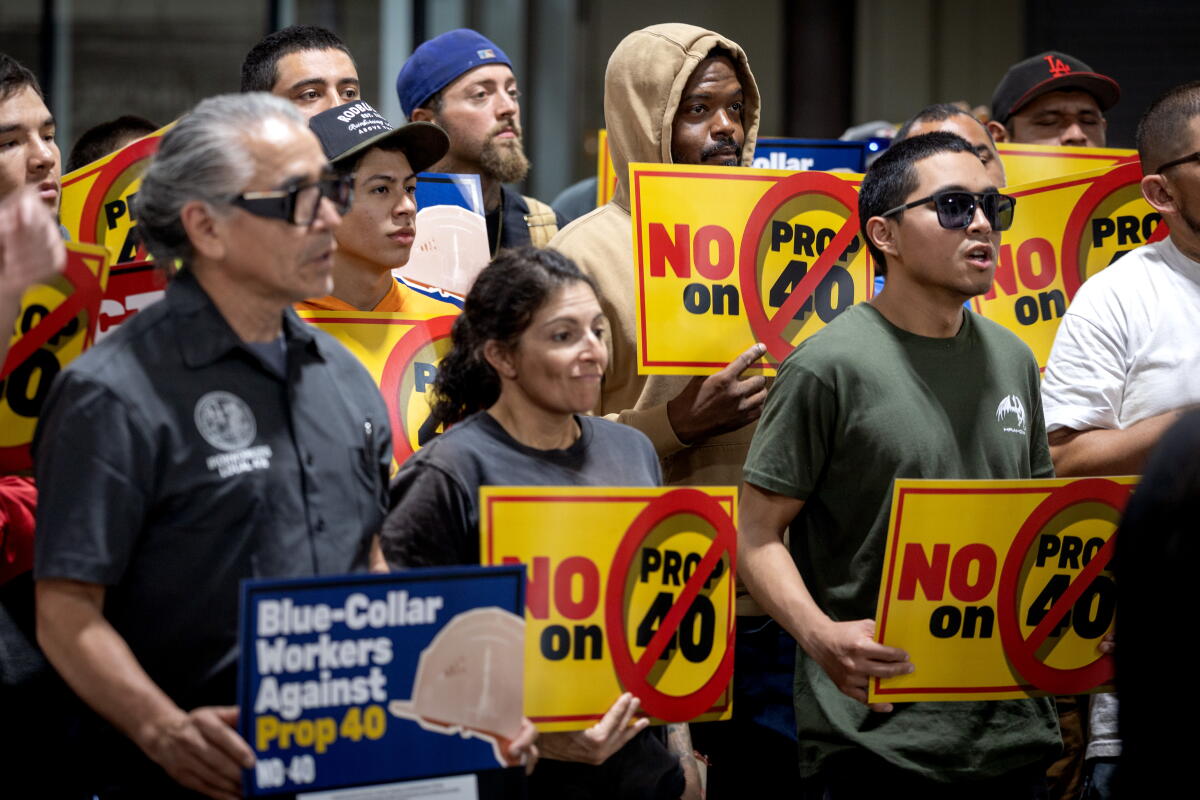
“In the trades, we know you always read the blueprints and you always read the fine print,” said Xochitl Medrano, the political director for the district council of the Ironworkers of the State of California and Vicinity. Medrano was surrounded by union workers chanting, “No on 40!”

“Our workers are not billionaires; they are working people. After 20, 30, or even 40 years of breaking their backs on the job sites, our members have the opportunity to have a decent pension, some retirement savings, and equity in a home that they’ve been working to pay off,” she said. “That’s not wealth handed to them. That’s sweat equity. … We won’t stand by and let a tax that’s supposed to target billionaires turn into a trap door for working families.”

Proposition 40 is among the most contentious issues on the Nov. 3 ballot. The measure was crafted by a healthcare union to offset $100 billion in impending federal healthcare funding cuts approved by congressional Republicans and signed by President Trump last year. Millions of Californians could lose their healthcare coverage because of those cuts.

There are two opposing measures on the November ballot, Propositions 41 and 42, that would nullify the billionaires tax if either receives more votes.

About 45% of likely voters supported Proposition 40, while 42% opposed it and 13% were undecided in a late September poll by UC Berkeley and the Los Angeles Times. That’s a decline in support compared with a poll six weeks earlier, when 48% of likely voters supported it while 41% opposed it.

The proposal has drawn more than $300 million in campaign contributions, nearly all against it. Ballot measures are not subject to caps on campaign donations.

Sanders was joined by Rep. Ro Khanna (D-Fremont) and artists including the rapper Common, who called for “them billionaires to pay up” between freestyle verses. Shepard Fairey, known for his famous portrait of President Obama, unveiled banners in support of the wealth tax campaign, which served as a backdrop on the event stage.

Rally attendee Datosha Williams, an SEIU-UHW member who works in healthcare customer service, said Proposition 40 is a backstop to federal healthcare cuts, which could lead to hospital closures around the state.

“My biggest fear is that I will see some of my coworkers lose their jobs,” she said. “My biggest fear is that my 8-year-old son, who is asthmatic, will have long waits in an ER.”

At the event at the Ironworkers Training Center in La Palma organized by labor leaders to oppose the wealth tax, apprentices attended workshops about rigging and collective bargaining rights.

“We’re not opposed to making the wealthy pay their fair share. We’re not opposed to creating a high-quality and low-cost health insurance plan for Californians,” said Andrew Gonzales, the council representative for the Los Angeles and Orange Counties Building and Construction Trades Council. “We just don’t think Prop. 40 is the right vehicle to go about that.”

Gonzales pointed to the volatile state budget’s dependence on tax revenue from wealthy Californians, some of whom have proactively moved out of the state because of the proposal.

“That’s already having an immediate impact to the state’s budget,” he said. “So we already see the danger that can occur.”

People attend a rally against Proposition 40 at the Iron Workers Apprenticeship Training Center.

Foes of Proposition 40 attend a rally on Monday at the Ironworkers Training Center in La Palma.

(Eric Thayer/Los Angeles Times)

Source link

Billionaire tax is dividing California healthcare system it’s designed to support

A proposal to tax California’s billionaires has fractured Democratic politics, repelled some of the state’s richest residents and exploded into a costly battle that’s overshadowing even the gubernatorial election.

Known as Proposition 40, the ballot measure is also dividing the very industry it’s supposed to help. The healthcare workers union behind the initiative, which would authorize a wealth tax on billionaires, says the levy would raise sorely needed funds to shore up health coverage.

By contrast, leading California hospital and doctor groups are opposing the measure ahead of the November vote. They say the one-time 5% levy on the state’s wealthiest is a risky gambit with an uncertain path to victory — as well as a distraction from other proposals to shore up healthcare.

“This is an experiment on a taxation scheme that’s not been done before, and it puts healthcare in a more vulnerable position as a result,” California Medical Assn. Chief Executive Dustin Corcoran said at a recent briefing in Sacramento. “It’s not a healthcare ballot measure.”

Less than six weeks before election day, polls show a divided electorate. But whatever the outcome, the fight is exposing a broader problem confronting California: how to preserve one of the nation’s largest expansions of publicly funded healthcare as a big chunk of the money that helped pay for it disappears.

Over the last decade, California increased access to publicly funded healthcare by broadening eligibility for Medi-Cal, the state’s Medicaid program, and other types of insurance, allowing millions more residents to gain coverage. The number of people without insurance fell to 2.4 million in 2024 from about 6.5 million in 2011.

Now, that trend is expected to reverse. According to the Congressional Budget Office, President Trump’s budget bill last year will lead to $1 trillion in healthcare-related cuts over a decade. Earlier this week, the Trump administration said it recently removed 760,000 people from Obamacare plans across the nation, alleging that some were enrolled improperly and others don’t exist.

Combined with strict work requirements, more frequent eligibility checks and a pullback in state spending pushed by Democratic Gov. Gavin Newsom, the changes are projected to push California’s uninsured population under the age of 65 to 4.6 million by 2030, according to the UC Berkeley Labor Center.

“Without trying to be melodramatic, when millions of people lose coverage, it is entirely predictable that thousands will die unnecessarily because of foregone treatment,” said Dave Regan, president of SEIU-UHW, the healthcare-workers union pushing the billionaire tax.

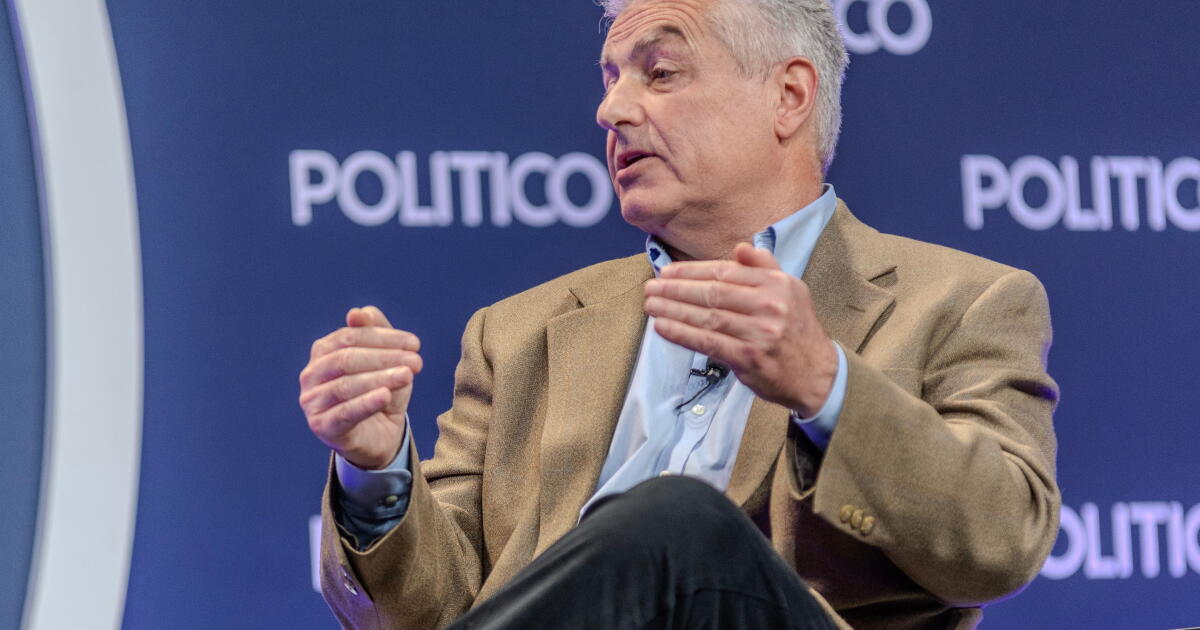
“There is an absolute consensus on what the problem is, and there’s a consensus that there’s no other solution on the table,” he said in an interview at Bloomberg’s San Francisco offices.

Even before the budget cuts start to bite, financial strains are mounting at institutions such as Martin Luther King Jr. Community Hospital in South Los Angeles.

MLKCH’s waiting room is now mostly used for treating patients, with 16 wooden cubicles functioning as care rooms. Sick or injured people are also cared for in the hospital’s front hallways and in what used to be the meditation chapel and the gift shop.

The hospital opened in 2015 with an emergency department built for 25,000 visits annually. In 2024, it handled 130,000. Dr. Elaine Batchlor, its CEO, said further funding reductions “would threaten the sustainability of the hospital.”

Batchlor isn’t taking a position on Proposition 40 and has been looking for other sources of revenue. SEIU-UHW’s Regan argues there’s no other way to raise the money needed to fill the massive gap.

The California Budget & Policy Center estimates the state stands to lose roughly $30 billion in federal Medi-Cal funding each year. Asking California lawmakers for that amount is a “fool’s errand,” Regan said. “And on top of that, the only people the legislature will tax are ordinary people.”

The union estimates the levy would raise $100 billion over five years, with 90% earmarked to shore up health coverage amid impending budget cuts.

Critics dispute the projection. The state’s nonpartisan Legislative Analyst’s Office says the tax would probably raise tens of billions of dollars, but potentially reduce income-tax revenue in the long run, as some ultrawealthy residents depart the state.

Recent polls show an increasingly contested path for Proposition 40. A recent UC Berkeley-Politico poll found 45% of likely voters in favor, but opposition has increased since early this year and now stands at 43%. A separate Public Policy Institute of California survey put support at 52% and opposition at 46%.

Led by Sergey Brin, wealthy opponents have poured almost $230 million into funding Building a Better California, according to a filing late Thursday. That’s helping them flood the airwaves with anti tax advertising. There are also two competing ballot measures designed to torpedo Proposition 40 if they pass.

Billionaires aren’t the only detractors. Critics have also assailed Proposition 40 for carving out an exception to California’s constitutional funding rules to steer most proceeds to healthcare. While the state generally earmarks at least 40% of General Fund revenue to public schools and community colleges, the billionaire-tax proposal excludes the new levy from that calculation.

Corcoran, the medical association chief, argues that even if Proposition 40 passes in November, legal challenges would potentially delay its implementation for years.

“There’s a lot that we can do looking ahead to 2028 when these cuts start taking greater effect that frankly would provide more immediate relief than Proposition 40 would,” he said. His group and others are pushing instead for large corporations to help cover the cost of public insurance for their workers.

Regan called that proposal “the worst public policy on planet Earth,” saying costs will be passed on to consumers and that it essentially acts as a payroll tax on low-wage workers.

He also disputed the notion the billionaire tax would lead the ultrawealthy to leave the state, pointing to Nvidia Corp. CEO Jensen Huang, who earlier this year said he would be “perfectly fine” with the levy. As for legal challenges to the billionaire tax, Regan said he believes they can be resolved in 12 months.

The uncertain funding picture has many hospitals bracing for cuts.

James Suver, CEO of Ridgecrest Regional Hospital, about 150 miles north of Los Angeles, said he’s not betting on proceeds from the billionaire tax. He’s weighing options that include pausing maternity care again, cutting physician recruitment and reducing emergency-room service.

“Our future under the most likely scenario is not looking very good,” Suver said. “We’re beyond doing minor nips and tucks to be able to offset some of the changes that I suspect may be happening in the future.”

Clanton writes for Bloomberg. Kara Wetzel of Bloomberg contributed.

Source link

$200 million-plus spent fighting and supporting billionaire tax

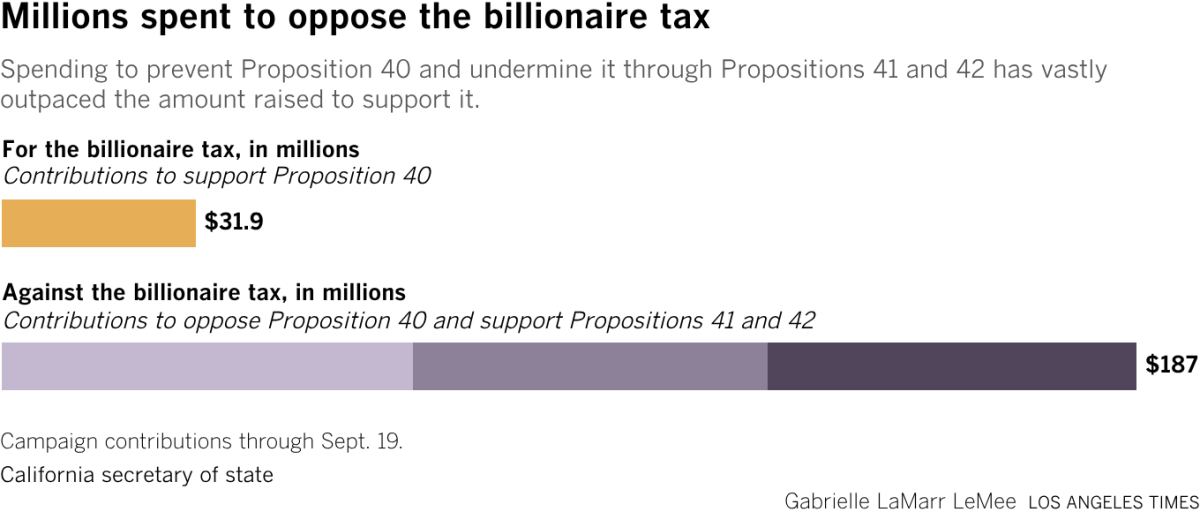
Opponents of the billionaire tax on the November ballot have vastly outraised the proposal’s supporters, with the anti-Proposition 40 effort and the backers of two other ballot measures crafted to nullify it raising $187 million compared to the $32 million raised by boosters of the wealth tax, according to campaign finance documents filed with the state.

The reports, filed Thursday, account for donations through Sept. 19 and do not include several million dollars that have poured into campaign coffers in recent days. The numbers are expected to vastly increase before the Nov. 3 election.

The bulk of the money raised by the proponents of Proposition 40, which would enact a one-time 5% tax on California billionaires’ assets, appears to have been spent on gathering signatures to qualify the measure for the November ballot. The campaign had only $207,000 in the bank, according to the latest campaign finance reports.

A leader of the union that crafted the proposal accused wealthy Californians who are spending heavily against the measure of lying to voters. The measure is designed to offset $100 billion in impending federal healthcare funding cuts expected to impacts millions of Californians.

“The billionaires take and take — tax break after tax break — and now they’re spending that money to deceive voters and avoid paying their fair share,” said Suzanne Jimenez, the chief of staff of the Service Employees International Union-United Healthcare Workers West. “Voters want their money back from the billionaires and want local emergency rooms to stay open. California does not need more tax breaks for billionaires. California needs emergency rooms for patients, hospitals that stay open, and healthcare people can access and afford.”

Opponents of the billionaire tax argue that it would do more harm than good.

“The more Californians learn, the more they see Proposition 40 for what it is — a harmful tax scheme that permanently damages the state’s budget and economy with zero accountability or safeguards to ensure funding actually improves care or lowers costs for patients,” said California Medical Assn. President Dr. René Bravo, the leader of one of the groups opposing the billionaire tax.

Proposition 41 would nullify the billionaire tax if, in the event that both measures are approved, it receives more “yes” votes. Proposition 41 would prohibit any new state tax from being excluded from a voter-approved cap that restricts how much tax revenue the state can spend each year.

“Californians deserve better results for their hard-earned tax dollars,” said Molly Weedn, a spokesperson for the Proposition 41 campaign.

Proposition 42 would prohibit new taxes on personal property, intellectual property, retirement accounts and other assets, and would limit situations in which a ballot measure or state lawmakers can impose or raise taxes retroactively — both of which are essential parts of Proposition 40. If both measures pass and Proposition 42 receives more “yes” votes, it would nullify the wealth tax.

The proposed billionaire tax has divided California Democrats, with Gov. Gavin Newsom opposing it while the state Democratic party supports it.

In recent polling, a majority of likely voters did not support any of the three proposals.

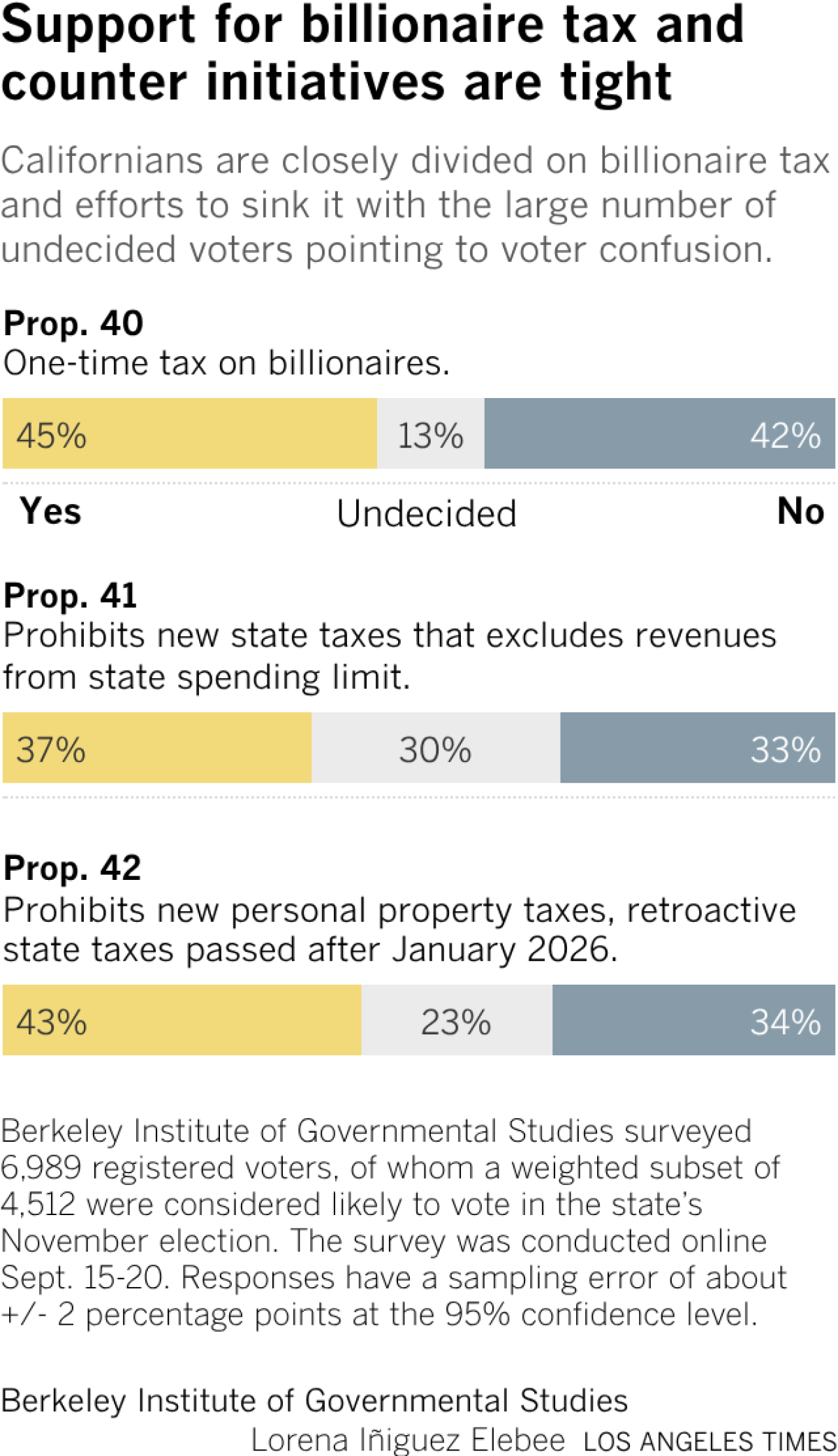
While 45% of likely voters supported the billionaire tax, 42% opposed it, according to a poll released Friday by UC Berkeley’s Institute of Governmental Studies and co-sponsored by the Los Angeles Times. Voters also are torn about the two ballot measures designed to nullify it.

The other measure receiving great attention, Proposition 39, which would require voters to show government-issued ID to cast ballots, faces a similar financial disparity. Opponents to the measure have raised $39.3 million compared to $15.6 million garnered by supporters.

Fifty-two percent of likely California voters oppose the voter ID proposal, while 39% support it and 9% are undecided, according to the Berkeley poll.

In the race to replace Newsom, Democratic former Biden cabinet member Xavier Becerra has raised $35.8 million, while his GOP rival, conservative strategist and television commentator Steve Hilton, has raised $22.3 million.

Becerra remains the front-runner in the governor’s race, which is not surprising since Democratic voters outnumber Republicans nearly 2 to 1. In last week’s Berkeley poll, the Democrat had the support of 58% of likely voters, while 33% backed the Republican.

Source link

Tax the rich? California voters are divided, according to new poll

The slate of statewide measures on the Nov. 3 ballot provides voters two opportunities to tax the rich, which in past years has proved tantalizing to California’s left-leaning electorate.

Only one of those measures has strong voter support, however, and it’s not the proposition that’s attracted nationwide attention, ignited a nearly quarter-billion-dollar political slugfest and created a rift among top leaders in the Democratic Party.

Likely voters expressed middling support for Proposition 40, a one-time 5% tax on billionaires’ assets intended to compensate for an impending $100 billion in federal healthcare funding cuts. They were far more likely to back Proposition 3, a ballot measure that would make permanent a tax increase on the wealthy that funds schools and healthcare, according to a poll released Friday by UC Berkeley’s Institute of Governmental Studies that is co-sponsored by The Times.

Proposition 3 appears to be a much less controversial endeavor, which may explain why it has more voter support. The ballot measure would extend a tax enacted in 2012 on individuals who earn at least $360,000 a year that is set to expire in 2031. Proposition 40 proposes a brand-new tax on billionaires and is opposed by Gov. Gavin Newsom, who fears that it could hurt the state’s finances in the long run.

“When you’re going about taxing the billionaires’ assets, I mean that’s something kind of new and different, and it’s risky, and the governor’s against it, and you know a lot of people are expressing caution about it,” said Mark DiCamillo, director of the poll.

Voters are deeply concerned about income disparity but also skeptical about the unusual approach of the billionaire tax.

Proposition 40 has drawn the greatest attention and campaign spending of the 14 ballot measures voters will decide on Nov. 3.

In the poll, 45% of likely voters support the proposal, while 42% oppose it and 13% are undecided. That’s a decline in support compared with six weeks ago, when 48% of likely voters supported it while 41% opposed it, and comes after nearly $100 million of spending on television ads, social media messages and mailers, largely from opponents.

The billionaire tax was crafted by a healthcare union in response to legislation passed by congressional Republicans and signed by President Trump last year that could result in millions of Californians losing Medi-Cal coverage, rural hospitals shuttering and other healthcare services being slashed unless a new funding source is found.

The proposal would retroactively apply to billionaires who lived in California as of Jan. 1, prompting some to preemptively move out of the state. Ninety percent of the revenue would fund healthcare programs, and the remaining funds would be spent on education programs and food assistance.

There are two counterproposals on the ballot that would nullify the wealth tax if either receives more votes than Proposition 40, and they have raised $144 million. Voters are torn about Proposition 41, which would prohibit any new state taxes from being excluded from a voter-approved cap that restricts how much tax revenue the state can spend each year. The billionaire tax would have such an exclusion. Voters also are divided on Proposition 42, which would prohibit new taxes on personal property, intellectual property, retirement accounts and other assets and would limit situations in which a ballot measure or state lawmakers can impose or raise taxes retroactively — both of which are essential parts of the billionaire tax initiative.

Proposition 42 has greater support, with 43% backing it, 34% opposing it and the remainder undecided, according to the poll. Even more voters were uncertain about Proposition 41: 3 in 10 said they were undecided, while 37% said they supported it and 33% said they planned to vote against it.

The large number of undecided voters this close to the election points to voters being overwhelmed by the sheer number of statewide ballot measures, DiCamillo said.

“It’s confusion,” he said, adding that many voters may make a decision once they receive more ballot information.

That said, the fact that none of these proposals has the support of more than 50% of likely voters doesn’t bode well for their prospects, DiCamillo said.

Ballots will begin arriving in the mailboxes of the state’s 23.2 million voters in days.

Democratic voters outnumber Republicans by nearly 2 to 1 in California, but the party’s leaders are deeply divided about the billionaire tax, given the volatile state budget’s reliance on the wealthy. Newsom, who is pondering a 2028 presidential campaign, and the two men vying to replace him — Democrat Xavier Becerra and Republican Steve Hilton — oppose it. Rep. Ro Khanna (D-Fremont), a potential 2028 White House contender, supports it, as does the California Democratic Party.

Additionally, Dave Regan, president of Service Employees International Union-United Healthcare Workers West and architect of the ballot measure, has come under scrutiny. Regan has been accused of threatening and intimidating women who worked for the union’s parent organization, and of physically assaulting one, according to reporting by The Times. He was also accused of trying to extort SEIU’s state council, suggesting that it could face an investigation over “governance issues” if it did not support Proposition 40, according to an investigation commissioned by SEIU.

Regan has denied these claims, describing them as a “smear” campaign orchestrated by Proposition 40 opponents.

Much less attention has been paid to Proposition 3. Californians who earn more than $360,000 now are subject to a 10.3% tax, while those who earn more than $721,000 face a 12.3% levy. The vast majority of the billions raised through this tax go to K-12 schools, while the remainder is spent on community colleges and healthcare.

The other ballot measure that is receiving national attention is Proposition 39, which would require voters to present a government-issued identification document to cast a ballot or provide a PIN or the last four digits of their Social Security number when submitting mail-in ballots.

The measure also would require the California secretary of state and county election officials to verify that registered voters are U.S. citizens by “using government data,” which according to supporters could include information in the federal Social Security Administration database, jury summons information and other government records.

The proposal comes as Trump has continued to make claims that elections, notably in California, are being rigged by Democrats. Americans are increasingly alarmed about the security and sanctity of voting, and growing fears about intimidation efforts at polling places in the midterm elections.

Fifty-two percent of likely California voters oppose the voter ID proposal, while 39% support it and 9% are undecided, according to the poll.

“It doesn’t look like it’s in a strong position,” DiCamillo said, noting that while voters have opposed it in prior polls, the opposition has grown.

Nearly one-third of voters were undecided about two other propositions:

  • Likely voters were evenly split about Proposition 4, which would repeal a ban on public funding of campaigns, with 35% supporting it and 35% opposing it, and the remainder undecided.
  • Four out of 10 likely voters opposed Proposition 43, which would increase the threshold necessary to pass local taxes from a simple majority to two-thirds, while 31% supported measure and 29% were undecided.

Voters will also face questions about environmental policy, housing, recall elections and other matters, as well as statewide, congressional and local elections. Californians are fatigued by the length of the ballot.

The Berkeley IGS/Times poll findings are based on an online survey in English and Spanish of 6,989 registered California voters, 4,512 of whom are considered likely voters, on Sept. 15-20. The results are estimated to have a margin of error of about 2 percentage points in either direction in the overall sample, and larger numbers for subgroups.

Source link

California health clinics accuse influential union and its leader of racketeering in civil lawsuit

The California Primary Care Assn. and five clinics filed a civil lawsuit in federal court Friday accusing SEIU-United Healthcare Workers West and its president, Dave Regan, of racketeering and using ballot initiatives to “shake down” community health centers.

The association alleges that Regan and his union orchestrated a “multi-year campaign of coercion, threats, and economic pressure” to “extort” what the lawsuit describes as “valuable property rights” and “labor-organizing terms” from CPCA and the health centers the association represents in California, according to a copy of the complaint obtained by The Times.

The suit says Regan pushed Proposition 44, which if approved by voters in November will restrict spending at nonprofit community health clinics, as political leverage against the industry. Regan then offered to call off the measure if CPCA agreed to support the union’s efforts to unionize 25,000 industry workers, the lawsuit states.

In the complaint, CPCA estimates that 25,000 new union members would generate $2.37 million in monthly revenue from dues paid to UHW.

“This is about Dave Regan and UHW in particular adopting a strategy to create harmful legislation and harmful ballot initiatives to force people to the table to negotiate favorable agreements that will benefit them financially and then when those agreements don’t go through, they allow these initiatives to go through to create punishment for the organizations that can’t come to terms, and then they keep coming back, over and over and over again,” said Brandon Thornock, chief executive of plaintiff Shasta Community Health, echoing claims in the lawsuit.

“It’s a complete waste of resources and it’s amoral.”

A spokesperson for UHW did not immediately respond to a request for comment on the lawsuit. In an interview in July, Regan denied asking the clinics to support his unionization efforts in exchange for dropping Proposition 44.

“We wanted to construct a relationship with the clinic association that prioritized appropriate funding of the community clinics in California, including restoring the healthcare cuts that were introduced by the ‘One Big [Beautiful] Bill,’” Regan said previously. “It was a strategic relationship where we’re working in a mutually cooperative way to properly fund the healthcare system to respect workers, and they were not interested in that.”

Regan is a powerful figure in California politics who has a history of using the ballot box to try to force the healthcare industry to unionize. The union leader has come under scrutiny this year over claims about his extreme political tactics, intimidating behavior toward and threats against women, and an allegation of assault more than 15 years ago, all of which he denies.

Regan is also the architect of California’s billionaire tax, a proposal on the November ballot to apply a one-time 5% tax on the net worth of billionaires that has splintered labor and divided Democrats.

The CPCA lawsuit, in the federal court in the Eastern District of California, alleges that Regan’s political tactics are not designed to win initiatives, “but to subjugate and terrify.”

The union, the lawsuit states, has filed dozens of punitive ballot measures in California “targeting hospitals and dialysis providers with the implied threat or directly stated purpose of coercing health care providers into acquiescing to their union organizing or bargaining demands.” UHW has spent over $216 million, the suit says, on measures to “harm patients, destroy services, and drive providers out of business.” The vast majority of the UHW-backed measures have been withdrawn, usually after the industry agrees to concessions, the suit states.

“No other singular entity or individual has engaged in such widespread corruption of California’s initiative process,” the suit states.

Proposition 44 requires that community clinics spend 90% of revenue on patient services, which Regan has said ensures that money is aligned with the mission of the health centers.

CPCA and health centers say restricting the funding would dramatically reduce money for other essential services and leave some clinics at risk of closing their doors.

The CPCA lawsuit alleges that Regan’s demands on Proposition 44 were sent in an email in January from a legislative staff member on behalf of the union. The offer, presented as a joint submission from UHW and two union affiliates, included a requirement that community health centers “hold elections for at least 5,000 employees in each of five years the agreement would be in effect, resulting in elections for 25,000 employees over the five-year period.”

The complaint says the email also disclosed that UHW said it would drop the initiative if CPCA agreed to the terms.

“The e-mail unambiguously shows that UHW and the Union Affiliates — bullied and instructed by Regan — agreed and intended to participate in an endeavor to abuse the ballot initiative process to extract valuable labor concessions from CPCA and CHCs, in violation of federal and state law,” the complaint states.

Negotiations to withdraw the measure fell apart on June 24, the day before the deadline to rescind initiatives from the statewide ballot.

The lawsuit alleges that the union offered a new deal that same day.

“UHW would withdraw the Clinic Penalty Initiative if, in exchange, CPCA reversed its opposition to UHW’s billionaires’ wealth tax initiative and took the funds it raised to oppose the Clinic Penalty Initiative and instead used that money to assist UHW in passing its wealth tax,” the lawsuit alleges. “The next morning, Regan, through an intermediary, offered the same ‘deal.’ CPCA refused to entertain such discussions.”

The lawsuit states that California’s community health centers served 6.7 million people in 2025 and 67% are enrolled in Medi-Cal, state subsidized healthcare coverage for low-income Californians. In many rural areas, health centers are sometimes the only source of primary care.

Thornock said Shasta Community Health has patients who travel more than an hour to get care and provides a program that transports them to health facilities. Under Proposition 44, the program would not be considered patient services.

“It was designed to create for us what becomes an existential crisis in many cases,” he said.

The CPCA lawsuit states that Regan and the union began seeking to extort unionization from nonprofit hospitals through ballot measures in 2011 and used the same strategy to try to grow their membership among dialysis center workers beginning in 2017. In early 2022, they began targeting CPCA and health centers through legislation, the lawsuit stated.

The suit also alleges that Regan and UHW are in violation of a California law that prohibits a proponent of a ballot initiative from seeking, soliciting, bargaining for, or obtaining any money or a thing of value from any person or entity for abandoning or preventing an initiative from moving forward.

A week before the lawsuit became public, The Times reported that independent investigators hired by SEIU found in a report that Regan had tried to “extort” an SEIU state council endorsement of the billionaire tax from other California union leaders. An outside law firm that investigated internal charges against Regan found that he suggested to David Huerta, then president of SEIU California, that the state council could be investigated for “governance issues” if the council did not endorse the billionaire tax on the November ballot. The state council later voted to remain neutral on the measure.

The law firm’s investigation, which was paid for by Service Employees International Union, substantiated an allegation that Regan threatened Tia Orr, executive director of SEIU California, over the council’s position on the ballot measure. The SEIU probe found an allegation that Regan also assaulted one of Orr’s predecessors in the job, Courtni Pugh, in 2009, to be credible.

A second investigation conducted by an outside law firm hired by SEIU California found sufficient evidence to substantiate a complaint that Regan bullied Jessica Bartholow, the council’s government relations director.

In interviews with investigators hired by the union and with The Times, Regan admitted to swearing at a staff member for SEIU California and adamantly denied bullying, threatening and assaulting women or seeking to force the state council to back his measure.

Regan remains in his job and alleges that he’s being unfairly targeted over his advocacy for the billionaire tax. SEIU, the national umbrella organization that represents local SEIU affiliates, has not taken any disciplinary action against him while an internal administrative review process moves forward.

Sources involved in negotiations over the billionaire tax said Regan also asked for concessions to grow his union in exchange for rescinding the measure from the ballot this year, which The Times previously reported.

Regan’s list of demands included union contracts with two private hospitals and a health clinic, an organizing neutrality agreement with healthcare clinics statewide, recognition of his union from dialysis clinics and for billionaires to remove measures they launched in response to his tax, according to two sources familiar with the talks who were granted anonymity to share details of the discussions.

The union leader called the allegation “categorically false” and denied that he asked for concessions for his union in exchange for removing the billionaire tax from the ballot.
Source link