bill essayli

Thomas Markle Sr. cut off his ankle monitor following child porn arrest

Meghan Markle‘s estranged father, Thomas Markle Sr., allegedly cut off his ankle monitor following his arrest on child pornography charges.

Four days ago, Markle Sr., 82, was ordered to wear a location monitoring device after a federal judge allowed him to remain out of custody pending his trial, according to Bill Essayli, first assistant U.S. attorney for the Central District of California. Markle Sr. was arrested in Florida and is charged in the Central District of California with possession of child pornography.

“He allegedly cut the bracelet off at 1:45 a.m. last night,” Essayli posted on X on Tuesday. “Release conditions are court orders, not suggestions. We are asking the court to revoke his release and detain him pending trial, and we will continue to prosecute this case to the fullest extent of the law.”

U.S. Magistrate Judge Lindsay Saxe Griffin has since ordered Markle Sr. to be jailed without bond at a hearing in Tampa, representatives from Essayli’s office told The Times.

Markle Sr. was arrested after federal authorities searched two storage units he allegedly rents in California. The storage units had been registered to Markle Sr. since 2008, with his most recent payments on both made in October via auto-pay.

Inside the storage units, agents say they found approximately 78 items, including slides, film negatives and books that contained suspected child pornography. The affidavit describes two images that show an adult man with a nude prepubescent girl. A third image depicts a nude prepubescent girl what appears to be a motel room in the Philippines. A witness who has known Markle Sr. since the 1970s identified him as the man in at least two photographs with a minor, according to the complaint.

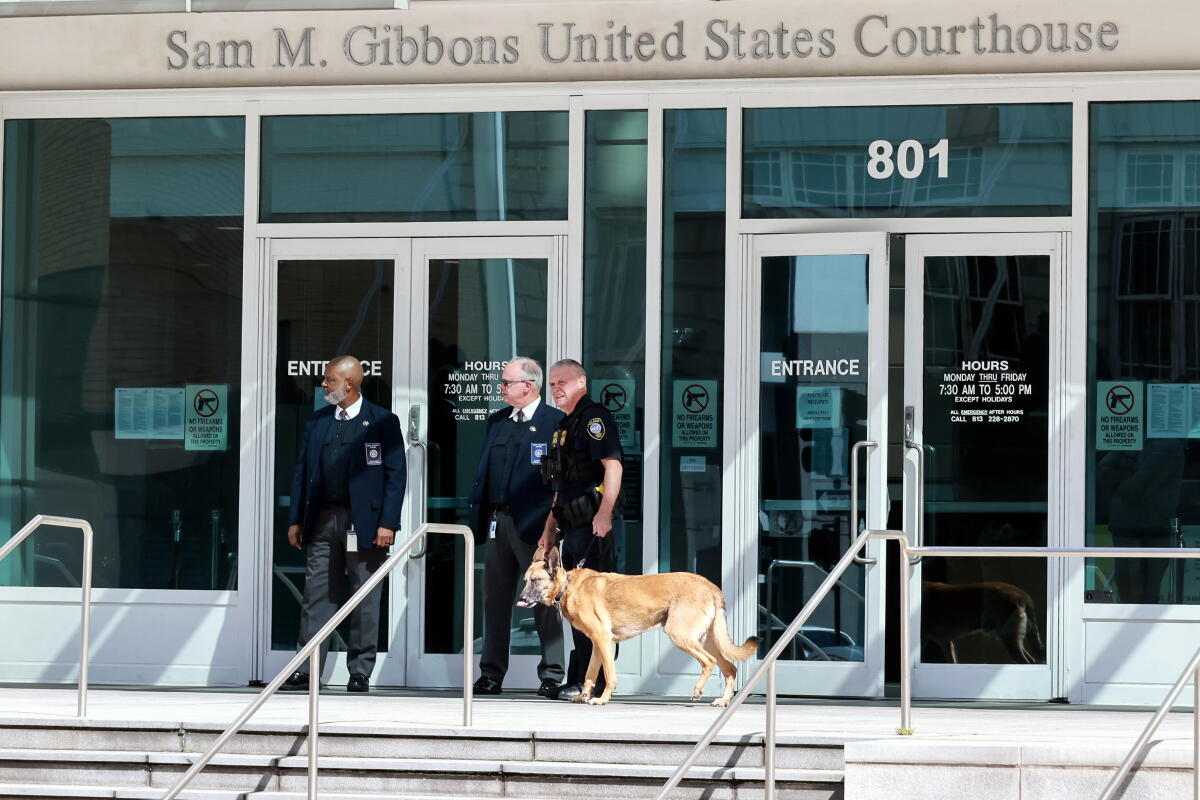
An external view of the Sean M. Gibbons U.S. Courthouse.

An external view of the Sean M. Gibbons U.S. Courthouse in Tampa, Fla. Meghan Markle’s father, Thomas Markle Sr., is facing charges of child pornography possession.

(Mike Carlson / Getty Images)

The affidavit further describes additional photographs that appear to show Markle Sr. with children in various stages of undress.

Last month, Meghan’s half-brother Thomas Markle Jr. claimed he’d found “hundreds, if not thousands” of child pornography images inside four large boxes at the Cebu, Philippines, home of his father, Markle Sr., and contacted authorities, according to the British tabloid the Sun.

Meghan’s team issued a statement to The Times following reports of the news, writing that she was “deeply distressed.”

“My thoughts are with any children who may have been harmed,” she said.

“In 2018, a letter was sent to the Metropolitan Police and Royalty and Specialist Protection. That letter was subsequently shared with me. It made troubling and disturbing allegations against my father and I was given assurances that these were being investigated,” she continued, adding, “I hope it can now be understood that, despite certain media publications’ distortion over the years, any distance from my father and my choice to not allow him to have contact with our children, was for one reason: to protect them.”

The Duchess of Sussex said that she trusted authorities were “doing the same for other families.”

“Although the breadth of what has now been uncovered is more sickening than one could ever imagine, my sincerest hope is that justice will be fully served and that the priority remains the safety and protection of innocent children,” she said.

Meghan’s relationship with her father, a former Hollywood lighting director, has been the subject of media scrutiny since 2018, when she and Prince Harry tied the knot. Markle Sr. did not attend the wedding.

Last month, Markle Sr. denied the accusations, calling them “bulls—” and “lies.” If convicted, he faces up to 20 years in prison.

Source link

California officials brace for unprecedented election interference by Trump administration

Top officials in California are bracing for unprecedented election interference from the Trump administration in coming days, including potential ballot seizures.

They are warning the public about such actions in striking messages casting President Trump and U.S. Department of Justice officials as threats to the vote and to American democracy. They have begged federal judges to reject warrant requests and hold the line against lawless probes. They have deployed armies of election lawyers and volunteer monitors, particularly to areas where congressional races could be close.

“California is dead serious about the security of [Tuesday’s] midterm elections. If Trump tries to meddle with California’s ballots, you can be sure as hell that we’ll prosecute those who help him,” Gov. Gavin Newsom said Monday. “Californians deserve a free and fair election, and that is exactly what we’ll deliver.”

Those efforts, echoing others from Democrats in Congress and liberal officials in other political battlegrounds, are like nothing seen before in the U.S., and in response to an equally extraordinary campaign by the Trump administration to intervene in state-run elections based on claims — espoused by Trump for years — that voting in places such as California has been corrupted by widespread fraud.

On Monday, Justice Department officials redoubled their effort to block about 20,000 California ballots from voters who they allege may be noncitizens by appealing to the U.S. Supreme Court, after lower courts rejected the request — and as another judge in a separate challenge barred them Monday from demanding California officials segregate the same ballots. The Supreme Court denied the request.

They and local partners also rolled out criminal charges against seven noncitizens accused of illegally voting or registering — bringing the total number of lawful permanent residents recently charged with election-related offenses in the state to 35.

Beyond California, the Trump administration is trying to preemptively negate any win by the Democrat in the Alaska Senate race, based on claims that the presence on ballots of a third candidate with the same name as incumbent Sen. Dan Sullivan (R-Alaska) is confusing voters.

The incumbent senator is identified as such on the ballot, and Alaska courts have already rejected similar challenges. A federal judge dismissed the administration’s suit Sunday.

The White House and the Justice Department have said they are simply trying to ensure American citizens’ votes aren’t diluted by illegitimate votes from noncitizens, and that Democrats aren’t able to steal the Alaska race by intentionally confusing voters.

But Democratic leaders have alleged that the lawsuits are part of a broader Trump administration effort to establish a “pretext” to challenge the outcome of Tuesday’s midterm elections if they don’t like the results.

On Saturday, Newsom wrote to federal district court judges across the state, urging them to deny any Trump administration requests for judicial warrants that would allow them “to seize ballots, election records, or certified voting technology while an election is underway and before the results are certified.”

Newsom wrote that he has “grave concerns” that federal agents will “quickly pivot” to making such requests in criminal courts given their mounting losses on other fronts.

The state’s “strict chain of custody, documentation, and retention laws related to ballots and ballot materials ensure any evidence of alleged wrongdoing tied to ballots or ballot materials is preserved and appropriately supervised by a court, so there is no legitimate law enforcement reason to seize ballots, ballot materials, and equipment needed to process and tabulate ballots,” Newsom wrote.

California Atty. Gen. Rob Bonta — whose office has been fighting the Trump administration in court — has also been increasingly vocal about his belief that Trump will take increasingly drastic steps to try to control the election results.

“He’s intent on pulling out all the stops, engaging in whatever type of lying, cheating, and stealing is necessary to get the outcome he wants. He starts with the outcome and he backs it out from there, and will do anything seemingly necessary to try to get to the outcome that he wants — instead of letting the facts, and the law, and the votes determine what the outcome is,” Bonta said in an interview on MS NOW that he posted Sunday.

Elections experts point to the administration’s many losses in court as evidence that its efforts are not working, and said most voters won’t experience any problems with casting their ballots.

They said they do have concerns about future efforts by the administration to intervene, including through dramatic steps such as ballot seizures, but whether it takes such steps may hinge on whether the balance of power in the House or Senate depends on the outcome of a small enough number of close races.

If the expected “blue wave” is large and races are not particularly close, it will be more difficult for the Trump administration to sway the outcome in its favor and less likely it will even try to do so — even if Trump publicly rejects the outcome as illegitimate.

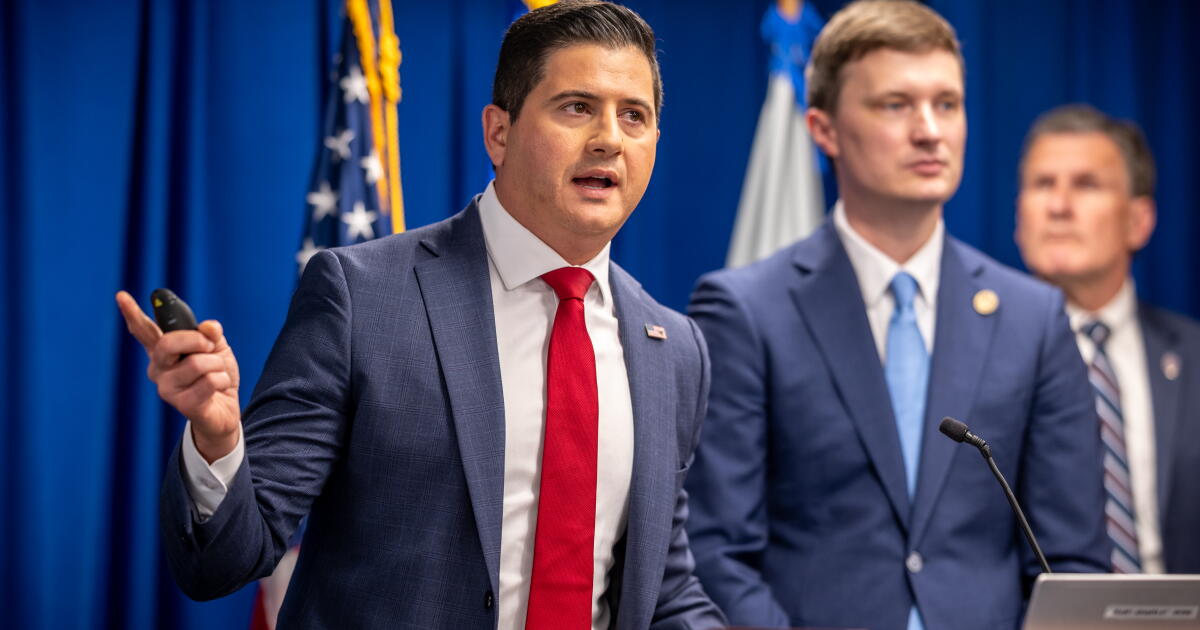
In announcing the latest charges, First Assistant U.S. Atty. Bill Essayli, the top federal prosecutors in Los Angeles, and San Luis Obispo County Dist. Atty. Dan Dow said the fight is not partisan. Six of the charges were federal; the seventh was brought by Dow locally.

Dow, the county’s district attorney since 2014 who has denied previous claims that he harbors anti-Muslim and anti-immigrant sentiments, last week announced that he was investigating a subset of “63 suspected non-citizens registered to vote” in the county from the broader federal list of 20,000 names statewide. On Monday, he appeared alongside Essayli to announce the one person charged in his county — and said more such cases could be coming.

He said California’s system, which requires registering voters to attest to the fact that they are citizens, is an “honor system” that doesn’t work.

One of those charged federally was Moria Dahan, 35, an Israeli national living in West Hills. Dahan was charged with making false statements on her naturalization application to become a U.S. citizen. Prosecutors alleged she illegally registered to vote, voted in person in 2024, and later falsely stated on naturalization papers, under penalty of perjury, that she had never claimed to be a U.S. citizen or registered to vote in a U.S. election.

Tiffany Feder, Dahan’s attorney, described the issue as a mix-up, and said her client never intended to illegally participate in voting. She said Dahan “was targeted through a very extensive scheme to induce her to register and vote,” and like other green card holders with limited English skills, believed the forms she was filling out were official and required.

“The truth is that the moment we discovered this, at her interview, we promptly withdrew her application for naturalization,” Feder said.

California has more than 23.4 million registered voters — meaning the 20,000 flagged individuals would account for less than one-tenth of 1% of all voters in the state, and the 35 charged a tiny sliver of that. State officials and election experts have pointed to the small numbers of arrests, despite a sweeping probe to find such voters by Essayli and others, as proof such fraud is rare.

Essayli argued the exact opposite Monday — saying the charges were just a “sampling” from the broader list of 20,000 individuals, and part of an effort to force state officials to take that list seriously by moving forward with local law enforcement partners such as Dow instead of waiting on the courts.

“Our goal is not to charge all 20,000 people,” Essayli said. “Our goal is to get California to not count the votes of noncitizens.”

Source link

California, feds continue election war after courts rebuke challenge to 20,000 ballots

Soon after a federal judge in Los Angeles sharply rejected a Trump administration effort to block 20,000 California ballots from voters it alleged may be noncitizens, the U.S. Justice Department announced it will appeal — leaving attorneys on both sides preparing Thursday for yet another court battle.

That was despite the lower court judge calling the request an unlawful threat to eligible voters in Tuesday’s midterm election and to free and fair American elections moving forward, and the same appellate court having already rejected the same plan days prior.

“Every day, more ballots are processed by election officials. This ongoing emergency disenfranchises American citizens through dilution,” wrote First Assistant U.S. Atty. Bill Essayli, the lead prosecutor in L.A.

Early Thursday, Gov. Gavin Newsom swiped back at the Trump administration, writing, “A warning to Donald Trump: I’m deploying election lawyers to key battleground districts in California to protect every vote. And I just made it a FELONY to illegally seize ballots.”

With just days to go until polls close, the heated election war between California and the Trump administration is showing no signs of slowing down, despite multiple court orders rejecting the administration’s central effort to interfere in the midterms by accusing state and county officials of willfully turning a blind eye to voter fraud.

That’s in part because lawyers within the U.S. Justice Department have been unrelenting in their pursuit of such control, both through court orders and threats to state and county officials. It’s also because those same officials have refused to yield, denouncing the threats in recent letters back to the Justice Department as unconvincing and illegal.

“Be aware that we consider DOJ’s efforts to threaten California election officials with criminal sanctions for following federal and state law to be an effort to unlawfully intimidate both election officials and California voters, which can undermine voters’ faith in the election process,” Susan K. Blitch, counsel for Monterey County, wrote in one.

Several elections experts warned the administration is trying to sow confusion and suspicion around an election in which the Republican Party is poised to lose ground, in part so they can reject the outcome. But they also said the courts have consistently rebuffed the Trump administration, and will continue to do so through Nov. 3 and after — with the recent rulings in the case over the 20,000 flagged ballots a perfect example.

“The federal government lost in every way it could possibly lose. It lost on the law, and it lost on the facts, and it lost on the equities — [or] weighing the harms to the various parties,” said Rick Hasen, director of the Safeguarding Democracy Project at UCLA School of Law.

Appeal, rebuke, appeal

Last week, Trump administration attorneys decided that U.S. District Judge David O. Carter was not ruling quickly enough on their emergency request for a temporary restraining order to block California, Secretary of State Shirley Weber and Los Angeles County Registrar-Recorder/County Clerk Dean Logan from counting the 20,000 ballots it asserted were from “likely noncitizens” — so they appealed straight to the U.S. 9th Circuit Court of Appeals.

On Monday, a three-judge panel there — including two appointees of President Trump and one of President Biden — denied the appeal for a lack of jurisdiction, because Carter hadn’t been given a chance to weigh in. However, two of the judges — Mark J. Bennett, one of the Trump appointees, and Gabriel P. Sanchez, the Biden appointee — also wrote separately to make clear that they would have denied the administration’s request on the merits, too, for being likely unconstitutional and in violation of federal law.

On Wednesday, Carter, an appointee of President Clinton, issued his own ruling, in which he wrote that the administration’s allegations about noncitizen voters were “not credible” and that the intervention it sought would violate a host of federal laws, sow chaos in the ongoing midterm election, likely lead to the disenfranchisement of legitimate voters and foster future political meddling in elections.

“This request violates longstanding constitutional principles mandating that states have control over their elections,” Carter wrote. “If [the Trump administration’s] last-minute request for relief were granted, either party could create chaos for their own political purposes to disrupt the election process.”

Carter wrote that never in American history “has the federal government, on the eve of an election, sought to coerce a state and local government to abandon their own Constitutional elections procedures and bend to the will of the Executive Branch,” and that, in bringing its suit, the Trump administration was asking the court to “believe that it reigns as a sole sovereign.”

“But California and its people are sovereign, too,” Carter wrote.

The ruling — forceful, unequivocal and based on several of the same arguments made by Bennett and Sanchez — was cheered by state officials and voting rights groups. Elections experts said it squared directly with their understanding of the law, and was appropriate in the face of the Trump administration’s unprecedented, legally baseless effort to intervene in an ongoing state-run election.

Trump administration officials did not see it that way, and weren’t taking no for an answer. Justice Department lawyers promptly filed notice of appeal back to the 9th Circuit — where the case is likely, though not guaranteed, to land before the same three-judge panel that previously rejected the administration’s demands.

War of words

On Wednesday night, Newsom appeared on “Jimmy Kimmel Live!” and predicted Trump will take sweeping steps to “literally suppress the vote, to set the conditions where he will then express doubt in the electoral outcome, and suggest that it was rigged.” But he also said California is fighting back and prepared.

“Right now, I am focused on getting over 1,000 poll workers, folks out there to monitor the DOJ monitors that Trump’s gonna send to try to steal this election,” Newsom said. “We have been running tabletop exercises. We have 1,000 volunteers. We have 134 election law attorneys that we’re sending out.”

On Thursday, Essayli replied to the latter deployment, writing, “You’re going to protect every legal or illegal vote? What about California citizens whose votes are being diluted by ineligible voters. Do their constitutional rights matter.”

Trump, meanwhile, asserted with no evidence that “there are hundreds of thousands of bad ballots, bad votes, in California. Millions, in my opinion.” He said California has “very corrupt elections,” and that if it had honest ones, he “would have won it by a lot.”

The remarks were just the latest in a swirling and highly public war of words between state and federal officials.

In Carter’s courtroom Tuesday, Essayli claimed the federal government has maintained a collaborative “tone” since it first demanded the state set aside ballots, and said he was surprised at how “adversarial” state elections officials had been. But Essayli and other Justice Department officials have been engaged for weeks in an aggressive back and forth with California officials online — which is highly unusual for prosecutors actively litigating related cases.

When Newsom’s office recently wrote that “Trump’s DOJ is so desperate to invent ‘widespread voter fraud,’ it sent California counties lists of people who NEVER voted — and voters from the WRONG COUNTY. Absolute clown show!,” Essayli shot back, “Hey Fraud King,” with a crown emoji. “We’re not waiting for them to vote.”

Also unusual have been the threats Justice Department attorneys have been sending to county elections officials in California, including in a series of Oct. 23 letters in which they asserted varying numbers of “likely aliens” per county, set a 48-hour deadline for the counties to cooperate with federal authorities to prove those voters are citizens.

In one letter to Kristin Connelly, head of the Contra Costa County registrar’s office, U.S. Atty. Craig Missakian flagged 407 potential noncitizens in the county, and said he was writing “to make unmistakably clear the legal implications” of processing any ballots from those voters.

On Wednesday, Thomas L. Geiger, Contra Costa County counsel, responded with his own letter, questioning the accuracy of the noncitizen claims and saying it would be “legally unsound” for Connelly to “disregard both California and federal law” in order to comply with Missakian’s demands.

Other county attorneys hit a sharper tone in their own responses. Tony Lopresti, an attorney for Santa Clara County, wrote that his county “reserves its rights to pursue all legal remedies against DOJ for its unlawful intimidation of election officials and California voters.”

Source link

L.A. judge weighs feds’ request to block 20,000 California votes

A federal judge on Tuesday seemed skeptical of a Trump administration request to immediately block California officials from counting about 20,000 ballots from voters whose citizenship the administration questions, but said he would not issue a ruling until Wednesday.

U.S. District Judge David O. Carter questioned how the administration had derived its list of suspect voters, worried about disenfranchising eligible voters, said the demands would represent a “monumental change” to California elections and suggested federal prosecutors bringing the case had other means of holding illegal voters accountable.

But just one day after a federal appeals court rejected the same request, Carter said at the conclusion of a 3½-hour hearing in Los Angeles that he needed more time to rule — except on one related issue.

“This court believes it would be wise — that it would be wise — that any threats to state and county elected employees cease immediately,” he said — a clear reference to federal authorities threatening elections officials with criminal penalties if they count any of the flagged ballots.

After the hearing, First Assistant U.S. Atty. Bill Essayli, the top federal prosecutor in Los Angeles who argued on behalf of the Trump administration, said he had made it “abundantly clear that American voters are being disenfranchised in real time,” and that the administration will wait to see what Carter says Wednesday but was likely to appeal the matter back up to the appellate court.

He also denied threatening state officials, despite the Justice Department having sent formal letters to election officials statewide last week warning them of criminal punishments, and Essayli reiterated that position Tuesday.

Carter’s hearing came after Monday’s decision from the U.S. 9th Circuit Court of Appeals — the reverse of what’s normal — because Justice Department attorneys had tried to go over Carter’s head after he didn’t acquiesce to a deadline they’d set for him to rule on their request for a temporary restraining order against the state last week.

However, when the three-judge appellate panel — composed of two appointees of President Trump and one of President Biden — ruled 2-1 Monday that it had no jurisdiction to hear the case given Carter hadn’t yet had the chance, the case returned to Carter’s courtroom.

And there, Carter — an appointee of President Clinton — seemed loath to rush to judgment, despite the Trump administration’s claims of urgency. He said the administration’s method for arriving at its list of potential noncitizen voters was unclear and that he would like to develop the record further, including by bringing in an expert for the court.

“What are these systems? What are the algorithms? How was this derived?” he said.

He also seemed unmoved by the Justice Department’s argument that the ballots must be segregated immediately to prevent noncitizen votes from being counted, and more focused on whether noncitizens who illegally vote can be identified and held accountable while avoiding disenfranchising legitimate voters in the process.

For those who do vote illegally, “you’ve got a remedy, for goodness sakes,” he told Essayli. “Go out and indict.”

The Justice Department sued California, Secretary of State Shirley Weber and Los Angeles County Registrar-Recorder/County Clerk Dean Logan on Oct. 15, two days after Acting Deputy Atty. Gen. Trent McCotter gave Weber and Logan 48 hours to set aside the ballots for the 20,000 flagged voters, whom McCotter described as “likely noncitizens.”

During the hearing, Essayli argued on behalf of the Trump administration that its demands on California and L.A. County were not onerous, could be complied with easily and did not call for ballots to go uncounted. Essayli said the federal government was in court “on a very narrow request for an injunction to separate ballots of those suspected of being noncitizens” only until the state can prove their citizenship.

He argued that the “reliability and credibility” of the federal government process for flagging the 20,000 voters is unquestionable — while also telling Carter, “We’re never going to stand here and tell you that everything is 100%.” He said every vote counts, as some elections “are decided by a handful of votes,” and that the federal government is simply asking California not to break existing federal law barring noncitizens from voting.

“We’re not telling California what they have to do. We’re telling them what they can’t do, which is just count these ballots without doing more to ensure whether they’re citizens or not,” Essayli said.

Essayli — who has aggressively sparred with California officials on social media for weeks — also argued to the court that the federal government has maintained a collaborative “tone” since first asking the state to segregate the ballots, and that he was surprised at how “adversarial” state elections officials have been on the issue.

Attorneys for Weber and the state said the Trump administration’s demand on the state “distorts several legal doctrines beyond recognition” and is clearly illegal, particularly during an ongoing election. They said the administration has provided no evidence that the 20,000 voters aren’t citizens, and has used “data and methods known to be unreliable.”

Michael Cohen, a deputy attorney general for the state, said the Trump administration questions California law that allows voters to attest to their citizenship under penalty of perjury, while ignoring the fact that standard was set not by the state but by Congress.

Anne Bellows, another deputy attorney general, said California has an established framework for running elections, and the Trump administration is trying to “sweep it off the table and replace it with a new, unclear procedure in which the federal government can issue a list and require California to change the way a subset of its voters’ ballots are received, and whether or not they are tabulated,” which she said was illegal and a “recipe for disenfranchisement” of thousands of legitimate voters.

“The stakes here are enormous,” she said.

Attorneys for Logan said the Trump administration has made its demands “without any credible argument” as to how it is legal, that the “proposed remedy” it is demanding from the state is “vague and unworkable,” and that if it wants to question California’s existing processes, “the proper audience for that argument” is Congress — not the federal court.

Several attorneys for voting and civil rights groups also argued against the Trump administration during the hearing, including by arguing that its reliance on third-party data sets — including from Lexis Nexis — was not a trustworthy way of identifying whether voters are citizens.

The litigation is just one part of a much wider battle by the Trump administration to intervene in state-run elections nationwide, and particularly in California, including on the notion that state elections have insufficient guardrails to prevent noncitizens from voting. Elections experts say such fraud occurs, but is exceedingly rare.

While the 9th Circuit panel’s unsigned ruling Monday rejected the Trump administration’s appeal for lack of jurisdiction, both judges in the majority — Mark J. Bennett, a Trump appointee, and Gabriel P. Sanchez, the Biden appointee — wrote independently to make clear that they would have rejected the case on its merits too.

They said it ran afoul of federal law barring interventions in voting in the immediate lead-up to elections, and the U.S. Constitution, which reserves control of elections for the states and oversight for Congress, not the executive branch.

Judge Patrick J. Bumatay, the other Trump appointee on the panel, also wrote independently in dissent — arguing the federal government must “have the power to stop this potential attack on the integrity of our elections.”

Carter previously rejected an administration lawsuit demanding California’s unredacted voter rolls as “unprecedented and illegal” — a decision similar to those made by dozens of other federal judges in other states. Federal prosecutors recently charged 28 lawful permanent residents in California with election-related crimes, including illegally registering to vote. Some of those charged expressed confusion, said they had no recollection of registering or had never voted.

There are more than 23 million registered voters in California.

Last week, Justice Department officials sent letters to election officials in counties across California demanding they sequester any flagged ballots in their jurisdictions, and warning them that they could face criminal penalties if they don’t. State officials denounced the letters as a legally baseless intimidation tactic.

Federal judges also have slapped back executive orders in which President Trump demanded new nationwide voter ID and citizenship requirements, and blocked a Trump administration plan to empower the U.S. Postal Service to vet mail ballots for the first time.

Beyond the courts, Democrats and voting rights groups have been strategizing for months on how to prevent the Trump administration from interfering in the midterm elections, which will determine control of Congress. The Trump administration has said it is merely trying to enforce the law and ensure that noncitizens do not illegally vote and negate the ballots of U.S. citizen voters.

Source link

In Trumpworld, dogs who commit voter fraud aren’t as bad as immigrants

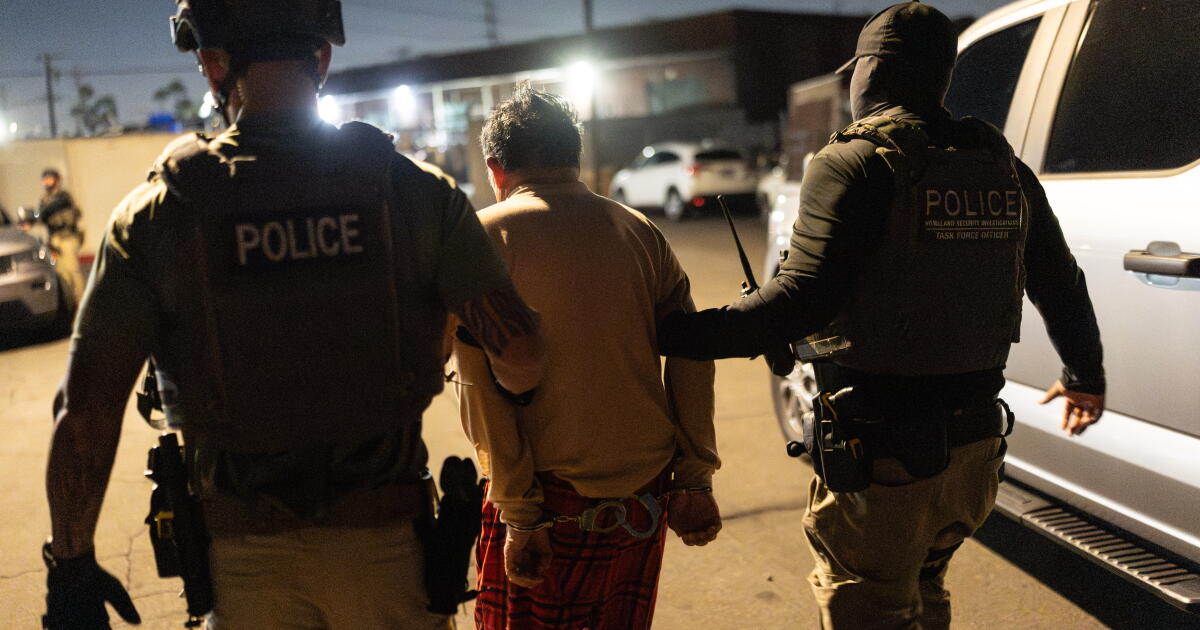
When federal prosecutors charged 28 California immigrants with illegally registering to vote, they invited friendly media outlets to document the early morning arrest of one suspect.

At a news conference in Los Angeles this week, First Assistant U.S. Atty. Bill Essayli intoned that the defendants’ alleged crimes proved President Trump’s long-held conspiracy theory that voter fraud threatens democracy and that noncitizens are voting by the boatload. Mug shots of the accused — lawful permanent residents, some of whom said they didn’t recall registering to vote — were displayed as if they were part of a Mafia-like conspiracy.

It all felt staged for maximum humiliation.

So what happened to a Costa Mesa woman who registered her dog to vote and attempted to cast ballots for it in two elections?

There was no perp walk for Laura Lee Yourex, who pleaded guilty to a misdemeanor. No melodramatic news conference from Orange County Dist. Atty. Todd Spitzer.

Nah, Spitzer dismissed Yourex’s case after she paid $1,500 for four electronic billboards along the 22 and 55 freeways. They feature a photo of her late boxer Maya Jean sporting an “I Voted” sticker alongside a warning — “Don’t be a dog. Voter Fraud is a Crime” — and the district attorney’s election fraud hotline number.

Yourex’s attorney has said she was trying to expose flaws in the state’s voter registration system by showing that even a dog could cast a ballot, a gimmick for which Spitzer had little sympathy.

He’s usually the modern-day equivalent of a hanging judge, the type of hard ass who wants his prosecutors to not only throw the book at defendants but also to bury them with a library. In an email, he told me that his office has successfully prosecuted two other voter fraud cases during his eight years in office and is pursuing three current ones. But as serious as voter fraud is, Spitzer has never preened in these cases the way Essayli has.

The Republican stalwart declined to comment on Essayli’s approach, saying he’s “not privy to any of the evidence in those cases.” When I asked why he chose a chuckle-inducing billboard as Yourex’s punishment, he argued that it successfully “address[ed] the harm that is done when engaging in this type of criminal behavior.”

Leave it to the Trump administration to make Spitzer — whose campaign slogan for his 2022 reelection was “#NoLAinOC” — come off as a big ol’ liberal softy. But when it comes to voter fraud, at least he’s meting out penalties that fit the crime, while Essayli is once again making Trump his North Star, not the Constitution.

The defendants charged with voter fraud deserve punishment, if they are indeed guilty. But as my colleagues Brittny Mejia and Kevin Rector reported, citing election experts, cases of noncitizens registering to vote are often a result of administrative error or confusion on the part of immigrants, for example, if they accidentally check a box at the DMV.

Essayli’s record as Trump’s top lawman in Southern California — he can’t even call himself the region’s U.S. attorney, since he hasn’t been confirmed by the Senate — is so laughable that I wouldn’t believe him if he claimed that water is wet.

His prosecutors have gone after activists involved in protests against Trump’s masked deportation goons with shoddy charges that were dropped, rejected by grand juries, ridiculed as “amateur hour” by a federal judge or resulted in not guilty verdicts. He’s a lackey who silently stood and watched last year as FBI agents tackled Alex Padilla during a news conference in Los Angeles just because the U.S. senator dared to challenge then-Homeland Security Secretary Kristi Noem’s ludicrous defense of mass immigration raids. He’s a coward who regularly declines to talk to press outlets — including The Times — that don’t think Trump is the greatest president in history.

Unsurprisingly, my request to interview Essayli — or at least receive emailed answers to questions including whether every felony defendant gets arrested with a phalanx of armed officers surrounding their home, whether that’s occurred in other voter fraud cases and whether his office regularly releases mug shots of felony defendants — went unanswered.

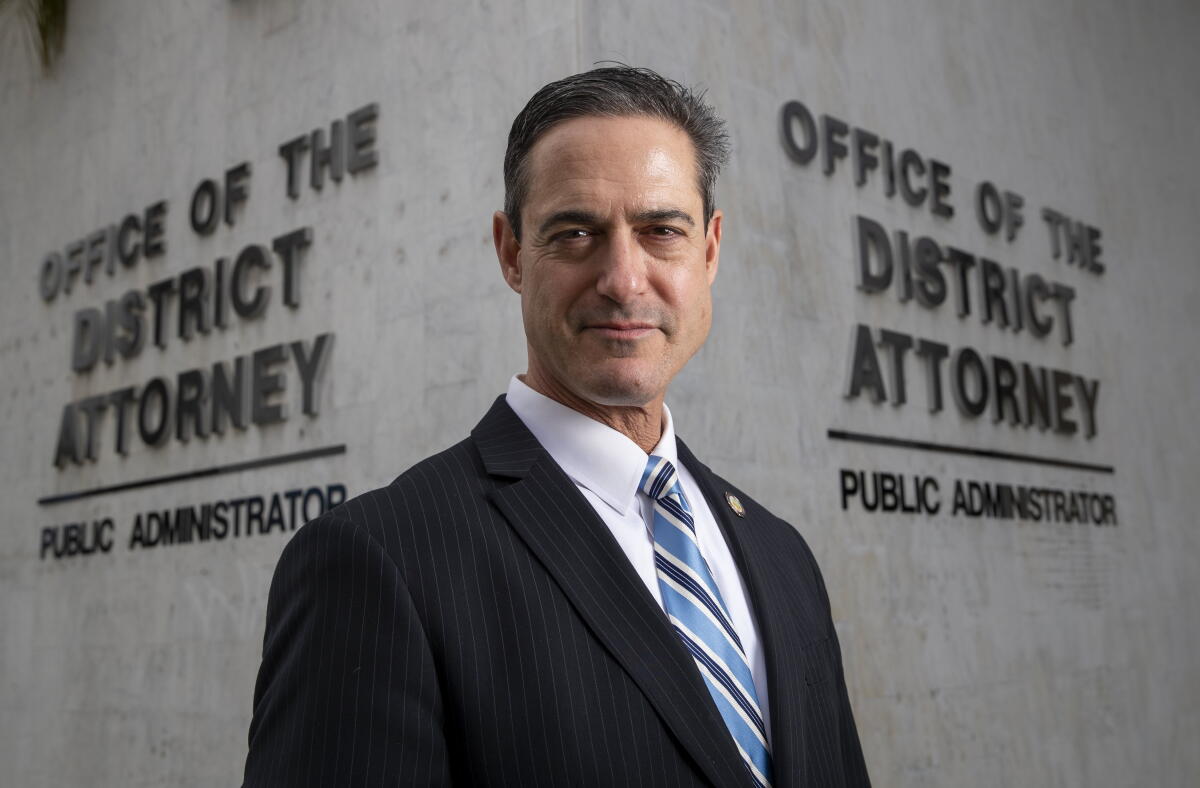
A man in a dark suit, with a blue striped tie, outside a building with signs that say Office of the District Attorney

Orange County Dist. Atty. Todd Spitzer said his office is pursuing three voter fraud cases.

(Allen J. Schaben / Los Angeles Times)

Mejia and Rector spoke to some of the accused immigrants and their families swept up by “Operation Protect the Vote,” who were bewildered as to what they had done wrong and why the U.S. Justice Department was swinging such a heavy hammer against them. They shouldn’t be.

What Essayli is doing in the name of rooting out voter fraud isn’t about upholding the law. It’s about validating Trump’s xenophobia. The show trials the defendants will probably face are not about getting rid the worst of the worst, as Trump long claimed. It’s about casting suspicion on all immigrants, legal and not.

What’s especially ironic — no, disgusting — about Essayli’s claims that immigrants who wrongly register to vote are disenfranchising American citizens is that the portrait of this country’s biggest election scofflaw hangs in every federal courthouse. It was Trump who wanted Congress to stop the electoral college from formalizing his 2020 loss to Joe Biden, claiming that Democrats stole the White House from him, and provoked a mob to storm the U.S. Capitol.

But facts have never stopped Essayli from making a pendejo out of himself. His pathetic, dangerous charade reminds me of an infamous voter fraud case from 30 years ago. I wrote about it this summer when Trump first announced he was going to sic the Justice Department on noncitizens who were supposedly voting en masse.

Back then, Loretta Sanchez forever changed O.C. politics when she beat Republican Rep. Bob Dornan by fewer than 1,000 votes. Like Trump, Dornan claimed he lost because of immigrants who illegally voted. Like today’s GOP, sympathetic prosecutors and lawmakers at the local and federal levels spent way too much time and taxpayer money looking into the baseless allegations.

Just as Operation Protect the Vote has already shown this year, with only 28 charged out of about 23 million registered voters in California, Sanchez’s 1996 victory was not achieved through a vast immigrant voting conspiracy.

At least in the Dornan fiasco, Republicans finally dropped their investigation and moved on. The few immigrants who did vote improperly had their ballots tossed but otherwise faced no legal problems.

I doubt Trump and Essayli will give up so easily. That would require humility, mercy and the ability to admit they’re wrong.

But hey, if a dog can cast a vote in California, I guess anything’s possible.

Source link

Trump’s attack on California voting is false, and a bit funny

In what may be one of the most comical self-owns in recent politics, the esteemed attorneys of the U.S. Department of Justice announced Monday that despite the extravagant and terrifying misuse of their investigative power under the Trump administration, they have so far been able to identify only 28 people in all of California who may have voted illegally.

“The announcement today by the United States DOJ makes the point that there is no widespread voter fraud,” California Atty. Gen. Rob Bonta said after the news conference announcing the results of “Operation Protect the Vote.”

Twenty-eight people out of about 23 million registered voters in the state — and not all of them even tried to vote, according to the feds. That’s about 1 in 820,000 folks allegedly registering or voting illegally, a rate that roughly matches how often people in the United States get struck by lightning in a given year.

So much for Trump’s endless claims that there is a vast, organized conspiracy between Democrats and undocumented people to have them vote in large numbers to steal elections. I’ll point out here that none of those charged Monday have been accused of colluding with one another or with Democratic overlords.

All the power of the government — investigative, technological, legal — has been thrown at finding these mysterious, diabolically clever ballot baddies. And now, thanks to Bill Essayli, first assistant U.S. attorney for the Central District of California, and his colleagues across this great state, we now know that all 28 of them will be held accountable, if the government can prove wrongdoing. And let’s be clear — people who vote illegally should be held accountable.

But wait, there’s more, because this election-stealing plot by immigrants certainly doesn’t stop at the state line. Seamus Hughes of Court Watch, an excellent site that tracks federal litigation, reported Monday that since the start of this administration, 169 people have been charged federally with illegally registering or voting.

That number includes the new California cases, so it means an additional 141 potentially illegal voters have been charged across the U.S. — all told about 1 in 1.25 million registered voters being accused of illegally registering or voting, making this crime slightly less likely than guessing a six-digit pin code on the first try.

There. Is. No. Election. Stealing.

But that’s where the funny part ends, because this attack on California elections is serious and just getting started.

The federal government, you’ve probably read, is suing California, claiming it gave the state a janky thumb drive with 20,000 names of registered voters that it sort of strongly suspects maybe aren’t legal voters. Important note here: The government has been very careful not to claim that these people voted illegally, just that it might be so based on questionable data, which I’ll get to in a minute.

The feds gave the state a silly 48-hour deadline to agree to change constitutional law, dump common sense and sequester these 20,000 ballots, if they were even returned, to double-check they were cast by valid voters.

When California rightfully refused — because elections are run by states, not the federal government — the federal government sued on the thinnest of legal grounds. It basically claimed that voting illegally is illegal, and if California doesn’t do exactly what Trump wants, it could be violating the Supremacy Clause of the Constitution by impeding the feds from enforcing the crime of voter fraud.

Bill Essayli

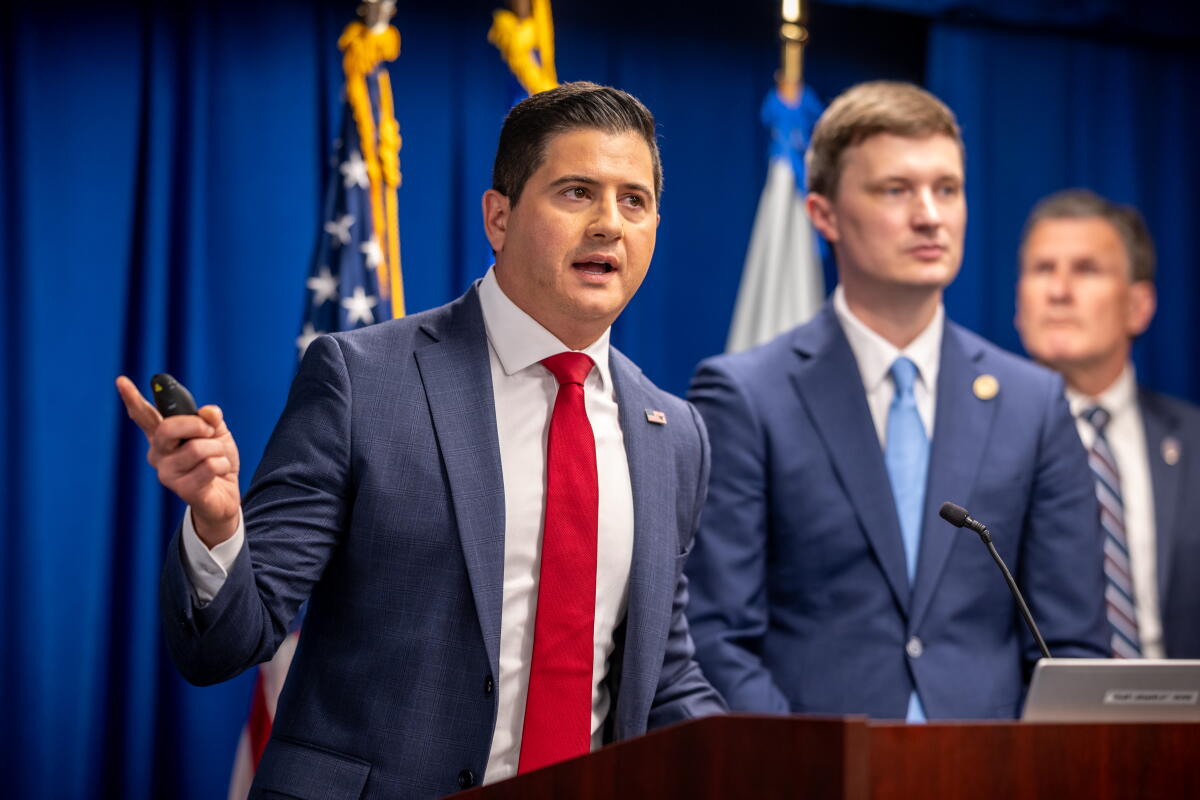
First Assistant U.S. Atty. Bill Essayli speaks at a news conference Monday at which officials announced that 28 people in California had been charged with voter fraud.

(David Butow / For The Times)

Which is basically arguing that if the state government fails to stop voter fraud using the flawed methods Trump likes, then the state is somehow stopping federal authorities from prosecuting voter fraud themselves. But didn’t they just enforce it with 28 cases?

Get ready, because “state-facilitated voter fraud,” is a new right-wing thing.

California is “being complicit in non-citizens voting in our elections, and as they were warned last week, not only is it a civil violation, but they could also face criminal consequences,” Essayli said, which if it happened would give Trumped-up charges a whole new meaning.

Essayli said state officials are not being “good faith actors,” but I’ll argue that shoe is on the other foot. The list of 20,000 alleged, suspected, maybe-maybe-not illegal voters was likely drawn from the Systematic Alien Verification for Entitlements (SAVE) program, created by Elon Musk’s Department of Government Efficiency, if you can remember that unfortunate relic.

It sought to draw data from more than a dozen government databases that were not only not compatible with such information sharing, but which had been kept separate until now for privacy reasons. Americans in general did not want the government collecting unified, know-all records of every citizen.

Luckily for us, I guess, the SAVE system can’t actually create reliable, unified records. It confuses people, convolutes them, merges records of people with similar names, and in general has been deemed unreliable by data experts.

In September, the good folks at the UCLA Voting Rights Project joined with the Coalition for Humane Immigrant Rights to sue the federal government over its use of that system to target naturalized citizens for removal from voter rolls. Turns out, the government appears to be targeting immigrants who are now citizens with these voter fraud accusations.

As I wrote about a few weeks ago, naturalized citizens make up about 1 in 10 eligible voters, and nearly a quarter of them live in California. But they also live in swing states such as Michigan, where Democrat Abdul El-Sayed may draw such voters, and in other places such as Georgia and Nevada where races might be decided by only a few votes.

These arrests and lawsuits while voting is already underway in the midterms are a not-subtle form of voter suppression. Imagine being a naturalized citizen in the Central Valley, where ICE is driving rampant fear and where Republican Rep. David Valadao is running against Democrat Randy Villegas in California’s 22nd Congressional District — one of the nation’s most closely contested races.

Would you consider sitting this election out just in case your ballot draws the frightening eye of the federal government? Even knowing that your vote is legal, what if you lived in a mixed-status household? Would it be worth risking voting if it meant a knock at the door from immigration checking on your status, and maybe finding that family member who lacks it?

Why take the risk?

“Basically, what they’re doing now is just completely harassing and intimidating naturalized citizens who are legally eligible to vote through these actions,” said Matt Barreto, co-founder of the Voting Rights Project.

And if the vote isn’t suppressed enough to give Trump the results he wants, these prosecutions and lawsuits feed the beast of conspiracy, giving Trump fodder to claim the results are fake, the election stolen.

And round and round we go, reckoning with Trump’s claims that lightning is striking everyone, everywhere, all at once, because the vote didn’t go his way.

Source link

Federal officials charge 28 in California noncitizen voting case

Federal authorities have charged 28 people from across California with illegally registering to vote or casting ballots in federal elections despite not being U.S. citizens — again escalating an election battle between the state and the Trump administration just weeks before the Nov. 3 midterms.

Authorities said 11 of the 28 were arrested as of Monday morning and that the 17 others “will be in custody in the near future.” Some of the 28, all of whom are lawful permanent residents of the U.S., are charged with lying about registering or voting on their naturalization paperwork, officials said; 21 of them are suspected of casting votes, some in multiple elections. None are undocumented immigrants, a favorite target of President Trump and a group he has accused of infiltrating U.S. elections in the past.

Those charged represent a tiny fraction of the 20,000 “likely noncitizens” that the Justice Department alleged are on California rolls just last week, and an even tinier fraction of the more than 190,000 noncitizens the Trump administration alleged were on state rolls as recently as July.

State officials have previously warned, along with independent elections experts, that the Trump administration has badly overstated voter fraud claims in other states. In Nevada, for example, officials recently found that all 185 people the Justice Department flagged as potential noncitizens were in fact citizens. The administration has repeatedly revised downward its estimate for how many “likely noncitizens” are on California’s rolls.

Acting Deputy Atty. Gen. Trent McCotter cast the arrests during a Monday news conference as proof that California voter rolls are corrupted and need to be purged to prevent noncitizens from negating the legitimate votes of U.S. citizens, and that California officials who have rebuffed recent Trump administration efforts to purge the state’s rolls are willfully obstructing justice.

“This Department of Justice will not look the other way while non-citizens vote in federal elections,” McCotter said. “Unfortunately, the same can’t be said for California and L.A. County.”

State and local officials — some of whom are being sued by the Justice Department over their handling of the broader claims — said voter fraud should be taken seriously, but that isolated cases are not evidence of widespread problems and that any voting allegations from the Trump administration must be viewed with skepticism.

Los Angeles County Supervisor Janice Hahn referred to Monday’s arrests as “voter intimidation and a blatant attempt to undermine trust in our midterm elections.”

“These arrests are being used to paint a picture of widespread voter fraud when we know that is not the case,” Hahn said. “California has laws in place to protect the integrity of our elections, and L.A. County is fully abiding by them.”

California Atty. Gen. Rob Bonta’s office said the 28 individuals charged Monday “represent a tiny fraction” of California’s 23 million registered voters, and that the Trump administration has not shown “evidence of widespread voter fraud, even if the allegations are true.”

Shifting claims

For months, federal prosecutors have been issuing grand jury subpoenas for voter records in California — suggesting a sweeping criminal investigation was underway.

In July, Homeland Security Secretary Markwayne Mullin asserted in a letter to California Secretary of State Shirley Weber that California may have more than 190,000 noncitizen voters on its rolls. Last week, McCotter wrote letters to Weber and Dean Logan, head of the L.A. County Registrar-Recorder/County Clerk’s office, giving them 48 hours to set aside the ballots of about 20,000 voters the Justice Department said were “likely noncitizens.”

When Weber and Logan balked at the demand — arguing the Justice Department had provided no proof the voters were ineligible, had presented similar and inaccurate claims in other states and had made the request too close to the upcoming election — the Justice Department sued Thursday, asking a court to immediately intervene and force the state and L.A. County to comply with McCotter’s demands.

In a filing in that case Monday, federal authorities cited the latest charges as more reason for the court to intervene, and before the election, to segregate out the flagged ballots until those voters’ citizenship can be verified — again raising uncertainty as to their citizenship status despite alleging during their news conference Monday that all were permanent residents.

“This Court should order California to set aside vote-by-mail ballots from likely noncitizens in the federal election — including any ballots cast by the individuals charged with [federal election] crimes this morning — until the voter’s citizenship status can be determined,” federal attorneys wrote.

The Trump administration’s apparent uncertainty about the citizenship of the voters it has flagged — and even those it’s charged — has been a focus of state and local officials. Bonta and others have questioned the drop from 190,000 to 20,000 and repeatedly pointed to what occurred in Nevada, where federal officials initially flagged more than 15,000 potential noncitizen voters. Independent election experts have also highlighted those discrepancies.

Rick Hasen, director of the Safeguarding Democracy Project at UCLA School of Law, wrote online Monday that the data the federal government relies on to find purported noncitizens are “unreliable.” He wrote that the Justice Department’s demands on California risk “disenfranchising thousands of voters, and from DOJ’s track record, the lion’s share will be eligible voters.”

David Becker, executive director of the nonpartisan Center for Election Innovation & Research, said the 28 alleged noncitizens charged represent “.0001% of California voters,” and that the Trump administration charging 28 people days after flagging 20,000 “raises serious questions as to whether DOJ has any evidence at all supporting their claims on the other 19,972 on their list.”

McCotter said the original 190,000 figure was “the ceiling,” while “20,000 is the floor” — with the larger figure representing individuals the administration had low, medium or high levels of confidence were noncitizens, and the smaller figure representing only those it has high confidence are noncitizens.

“So there’s not inconsistency between those numbers. They’re just looking at different levels of confidence,” he said.

McCotter also said the notion that a federal list of more than 15,000 alleged noncitizens in Nevada had resulted in zero noncitizens being found was a “false storyline,” in part because the larger group was never vetted by the state. However, he also acknowledged that the 185 that were vetted — and found to be citizens — were those the federal government had held “high confidence” in being noncitizens.

How the Justice Department further zeroed in on the 28 charged individuals also was not entirely clear.

U.S. Atty. Craig Missakian, the top federal prosecutor in Northern California, said prosecutors compared information from Homeland Security with voter information they subpoenaed from Weber’s office and various county election offices. Some of the criminal complaints said Homeland Security Investigations received investigative referrals from its Identity and Benefit Fraud Unit, which provided “relevant information regarding alleged voter fraud or related identity-based fraud indicators.”

Kevin Murphy, special agent in charge of Homeland Security Investigations in San Diego, said the underlying investigations were not “based on assumptions or a single piece of information,” but required “thorough investigative work, coordination, and a commitment to ensuring that enforcement action is supported by the facts.”

Those charged include 13 people from the Central District of California, who live in Los Angeles, Long Beach, Rancho Palos Verdes, Anaheim, West Covina and other cities. They hail from a mix of nations, including Belize, Canada, El Salvador, Guatemala, Honduras, India and Mexico. Five others were charged in the Northern District of California, with one from San Francisco and others from the wider Bay Area; four in the Southern District and six in the Eastern District.

First Assistant U.S. Atty. Bill Essayli, the top federal prosecutor in L.A., dismissed the idea that such fraud is rare or that Trump officials are overstating the threat. “This is not a conspiracy theory,” Essayli said. “This is not made-up stuff.”

Essayli specifically highlighted the case of a 72-year-old Omar Munoz from Belize, who was arrested in a pre-dawn raid Monday at his home in Commerce. Federal authorities allege that he fraudulently registered to vote in 2019, voted in 2020, twice in 2022 and again in 2024. He is also accused of lying on his naturalization application.

In federal court downtown late Monday, Munoz’s daughter Lliani Orantes, a nurse born in the U.S., said the family was trying to figure out what happened, after federal officials swarmed their block and took her father, who is recovering from a recent surgery.

She said her brother, a registered voter, shares her father’s name, as does a nephew, and the family is wondering if it is all a mix-up. “Did the names get misconstrued,” she wondered.

McCotter said in the last seven weeks, the Trump administration has charged 113 people across 20 states with voting-related crimes. More than 154 million people voted nationally in the 2024 presidential election.

What’s ahead

Federal officials said their work — dubbed “Operation Protect the Vote” — would continue through the election and beyond.

Essayli said California’s own process for verifying voters’ citizenship, including requiring that they attest to being a citizen when they register, is insufficient. He said California election officials have “no idea who is a citizen,” but also know “they have noncitizens who are getting ballots as we speak” and several years ago admitted in an audit that noncitizens were being registered at the DMV.

“When we submit a list of 20,000 noncitizens to California that we are pretty sure are not citizens, it is outrageous that the response from the state is, ‘We don’t believe you and we’re not even going to look at it,’” he said. “That is not good faith actors. They are being complicit.”

McCotter said there “may be some names” on the list of 20,000 flagged voters “who, it turns out, ultimately are citizens.” He said federal authorities are “not perfect,” which is why they’ve asked California officials to work with them. “We could knock through most of these names pretty quickly, probably in a day or two, if California would work with us.”

He said the timeline — amid an ongoing election — was due to state officials refusing to cooperate sooner. “It’s an emergency of their own creation.”
Source link