Bend

US Supreme Court allows border wall in Big Bend National Park to proceed | Courts News

A lawsuit had sought to block border wall construction in the Big Bend National Park by targeting the waivers that sidestep environmental protections.

The United States Supreme Court has allowed President Donald Trump’s administration to build a border wall through a remote section of Big Bend National Park in West Texas.

In its decision on Monday, the court granted the government’s emergency request to lift a lower court’s injunction that had paused construction while the matter was litigated.

Recommended Stories

list of 3 itemsend of list

The injunction, it said, “impedes the Government from advancing its ‘compelling interests’ in border security and integrity”.

The border wall has long been a signature part of Trump’s platform to restrict immigration into the US.

During his first successful bid for the presidency in 2016, for instance, he rallied supporters with chants of “Build the wall!”

But the push to expand the border barrier through the popular national park has met pushback from conservationists, local officials and some members of Trump’s own Republican Party.

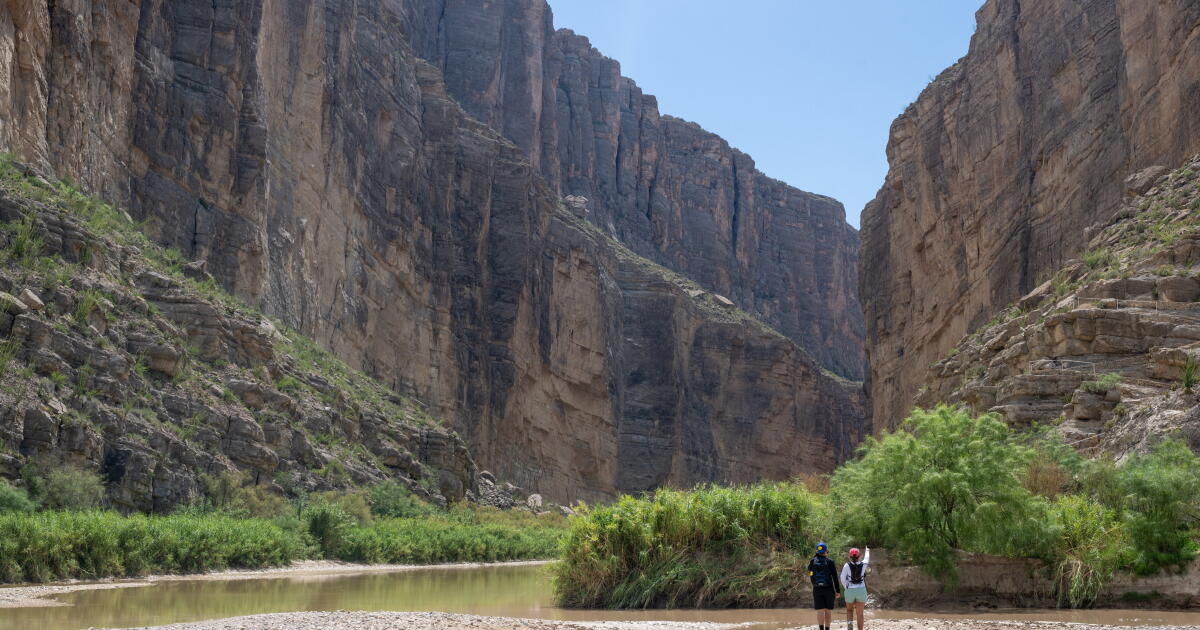
Big Bend National Park includes mountain ranges and desert that serve as a home to endangered species like the Mexican long-nosed bat.

Opponents say the plan to build the wall through the park would disrupt the ecologically and culturally significant landscape.

The Trump administration, however, has depicted the project as an urgent priority for national security and immigration control. It has described the Big Bend area as an artery for irregular border crossings and drug trafficking.

US District Judge Kathleen Cardone blocked the construction in October, noting that while the Big Bend sector makes up more than 25 percent of the US-Mexico border, it accounts for only 0.3 to 2.2 percent of migrant apprehensions.

“Therefore, if the Big Bend Sector is an area of high illegal entry, so is every other sector, and the waiver authority would apply to the entire US-Mexico border,” Cardone wrote.

The Supreme Court, however, said the government was “exceedingly likely to prevail” on its argument that Cardone lacked jurisdiction under the 1996 Illegal Immigration Reform and Immigrant Responsibility Act, which limits the ability of lower courts to rule on border barriers.

Under that law, district courts can only hear claims alleging a violation of the US Constitution. The Supreme Court found that the challengers’ claim did not qualify, writing that “there is no such thing as a ‘constitutional’ major-questions claim”.

Justice Ketanji Brown Jackson was the only justice to indicate she would have denied the government’s request. She did not explain her reasoning.

The Center for Biological Diversity was among the plaintiffs who brought the lawsuit against the Department of Homeland Security, along with Friends of the Ruidosa Church and a local river guide and landowner.

The lawsuit challenged waivers used by the agency to fast-track border construction and sidestep environmental and conservation laws.

Without those waivers, plaintiffs said that construction would have to comply with laws such as the Endangered Species Act, the National Environmental Policy Act and the National Historic Preservation Act to alter the landscape in “one of the most remote and ecologically and culturally significant landscapes in the United States”.
Source link

Supreme Court OKs border wall construction in Big Bend area of Texas

The Supreme Court has cleared the way for the Trump administration to build a border wall through the scenic and rugged Big Bend sector of west Texas.

The justices on Monday granted an emergency appeal from Trump’s lawyers and set aside a judge’s order that had paused further construction along a 517-mile section of the Rio Grande.

Justice Ketanji Brown Jackson dissented alone and without an explanation.

In an unsigned opinion, the court said federal courts did not have the authority to stand in the way and block efforts along the border.

“The balance of the equities also favors the government,” the court said. “Construction in the Big Bend Sector will diminish the [plaintiffs’] ability to use and enjoy the area. But Congress’s enactment of [the special law] — which permits the Secretary to waive the requirements of environmental protection and other conservation laws — reflects a clear preference for expeditious border construction over the very harms” cited by the opponents.

A broad coalition of environmentalists, cattle ranchers, farmers, river boat guides, outdoor activists and church leaders had gone to court in El Paso seeking to stop the construction.

“The Trump administration and its contractors are hellbent on destroying one of America’s greatest national parks, and the Supreme Court just gave them the green light,” said Laiken Jordahl, national public lands advocate at the Center for Biological Diversity. “This horrific decision clears the way for contractors to bulldoze pristine desert and dynamite canyon walls before the courts have even decided whether this destruction is legal.”

But Trump’s lawyers pointed to unusual measures adopted by Congress that gave the Department of Homeland Security broad authority to construct border barriers “to deter illegal crossings in areas of high illegal entry.” One provision authorized the department’s secretary to “waive all legal requirements” that stood in the way, including environmental protection measures.

U.S. Customs and Border Protection said it does not plan to build a border wall in the Big Bend National Park, with its steep canyons, but said new patrol roads and vehicle barriers would be added.

However, U.S. District Judge Kathleen Cardone, an appointee of President George W. Bush, issued a preliminary injunction on Oct. 2 to halt further work on the border barriers. She said the government’s own evidence showed illegal entries and drug smuggling were much less common in the Big Bend sector.

“For ‘high illegal entry’ to impose any limit, it must at least mean, not ‘the lowest rate of illegal entry,’” she said. “The Bend Sector has the lowest rate of illegal entry along the entire U.S.-Mexico border.”

Solicitor Gen. D. John Sauer filed a fast-track appeal at the Supreme Court and urged the justices to set aside her order and to rule on the underlying legal question. He cited evidence that over four years, there were 89,000 apprehensions of illegal migrants in the Big Bend sector which covers nearly one-fourth of the U.S.-Mexico border.

“The Sinaloa and Juarez cartels operate south of this sector across the Mexico border and seek to exploit any vulnerabilities in United States border protection to traffic humans, drugs and weapons across the border and infiltrate the United States,” he told the court. “Leaving a 300-plus-mile gap in border defenses would act as a dangerous magnet for cartels and other bad actors to exploit as other routes close off.”

Source link

Trump’s border chief defends wall plans in Texas’ Big Bend despite a court setback

The Trump administration’s top border official defended plans to build a wall and other infrastructure in Texas’ Big Bend region despite mounting opposition against the project and a court-ordered pause on construction, saying his goal of fortifying the country’s borders was “non-negotiable.”

In an exclusive interview with the Associated Press, Customs and Border Protection Commissioner Rodney Scott argued that the $46-billion wall project was justified despite a bipartisan coalition of landowners, local businesses and environmentalists who view it as a waste of taxpayer money that could be destructive to a region with historically low migrant crossings.

“Our No. 1 goal right out the gate is we have to know who and what is coming into the United States,” Scott said on Thursday. If the Big Bend region were left without a wall or other border infrastructure while other areas along the border get those fortifications, he said, “I am 100% convinced it will be completely overrun and destroyed.”

The fight over Big Bend has become a major test for how far the Republican administration is willing to go for the border wall, President Trump’s signature infrastructure project.

Scott, a former Border Patrol agent, was tapped by Trump to complete it.

His agency is responsible for executing a plan funded last summer by Republicans in Congress to line the roughly 2,000-mile border with Mexico with a mixture of 30-foot-tall steel walls, vehicle barriers, new roads and surveillance technology to prevent illegal immigration and smuggling.

The Trump administration says it is building about 12 miles a week. Scott, who gets daily progress updates, said it will be complete by the end of Trump’s second term. The primary border wall — some areas also get a secondary layer — will be done by the end of December 2027.

“We’re actually ahead of schedule,” Scott said.

1

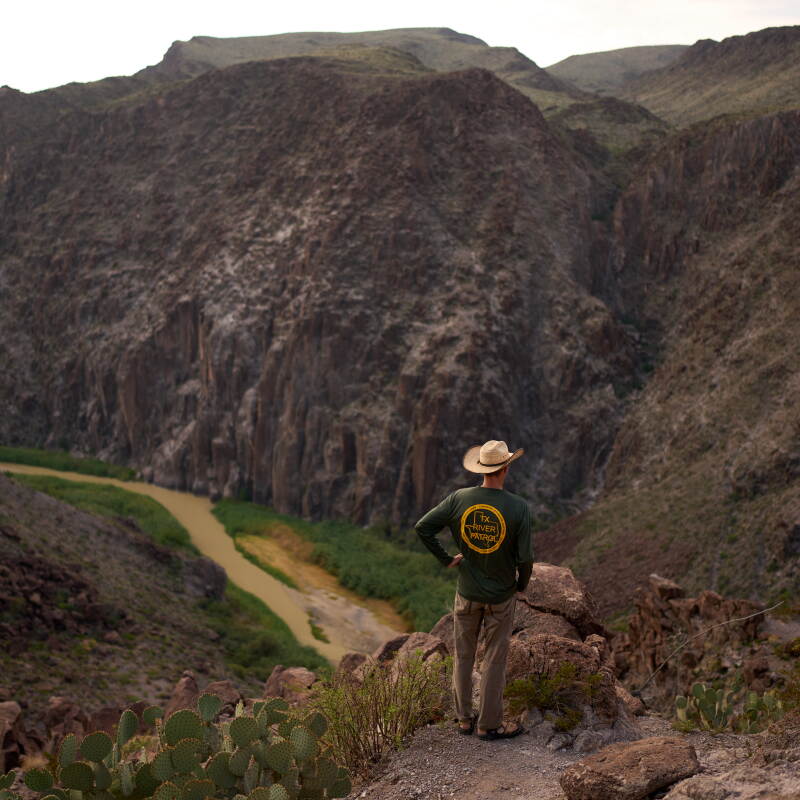
Charlie Angell stands on an overlook of the Rio Grande river

2

Pamela Priddy, center, holds up signs with others during a weekly protest

1. Charlie Angell stands on an overlook of the Rio Grande river 2. Pamela Priddy, center, holds up signs with others during a weekly protest against barriers along the border in the Big Bend region, Saturday, Sept. 26, 2026, in Study Butte, Texas. (John Locher / Ap Photo/john Locher)

Big Bend is a test for the Trump administration’s plans for the wall

The wall plan has run into resistance in places like Big Bend. The Trump administration was dealt a major setback earlier this month when a judge ordered a pause on border wall construction in the region, citing what could be a likelihood that plaintiffs “will suffer serious, irreparable harm without an injunction.” The administration has asked the Supreme Court to lift the order.

The ruling included any construction in Big Bend National Park, an area that has seen a loud bipartisan outcry, including from some Republican lawmakers.

After bulldozers were spotted in the park tearing up ground in August, Scott ordered a pause on all construction-related activity there while he went to talk to people in the region. He said the agency is making other outreach to locals to discuss how to build projects so they don’t mar the park.

“We’re talking through and figuring out what is the right solution for that area,” he said.

Scott said he can’t get into specific details on what the agency’s plans are for the park because of the numerous ongoing lawsuits, but he reiterated that the project won’t include tall steel walls.

He also said that the agency’s stated goal of protecting the country and knowing what’s coming in and going out is “non-negotiable.”

He said the region’s formidable natural barriers were not enough to prevent people from entering the country illegally through other more navigable points. And he expressed concern that cartels that control smuggling from Mexico into the U.S. would exploit any opening.

CBP has come under fire for immigration enforcement tactics

Scott leads an agency of 67,000 employees responsible for controlling who and what comes into the country through official border crossings like airports or seaports and stopping illegal smuggling and migration outside those official border crossing points.

The agency came under heavy scrutiny last year when its officers were sent into cities deep inside the country to help carry out Trump’s immigration crackdown alongside Immigration and Customs Enforcement.

Agents with the Department of Homeland Security patrol in a neighborhood

Agents with the Department of Homeland Security, which includes Immigration and Customs Enforcement, Border Patrol and Customs Enforcement patrol in a neighborhood after apprehending a person on Jan. 31 in St. Paul, Minn.

(Eric Thayer/Los Angeles Times)

As protests against an operation rocked Minneapolis, a Border Patrol officer and a CBP officer both fired shots in an encounter that killed a U.S. citizen, Alex Pretti. The shooting eventually prompted the Trump administration to wind down high-profile city-based crackdowns. A CBP officer who was the face of the missions, Gregory Bovino, who led a helicopter raid at a large apartment building and used chemical agents to confront demonstrators, retired earlier this year.

Scott said while CBP still helps ICE, it’s now less involved in immigration enforcement far from the country’s borders because ICE has since hired more officers to its ranks. Scott wouldn’t comment on the investigation into the Pretti killing, saying that it was being handled by the FBI and was ongoing. And when asked about Bovino’s tactics, he said the officer didn’t report to him during the operations.

Scott spoke to the AP just outside the border with Canada, where he met with border security representatives from other countries to share information about threats and trends. During his trip, he visited an operations center where he said Canadian and American law enforcement work together.

That border has far fewer threats than the U.S. border with Mexico. Scott said cartels in Mexico are increasingly sending drones into the United States to move contraband and keep tabs on Border Patrol agents. In Mexico, the cartels have been using drones to attack each other or Mexican law enforcement.

The Department of Homeland Security, which includes CBP, recently announced temporary flight restrictions targeting unauthorized drone activity in a zone extending a mile north of the U.S.-Mexico border as a way to counter cartels.

“We want to make sure,” Scott said, “that threat does not come into the United States.”

Santana writes for the Associated Press.

Source link

Trump administration seeks Supreme Court approval to build Big Bend wall | Courts News

US federal judge blocked wall’s construction on Texas-Mexico border amid an ongoing legal battle.

The Trump administration has asked the Supreme Court to allow it to resume plans to build a border wall through the Big Bend region of West Texas, as part of its anti-immigration policy to strengthen security on the border with Mexico.

The Justice Department filed an emergency request on Wednesday asking the court to lift a federal judge’s injunction in a lower court that has halted construction while a lawsuit against the project, brought by an environmental group and other challengers, plays out.

Recommended Stories

list of 3 itemsend of list

The Department of Homeland Security plans include vehicle barriers, patrol roads, lighting and detection technology in and around Big Bend National Park.

Big Bend has about 805km (500 miles) of border, and, according to opponents of the project who have sued the administration, accounts for about 1 percent of migrant arrests.

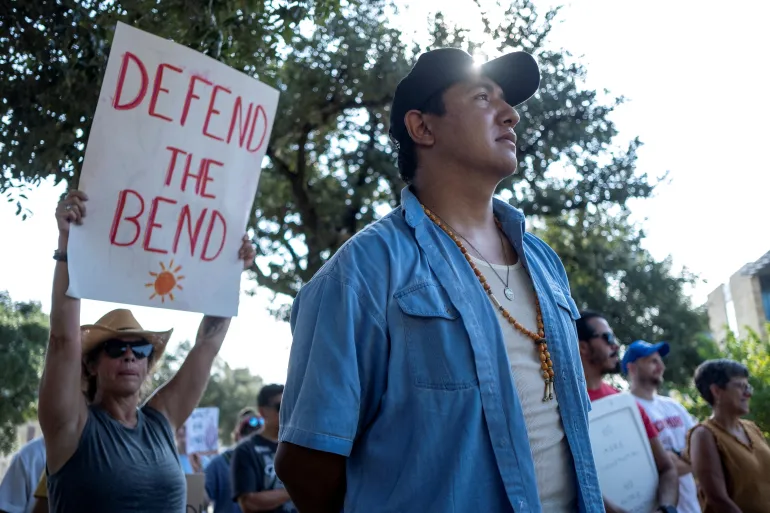
Lipan Apache tribe member Joey Montoya attends a rally opposing border wall construction in Big Bend National Park outside the US federal courthouse during an emergency hearing for a Petition for a Temporary Restraining Order against the Department of Homeland Security, in San Antonio, Texas, US, August 28, 2026 [Joel Angel Juarez/Reuters]
Lipan Apache tribe member Joey Montoya attends a rally opposing border wall construction in Big Bend National Park, outside the federal courthouse during an emergency hearing on the project in San Antonio, Texas, on August 28, 2026 [File: Joel Angel Juarez/Reuters]

Landscape, historic church

The lawsuit, filed by plaintiffs including the Center for Biological Diversity and a Big Bend-area river guide, seeks to preserve the landscape, protect a historic church, and challenge the federal government’s waivers of environmental and historical laws to fast-track the $1.7bn project.

Former Homeland Security Secretary Kristi Noem and current Secretary Markwayne Mullin, who issued the waivers between February and July, found the region to be an “area of high illegal entry”, requiring additional barriers to control the border.

US District Judge Kathleen Cardone issued an injunction in El Paso on October 2 halting work “until and unless Defendants comply with all applicable laws,” she wrote in her order.

In a later opinion, the judge found that the waivers exceeded the authority of Noem and Mullin.

The Justice Department in its request urged the Supreme Court to pause or overturn Cardone’s injunction.

The Supreme Court has not yet responded to this appeal.

“Even assuming that the secretary’s waiver authority implicates a question of ‘vast economic and political significance,’ Congress did clearly authorize the secretary both to build border barriers and to waive legal requirements in order to facilitate their expeditious construction,” the Justice Department wrote.

In August, the administration paused construction in Big Bend after the project drew bipartisan criticism over its potential impact on the park’s landscape and wildlife.

Source link