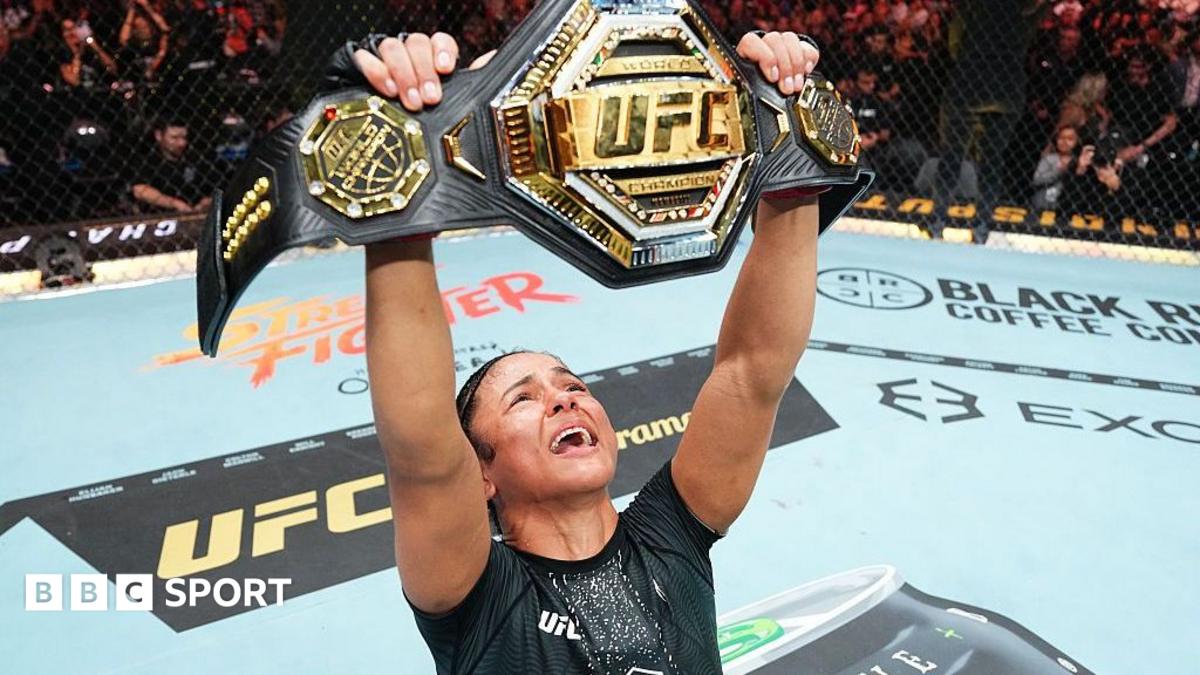
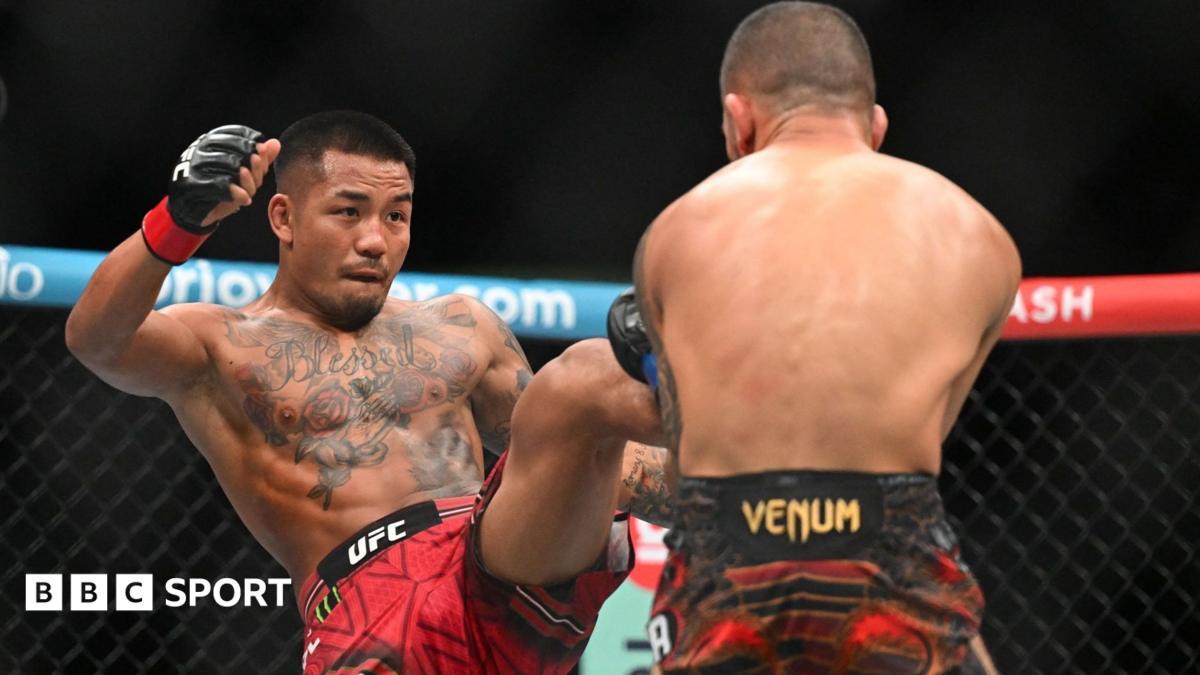
Alexandre Pantoja did not tap Joshua Van’s glove before the fight began. Nine months after an injury ended his reign as flyweight champion in just 26 seconds, the Brazilian returned to the Octagon to try to reclaim the belt that slipped away.
This time, no injury clouded the result. Pantoja came out determined to impose his style from the opening seconds, but Van found a way to keep him at a distance, counter with his boxing and survive the former champion’s take-down attempts.
After five rounds, the judges awarded the fight to the Van by unanimous decision, with scores of 49-46, 49-47 and 50-45.
Van retained the 125-pound title in the main event of UFC 331, held Saturday at Crypto.com Arena in front of a sold-out crowd of 19,357 fans. UFC CEO Dana White said the event generated $8.3 million in box office revenue, the highest in the arena’s history.
The result also vindicated Van’s claim to the championship.
In December 2025, Pantoja threw a high kick that Van caught. The Brazilian lost his balance and braced his left arm on the canvas to break his fall, but his elbow dislocated. The fight ended after 26 seconds and Van was awarded the belt.
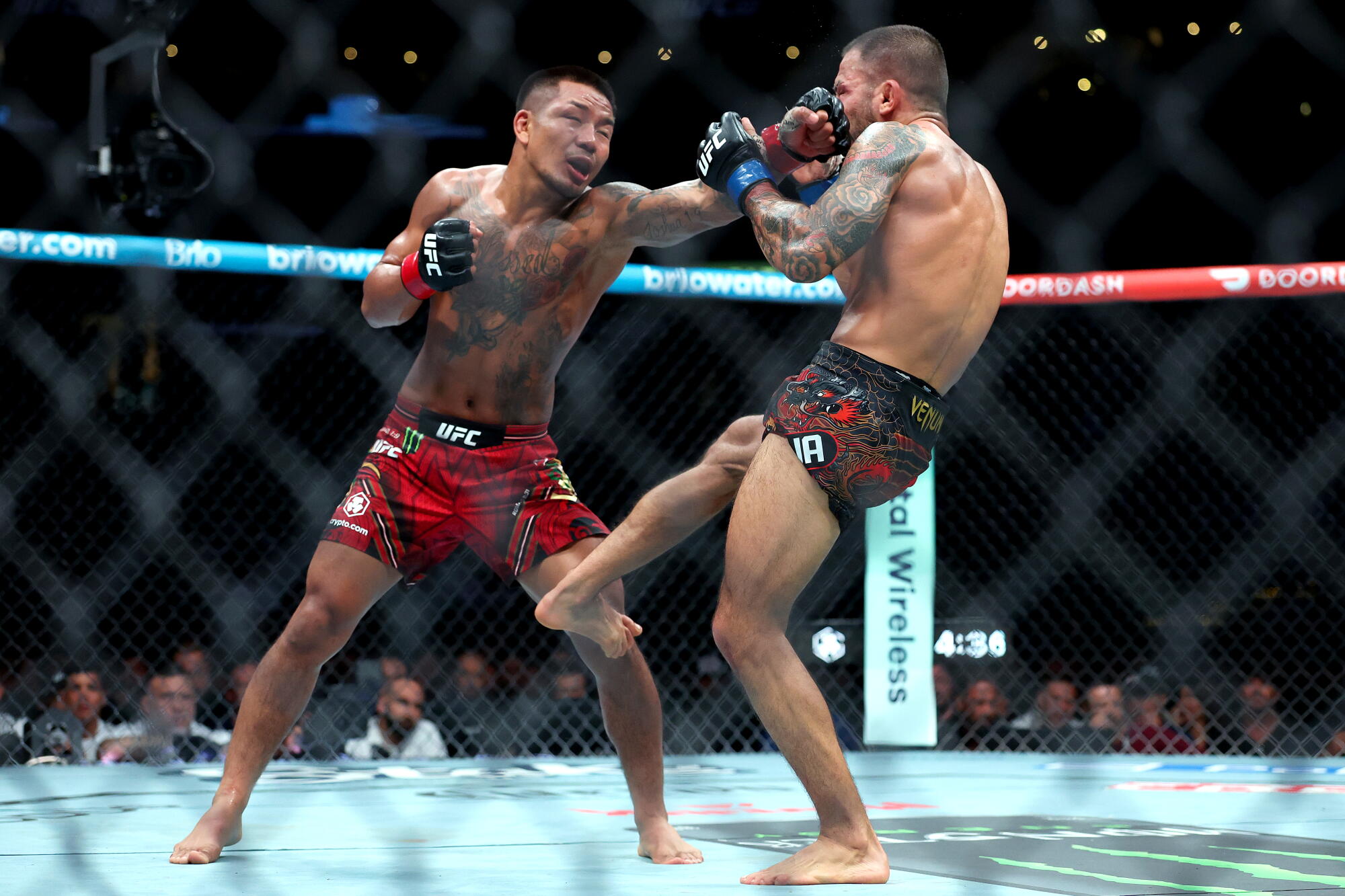
Joshua Van punches Alexandre Pantoja during their UFC 331 flyweight championship bout at Crypto.com Arena on Saturday.
(Luke Hales / Getty Images)
Both fighters had much to gain during their return to the Octagon.
The animosity that had built up was evident from the start. As the fight began, Pantoja went straight for Van. The Brazilian scored an early takedown and sought to keep the champion on the mat, attempting to turn the fight into a grappling and ground-and-pound battle.
Van resisted and managed to get back to his feet. The lack of action during some early stretches prompted the first boos from the crowd.
But the pace changed.
Van began to find openings with his hands and Pantoja had to absorb strikes while continuing to seek takedowns. The champion also showed better defense against the Brazilian’s advances as the rounds progressed.
In the second round, the fight had to be briefly stopped after Pantoja claimed a headbutt. The strike was reviewed and determined to have been accidental, so the fight continued.
“I don’t even know why he was getting worked up. He came at me throwing punches, and I was just trying to counter, and he simply hit me in the head,” Van said. “I guess … I have a tougher head. So then he started complaining and all that. He was saying, ‘You headbutted me, you’re cheating.’ And I told him, ‘You hit me!’ So… um … that was it.”
Van began to take greater control of the fight during the second and third rounds. His boxing allowed him to keep Pantoja at a distance and respond when the Brazilian tried to close in to take him down. Pantoja kept pressing, but he could no longer control the fight on the ground for extended periods.
The fourth round allowed the former champion to regain some of the control he’d lost. Pantoja managed to take Van down to the canvas again and worked from the top for much of the round, showing that he could still trouble the champion when he managed to impose his style.
Van, however, ended the fight on a high note.
“I knew I hurt him — you know, I knew I hurt him,” Van said. “He’s a mental giant, you know. He just didn’t want to go down. He doesn’t want to show that he’s hurt, but I know deep down he was hurt. But like I said, man, that’s why I respect him so much.”
In the fifth round, the champion landed a powerful right-hand punch that knocked Pantoja down. The Brazilian managed to recover and continue until the end, but the blow ultimately tipped the fight in Van’s favor.
Alexandre Pantoja tries to pin Joshua Van on the ground during their UFC 331 flyweight championship bout at Crypto.com Arena on Saturday.
(Luke Hales / Getty Images)
Ahead of the bout, Van defended his title in May against Tatsuro Taira, winning by technical knockout in the fifth round. Pantoja, on the other hand, hadn’t competed since his elbow injury against Van.
“There’s nothing to prove, man,” Van said. “Like I said, I knew I was going to win the first fight, too. So it’s like: ‘OK, do you guys want to see me win again?’”
Before the fight, tensions between the two had escalated. Van had insisted that his first victory wasn’t solely due to Pantoja’s injury, while the Brazilian argued that the December result didn’t show who was truly the better fighter.
The answer, this time, came after 25 minutes.
Tsarukyan knocks out Ruffy
Arman Tsarukyan celebrates after earning a knockout win over Mauricio Ruffy during his UFC 331 lightweight bout at Crypto.com Arena on Saturday.
(Luke Hales / Getty Images)
The co-main event of the night also ended sooner than expected.
Arman Tsarukyan and Mauricio Ruffy arrived at Crypto.com Arena with a five-round bout scheduled and key positions in the lightweight division on the line. Ruffy accepted the fight with just four weeks of preparation after Charles Oliveira was pulled from the card.
Ruffy came out ready to trade blows and showed speed in the opening minutes. Tsarukyan, as he had done for much of his career, sought to use his wrestling skills to change the pace of the fight.
Tsarukyan managed to drive Ruffy against the cage and began landing elbows. At the 4:56 mark of the first round, Tsarukyan landed two elbows that knocked Ruffy out and forced the referee to stop the fight.
“I came to Los Angeles to enjoy the city,” Tsarukyan said. “But I also came to win. I owe those elbows to one of my coaches who taught me how to use them.”
Joshua Van retained his flyweight title with a commanding win over Alexandre Pantoja in their rematch at UFC 331 in Los Angeles.
The 24-year-old from Myanmar beat Brazilian Pantoja in December 2025 after Pantoja suffered an accidental elbow dislocation 26 seconds into the fight.
Van, the first UFC champion born in the 2000s, defended the belt against Tatsuro Taira in May but can now claim to be the best in the division after soundly beating 36-year-old Pantoja again.
“A lot of people said that was an accidental win, well, doubt me now,” Van said after extending his professional MMA record to 18 wins and two losses.
Pantoja took Van down in the first round, before landing heavy punches and knees in a fiery exchange, as Van retaliated with a slicing elbow.
Van, who moved to the United States when he was 12, then peppered Pantoja with left-handed jabs in the second round, and rocked the Brazilian with a fluid combination of punches in the third.
Pantoja controlled the fourth round as he took Van down but was unable to submit him.
In the final round, Van stalked Pantoja and knocked him down with an overhand right, securing the win in the judges’ scorecards.
Scottish fighter Casey O’Neill also won on the night, beating Eduarda Moura with an armbar submission.
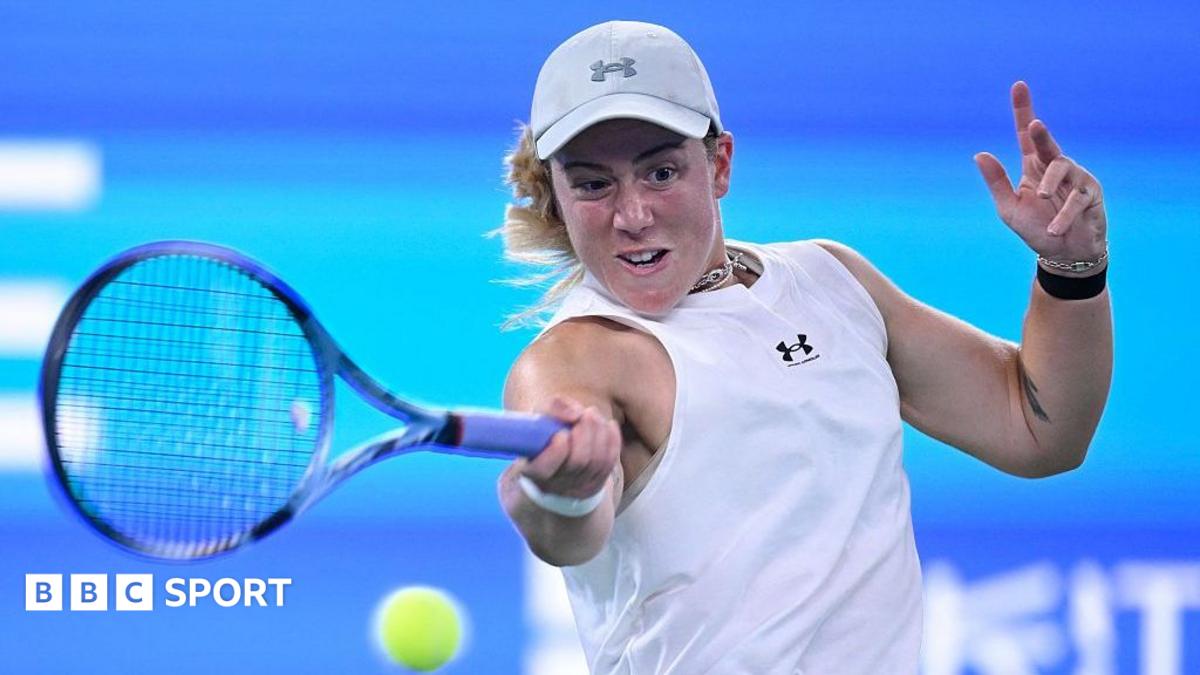
NEW YORK: Alexander Zverev won his second major championship and kept American men without a Grand Slam title since 2003, beating Ben Shelton 6-3, 7-6 (2), 5-7, 6-2 on Sunday in the US Open final.
Zverev finally broke through in the majors by winning this year’s French Open and followed up by finally adding the title in New York that he so painfully let slip away in 2020.
The No. 1 seed in a Grand Slam for the first time, he capitalized on Shelton’s shaky start in his first major final, played a nearly flawless tiebreaker on serve and then turned back Shelton’s comeback attempt in front of a crowd that desperately cheered him on.
Shelton was trying to win the first title by an American man since Andy Roddick won in Flushing Meadows in 2003, as well as the first by a Black man since Arthur Ashe in 1968.
But Zverev was too good in majors this year and apparently didn’t even know how good he was. He finished the match on his serve but didn’t seem to realize it, dropping back behind the baseline as if set to return. Only a few moments later did he figure out he had won, raising his arms in celebration.
Alexander Zverev used his greater experience to beat home hope Ben Shelton in the US Open final and quiet a partisan crowd hoping to laud a rare American men’s champion.
German top seed Zverev lifted a heavy burden by winning his first major title at this year’s French Open and has quickly added another with a 6-3 7-6 (7-2) 5-7 6-2 victory over Shelton in New York.
At the start of the season, there were question marks over whether 29-year-old Zverev would ever win one of the sport’s biggest prizes.
Now he is celebrating becoming a multiple Grand Slam singles champion, having seen the path to glory partially cleared by injuries to Jannik Sinner and Carlos Alcaraz.
Sinner and Alcaraz swept the board between them at the majors in 2024 and 2025 – and Zverev has taken full advantage against the rest of the field in their absences.
Big-hitting Shelton has long been identified as a player who can win the most prestigious titles, but ultimately came up short in his first Grand Slam final against a rejuvenated Zverev.
Eighth seed Shelton was aiming to become the first American man to win a major title since Andy Roddick in 2003, but losing serve in the first game of the match set the tone as Zverev controlled the opening two sets.
The momentum shifted in the third set, however, as Shelton finally started applying serious pressure on Zverev’s serve.
Taking his third break opportunity provided encouragement to the 24,000 home fans on Arthur Ashe Stadium, but Zverev quickly reasserted his authority early in the fourth to extinguish American dreams.
Zverev did not initially know he had secured victory when Shelton hit a return long on championship point, only breaking out into a broad and slightly surprised smile after his team pointed out the score to him.
By that point, Ohio State had just blown a 20-point, fourth-quarter lead to Texas, and Oregon had, hours earlier, been stunned by Oklahoma State. The path to the top of the Big Ten suddenly seemed open as ever, just as the Trojans’ tremendous freshman caught the punt and took off in search of an opening himself.
With his stunning start to the season, no one player at USC — and perhaps in all the nation — had manufactured more hope through two games. While the conference’s other top teams spent the day licking their wounds, here, once again, was Mosley weaving joyfully through the open field and conjuring the very same magic from thin air. He shook off one tackle, then another. Soon enough, he was gone for an 86-yard punt return, and the No. 14 Trojans were rolling, comfortably on their way to a 49-30 win over Louisiana.
The second half didn’t feel quite as hopeful, as the Trojans let up and let Louisiana linger around through a victory that coach Lincoln Riley deemed “up and down.”
Still, the win was USC’s 10th straight at home, going back to the 2024 season, and gives the Trojans’ a spotless nonconference slate in 2026 — not that anyone would confuse their early-season schedule for a murderer’s row. There won’t be any easy home wins from here, though, with USC’s next three games against Oregon, Washington and Ohio State.
“It’s been good getting adjusted to this,” Mosley said. “But now we go on the road, so that’ll be a new adjustment.”
USC has, in glimpses this season, looked like a team that belongs among those Big Ten behemoths. And the most encouraging of those moments have largely come from the Trojans’ talented freshman class.
Mosley, who also had an acrobatic receiving touchdown Saturday, wasn’t the only one who made his presence felt. Tight end Mark Bowman had his eagerly anticipated breakout game, as he exploded for six catches, one of which he capped by hurdling two defenders. He finished with 83 yards and two touchdowns, all in the first half. Defensive tackle Luke Wafle, meanwhile, continued his streak of early dominance by tallying a team-leading seven tackles.
USC tight end Mark Bowman hurdles over Louisiana safety Kody Jackson during the first half Saturday.
(Kevin Terrell / Getty Images)
“I feel like our peak, our trajectory should be even higher because of how many young guys are playing,” Riley said.
The win wasn’t nearly as dominant an effort for the rest of USC’s defense, which was coming off of a shutout of Fresno State. Louisiana averaged 7.6 yards per play and scored 20 points in the second half, led by dual threat quarterback Lunch Winfield, who scampered to 91 rushing yards.
“We’re just gonna take this as a learning moment,” defensive tackle Jide Abasiri said. “I just feel like sometimes we’ll get comfortable or complacent, then that’s something we need to, going forward, fix when adversity hits.”
It wasn’t the sharpest night for the Trojans’ offense, either. Though, you wouldn’t know it from the box score. While USC rushed for 214 yards, nearly 100 came in the fourth quarter, with the game well in hand. Quarterback Jayden Maiava put up numbers once again, as well, completing 19 of 29 passes for 261 yards and five touchdowns.
USC receiver Trent Mosley makes a touchdown catch under pressure from Louisiana safety Maurion Eleam Saturday at the Coliseum.
(Mark J. Terrill / Ap Photo/mark J. Terrill)
The five passing scores tied a career high. But Maiava said after the game that it “definitely didn’t feel like” that strong of a performance.
Through two games, Maiava had accounted for as many touchdowns (six) as he had incomplete passes entering Saturday’s game. But on Saturday, he missed his first three passes, the third of which went directly to a Louisiana defensive back.
The interception was Maiava’s first of the season, and it led to a Louisiana field goal, giving the Ragin’ Cajuns (1-1) an early lead. It was also the first time the Trojans trailed this season.
USC (3-0) and its quarterback settled down after that. The Trojans mounted a 12-play scoring drive on the ensuing possession, and Maiava found Bowman for a five-yard score. Then, they mounted a 10-play drive, and Maiava found Bowman again.
By that point, USC’s offense had piled up almost 200 yards, while Louisiana had scraped together just 18.
But the Ragin’ Cajuns refused to go away — for the moment, at least. They marched the length of the field and scored, cutting USC’s lead to 14-10.
That was the closest they’d get. The Trojans mounted a third straight drive of 10 plays or more, and this time, Maiava fired a touchdown pass through the hands of a Louisiana defensive back on its way to freshman Kayden Dixon-Wyatt.
The knockout blow came soon after that. After its follow-up drive went nowhere, Louisiana made the mistake of punting to Mosley, who took off sprinting to his right and didn’t stop until he reached paydirt.
The punt return was his fourth score of the season. He added a fifth before the final buzzer sounded.
The rest of the night wouldn’t go nearly as smoothly. The intensity, Riley said, “dipped a little bit.” Louisiana would linger, well into the fourth quarter.
But by then, the Trojans could safely coast their way to a clean non-conference sheet, knowing the trust test of their season – and their stellar true freshmen – is still to come.
Rybakina rarely shows emotion on the court but there was a brief flash of a smile as she clinched her second major victory of an outstanding 2026 season.
That illustrated the sense of satisfaction she felt after winning a title few had predicted – not only because she had never previously gone beyond the last 16 in New York but the circumstances coming into the final major of the season.
With her penetrating serve and thunderous groundstrokes, Rybakina has a brand of first-strike tennis that can take the racquet out of anyone’s hands.
Therefore it has been a surprise she has not enjoyed greater success on the Flushing Meadows hard courts, perhaps a result of her personality not being particularly suited to the brash nature of New York.
“I was coming here for the last 10 years and it was never successful. I’m falling in love with New York more and more,” Rybakina, 27, said.
What makes the second seed’s victory even more remarkable is that she was unsure if she would be fit enough to even play.
Rybakina was unable to walk for several days after injuring her ankle in the Cincinnati Open quarter-finals, putting her chances of competing here in serious jeopardy.
Not only was Rybakina able to play, but she cruised through her opening four matches thanks to a huge service game that rarely allowed opponents to get into points.
Rybakina’s next two wins over China’s Zheng Qinwen and home favourite Coco Gauff required more work after losing the first sets, proving she had the durability to come through tough battles.
Against Sabalenka, she showed both facets of her game, bullying her from the baseline and digging in when necessary to leave her only a French Open title away from the career Grand Slam.
“Some magic is happening. I was unlucky with injury and just going day by day,” Rybakina told Sky Sports.
“We didn’t know how it was going to be so I’m super happy and still can’t believe it.”
NEW YORK: Elena Rybakina won her first US Open title and punctuated her climb to the top of women’s tennis by beating Aryna Sabalenka 6-4, 5-7, 6-2 on Saturday.
Rybakina had already been guaranteed to replace Sabalenka at No. 1 in the rankings next week and for good measure took the US Open title that Sabalenka had won the previous two years.
“It’s tough to find words right now, honestly,” Rybakina said. “I don’t expect nothing like this coming to this tournament. I’ve been dealing with a little bit with an injury, but somehow everything aligned together on my side.”
It was the third Grand Slam title for Rybakina and the second this year — both against Sabalenka on hard courts. She opened the season by beating Sabalenka for the Australian Open title.
This time, she stopped Sabalenka’s 19-match winning streak at the US Open, where she hadn’t lost since falling to Coco Gauff in the 2023 final.
“I really felt like home here and cannot wait to come back next year,” Sabalenka said. “I wish I could perform a little bit better but I guess next year.”
Rybakina earned $5.5 million, the largest prize in Grand Slam history, and tied Sabalenka and French Open winner Mirra Andreeva with a tour-high three titles this season.
Aryna Sabalenka, of Belarus, left, and Elena Rybakina, of Kazakhstan, right, hold up their trophies after Rybakina won the women’s singles final of the US Open tennis championships Saturday, Sept. 12, 2026, in New York. (AP)
Sabalenka took home $2.8 million but it was clear how little that meant to her, as she smashed her racket after a brief hug with Rybakina at the net.
Sabalenka was trying to become the first person since Serena Williams from 2012-14 to win three in a row at Flushing Meadows.
Rybakina dethroned the champ without even having her best stuff. The WTA Tour leader in aces got less than half of her first serves in but instead put Sabalenka under constant pressure with a strong return game, racking up 12 break chances and converting three, which was all she needed.
The third meeting of No. 1 vs. No. 2 in a US Open women’s final since 2000 was the first to go the way of the challenger. Williams was the top seed for the other two, beating her sister Venus in 2002 and Victoria Azarenka in 2013.
The numbers didn’t signify much this time, because they are going to flip Monday. Sabalenka has held the top spot for 99 consecutive weeks, but Rybakina gained enough points to unseat her simply by reaching the semifinals.
She didn’t stop there.
The 27-year-old who was born in Russia but represents Kazakhstan won her first major title at Wimbledon in 2022 and now needs just the French Open to complete the career Grand Slam.
And it’s clear her power — and her ability to absorb her opponent’s — was something that unnerved Sabalenka.
A native of Belarus, Sabalenka sometimes swings from her heels, like a golfer trying to unleash a 300-yard drive, grunting “Aaaaahhhh!” as she takes her mighty cuts.
Rybakina’s power comes more easily. There is little sound coming from her side of the net besides the squeaking of her sneakers, and she rarely shows any hint of stress.
“I think Elena is probably — not nonchalant, I don’t want to say that, because she’s not nonchalant — but just no reaction ever,” Gauff said after losing to Rybakina in the semifinals.
Belarus’ Aryna Sabalenka reacts during her women’s singles final match against Kazakhstan’s Elena Rybakina. (Reuters)
Rybakina did show some frustration after pulling a backhand wide with a break point in the opening game of the third set, but soon she had taken charge of the match for good.
Sabalenka had won the two other meetings this season, on the hard courts at Indian Wells and Miami, and leads their rivalry 10-8.
But her season then took a strange dip after those victories. Sabalenka fell to Naomi Osaka in the fourth round at Wimbledon, then returned to action with consecutive fourth-round exits in Toronto and Cincinnati.
Rybakina had to take a brief break after she was forced to stop playing in her quarterfinal match against Iga Swiatek in Cincinnati because of a foot injury, but she was healthy in time for a tournament where she had never done particularly well, failing to advance past the fourth round until this year.
“I honestly was coming here for the last 10 years, and it was never successful — nothing close to that,” Rybakina said. “It’s just incredible. I’m falling in love with New York more and more.”
Arthur Ashe Stadium, meanwhile, had been Sabalenka’s house, with four straight trips to the final and six to at least the semis. Whatever troubled her during the summer seemed forgotten once she was back in New York — until Saturday.
Sabalenka repeatedly looked toward her coaches’ box with her palms up, wondering why everything was going so poorly, and showed much more frustration than that when she double-faulted to hand Rybakina a 3-2 lead in the first set. Rybakina hit the serve back and the ball bounced directly to Sabalenka, who whacked it into the crowd, earning a warning from the chair umpire.
Sabalenka eventually began putting consistent pressure on Rybakina in the second set. She picked up two break points with a chance to end the set with a 5-4 lead, and though Rybakina won four straight points to get out of that jam, Sabalenka got another chance in the next service game and this time capitalized, stepping into a return to set up a miss by Rybakina.
In the evening session, with a star-studded crowd watching on, it was over to Shelton and Tiafoe to provide the entertainment – and they did not disappoint.
The pair combined for 74 winners, with 47 coming from the racquet of Shelton, who also sent down 20 aces as he backed up a stunning quarter-final win over Carlos Alcaraz with another memorable showing.
He won 77% points behind his first serve, while successfully targeting the second serve of Tiafoe, winning 62% of points when he opponent failed to land a first serve.
Shelton signalled his intent with an ace hammered down the T to start the match as the pair went at each other from the outset.
While an early break-point chance passed Tiafoe by, the 11th seed continued to threaten the Shelton serve and, aided by a double fault, broke for 5-4 before serving out the set.
Shelton wasted no time in mounting his comeback in the second, though, as he lasered a forehand down the line to break to love for a 2-0 lead.
Although Tiafoe broke back immediately, Shelton remained in the ascendancy and the pressure told as he broke to lead 5-3 before seeing out the set.
The third set included a number of scintillating rallies, Tiafoe coming out on top after 31 shots back and forth to stave off a break point – only for his opponent to hit a winner at the end of a 28-shot rally to break a couple of games later.
Shelton broke again at the end of a gruelling 15-minute game to take a two-sets-to-one lead.
The chance to regroup and take a breather between sets resulted in a refreshed Tiafoe mounting an early attack in the fourth, but he failed to convert two break points in the opening game, Shelton got his chance at 6-5 and brought up three match points.
Shelton netted on the first of them, but that was the last shot he played as a Tiafoe double fault gave a thrilling contest a rather tame end.
Aryna Sabalenka beat Jessica Pegula 7-5, 6-2 to reach US Open final with Elena Rybakina, who toppled her as World No 1.
Published On 11 Sep 202611 Sep 2026
Aryna Sabalenka stormed past Jessica Pegula in straight sets on Thursday to keep her bid for a rare US Open threepeat on track, booking a championship showdown with Elena Rybakina.
Sabalenka was simply unstoppable in a 7-5, 6-2 victory on Arthur Ashe Stadium, where she beat Pegula en route to US Open victories in 2024 and 2025.
Recommended Stories
list of 4 itemsend of list
Rybakina battled back to beat 2023 champion Coco Gauff 3-6, 6-4, 6-4.
In Saturday’s final, the Kazakh will try to deal Sabalenka another blow after her run to the semifinals ensured she will end the Belarusian’s reign atop the world rankings.
Sabalenka, bidding to join Chris Evert and Serena Williams as the only women to win three straight US Open titles, pounded third-seeded Pegula remorselessly with her powerful groundstrokes.
“I was super desperate,” said Sabalenka, who has had a slow summer since back-to-back wins at Indian Wells and Miami in March.
“I wanted it badly to go to the finals, and of course, I want to go all the way.
“The mentality was just I’m ready. I’m ready for whatever it’s going to take to get the win,” Sabalenka added, after producing her best performance of the tournament to snuff out Pegula’s dream of a first-ever Grand Slam title.
Sabalenka’s frustration at her inability to make any headway against Pegula’s serve showed in a tense first set. But she maintained her focus and was rewarded as Pegula, feeling the pressure to stay in the set as she served down 6-5, fell behind 0-40.
The American saved one set point but could not salvage the next.
Sabalenka kept rolling in the second set, attacking Pegula’s suspect second serve and seizing a break for a 3-1 lead when she lasered a forehand into the corner.
She sealed the victory with another break courtesy of another thunderous forehand.
“I thought her level was insanely high,” Pegula said. “Honestly, I don’t really know if there was much I could do today.”
Rybakina, who beat Sabalenka in the Australian Open final in January to claim her second Grand Slam title, said she would need to raise her level to do the same in Flushing Meadows.
“I feel like I definitely need to step my game up, serve much better than today and stay aggressive,” Rybakina said.
Gauff’s bid to return to the final for the first time since she defeated Sabalenka for the 2023 title had got off to a smooth start, the American gaining the lone break of the opening set for a 4-2 lead and pocketing the set with a love game.
But Rybakina hit back with an early break on the way to a 4-1 lead in the second.
Gauff responded superbly, breaking back and holding to square the set at 4-4 to roars from the crowd.
But she was unable to make the most of her fightback and double-faulted in the 10th game to hand two set points to Rybakina, who pounced to force a third set.
Rybakina looked on the brink of victory after breaking Gauff for a 5-3 lead in the third. Gauff broke back, but Rybakina clinched it in the next game.
A deft volley from Rybakina left her with two match points, and Gauff then hit a wide-open smash long to hand her opponent victory.
“I feel like I was a little bit lucky on her serve,” Rybakina said. “A couple of deep returns, one mistake from her, it went quickly my way … It was a real battle.”
Gauff, meanwhile, was left reflecting on the fine margins of the defeat.
“It honestly came down to a couple of service games of mine in both sets and I didn’t quite hold,” Gauff said. “I think she was able to hold the line a bit better than I could tonight.”
The men’s semifinals are on Friday, when eighth-seeded Ben Shelton takes on 11th seed Frances Tiafoe in an all-American clash.
Shelton took out defending champion and seven-time Grand Slam winner Carlos Alcaraz in an epic quarterfinal that ended at 3:34am on Wednesday – the latest finish in tournament history.
“Big Ben” and “Big Foe” will duel for a chance to end American men’s 23-year Grand Slam title drought.
The winner will take on either top-seeded French Open champion Alexander Zverev or unseeded Russian Karen Khachanov.
World champion Wu Yize fell in the third round of the English Open as Liam Davies scored an eye-catching 4-1 victory in Brentwood.
Welsh prospect Davies, 20, opened up a 3-0 lead on his way to the first ranking event quarter-final of his career, helped by a break of 105 in the second frame, then completed his victory as China’s Wu struggled to find his dynamic best form.
Tantalisingly, Davies will face compatriot Mark Williams, the three-time world champion, in the last eight on Friday evening.
Williams, still a major force on the baize at the age of 51, had breaks of 76, 103 and 63 in a late-night 4-1 victory over England’s Barry Hawkins.
Mark Selby, who was runner-up at last week’s British Open and won the China Open in August, had his hopes of reaching another final ended by a 4-3 defeat against fellow former world champion Kyren Wilson.
Selby led 2-0 in the all-English tussle after an early break of 112 but then lost the next three frames. He dragged himself level, but Wilson trebled in the yellow to effectively make sure of victory in the decider.
England’s Judd Trump, newly deposed as world number one, edged a tense decider against Scot Anthony McGill to take a 4-3 victory.
Trump will face a quarter-final against Shaun Murphy who was taken the distance after midnight by Pang Junxu before racing through the deciding frame with a 103 break.
Ali Carter had a highest break of 75 as he completed a 4-2 win over Gong Chenzhi, Zhou Yuelong made a 141 in his 4-2 victory over Chinese compatriot Yuan Sijun, and Ding Junhui beat Joe O’Connor 4-1.
NEW YORK: Elena Rybakina is headed to the US Open semifinals and to the top of the women’s tennis rankings.
Rybakina edged Zheng Qinwen 3-6, 6-1, 6-4 on Wednesday, guaranteeing she will become No. 1 in the WTA rankings.
The Australian Open champion will face No. 4 Coco Gauff or No. 5 Mirra Andreeva on Thursday. Top-ranked Aryna Sabalenka faces No. 3 Jessica Pegula in the other semifinal.
But no matter what happens in the remaining matches, Rybakina will end Sabalenka’s 99-week stay at No. 1 when the new rankings are released Monday.
“It’s just a number right now and of course I’m in the semis so my goal is to win the tournament,” Rybakina said. “It’s an amazing achievement but you know how quick everything can change in tennis, ranking-wise, during the match, so I feel like I just need to focus on my game, try to recover and enjoy tomorrow.”
Elena Rybakina, of Kazakhstan, left, and Qinwen Zheng, of China, meet at the net after Rybakina won their match during the quarterfinal round of the U.S. Open tennis championships, Wednesday, Sept. 9, 2026, in New York. (AP)
Rybakina and Zheng were scheduled to start about eight hours after Ben Shelton finished off his victory over defending champion Carlos Alcaraz at 3:33 a.m., the latest finish in U.S. Open history.
Rybakina said she struggled with the sun and shadows in Arthur Ashe Stadium early on after starting later in the day in her previous matches.
Zheng capitalized on Rybakina’s early struggles to get her only break of the match against one of the best servers in women’s tennis and take a 5-3 lead in the first set.
But Zheng, who had been playing from behind so much in Flushing Meadows, couldn’t hold onto the lead and Rybakina rolled through the second set in 38 minutes.
Zheng, the 2024 Olympic gold medalist from China, had to come through the qualifying tournament just to make the main draw after elbow surgery dropped her down the rankings to her current place of No. 121. Once ranked No. 4, she is guaranteed to move back into the top 60.
Elena Rybakina, of Kazakhstan, celebrates winning a match against Qinwen Zheng, of China, during the quarterfinal round of the U.S. Open tennis championships, Wednesday, Sept. 9, 2026, in New York. (AP)
She made a dramatic run to the quarterfinals, erasing a 5-0 deficit in the third set against Madison Keys in the third round and then climbing out of another 5-0 hole in the first set in her fourth-round victory over No. 8-seed Iga Swiatek.
But a double-fault gave her opponent a 5-4 lead in the third set and Rybakina served it out to reach the U.S. Open semifinals for the first time.
“I think the wins that I had so far are great, but obviously today in the match I got a lot of chances in the third set, but I didn’t take it,” Zheng said. “That was a bit pity for me to lose this match, but obviously I could take positive things from U.S. Open this year.”
Rybakina came into the tournament needing only to reach the semifinals to ensure she would move past Sabalenka. Had the 27-year-old from Kazakhstan lost before the final four, Sabalenka, Pegula or Gauff could have been No. 1 next week by winning the tournament.
Top-seeded Alexander Zverev was to face Botic van de Zandschulp in one quarterfinal match Wednesday, with No. 28 Alexander Blockx playing Karen Khachenov in the other. The winners will meet Friday, the same day Shelton and No. 11 seed Frances Tiafoe will square off in an all-American semifinal match.
Unseeded Michelsen came into the match in fine form, having not dropped a set at the tournament prior to facing Tiafoe, and grasped the momentum in the first set.
After the pair traded breaks of serve early in the match, Michelsen got the deciding break at 6-5 in a set where he fired 15 winners to Tiafoe’s four.
Michelsen continued to have the upper hand, with his backhand proving decisive on key points and, after taking the second set, he went up a break early in the third.
It was not until Michelsen was serving for the match at 5-4 that nerves began to hit. He served two double faults and Tiafoe broke to level, won the set and took the opening three games of the fourth set.
After holding Michelsen off, Tiafoe took the match to a deciding set where the pair traded multiple breaks of serve – invigorating the spectators on Arthur Ashe Stadium.
A fan favourite, Tiafoe thrived off the energy of the New York crowd as he then got the better of the tie-break to seal his fourth five-set victory at a major in 2026.
“He’s a great guy for consoling me in that moment,” said Michelsen of their post-match embrace.
“I was trying to keep it together, and I didn’t do a good job of that. He was saying a lot of nice personal things.
“I’ve got a lot of time to grow physically and mentally. I’m going to be here again. I know it.”
Tiafoe is hoping to reach the final at Flushing Meadows for the first time, following defeats by Alcaraz in 2022 and Taylor Fritz in 2024.
The National Television Awards are back for 2026 and every year, the biggest TV talent takes on one another to win the top prizes in the coveted categories
20:15, 08 Sep 2026Updated 20:44, 08 Sep 2026
Clarkson’s Farm won Reality Docuseries (Image: Getty Images for The NTA’s)
The big award ceremony is back, with Joel Dommett hosting for a sixth year in a row. Every year, he rubs shoulders with national treasures, such as Ian McKellen, and ahead of the ceremony, he told The Mirror that “just to be part of that is really cool”.
“There was a moment where I was still on stage with Ian McKellen for seven minutes, watching the VTs,” he told us, “I was just panting, because I was running around before, but then I was watching the VTs with Ian, who was presenting an award next. We had a nice little chat and I loved that moment because he’s someone you would never meet in real life.”
The NTAs are also celebrating their first all-female drama performance shortlist – with Gavin And Stacey star Ruth Jones to compete with Ella Bruccoleri, Judy Parfitt, Sheridan Smith and Vicky McClure for the prize.
Rybakina, 27, dropped only four points in a near flawless performance on serve against four-time Grand Slam champion Osaka, who said after the match she was struggling with pain in her leg.
She faced the 28-year-old full of confidence, having not dropped a set in her opening three matches at the tournament, and took control of the contest in a dominant first set.
Reigning Australian Open champion Rybakina opened up a double break over Osaka, before sealing the set in just 21 minutes.
Osaka showed greater resistance early in the second set but, after failing to convert her only break point of the match, Rybakina soon seized control again.
She broke to go 4-3 up, before safely seeing out the rest of the match, with Osaka unable to contend with her opponent’s deep groundstrokes.
Rybakina sealed the match inside 66 minutes with her seventh ace of a match where she hit a total of 29 winners to Osaka’s nine.
Asked about the gap of almost six years since her last major win, at the 2021 Australian Open, Osaka said: “I thought about it, and if I win another Grand Slam, it’s not going to change my life.
“That’s kind of crazy that I can say that, because I remember the first Slam that I won, it was, like, a huge whirlwind.”
Alcaraz said after his third-round win that he was happy with the level of fitness he had shown in the early rounds following his lengthy absence, while he demonstrated against Paul that the quality of his shot-making is as good as ever.
One sensational cross-court forehand winner early in the second set, which landed in from an almost impossible angle, was measured at 103mph.
That came shortly after Alcaraz had broken Paul’s serve in the 10th game of a tight, high-quality opening set to take it 6-4.
Paul, who was attempting to reach the quarter-finals of his home Grand Slam for the first time, battled hard throughout but Alcaraz proved to be too strong.
Paul had two break points when Alcaraz served for the match at 5-4 in the third set, but the two-time US Open champion put together a run of four straight points to seal victory.
Former British number one Tim Henman told Sky Sports: “When you haven’t played tennis for four weeks, it seems a lot and you can be a bit rusty. This is four and a half months.
“If you would have given Alcaraz a blank piece of paper at the beginning of the tournament and asked how he’d want the first four matches to go, he would have scripted it exactly like that.
“He’s had a few slightly challenging moments but, in the important moments, he’s just come up with incredible tennis. That’s got to give him so much confidence moving forward.”
Later on Sunday, home hope Frances Tiafoe delighted American fans with a entertaining victory over 2021 champion Daniil Medvedev.
Tiafoe saved a set point in the third-set tie-break before wrapping up a 7-6 (7-1) 6-4 7-6 (8-6) win moments later to maintain his perfect record on Louis Armstrong Stadium.
The 11th seed has won all 10 of his matches on the US Open’s secondary show court, while it is just his second win in eight appearances against Russian Medvedev.
Tiafoe, a two-time semi-finalist in New York, will face fellow American Alex Michelsen in the last eight after the 22-year-old beat Argentina’s Tomas Martin Etcheverry 7-6 (8-6) 6-4 6-4 to reach his first Grand Slam quarter-final.
Carlos Alcaraz swept Wu Yibing aside to reach the US Open fourth round – and said he is getting better with every match as he continues his return from a long-term injury lay-off.
The Spaniard underlined why he remains a serious contender to defend his title in New York with a 6-3 6-4 6-1 victory over China’s Wu.
The 23-year-old’s opening-round match in Flushing Meadows was his first on a singles court for 139 days after injuring his wrist in April.
Alcaraz came through his opener in straight sets but had to battle back from a set down against Portugal’s Jaime Faria in the second round.
However, Alcaraz continued to build momentum on Friday, needing two hours and 20 minutes on court to beat Wu.
“To be honest, I’m better than I thought,” the seven-time major champion said.
“Physically I thought I was going to be bad after the first match, but I am recovering really well. I am doing great things off the court to be in a good state.
“Right now, I think my level is really good. I think I have caught the rhythm of the competition.
“Every time that I step on the court I give it all. I’m just trying to improve, be better every match and I think I’m getting there.”
American 20th seed Tommy Paul – who Alcaraz has beaten six times in a row – awaits in the fourth round.
Alcaraz’s path to an eighth major title has opened up over the past few days.
French Open champion and Wimbledon runner-up Alexander Zverev heads the men’s draw in the absence of injured world number one Jannik Sinner.
As the second seed, Alcaraz cannot meet Zverev until the final – and the German has been taken to five sets and kept on court until 2am in his two matches so far.
Novak Djokovic suffered a shock first-round exit to Argentine Mariano Navone, while Canadian third seed Felix Auger-Aliassime lost to Karen Khachanov in the second round.
As it stands, American eighth seed Ben Shelton is the only top-10 player that Alcaraz can meet before the semi-finals. He could then face seventh seed Daniil Medvedev in the last four.
Alcaraz has won all three of his meetings with Shelton and has a 6-3 winning head-to-head against Medvedev – although the inconsistent Russian beat him at Indian Wells in March.
Meanwhile, Zverev’s potential pre-final opponents include home hope Taylor Fritz and Italy’s French Open runner-up Flavio Cobolli.
Beau Greaves made darts history by becoming the first woman to win a match on the European Tour.
The 22-year-old, who was edged out 6-5 by Rob Cross on her European Tour debut in Hungary last week, beat Daryl Gurney 6-4 in the Czech Open.
Gurney beat Greaves in a deciding set in their first-round match at the PDC World Championship in December and he moved into a 3-1 lead in Prague.
However, Greaves reeled off three straight legs with 14, 13 and 11-dart finishes to go 4-3 in front and, even though Gurney levelled at 4-4, she went on to take victory and become the first female winner in the European Tour’s 15-year history.
“It feels amazing,” said Greaves, who will play world number two Luke Humphries in the second round on Saturday.
“It’s just so nice to win a game, I was so nervous at the start, I don’t know why. It took me so long to get settled, but luckily I did enough to win the game.
“It means loads to me, the crowd’s fantastic. It’s such a tight stage and you feel so much from the crowd. I’m really enjoying it and loving the experience.”
On facing Humphries, she added: “I’ve played Luke on the big stage before so I know what to expect, he’s world class so I’m going to have to play a lot better than I did tonight.
“What more do you want than on a Euro Tour to play one of the best players in the world? I’ll look forward to it and I’ll be ready.”
The Rams went into training camp with a roster jammed with stars and other notable players.
So for an undrafted player to make the team’s initial 53-man roster was among the most unlikely scenarios in the NFL.
And that was before future Hall of Fame defensive lineman Aaron Donald announced Sunday that he was ending a two-year retirement to rejoin a team favored to win the Super Bowl.
But outside linebacker Wesley Bailey, an undrafted free agent who played at Rutgers and Louisville, beat the odds. The 6-foot-5, 265-pound Bailey impressed during preseason games against the Kansas City Chiefs and New Orleans Saints before playing only a few snaps against the Chargers, an indication that coach Sean McVay was going to keep him.
The Rams waived or terminated the contracts of 34 players, including defensive lineman Tim Keenan III, a seventh-round draft pick. If they clear waivers, many are expected to be signed to the 16-player practice squad.
The Rams moved to get something for at least one player they feared would not clear waivers, trading tight end Mark Redman to the Green Bay Packers for a 2028 seventh-round draft pick.
They also placed offensive linemen Justin Dedich and Keagen Trost on injured reserve, along with quarterback Matthew Caldwell.
The Rams, led by quarterback Matthew Stafford, the reigning NFL most valuable player, open the season on Sept. 10 against the San Francisco 49ers in Melbourne, Australia.
Star receiver Puka Nacua and starting left tackle Alaric Jackson are the subjects of continuing investigations by the NFL related to separate off-the-field incidents. If the league determines that they violated the league’s personal-conduct policy, they could be suspended.
Barring change, the Rams will travel to Australia with a roster top-heavy with tight ends, receivers and outside linebackers and — because of players’ versatility — minimal numbers at cornerback.
McVay’s incorporation of three tight-end sets into the offense last season paved the way for the Rams to carry five tight ends: Tyler Higbee, Colby Parkinson, Davis Allen, Terrance Ferguson and rookie Max Klare. Ferguson’s skill set ostensibly makes him an option as a third receiver behind stars Puka Nacua and Davante Adams.
The Rams’ trade last week for veteran Tutu Atwell, in a deal that sent running back Jarquez Hunter to the Miami Dolphins, gives them seven receivers.
Bailey is part of an outside linebacker group that includes Myles Garrett, Byron Young, Josaiah Stewart and Desjuan Johnson.
Trent McDuffie, Jaylen Watson, Emmanuel Forbes Jr. and Josh Wallace are the cornerbacks. The Rams kept only four in part because safety Quentin Lake plays as a hybrid slot corner/inside linebacker, and Wallace can play safety.
Dedich and Trost must sit out four games. The nine offensive linemen on the roster are starting center Coleman Shelton, guards Kevin Dotson and Steve Avila and tackles Jackson and Warren McClendon Jr., along with reserves David Quessenberry, Beaux Limmer, Bill Murray and Dylan McMahon.