
bath

The Prem: Harlequins 17-33 Bath: Carreras magic lights up opening night win Bath

The Prem

Harlequins (10) 17

Tries: Porter, Cunningham-South, Delgado Cons: Slevin

Bath (28) 33

Tries: Du Preez, Cokanasiga, Carreras, Frost, Richards Cons: Russell 4

A terrific try from full-back Santiago Carreras was the highlight of Bath’s opening night 33-17 bonus-point victory over Harlequins.

The Argentina international intercepted a Tyrone Green pass with his boot, kicking the ball into the air before collecting it one-handed before it went out of play and smoothly accelerating away to score under the posts in a real moment of magic.

Dan du Preez, Joe Cokanasiga and Dan Frost added first-half tries for Bath who led 28-10 at the break, with Will Porter and Chandler Cunningham-South replying for Quins.

Pedro Delgado reduced the gap to 11 points early in the second half but Ewan Richards’ late try ensured it would be Bath who started the new season with a win.

More to follow.

Harlequins: Green; Anderson, Beard, Bradley, Murley (c); Slevin, Porter; Hobson, Walker, Delgado, Dun, Browne, Kenningham, Evans, Cunningham-South.

Replacements: Riley, Wenger, Johnson-Holmes, Treadwell, Petti, Friday, Bellamy, Isgro.

Sin-bin: Riley (53)

Bath: Carreras; Cokanasiga, Lawrence, Ojomoh, De Glanville; Russell, Carr-Smith; Obano, Frost, Stuart, Hill, Ewels (c), Bayliss, Underhill, Du Preez.

Replacements: Tuipulotu, Kirk, Griffin, Richards, Pepper, Van der Linde, Redpath, Reid.

Referee: Karl Dickson

Source link

Charming destination with medieval streets has UK’s best restaurants – not Bath or Edinburgh

The city has been highlighted by Tripadvisor Travelers’ Choice Awards: Best of the Best Restaurants for 2026, which is based on first-hand reviews from millions of travellers over the last year

A charming UK city with medieval streets and a towering minster is also home to the country’s best restaurants.

While the silver-spoon-holding residents of foodie capitals London, Manchester, and Edinburgh may consider themselves to live in the UK’s culinary epicentre, they’re wrong.

The newly released Tripadvisor Travelers’ Choice Awards: Best of the Best Restaurants for 2026, which is based on first-hand reviews from millions of travellers over the last year, shows there is one UK city with a far higher concentration of great eateries than anywhere else, despite having a population almost 50 times smaller than London.

The standout is York in North Yorkshire.

The city of 200,000 had the highest-ranked restaurants of anywhere in the UK, with Brazilian joint Casa Brazilian Rodizio ranking eighth worldwide. The family-run, authentic Brazilian rodizio-style restaurant aims to “provide an unforgettable authentic taste, service and experience for an unbeatable set price!” By all accounts, it has succeeded.

“Went out for a family meal yesterday, the food was absolutely amazing, the place was astonishing. The meat tasted rich, and the buffet had so many amazing options,” wrote one of Casa Brazilian Rodizio’s reviewers among the thousands awarding it 4.9/5 stars.

Other York restaurants performed really well in the UK rankings, with Buongiorno, Enoteca By L’uva and Damastique making the top 25 in the ‘best casual dining’ list. Legacy At The Grand also found itself at number seven in a rundown of the UK’s best date-night restaurants, and Melton’s reached the same spot on the ‘best fine dining’ rundown. And finally, the family-run Turkish outfit Kapadokya 50 was named one of the UK’s best hidden gems.

York’s rise to become the country’s premier gastronomy spot is an interesting one. The medieval city has always tempted in history buffs with its minster, Jorvik Centre and Quilt Museum, and it’s long boasted of having more pubs than days of the year to drink in them, a fact that seemed suspect when I lived there a decade ago and is almost certainly not true now. But the foodie revolution that’s taken place there is a more recent and quiet phenomenon.

A new crop of young chefs has been putting the city’s food in the spotlight, in backstreets from Micklegate to The Shambles. Among the gang is Tommy Banks, one of the youngest chefs in the UK to win a Michelin star, who leads Roots York in the city centre. His cooking relies heavily on homegrown produce, farm-to-table tasting menus, and unique preservation techniques.

Another is Ahmed Abdalla, head chef at Legacy inside The Grand hotel, who creates modern British tasting menus with classic Yorkshire ingredients. And Joshua and Victoria Overington run Restaurant Mýse, a place that specialises in local Anglo-Saxon culinary heritage.

The Michelin Guide lists 16 restaurants in York and its surroundings, three with stars and a Michelin Green Star, including Roots and Mýse.

Eduardo Caetano, owner of Casa Brazilian Rodizio, opened the restaurant 11 years ago. “The philosophy of the restaurant is casa, which means home. When you come in, you come into our home. You are my guest. If the food is not good enough for me, it’s not good enough for me,” he told the Mirror.

“The offering in York is an extremely competitive market, there are loads of places to eat. I love that there are so many family businesses here. For me, York is the only place in the world that feels like home.”

In terms of places in York he loves to eat, Eduardo recommended Delrio’s Italian Restaurant. “I love going there,” he added.

It’s not just in high-end restaurants that York is excelling; its casual dining scene is also strong. Recent additions doing well locally include authentic Neapolitan pizzeria Cresci Pizzeria, which has become a citywide favourite, while the gut-busting sandwiches of Browns in Heslington remain a cheap, filling option.

This all sits against a backdrop of the Shambles Market, York’s main daily open-air market, located at Silver Street in the heart of the city. Come early November, it is joined by the Christmas Market, with Alpine chalets filling up Parliament Street and St Sampson’s Square. Whether you find festive fare charming or a logistical impediment, stallholders not only bring a real buzz to the city, but plenty of gastro-delights.

You can get loaded on artisanal hot cocoa, locally made gin, scratchings, high-end crumble and much more.

Similarly, the long-term culinary heritage of York is evident in its fantastic pubs, many of which also serve up delicious food. The House of Trembling Madness is a wonderfully wonky pub that pairs cheese boards and yards of ale, while Valhalla York on Patrick Pool is a Viking-themed ale house serving hearty meat and cheese boards alongside local mead and ales.

The success of York as a food city is no accident. The city has actively invested in growing this reputation through events such as York Restaurant Week, now one of the UK’s biggest events of its kind since its 2019 launch, with the most recent edition doubling to two weeks and featuring over 100 participating venues. The previous October’s event saw over 22,000 vouchers downloaded, bringing in nearly £400,000 for local businesses, a 70% jump from the year before.
Source link

Taxidermy sound bath? It just works at the Natural History Museum

I lay on my back and stared at a bright blue painted sky, dappled with puffy clouds. As my mind drifted, the sound of a breeze, created by handheld fans, filled the room. Then came a symphony of chimes, crystal bowls, wave drums and rain sticks. To my right, a black bear cub eyed me curiously.

Soon a thunderous crescendo of gongs arose. I looked to my left, where two endangered polar bears stood on a sheet of ice, ocean looming behind them.

The noises softened and went still. With a resounding clap from participants around the room, I came back to reality.

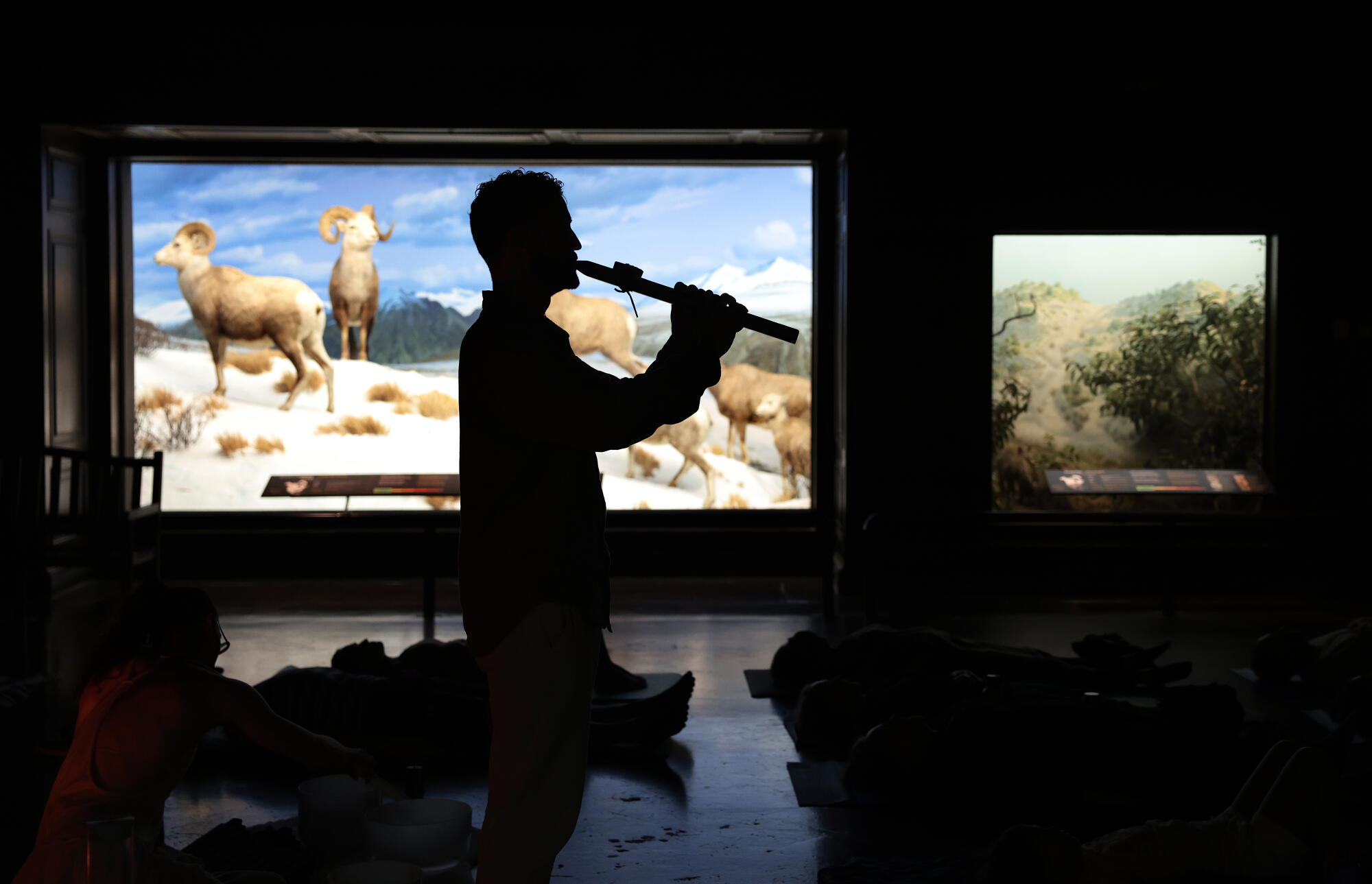
I wasn’t in a forest, nor the Arctic. And no, I had not recently taken any psychedelic substances. I was at a sound bath in the North American Mammal Hall at L.A.’s Natural History Museum, surrounded by dioramas of taxidermy, meditative instruments and sound healers from the Oso Sound Healing Studio.

Avery Whitmore leads participants in a sound bath.

Avery Whitmore leads participants in a sound bath.

Hosted earlier this month, the sound bath was the first of two events in the museum’s new Mindfulness Mornings at the Museum series, where guests can experience a meditative practice in the iconic gallery before opening hours. A nearly sold-out yoga session led by SoulPlay Yoga will take place on Sept. 13, and museum organizers hope to host more events after that, said Joel Quizon, the manager of public programs.

The Natural History Museum always looks for ways to “activate the museum space,” Quizon said. Ahead of the sound bath, Oso Sound Healing Studio founder Avery Whitmore said the unconventional space would invite a childlike energy, a deeper connection to animals and introspection.

“Just seeing these older animals, it takes you into another place,” Whitmore said. “It could invite you into a deeper meditation about where we are, where we come from. In that mind state, you might be a little bit more receptive to exploring the same questions about yourself.”

The museum introduced Mindfulness Mornings following the success of its past wellness events — including sound baths that were part of its First Fridays after-hours series. With those events, the lines went “down to the basement,” Quizon said.

People laying down on the floor during a sound bath.

The Natural History Museum is an apt venue for mindfulness events as people already see it as an “oasis [in] the city,” said Joel Quizon, the museum’s manager of public programs.

Two women lay on yoga mats

Participants Kenny Mayo of Culver City, left, and Verseilla McCloskey of Long Beach are immersed in sound.

Whitmore, who previously collaborated with the museum during First Fridays in 2025, founded Oso Sound Healing Studio in 2023. He played piano and percussion as a child and later guitar as an adult, but “put all of that away for many years,” he said.

About a decade ago, personal struggle led him to seek out spiritual practices, and that healing guided him toward being of service to others. That led him to attend massage school — not to start a career as a massage therapist, he said, but to learn how to give back to others.

The experience inspired him to learn other healing modalities, including breath work and sound meditation: the latter of which reignited his musical appreciation. “ It helped to revisit that, or reawaken it from another perspective,” Whitmore said.

When I attended the sound bath, about 100 people filled the hall and Whitmore opened the meditation by asking how many new sound bathers were here. More than half of the attendees, including me, raised their hands.

During the practice, participants can peek and see the varied habitats of North America beside them.

During the practice, participants can peek and see the varied habitats of North America beside them.

Avery Whitmore created a sound bath experience inspired by the unique museum space.

Avery Whitmore created a sound bath experience inspired by the unique museum space.

With the overhead lights dimmed and soft light spilling from the dioramas, the displays looked like windows to other worlds. I took a mat next to the American black bears and American badgers, only slightly jealous that the mats next to the large-scale walrus diorama were taken.

The meditation lasted about an hour. In addition to the variety of instruments evoking the sounds of nature, it incorporated breathwork, vocal exercises and a small amount of physical sensation: a refreshing spritz of rose water. Sets of instruments were stationed along every wall of the room, fully encompassing us in sound. Peeking at the animals around me, I couldn’t help but think of them as characters whenever new instruments joined the symphony.

“Definitely the coolest sound healing experience I’ve been to,” said Kenny Mayo, 35, after the sound bath.

“The different stations felt like an orchestra. It was put together in such a beautiful, methodical way, and all of the instruments were harmonizing perfectly.  It felt like no matter where you were, there was something close to you,” Mayo said.

Toward the end of the meditation, Whitmore asked participants to envision an animal and invited them to receive its message. Mayo said she thought of a hawk, and found meaning in connecting with the spirits of animals that “don’t exist anymore.”

“It’s a magical thing, to be able to see the history of all the animals, our ancestors,” she said. “We can still connect to the essence.”

I looked at the taxidermy black bear cub, standing energetically on its hind legs, and imagined the future ahead of it; then across the room to the adult polar bears, traversing an icy surface that, beyond the diorama, continues to melt away.

As part of the meditation, participants were invited to think about where they were, and where they've come from.

As part of the meditation, participants were invited to think about where they were, and where they’ve come from.

Source link