Bass and Raman skirmish over treatment of small business. The Valley is a battleground
The landmark Casa Vega Mexican restaurant in Sherman Oaks was honored in May with a sign proclaiming its corner of Ventura Boulevard as “Casa Vega Square.”
Mayor Karen Bass was there, and so was City Councilmember Monica Rodriguez, whose district is on the other side of the San Fernando Valley. The event was perhaps more notable for who wasn’t there: Nithya Raman, the mayoral candidate whose City Council district includes Casa Vega.
To Raman’s critics, the episode represents what they say is one of her biggest flaws as an elected official: not tending to the parochial needs of her district. Bass has sounded that theme repeatedly during the mayoral election campaign, including calling Raman “contemptuous of her constituents” during their televised debate on NBC4 and Telemundo 52 Oct. 13.
Raman called that “a lie.” Some of Raman’s constituents beg to differ, saying her office has seemed unwilling to help with a broad array of city services, including fixing broken sidewalks and removing homeless encampments.
“She’s just been MIA,” said Jessica Lewis, who owns Dragonfly Cycle and Train, a fitness studio in Sherman Oaks. “I would send photos of what I was experiencing, like human feces at my front door, encampments at the back door … all those emails just fell on deaf ears.”
Raman spokesperson Stella Stahl disputed that contention, saying the council office has “a proactive constituent service team.”
“Our approach is to listen to those who live and work in a neighborhood, then use every tool the city has to fix what they’ve told us is broken,” Stahl said.

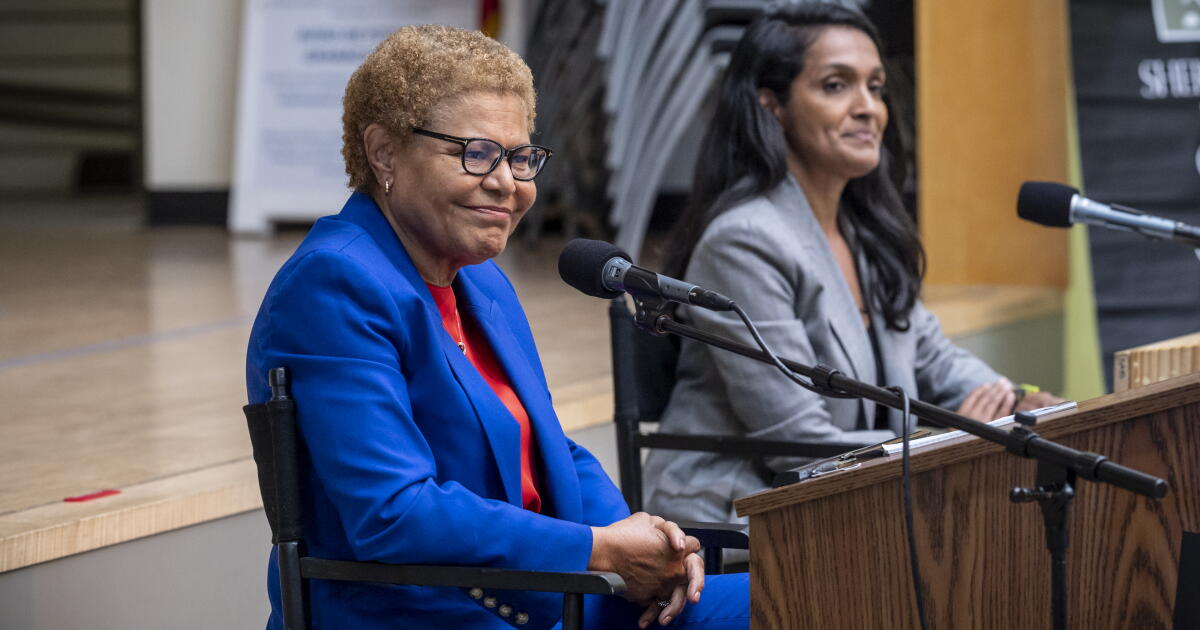
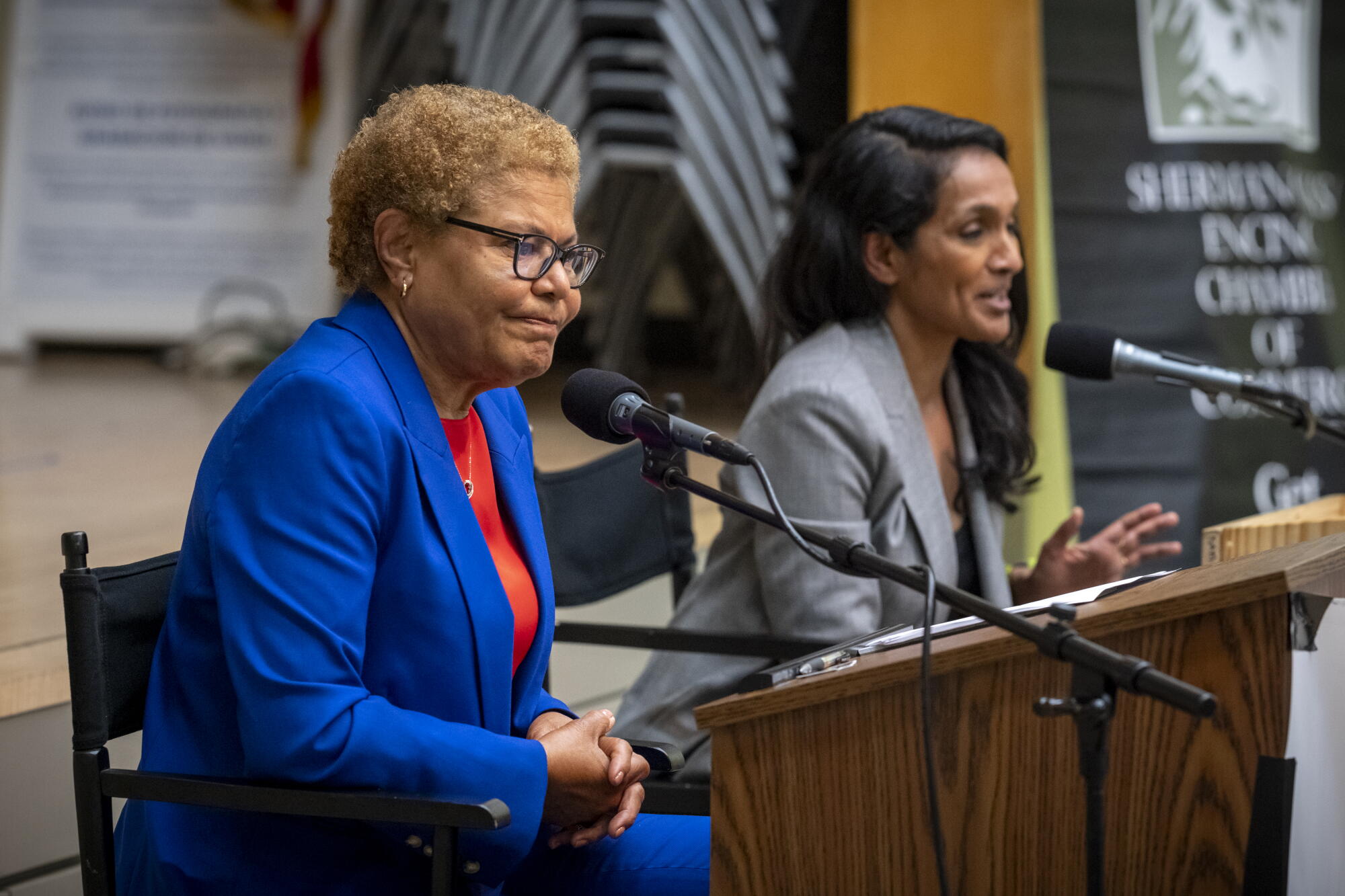
L.A. Mayor Karen Bass, left, and challenger Nithya Raman during their debate before the Sherman Oaks Homeowners Assn.
(David Butow / For The Times)
Raman co-presented the motion to designate Vega Square, along with Councilmember Rodriguez, according to documents filed in March. Raman was unable to attend the ceremony because of scheduling conflicts, Stahl said, but other Raman staffers were present.
Councilmember Rodriguez said her staff spearheaded the designation, part of her broader work to “enshrining the many positive contributions that Latino families have made throughout our city.”
To be sure, Raman has constituents who are big fans. Marissa Rodriguez said she wasn’t aware of the web of licenses and city permits she would have to obtain before she could open her wine shop in Studio City, Dia Natural Wine. The process felt monumental, she said, and nearly impossible to complete on her own.
She reached out to Raman’s team, and said the council office’s help was integral to Dia Natural Wine making its debut in 2022.
“I thought I could do this myself, and at a certain point, I hit a ton of roadblocks at the city,” Marissa Rodriguez said. “They were extremely helpful in just sort of helping me navigate who I needed to talk to.”
Tyler Simmons, who owns a coffee wine bar, Reunion & Co., on Hyperion Avenue in the Franklin Hills neighborhood of Los Feliz, said Raman and her team have always been receptive to his community’s needs.
In response to complaints of speeding, he said, Raman’s office helped get four speed tables — a flatter, wider version of speed bumps — installed in the intersection near his business last year.
“She’s done her best,” Simmons said. “I think there’s larger systemic issues at play within the city … it’s bigger than a councilperson, unfortunately. I’m hoping, if she wins, she’ll help change all that.”

Sidewalks in disrepair along the 1300 block of Ventura Blvd on Friday, Oct. 16, 2026, in Sherman Oaks, California. Christy Vega, owner of Casa Vega, claims that Nithya Raman, Councilmember, Fourth District, has been unhelpful and ignored her requests to get certain city services, including street sidewalk repairs and addressing homelessness in her parking lot. (Gary Coronado/For The Times)

A street in disrepair along the 1300 block of Ventura Blvd on Friday, Oct. 16, 2026, in Sherman Oaks, California. Christy Vega, owner of Casa Vega, claims that Nithya Raman, Councilmember, Fourth District, has been unhelpful and ignored her requests to get certain city services, including street sidewalk repairs and addressing homelessness in her parking lot. (Gary Coronado/For The Times)
On the other hand, Casa Vega owner Christy Vega rattles off a long list of complaints when discussing Raman and her office. She said she’s spent years seeking help from Raman’s staff, including to make repairs on sidewalks and pavement outside the restaurant, and to remove a homeless encampment that sprang up during the COVID-19 pandemic.
“With Raman’s office, they viewed me as a nuisance rather than someone who’s trying to keep her employees safe,” Vega said.
Vega is supporting Bass in the Nov. 3 election, and she sits on on the board of Thrive LA, an advocacy group backed by business and community leaders that is running ads against Raman in the mayoral race and also ran anti-Raman ads during her 2024 City Council reelection campaign.
Vega says she’s not supporting Raman because of her experience seeking help from Raman’s council office for problems her business encountered, including cars being broken into in the restaurant’s parking lot and muggings on the street out front. One employee was stabbed at a nearby bus stop, and another fell because of the potholes in the alley behind her restaurant, she said.
At one point, Vega said, she called Raman’s office to ask for help in fixing the curb near her restaurant that was damaged during a street racing incident.
Vega said she was told by Raman’s office that she would need to fix the curb herself, meaning she’d have to pull permits, hire a contractor and pay out of pocket for the repairs Vega said she pushed back, and a staff member suggested she move to another district.
Raman’s office didn’t comment on that assertion, but Stahl said that the Bureau of Street Services isn’t funded to repair damaged sidewalks, and the responsibility falls to the adjacent property owners.
“Every constituent who contacts our office deserves a response, and we take Ms. Vega’s concerns seriously. People often reach out to us on their hardest days,” Stahl said. “Unfortunately, we weren’t able to accommodate it at that time. Telling constituents no to basic service requests is frustrating for residents and for us, and it’s part of why the council member ran for office.”
Councilmember Rodriguez, who represents the northeast San Fernando Valley, said she’s stepped in to help business owners in Raman’s district over the years. Most recently, she helped Vega with permitting issues on the restaurant’s outdoor patio.

A sign for L.A. Councilmember Nithya Raman’s district office on Ventura Boulevard in the San Fernando Valley.
(Gary Coronado / For The Times)
“I’ve heard some of the same frustrations and stories from many people. … It reflects a pattern,” said Rodriguez, who is backing Bass for mayor. “If this is your audition [for mayor] based on your performance in your own district, I think it’s an example of the responsiveness of what people can expect.”
Sophia Brodetsky, who owns the Valley Inn restaurant with her husband in Sherman Oaks, isn’t happy with either mayoral candidate, but said Bass’ office has been more receptive to her needs.
Brodetsky has endured robberies, property damage and homeless encampments that have disrupted her restaurant that dates back to 1947, she said.
“They’re running for office right now. They promise you an arm and a leg, but they don’t deliver,” Brodetsky said.
According to Vega and Lewis, owner of the Dragonfly gym, a number of Sherman Oaks business owners reached out to Bass after she was elected mayor in 2022 to voice their concerns about Raman’s stewardship of the district.
The mayor met with a group of business owners in the area in 2023 and she convened weekly safety meetings between business owners, district leaders and local law enforcement to address their concerns, Vega said.
Vega said it was Bass and Rodriguez who helped her navigate the permit process when she sought to open an outdoor patio for her restaurant last year.
“I wasn’t a supporter of hers. I wasn’t someone that she owed any favors to,” Vega said of Bass. “She answered the phone immediately, and she heard the panic of my voice and my tears, and she said, ‘I’m on it.’”
Lewis, however, said she and others felt betrayed by Bass when she endorsed Raman for reelection in 2024.
“That just felt like a huge slap in the face,” Lewis said.
Lewis said she plans to vote for Bass, but reluctantly. Keeping her business afloat has felt nearly impossible at times, she said, but getting help from both the council and the mayor’s office has been an even tougher hurdle.
“The council office would blame the mayor’s office. The mayor’s office would blame the county,” Lewis said. “It was like everyone was just pointing fingers at someone else, and no one was actually doing anything about it.”