barrel

Brent crude oil falls below $80 per barrel; WTI continues to decline

1 of 2 | Crude carrier Universal Winner, a South Korean oil tanker operated by Korean shipping company HMM, reaches waters off the southeastern port city of Ulsan, South Korea, on June 10, about three weeks after exiting the Strait of Hormuz where it had been stranded amid tensions in the Middle East. Photo by Yonhap/EPA

June 16 (UPI) — Oil prices have fallen to their lowest levels since the start of the Iran war with Brent crude oil declining to less than $80 per barrel on Tuesday.

Brent crude oil, the international benchmark, traded for $79.96 on Tuesday morning. It is the first time since the war started that it has traded below $80 per barrel. It has since inched above the $80 mark to about $80.19.

The price of West Texas Intermediate, the U.S. benchmark, has dipped by about 3.8% on Tuesday to $77.71 per barrel.

Tuesday marks the second consecutive day of descending oil prices spurred along by Sunday’s announcement that the United States and Iran have come to terms on a peace agreement. Prior to the announcement, oil prices had risen by about 14% since the start of the war.

Iran closed the Strait of Hormuz after the United States and Israel launched attacks on Feb. 28. The United States later instituted a naval blockade on the strait, stopping any vessels using Iranian ports.

The terms of the peace deal have not been made public. The United States and Iran have electronically signed a preliminary agreement and are expected to officially sign off on the peace deal on Friday.

While oil prices have fallen significantly, gas prices have moved more slowly, dropping by three cents on Tuesday. The national average for a gallon of regular-grade gas is $4.04, AAA reports. Gas prices remain elevated by about 36% since the start of the war.

President Donald Trump said Sunday that the traffic on the Strait of Hormuz would resume immediately. However, it may still take weeks for operators on the strait to actually allow tankers to pass through.

About 20% of the Middle East oil trade uses the Strait of Hormuz.

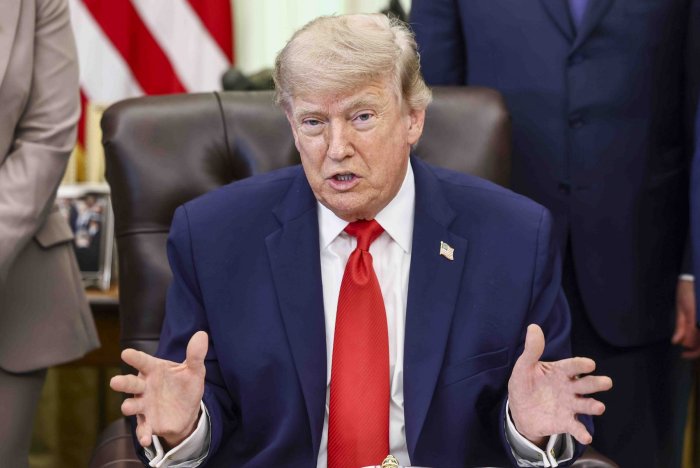
President Donald Trump speaks to reporters about restoring commercial fishing access to areas of the Pacific during a signing ceremony in the Oval Office of the White House on Thursday. Photo by Jim Lo Scalzo/UPI | License Photo

Source link

Oil drops to $80 a barrel and markets rise as Trump touts peace agreement with Iran

Published on

Crude prices retreated on Monday as US President Donald Trump confirmed a peace agreement with Iran and both sides announced a lifting of their respective blockades of the Strait of Hormuz.


ADVERTISEMENT


ADVERTISEMENT

At the time of writing, the front month contract on US West Texas Intermediate (WTI) crude was down almost 6% from Friday’s close to roughly $80 per barrel, while Brent crude, the international standard, dropped around 5% to about $83 per barrel.

The specific concessions made by each side are still unclear and there are questions surrounding whether the Prime Minister of Israel will respect the withdrawal of troops from southern Lebanon, which, according to the Prime Minister of Pakistan is included in the deal.

Benjamin Netanyahu has yet to publicly address the US-Iran deal, or the issue of Lebanon, and CNN has reported that the Prime Minister of Israel is seeking an urgent meeting with US President Donald Trump after this week’s G7 summit.

Nonetheless, markets are reacting swiftly to the prospect of the Strait of Hormuz slowly reopening and the potential that the Iran war is closer to ending than reigniting.

The freshly announced peace deal is currently expected to be signed on Friday.

European, Asian and US markets

At the open, European markets also rose on the news that there is meaningful progress in ending the Iran war.

Both the Euro Stoxx 50 and the broader pan-European Stoxx 600 traded over 1% higher at the start of Monday’s session.

The UK’s FTSE 100, Germany’s DAX 30, Italy’s FTSE MIB, Spain’s IBEX 35, the Netherlands’ AEX and Switzerland’s CH20, all traded between 0.5% and 1% higher than their Friday close.

France’s CAC 40 led the pack and rose almost 1.5%.

In the US, S&P500 futures traded over 2% higher and the teach-heavy Nasdaq 100 rose more than 3%.

In other trade dealings on Monday, Asia-Pacific markets jumped overnight with South Korea’s Kospi climbing over 5%, recovering from a 4% drop on Friday, while Japan’s Nikkei 225 also traded roughly 3% higher.

Australia’s S&P/ASX 200 rose 0.8%, while Hong Kong’s Hang Seng Index jumped about 0.5% and Shangai’s SSE climbed over 1.5%.

Source link

Iran conflict: Why has oil stayed near $100 a barrel? | US-Israel war on Iran

The worst-case oil scenario has been avoided, but inflation and slower growth continue to weigh on the global economy.

More than 100 days into the Iran conflict, 20 percent of the world’s energy flows remain disrupted, with the scenario described as the biggest supply shock in history.

For now, the nightmare scenario has been avoided. Oil prices are still at approximately $100 a barrel.

Many analysts have warned that a prolonged disruption to the Strait of Hormuz could send oil above $200 a barrel, triggering a global economic crisis.

Various countries have released their strategic reserves, exporters have found alternative routes and weaker demand has helped contain prices. But the buffers are thinning.

The Organisation for Economic Co-operation and Development (OECD) warns the economic impact could linger well into 2027, even if the conflict ends tomorrow.

Source link

Oil drops below $100 per barrel, but gas prices remain high in U.S.

May 25 (UPI) — With the United States and Iran reportedly nearing a peace deal, oil prices fell slightly below $100 per barrel early Monday, suggesting optimism from traders to start the week.

Gas prices also declined slightly in the United States in the last week, but remain above $4.50 per gallon for regular on Memorial Day.

President Donald Trump has indicated that negotiations are “proceeding nicely,” and Iran acknowledged that talks have progressed but that a deal has not been reached, The BBC reported.

In European trading, Brent crude dropped to $95.04 per barrel and WTI futures dropped dropped to $91.02 per barrel — both declines of more than 5% — the Wall Street Journal reported.

Even with gas prices high, The Hill reported that more than 39 million people were projected to travel the roads during Memorial Day weekend, even as gas prices have remained consistently high since the start of the war in Iran.

Regular gas on Monday averaged $4.50 per gallon, which is down $0.01 from one week ago, but still $0.40 higher than one month ago, AAA reported.

Similar, diesel averaged $5.59 per gallon on Monday, which is down $0.03 from one week ago, and $0.40 more than one month ago.

“Memorial Day travel is still reaching record levels, but with the smallest year-over-year increase in more than a decade,” said Tiffany Wright, spokesperson for AAA’s The Auto Club.

“Although travel demand remains strong, higher fuel prices and persistent inflation may cause some travelers to shorten trips, delay plans or stay closer to home.”

The longer that the United States and Iran take to agree on a peace plan and the Strait of Hormuz remains closed, gas prices are unlikely to decrease significantly and energy markets will take a while to get back to normal, Axios reported.

“Gas prices are currently falling, but until we see an agreement signed and a significant amount of ships transit the Strait, the national average prices of gasoline will likely remain well above $4.00 per gallon,” said Patrick De Haan, head of petroleum analysis for Gas Buddy.

Members of the 3rd U.S. Infantry Regiment, or “The Old Guard,” place some 250,000 American flags throughout Arlington National Cemetery in preparation for Memorial Day in Arlington, Va., on May 21, 2026. Photo by Bonnie Cash/UPI | License Photo

Source link