The banality of evil in the Border Patrol’s secret anti-immigrant slur
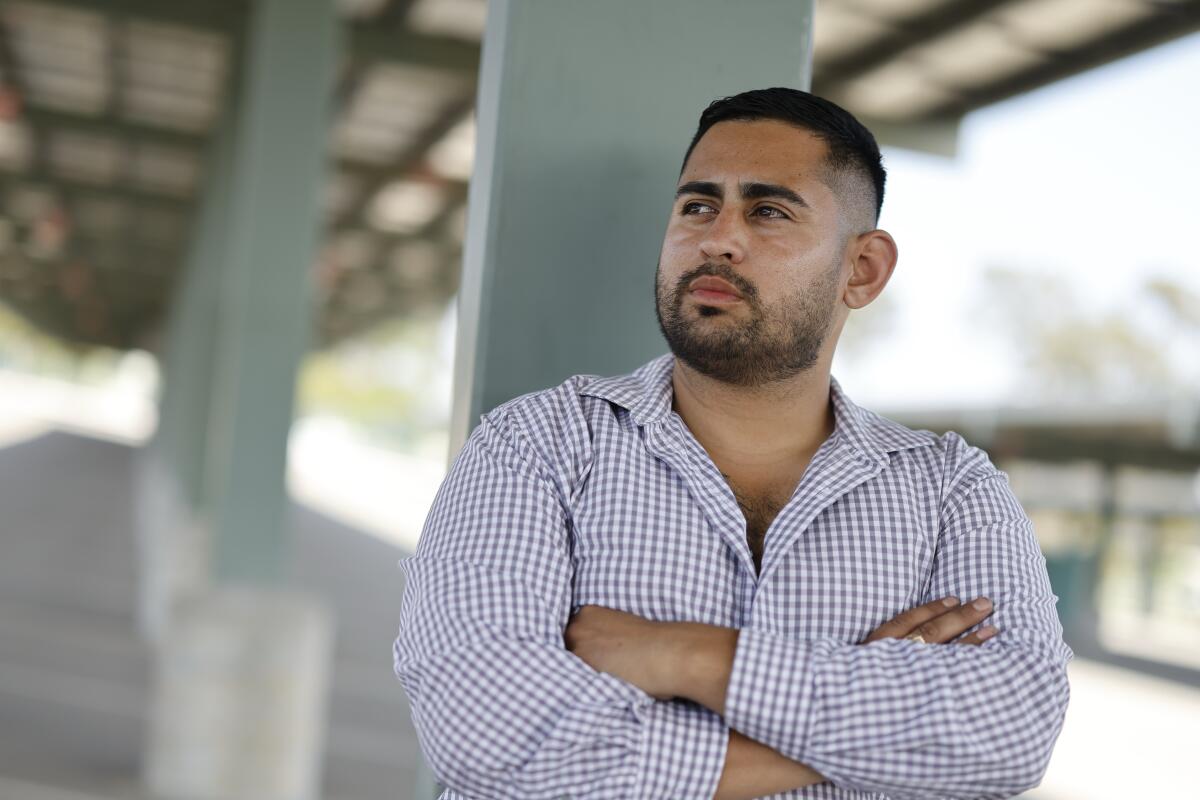
Javier Ramirez was handcuffed in the back of an unmarked car, bruised and confused, when immigration agents used a word he had never heard before.
It was June 2025, and they were bragging about the raids in the Los Angeles area that swept up hundreds of immigrants — and a few U.S. citizens, like Ramirez. The unfamiliar word caught Ramirez’s ear.
Tonk.
“I wondered what that meant — I thought it was some code,” the 33-year-old tow truck driver told me over a Zoom call this week. “But I didn’t make a big fuss about it then.”
Masked men had thrown him to the ground outside a tow yard in Montebello, for reasons they wouldn’t divulge. He ended up in the car with a man detained in another roundup, headed for the Metropolitan Detention Center in downtown Los Angeles.
The color disappeared from Ramirez’s face when I explained what “tonk” means.
For at least half a century, Border Patrol workers have used the onomatopoeic word, referring to the sound of someone getting hit, as slang for undocumented immigrants. Body camera footage and text chains from last summer’s immigration raids, released this week in a court filing, captures agents throwing around anti-immigrant insults like “wet” and “tonk” with the same ease that the rest of us say “and” or “the.”
The most egregious example, I told Ramirez, was directed at him and his friend, fellow U.S. citizen Brian Gavidia.
A video shows an agent shouting, “One tonk f— got away, dude!” as colleagues manhandle the pair. The same agent, who spoke with a Chicano accent, later sped off in a vehicle while asking in Spanglish, “¿Alguien arresto un tonk, güey?” — Did someone arrest a tonk, man?
“Oh, wow, OK, that’s really bad,” Ramirez finally said, laughing bitterly while gathering his thoughts. “It’s kind of hurtful. They’re just assuming who I am.”
Ramirez asked his attorney, Luis Castillo, if the agents who accosted him “had violence on their mind when they used that word.”
“You’re getting a double whammy,” the longtime civil rights lawyer replied. “They’re hitting you twice, physically and psychologically.”
No, Luis: they’re hitting us all.
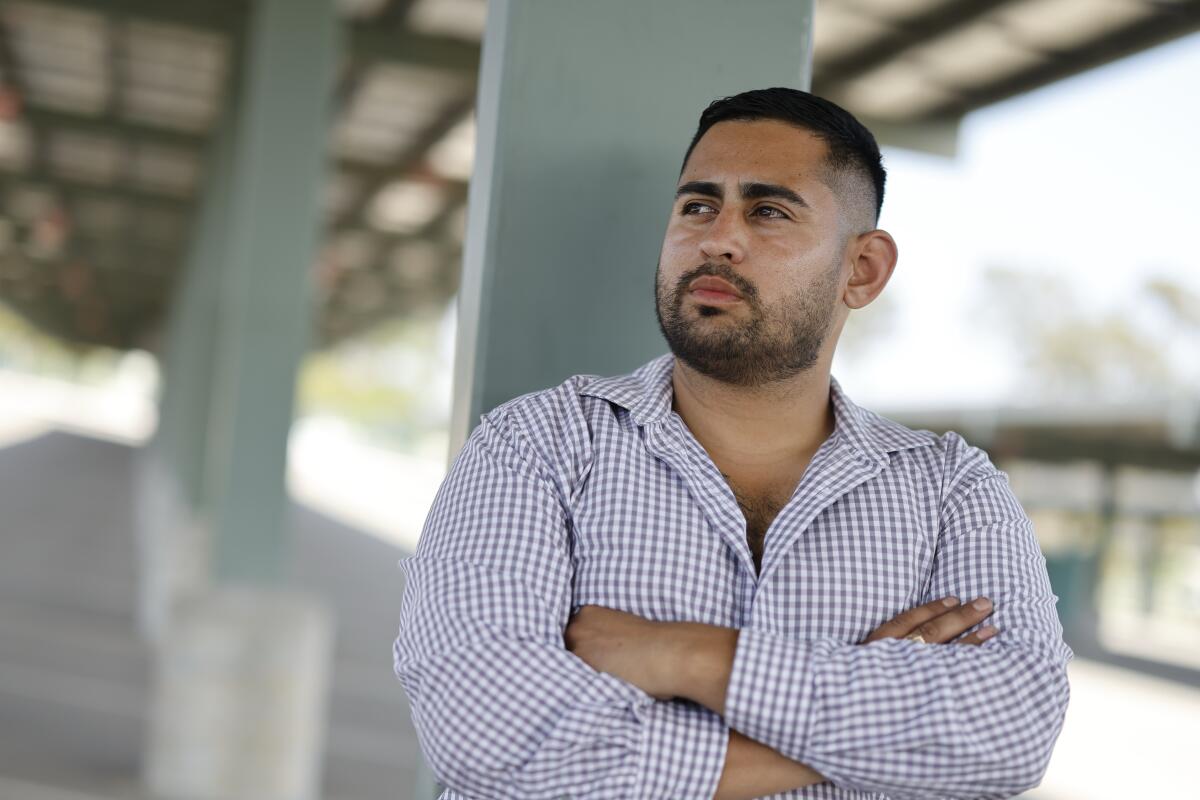
Brian Gavidia stands in a parking lot next to East Los Angeles College in Monterey Park in 2025 a day after he and his friend were roughed up by immigration agents outside a tow yard in Montebello. The two are suing the federal government for violating their civil rights.
(Carlin Stiehl / Los Angeles Times)
If you’re still doubting that racist violence fuels President Trump’s deportation deluge, just consider what Gavidia and Ramirez have been through.
La migra roughed them up even as they screamed that they had documents to prove their U.S. citizenship. They took Gavidia’s Real ID and never returned it. Ramirez was detained for five days and charged with trying to assault a federal officer and interfere with their work — a case that went nowhere because he did no such things.
The American Civil Liberties Union and Public Counsel, along with other groups and private attorneys, included the body cam footage in a court filing asking a federal judge to bar immigration agents from making stops based on racial profiling.
Gavidia is part of that lawsuit, while Ramirez has sued separately. Now, the two men are more certain than ever that the Trump administration’s deportation strategy isn’t about getting the worst of the worst.
To la migra, all Latinos are tonks.
“I never even heard the word, but once [lawyers] told me the explanation of what it meant, I was disgusted instantly,” said Gavidia, 30, who fixes up and sells cars. “They already knew what they were coming to do. We told them we were Americans. It didn’t matter. We were brown, and that was enough.”
“I saw [the tonk video] 300 times,” Gavidia added, “and it’s giving me more trauma.”
“Tonk” has been a dirty little secret of the Border Patrol for decades — workplace lingo showing that the banality of evil that’s la migra on its best days has transformed into something far uglier under Trump.
The slur is so vile — predicated on violence by law enforcement, unlike ethnic jabs that insult food or culture — that it has never crossed over into mainstream English. “Tonk” in its anti-immigrant meaning doesn’t appear in the Merriam-Webster dictionary or even the Dictionary of American Regional English, the premier academic collection of American slang.
And that’s exactly how the Border Patrol likes it.
The earliest use of “tonk” to demean immigrants that I’ve been able to find is in a 1976 book by Paul Schuster Taylor, an early pioneer of Mexican American studies best known for documenting the plight of Dust Bowl refugees along with his wife, photographer Dorothea Lange.
Taylor quoted a Border Patrol inspector referring to Mexicans as “tonks” but offered no definition. In a 1978 hearing, Immigration and Naturalization Service Commissioner Leonel Castillo said the slur was “sort of like the new term” for “wets.”
Castillo — no relation to Luis — nevertheless defended his agents’ use of anti-immigrant words.
“I think it’s the way — the tone in which you use it, and then how you treat people,” he said, maintaining that the verbiage was ingrained in the “very fine gentlemen” who worked under him.
“It’s very hard to change them,” he said. “But they’re not necessarily bad people.”
A year later, an anonymous Border Patrol agent writing for the white supremacist publication Instauration debunked Castillo’s apologia. He claimed that “tonk” derived from the thudding noise when agents smashed a flashlight on an immigrant’s head.
“The Anglos of the Border Patrol are not as intimidated by federal guidelines as people might think,” the agent wrote. “We have our own methods of interrogation in the desert.”
San Diego State English professor William Nericcio has spent his career studying anti-Mexican hate. He grew up around Laredo, Texas, in the 1970s and 1980s with “guys and their dads who worked in Border Patrol because it was a good job.”
Yet he hadn’t heard of “tonk,” either.

Immigration agents detain two men at a car wash in Montebello, Calif., in 2025.
(Gregory Bull / Associated Press)
“A drum roll of anti-Mexican violence turns into a soundtrack — wetback, beaner, spic and now, tonk,” Nericcio responded when I asked why the slur has stuck for so long among immigration agents. “Of all these anti-Mexican terms, this is the only one that directly connects to an act of violence. It’s a thing of pride when you say it — ‘Hey boss, I got a tonk today! Where’s my bonus?’ It’s glory days for them.”
The casual use of “tonk” by la migra eventually became a PR embarrassment even for the Trump administration. In 2019, during Trump’s first term, a Customs and Border Protection spokesperson told an Arizona public radio station that the slur “is now considered a derogatory term and CBP does not condone its use.”
This time around, a Department of Homeland Security spokesperson told my Times colleagues that “agents are focused on protecting the American people — not entertaining performative outrage.”
CBP didn’t respond to my multiple requests for comment about whether its internal guidelines continue to discourage “tonk” and whether agents face any discipline for using it.
If you’re not disgusted by this devolution in protocol, I’m not sure what can possibly disgust you.
ACLU lawyer Mayra Joachin said the body cam footage is “clear evidence that these stops were always about individuals’ appearance of being Latino working class” and is proof of the “culture of racism underlying” the Trump administration’s deportation strategy.
How are Gavidia and Ramirez feeling now, after being called a racist slur they hadn’t even known existed and that doesn’t even technically apply to them?
“If you’re a U.S. citizen, you can’t be free in the U.S.,” Ramirez said. What happened to him “can happen to anyone, it can happen to their kids and family, and when it happens to their family, that’s when they’re going to see the truth of what’s happening.”
Gavidia, who voted for Trump in 2024, said that immigration agents think they “are above the Constitution and law.”
“That’s sad and disgusting,” he said. “If we don’t stop this and fight this now, it’s going to get worse and worse.”