DODGING the crowds on Oxford Street could become a thing of the past ahead of new plans to ban all traffic.
The busy London street is taking its first steps to becoming pedestrianised and will partially close to cars in October.
The plan is for Oxford Street is to become a ‘pedestrian plaza’Credit: Mayor of LondonCars and buses will be rerouted through part of Oxford Street from next monthCredit: Alamy
It’s not the first time that Oxford Street has been closed to vehicles – but this will be a move for a permanent change.
London Mayor Sadiq Khan‘s vision is for it to be transformed into a ‘pedestrian plaza’ at the cost of £150million.
Sign up for the Travel newsletter
Thank you!
At first, not all of Oxford Street will be closed to cars – the plan is for 1km to be traffic free by the second half of October.
Buses won’t be allowed to drive down the pedestrianised area either and will be diverted to other roads.
The section closed to traffic will be Orchard Street near Selfridges and Great Portland Street.
This area includes the Oxford Circus junction where Oxford Street and Regent Street cross.
Not only will the road be shut, but there will be new seating and planters installed too.
This is a test followed by a review of the scheme which will take place in spring 2027 – work will then start on making it permanent later on in the year.
The end aim is for Oxford Street to undergo an enormous £150million to be completely pedestrianised between Oxford Circus and Marble Arch.
There will be more space for its 500,000 daily visitorsto walk around by replacing the roads with paths.
There are 500,000 daily visitors on Oxford StreetCredit: Alamy
There are concerns though – some locals are worried that the pedestrianisation will push the traffic out into the surrounding areas such as Soho and Mayfair.
Council leader Paul Swaddle has raised further issues including safety.
He said: “At the moment, if you go to Oxford Street at midnight, there are buses, there are people getting night buses – you would feel relatively safe.
“If you were crossing that on your own – if one of my kids was crossing it on their own in the evening, I’d be concerned.”
Other concerns are about emergency services, however unlike private vehicles, they will have access to the street at any time in the new plan.
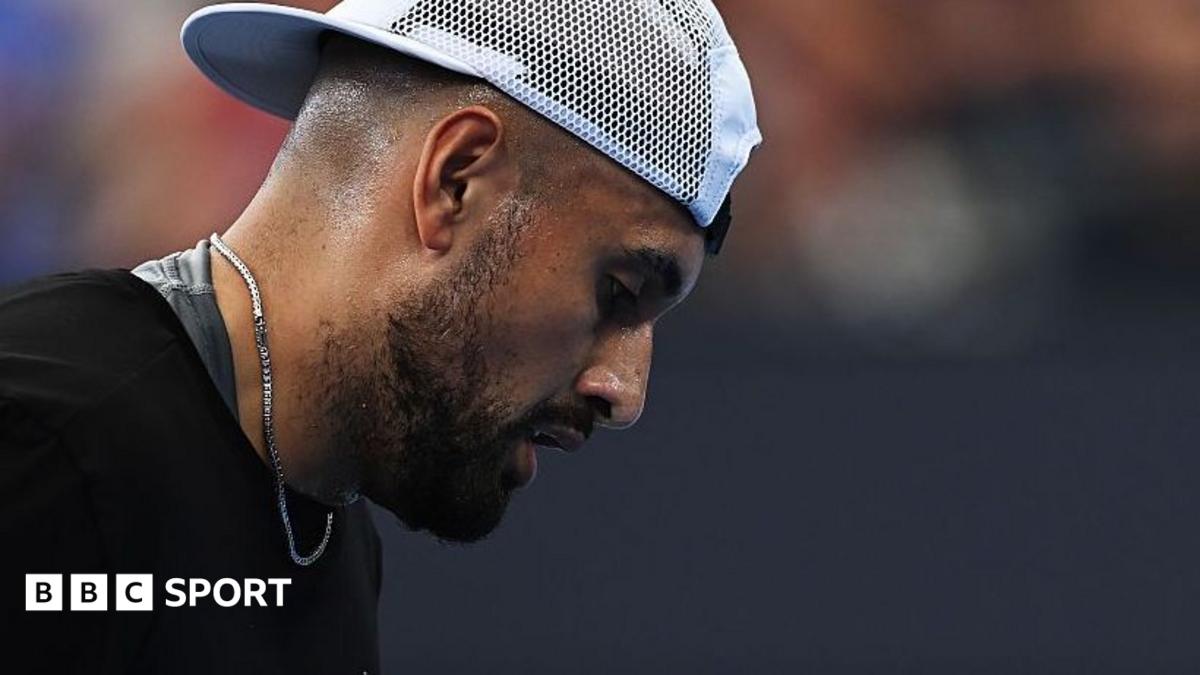
Nick Kyrgios is eligible to return to tennis after accepting a one-month ban for testing positive for cocaine.
The Australian, 31, was provisionally suspended on 4 August after a sample he submitted during the Mallorca Open in June was found to contain benzoylecgonine, a metabolite of cocaine.
Kyrgios told investigators from the International Tennis Integrity Agency (ITIA) that he used cocaine at a nightclub in Magaluf in the early hours of 20 June.
He played his first-round match at the Mallorca tournament two days later, losing in straight sets to compatriot Adam Walton.
The ITIA accepted he used cocaine outside of competition after consulting with an an independent expert.
Kyrgios could have faced a maximum three-month ban but it has been reduced to one month after he entered a treatment programme.
His one-month ban ended on Thursday, 3 September.
Kyrgios, who has fallen to 918 in the world rankings, will also lose his prize money of 6,570 euros (£5,650).
When the positive test was announced, Kyrgios said he would step away from social media and public life for the next 28 days to “focus on getting myself right”.
The former world number 13 has played just four singles matches this season, having struggled with knee and wrist injuries in recent years.
He last played in the men’s doubles at Wimbledon, where he and partner Alexander Bublik lost in the first round.
After his initial suspension was announced, Kyrgios said the past few years of injuries had taken “a huge toll on me, both mentally and physically”.
“My body hasn’t been able to do what my mind expects it to do,” he wrote in a lengthy statement on Instagram.
“Coming to terms with being near the end of my career has been harder than I ever imagined.
“None of that excuses what I did.”
Cocaine is classified as a stimulant and substance of abuse on the World Anti-Doping Agency’s prohibited list.
Kyrgios has long been a controversial figure in tennis.
His behaviour on court has been widely criticised and he has been given numerous large fines for smashing racquets, making audible obscenities and arguing with the umpire.
In 2023, he admitted assaulting an ex-girlfriend two years earlier. He avoided a criminal conviction.
He was criticised further for making a series of comments which have been considered misogynistic.
In 2024 he shared a post from controversial influencer Andrew Tate. He later said he had gone “to all lengths” to distance himself from the self-proclaimed misogynist.
Kyrgios was also critical of the handling of two high-profile anti-doping cases involving top players Jannik Sinner and Iga Swiatek, calling them “disgusting” for tennis.
Kyrgios has won seven ATP Tour singles titles and reached the Wimbledon final in 2022, losing in four sets to Novak Djokovic.
He and compatriot Thanasi Kokkinakis won the Australian Open men’s doubles title together in 2022.
Kyrgios has also spoken about his struggles with mental health, saying he “genuinely contemplated” suicide and spent time in a psychiatric hospital in London after losing at Wimbledon in 2019.
BOSTON — A federal judge in Boston said Thursday the U.S. Postal Service has told her nothing about how it would implement a plan to regulate mail ballots for the midterms as she considers whether to let the plan proceed in the weeks before Election Day.
U.S. District Court Judge Indira Talwani is deciding whether to extend her prohibition on the proposed regulation of mail ballots, an effort undertaken as part of an executive order by President Trump. The hearing in the closely watched case came a day before the first state begins sending mail ballots to voters.
“We are 70 days from the election and I have nothing from the USPS about how this will happen,” Talwani told Michael Velchik, the Justice Department lawyer representing the Postal Service.
Last week, Talwani imposed a 14-day temporary restraining order to keep it from being used. That order expires next week as more states begin sending out mail ballots. Velchik said the administration will most likely go to the Supreme Court by the end of the week to seek permission to resume implementing the plan.
Talwani has been here before. In June, she prohibited the administration from implementing Trump’s order for the November election, ruling the changes came too close to voting for the federal government to embark on such a project.
But the Supreme Court late last month ruled that Talwani’s order was premature because the Postal Service had not yet published regulations governing how it would apply Trump’s order. The agency did so just before the high court ruling came down, prompting Democrats and voting rights groups to swiftly re-file their lawsuits.
They counter that the president has no authority to set election rules, which is a power designated in the Constitution to the states and in some cases Congress.
They won an initial victory with Talwani’s restraining order, which has already been appealed by the administration.
Trump has long opposed mail voting and falsely blamed it for his 2020 election loss to Democrat Joe Biden, even though he often uses that method to cast his own ballot.
Election officials say there’s simply no way they can comply with the Postal Service directives, which could require a complete overhaul of their operations. Before it delivers mail ballots for any state, the Postal Service would have to approve the design of the envelopes that contain them and have the state upload a list of voters receiving them to an online portal.
Some ballots have already gone out. A few municipalities in Wisconsin opted to send mail ballots to voters earlier this week, but Friday marks the full kickoff of voting as North Carolina starts shipping its mail ballots to all voters who requested them.
The administration has contended the changes are relatively minor and legal. But the portal was still not active this week, and most election offices have already printed their envelopes and ballots.
Velchik told Talwani that the federal government is offering states the choice to opt into the system. But the Postal Service has yet to identify a single state that has done so.
A whistleblower report made public this week warns that the postal system’s requirements could lead to millions of mail ballots never being sent. The new rule requires all ballots to be physically brought to post offices before being mailed to voters, but if a single one’s bar code registers an error, the whole batch gets thrown out, even if it contains tens of thousands of legitimate ballots.
Riccardi and Casey write for the Associated Press. Riccardi reported from Denver.
Aug. 28 (UPI) — The Trump administration on Friday asked the Supreme Court to allow the Pentagon to ban transgender individuals from serving in the military.
A federal appeals court ruled in June that the military’s attempts to remove transgender Americans was “both arbitrary and based upon animus.”
On Friday, Solicitor General John D. Sauer appealed to the country’s top court to reverse the ruling.
“The court asserted that the policy likely denies equal protection because it reflects invidious discrimination against trans-identifying people,” Sauer wrote in his petition. “That gravely erroneous holding warrants this Court’s review.”
“The authority of the U.S. military to determine who may serve in the Nation’s armed forces is a matter of exceptional importance,” he added. “Whether the Constitution prohibits the military from exercising that authority by adopting a policy like the one here is a recurring issue, which has arisen before and will likely arise again absent this Court’s review.”
He signed an executive order saying transgender troops’ health needs are “inconsistent” with service in the military.
The National Center for LGBTQ Rights and GLAD Law sued in February, and the federal appeals court in the District of Columbia agreed with the plaintiffs.
Judge Robert Wilkins said the ban on transgender service members “appears driven by the bare desire to harm a politically unpopular group.”
“We are confident the Supreme Court will affirm that the Trump administration cannot base policies on hostility toward a group of people,” said Jennifer Levi, GLAD Law senior director of transgender and queer rights, in a statement.
“As the Trump administration’s own attorneys admitted, these are qualified individuals who are meeting all military standards,” Levi added. “There is no reason to waste millions of taxpayer dollars to kick out thousands of highly trained, skilled, and decorated troops based on nothing but hostility and this administration’s political whims.”
The Supreme Court is on summer recess and will return on Oct. 5.
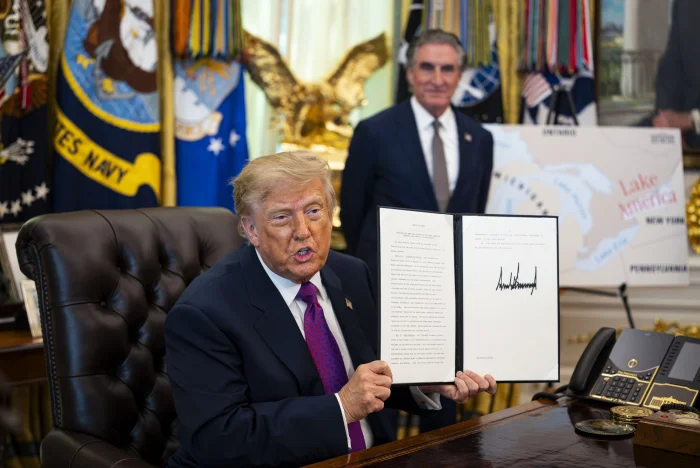
President Donald Trump signs an executive order to rename Lake Ontario as Lake America in the Oval Office of the White House on Thursday. Photo by Al Drago/UPI | License Photo
After an outcry from immigrant and civil rights advocates over plans to equip immigration officers with gloves capable of delivering electric shocks, California lawmakers on Thursday unveiled a bill that would ban the use of shock gloves by any law enforcement agent in the state.
The gloves deliver can an electrical shock strong enough to drop a strong man to his knees in an instant, and proponents say the gloves provide a fast and non-lethal way to subdue a person.
Two weeks ago, the Associated Press reported that the Department of Homeland security planned to use $10 million to $20 million to procure the gloves from Compliant Technologies of Lexington, Ky., for Immigration and Customs Enforcement agents. The department defended its decision, saying it was “made with careful consideration” and that other law enforcement agencies in the country already use the technology.
Civil rights organizations including the American Civil Liberties Union accused the department of attempting to intimidate the public by arming agents with another use-of-force option. They noted that ICE already is contending with criticism for multiple deaths in custody and during arrests.
Assembly Bill 2760, authored by state Assemblymember LaShea Sharp-Collins (D-San Diego), would prohibit local, state and federal agencies from possessing, using or procuring electric taser gloves in the state or with state funds.
“We cannot spend state money or tax dollars on technology that is not to better our state,” Sharp-Collins said during a news conference with other lawmakers in Sacramento. “It cannot be used on our children, it cannot be used on our teachers, our business owners, it cannot be used on anyone.”
The CTG-5 G.L.O.V.E — standing for Generated Low Output Voltage Emitter — resembles a thick work glove and can be activated to emit a 380-volt shock upon contact with a body. Compliant Technologies has maintained that the gloves are weaker than traditional tasers, but critics say they can be life-threatening in the hands of ICE.
“Many people try to say weapons like this are about de-escalation, but I don’t know how many people have put hands on someone and said that’s de-escalation,” state Assemblymember Alex Lee (D-Alameda) said. “There’s already a spectrum of non-lethal, less-than-violent weapons out there that exists… ICE and law enforcement don’t need another tool.”
The gloves have been adopted in detention centers, law enforcement agencies and jails across the country, though apparently none in California. Last week, AP reported that Omaha police agreed to stop using the shock gloves after parents realized they’d been adopted by departments that monitored schools.
Sharp-Collins said she prepared the legislation in consultation with the state attorney general’s office and legislative council to ensure it would withstand a challenge from the Trump administration if it became law.
The Senate voted 30-9 on Monday to approve a rule change that would allow for the bill to pass quickly before the end of the legislative session on Aug. 31.
Dolly Parton may be gone, but her spirit of self-expression is still making waves — this time in a Texas federal court.
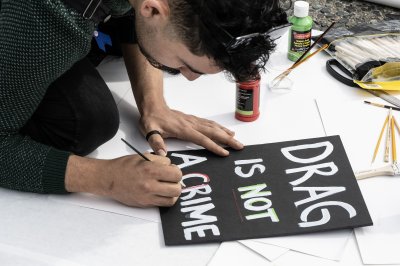
U.S. District Judge David Hittner on Tuesday cited the late artist in his decision to strike down Senate Bill 12, a 2023 law that sought to restrict drag shows. His decision, which blocks the Texas attorney general from enforcing the law, noted that the prohibition was “an unconstitutional restriction on speech.”
Just as many people “chastised Dolly Parton as a voluptuous sex symbol because of her big hair, flamboyant clothes and breast exposure … there are erotic elements in countless popular performances that could be subject to both civil and criminal penalties under S.B. 12,” Hittner wrote in his decision.
And because the law doesn’t specify who determines whether a performance “appeals to the prurient interest” or that the work be considered as a whole, a single sexual or erotic moment in a performance could result in penalties, he wrote. Those penalties include civil fines of up to $10,000 for businesses and a misdemeanor charge that carries up to a year in jail for participating individuals.
Parton was referenced several times in court records associated with the case. One of the plaintiffs, Brigitte Bandit, a drag queen and longtime activist, frequently performs as the Grammy-winning artist.
In an Instagram post on Tuesday, Bandit wrote that Parton had been a “huge influence” on her life and her drag performances. She even brought a children’s book about Parton to testify at the Texas Capitol, which eventually got back to the country music star, who then gifted Bandit a signed rhinestone-covered guitar.
“Dolly has shaped much of my life as a drag artist,” Bandit wrote on Instagram, calling her a “queen who has changed the world with her love, artistry, and GLAM! my diva forever.”
After the 2016 mass shooting at Pulse, a gay nightclub in Orlando, Fla., Parton called herself a “patron saint” of the gay community in an interview with Billboard.
“All those drag queens, sometimes I see some of them look more like me than I do,” said the star, who famously lost a Dolly Parton lookalike contest.
Tuesday’s ruling wasn’t the first time the law, widely touted as a “drag ban,” has been deemed unconstitutional by the courts.
Hittner initially struck down the law in September 2023, just a few months after the Texas Legislature passed it. In November 2025, a three-judge panel of the 5th U.S. Circuit Court of Appeals vacated the lower court’s injunction and returned the case to district court with instructions on how to reconsider it.
In the end, the high court’s directions did not change Hittner’s determination that the law violates the 1st and 14th amendments.
Hittner wrapped up his decision with a suggestion for those who oppose or are offended by the performances: “[T]he solution is relatively simple … just don’t go.”
Dutch group Christians for Israel is taking the government to court in the Netherlands over its plans to introduce a ban on importing goods from illegal Israeli settlements in the occupied West Bank and Golan Heights.
The ban, which was announced in July, is due to take effect on September 22 and will run for three years. It bars importing, buying and selling goods produced in Israeli settlements, as well as intermediary services and any attempt to circumvent the rules.
Recommended Stories
list of 3 itemsend of list
But the Israel Product Centre (IPC), part of Christians for Israel (CvI), a Dutch evangelical organisation which a recent study found has donated about $300,000 to illegal settlements in the occupied West Bank, has responded by filing summary proceedings against the state, with the hearing due today.
Here’s what we know about this case.
What is the case about?
The IPC has issued summary proceedings against the Dutch state, seeking to block the July decree.
The IPC argues the measure is “one-sided” and that the window it now has to clear its existing stock – some 20,000 bottles of wine – is too short.
It is also arguing that a national ban conflicts with the European Union’s principle of free movement of goods.
A verdict is not expected for about two weeks.
How has this case come about?
EU rules have long required goods from illegal settlements in the occupied West Bank to be labelled by their origin – Palestine – rather than as “product of Israel”, but the bloc has not placed an outright ban on trading with Israeli settlements. That remains up to individual countries.
In February 2020, the Dutch advocacy group DocP urged consumers to file complaints with the Dutch food safety authority, NVWA, if they found wine and Dead Sea cosmetics had been mislabelled.
Following complaints, the IPC changed its labelling to “product uit een Israelisch dorp in Judea & Samaria [product from an Israeli village in Judea and Samaria],” which it argued accurately reflected the exact geographical and administrative reality of the origins of the products without deceiving the buyer. Judea and Samaria is the biblical name used by the Israeli government to refer to the West Bank. DocP argued this fell short of the requirement to label products correctly, and continued its campaign.
In 2021, the NVWA agreed and fined the IPC 2,100 euros (about $2,500) for mislabelling goods.
Then, in July 2024, the International Court of Justice (ICJ) issued an advisory opinion that Israel’s presence in the occupied Palestinian territory is unlawful and must end “as rapidly as possible”.
This shifted the legal argument beyond mere consumer labelling, with the court saying countries should take steps to prevent trade or investment relations which help to maintain the unlawful presence of Israeli settlers in the Palestinian territories.
The lower house of the Dutch parliament acted on that in September 2025, proposing an import ban.
The national decree against importing goods from Israeli settlements was made in July this year.
Does Christians for Israel describe the West Bank as ‘Israel’?
CvI describes the West Bank as a “disputed territory” rather than accepting the international legal description of it as “occupied Palestinian territory”.
It says it believes that Israel has strong claims to sovereignty there and that Jews have a right to live there.
The vocabulary matters in a legal sense, as “disputed territory” is not the same as “annexed territory”, therefore, the legal apparatus which would make settlement trade unlawful doesn’t straightforwardly apply.
The group’s stated reasons for funding projects there, it says on its website, are rooted in the Bible; it cites Ezekiel 47:21-23: “Peace for the Jewish people and resident foreigners inheriting alongside the tribes of Israel.”
However, the ICJ’s July 2024 advisory opinion is clear that the Fourth Geneva Convention’s Article 49(6) and successive Security Council resolutions treat the territories as occupied and the settlements as unlawful.
(Al Jazeera)
How have other Christian organisations in the West responded to trade with settlements?
Western churches are split on the issue, with CvI sitting at one end of the spectrum.
Mainline Protestants, including the Presbyterian Church in the United States, have divested shareholdings in Caterpillar, HP and Motorola Solutions as early as 2014, and from Israeli bonds in 2024. The United Methodist Church has opposed Israeli settlements since 1996 and sold its Israeli bond holdings last August.
The World Council of Churches called for sanctions against illegal Israeli settlements in 2025, divestment and an arms embargo.
The Vatican calls settlements an obstacle to peace but has avoided divestment so far.
Christian Zionist bodies, however, including Christians United for Israel (CUFI) and the International Christian Embassy Jerusalem, send funding for settlements and fight against boycotts.
How significant is this ban?
It is significant considering that the Netherlands is one of only four EU countries currently imposing a ban on trade with illegal Israeli settlements.
Trade from illegal settlements to the EU is estimated to be worth up to $400m per year.
The Netherlands is also a big market for the illegal settlements; a recent investigation by legal advocacy group Global Echo, which analysed thousands of shipments from Israeli settlements between 2017 and 2026, shows that within the EU, the Dutch market is the largest importer of goods from illegal settlements, with about 30 percent destined for or passing through the country.
Which European countries have banned products from West Bank settlements?
Spain has banned all imports of products from illegal Israeli settlements in the occupied Palestinian territory, including the West Bank, East Jerusalem and the Golan Heights, since September 2025. The decree also enforces an embargo on defence exports and dual-use technology to Israel, bans ships carrying military fuel for Israel from Spanish ports, and restricts advertising for services or goods linked to Israeli settlements.
Ireland’s parliament approved the text of its Israeli Settlements (Prohibition of Importation of Goods) Bill in May and the bill was signed into law in July. It covers all goods produced in Israeli settlements, but excludes services.
Belgium’s federal government approved a draft royal decree in July introducing a specific regime for goods from Israeli settlements in the West Bank and East Jerusalem. The precise details of the new law will be determined by the government in due course.
Slovenia imposed restrictions on imports from Israeli settlements under its previous government, but the new conservative government reversed them in June 2026.
The EU as a bloc remains deadlocked over whether a ban counts as foreign policy requiring unanimity or trade policy needing only a qualified majority, with ministers not meeting again in a decision-making format until October.
Israeli Foreign Minister Gideon Saar last year described the push by some European governments to implement the ICJ advisory opinion as “shameful”.
Which European countries still allow trade with West Bank settlements?
Nearly all of them.
Outside the three European Union states which still have bans in place, settlement goods can be sold legally everywhere, including in most of the EU.
At a July 2026 meeting of EU foreign ministers in Brussels, which addressed trade from Israeli settlements in Palestinian territories, Germany, Austria, Czechia and Hungary were opposed to an EU-wide ban.
Beyond the EU, the United Kingdom does not forbid trade with illegal Israeli settlements, although new Prime Minister Andy Burnham is reportedly considering a ban. In a recent parliamentary briefing, Amnesty International called on the UK government to implement a ban.
It said: “The argument for a UK ban on trade with settlements is clear. The UK government itself accepts it should take stronger action in response to settlement expansion and annexation. The International Court of Justice has directed states not to trade with Israel in relation to the Occupied Palestinian Territory; and there is precedent in UK law and policy to not trade with illegally occupied lands, ie Crimea and other illegally occupied parts of Ukraine.”
Aug. 26 (UPI) — A U.S. district court has blocked Texas from banning drag performances as unconstitutional, ruling that the solution to the problem is for those who find such events offensive to just not attend.
Texas Gov. Greg Abbott signed Senate Bill 12 into law in June 2023 to ban “sexually oriented performances” via civil penalties on businesses that host them and criminal penalties on performers.
It has been debated in the courts since, with a court ruling it unconstitutional in 2023 and an appeals court in February allowing it to take effect while sending the case back to the district court for review.
On Tuesday, U.S. District Judge David Hittner, a Reagan appointee who issued the 2023 ruling, declared Senate Bill 12 an unconstitutional restriction on speech and ordered that the state be permanently enjoined from enforcing it.
“Finally, for those who find such activities as described in this case offensive, the solution is relatively simple … just don’t go,” Hittner said.
Texas Attorney General Ken Paxton, who is running for the U.S. Senate with President Donald Trump‘s endorsement, called the ruling in a statement “flawed,” arguing without proof that it will endanger children while being “an affront to Texas values.”
“I will appeal this decision immediately and continue to fight to protect our kids,” he said online.
Meanwhile, civil rights and LGBTQ advocates celebrated the ruling.
“Today’s decision confirms that the legislature’s attempt to ban drag performances was unconstitutional from start to finish,” Brian Klosterboer, senior staff attorney at the American Civil Liberties Union of Texas, which filed the original lawsuit in August 2023, said in a statement.
“This law stifled free expression across our state and made people afraid to engage in or attend drag shows and other performances. But all Texans — no matter our gender or background — are guaranteed the right to free expression.”
Brigitte Bandit, a drag performer and a plaintiff in the case, said the ruling was “a relief.”
“As a lifelong Texan, I’m sick of this state trying to censor art and stoke hatred and violence against drag artists and the LGBTQIA+ community. No one should be punished for performing drag, and I wish lawmakers would take steps to protect kids from real dangers in our state instead of trying to divide and marginalize us.”