We’re tracking races across California, including primary elections for U.S. congressional districts that were recently redistricted. Results for governor, statewide officers such as the attorney general and insurance commissioner, as well as state Senate and Assembly contests are available on this page.
In state-level primary races, the top two finishers will move on to the general election in November. Their names will be indicated with checkmarks once their races are called by the Associated Press.
Initial results are expected shortly after the polls close at 8 p.m.
Every registered voter in the state receives a ballot by mail. To vote by mail, these ballots must be postmarked by June 2. They may take several days to process. Results from provisional and conditional ballots also take longer, and will be added to the tally once they are cleared.
The data on this page updates periodically as results come in from the Associated Press. The secretary of state will certify results in early July.
twitter
facebook
envelope
angle-double-right
angle-down
angle-up
long-arrow-right
Jump to:
Governor
The California governor’s race is a tight battle between 24 Democrats , 12 Republicans and 25 candidates from other parties or with no party preference . Half a dozen of which had real support in the polls. The crowded field is vying to replace Democratic Gov. Gavin Newsom. California has never elected a woman as governor and only once a person of color, making this race potentially historic for the state. The top two vote-getters move on to the general election regardless of party preference.
California’s congressional map was redrawn last year after the passage of Proposition 50. Several seats are expected to flip from red to blue due to Newsom’s redistricting effort. In some cases, districts were moved slightly and incumbents remain unchallenged. However, in one area, lines have been redrawn with no overlap at all with their current boundary: Rep. Ken Calvert’s 41st District in the Inland Empire was eliminated and completely redrawn in Los Angeles County. Calvert is now challenging Republican incumbent Young Kim in the 40th District. Both are marked as incumbents on the table below.
The 1st Congressional District — which was redrawn further south to cover portions of Butte, Colusa, Glenn, Lassen, Modoc, Shasta, Siskiyou, Sutter, Tehama and Yuba counties — is holding a special primary election to fill the seat left vacant by Rep. Doug LaMalfa’s death in January.
twitter
facebook
envelope
angle-double-right
angle-down
angle-up
long-arrow-right
District 1 (unexpired term)
A candidate can win by getting a majority of the vote. If no one receives 50% + 1, the top two advance to November election.
It’s election day in California’s 2026 primary, and you’re headed to the polls — until you realize you’re not sure you’re registered, or fear you might not make it to the vote center on time.
Here are some common election day concerns and challenges and how to end your Tuesday with an “I voted” sticker.
Eligible citizens who need to register or re-register to vote within 14 days of an election can complete this process and vote at county elections offices, polling places or vote centers. To register you’ll need to provide a driver’s license, a state identification number or the last four digits of your Social Security number.
A complete list of county election office addresses can be found here.
Your submitted ballot will be processed and counted once the county elections office has completed the voter registration verification process.
If you’re unsure about your voter status, you can find your record here by providing some personal information including your date of birth and driver’s license number.
I don’t know where my polling place is
You can find your nearest polling place on the California secretary of state’s website here.
You can also use Los Angeles County’s voter center locator on the registrar-recorder/county clerk website here.
On election day, voting centers are open from 7 a.m. to 8 p.m. across the state.
I can’t submit my mail-in ballot myself
You can have someone else submit your ballot.
Anyone can drop off your mailed ballot as long as you authorize them to do so and they do not get paid on a per-ballot basis, according to the secretary of state.
You and the person you’ve authorized to submit your mailed ballot must fill and sign the outside of the ballot envelope.
I forgot my check-in code for in-person voting
Los Angeles County election officials say you can check in at a vote center by scanning your “quick check-in code” — a number that verifies your voter registration.
Your code can be found on your mailed sample ballot and vote center postcard. Take either of those hard copies to the vote center.
If you forgot the hard copies, you can retrieve the code by verifying your voter registration here. You’ll need to input your last name, birth date, the house number of your residential address and ZIP Code. For assistance call, (800) 815-2666, Option 2.
I want to drop my ballot in a box but fear it’s too late
There are three ways you can submit your mailed ballot on election day:
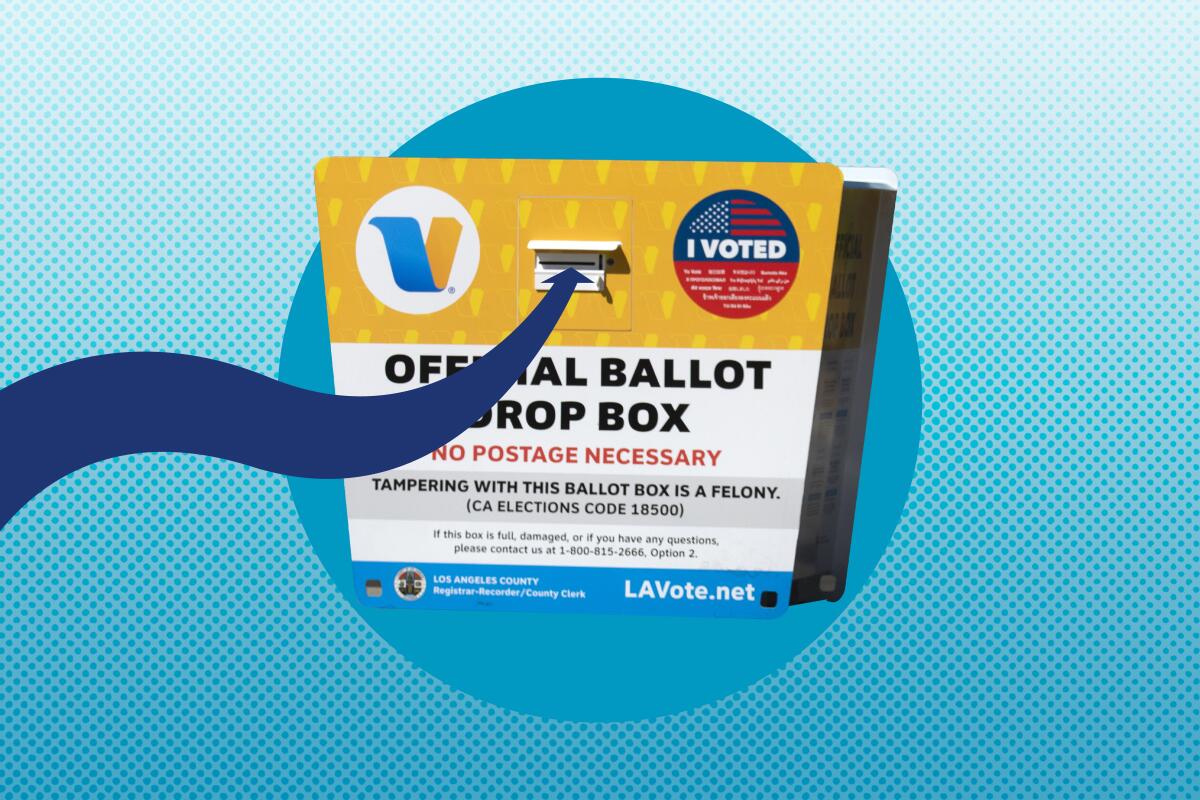
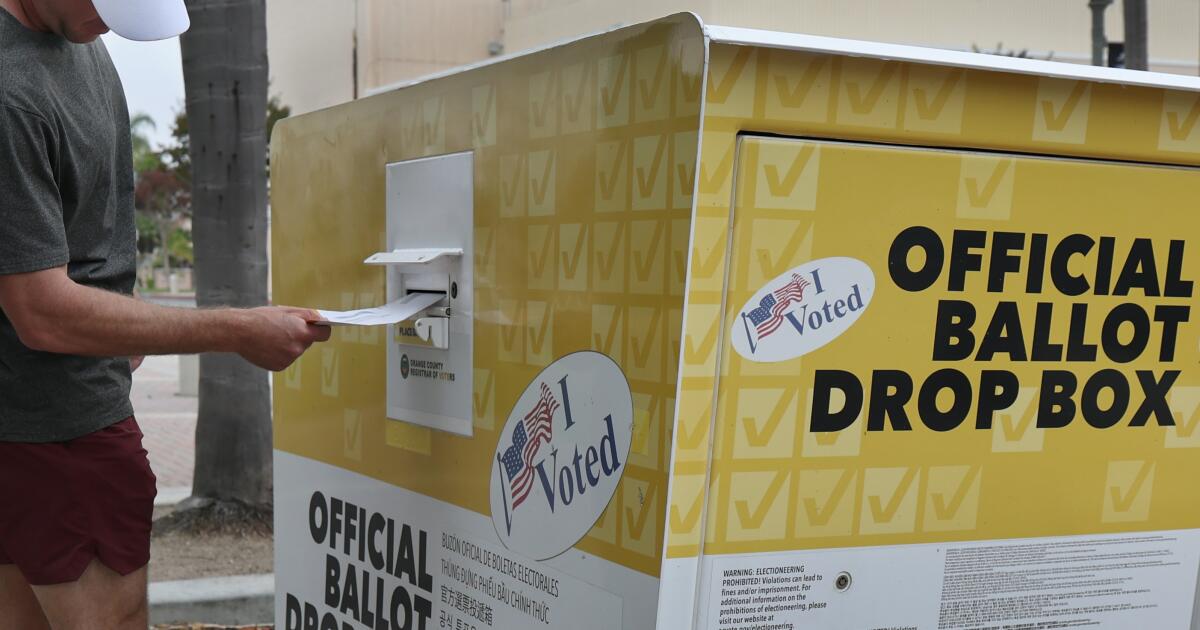
You can put it in a ballot drop box. The cutoff time for doing so is 8 p.m., which is also when the polls close on election day.
Drop it off at a vote center, where the deadline is the same.
Drop it off at a United States post office. Be sure to get a hand-stamped postmark from a postal employee. Mailed ballots must be postmarked on election day and received no later than seven days after election day.
I think I forgot to sign by mailed ballot envelope
If you failed to sign your vote-by-mail ballot return envelope, your vote will still count.
Your county elections official will notify you by mail, phone or email, according to the secretary of state. You can also be notified by way of the “Where’s My Ballot?” tracking tool if you have signed up for automatic notifications that will ping you if there are issues with your ballot.
Your county elections office will provide you with a form to fill out and return completed.
The form will be given to you two days prior to the day your county certifies the election, so be sure to fill it out and return it to your county elections office right away.
I’m going to be late getting to the polls; can I still vote?
In California, any voter who is in line at 8 p.m. when the polls are scheduled to close is allowed to vote, according to the secretary of state.
If there is a line when the polls close, a poll worker stands at the back of the line to let people who arrive after 8 p.m. know that the polls have closed.
Any voter who arrives after the polls have closed may not be allowed to vote, even if voters who were in line to vote before the polls closed are in the process of voting.
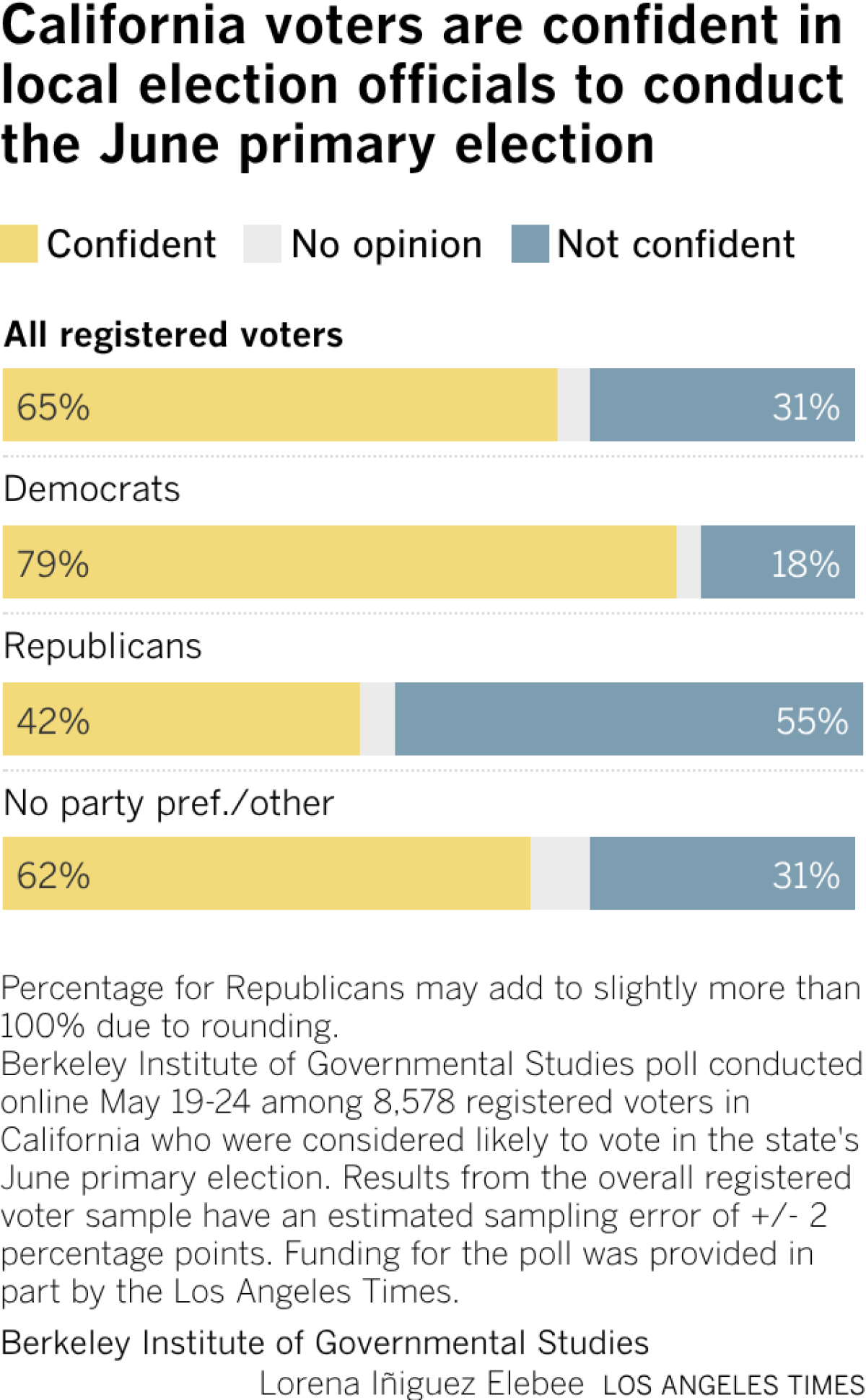
California voters are deeply divided over the trustworthiness of state elections heading into Tuesday’s primary, with most Democrats but less than half of Republicans expressing confidence in the electoral process, according to a new poll.
The polarized view follows a years-long campaign by President Trump and his Republican allies to question the legitimacy of American elections, especially in California and other blue states. It also follows robust efforts from liberal leaders, elections officials and voting rights experts to denounce Trump’s claims as baseless.
Overall, registered voters in the state — which skews heavily Democratic — expressed confidence in local election officials by a 2-to-1 margin, with 65% expressing confidence and 31% expressing a lack of confidence, according to the poll released Tuesday by the UC Berkeley Institute of Governmental Studies and co-sponsored by The Times.
However, those figures shift dramatically when sorted by political party, and even more when parsed by partisan leaning.
For example, 79% of Democratic voters expressed confidence in local officials running a secure and fair election, compared to 62% of independent voters and 42% of Republican voters, the poll found.
While 82% of voters who identified as strongly liberal expressed confidence, just 38% of voters who identified as strongly conservative did so.
A volunteer assists Melani Hurwitz at a polling location Monday at the Cal State Long Beach Walter Pyramid.
(Eric Thayer / Los Angeles Times)
“It’s clearly a partisan issue, and it is being promoted by the president and others who are his followers,” said Mark DiCamillo, the director of Berkeley IGS polls. “Strong conservatives and the Republicans are the least confident, and a lot of them are saying [they are] not at all confident. That’s a pretty extreme statement.”
Rick Hasen, an election law expert and director of the Safeguarding Democracy Project at UCLA Law, said he expected Republican confidence to be even lower given Trump’s decade of undermining trust in elections, especially in liberal, diverse states such as California. But he said neither Trump’s narrative nor public sentiment about election security — which generally shows voters are more confident “when their side wins” — reflects reality, which is that “our elections are administered well.”
“There’s very little evidence of manipulation or of fraud or even of incompetence,” Hasen said. “Anyone who looks objectively would see that there are numerous safeguards to ensure we have free and fair elections in California.”
Trump has long contended without evidence that voter fraud is pervasive among undocumented immigrants and in states, such as California, that use mail ballots, and blamed his 2020 loss to Joe Biden on such fraud despite experts rejecting the claim and Trump’s own allies and lawyers being unable to prove it.
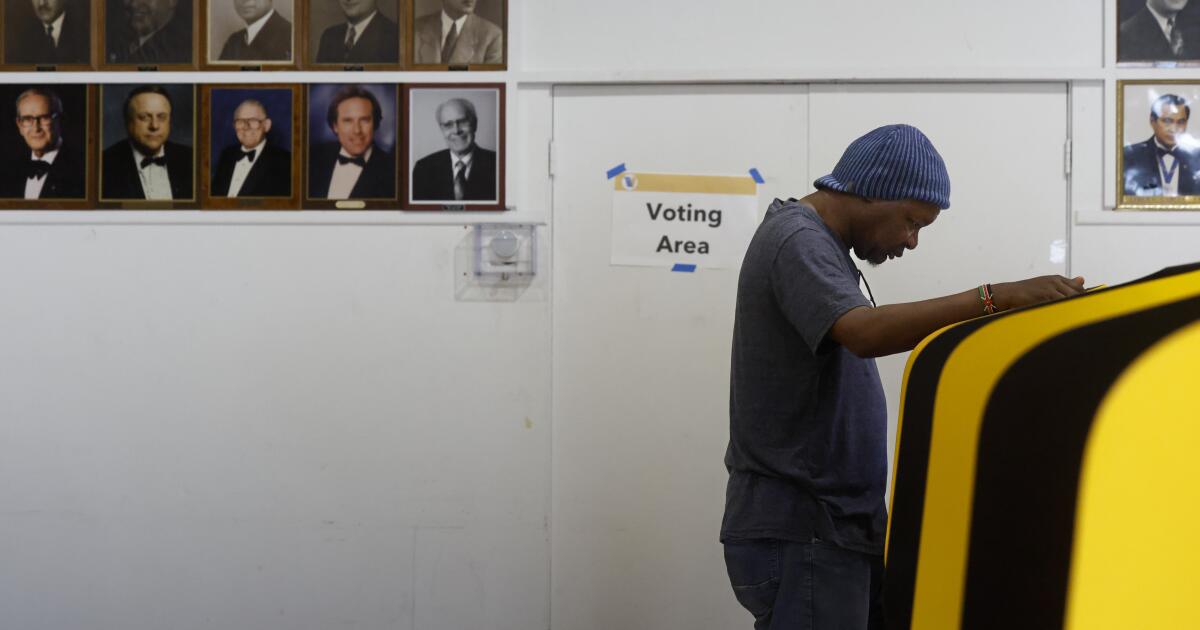
A voter casts their vote inside the Westchester Family YMCA Annex on Monday.
(Kayla Bartkowski / Los Angeles Times)
Since returning to the White House last year, Trump has tried to implement strict new requirements for voter ID and proof of citizenship and to limit or bar mail-in voting, and called for greater federal or Republican Party control over state-run elections. In February, he said that “Republicans ought to nationalize the voting” in “at least 15 places” where they lose.
Democratic leaders, elections experts and voting rights advocates have all pushed back. They’ve backed their assurances that the state’s elections are safe with lawsuits to block Trump’s efforts to assert federal control. They also warn that his administration may try to intervene anyway, including by sending federal immigration agents to polling locations or intercepting or invalidating mailed ballots.
Last week Gov. Gavin Newsom signed a bill barring federal agents and other law enforcement from interfering with local and state elections officials or confiscating ballots, voter rolls or voting machines without a warrant. Newsom said California voters were experiencing “legitimate anxiety” over election integrity given the threats from the Trump administration and the recent actions of Riverside County Sheriff Chad Bianco — a MAGA-backed Republican candidate for governor who recently seized hundreds of thousands of ballots as part of what he said was an investigation into potential fraud in last year’s election.
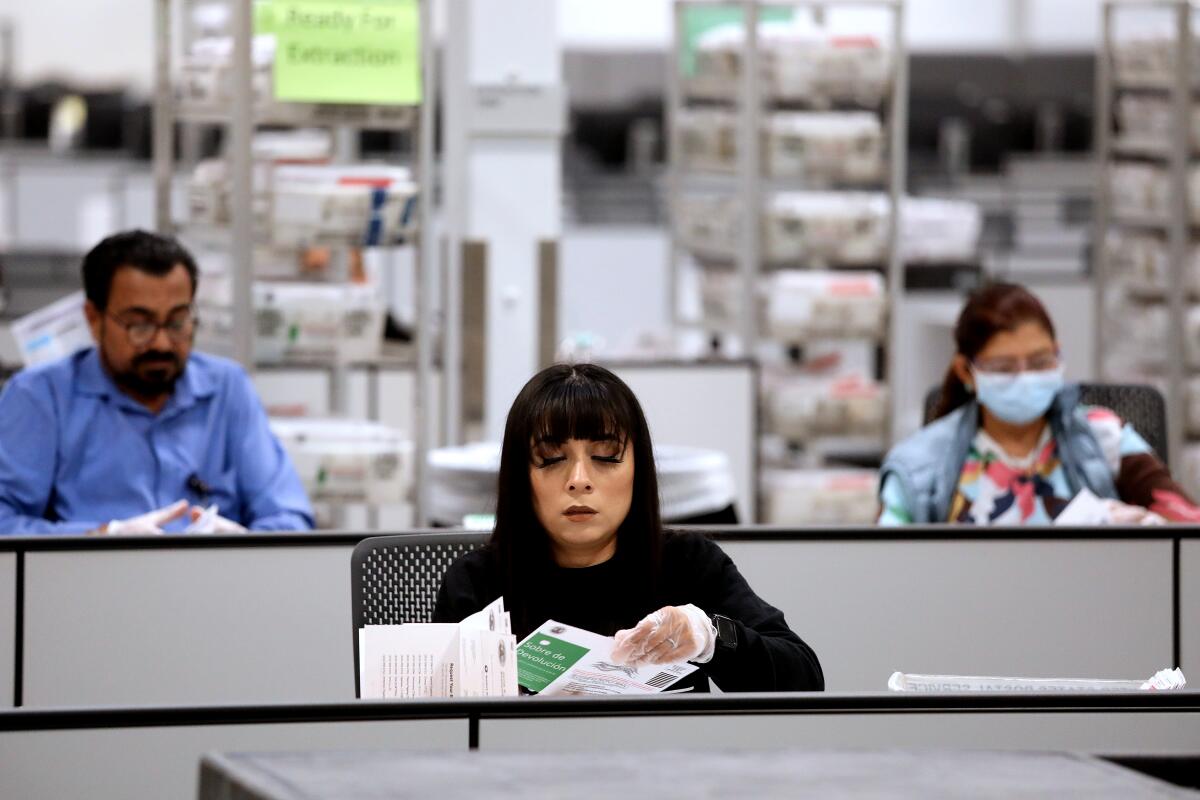
An election worker collects extracted vote by mail ballots to be tallied at the Los Angeles County Registrar-Recorder/County Clerk Ballot Processing Center in City of Industry.
(Gary Coronado / For The Times)
Newsom said he expects Trump to interfere with the upcoming election as well because “every single thing that Donald Trump is saying only suggests that he will do more, not less, to intimidate and to impact the outcome of this election,” but that the state stands ready to respond.
California Atty. Gen. Rob Bonta last week said that his office is preparing for “all different types of scenarios” involving federal interference, from ballots being seized to immigration agents showing up at polling locations.
“We are currently monitoring any potential risks or threats, and we’re ready for any possibility,” he said.
Sen. Alex Padilla (D-Calif.) last week blasted the U.S. Postal Service for issuing a proposed rule to implement Trump’s mail ballot changes, despite the ongoing litigation. In April, Rep. Nancy Pelosi (D-San Francisco) helped convene a pair of “shadow hearings” in California where fellow House Democrats and a panel of experts shot down Trump’s claims about widespread fraud and expressed confidence in state elections.
A Berkeley IGS Poll from a year ago found that California voters support requiring first-time voters to show ID to prove citizenship in order to register, and that most supported requiring a government ID every time a voter casts a ballot. However, another Berkeley IGS Poll from last month found that strong majorities of California voters believe American democracy is under attack or being “tested.”
Dean Logan, head of the L.A. County registrar-recorder/county clerk’s office, said that overall confidence, “despite a sometimes volatile state and national narrative,” was “gratifying.”
“Election officials take connection to their community seriously. We recognize that our job is to facilitate their voting experience, and that voter participation is key to election security,” Logan said. “Regardless of party affiliation, our role as election officials focuses on the function and process of ensuring the voice of the electorate is heard and that compliance with the election laws adopted in our state is achieved.”
Jesse Salinas, president of the California Assn. of Clerks and Elections Officials and the registrar of voters in Yolo County, said local elections officials are “proud to be a steady source of trust at a consequential moment,” and stand ready to “open our doors to any voter who wants to see firsthand how our elections work and to answer any questions they may have.”
Times staff writer Iris Kwok contributed to this report.
If the last few weeks have shown us anything, it’s that the gubernatorial primary is an unexpectedly close race among a trio unlikely leaders: MAGA Republican Steve Hilton, and Democrats Xavier Becerra and Tom Steyer.
Though Trump endorsed Hilton, a former Fox News host, a Hilton loss may be just what Trump wants — more fuel to fire up his MAGA base with false claims of rigged elections.
“Whether Hilton finishes first, second, or third, Trump will declare with zero evidence that there is voter fraud.,” Matt Barreto told me. He’s a professor of political science at UCLA and a founder of its Voting Rights Project, meant to promote free and fair elections.
And since California will probably take days or weeks to count all the ballots, a tight race will be fertile ground for those fraudulent fraud claims. President Trump has already started, clearly planning to use our primary to further his push to assert federal control of state-run elections.
California is not, of course, dishonest in its voting, and Trump has whined about elections for so long that this rhetoric might elicit little more than a shrug from most. But California elections matter at this pivotal moment only months before the midterms. Fraud claims here will further erode trust in our electoral system and could provide Trump with ammunition for interference across the country.
Voter fraud claims may also test a new California law meant to protect real election integrity and trust — a law (Senate Bill 73, signed by Gov. Gavin Newsom last week) that has received little notice but one that could provide a model of protection for the rest of the U.S. It stops law enforcement agents, including federal agents, from “providing unauthorized access, disruption, modification, or seizure of voter rolls, voter lists, or certified voting technology,” without a court order.
Call it the Sheriff Chad Bianco Act.
Bianco, another MAGA gubernatorial hopeful, seized hundreds of thousands of ballots from a recent election, claiming he was investigating the kind of wrongdoing Trump constantly alleges without proof. State Sen. Tom Umberg (D-Santa Ana), a former federal prosecutor, said the warrant Bianco obtained from a friendly judge was “woefully deficient.”
So Umberg helped pass the measure to “protect the integrity of California elections” from “rogue law enforcement officials,” he said.
And he’s not just talking about Bianco.
“I am worried about interference in the election by federal authorities,” Umberg said. “I believe Donald Trump when he says, ‘I’m going to interfere in the election.’”
Umberg is so concerned that he has two other bills in the works he hopes will be law by November. One would stop Immigration and Customs Enforcement agents from being present at polling places. The other would make it illegal for anyone running for a third term as president to appear on the California ballot.
The buildup of fraud claims around California elections and the pushback from legislators like Umberg is a background battle that hasn’t received much attention, but one that is real and consequential.
Trump, through demands for voter rolls by the U.S. Department of Justice, the promotion of the SAVE Act, vague threats of ICE or other federal agents at polls, and the placement of election deniers in key federal rolls has gutted safeguards for voting on the national level.
States have been slow to meet the threat, largely waiting for November to see how it plays out. California, to it’s credit, isn’t so complacent.
The strange circumstances of this particular California election may be a test for both sides. Barreto, the UCLA voting expert, said he thinks “Hilton has the highest probability of finishing first on Tuesday with Becerra close by in second, and Steyer in third.”
But that could — and probably would — change as more ballots are counted.
By Thursday, Barreto said, it’s probable (far from certain) that Becerra is in the lead and Hilton is second.
“There will definitely be millions more ballots counted on Wednesday and Thursday and they will be disproportionately Democratic and contribute to both Becerra and Steyer numbers,” he said.
Maybe pushing Steyer into second? Again, a long shot. But possible.
Democrats have been holding on to their ballots until the last minute this year, with a huge number waiting until just the last few days to vote. It’s possible (though unlikely) that by sheer numbers, Democratic voters will propel both Steyer and Becerra toward November.
We do know that Republicans, despite their smaller numbers, have been voting, and trusting the postal service with their ballots this time around at a fairly high rate. That’s despite Trump’s claims that mail-in voting is inherently fraudulent.
So at the same time that we are expecting a big influx of Democratic ballots in coming days, Republicans may be closer to their voting peak, meaning Hilton’s numbers could top out on election night.
If Hilton doesn’t make the top three, after having been in the lead during in-person voting, MAGA will most certainly lose its collective mind.
And Trump will have something just as good as a Republican governor in the Golden State — “proof” we cheated.
The June 2026 election has been dominated by a down-to-the-wire governor’s race that has been filled with drama, scandal and much national attention.
A large group of Democrats are vying to replace Gov. Gavin Newsom in this very blue state. But the candidates have — until recently — struggled to generate wide excitement, and it’s far from clear who will win. On the Republican side, commentator Steve Hilton has benefited from the divided Democrats (and a Trump endorsement) to remain near the top of the pack in polls.
But the governor’s race is far from the only vital decision voters will make.
Los Angeles residents will vote for mayor in a race that is far from certain. And there are numerous state, county, local and judicial candidates to choose from.
Here is a breakdown:
When is the election?
The election is Tuesday, but early voting has already been already under way.
You can find your polling place here or by calling (800) 345-8683. All polling locations are open on election day from 7 a.m. to 8 p.m.
(Photo illustration by Nicole Vas / Los Angeles Times; Francine Orr / Los Angeles Times)
What are the big statewide races?
Let’s start with the race for governor, of course. With Newsom term-limited, Democrats and Republicans are competing for California’s open gubernatorial seat in what could reshape the state’s political landscape. Democrats went in hoping for easy sailing, but a wide field and no superstar name has left the race something of a tossup, though Xavier Becerra has been rising in recent polls. On the Republican side, Hilton continues to poll strongly.
There is a possibility California could make history: The state has never has elected a woman as governor, and only once has a person of color held the office.
But there are many down-ballot statewide races as well,
(Photo illustration by Nicole Vas / Los Angeles Times; Mark J. Terrill / Associated Press)
What are the big L.A. races?
The L.A. mayor’s race is grabbing all the attention. Polls show the leading candidates are Mayor Karen Bass, City Councilmember Nithya Raman and community activist and former reality TV personality Spencer Pratt. Those same polls show Bass has struggled in the aftermath of the 2025 firestorms, a big issue for Pratt. Another major topic is affordability, which Raman has taken up.
But there are several other competitive races plus ballot measures.
What are the big L.A. County races?
These contests don’t get the attention of the mayor’s and governor’s races, but L.A. County voters have a lot of choices to make.
With former Biden Cabinet secretary Xavier Becerra surging in recent polls, the two candidates battling to win the second spot in this week’s primary and advance to the November election highlighted the strategic reasons why they believe voters ought to support them.
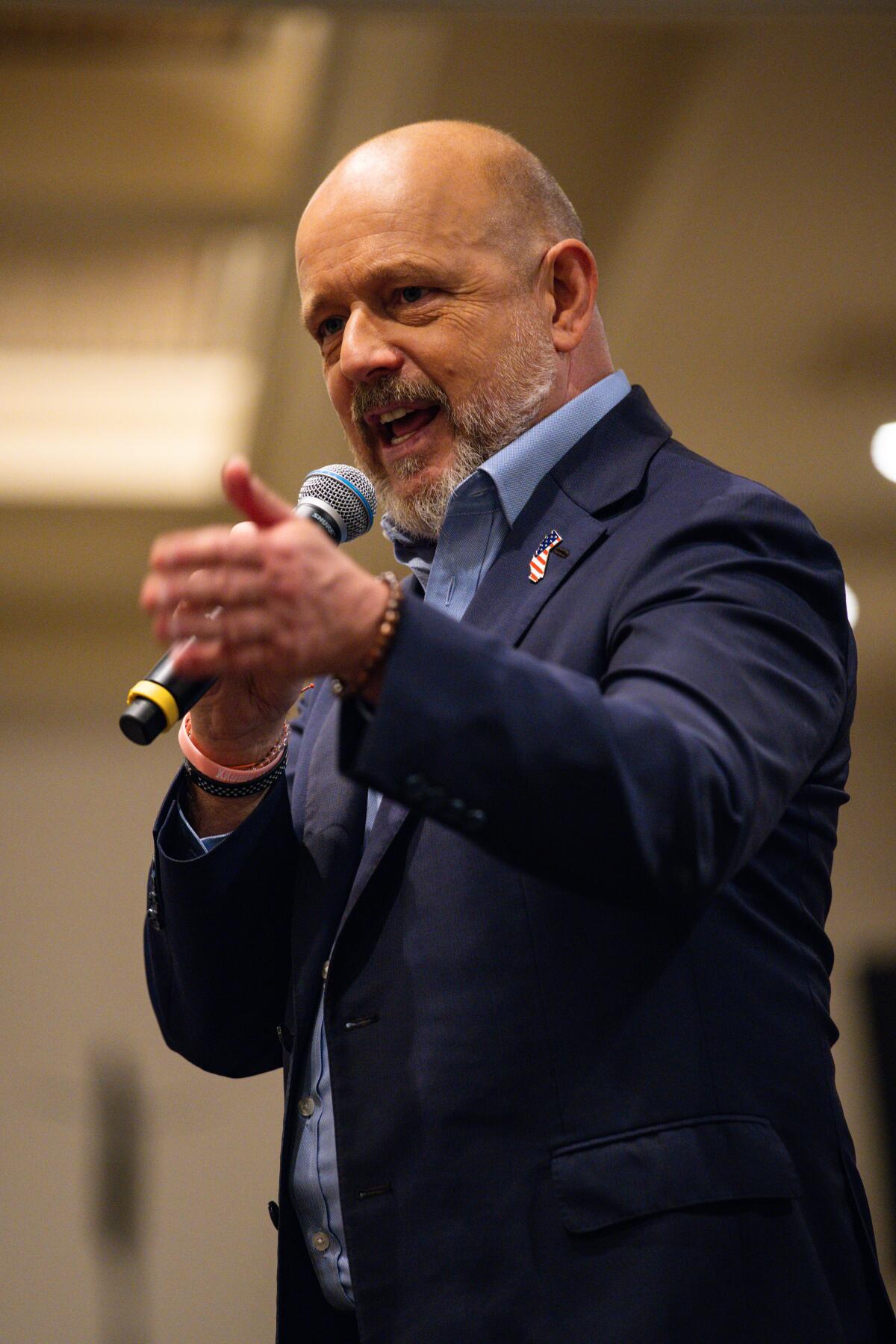
Republican Steve Hilton — a former conservative commentator who rocketed past his main GOP rival, Riverside County Sheriff Chad Bianco, after President Trump endorsed him in April — urged voters to back him to avoid the possibility of two Democrats facing off in November.
“I want us to fight like we are third. We aren’t going to let this slip away,” Hilton told a few hundred people at the Santa Monica Hilton Hotel & Suites on Sunday morning.
Steve Hilton surged ahead of his GOP rival, Riverside County Sheriff Chad Bianco, after receiving an endorsement from the president.
(Kayla Bartkowski/Los Angeles Times)
The former British political strategist once led the polls, but has slipped slightly behind Becerra. Not too far behind Hilton is billionaire hedge fund founder turned climate change activist Tom Steyer, a Democrat.
During his hour and a half appearance, Hilton veered between his oft-repeated criticisms about 16 years of Democrat-led rule in California to jabs at the top Democrats in the race.
Steyer’s nonstop advertising blitz is “one reason alone to defeat him,” while Becerra is the “living embodiment of more of the same.”
“Our secret weapon? The Democrat candidates,” Hilton said to chuckles.
Asked why voters shouldn’t back Bianco, Hilton said it was simple math. Only the first- and second-place finishers in the June 2 primary will advance to the general election, regardless of party affiliation.
“Every vote for Chad Bianco is a vote for two Democrats in the top two,” he said.
If a GOP gubernatorial candidate fails to make the November ballot, it would depress the Republican vote, harming the party’s down-ballot candidates, as well as handicap a Republican-led ballot initiative that would require voters to show government-issued ID to cast ballots.
California gubernatorial candidate Tom Steyer takes a picture with a volunteer during a Get Out the Vote rally at Los Angeles Trade Technical College on Sunday.
(Eric Thayer/Los Angeles Times)
Steyer, who has spent a record-breaking $216 million of his wealth on his gubernatorial bid, argued that he is the only candidate in the race who is not beholden to special interests. He hammered Becerra for the support he has received from corporations including Meta, Airbnb, Uber and Chevron. Steyer argued that Becerra, if elected governor, would be more responsive to special interests than financially strapped Californians.
“We’ve seen it in this race. Chevron cuts you a check and you look the other way when they hike prices at the pump. Meta gives you money and your AI plan starts sounding like ChatGPT,” Steyer, sporting a ball cap labeling himself a “class traitor,” told more than 500 supporters at a community college near downtown Los Angeles on Sunday afternoon. “That’s the story of Xavier Becerra.”
Corporations, along with labor unions and interest groups including the California Assn. of Realtors, have spent more than $18.7 million to boost Becerra as of Sunday, according to the election spending tracker California Target Book.
“These companies may be selfish, but they’re not stupid. They don’t give hundreds of thousands of dollars to get someone elected unless they know he’s going to be on their side,” Steyer said.
Though Steyer earned his fortune in part through past investments in private prisons, fossil fuels and private equity, his supporters described him as a reformed billionaire who stepped away from those industries more than a decade ago.
Francesca Fiorentini, a comedian and podcaster, compared Steyer to Charles Dickens’ fictional miser Ebenezer Scrooge.
“At the end of ‘A Christmas Carol,’ nobody turns to Ebenezer and is like, ‘No, I’m not gonna accept your gifts.’ No, they welcome him. They might clown him a little bit, but we need to welcome someone like Tom Steyer,” Fiorentini said. “Tom Steyer is actually listening, he actually cares, he’s actually changing his belief system and he’s acting accordingly.”
Though he mainly went after Becerra, Steyer also made sure to criticize Hilton.
“You are not voting for who’s on the ballot, you’re voting for the California that comes after,” Steyer said. “The California that Steve Hilton is running on sounds exactly like what Trump wants: higher prices, lower wages, and less freedom.”
His campaign underscored his attacks against Becerra by having a handful of supporters dressed as zombies speak outside of Becerra’s Sunday evening rally in Long Beach. Waving signs naming businesses that have supported Becerra, they wore lanyards describing “Big Oil,” “Big Tech” and other corporate sectors as Becerra’s “bestie.”
At a raucous rally, elected officials, labor leaders and reproductive rights advocates were among the speakers who introduced Becerra, who attacked Steyer and Hilton, though not by name.
“We are not going to let a billionaire or Trump’s handpicked candidate take over this state,” he told more than 1,000 people at the city’s convention center. “We are not going to let them gut Medicaid while Californians work hard to build a future. We are not going to let them buy an election…. Not here, not in this state, not on our watch.”
Becerra seemed in awe as he stood in front of the packed room.
“Look around this room. One of our opponents has a billion dollars in a checkbook,” he said. “We have something better… We don’t have the money, but we have the movement. We don’t have the money, but we’ve got the momentum. And in this state, if you’ve got the momentum, you run across the finish line, and you win, baby, you win.”
Becerra also released a new video that ostensibly attacks Hilton as “Trump’s favorite” — a thinly veiled effort to prop up Hilton among Republicans to ensure he finished ahead of Steyer in the primary. Given that Democratic voters outnumber Republicans by almost 2 to 1, Becerra would much rather face Hilton than Steyer in the general election.
Newsom’s campaign employed this strategy to boost GOP businessman John Cox in the 2018 gubernatorial election, as did then-Rep. Adam Schiff against Republican Steve Garvey in Schiff’s successful 2024 U.S. Senate race.
Billionaire Tom Steyer has argued that he is the only candidate not beholden to special interests.
(Eric Thayer/Los Angeles Times)
Steyer launched an ad this weekend titled “Risky” that implies Becerra could face criminal charges related to the acts of two former advisors who have plead guilty to federal charges related to stealing campaign funds from a dormant Becerra campaign account.
Becerra’s campaign called the ad defamatory in a cease and desist letter sent to the Steyer campaign on Saturday.
Becerra, Hilton and Steyer, the front-runners in the race, barnstormed the state in the final days before the June 2 primary. They devoted much of their attention to voters in Southern California, which is home to many of the state’s 23.2 million registered voters. Lower-polling candidates also stumped in the Southland — San José Mayor Matt Mahan greeted diners at Grand Central Market in downtown Los Angeles, and former Orange County Rep. Katie Porter kicked off a union canvassing event in Orange on Saturday.
Unlike recent contests to lead the nation’s most populous state, this year’s gubernatorial contest failed to energize the electorate. Despite a crowded field of candidates with notable resumes, as well as record-breaking spending by Steyer and independent-expenditure committees. Californians only recently tuned in.
Political experts of both parties believe voters malaise was due to fatigue about the nation’s political polarization, as well as Trump administration policies such as federal tariffs that drove up prices everywhere and some that disproportionately affected California, such as immigration raids. Southern Californians were also reeling from the devastating wildfires in the Pacific Palisades and Altadena and last year’s special election to redraw the state’s congressional boundaries.
Earlier this year, Democratic leaders worried that their voters would splinter among their candidates, creating a scenario where two Republicans advanced to the general election. They controversially urged their party’s candidates to assess their viability, effectively urging several low-polling candidates to drop out of the race.
Democratic turnout also prompted concerns. As of May 22, mail ballots returned by Democrats were 9.2% lower compared with the 2022 gubernatorial primary, while ballots returned by Republicans were 11.6% higher, according to Political Data Intelligence. But the return rates are shifting — as of Friday, Democrats were 7% behind their 2022 return rate, while Republicans were 6.8% higher.
The most recent polls suggest that the prospect of two Republicans advancing to the general election is nonexistent, and there is now a slim chance that two Democrats win the top two spots in the June 2 primary.
Election workers collecting ballots from a drop box in downtown Los Angeles on Sunday found multiple mail-in ballots that had been burned, officials say.
The vandalism was discovered Sunday morning outside the Department of Public Social Services building in the Civic Center area. According to county officials, election staff were conducting a routine ballot collection when they found the damaged ballots.
They “appeared to have sustained fire-related damage inside an Official Ballot Drop Box,” according to a news release from the Los Angeles County Registrar-Recorder/County Clerk’s Office.
Officials did not immediately provide further details.
A second incident of election-related vandalism was reported at a voting center in Long Beach. The incident occurred at the center at Cesar E. Chavez Park. No other details were provided.
News of the vandalism comes just days before election day on June 2.
In L.A. County, ballot drop boxes are collected on a regular schedule by two election workers, according to the county registrar-recorder’s website. Drop-off boxes are available to voters 29 days before election day. Boxes are typically bolted into concrete or chained in place.
“Our responsibility is to protect voters and ensure every eligible voter has the opportunity to cast a ballot,” said Dean Logan, registrar-recorder/county clerk. “Any attempt to interfere with voting or election operations is taken seriously. We will continue working closely with law enforcement and other partners to safeguard the voting process and ensure voters can participate with confidence.”
The registrar-recorder is “carefully reviewing both incidents and working to identify any voters who may have been affected,” according to the release. “Voters whose ballots may have been impacted by the Drop Box incident will be contacted directly and provided information about available options, including replacement ballots if necessary.”
In 2020, a ballot box caught on fire at the Baldwin Park Library, prompting an investigation of potential arson. Firefighters had to cut open the metal drop box to extinguish the fire, and numerous ballots inside were damaged, some charred beyond recognition.
The Los Angeles Police Department did not immediately provide details about Sunday’s incident. A police report was filed, according to the county registrar-recorder.
Yes, voting centers will be open across Los Angeles this week. And no, you don’t have to cast your ballot by mail.
With days left before the June 2 primary, President Trump made a round of misleading claims about the electoral process, this time falsely suggesting that the city was holding elections only by mail.
Trump’s comments came Saturday during an appearance on Fox News when he was asked by host Lara Trump — the president’s daughter-in-law — about his predictions for the upcoming primary.
“You know, they don’t have voting booths; everything’s by mail,” Trump responded. “I don’t think a Republican can win in California unless you pass the Save America Act — then they’re gonna have to show proof of citizenship, they’re going to have to get rid of mail-in voting.”
The L.A. County registrar-recorder moved to set the record straight in a tweet posted Sunday morning that read “MISINFORMATION ALERT.”
MISINFORMATION ALERT: There are 646 Vote Centers open in Los Angeles County — all with multiple voting booths, open today and tomorrow 10AM to 7PM & Tuesday (Election Day) 7AM to 8PM. https://t.co/suHN4efyXJ…. In-person options available in all elections. /@FoxNews@WhiteHousehttps://t.co/vH4VAGfdp9
— Los Angeles County Registrar-Recorder/County Clerk (@LACountyRRCC) May 31, 2026
Noting that in-person voting was in fact allowed, the agency announced that it had 646 vote centers across the county — each with multiple voting booths. The centers will be open from 10 a.m. to 7 p.m. on Monday and Tuesday, the agency said in the posting, while tagging Fox News and the White House.
A map of polling locations featured on the agency’s website shows that there are dozens of voter centers available countywide. Mobile vote centers also were made available at various sites in the county. Mobile voting runs for the 10 days before election day and will not be available on June 2, according to the county registrar-recorder.
As of Friday morning, 333,000 mail-in votes had been cast in the June 2 primary for Los Angeles mayor, city attorney, city controller and eight of the 15 City Council seats. This was up from 321,000 at the same time in 2022, according to registrar-recorder.
Registered voters already should have received a ballot in the mail. Those who choose to vote in person can take their mail-in ballot to a vote center and ask to vote in person instead. Residents who haven’t yet registered to vote can still do so by requesting a conditional voter registration application at any voter center and filling out their ballot as they normally would.
Recent polling suggests that, ahead of Tuesday’s primary, incumbent Los Angeles Mayor Karen Bass has what pollsters deem a statistically insignificant lead in her bid for reelection as the city’s top executive. Bass is locked in a tight race with councilmember and former ally Nithya Raman and Spencer Pratt.
Trump has signaled his support for Pratt but hasn’t formally endorsed the former reality TV star and registered Republican. Former Trump advisor Steve Bannon said the president hadn’t done so out of the fear it would hurt Pratt’s chances in Democrat-dominant Los Angeles.
In 2020, during the outbreak of the COVID-19 pandemic, Gov. Gavin Newsom took the unprecedented step of issuing a statewide order for voting by mail for that year’s election in what he described as a necessary step to limit the virus’ spread.
A handful of rural counties had no in-person voting locations that March.
In 1979, the state eliminated the need for an excuse to receive an absentee ballot, and an option to choose permanent absentee voting was created in 2002. In the decades since, Californians have embraced the flexibility that voting away from a polling place offers. In nearly every statewide election since 2008, the majority of votes have not been cast at a traditional polling place.
Fourteen more counties — including Orange, Sacramento and Santa Clara — have adopted the state Voter’s Choice Act, an optional state law that requires them to mail every voter a ballot and to replace traditional neighborhood polling places with multipurpose vote centers. Those in-person locations offer multiple election services for up to 10 days before election day.
Los Angeles, the 15th county to adopt the new state law, was initially given special permission by the Legislature to implement it without mailing every voter a ballot.
Trump has for years repeated baseless claims that the 2020 election was stolen and that undocumented immigrants were swaying elections by voting illegally.
In light of these claims, Trump and some Republicans have pushed for new restrictions on voters. A federal proposal known as the Save America Act — which would require Americans to prove they are U.S. citizens before they register to vote and to show identification at the polls, among other things — cleared the U.S. House but stalled out in the Senate.
In November, California voters will weigh in on a similarly contentious ballot measure pushed by Republicans that would require all voters in future elections to show identification every time they vote in person or provide a special PIN when submitting mail-in ballots.
Under current state law, Californians are required to provide identification when registering to vote and must swear under penalty of perjury, a felony, that they are eligible to vote and are U.S. citizens. They are not required to show or provide identification when casting a ballot in person or by mail.
If passed, the California ballot measure would require voters to present government-issued identification, such as a state driver’s license, every time they vote. Voters mailing ballots would be required to write a four-digit number, essentially a PIN, on their ballot envelopes matching the one generated when they registered to vote.
Critics of California’s voter ID initiative, including many legal scholars, say the ballot measure addresses a problem that does not exist.
In May, a federal judge handed Trump a victory by declining to halt the president’s executive order creating a federal list of eligible voters and then directed the U.S. Postal Service to deliver mail ballots only to those on the list. Observers say the decision opens the door for potential sweeping changes in how American elections are run shortly before this year’s midterm elections.
In a typical midterm year, Donna Layne casts her ballot long before election day.
But this time around was different for the 75-year-old Democrat. Late-cycle controversies and fear of a “wasted vote” leading to a lockout for Democrats in the race for California governor meant she didn’t make her final decision until Friday.
California Democrats have been wringing their hands for weeks about who would emerge as front-runners in the crowded race to replace termed-out Gov. Gavin Newsom. The sudden departure of high-profile candidate Eric Swalwell amid sexual assault allegations and California’s jungle primary system, which sends the top two vote-getters to the November general election regardless of their party affiliation, added pressure for Democrats to coalesce around candidates who had the best chance of advancing.
“I was concerned,” Layne said as she slid her ballot into a drop box. “I wanted to make my ballot count and I was afraid that there might be two Republicans because they had been polling pretty high, so I wanted to be strategic about it.”
On Friday morning, voters — predominately Democrats like Layne — trickled into the Orange County Registrar of Voters in Santa Ana to turn in their ballots. A few told The Times they frequently wait to vote until the days leading up to the election so they can watch all the debates and get the most up-to-date information about the candidates.
But most said they hung onto their ballots this year for far longer than usual.
As of Friday, 19% of California Republicans had already cast their ballot, compared with roughly 16% by the same time in the 2022 primary cycle, according to data from Political Data Inc.
An election worker separates ballots from vote by mail envelopes to be tallied at the Los Angeles County Registrar-Recorder/County Clerk Ballot Processing Center on Thursday in City of Industry.
(Gary Coronado/For The Times)
Meanwhile, only 14% of the state’s far-more-numerous registered Democrats have returned their ballots, down from 17% at this point in 2022. Only 29% of Democrats age 65 years and older — generally enthusiastic voters — had returned their ballots, down from 33% in 2022, data show.
But that doesn’t mean that Democrats will stay on the sidelines. Data show Democrats have started returning their ballots in earnest over the past several days, a trend that’s likely to continue through election day, said Paul Mitchell, the vice president of Political Data Inc.
“It’s the predominance of this fear that they’ve heard in the media — and that’s largely abated — that a Democrat won’t make it to the runoff,” Mitchell said. “In fact, there’s a growing sense that we could have two Democrats make the runoff, so that fear has — for the political class — gone away, but voters are still clinging to it.”
Democrat Xavier Becerra, the former Health and Human Services secretary, has risen steadily in recent polls, positioning him well to potentially advance to November. He was the leading candidate in a poll released Thursday by UC Berkeley’s Institute of Governmental Studies that was co-sponsored by the Los Angeles Times, garnering support from 25% of likely California voters.
Former U.S. Secretary of Health and Human Services and California Atty. Gen. Xavier Becerra, a front-runner in the race for governor, shares a light moment with supporters at the UFCW Local 1167 Union Hall in Bloomington, on Friday.
(Genaro Molina/Los Angeles Times)
Slightly behind with support from 21% of likely state voters was Republican Steve Hilton, a former Fox News commentator whom President Trump has endorsed. In third place with 19% support was another Democrat: Tom Steyer, a hedge fund founder and environmental activist.
With support increasing for Becerra, Hilton and Steyer since the last Berkeley IGS/Times poll in March, the survey provided the clearest indication yet that those candidates have separated themselves from the rest of the field.
Support for Riverside County Sheriff Chad Bianco, the only other major Republican candidate in the race, dropped 5 percentage points from the March poll to last week’s, putting him in a distant fourth at 11%. Former Democratic Rep. Katie Porter saw her support drop by almost half to 7%. Other prominent Democrats — San José Mayor Matt Mahan, former Los Angeles Mayor Antonio Villaraigosa and state Supt. of Public Instruction Tony Thurmond — were all in the low single digits, the poll found.
Republican candidate Steve Hilton speaks at a news conference outside the CIF State Track Championship in Clovis, where transgender athlete AB Hernandez will be was to compete Friday.
(Tomas Ovalle/For The Times)
Roughly a dozen registered Democrats interviewed by The Times said they cast their ballots last week for the person they thought would have the best chance of making it through the state’s jungle primary, even if it wasn’t their ideal candidate.
“I love Katie Porter,” said Connie Wadsley, 78. “I really do, but I just didn’t see her as being able to pull it off. I just don’t think society is ready for a woman governor as much as that pains me to say.”
In the end, Wadsley and her husband, Victor, cast their ballots for Steyer. Becerra, she said, is too much of a career politician for her liking, but Steyer impressed her with his promise not to take corporate money and his position on social justice issues.
“I think we need to shake things up in this state — in this nation,” she said. “Yeah, [Steyer] is a billionaire and I’m not really excited about that, but he truly seems to be spending his money on things that I feel are important.”
For some voters, the sheer volume of gubernatorial candidates — 61 in all — was off-putting. Some even organized gatherings with politically like-minded friends to discuss the best course of action.
“I think it was really overwhelming for a lot of people, especially when they got their ballot and saw all of those names,” said Linda Verraster, co-president of the Democratic Women of South Orange County. “There was this fear of making a mistake — air quotes — that would lead to two Republicans in the runoff.”
Gov.-elect Arnold Schwarzenegger, left, and Gov. Gray Davis joke with each other as Davis shows Schwarzenegger the governor’s private office at the Capitol in Sacramento on Oct. 23, 2003.
(Rich Pedroncelli / Associated Press )
The race seems somewhat reminiscent of the 2003 recall election when 135 candidates vied to replace then-Gov. Gray Davis amid the state’s energy crisis. Actor Arnold Schwarzenegger, a Republican, won decisively with roughly 48% of the vote.
But this race differs in a few key ways, experts say.
Mainly, while all of the top candidates have impressive resumes, there’s a lack of star power that could help propel someone to the forefront. Instead, Democrats “have an option of like moderate Dem to slightly less-moderate Dem,” said Matt Lesenyie, an assistant professor of political science at Cal State Long Beach.
“There’s a lot of people, but they occupy a very similar lane and I think that’s been a lot of the problem,” he said. “They’re loathe to really critique some of the foundational problems like a real ideological opponent would.”
Verraster put it even more simply: “There’s no unicorn.”
Still, she’ll be happy if either of the two Democratic front-runners — or both — make the ballot.
With just days left to cast your vote in California’s primary election on June 2, The Times has answers to your last-minute questions about the voting process.
Here’s what you need to know:
What are the key races to watch?
The California governor’s race is a tight battle between Democrats and Republicans who are vying to replace Democratic Gov. Gavin Newsom, who is serving his second term and cannot run again. Top candidates include a Riverside County Sheriff, a former senior advisor to British Prime Minister David Cameron, a former Los Angeles mayor, a billionaire hedge fund founder and a member of the U.S. House of Representatives. Your guide to the race for California governor can be found here.
In the Los Angeles city mayoral race, incumbent Karen Bass faces a reelection challenge from a field of candidates that include a reality TV personality, a tech entrepreneur, a City Council member and a progressive community leader. Your guide to the L.A. mayor’s race can be found here.
What is on the ballot?
There are several races, ballot measures, local district seats and statewide races that Southern Californians must decide on.
Most of the attention will be on the races for California governor and the mayor of Los Angeles.
City of Los Angeles residents have several other items to consider, including:
County of Los Angeles residents will be asked to vote on:
Voters will decide on six local congressional district seats and other statewide races including the:
A comprehensive breakdown of each race or proposed tax measure can be found here.
What is an open primary?
An open primary allows the top two candidates who garner the most votes to move on to the general election in November, no matter what party they belong to.
This system could allow two candidates from the same party to advance to the general election.
Is it too late to vote by mail?
No. You can return your vote-by-mail ballot by:
Dropping it off in the return envelope at a secure official drop box now through the close of polls on June 2.
Dropping it off in person at a polling place, vote center or county elections office by 8 p.m. on June 2.
Dropping it off at the post office. Mailed ballots must be postmarked on or before election day and received no later than 7 days after election day. To ensure your ballot is postmarked by election day, mail it at least five days before June 2. If mailing on election day, get a hand-stamped postmark from a postal employee at a United States Post Office.
What is the deadline to return a vote-by-mail ballot?
In order to be counted, vote-by-mail ballots must be postmarked on or before election day, June 2, and received by your county elections office by June 9.
How do I check if I’m registered to vote?
To find out if you’re registered to vote, visit the secretary of state’s website. You’ll need to enter a California driver’s license or identification number or the last four digits of your Social Security number.
You also can call the state’s voter hotline (available in 10 languages) at (800) 345-8683 to get a paper application mailed to you, or you can pick up one at a county election office, most California libraries and United States Post Office locations, as well as many federal, state and local government offices — including the Department of Motor Vehicles.
If you opted to register online, officials say you should wait at least 24 hours before checking your voter status.
How do I register to vote? Can I register on election day?
Eligible citizens who need to register or reregister to vote within 14 days of an election can complete this process to register and vote at county elections offices, polling places or vote centers.
To find an early voting location, use the secretary of state search tool here. You can find your local polling places here.
Your submitted ballot will be processed and counted once the county elections office has completed the voter registration verification process.
How do I check my voter status?
You can check your voter status from the California secretary of state website here. To find your record, you’ll need to provide your full name, date of birth, state driver’s license or identification card number and the last four digits of your Social Security number.
Where is my closest drop box?
Secure ballot drop-off locations opened May 5. You can visit the Los Angeles County Office of the Registrar-Recorder/County Clerk’s website here to find a ballot box near you.
SACRAMENTO — Gov. Gavin Newsom has threatened to tax 100% of the money Californians receive from President Trump’s “anti-weaponization” fund for his political allies.
Trump’s Justice Department had announced last week that it would establish a $1.776-billion fund to compensate allies of the president who claim they have “suffered weaponization and lawfare” under the Biden administration’s Justice Department.
“Anyone from California that receives any of those funds, we want to tax 100% of those proceeds,” the governor told reporters Thursday.
“That’s an action the state of California can take …[and] it’s an action we look forward to taking.”
Just how Newsom would do so remains unclear. He indicated that he would need action from the Democratic-led California Legislature to impose the new tax. If adopted, the measure would likely face legal challenge.
The fund has prompted outrage from Democrats and some Republicans — including Sen. Mitch McConnell (R-Ky.), who said in a statement that the “slush fund,” which would “pay people who assault cops,” was “utterly stupid.”
Newsom’s remarks about Trump’s settlement fund came on Thursday as he signed a bill designed to prevent election interference ahead of Tuesday’s primary.
The bill, Senate Bill 73, restricts law enforcement agencies and officers — including those from federal agencies — from interfering with state and local election officials, such as confiscating ballots, voter rolls or voting machines without a warrant.
The governor said the bill is meant to address “legitimate anxiety” over threats to election integrity after Riverside County Sheriff Chad Bianco’s decision to seize ballots from the county’s voter registrar as part of a fraud probe. Bianco, a long-time Trump supporter, is one of the top Republicans running to succeed Newsom after the end of his second and final term as governor.
Newsom also pointed to ICE and Border Patrol’s decision last November to stage an event near Dodger Stadium, calling it a “show of force designed to intimidate free expression and free speech.”
“That’s why we have to step up and we have to draw the line,” Newsom said. “We have to clarify the rules of engagement… there are fines associated with this, criminal fines and jail time of three years, so that’s a warning [to] the folks out there that think they can do the bidding of the Trump administration.”
Newsom said he expects Trump to interfere with the upcoming election — noting that the president has falsely claimed that he “won” California in the last election.
“Every single thing that Donald Trump is saying only suggests that he will do more, not less, to intimidate and to impact the outcome of this election,” Newsom said. “I absolutely expect the worst again, because we’ve been on the receiving end of it.”
As plenty of Californians remain undecided about the gubernatorial primary’s unsettled Democratic field, some are waiting to cast their ballots, creating the potential for a slower vote count or a longer wait to find out the winners.
Though the landscape could change quickly if Democrats coalesce around a single candidate within the next several days — signs of which were emerging this week — for now, many Democratic-leaning voters appear to be waiting for new developments before making their final decisions, political analysts say.
“This has been a roller coaster of a race, and I think voters are waiting to see when the ride is going to end and cast a vote at that time,” said Steve Maviglio, a Democratic strategist.
A larger-than-usual number of people casting mail ballots on or close to election day could extend the ballot-counting process, said Kim Alexander, president of the nonpartisan California Voter Foundation. County election officials said they were prepared for that possibility. Early returns so far haven’t made it clear whether most voters will wait longer than usual to cast ballots.
Mike Sanchez, a spokesperson for the Los Angeles County registrar, said the county was “fully prepared” for the possibility of receiving “a significant number” of ballots returned close to or on election day, June 2.
“It is not uncommon in primary elections, particularly those with a large number of contests and candidates, for some voters to take additional time to review their ballots and hold onto them longer before returning them,” he said.
Californians who want to vote on or close to election day can vote in person or use a mail-ballot return option that doesn’t rely on the U.S. Postal Service to help speed the process and avoid the risk of a mail ballot arriving late, election officials said.
Hesitation by Democratic-leaning voters reflects the toll of a historically uncertain primary race for governor. The contest has been marked by the unusual lack of a clear Democratic front-runner and the party’s failure to line up behind a single candidate after former U.S. Rep. Eric Swalwell dropped out in April.
Early concerns within the party that a split Democratic electorate could put two Republicans on the November ballot under the state’s top-two primary system also heightened the sense of stakes among left-leaning voters.
Those factors, combined with a large slate of candidates, voter confusion about how candidates’ platforms differ and a desire to choose the person “most likely to win” have made Democratic-leaning voters uncertain, said Christian Grose, director of the USC Democracy and Fair Elections Lab.
“There’s a little bit of, whoever’s in the lead some Democrats are choosing to vote for … but people don’t know who that person is,” Grose said, noting that “some of that [could start] to go away” as the race tightens.
An indication that Democrats are starting to consolidate around Xavier Becerra, the former U.S. Health and Human Services secretary, came Tuesday in a new survey released by the California Democratic Party. It showed Becerra with support from 21% of respondents, followed by billionaire Tom Steyer with 15%.
Republican-leaning voters appear to favor Steve Hilton, who had support from 22% of survey respondents. Republican Chad Bianco, the Riverside County sheriff, had 10%. Under California’s primary system, the top two vote-getters advance to the general election, regardless of party.
Tallies from a handful of counties showed varying early turnout so far.
In San Francisco, a relatively small number of ballots have been returned, indicating that voters may be waiting, Michelle Parker, president of the city’s elections commission, said Tuesday. If people vote by mail close to election day — rather than voting in person or using a drop box — it could affect the speed of vote-counting, a possibility the city’s election staff is prepared for, she said.
“We’ll see how quickly they come in, but knowing what the news has been like and watching what the dynamic has been like across the state, I’m not surprised people are waiting,” Parker said, referring to the governor’s race.
In San Bernardino County, 5.6% of mail ballots had been returned as of Tuesday, a rate comparable with previous elections, Registrar of Voters Joani Finwall said. Election officials “strongly encourage” voters to cast ballots early using drop boxes or early voting locations, Finwall said.
In Orange County, by contrast, data so far indicate that voters are not waiting, the Registrar of Voters office said. More than 129,000 vote-by-mail ballots had been returned by the end of the day Monday, more than had been returned by the same time in the 2024 and 2022 primaries. Of those, a slightly higher percentage of Republicans than Democrats had voted.
If a large number of voters were to wait until June 2 to cast a mail ballot, the county would be able to efficiently process them, said Registrar of Voters Bob Page, noting that 90% of the county’s early vote-by-mail ballots were included in election night results in the 2024 presidential primary.
Voters should be prepared for the possibility that the gubernatorial results aren’t determined on election night, Grose said. One candidate could appear to be in the lead on election night and another could overtake them once all ballots are counted.
State election officials warned this month that some social media posts urging Democrats to vote “late” could be misinformation. Secretary of State Shirley Weber’s office said it would look into such posts, one of which falsely attributed the message to historian Heather Cox Richardson.
Mail ballots must be postmarked on or before election day and arrive within seven days after the election; otherwise, they are considered late and not counted.
Rusty Hicks, chair of the California Democratic Party, acknowledged chatter around people holding onto their ballots but said the survey released Tuesday indicated voters are “beginning to move towards specific candidates.”
Even as Becerra and, to a lesser extent, Steyer rose in popularity, other Democrats saw support in the single digits in the poll, including former U.S. Rep. Katie Porter, San José Mayor Matt Mahan and former Los Angeles Mayor Antonio Villaraigosa.
“This race isn’t over; we’ve certainly seen a lot of twists and turns to this point, but you do see some clear consolidation taking place for both Democrats and Republicans,” Hicks said on a call with reporters. “I’m not concerned about California Democrats having their voices heard.”
“There is some uncertainty among Democrats about, ‘Is there one more shoe to drop for someone?” Grose said. “That’s one reason people are holding onto their ballots.”
Voters who want to cast ballots later than May 26 should return their mail ballots at a voting site, county election office or drop box, rather than via the Postal Service, by 8 p.m. on June 2 or should vote in person, recommended Alexander, of the California Voter Foundation.
Because mail ballots require election officials to conduct signature verification, they take longer to count than in-person ballots. In addition, recent changes at the U.S. Postal Service have slowed mail service, creating a higher potential for mailed ballots to arrive late.
Alexander also urged voters to take advantage of Saturday in-person voting, available at county election offices statewide the weekend before election day, and other early voting options.
“I am very sympathetic with voters who want to take their time to make their decision in this very fluid election,” she said. “The important thing is to have a plan.”