Balearic Islands Airport

Exact date of Spanish islands protests revealed as ‘kill a tourist’ graffiti spotted

Brits heading to popular Spanish islands this summer may find themselves at the heart of anti-tourism protests, with a pressure group insisting that there will be a “historic turnout”

Spain’s anti-tourism protests could escalate this summer, as pressure group Menys Turisme Més Vida (Less Tourism More Life) announced plans for a major demonstration that it expects to have a “historic turnout”.

The news comes as sites in the Canary Islands have been daubed with anti-tourist graffiti, including reports from local news outlet Canarian Weekly of a ‘kill a tourist’ slogan being spotted in Tenerife. The graffiti was spotted by two expats hiking in Punta del Hidalgo, who then claimed they saw further disturbing graffiti during a walk to Bollullo Beach on the island’s north coast.

In a separate incident last week, five estate agents in Majorca with international names were daubed with graffiti including ‘guilty’ and ‘Guiris out!’ in an overnight attack. Guiri is a derogatory Spanish term used for tourists from Northern Europe.

Menys Turisme Més Vida announced a protest in Palma, a popular destination for Brits on the island of Majorca on July 26, which coincides with the start of the busiest school holiday season. Meanwhile there are protests planned in Menorca on June 13 with a similar anti-tourism sentiment.

In a statement on its website, the group said: “️We consider that the demands expressed during previous mobilisations have been ignored while problems such as the housing access crisis, tourist saturation, the destruction of the territory, the precariousness of living conditions and the pressure on public resources and services continue to worsen.

“Under the slogan ‘Majorca at the limit’, the call aims to once again demonstrate the strength of existing social unrest in the face of an economic model that continues to break tourism records while the living conditions of a growing part of the resident population worsen.”, it added.

The group claims that the protest has the support of 53 social , environmental, trade union, neighbourhood and cultural groups on the island, which sees nearly 13 million tourists annually, with Brits the second-largest percentage after Germany.

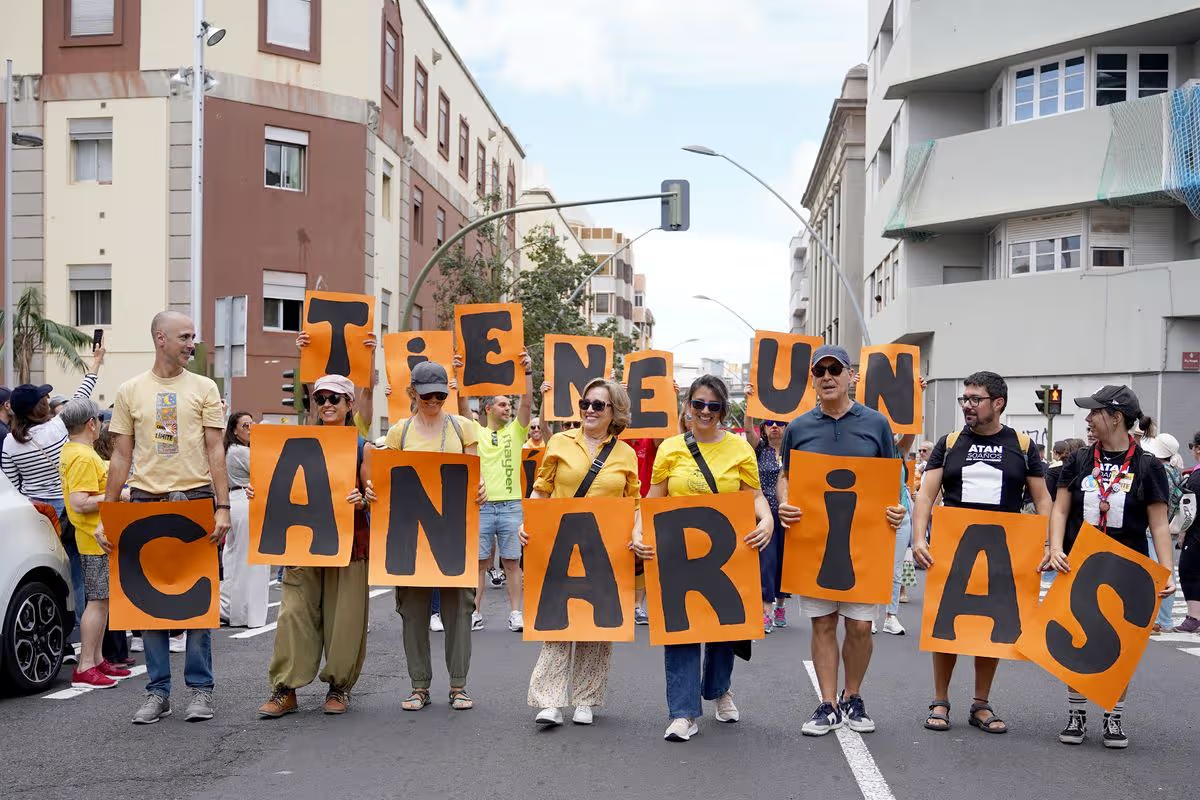
Majorca saw protests last June that organisers claim were attended by 30,000 people, although varying reports claim numbers from 5,000 to 8,000. This included reports of some people sitting on terraces being harassed by protestors. Another notable protest took place in Barcelona on June 15, 2025, in which smoke devices were used and tourists soaked with water pistols.

While there have been reports of a tourist slowdown in the Balearics and Canaries, anti-tourism protests do not seem to have a massive impact on visitor numbers. In April, the Canaries saw a drop in visitors of 8.3% compared to the year before, but this meant 1.2 million foreign tourists still visited the islands. It was also the first drop seen on the volcanic archipelago since the pandemic.

Over Easter, the Balearics reported a fall of nearly 20% in in-person tourist spending by card, despite an overall increase in spending across Spain as a whole, suggesting visitors were choosing to spend their money elsewhere.

Have a story you want to share? Email us at webtravel@reachplc.com

Source link

New Spain airline ticket prices travel alert for 3 major UK tourist hotspots

Tourists travelling to some of the most popular holiday destinations in Spain have been handed an update on prices

Travel officials in Spain have warned that airline ticket prices are set to rocket this summer. The warning comes as the Iran conflict places severe strain on the supply of jet fuel to airlines across the globe.

The mounting pressures have already prompted some airlines to scale back their planned flight schedules, with knock-on effects already being felt on ticket prices. And bosses say there are further headaches ahead for holidaymakers at some of the most popular Brit tourist spots as the peak travel season approaches – with around 18 million Brits heading to Spain every year.

The latest alert was issued by travel agents in Spain. The Balearic Islands Travel Agencies Association (AVIBA) has warned those heading to popular destinations such as the 3 key tourist spots of Mallorca, Menorca and Ibiza to brace themselves for steeper ticket prices – even as it confirmed flights to the region are not expected to be reduced.

According to reports in the Spanish media, AVIBA president Pedro Fiol cautioned that ticket prices will inevitably rise sharply due to the financial pressures stemming from the conflict. He warned that the war is likely to produce a summer “with a context of greater tension and rising costs that will be gradually passed on to ticket prices”, Spanish website Ultima Hora reports.

Despite this, he maintained that the profitability of routes to the Balearic Islands makes it unlikely that flights to the area will be axed. He did, however, flag that this could become a possibility outside of peak season.

AVIBA note that airlines are currently maintaining “a certain restraint” in airfares. But the president warned that the scarcity and increased cost of fuel driven by the Iran conflict will undoubtedly result in higher airfare prices. The Airline Association (ALA) has issued a similar forecast.

Lufthansa yesterday confirmed the axing of some 20,000 flights through October as part of its operational shake-up. The carrier explained that these reductions relate to unprofitable bases, though none of these are located in Spain. The strategy is to refocus resources on the most lucrative routes.

Mr Fiol said: “We don’t foresee a summer with planes grounded due to a lack of fuel, but we do anticipate a more complex and price-driven environment.” Meanwhile, Spanish website INB3N reports that Mr Fiol also cautioned there was a danger that additional flights could be compelled to make stops so aircraft can refuel mid-journey.

This week, TUI revealed the Iran war set it back around 40 million euros (£34.8 million) last month after it was obliged to bring home thousands of holidaymakers and staff. Europe’s biggest travel operator slashed its profit forecast and suspended revenue guidance as a consequence, causing its shares to fall.

The firm is amongst travel companies to have been substantially disrupted by the conflict in the Middle East, which erupted at the end of February. It is also amongst airline operators to face strain from a spike in jet fuel prices after the conflict drove up the cost of oil.

And holidaymakers should have “no worries” about flights being cancelled this summer, despite airlines confronting a “triple whammy” as a consequence of the conflict in the Gulf, a former industry boss has maintained.

Tim Jeans, a former commercial director at Ryanair who was later managing director of Monarch Air, said that while there “may be some trimming of schedules” by airlines, he did not expect carriers to scrap routes entirely.

His remarks follow stark warnings from the trade body representing European airports, which cautioned that a “systemic” jet fuel shortage could emerge ahead of the peak summer season if the Strait of Hormuz fails to reopen in the coming weeks.

Airports Council International, which represents more than 600 airports, recently wrote to European commissioners for energy, transport and tourism, warning that if the vital strait does not reopen in a “significant and stable way within the next three weeks” then “systemic jet fuel shortage is set to become a reality for the EU”.

Director-general Olivier Jankovec said: “The fact that we are entering the peak summer season… is only adding to those concerns.” However, Mr Jeans insisted: “I don’t see a situation where flights will get cancelled because of the non-availability of fuel.”

He acknowledged that there was a “triple whammy for airlines at the moment”, pointing to “the issues in the Middle East which has caused a massive spike in the cost of fuel”.

Speaking on BBC Radio Scotland’s Breakfast programme, Mr Jeans added: “That in turn is pushing up ticket prices, and the uncertainty around whether it is going to be possible to travel, plus the increase in prices is reducing demand.

“And so you have a situation where airlines are looking at their bookings for the next three months ahead and saying ‘should we fly that flight, is it going to be profitable?'”

Source link